Prospects for Panspermia via Interstellar Objects like 3I/ATLAS
Pith reviewed 2026-07-02 16:49 UTC · model grok-4.3
The pith
Interstellar objects like 3I/ATLAS could transport microbes if ice shields them during long journeys and perihelion heating activates them without lethal damage.
A machine-rendered reading of the paper's core claim, the machinery that carries it, and where it could break.
Core claim
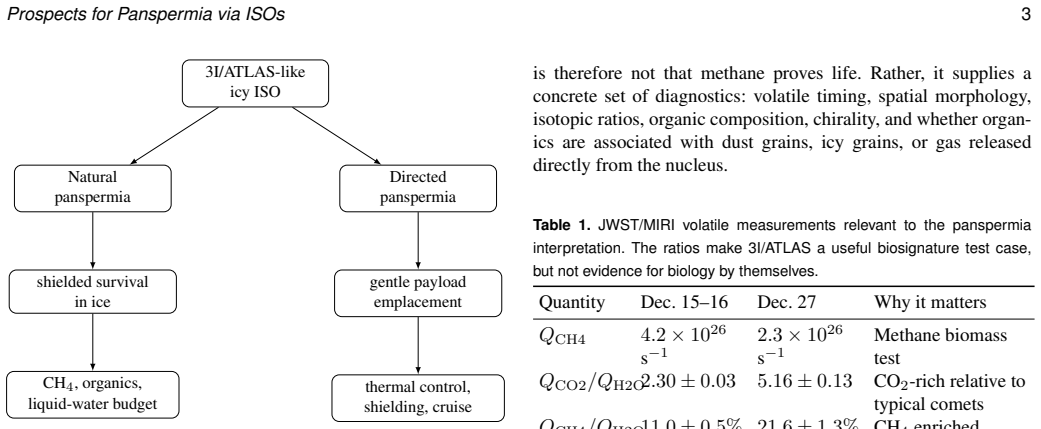
Natural panspermia is plausible as microbes can survive or repair damage in ice films, veins, or frozen matrices at very low metabolic rates. Methane production is more nuanced, with frozen survival metabolism requiring 10^14 to 10^15 kg of biomass to match observed rates, while active methanogens in warm liquid settings produce it far faster. Directed panspermia is hindered because a direct 60 km/s impact releases 1.8 times 10^9 J per kg, destroying any capsule. Objects like 3I/ATLAS are best treated as test cases for panspermia diagnostics rather than evidence for life, with natural panspermia requiring both preservation and a credible liquid-water or near-surface activation pathway.
What carries the argument
Ice shielding within interstellar objects that enables microbial dormancy during interstellar cruise and potential activation during perihelion passage.
If this is right
- Natural panspermia requires both long-term preservation inside ice and a credible pathway for activation in liquid water or near-surface settings.
- JWST methane rates imply either very large frozen biomass or much smaller active populations if liquid substrate-rich conditions occur.
- High-speed impacts rule out surface-planted biological capsules for directed panspermia because the specific energy exceeds TNT by hundreds of times.
- Volatile ratios from SPHEREx and JWST supply compositional diagnostics that future ISO observations can use to test panspermia conditions.
Where Pith is reading between the lines
- Surveys that find more ISOs with varying ice thicknesses could map the range of shielding conditions that permit survival.
- Thermal models of perihelion passages might identify narrow time windows when activation is most likely, guiding targeted searches.
- The dormant-versus-active distinction implies that panspermia probability depends on the fraction of time an object spends in each phase during galactic transit.
Load-bearing premise
Microbes or biomolecules remain viable after long interstellar exposure inside shielded ice and can later become active upon perihelion heating or exposure without lethal radiation or thermal damage.
What would settle it
A measurement or simulation showing that cumulative radiation doses inside ice exceed microbial repair capacity before any activation window, or sampling of ISO material that finds zero viable microbes or biomolecules after interstellar transit.
Figures
read the original abstract
We study the feasibility of natural and directed panspermia via interstellar objects (ISOs) like 3I/ATLAS. The paper is organized around two questions. First, could natural panspermia occur if microbes or biomolecules survived inside shielded ice and were later exposed during perihelion and outbound activity? Second, could directed panspermia occur if a technological civilization planted life-bearing material inside or onto an icy ISO so that it later transported life through the Milky Way? We combine data on 3I/ATLAS with order-of-magnitude thermal, biological, and mission constraints. SPHEREx provides the volatile and organic context through CO$_2$, H$_2$O, CO, dust, and a broad C--H feature, while JWST/MIRI provides the first direct CH$_4$ detection in an interstellar object and confirms an unusual volatile inventory, including enhanced CO$_2$:H$_2$O and CH$_4$:H$_2$O ratios. We distinguish dormant interstellar cruise from active perihelion. Natural panspermia is plausible as microbes can survive or repair damage in ice films, veins, or frozen matrices at very low metabolic rates. Methane production is more nuanced. Frozen survival metabolism would require $\sim10^{14}$--$10^{15}$ kg of biomass to match the JWST CH$_4$ rates, but active methanogenic archaea in warm, liquid, substrate-rich settings can produce methane many orders of magnitude faster, reducing the required biomass in optimistic laboratory-rate comparisons. Directed panspermia faces a different challenge: a direct 60 km s$^{-1}$ impact releases $1.8\times10^9$ J kg$^{-1}$, hundreds of times the specific energy of TNT, and would destroy a biological capsule. 3I/ATLAS-like objects are therefore best treated as test cases for panspermia diagnostics rather than as evidence for life. Natural panspermia requires preservation plus a credible liquid-water or near-surface activation pathway.
Editorial analysis
A structured set of objections, weighed in public.
Referee Report
Summary. The manuscript examines the feasibility of natural and directed panspermia via interstellar objects such as 3I/ATLAS. It incorporates SPHEREx and JWST/MIRI data on volatiles (CO2, H2O, CO, dust, C-H feature) and the first CH4 detection with enhanced ratios, distinguishing dormant interstellar cruise from perihelion activation. Natural panspermia is deemed plausible if microbes survive or repair damage in shielded ice at low metabolic rates, with biomass estimates of ~10^14--10^15 kg for frozen methane production versus lower for active regimes. Directed panspermia is challenged by 60 km s^{-1} impacts releasing 1.8×10^9 J kg^{-1}, sufficient to destroy biological capsules. The paper concludes that 3I/ATLAS-like objects are best viewed as test cases for panspermia diagnostics, with natural panspermia requiring both preservation and a liquid-water activation pathway.
Significance. If the survival and activation assumptions hold, this work provides a concrete framework connecting ISO observations to panspermia hypotheses through order-of-magnitude thermal, biological, and mission constraints. Strengths include the use of real telescope datasets for volatile context and the explicit separation of dormant versus active phases. The impact energetics calculation offers a clear physical bound on directed panspermia. However, the order-of-magnitude approach and unquantified assumptions limit its ability to move beyond plausibility arguments.
major comments (2)
- [Methane production discussion] Methane production discussion: the comparison between frozen survival metabolism (~10^{14}--10^{15} kg biomass to match JWST CH4 rates) and active methanogenic archaea (many orders of magnitude faster) mixes regimes without error bars, sensitivity analysis on the production rate scaling factor, or explicit ranges, which is load-bearing for the claim that the required biomass is nuanced and reduced in optimistic cases.
- [Directed panspermia impact analysis] Directed panspermia section: the specific energy release of 1.8×10^9 J kg^{-1} at 60 km s^{-1} is used to conclude that a biological capsule would be destroyed, but no specific energy threshold or cap for capsule destruction is provided, leaving the quantitative link between impact physics and biological viability incomplete.
minor comments (1)
- [Abstract and volatile inventory section] The abstract and text refer to a 'broad C--H feature' from SPHEREx without clarifying its exact wavelength range or how it constrains organic content relative to the CH4 detection.
Simulated Author's Rebuttal
We thank the referee for their constructive comments, which highlight opportunities to strengthen the quantitative aspects of our order-of-magnitude analysis. We respond to each major comment below and will incorporate revisions to address the identified gaps.
read point-by-point responses
-
Referee: Methane production discussion: the comparison between frozen survival metabolism (~10^{14}--10^{15} kg biomass to match JWST CH4 rates) and active methanogenic archaea (many orders of magnitude faster) mixes regimes without error bars, sensitivity analysis on the production rate scaling factor, or explicit ranges, which is load-bearing for the claim that the required biomass is nuanced and reduced in optimistic cases.
Authors: We agree the presentation mixes regimes without sufficient quantification. The frozen-metabolism biomass estimate assumes low-temperature rates in ice matrices, while the active case draws from optimal laboratory conditions for methanogens. In revision we will add an explicit sensitivity analysis: we will tabulate biomass requirements across a factor of 10^3--10^6 variation in production rate (reflecting literature ranges for dormant vs. active metabolism) and attach order-of-magnitude uncertainty bands to both estimates. This will make the reduction in required biomass under optimistic active-regime assumptions more transparent and quantitative. revision: yes
-
Referee: Directed panspermia section: the specific energy release of 1.8×10^9 J kg^{-1} at 60 km s^{-1} is used to conclude that a biological capsule would be destroyed, but no specific energy threshold or cap for capsule destruction is provided, leaving the quantitative link between impact physics and biological viability incomplete.
Authors: The referee is correct that we did not supply an explicit destruction threshold. The 1.8×10^9 J kg^{-1} value is presented relative to TNT to illustrate the extreme regime, but a direct comparison to biological inactivation energies is missing. In the revised manuscript we will add a short clause citing hypervelocity-impact sterilization literature, noting that microbial inactivation typically occurs above ~10^7–10^8 J kg^{-1} (via shock heating and vaporization), thereby placing our calculated energy release well above established thresholds while preserving the order-of-magnitude character of the argument. revision: yes
Circularity Check
No significant circularity identified
full rationale
The paper combines external JWST and SPHEREx observations of 3I/ATLAS volatiles with order-of-magnitude thermal and biological constraints drawn from general literature on microbial survival in ice. These calculations are framed as feasibility bounds rather than derivations that reduce to author-fitted parameters or self-referential equations. No load-bearing step invokes a self-citation chain, renames a fitted input as a prediction, or imports a uniqueness theorem from the authors' prior work. The distinction between dormant cruise and perihelion activation rests on cited external biological premises that remain independently falsifiable.
Axiom & Free-Parameter Ledger
free parameters (2)
- biomass for frozen methane production =
10^14--10^15 kg
- methane production rate scaling factor
axioms (2)
- domain assumption Microbes can survive or repair damage in ice films, veins, or frozen matrices at very low metabolic rates over interstellar timescales.
- standard math A 60 km/s impact releases 1.8e9 J kg^-1, sufficient to destroy a biological capsule.
Reference graph
Works this paper leans on
-
[1]
Lisse, C. M., Bach, Y . P ., Bryan, S. A., et al. 2026, Research Notes of the AAS, 10, 26, doi:10.3847/2515-5172/ae3f95
-
[3]
Benedict, M. N., Gonnerman, M. C., Metcalf, W. W., & Price, N. D. 2012, Journal of Bacteriology, 194, 855, doi:10.1128/JB.06040-11
-
[4]
Topcuoglu, B. D., Meydan, C., Nguyen, T. B., Lang, S. Q., & Holden, J. F. 2019, Applied and Environmental Microbiology, 85, e00180-19, doi:10.1128/AEM.00180-19
-
[5]
Chen, X., Ottosen, L. D. M., & Kofoed, M. V . W. 2019, Frontiers in Bioengineering and Biotechnology, 7, 34, doi:10.3389/fbioe.2019.00034
-
[6]
Rohde, R. A. & Price, P . B. 2007, Proceedings of the National Academy of Sciences, 104, 16592, doi:10.1073/pnas.0708183104
-
[7]
Tung, H. C., Bramall, N. E., & Price, P . B. 2005, Proceedings of the National Academy of Sciences, 102, 18292, doi:10.1073/pnas.0507601102
-
[8]
Hoang, T. & Loeb, A. 2020, ApJ Letters, 899, L23, doi:10.3847/2041- 8213/abab0c
-
[9]
Dieser, M., Battista, J. R., & Christner, B. C. 2013, Applied and Environmental Microbiology, 79, 7662, doi:10.1128/AEM.02845-13
-
[10]
Fellows, C. M., Brown, T. C., Cooper, A., & Parigi, M. 2020, Publications of the Astronomical Society of Australia, 37, e006, doi:10.1017/pasa.2019.46
-
[11]
1987, The Astrophysical Journal, 319, 993, doi:10.1086/165516 NASA
Prialnik, D., Bar-Nun, A., & Podolak, M. 1987, The Astrophysical Journal, 319, 993, doi:10.1086/165516 NASA. 2023, Radioisotope Heater Units – Fact Sheet, NASA Science, https://science.nasa.gov/resource/radioisotope-heater-units-fact-sheet/
-
[12]
prospects_panspermia_3i_atlas_ija
Elfer, N. C. 1996, Structural Damage Prediction and Analysis for Hyperveloc- ity Impacts: Handbook, NASA Contractor Report 4706, NASA Marshall Space Flight Center i i “prospects_panspermia_3i_atlas_ija” — 2026/7/2 — 0:25 — page 8 — #8 i i i i i i 8 Kakharov and Loeb
1996
-
[13]
Cheng, A. F., Agrusa, H. F., Barbee, B. W., et al. 2023, Nature, 616, 457, doi:10.1038/s41586-023-05878-z
-
[14]
Bierhaus, E. B., Clark, B. C., Harris, J. W., et al. 2018, Space Science Reviews, 214, 107, doi:10.1007/s11214-018-0521-6
-
[15]
C., Mosley-Thompson, E., Thompson, L
Christner, B. C., Mosley-Thompson, E., Thompson, L. G., & Reeve, J. N. 2002, Applied and Environmental Microbiology, 68, 6435, doi:10.1128/AEM.68.12.6435-6438.2002
-
[16]
Crick, F. H. C. & Orgel, L. E. 1973, Icarus, 19, 341, doi:10.1016/0019- 1035(73)90110-3
-
[17]
J., Weryk, R., Micheli, M., et al
Meech, K. J., Weryk, R., Micheli, M., et al. 2017, Nature, 552, 378, doi:10.1038/nature25020
-
[18]
2020, Nature Astronomy, 4, 53, doi:10.1038/s41550-019-0931-8
Guzik, P ., Drahus, M., Rusek, K., et al. 2020, Nature Astronomy, 4, 53, doi:10.1038/s41550-019-0931-8
-
[19]
Lingam, M. & Loeb, A. 2018, The Astronomical Journal, 156, 193, doi:10.3847/1538-3881/aae09a
-
[20]
2018, ApJ Letters, 868, L12, doi:10.3847/2041-8213/aaef2d
Ginsburg, I., Lingam, M., & Loeb, A. 2018, ApJ Letters, 868, L12, doi:10.3847/2041-8213/aaef2d
-
[21]
Bottke, W. F., Durda, D. D., Nesvorny, D., Jedicke, R., Morbidelli, A., V okrouhlicky, D., & Levison, H. F. 2005, Icarus, 175, 111, doi:10.1016/j.icarus.2004.10.026
-
[22]
Jewitt, D. & Seligman, D. Z. 2023, Annual Review of Astronomy and Astrophysics, 61, 197, doi:10.1146/annurev-astro-071221-054221
-
[23]
LSST: From Science Drivers to Reference Design and Anticipated Data Products,
Ivezic, Z., Kahn, S. M., Tyson, J. A., et al. 2019, The Astrophysical Journal, 873, 111, doi:10.3847/1538-4357/ab042c
-
[24]
2004, in Comets II, ed
Prialnik, D., Benkhoff, J., & Podolak, M. 2004, in Comets II, ed. M. C. Festou, H. U. Keller, & H. A. Weaver (Tucson, AZ: University of Arizona Press), 359
2004
-
[25]
Mileikowsky, C., Cucinotta, F. A., Wilson, J. W., et al. 2000, Icarus, 145, 391, doi:10.1006/icar.1999.6317
-
[26]
L., Munakata, N., Horneck, G., Melosh, H
Nicholson, W. L., Munakata, N., Horneck, G., Melosh, H. J., & Set- low, P . 2000, Microbiology and Molecular Biology Reviews, 64, 548, doi:10.1128/MMBR.64.3.548-572.2000
discussion (0)
Sign in with ORCID, Apple, or X to comment. Anyone can read and Pith papers without signing in.