REVIEW 4 major objections 6 minor 1 cited by
Unpacking Softmax: How Temperature Drives Representation Collapse, Compression, and Generalization
T0 review · 4 major / 6 minor · reviewed 2026-08-07 · deepseek-v4-flash
Pith's one-line read Softmax temperature—through the norm of the logits at initialization—biases deep classifiers toward low-rank, compressed representations, trading away out-of-distribution generalization while improving out-of-distribution detection.
desk verdict A broad, internally consistent empirical story about softmax temperature and representation rank, attached to a mechanism that is not actually derived for the architectures tested. read the letter →
The pith
A machine-rendered reading of the paper's core claim, the machinery that carries it, and where it could break.
The reading
What carries the argument
The load-bearing object is the decomposition of the logits matrix $M = W A$ into the last layer's weights and the penultimate representations, analyzed through their singular value decompositions: $\|M\| = \|\Sigma_W V_W^\top U_A \Sigma_A\| \leq \|\Sigma_W \Sigma_A\|$. This inequality splits logits-norm growth into two mechanisms—singular-value scaling and singular-vector alignment—and the paper shows high-temperature training exploits the second: the top singular vectors of weights and activations align across layers, so the top singular value of the final logits becomes the product of per-layer top singular values, $\sigma_1^L = \prod_{i=1}^{L-1} \sigma_1^i \geq (\sigma_1^k)^L$, which grows exponentially in depth when the smallest top singular value exceeds $1$. That compounding produces representation collapse measured by numerical rank, and the bound $\operatorname{rank}(\partial L/\partial W^i) \leq \operatorname{rank}(A^{i-1})$ makes the collapse self-reinforcing through gradients. The counterbalancing piece is Proposition 3.1, a tight bound on the spectral gap of any column-stochastic matrix $S$, $0 \leq \sigma_1(S) - \sigma_n(S) \leq \sqrt{1+r} - \sqrt{\max\{1/n - r, 0\}}$ with $r$ the maximal sum of column inner products; this is the formal reason that raising $\|M\|$ alone raises the post-softmax rank of a fixed low-rank matrix. The supporting diagnostics are effective depth $\kappa$ (the first layer whose linear probe reaches $99\%$ of final accuracy, divided by depth), OOD generalization loss $\rho$ (the normalized gap between best and final-layer OOD probe accuracy), and solution rank (numerical rank of the pre-softmax logits).
What would settle it
Train a deep ReLU classifier at high temperature while recording, per layer, the cosine similarity between the top singular vectors of the weights and of the incoming activations; if numerical rank collapses before any alignment appears, or if the top singular value of the final logits does not track the product of per-layer top singular values, then the alignment-driven exponential-collapse mechanism is not the cause of rank-deficit bias.
Extended reading notes
Core claim
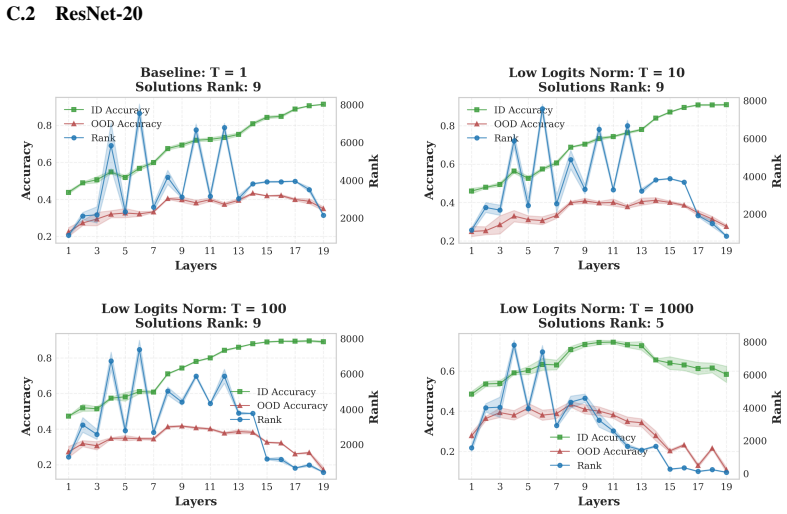
The paper's central claim is that high-temperature training induces a rank-deficit bias: softmax-based deep networks converge to solutions with $\operatorname{rank}(M)$ much less than $c-1$, far below the rank predicted by Neural Collapse, and this bias is governed by the norm of the logits at initialization. Because softmax with temperature $T$ equals softmax with temperature $1$ applied to logits scaled by $1/T$, temperature is functionally a logits-norm control. High temperature flattens output distributions into a symmetric loss landscape, and the network escapes this symmetry by growing the logits norm; the growth path high-temperature models take is singular-vector alignment across layers, which compounds top singular values exponentially and collapses the numerical rank of representations. Collapsed representations then cap the rank of gradients, with $\operatorname{rank}(\partial L/\partial W^i) \leq \operatorname{rank}(A^{i-1})$, locking in the collapse. Softmax nevertheless restores output rank: Proposition 3.1 bounds the spectral gap of any softmaxed matrix by the mutual similarity of its columns, which the growing logits norm decreases, and a constructive proof (Proposition K.1) shows that pre-softmax rank $2$ suffices for full-rank post-softmax outputs with any number of classes. The empirical signature is uniform across MLP, VGG, ResNet, and ViT on CIFAR and ImageNet: comparable final accuracy, lower effective depth $\kappa$, higher OOD generalization loss $\rho$, and lower solution rank, together with better OOD detection under the NECO metric (for instance, a ResNet-34 on ImageNet-1k drops from solution rank 512 to 122 under high temperature).
Load-bearing premise
The cascade argument assumes that ReLU layers compound their top singular values the way perfectly aligned linear maps do, and the paper's own derivation (Section 3.1) sets the product formula $\sigma_1^L = \prod_i \sigma_1^i$ without accounting for the ReLU nonlinearity; if that alignment does not survive ReLU, the claimed exponential collapse and gradient-collapse feedback are not established by the presented math.
Editorial extensions
If this is right
- Temperature becomes a deployment dial: training at high temperature (or with other low-logits-norm choices such as smaller initialization or narrower layers) yields models with comparable accuracy, compressed internal representations, and measurably better OOD detection scores on the NECO metric.
- The compression–generalization exchange is systematic: lower solution rank and lower effective depth come with higher OOD generalization loss, so a model tuned for compactness should be expected to transfer worse to new distributions.
- Rank-deficit bias is not a neural-collapse phase: it appears early in training, before the terminal phase, without weight decay or regularization, and it coexists with only partial satisfaction of neural-collapse conditions.
- The effect is not specific to cross-entropy: training with MSE loss applied after softmax reproduces the same rank-deficit trends for ResNet-34 on CIFAR-100, and baseline VGG-19 is already collapsed because its default initialization produces low logits norms.
- Architecture sets an implicit temperature: initialization scale, network width, and normalization placement all move the logits norm, so two networks trained identically can land on opposite sides of the trade-off.
Reading between the lines
- Temperature scheduling—starting hot to compress and cooling late to restore OOD generalization—is the natural next experiment, and the paper explicitly leaves it open; the trade-off data suggest the two regimes' benefits could be combined in one run.
- The same logits-norm logic should apply to the softmax inside transformer attention, where it may connect to attention entropy collapse and the need for register tokens; this is an extension, not a claim the paper makes.
- Because the paper proves rank-2 logits can produce full-rank softmax outputs, classification capacity is not the reason models find high-rank solutions; training methods that bias toward near-rank-2 representations could compress models dramatically if the OOD-generalization cost is acceptable.
- The observed negative correlation between OOD generalization and OOD detection may hold beyond high-temperature training, suggesting the trade-off is a property of softmax-trained classifiers rather than a temperature artifact.
Editorial analysis
A structured set of objections, weighed in public.
Referee Report
Summary. The paper studies how the softmax temperature, and more generally the norm of pre-softmax logits, shapes the learned representations of deep classifiers. It introduces the notion of "rank-deficit bias": training with high softmax temperature or low initial logit norm yields solutions whose pre-softmax logits have numerical rank far below the Neural Collapse prediction c-1, together with compressed representations (lower effective depth) and worse out-of-distribution generalization but better out-of-distribution detection. The authors support this with experiments across MLPs, VGGs, ResNets, and ViT on CIFAR-10/100, ImageNet-100, and ImageNet-1k, and they propose a mechanism based on singular-vector alignment and logit-norm amplification. They also prove Proposition 3.1, a bound on the singular-value gap of column-stochastic matrices, and derive a theoretical minimal rank of 2 for full-rank post-softmax outputs.
Significance. If the core empirical relationship holds, this is a practically useful and fairly general finding: softmax temperature, or architectural choices that affect logit norms, can be used to trade representation compactness against OOD generalization and to improve OOD detection. The study is largely self-contained: the main correlation is tested by direct temperature and logit-norm interventions, and the experimental coverage across architectures and datasets is unusually broad. Proposition 3.1 is mathematically correct as stated, and the reported OOD generalization/detection tradeoff is a valuable empirical observation. However, the mechanistic derivation in Section 3.1 is not established for the ReLU networks tested, and several abstract-level claims overgeneralize beyond the data (notably CIFAR-10 shows no rank deficit). These issues are fixable within the scope of the manuscript, so the appropriate response is a major revision rather than rejection.
major comments (4)
- [Section 3.1] The collapse cascade relies on the formula sigma_1^L = product_{i=1}^{L-1} sigma_1^i for "maximally aligned networks." This identity is exact only for compositions of linear maps with aligned singular subspaces. For a ReLU network the layer map is A_i = ReLU(W_i A_{i-1}); ReLU is positively homogeneous and 1-Lipschitz but not linear, and the top singular value of the composed input-output map can be strictly smaller than the product of the layerwise weight singular values. The manuscript itself notes in Appendix D.2 that ReLU can restore full rank in deep unconstrained feature models, so the assumption that ReLU does not break the singular-vector chain is nontrivial and is not derived. As written, Sections 3.1-3.2 do not establish exponential collapse for the architectures tested; the cascade should either be labeled a heuristic or be supported by a proper analysis of ReLU compositions.
- [Section 3.1, Figures 3 and 10] The alignment reported in Figures 3 and 10 is the cosine similarity between singular vectors of W_i and A_i within the same layer, but the product formula used in the claimed collapse mechanism requires alignment between the dominant output direction of layer i and the dominant input direction of layer i+1. The plotted diagnostic therefore does not measure the quantity needed for multiplicative amplification, and it cannot by itself support the claim that alignment compounds across depth. The authors should either report a cross-layer alignment measure, such as alignment between the left singular vectors of W_i and the right singular vectors of W_{i+1}, or provide another direct test of the proposed cascade.
- [Section 3.2, Proposition 3.1 and Appendix J] Proposition 3.1 is a valid tight upper bound on sigma_1(S)-sigma_n(S), but it does not logically imply that increasing the logit norm boosts the numerical rank of the post-softmax matrix. As the column similarity r decreases, the bound tightens, which is consistent with rank increase, but a tighter upper bound alone does not force the spectral gap to shrink; the monotonic rank increase is an empirical observation from Figure 6. The text claims that the proposition shows the rank depends on column similarity and that norm amplification boosts rank; this should be rephrased so that the proposition's exact role is clear, or supplemented with a direct argument comparing ranks rather than only bounding the singular-value gap.
- [Table 1, Abstract, Section 7] The abstract and conclusions state that softmax networks converge to solutions of rank "much lower than the number of classes" and that this departs from Neural Collapse. However, for CIFAR-10 (10 classes) all reported SR values are 9, which equals the Neural Collapse value c-1 and is not much lower than c; Tables 7 and 8 confirm that temperature variation leaves SR at 9 on CIFAR-10. The rank-deficit phenomenon is clearly present for CIFAR-100 and ImageNet, but the universal formulation overstates the evidence. The claims should be restricted to settings with sufficiently many classes, or the authors should explain why the CIFAR-10 regime is not a counterexample to the stated definition of rank-deficit bias.
minor comments (6)
- [Section 2.1] The numerical-rank threshold gamma is a free parameter, and the statement "the default value of this hyperparameter proposed in PyTorch" does not define it precisely; please specify the exact tolerance and the matrix size used for each rank computation, since SR is a central quantity.
- [Equation (2)] The second equality in Equation (2) is attributed to singular vectors being orthonormal, but it actually follows from invariance of the Frobenius norm under orthogonal transformations; rephrasing would avoid confusion.
- [Abstract and throughout] There are several typographical issues, including "doessoftmax" in the Introduction, stray spaces around "softmax" in the abstract and conclusions, and inconsistent capitalization of "MSELoss" in Appendix F; a careful proofreading pass is recommended.
- [Table 1] The footnote "dagger shows when the rank is bounded by the size of the classifier" is not explained in the main text; for ImageNet-1k ResNet-34 the SR of 512 equals the penultimate width, so the comparison across architectures is affected by bottleneck dimensions and should be discussed.
- [Appendix F] The milder MSE results are attributed to "poorly designed parameters" without supporting evidence; either tune the hyperparameters or soften this explanation.
- [Appendix N] The limitation statement in Appendix N concedes that "a deeper theoretical analysis of the dynamics governing inner product evolution during training remains an important next step"; this is consistent with Major Comment 1 and should be reflected in the main text's characterization of the theoretical contribution.
Circularity Check
No significant circularity: the temperature-rank-OOD claims rest on direct empirical interventions, and the formal propositions are self-contained matrix inequalities and constructions.
full rationale
The central claims are empirical and self-contained: Table 1 and Figures 2-5, 11-16 directly vary softmax temperature or initialization logit norm and measure solution rank, effective depth, and OOD probe accuracy across several architectures; no fitted parameter is later relabeled as a prediction. The rank threshold is the PyTorch-default relative tolerance, so low logit norm does not automatically force low numerical rank by construction. The two formal results are independent: Proposition 3.1 (Appendix J) is a Gershgorin-based bound on the singular-value gap of any stochastic matrix, and Proposition K.1 explicitly constructs a rank-2 pre-softmax matrix whose scaled softmax is full-rank; neither assumes the rank-deficit phenomenon it is used to explain. The Section 3.1 product formula is a linear-algebra identity for aligned singular vectors, and Appendix N concedes that a deeper theoretical analysis of inner-product evolution is still needed, so the mechanism is admittedly underived rather than circularly assumed. Self-citations [12], [25], and [33] support background or auxiliary statements (temperature flattening, batch-norm rank preservation, intermediate-feature transfer) and are corroborated by the paper's own experiments (Figure 2, Appendix E), so they are not load-bearing. A footnote stating softmax_T(e)=softmax_1(e/(||e||T)) appears mathematically incorrect, but that is a correctness concern, not evidence that the conclusions reduce to their inputs.
Assumptions & free parameters
free parameters (2)
- Numerical rank threshold gamma =
PyTorch default tolerance
- Effective-depth threshold =
99% of final-layer linear probe accuracy
assumptions (5)
- standard math Gershgorin circle theorem
- ad hoc to paper Linearity of ReLU layers for the singular-value product formula
- ad hoc to paper Row-normalized Gaussian Gram construction represents classifier logits
- domain assumption Numerical rank of the raw activation matrix is the right proxy for representation capacity
- standard math Softmax temperature equivalence
Cite this review
Pith. "Pith review of Unpacking Softmax: How Temperature Drives Representation Collapse, Compression, and Generalization." pith.science (2026). https://pith.science/paper/OAYRY7AP
@misc{pith2026250601562,
  author       = {Pith},
  title        = {Pith review of: Unpacking Softmax: How Temperature Drives Representation Collapse, Compression, and Generalization},
  year         = {2026},
  howpublished = {\url{https://pith.science/paper/OAYRY7AP}},
  note         = {Machine review of arXiv:2506.01562}
}
read the original abstract
The softmax function is a fundamental building block of deep neural networks, commonly used to define output distributions in classification tasks or attention weights in transformer architectures. Despite its widespread use and proven effectiveness, its influence on learning dynamics and learned representations remains poorly understood, limiting our ability to optimize model behavior. In this paper, we study the pivotal role of the softmax function in shaping the model's representation. We introduce the concept of rank deficit bias - a phenomenon in which softmax-based deep networks find solutions of rank much lower than the number of classes. This bias depends on the softmax function's logits norm, which is implicitly influenced by hyperparameters or directly modified by softmax temperature. Furthermore, we demonstrate how to exploit the softmax dynamics to learn compressed representations or to enhance their performance on out-of-distribution data. We validate our findings across diverse architectures and real-world datasets, highlighting the broad applicability of temperature tuning in improving model performance. Our work provides new insights into the mechanisms of softmax, enabling better control over representation learning in deep neural networks.
Figures


Figures from the paper (22 more)




Forward citations
Cited by 1 Pith paper
-
Over-Alignment vs Over-Fitting: The Role of Feature Learning Strength in Generalization
Training neural networks with an intermediate feature learning strength generalizes best; the paper derives this from a trade-off between over-alignment to the empirical class mean and over-fitting from a large hypoth...
Reference graph
Works this paper leans on
-
[1]
Shih-Chii Liu. A winner-take-all circuit with controllable soft max property.Advances in neural information processing systems, 12, 1999
work page 1999
- [2]
-
[3]
Carsten Peterson and Bo Söderberg. A new method for mapping optimization problems onto neural networks.International Journal of Neural Systems, 01(01):3–22, 1989
work page 1989
-
[4]
Vision transformers need registers.arXiv preprint arXiv:2309.16588, 2023
Timothée Darcet, Maxime Oquab, Julien Mairal, and Piotr Bojanowski. Vision transformers need registers.arXiv preprint arXiv:2309.16588, 2023
arXiv 2023
-
[5]
Eureka-Moments in Transformers: Multi-Step Tasks Reveal Softmax Induced Optimization Problems
David T. Hoffmann, Simon Schrodi, Nadine Behrmann, V olker Fischer, and Thomas Brox. Eureka-moments in transformers: Multi-step tasks reveal softmax induced optimization prob- lems.arXiv preprint arXiv:2310.12956, 2023
work page Pith review arXiv 2023
-
[6]
A study on relu and softmax in transformer.arXiv preprint arXiv:2302.06461, 2023
Kai Shen, Junliang Guo, Xu Tan, Siliang Tang, Rui Wang, and Jiang Bian. A study on relu and softmax in transformer.arXiv preprint arXiv:2302.06461, 2023
arXiv 2023
-
[7]
Stabilizing transformer training by preventing attention entropy collapse.ICML, 2023
Shuangfei Zhai, Tatiana Likhomanenko, Etai Littwin, Dan Busbridge, Jason Ramapuram, Yizhe Zhang, Jiatao Gu, and Josh Susskind. Stabilizing transformer training by preventing attention entropy collapse.ICML, 2023
work page 2023
-
[8]
Attention is all you need.Advances in Neural Information Processing Systems, 2017
A Vaswani. Attention is all you need.Advances in Neural Information Processing Systems, 2017
2017
Show all 51 references
-
[9]
An image is worth 16x16 words: Transformers for image recognition at scale.arXiv preprint arXiv:2010.11929, 2020
Alexey Dosovitskiy. An image is worth 16x16 words: Transformers for image recognition at scale.arXiv preprint arXiv:2010.11929, 2020
2010 arXiv
-
[10]
Rethink- ing softmax: Self-attention with polynomial activations.arXiv preprint arXiv:2410.18613, 2024
Hemanth Saratchandran, Jianqiao Zheng, Yiping Ji, Wenbo Zhang, and Simon Lucey. Rethink- ing softmax: Self-attention with polynomial activations.arXiv preprint arXiv:2410.18613, 2024
2024
-
[11]
Theory, analysis, and best practices for sigmoid self-attention.arXiv preprint arXiv:2409.04431, 2024
Jason Ramapuram, Federico Danieli, Eeshan Dhekane, Floris Weers, Dan Busbridge, Pierre Ablin, Tatiana Likhomanenko, Jagrit Digani, Zijin Gu, Amitis Shidani, et al. Theory, analysis, and best practices for sigmoid self-attention.arXiv preprint arXiv:2409.04431, 2024
2024 arXiv
-
[12]
softmax is not enough (for sharp out-of-distribution).arXiv preprint arXiv:2410.01104, 2024
Veli ˇckovi´c, Petar, Christos Perivolaropoulos, Federico Barbero, and Razvan Pascanu. softmax is not enough (for sharp out-of-distribution).arXiv preprint arXiv:2410.01104, 2024. 10
2024 arXiv
-
[13]
Vardan Papyan, X. Y . Han, and David L. Donoho. Prevalence of neural collapse during the terminal phase of deep learning training.Proceedings of the National Academy of Sciences, 117(40):24652–24663, 2020
2020
-
[14]
Pytorch: An imperative style, high-performance deep learning library.Advances in neural information processing systems, 32, 2019
Adam Paszke, Sam Gross, Francisco Massa, Adam Lerer, James Bradbury, Gregory Chanan, Trevor Killeen, Zeming Lin, Natalia Gimelshein, Luca Antiga, et al. Pytorch: An imperative style, high-performance deep learning library.Advances in neural information processing systems, 32, 2019
2019
-
[15]
Symmetry induces structure and constraint of learning, 2024
Liu Ziyin. Symmetry induces structure and constraint of learning, 2024
2024
-
[16]
Neural collapse: A review on modelling principles and generalization, 2023
Vignesh Kothapalli. Neural collapse: A review on modelling principles and generalization, 2023
2023
-
[17]
The impact of geometric complexity on neural collapse in transfer learning, 2024
Michael Munn, Benoit Dherin, and Javier Gonzalvo. The impact of geometric complexity on neural collapse in transfer learning, 2024
2024
-
[18]
Linking neural collapse and l2 normaliza- tion with improved out-of-distribution detection in deep neural networks, 2023
Jarrod Haas, William Yolland, and Bernhard Rabus. Linking neural collapse and l2 normaliza- tion with improved out-of-distribution detection in deep neural networks, 2023
2023
-
[19]
Neco: Neural collapse based out-of-distribution detection, 2024
Mouïn Ben Ammar, Nacim Belkhir, Sebastian Popescu, Antoine Manzanera, and Gianni Franchi. Neco: Neural collapse based out-of-distribution detection, 2024
2024
-
[20]
Controlling neural collapse enhances out-of-distribution detection and transfer learning, 2025
Md Yousuf Harun, Jhair Gallardo, and Christopher Kanan. Controlling neural collapse enhances out-of-distribution detection and transfer learning, 2025
2025
-
[21]
Stabilizing contrastive RL: Techniques for robotic goal reach- ing from offline data
Chongyi Zheng, Benjamin Eysenbach, Homer Rich Walke, Patrick Yin, Kuan Fang, Ruslan Salakhutdinov, and Sergey Levine. Stabilizing contrastive RL: Techniques for robotic goal reach- ing from offline data. InThe Twelfth International Conference on Learning Representations, 2024
2024
-
[22]
A simple framework for contrastive learning of visual representations
Ting Chen, Simon Kornblith, Mohammad Norouzi, and Geoffrey Hinton. A simple framework for contrastive learning of visual representations. InInternational conference on machine learning, pages 1597–1607. PMLR, 2020
2020
-
[23]
Understanding dimensional collapse in contrastive self-supervised learning
Li Jing, Pascal Vincent, Yann LeCun, and Yuandong Tian. Understanding dimensional collapse in contrastive self-supervised learning. InInternational Conference on Learning Representa- tions, 2022
2022
-
[24]
Jimmy Lei Ba, Jamie Ryan Kiros, and Geoffrey E. Hinton. Layer normalization.arXiv preprint arXiv: 1607.06450, 2016
2016 arXiv
-
[25]
Batch normalization provably avoids rank collapse for randomly initialised deep networks.arXiv preprint arXiv: 2003.01652, 2020
Hadi Daneshmand, Jonas Kohler, Francis Bach, Thomas Hofmann, and Aurelien Lucchi. Batch normalization provably avoids rank collapse for randomly initialised deep networks.arXiv preprint arXiv: 2003.01652, 2020
2003 arXiv
-
[26]
Feature learning in deep classifiers through intermediate neural collapse
Akshay Rangamani, Marius Lindegaard, Tomer Galanti, and Tomaso A Poggio. Feature learning in deep classifiers through intermediate neural collapse. In Andreas Krause, Emma Brunskill, Kyunghyun Cho, Barbara Engelhardt, Sivan Sabato, and Jonathan Scarlett, editors,Proceedings of...
2023
-
[27]
Neural collapse in the intermediate hidden layers of classification neural networks, 2023
Liam Parker, Emre Onal, Anton Stengel, and Jake Intrater. Neural collapse in the intermediate hidden layers of classification neural networks, 2023
2023
-
[28]
Neural collapse for unconstrained feature model under cross- entropy loss with imbalanced data.Journal of Machine Learning Research, 25(192):1–48, 2024
Wanli Hong and Shuyang Ling. Neural collapse for unconstrained feature model under cross- entropy loss with imbalanced data.Journal of Machine Learning Research, 25(192):1–48, 2024
2024
-
[29]
Neural collapse versus low-rank bias: Is deep neural collapse really optimal?arXiv preprint arXiv:2405.14468, 2024
Peter Súkeník, Marco Mondelli, and Christoph Lampert. Neural collapse versus low-rank bias: Is deep neural collapse really optimal?arXiv preprint arXiv:2405.14468, 2024
2024 arXiv
-
[30]
On calibration of modern neural networks
Chuan Guo, Geoff Pleiss, Yu Sun, and Kilian Q Weinberger. On calibration of modern neural networks. InInternational conference on machine learning, pages 1321–1330. PMLR, 2017. 11
2017
-
[31]
Aero: Softmax-only llms for efficient private inference, 2024
Nandan Kumar Jha and Brandon Reagen. Aero: Softmax-only llms for efficient private inference, 2024
2024
-
[32]
What variables affect out-of-distribution generalization in pretrained models?arXiv preprint arXiv:2405.15018, 2024
Md Yousuf Harun, Kyungbok Lee, Jhair Gallardo, Giri Krishnan, and Christopher Kanan. What variables affect out-of-distribution generalization in pretrained models?arXiv preprint arXiv:2405.15018, 2024
2024 arXiv
-
[33]
The tunnel effect: Building data representations in deep neural networks
Wojciech Masarczyk, Mateusz Ostaszewski, Ehsan Imani, Razvan Pascanu, Piotr Miło´s, and Tomasz Trzcinski. The tunnel effect: Building data representations in deep neural networks. Advances in Neural Information Processing Systems, 36, 2024
2024
-
[34]
Head2toe: Utilizing intermediate representations for better transfer learning
Utku Evci, Vincent Dumoulin, Hugo Larochelle, and Michael C Mozer. Head2toe: Utilizing intermediate representations for better transfer learning. InInternational Conference on Machine Learning, pages 6009–6033. PMLR, 2022
2022
-
[35]
Linguistic collapse: Neural collapse in (large) language models, 2024
Robert Wu and Vardan Papyan. Linguistic collapse: Neural collapse in (large) language models, 2024
2024
-
[36]
Very deep convolutional networks for large-scale image recognition
Karen Simonyan and Andrew Zisserman. Very deep convolutional networks for large-scale image recognition. InInternational Conference on Learning Representations, 2015
2015
-
[37]
Deep residual learning for image recognition
Kaiming He, Xiangyu Zhang, Shaoqing Ren, and Jian Sun. Deep residual learning for image recognition. InProceedings of the IEEE conference on computer vision and pattern recognition, pages 770–778, 2016
2016
-
[38]
Feed-forward neural networks.Ieee Potentials, 13(4):27–31, 1994
George Bebis and Michael Georgiopoulos. Feed-forward neural networks.Ieee Potentials, 13(4):27–31, 1994
1994
-
[39]
Learning multiple layers of features from tiny images, 2009
Alex Krizhevsky. Learning multiple layers of features from tiny images, 2009
2009
-
[40]
Imagenet: A large-scale hierarchical image database
Jia Deng, Wei Dong, Richard Socher, Li-Jia Li, Kai Li, and Li Fei-Fei. Imagenet: A large-scale hierarchical image database. InComputer Vision and Pattern Recognition, 2009. CVPR 2009. IEEE Conference on, pages 248–255. IEEE, 2009
2009
-
[41]
Pytorch image models
Ross Wightman. Pytorch image models. https://github.com/rwightman/ pytorch-image-models, 2019
2019
-
[42]
Rethinking the value of network pruning, 2019
Zhuang Liu, Mingjie Sun, Tinghui Zhou, Gao Huang, and Trevor Darrell. Rethinking the value of network pruning, 2019
2019
-
[43]
Deep neural collapse is provably optimal for the deep unconstrained features model.Advances in Neural Information Processing Systems, 36:52991–53024, 2023
Peter Súkeník, Marco Mondelli, and Christoph H Lampert. Deep neural collapse is provably optimal for the deep unconstrained features model.Advances in Neural Information Processing Systems, 36:52991–53024, 2023
2023
-
[44]
Weight decay induces low-rank attention layers.Advances in Neural Information Processing Systems, 37:4481–4510, 2024
Seijin Kobayashi, Yassir Akram, and Johannes V on Oswald. Weight decay induces low-rank attention layers.Advances in Neural Information Processing Systems, 37:4481–4510, 2024
2024
-
[45]
Delving deep into rectifiers: Surpassing human-level performance on imagenet classification, 2015
Kaiming He, Xiangyu Zhang, Shaoqing Ren, and Jian Sun. Delving deep into rectifiers: Surpassing human-level performance on imagenet classification, 2015
2015
-
[46]
An unconstrained layer- peeled perspective on neural collapse
Wenlong Ji, Yiping Lu, Yiliang Zhang, Zhun Deng, and Weijie J Su. An unconstrained layer- peeled perspective on neural collapse. InInternational Conference on Learning Representations, 2022
2022
-
[47]
Gerschgorin
S. Gerschgorin. Uber die abgrenzung der eigenwerte einer matrix.Izvestija Akademii Nauk SSSR, Serija Matematika, 7(3):749–754, 1931. 12 A Experimental details A.1 Architectures In this section, we detail the model architectures examined in the experiments and list all hyperpa-...
1931
-
[48]
This differs fundamentally from our direct measurement of pre-softmaxlogits, which directly impact model decisions
Measurement Protocol:DUMF studies measure rankbeforethe ReLU activation, observing that ReLU can restore the full rank. This differs fundamentally from our direct measurement of pre-softmaxlogits, which directly impact model decisions
-
[49]
This setup was recently shown to induce a low-rank bias [44]
Architectural Constraints:To observe low-rank solutions, these works stack multiple linear layers atop standard backbones and employ high weight decay. This setup was recently shown to induce a low-rank bias [44]
-
[50]
Practical Relevance:Our experiments demonstrate rank collapse occurs in standard archi- tectures (MLPs, ResNets, VGGs) across multiple datasets without specialized regularization or architectural modifications. 21 D.3 Softmax Temperature Effects Temperature scaling has been em...
-
[51]
showedL 2 regularization can improve detection at the cost of generalization. Our work extends these findings by demonstrating how logit norm reduction—whether through architectural choices or temperature scaling—creates a tunable tradeoff between OOD generalization and detect...
Reviewed August 7, 2026 · model on record in the stance chip above.
Discussion (0). Sign in to comment.