REVIEW 3 major objections 5 minor 1 cited by
Radiative Back-Reaction on Charged Particle Motion in the Dipole Magnetosphere of Neutron Stars
T0 review · 3 major / 5 minor · reviewed 2026-08-11 · deepseek-v4-flash
Pith's one-line read Radiative back-reaction in a neutron star's dipole magnetosphere sends charged particles onto the surface when the Lorentz force is attractive, and widens their orbits when it is repulsive.
desk verdict First systematic LL radiation-reaction study in a dipole NS magnetosphere with a genuinely new vertical-widening effect, but the unquantified tail term is the same order as the local terms in the simulated regime, so the classification is conditional. read the letter →
The pith
A machine-rendered reading of the paper's core claim, the machinery that carries it, and where it could break.
The reading
What carries the argument
The machinery is the combination of the conservative effective potential $V_{\mathrm{eff}}(r,\theta;L,b)$, whose local extrema give the equatorial and off-equatorial circular orbits and whose Hessian governs their stability, with the Landau-Lifshitz form of the radiation-reaction equation, obtained from the DeWitt-Brehme equation by dropping the Ricci and non-local tail terms. The magnetic parameter $b = qB/m$ encodes the strength of the Lorentz force relative to gravity, and the reaction parameter $k = 2q^2/(3mGM)$ sets the radiation-reaction strength. The load-bearing identity is the local term $\frac{q k}{m} F^\alpha{}_{\beta;\alpha}u^\beta u^\mu$, which the paper's numerical experiments single out as the source of orbital widening and of the accompanying increase in specific energy and angular momentum. The critical latitude $\theta_{w/f}(b)$ is defined by the off-equatorial orbit that separates the widening basin from the fall basin.
What would settle it
Integrate the full DeWitt-Brehme equation, retaining the tail integral (52), for a representative repulsive case such as $b = -2$ with radiation-reaction parameter $k = 0.1$, starting from a stable off-equatorial orbit. If the orbit still drifts outward and gains specific energy, the local-term explanation survives; if it falls onto the surface instead, the neglected tail term controls the outcome and the reported classification is an artifact of the local approximation.
Extended reading notes
Core claim
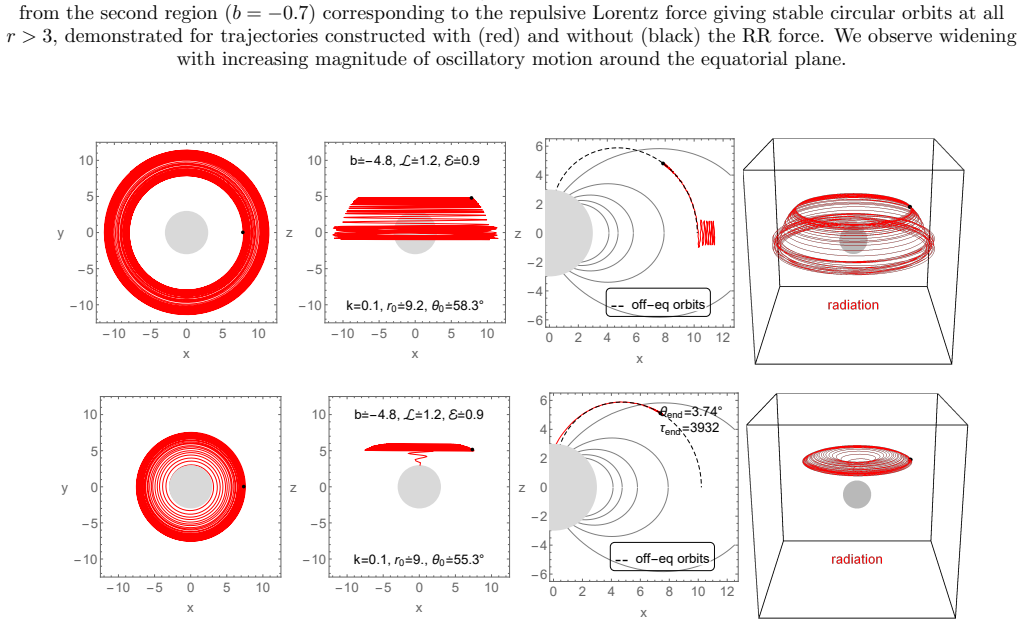
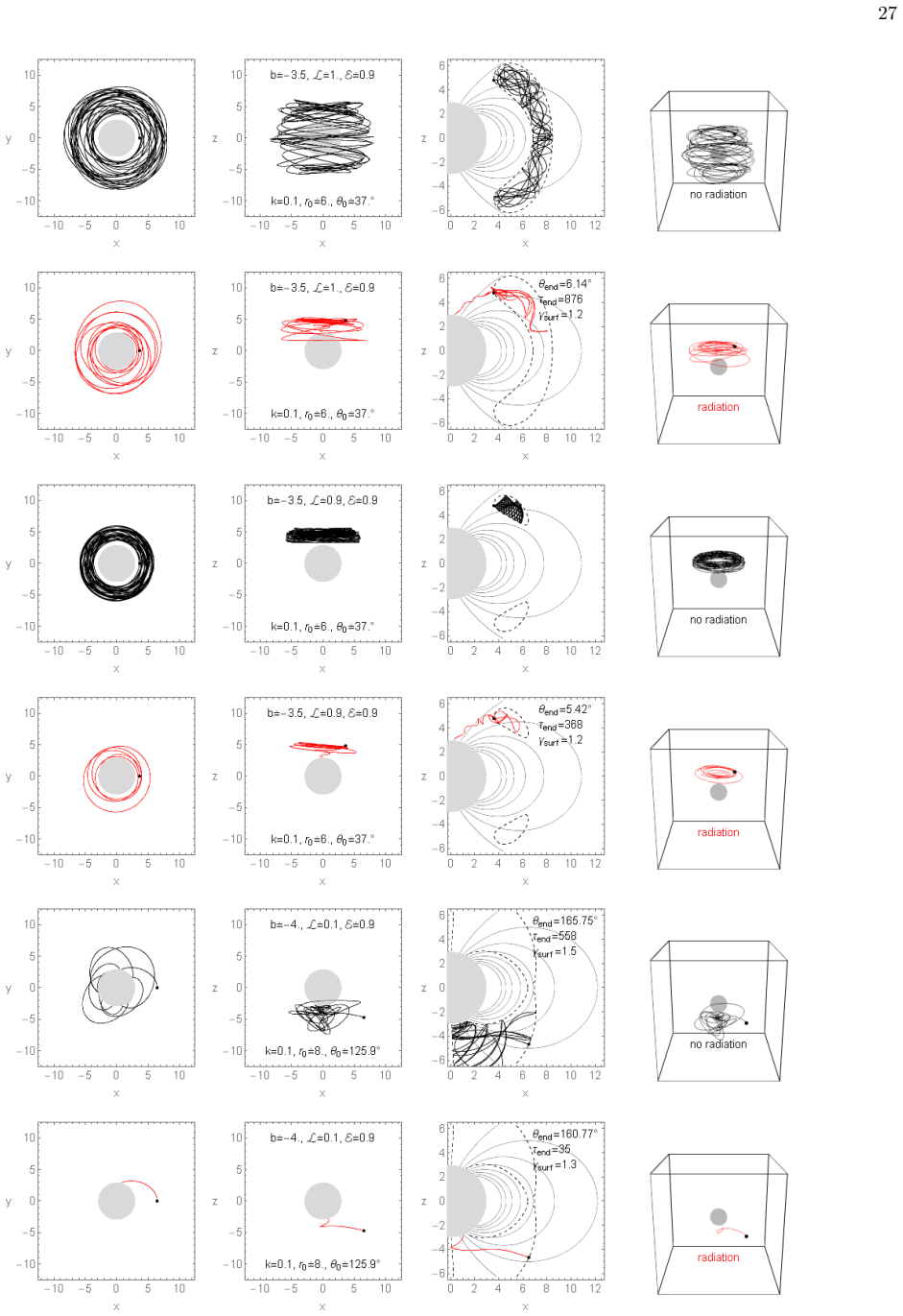
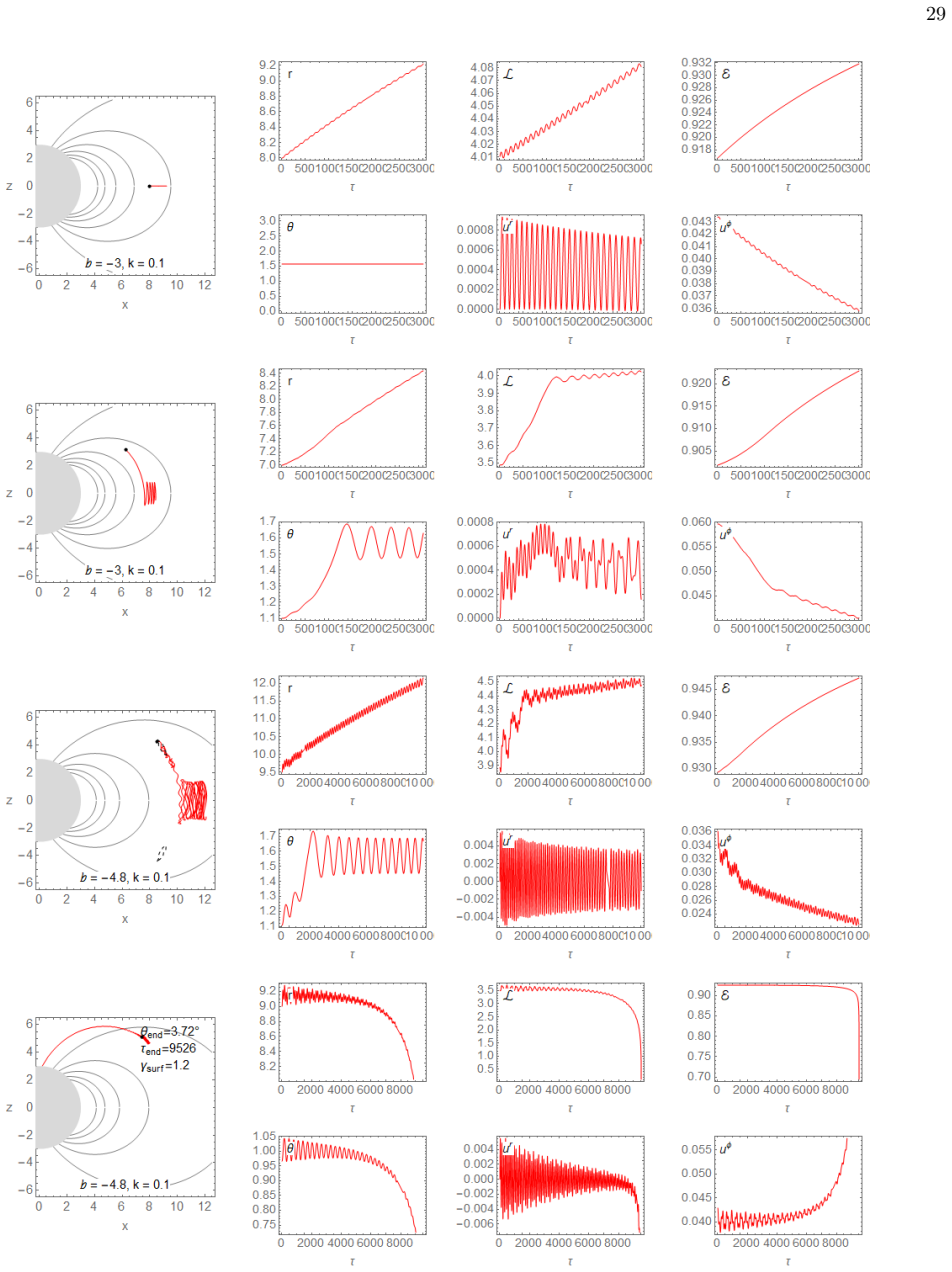
On the paper's own terms, the central claim is that the Landau-Lifshitz approximation to the DeWitt-Brehme equation, applied to charged test particles in a dipole magnetosphere, produces two qualitatively different long-term behaviors. For an attractive Lorentz force ($b>0$) the back-reaction acts as pure damping: equatorial circular orbits, epicyclic motion, and chaotic belts all end with the particle falling onto the neutron star surface. For a repulsive Lorentz force ($b<0$) the back-reaction can do work: stable equatorial circular orbits undergo orbital widening, with both specific energy and specific angular momentum increasing over time, and off-equatorial circular orbits slide along the family of off-equatorial orbits either toward the equator, where they widen with growing vertical oscillations, or toward the surface, depending on whether the initial latitude lies above or below a critical value $\theta_{w/f}(b)$. The paper reports vertical orbital widening as a new effect not seen in a uniform magnetic field, attributes it to the inhomogeneity of the dipole field, and identifies the Maxwell-tensor derivative term in the Landau-Lifshitz equation as the one responsible for the energy gain.
Load-bearing premise
The calculations assume that the delayed, non-local part of the radiation reaction, radiation that curves through the spacetime and returns to the particle, never matters because the neutron star's surface at $R=3M$ absorbs any returning radiation before it acts; all reported widening and energy gain are carried by the local part of the reaction, and a significant delayed contribution could reverse them.
Editorial extensions
If this is right
- Under an attractive Lorentz force, radiating charge cannot remain on any bound orbit: every tested equatorial, off-equatorial, epicyclic, or chaotic trajectory ends on the surface, so radiative losses hasten accretion onto the star.
- Under a repulsive Lorentz force, stable equatorial orbits expand, so a radiating particle can move outward while emitting synchrotron radiation, transporting angular momentum away from the star in the process.
- Off-equatorial particles starting above the critical latitude $\theta_{w/f}(b)$ first slide to the equator and then widen; below it they precipitate onto the star, giving a latitude-selected fate for radiation belts.
- The critical latitude $\theta_{w/f}(b)$ is independent of the radiation-reaction parameter $k$, so the widening-versus-fall classification does not depend on the reaction strength even though the timescales do.
- Vertical oscillation amplitude grows during widening, a signature specific to the dipole field and absent in uniform-field models, so the dipole geometry itself shapes the late-time motion.
Reading between the lines
- If the local-term energy gain is real and is not cancelled by the tail term, a radiating charged particle in a dipole field acts as a small energy-extraction engine, gaining specific energy from the field structure while emitting radiation; an astrophysical test would be to search for gradual outward migration of X-ray-emitting hot spots or rings around magnetized neutron stars.
- The same Landau-Lifshitz machinery with the tail term included is known to behave differently around black holes, so applying the full DeWitt-Brehme equation to a black hole in a dipole field would determine whether the widening-versus-fall dichotomy persists or is replaced by tail-driven behavior.
- Real neutron stars rotate, which adds an electric field and a unipolar-inductor potential that the static model omits; rotation could shift the critical latitude and turn the predicted polar fall into a voltage-driven outflow.
- Because the critical latitude is independent of the reaction strength $k$, the same classification should apply to dust, protons, and electrons once rescaled, so the effect could be searched for across very different particle populations around the same star.
Editorial analysis
A structured set of objections, weighed in public.
Referee Report
Summary. This paper studies the motion of charged test particles in the exterior of a non-rotating neutron star modeled by the Schwarzschild metric with a dipole magnetic field. It first characterizes conservative equatorial and off-equatorial circular orbits and their associated belts using an effective potential. It then integrates the Landau-Lifshitz equation with the DeWitt-Brehme tail term neglected, for large (illustrative) radiation-reaction parameters k=0.1 and 0.01, and classifies the outcomes: under an attractive Lorentz force the radiation reaction drives particles to the stellar surface, while under a repulsive Lorentz force stable circular orbits widen and off-equatorial orbits either migrate to the equator and widen or fall to the surface, with a numerically determined critical latitude θ_w/f(b).
Significance. The paper provides a systematic numerical catalog of radiation-reaction effects in a dipole magnetosphere, extending the authors' earlier work on conservative motion. The analytic effective-potential analysis of off-equatorial orbits is useful, and the comparison between orbits with and without radiation reaction is clearly presented. If the classification survives a quantitative treatment of the tail term, the predicted widening/fall boundary and the vertical widening of oscillatory orbits would be interesting, falsifiable features for models of charged dust or plasmoids in neutron-star magnetospheres. The manuscript is honest about the illustrative character of the large k values and about the open tail-term problem; however, the central claims currently rest on an unquantified truncation and on an unshown term-by-term attribution, which is why I recommend major revision.
major comments (3)
- [Section V, Eq. (53)] The neglect of the tail term in Eq. (52) is load-bearing but unquantified. The argument that the Schwarzschild reflective barrier is hidden beneath the NS surface at R=3M and that radiation entering the surface is captured does not exclude curvature-scattering contributions to the tail from the exterior region r>3M; for synchrotron-type orbits part of the scattered field can return on orbital timescales before reaching the surface. Refs. [70,71] show for magnetized Schwarzschild backgrounds that the tail can be comparable to or dominate the local terms and can change the sign of the energy transfer. Since Fig. 19 and the widening/fall classification are the paper's central quantitative output, I request a quantitative estimate of the relative size of the tail term for representative parameters (e.g., the cases of Fig. 18), or a computation including the tail via the methods of Refs. [70,71] for a subset of trajectories, before the classification can be considered robust.
- [Section VI.B.4, Fig. 25] The attribution of the energy increase during orbital widening to the q k/m F^α_{β;α} u^β u^μ term rests on the statement that 'preliminary calculations confirm' this, but the supporting calculation is not shown. This is load-bearing because Section VI.B.4 uses the energy increase to explain the counter-intuitive widening effect, and because the same term may be sensitive to the neglected tail. Please show the decomposition of dE/dτ and dL/dτ into the Lorentz, FRR1, and FRR2 contributions for at least one widening and one falling trajectory, or otherwise provide the calculation that isolates the Maxwell-derivative term.
- [Section VI.B.2, Fig. 19] The critical latitude θ_w/f(b) is presented as independent of the RR parameter k, and Fig. 19 is labeled 'For all k', but the numerical evidence shown is only for k=0.1 and k=0.01 (and for a few values of b). If the independence is a genuine property of the LL dynamics, it requires either an analytic argument or a convergence study over a wider range of k (including values closer to realistic k~10^{-18} for electrons or dust, where the widening timescale may change qualitatively). As it stands, the claim that Fig. 19 applies 'for all k' exceeds the presented evidence.
minor comments (5)
- [Section VI.B.2] The verbal specification of the three regimes contains reversed inequalities: 'First regime (0 < b < -0.654)' should read '-0.654 < b < 0', and the second and third regimes are similarly misordered.
- [Section IV, Eq. (53)] The last term on the right-hand side of Eq. (53) ends with a bare 'uμ' after an expression that already contains u^μ; the index structure appears to have a typo and should be checked.
- [Reference [22]] Reference [22] is cited as 'Submitted .., .. (2024), arXiv:... [astro-ph.HE]' with placeholder text; it should be updated to the published or arXiv identifier before publication.
- [Fig. 2] The 'Stable' labels in Fig. 2 do not clearly indicate which side of each curve (brISCO or bθISCO) is stable; please add explicit shading or arrow annotations defining the stability region.
- [Section III.C, Eqs. (28)-(30)] The subscript 'Coff' for off-equatorial circular orbits is introduced after the equations that use it; clarify the notation and distinguish it from the subscript 'c' used for equatorial circular orbits.
Circularity Check
No significant circularity: the RR trajectories and the widening/fall boundary are read directly from numerical integrations of Eq. (53), not fitted to the conclusions; self-citations supply context but the needed formulas are reproduced in this paper.
full rationale
The paper's central derivation chain is self-contained for its principal claims. The conservative part (Sections II and III) starts from the Hamiltonian (10) and the dipole vector potential (3), constructs the effective potential (16), and obtains circular orbits from the simultaneous vanishing of its derivatives; the stability functions brISCO (26) and bthetaISCO (27) are given explicitly or as root conditions, so the companion paper [22] is a context citation rather than a load-bearing black box. The radiation-reaction part (Sections IV and VI) numerically integrates the Landau-Lifshitz equation (53) with stated parameters (b, L, E, k), and the reported fall/widening taxonomy, including the critical latitude theta_w/f(b), is a classification of those same integrations rather than a quantity fitted to an external dataset or to the conclusions; no presented step defines its output in terms of the effect it is meant to predict. The main caveats are limitations and correctness risks, not circularity: the neglect of the tail integral (52) in Eq. (53) is justified in Section V by the surface-capture argument and footnote [73] but is not quantified for backscattering in the exterior region r>3M, and Refs. [70,71] show that tail effects can be important around black holes; Table I's order-of-magnitude estimate Ftail~k is not a bound on the non-local integral (52), so the neglect remains an assumption. Likewise, the attribution of the widening to the local Maxwell-derivative term is supported only by 'preliminary calculations' mentioned in Section VI.B.4. These concerns could shift or erase the reported boundary, but they do not make the derivation tautological. The nonzero score reflects the minor self-citation to the companion analysis [22] and the unquantified tail assumption; no circular reduction was found.
Assumptions & free parameters
free parameters (3)
- RR parameter k =
0.1 and 0.01
- magnetic parameter b =
values from -1000 to 105 in figures
- initial conditions (E, L, r0, theta0) =
given per trajectory in figure captions
assumptions (6)
- domain assumption Schwarzschild exterior geometry is a valid model for the non-rotating NS spacetime
- domain assumption The dipole magnetic field of Wasserman-Shapiro is the correct external field configuration
- domain assumption Test-particle approximation: the particle's charge and mass do not affect the background
- ad hoc to paper Landau-Lifshitz equation with tail term dropped is a valid approximation for radiation reaction
- standard math Stability of circular orbits is governed by the Hessian of the effective potential
- domain assumption Identification of motion regimes: |b|<<1 gravitational, |b|~1 chaotic, |b|>>1 magnetic
Cite this review
Pith. "Pith review of Radiative Back-Reaction on Charged Particle Motion in the Dipole Magnetosphere of Neutron Stars." pith.science (2026). https://pith.science/paper/OB2SMO5F
@misc{pith2026241204996,
  author       = {Pith},
  title        = {Pith review of: Radiative Back-Reaction on Charged Particle Motion in the Dipole Magnetosphere of Neutron Stars},
  year         = {2026},
  howpublished = {\url{https://pith.science/paper/OB2SMO5F}},
  note         = {Machine review of arXiv:2412.04996}
}
read the original abstract
The motion of charged particles under the Lorentz force in the magnetosphere of neutron stars, represented by a dipole field in the Schwarzschild spacetime, can be determined by an effective potential, whose local extrema govern circular orbits both in and off the equatorial plane, which coincides with the symmetry plane of the dipole field. In this work, we provide a detailed description of the properties of these "conservative" circular orbits and, using the approximation represented by the Landau-Lifshitz equation, examine the role of the radiative back-reaction force that influences the motion of charged particles following both the in and off equatorial circular orbits, as well as the chaotic orbits confined to belts centered around the circular orbits. To provide clear insight into these dynamics, we compare particle motion with and without the back-reaction force. We demonstrate that, in the case of an attractive Lorentz force, the back-reaction leads to the charged particles falling onto the neutron star's surface in all scenarios considered. For the repulsive Lorentz force, in combination with the back-reaction force, we observe a widening of stable equatorial circular orbits; the off-equatorial orbits shift toward the equatorial plane and subsequently widen if they are sufficiently close to the plane. Otherwise, the off-equatorial orbits evolve toward the neutron star surface. The critical latitude, which separates orbital widening from falling onto the surface, is determined numerically as a function of the electromagnetic interaction's intensity.
Figures


Figures from the paper (27 more)







Forward citations
Cited by 1 Pith paper
-
From St{\o}rmer to Schwarzschild: Analytical Dynamics of Charged Particles in a Dipole Magnetosphere
In a Schwarzschild spacetime with a leading-dipole magnetic field, the inner stable charged-particle orbit first moves inward with magnetic coupling, then outward, with the limiting mode switching from radial to verti...
Reference graph
Works this paper leans on
-
[1]
The fall occurs along a trajectory confined to the equatorial plane – see FIG
Equatorial circular orbits The RR force acting on particles following unstable or near-marginal stable equatorial circular orbits under the magnetic attraction, where the effective potential is open in the radial direction, always leads to the particle’s immediate onto the NS surface. The fall occurs along a trajectory confined to the equatorial plane – s...
-
[2]
”Smoothing” of epicyclic near-circular motion Particles slightly displaced from the position of a cir- cular orbit in the equatorial plane experience different outcomes depending on the nature of the effective poten- tial barrier corresponding to motion under the Lorentz force. When the barrier is restricted in the radial direc- tion, but open vertically ...
-
[3]
Chaotic bound orbits The chaotic motion of particles off the equatorial plane, within large regions around the equatorial circular orbits, is explored in two cases: (i) when the effective barrier under the Lorentz force is open to the NS surface in the radial direction, and (ii) when there is an island bar- rier allowing for trapped motion under the Loren...
-
[4]
Under the combined in- fluence of the Lorentz force and the RR force, the or- bits slowly expand, in contrast to the usual shrinking observed with the attractive Lorentz force
Equatorial circular orbits: widening In the case of equatorial circular orbits, a phenomenon unique to the presence of the repulsive Lorentz force can be observed – orbital widening. Under the combined in- fluence of the Lorentz force and the RR force, the or- bits slowly expand, in contrast to the usual shrinking observed with the attractive Lorentz forc...
-
[5]
13: The RR influence for the motion under attractive Lorentz force with effective potential barrier open in the inward radial direction
Off-equatorial circular orbits: widening vs fall Particles following off-equatorial circular orbits under the influence of the repulsive Lorentz force can exhibit 19 FIG. 13: The RR influence for the motion under attractive Lorentz force with effective potential barrier open in the inward radial direction. FIG. 14: The RR influence for the motion under at...
-
[6]
When chaotic motion crosses the equatorial plane, the RR force gradually converts this motion into an orbital widening of chaotic nature, provided that the correspond- 21 FIG
Chaotic motion in the belts The large-scale chaotic motion in belts, initially gov- erned solely by the Lorentz force, demonstrates similar effects under the additional influence of the RR force as in the previous cases of motion near circular orbits. When chaotic motion crosses the equatorial plane, the RR force gradually converts this motion into an orb...
-
[7]
The time evolution of these characteristics revels the signatures of the RR force’s in- fluence on the motion
Evolution of the motion parameters due to the RR force To gain a deeper understanding of the role of the RR force in the motion of charged test particles, we need to study the time evolution of the key motion parameters, such as the specific energy and specific angular momen- tum under the combined influence of the gravitational, Lorentz, and RR forces. T...
-
[8]
S. B. Popov, High magnetic field neutron stars and magnetars in binary systems, IAU Symposium 363, 61 (2023), arXiv:2201.07507 [astro-ph.HE]
work page Pith review arXiv 2023
Show all 91 references
-
[9]
R. P. Eatough, H. Falcke, R. Karuppusamy, K. J. Lee, D. J. Champion, E. F. Keane, G. Desvignes, D. H. F. M. Schnitzeler, L. G. Spitler, M. Kramer, B. Klein, C. Bassa, G. C. Bower, A. Brunthaler, I. Cognard, A. T. Deller, P. B. Demorest, P. C. C. Freire, A. Kraus, A. G. Lyne, A...
2013 arXiv
-
[10]
R. Gold, J. C. McKinney, M. D. Johnson, and S. S. Doeleman, Probing the Magnetic Field Structure in Sgr A* on Black Hole Horizon Scales with Polarized Radia- tive Transfer Simulations, Astrophys. J. 837, 180 (2017), arXiv:1601.05550 [astro-ph.HE]
2017 arXiv
-
[11]
R. A. Daly, Black Hole Spin and Accretion Disk Mag- netic Field Strength Estimates for More Than 750 Ac- tive Galactic Nuclei and Multiple Galactic Black Holes, Astrophys. J. 886, 37 (2019), arXiv:1905.11319 [astro- ph.HE]
2019 arXiv
-
[12]
M. Y. Piotrovich, A. G. Mikhailov, S. D. Buliga, and T. M. Natsvlishvili, Determination of magnetic field strength on the event horizon of supermassive black holes in active galactic nuclei, Monthly Notices of the RAS 495, 614 (2020), arXiv:2004.07075 [astro-ph.HE]
2020 arXiv
-
[13]
Ruffini and A
R. Ruffini and A. Treves, On a Magnetized Rotating Sphere, Appl. Phys. Lett. 13, 109 (1973)
1973
-
[14]
Prasanna, General-relativistic analysis of charged- particle motion in electromagnetic fields surrounding black holes, La Rivista del Nuovo Cimento (1978-1999) 3, 1 (1980)
A. Prasanna, General-relativistic analysis of charged- particle motion in electromagnetic fields surrounding black holes, La Rivista del Nuovo Cimento (1978-1999) 3, 1 (1980)
1980
-
[15]
Ruffini and J
R. Ruffini and J. R. Wilson, Relativistic magnetohydro- dynamical effects of plasma accreting into a black hole, Phys. Rev. D 12, 2959 (1975)
1975
-
[16]
S. V. Dhurandhar and N. Dadhich, Energy-extraction processes from a Kerr black hole immersed in a mag- netic field. I. Negative-energy states, Phys. Rev. D 29, 2712 (1984)
1984
-
[17]
Parthasarathy, S
S. Parthasarathy, S. M. Wagh, S. V. Dhurandhar, and N. Dadhich, High Efficiency of the Penrose Process of Energy Extraction from Rotating Black Holes Immersed in Electromagnetic Fields, Astrophys. J. 307, 38 (1986)
1986
-
[18]
R. D. Blandford and R. L. Znajek, Electromagnetic ex- traction of energy from Kerr black holes., Monthly No- tices of the RAS 179, 433 (1977)
1977
-
[19]
Dadhich, A
N. Dadhich, A. Tursunov, B. Ahmedov, and Z. Stuchl ´ ık, The distinguishing signature of magnetic Penrose pro- cess, Monthly Notices of the RAS 478, L89 (2018), 37 arXiv:1804.09679 [astro-ph.HE]
2018 arXiv
-
[20]
Stuchl ´ ık, M
Z. Stuchl ´ ık, M. Koloˇ s, J. Kov´ aˇ r, P. Slan´ y, and A. Tur- sunov, Influence of Cosmic Repulsion and Magnetic Fields on Accretion Disks Rotating around Kerr Black Holes, Universe 6, 26 (2020)
2020
-
[21]
Koloˇ s, A
M. Koloˇ s, A. Tursunov, and Z. Stuchl ´ ık, Radiative Pen- rose process: Energy gain by a single radiating charged particle in the ergosphere of rotating black hole, Phys. Rev. D 103, 024021 (2021), arXiv:2010.09481 [gr-qc]
2021 arXiv
-
[22]
Stuchl ´ ık, M
Z. Stuchl ´ ık, M. Koloˇ s, and A. Tursunov, Penrose Process: Its Variants and Astrophysical Applications, Universe 7, 416 (2021)
2021
-
[23]
Stuchl ´ ık, A
Z. Stuchl ´ ık, A. Kotrlov´ a, and G. T¨ or¨ ok, Multi-resonance orbital model of high-frequency quasi-periodic oscilla- tions: possible high-precision determination of black hole and neutron star spin, Astronomy and Astrophysics Jour- nal 552, A10 (2013), arXiv:1305.3552 [ast...
2013 arXiv
-
[24]
Koloˇ s, Z
M. Koloˇ s, Z. Stuchl ´ ık, and A. Tursunov, Quasi- harmonic oscillatory motion of charged particles around a Schwarzschild black hole immersed in a uniform mag- netic field, Classical and Quantum Gravity 32, 165009 (2015), arXiv:1506.06799 [gr-qc]
2015 arXiv
-
[25]
Koloˇ s, A
M. Koloˇ s, A. Tursunov, and Z. Stuchl ´ ık, Possible sig- nature of the magnetic fields related to quasi-periodic oscillations observed in microquasars, European Physi- cal Journal C 77, 860 (2017), arXiv:1707.02224 [astro- ph.HE]
2017 arXiv
-
[26]
P´ anis, M
R. P´ anis, M. Koloˇ s, and Z. Stuchl ´ ık, Determination of chaotic behaviour in time series generated by charged particle motion around magnetized Schwarzschild black holes, European Physical Journal C 79, 479 (2019), arXiv:1905.01186 [gr-qc]
2019 arXiv
-
[27]
Stuchl ´ ık, M
Z. Stuchl ´ ık, M. Koloˇ s, and A. Tursunov, Large-scale mag- netic fields enabling fitting of the high-frequency QPOs observed around supermassive black holes, Publications of the Astronomical Society of Japan 74, 1220 (2022)
2022
-
[28]
The tidal charge in the braneworld models of NSs [77] can be also well applied for fitting the data of HF QPOs in binary systems containing a NS [78]
-
[29]
J. Vrba, M. Koloˇ s, and Z. Stuchl ´ ık, Charged particles in dipole magnetosphere of neutron stars: epicyclic oscilla- tions in and off equatorial plane, Submitted .., .. (2024), arXiv:... [astro-ph.HE]
2024
-
[30]
T¨ or¨ ok, P
G. T¨ or¨ ok, P. Bakala, E. ˇSr´ amkov´ a, Z. Stuchl ´ ık, and M. Urbanec, On Mass Constraints Implied by the Rel- ativistic Precession Model of Twin-peak Quasi-periodic Oscillations in Circinus X-1, Astrophys. J. 714, 748 (2010), arXiv:1008.0088 [astro-ph.HE]
2010 arXiv
-
[31]
For non- rotating compact objects such an extreme acceleration is not possible [17]
The Lorentz force acting on electrons or protons (ions) in vicinity of the event horizon of magnetized rotating BHs, or the surface of magnetized rotating NSs can cause their enormous acceleration [13, 15, 79, 80] because of the electric component of the electromagnetic field ...
-
[32]
Recall that in the charged Kerr-Newman-(de Sitter) spacetimes the motion of charged test particles is fully regular and can be given in terms of elliptic integrals [31, 55, 81–84]
-
[33]
Tursunov, M
A. Tursunov, M. Koloˇ s, Z. Stuchl ´ ık, and D. V. Gal’tsov, Radiation Reaction of Charged Particles Orbiting a Mag- netized Schwarzschild Black Hole, Astrophys. J. 861, 2 (2018), arXiv:1803.09682 [gr-qc]
2018 arXiv
-
[34]
Stuchl ´ ık, M
Z. Stuchl ´ ık, M. Koloˇ s, A. Tursunov, and D. Gal’tsov, On the Role of the Tail Term in Electromagnetic Radiation Reaction, Universe 10, 249 (2024)
2024
-
[35]
B. S. DeWitt and R. W. Brehme, Radiation damping in a gravitational field, Annals of Physics 9, 220 (1960)
1960
-
[36]
L. D. Landau and E. M. Lifshitz, Course of theoret- ical physics - Pergamon International Library of Sci- ence, Technology, Engineering and Social Studies, Ox- ford: Pergamon Press, 1975, 4th rev.engl.ed. (Pergamon Press, 1975)
1975
-
[37]
A. A. Tursunov, M. Koloˇ s, and Z. Stuchl ´ ık, Orbital widening due to radiation reaction around a magnetized black hole, Astronomische Nachrichten 339, 341 (2018), arXiv:1806.06754 [gr-qc]
2018 arXiv
-
[38]
C. W. Misner, K. S. Thorne, and J. A. Wheeler, Gravita- tion (W. H. Freeman Princeton University Press, United States, 1973)
1973
-
[39]
J. A. Petterson, Magnetic field of a current loop around a Schwarzschild black hole, Phys. Rev. D 10, 3166 (1974)
1974
-
[40]
standard
I. Wasserman and S. L. Shapiro, Masses, radii, and mag- netic fields of pulsating X-ray sources : is the “standard” model self-consistent ?, Astrophys. J. 265, 1036 (1983)
1983
-
[41]
T. M. Braje and R. W. Romani, Magnetospheric Scat- tering and Emission in Millisecond Pulsars, Astrophys. J. 550, 392 (2001), arXiv:astro-ph/0004407 [astro-ph]
2001 arXiv
-
[42]
This dipole field is identical to those generated by an electric current loop orbiting in the equatorial plane of the Schwarzschild geometry [32, 50, 85]
-
[43]
Bakala, E
P. Bakala, E. ˇSr´ amkov´ a, Z. Stuchl ´ ık, and G. T¨ or¨ ok, On magnetic-field-induced non-geodesic corrections to rela- tivistic orbital and epicyclic frequencies, Classical and Quantum Gravity 27, 045001 (2010)
2010
-
[44]
Urbanec, J
M. Urbanec, J. C. Miller, and Z. Stuchl ´ ık, Quadrupole moments of rotating neutron stars and strange stars, Monthly Notices of the RAS 433, 1903 (2013), arXiv:1301.5925 [astro-ph.SR]
2013 arXiv
-
[45]
R. C. Tolman, Static solutions of Einstein’s field equa- tions for spheres of fluids, Phys. Rev. 55, 364 (1939)
1939
-
[46]
Jiang and K
N. Jiang and K. Yagi, Improved analytic modeling of neutron star interiors, Phys. Rev. D 99, 124029 (2019), arXiv:1904.05954 [gr-qc]
2019 arXiv
-
[47]
Stuchl ´ ık and J
Z. Stuchl ´ ık and J. Vrba, Trapping of null geodesics in slowly rotating extremely compact Tolman VII space- times, European Physical Journal Plus 136, 977 (2021), arXiv:2108.09466 [gr-qc]
2021 arXiv
-
[48]
M. A. Abramowicz, J. C. Miller, and Z. Stuchl ´ ık, Concept of radius of gyration in general relativity, Phys. Rev. D 47, 1440 (1993)
1993
-
[49]
Stuchl ´ ık, S
Z. Stuchl ´ ık, S. Hled ´ ık, and J. Novotn´ y, General relativis- tic polytropes with a repulsive cosmological constant, Phys. Rev. D 94, 103513 (2016), arXiv:1611.05327 [gr- qc]
2016 arXiv
-
[50]
Novotn´ y, J
J. Novotn´ y, J. Hlad ´ ık, and Z. Stuchl ´ ık, Polytropic spheres containing regions of trapped null geodesics, Phys. Rev. D 95, 043009 (2017), arXiv:1703.04604 [gr-qc]
2017 arXiv
-
[51]
N. K. Glendenning, ed., Compact stars : nuclear physics, particle physics, and general relativity / Norman K. Glendenning. New York : Springer, 2000. (Astronomy and astrophysics library) (2000)
2000
-
[52]
Bahcall, B
S. Bahcall, B. W. Lynn, and S. B. Selipsky, Fermion Q- stars, Nuclear Physics B 325, 606 (1989)
1989
-
[53]
Weber, Pulsars as Astrophysical Laboratories for Nu- clear and Particle Physics (CRC Press, 2017)
F. Weber, Pulsars as Astrophysical Laboratories for Nu- clear and Particle Physics (CRC Press, 2017)
2017
-
[54]
van der Klis, Millisecond Oscillations in X-ray Bina- 38 ries, Annual Review of Astronomy and Astrophysics 38, 717 (2000), arXiv:astro-ph/0001167 [astro-ph]
M. van der Klis, Millisecond Oscillations in X-ray Bina- 38 ries, Annual Review of Astronomy and Astrophysics 38, 717 (2000), arXiv:astro-ph/0001167 [astro-ph]
2000 arXiv
-
[55]
Ecker and L
C. Ecker and L. Rezzolla, Impact of large-mass con- straints on the properties of neutron stars, Monthly No- tices of the RAS 519, 2615 (2023), arXiv:2209.08101 [astro-ph.HE]
2023 arXiv
-
[56]
S. B. Popov, Origins of magnetars in binary systems, Astronomical and Astrophysical Transactions 29, 183 (2016), arXiv:1507.08192 [astro-ph.HE]
2016 arXiv
-
[58]
A. N. Aliev and D. V. Galtsov, Radiation from relativistic particles in nongeodesic motion in a strong gravitational field., General Relativity and Gravitation 13, 899 (1981)
1981
-
[59]
Kov´ aˇ r, Z
J. Kov´ aˇ r, Z. Stuchl ´ ık, and V. Karas, Off-equatorial orbits in strong gravitational fields near compact ob- jects, Classical and Quantum Gravity 25, 095011 (2008), arXiv:0803.3155 [astro-ph]
2008 arXiv
-
[60]
Particles under magnetic attraction, with b > 0, have to follow the counter-rotating off-equatorial orbits with ωφ < 0
-
[61]
Bicak, Z
J. Bicak, Z. Stuchlik, and V. Balek, The Motion of Charged Particles in the Field of Rotating Charged Black Holes and Naked Singularities. I. The General Features of the Radial Motion and the Motion Along the Axis of Symmetry, Bulletin of the Astronomical Institutes of Czechos...
1989
-
[62]
Balek, J
V. Balek, J. Bicak, and Z. Stuchlik, The Motion of the Charged Particles in the Field of Rotating Charged Black Holes and Naked Singularities. II. The Motion in the Equatorial Plane, Bulletin of the Astronomical Institutes of Czechoslovakia 40, 133 (1989)
1989
-
[63]
J. E. Gunn and J. P. Ostriker, Magnetic Dipole Radiation from Pulsars, Nature (London) 221, 454 (1969)
1969
-
[64]
R. A. Chevalier and C. Fransson, Circumstellar matter and the nature of the SN1987A progenitor star, Nature (London) 328, 44 (1987)
1987
-
[65]
J. B. Climent, J. C. Guirado, M. P´ erez-Torres, J. M. Marcaide, and L. Pe˜ na-Mo˜ nino, Evidence for a radiation belt around a brown dwarf, Science 381, 1120 (2023), arXiv:2303.06453 [astro-ph.SR]
2023 arXiv
-
[66]
V. P. Frolov and A. A. Shoom, Motion of charged parti- cles near a weakly magnetized Schwarzschild black hole, Phys. Rev. D 82, 084034 (2010), arXiv:1008.2985 [gr-qc]
2010 arXiv
-
[67]
R. C. Duncan and C. Thompson, Formation of Very Strongly Magnetized Neutron Stars: Implications for Gamma-Ray Bursts, Astrophysical Journal Letters 392, L9 (1992)
1992
-
[68]
V. V. Usov, Millisecond pulsars with extremely strong magnetic fields as a cosmological source of γ-ray bursts, Nature (London) 357, 472 (1992)
1992
-
[69]
L. D. Landau and E. M. Lifshitz, Quantum Mechanics: Non-relativistic Theory , 3rd ed., Course of Theoretical Physics, Vol. 3 (Pergamon Press, London, 1977)
1977
-
[70]
L. B. Loeb, Science 124, 35 (1956), https://www.science.org/doi/pdf/10.1126/science.124.3210.35.a
1956 doi
-
[71]
Kimura and P
K. Kimura and P. J. Morrison, On energy conservation in extended magnetohydrodynamics, Physics of Plasmas 21, 082101 (2014), arXiv:1406.2745 [physics.plasm-ph]
2014 arXiv
-
[72]
Comisso and F
L. Comisso and F. A. Asenjo, Thermal-Inertial Effects on Magnetic Reconnection in Relativistic Pair Plasmas, Phys. Rev. Lett. 113, 045001 (2014), arXiv:1402.1115 [physics.plasm-ph]
2014 arXiv
-
[73]
Kawazura, Modification of magnetohydrodynamic waves by the relativistic Hall effect, Phys
Y. Kawazura, Modification of magnetohydrodynamic waves by the relativistic Hall effect, Phys. Rev. E 96, 013207 (2017), arXiv:1706.07077 [physics.plasm-ph]
2017 arXiv
-
[74]
Yoshino, M
S. Yoshino, M. Hirota, and Y. Hattori, Applicability cri- teria of proper charge neutrality and special relativis- tic MHD models extended by two-fluid effects, arXiv e-prints , arXiv:2410.03317 (2024), arXiv:2410.03317 [physics.plasm-ph]
2024 arXiv
-
[75]
J. D. Jackson, Classical Electrodynamics, 3rd ed. (Wiley, 1999)
1999
-
[76]
Poisson, The Motion of Point Particles in Curved Spacetime, Living Reviews in Relativity 7, 6 (2004), arXiv:gr-qc/0306052 [gr-qc]
E. Poisson, The Motion of Point Particles in Curved Spacetime, Living Reviews in Relativity 7, 6 (2004), arXiv:gr-qc/0306052 [gr-qc]
2004 arXiv
-
[77]
J. S. Santos, V. Cardoso, and J. Nat´ ario, Electromag- netic radiation reaction and energy extraction from black holes: The tail term cannot be ignored, Phys. Rev. D 107, 064046 (2023), arXiv:2303.03411 [gr-qc]
2023
-
[78]
J. S. Santos, V. Cardoso, and J. Nat´ ario, Radiation reac- tion in weakly magnetized black holes: Can the tail term be ignored in the strong field regime?, Phys. Rev. D 109, 124032 (2024), arXiv:2404.02195 [gr-qc]
2024 arXiv
-
[79]
Tursunov, M
A. Tursunov, M. Zajaˇ cek, A. Eckart, M. Koloˇ s, S. Britzen, Z. Stuchl ´ ık, B. Czerny, and V. Karas, Ef- fect of Electromagnetic Interaction on Galactic Cen- ter Flare Components, Astrophys. J. 897, 99 (2020), arXiv:1912.08174 [astro-ph.GA]
2020 arXiv
-
[80]
The tail term enters the play for extremely compact stars having a radius at R <3M
-
[81]
Koloˇ s, M
M. Koloˇ s, M. Shahzadi, and A. Tursunov, Charged particle dynamics in parabolic magnetosphere around Schwarzschild black hole, European Physical Journal C 83, 323 (2023), arXiv:2304.13603 [gr-qc]
2023 arXiv
-
[82]
For the possible role of the tail term in the RR force see [27]
-
[83]
An epicyclic harmonic motion is, of course, possible in a sufficiently small vicinity of stable circular orbits also in the chaotic regime of the motion
-
[84]
Dadhich, R
N. Dadhich, R. Maartens, P. Papadopoulos, and V. Reza- nia, Black holes on the brane, Physics Letters B 487, 1 (2000), arXiv:hep-th/0003061 [hep-th]
2000 arXiv
-
[85]
Kotrlov´ a, Z
A. Kotrlov´ a, Z. Stuchl ´ ık, and G. T¨ or¨ ok, Quasiperiodic oscillations in a strong gravitational field around neutron stars testing braneworld models, Classical and Quantum Gravity 25, 225016 (2008), arXiv:0812.0720 [astro-ph]
2008 arXiv
-
[86]
Stuchl ´ ık and M
Z. Stuchl ´ ık and M. Koloˇ s, Acceleration of the charged particles due to chaotic scattering in the combined black hole gravitational field and asymptotically uniform mag- netic field, European Physical Journal C 76, 32 (2016), arXiv:1511.02936 [gr-qc]
2016 arXiv
-
[87]
Tursunov, Z
A. Tursunov, Z. Stuchl ´ ık, M. Koloˇ s, N. Dadhich, and B. Ahmedov, Supermassive Black Holes as Possible Sources of Ultrahigh-energy Cosmic Rays, Astrophys. J. 895, 14 (2020), arXiv:2004.07907 [astro-ph.HE]
2020 arXiv
-
[88]
Carter, Black hole equilibrium states., in Black Holes (Les Astres Occlus) (1973) pp
B. Carter, Black hole equilibrium states., in Black Holes (Les Astres Occlus) (1973) pp. 57–214
1973
-
[89]
Stuchlik, The Motion of Test Particles in Black-Hole Backgrounds with Non-Zero Cosmological Constant, Bul- letin of the Astronomical Institutes of Czechoslovakia34, 129 (1983)
Z. Stuchlik, The Motion of Test Particles in Black-Hole Backgrounds with Non-Zero Cosmological Constant, Bul- letin of the Astronomical Institutes of Czechoslovakia34, 129 (1983)
1983
-
[90]
G. V. Kraniotis, Frame dragging and bending of light in Kerr and Kerr (anti) de Sitter spacetimes, Classical and Quantum Gravity 22, 4391 (2005), arXiv:gr-qc/0507056 [gr-qc]. 39
2005 arXiv
-
[91]
G. V. Kraniotis, Gravitational redshift/blueshift of light emitted by geodesic test particles, frame-dragging and pericentre-shift effects, in the Kerr-Newman-de Sit- ter and Kerr-Newman black hole geometries, European Physical Journal C 81, 147 (2021)
2021
-
[92]
Preti, On charged particle orbits in dipole magnetic fields around Schwarzschild black holes, Classical and Quantum Gravity 21, 3433 (2004)
G. Preti, On charged particle orbits in dipole magnetic fields around Schwarzschild black holes, Classical and Quantum Gravity 21, 3433 (2004)
2004
Reviewed August 11, 2026 · model on record in the stance chip above.
Discussion (0). Continue with ORCID to comment.