REVIEW 4 major objections 5 minor 1 cited by
MoGA: 3D Generative Avatar Prior for Monocular Gaussian Avatar Reconstruction
T0 review · 4 major / 5 minor · reviewed 2026-08-06 · deepseek-v4-flash
Pith's one-line read MoGA claims that a single image can yield a high-fidelity, animatable 3D Gaussian avatar by fitting a learned generative avatar model to six synthetic views from multi-view diffusion, with the generative prior supplying initialization, 3D…
desk verdict Solid new combination of a 3D generative avatar prior with multi-view diffusion for single-image avatar reconstruction, but the central generalization claim is unverified because the prior training split and eval protocol are not disclosed. read the letter →
The pith
A machine-rendered reading of the paper's core claim, the machinery that carries it, and where it could break.
The reading
What carries the argument
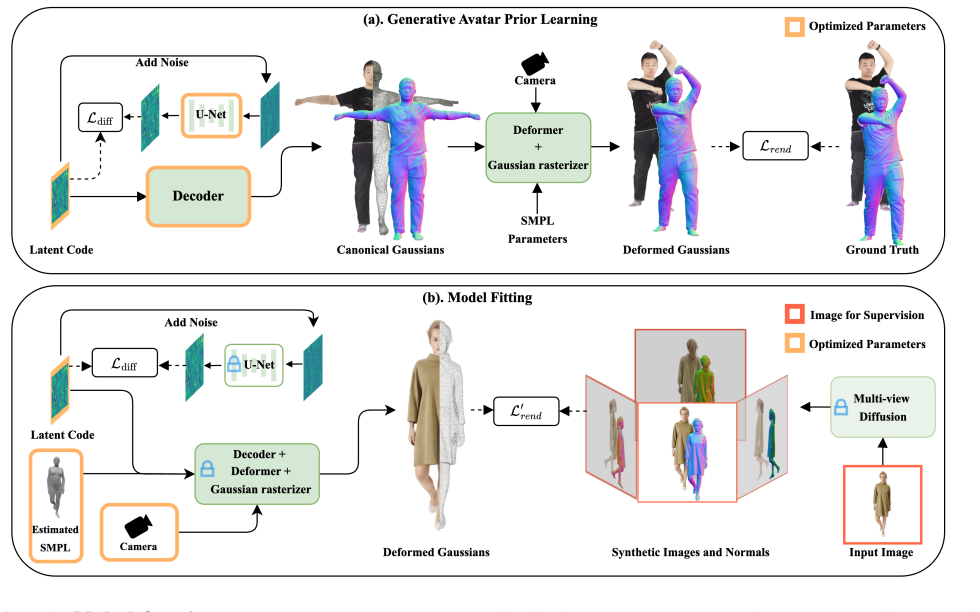
The central object is a generative 3D Gaussian avatar prior: per-subject latent codes decoded by a shared CNN into UV maps of 2D Gaussian attributes (opacity, center, color, scale, rotation), anchored as residuals to SMPL-X and deformed by voxel-grid skinning weights. The mechanism that carries the argument is a latent diffusion model trained in the same UV latent space as the auto-decoder, which turns the diffusion denoising objective into a regularizer during model inversion. With the decoder and diffusion model frozen, fitting minimizes a rendering loss (RGB and normal L2, perceptual, normal-consistency, depth-distortion) plus the diffusion loss, so the prior actively inpaints occluded or inconsistently synthesized regions rather than merely initializing the optimization. Camera and body pose are then refined alternately against a mask-aware photometric loss, which the paper credits with correcting abnormal poses inherited from the synthetic views.
What would settle it
Take a set of held-out identities wearing clothing and hairstyles far from the generative prior's training distribution, capture ground-truth 3D scans of them, and reconstruct each from a single photo. If the fitted avatar's Chamfer distance to the scan is no better than fitting without the prior, or if the reconstruction collapses to the prior's average body while ignoring the input identity, then the claim that the prior regularizes without over-prioritizing the training distribution fails.
Extended reading notes
Core claim
MoGA's central claim is that Gaussian avatar creation from a single image is best formulated as model inversion of a generative 3D avatar model against synthetic multi-view images. The generative model is an auto-decoder: each identity has a latent code $X_i \in \mathbb{R}^{64\times64\times32}$, a shared CNN decoder turns the code into a $256\times256\times12$ UV map of 2D Gaussian attributes anchored to the SMPL-X template, and a deformation module moves the canonical Gaussians into posed space for splatting. Training uses a single-stage pipeline that jointly optimizes the auto-decoder and a latent diffusion model so the latent space is smooth. At test time, image-guided sampling provides the starting code, and the method solves $\min_X \lambda_{\mathrm{rend}} L'_{\mathrm{rend}}(X) + \lambda'_{\mathrm{diff}} L_{\mathrm{diff}}(X)$ with the decoder and diffusion model frozen; the diffusion loss works as a learned prior that regularizes and inpaints the latent code. Camera and SMPL-X pose parameters are optimized alternately against a mask-aware photometric loss during the same fitting process. The paper argues that this prior — not the multi-view diffusion alone — is what removes the blur and 3D inconsistency that plague earlier systems, and that it also enables the avatar to be animated without post-processing.
Load-bearing premise
The learned avatar prior's latent space must be smooth and expressive enough to represent any new person's appearance, clothing, and pose from a single photo; if a real identity falls outside that space, the fitted avatar will look plausible but will not faithfully match the input person.
Editorial extensions
If this is right
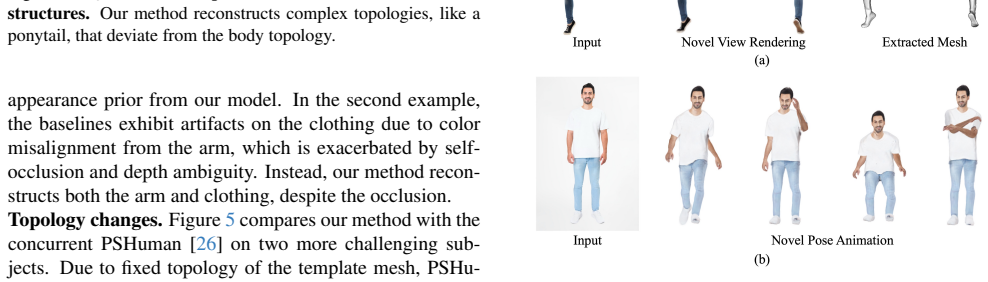
- Reconstructed avatars are animatable immediately: the SMPL-X skeleton and skinning weights let a user apply new poses to the fitted Gaussian avatar without post-processing.
- Self-occluded body parts, such as an arm or hand behind the torso, are completed by the 3D prior instead of being left blurry or broken as in diffusion-only reconstructions.
- Appearance and geometry that deviate from the body template — ponytails, hats, loose clothing — can be represented because Gaussian primitives are not stuck to fixed topology.
- In-the-wild images with challenging poses and clothing should reconstruct more plausibly than previous single-view methods, with fewer artifacts in side and back views.
- If the prior is the active ingredient, further gains should come from improving the diversity and realism of the generative avatar model rather than from generating more or higher-resolution diffusion views.
Reading between the lines
- An immediate testable extension is a systematic public sweep over the number of hallucinated views; the paper's supplementary ablation on view count would reveal how much of the gain is due to the prior versus the extra observations.
- The same inversion-and-diffusion-regularization recipe should transfer to other structured 3D representations, such as heads or hands, whenever a generative model with a canonical feature-space latent code is available.
- Because the fitting procedure optimizes pose photometrically, the method may double as a self-supervised pose refiner for in-the-wild images, independent of the avatar reconstruction task.
- If the bottleneck is latent-space expressiveness, then expanding the 3D training data or latent dimensionality of the generative prior should improve single-image fidelity more than improving the multi-view diffusion model.
Editorial analysis
A structured set of objections, weighed in public.
Referee Report
Summary. The paper proposes MoGA, a framework for reconstructing a 3D Gaussian avatar from a single-view image by fitting a learned generative 3D avatar prior to six synthetic views hallucinated by a pretrained multi-view diffusion model. The generative prior is trained with a single-stage pipeline combining a Gaussian auto-decoder and a latent diffusion model; at test time, model inversion with image-guided initialization, diffusion-based regularization, and photometric pose refinement yields the avatar. Experiments on THuman2.1 and CustomHumans report substantially higher PSNR than SIFU, SiTH, and PSHuman, and ablations show the importance of initialization and the avatar prior. The paper also presents qualitative in-the-wild results and animatable avatars.
Significance. If the reported results are validated, MoGA would demonstrate that a learned 3D generative avatar prior can effectively regularize sparse-view fitting from a monocular image, addressing the 3D-inconsistency and self-occlusion problems that limit current 2D diffusion-based baselines. The method is timely and well-motivated, and the paper includes quantitative comparisons on two public datasets, ablations, and a commitment to release code and models. The main contributions—using a generative 3D prior for initialization, regularization, and pose refinement—are clearly articulated and potentially useful to the community. However, the credibility of the central generalization claim currently rests on two pieces of undisclosed information: the identity-disjointness of the prior training split and the exact evaluation protocol. The paper also repeatedly defers critical details to a supplementary document that is not available in the reviewed version. These issues must be resolved before the results can be taken at face value.
major comments (4)
- [Sec. 3.1.4 and Sec. 4] The paper does not state which dataset is used to train the generative avatar prior in Sec. 3.1.4, nor whether the evaluation identities in Table 1 (THuman2.1 and CustomHumans) are excluded from that training set. Since THuman2 and CustomHumans are the natural sources of 3D human data for such a prior, overlap is plausible. If the prior has seen the test identities, the large PSNR gains in Table 1 (24.09 vs 19.96 on THuman2.1) could reflect memorization rather than generalization to unseen people. The authors must disclose the training split and, if there is any overlap, re-run the evaluation on an identity-disjoint split.
- [Sec. 4.1 and Eq. (8)] The evaluation protocol for Table 1 is unspecified: the paper does not state whether the quantitative metrics are computed on the same six synthetic views used in the fitting objective L'_rend (Eq. 7) or on different, held-out views. If PSNR/SSIM/LPIPS are measured on the views that the method directly optimizes against, the comparison is partly circular and the reported improvements over baselines would be inflated. The authors must specify which views are evaluated and provide the corresponding ground-truth source.
- [Table 1, CustomHuman row] Section 4.1 claims that MoGA 'also demonstrates a clear improvement in geometry,' but in Table 1 on CustomHuman the P2S metric for MoGA (1.4821) is worse than for PSHuman (1.4695), and NC (0.834 vs 0.828) is only marginally better. The geometry improvement is therefore not uniform across metrics. The claim should either be tempered or supported with error bars and statistical significance tests, especially given the small magnitude of the differences.
- [Throughout; Sup. Mat.] The paper repeatedly defers essential technical details—training data split, decoder architecture, deformer skinning, preprocessing for pose estimation, pose optimization details, and robustness ablations—to 'Sup. Mat.' and states that limitations appear in the supplementary. However, no supplementary material accompanies the arXiv version (v3), making these details unverifiable. For a paper whose central claim depends on the training/evaluation setup, the supplement must be provided or the missing information must be incorporated into the main text.
minor comments (5)
- [Abstract] The phrase 'Moncular Gaussian Avatar' contains a typo; it should read 'Monocular Gaussian Avatar.'
- [Figure 1 caption] The word 'genereate' should be 'generate.'
- [Sec. 2.2] The word 'acheive' should be 'achieve.'
- [Sec. 4.1] The paper uses 'THuman2.1' in Table 1 and 'THuman2' in the datasets paragraph; the dataset name should be used consistently throughout.
- [Sec. 3.2.3] The text 'More details of this computation can be found in Sup. Mat.' and similar deferrals would be more helpful to readers if they included a brief statement of the method, since the supplement is not currently accessible.
Circularity Check
No demonstrable circularity: MoGA's per-identity fitting is a genuine model-inversion procedure, and the unstated prior-training/test split is a verification gap rather than a circular reduction.
full rationale
The derivation chain is self-contained and non-circular. The generative avatar prior is trained once (Sec. 3.1.4) with a rendering loss (Eq. 5) and a latent diffusion loss (Eq. 6); at test time the decoder and diffusion weights are frozen and only the per-identity latent code, pose, and camera are optimized (Eqs. 7-9). The Table 1 improvements are therefore not a fitted-parameter-renamed-as-prediction: the latent code for each test identity is obtained by solving Eq. (8) against synthetic views from an external multi-view diffusion model, and the reported PSNR/SSIM/LPIPS are rendered-image metrics, not quantities directly minimized in the loss. The paper's self-citations (e.g., AG3D [11] for the deformer, and its own prior avatar papers in related work) are design choices or background, not load-bearing uniqueness arguments. The one substantive concern is empirical and not visible in the equations: the paper never states whether the generative prior training identities are disjoint from the THuman2.1/CustomHumans test subjects, nor exactly which views are used for the metrics. If the prior were trained on the same identities, Table 1 would overstate generalization; if metrics were computed on the same six synthetic views used in Eq. (7), part of the gain would be expected. These are unverified experimental conditions that should be disclosed, but they are not a circular reduction derivable from the paper's own formulation. The paper also repeatedly defers details to a supplement that is not provided, which further limits verifiability but does not constitute circularity. Under the rule that circularity must be exhibited by quotation and specific reduction, no such step is present here.
Assumptions & free parameters
free parameters (4)
- Loss weights lambda_* in Eqs. (4), (5), (7), (9) =
not reported
- Number of hallucinated views =
6
- Latent code dimensionality and UV resolution =
64x64x32 latent, 256x256x12 UV
- Per-subject latent codes Xi during prior training =
trained per identity
assumptions (4)
- domain assumption SMPL-X template is a sufficient anchor: Gaussians defined as residuals from its UV map can represent clothing and hair outside the template topology.
- domain assumption The frozen latent diffusion model learned in UV feature space is a useful regularizer that can inpaint missing regions and enforce 3D consistency.
- domain assumption The multi-view diffusion model generates six views from one image that contain enough correct information despite being 3D-inconsistent.
- domain assumption Initial SMPL-X and camera parameters from a pose estimator are close enough for alternating photometric pose refinement to succeed.
Cite this review
Pith. "Pith review of MoGA: 3D Generative Avatar Prior for Monocular Gaussian Avatar Reconstruction." pith.science (2026). https://pith.science/paper/OB7J6PTG
@misc{pith2026250723597,
  author       = {Pith},
  title        = {Pith review of: MoGA: 3D Generative Avatar Prior for Monocular Gaussian Avatar Reconstruction},
  year         = {2026},
  howpublished = {\url{https://pith.science/paper/OB7J6PTG}},
  note         = {Machine review of arXiv:2507.23597}
}
read the original abstract
We present MoGA, a novel method to reconstruct high-fidelity 3D Gaussian avatars from a single-view image. The main challenge lies in inferring unseen appearance and geometric details while ensuring 3D consistency and realism. Most previous methods rely on 2D diffusion models to synthesize unseen views; however, these generated views are sparse and inconsistent, resulting in unrealistic 3D artifacts and blurred appearance. To address these limitations, we leverage a generative avatar model, that can generate diverse 3D avatars by sampling deformed Gaussians from a learned prior distribution. Due to limited 3D training data, such a 3D model alone cannot capture all image details of unseen identities. Consequently, we integrate it as a prior, ensuring 3D consistency by projecting input images into its latent space and enforcing additional 3D appearance and geometric constraints. Our novel approach formulates Gaussian avatar creation as model inversion by fitting the generative avatar to synthetic views from 2D diffusion models. The generative avatar provides an initialization for model fitting, enforces 3D regularization, and helps in refining pose. Experiments show that our method surpasses state-of-the-art techniques and generalizes well to real-world scenarios. Our Gaussian avatars are also inherently animatable. For code, see https://zj-dong.github.io/MoGA/.
Figures


Figures from the paper (5 more)




Forward citations
Cited by 1 Pith paper
-
Information-Regularized Constrained Inversion for Stable Avatar Editing from Sparse Supervision
A conditioning-guided constrained inversion method restricts avatar edits to a low-dimensional part-specific subspace and uses an information matrix spectrum from pipeline linearization to predict and ensure stability...
Reference graph
Works this paper leans on
-
[1]
Gaussian shell maps for efficient 3d human generation
Rameen Abdal, Wang Yifan, Zifan Shi, Yinghao Xu, Ryan Po, Zhengfei Kuang, Qifeng Chen, Dit-Yan Yeung, and Gor- don Wetzstein. Gaussian shell maps for efficient 3d human generation. In Proceedings of the IEEE/CVF Conference on Computer Vision and Pattern Recognition , pages 9441– 9451, 2024. 3
work page 2024
-
[2]
Video based reconstruction of 3d people models
Thiemo Alldieck, Marcus Magnor, Weipeng Xu, Christian Theobalt, and Gerard Pons-Moll. Video based reconstruction of 3d people models. InProceedings of the IEEE Conference on Computer Vision and Pattern Recognition , pages 8387– 8397, 2018. 3
work page 2018
-
[3]
Photorealistic monocular 3d reconstruction of humans wear- ing clothing
Thiemo Alldieck, Mihai Zanfir, and Cristian Sminchisescu. Photorealistic monocular 3d reconstruction of humans wear- ing clothing. In Proceedings of the IEEE/CVF Conference on Computer Vision and Pattern Recognition , pages 1506– 1515, 2022. 2
work page 2022
-
[4]
Federica Bogo, Angjoo Kanazawa, Christoph Lassner, Peter Gehler, Javier Romero, and Michael J. Black. Keep it SMPL: Automatic estimation of 3D human pose and shape from a single image. In Computer Vision – ECCV 2016 . Springer International Publishing, 2016. 5
work page 2016
-
[5]
pi-gan: Periodic implicit generative adversarial networks for 3d-aware image synthesis
Eric R Chan, Marco Monteiro, Petr Kellnhofer, Jiajun Wu, and Gordon Wetzstein. pi-gan: Periodic implicit generative adversarial networks for 3d-aware image synthesis. In Pro- ceedings of the IEEE/CVF conference on computer vision and pattern recognition, pages 5799–5809, 2021. 3
2021
-
[6]
Efficient geometry-aware 3d generative adversarial networks
Eric R Chan, Connor Z Lin, Matthew A Chan, Koki Nagano, Boxiao Pan, Shalini De Mello, Orazio Gallo, Leonidas J Guibas, Jonathan Tremblay, Sameh Khamis, et al. Efficient geometry-aware 3d generative adversarial networks. In Pro- ceedings of the IEEE/CVF conference on computer vision and pattern recognition, pages 16123–16133, 2022. 3
2022
-
[7]
Single-stage diffusion nerf: A unified approach to 3d generation and reconstruction
Hansheng Chen, Jiatao Gu, Anpei Chen, Wei Tian, Zhuowen Tu, Lingjie Liu, and Hao Su. Single-stage diffusion nerf: A unified approach to 3d generation and reconstruction. In Proceedings of the IEEE/CVF international conference on computer vision, pages 2416–2425, 2023. 2, 3, 5
work page 2023
-
[8]
Gener- alizable human gaussians from single-view image
Jinnan Chen, Chen Li, Jianfeng Zhang, Lingting Zhu, Buzhen Huang, Hanlin Chen, and Gim Hee Lee. Gener- alizable human gaussians from single-view image. arXiv preprint arXiv:2406.06050, 2024. 2, 3
arXiv 2024
Show all 62 references
-
[9]
Primdiffusion: V olumet- ric primitives diffusion for 3d human generation
Zhaoxi Chen, Fangzhou Hong, Haiyi Mei, Guangcong Wang, Lei Yang, and Ziwei Liu. Primdiffusion: V olumet- ric primitives diffusion for 3d human generation. Advances in Neural Information Processing Systems, 36:13664–13677,
-
[10]
Pina: Learning a personalized implicit neural avatar from a single rgb-d video sequence
Zijian Dong, Chen Guo, Jie Song, Xu Chen, Andreas Geiger, and Otmar Hilliges. Pina: Learning a personalized implicit neural avatar from a single rgb-d video sequence. In Pro- ceedings of the IEEE/CVF Conference on Computer Vision and Pattern Recognition, pages 20470–20480, 2022. 3
2022
-
[11]
Ag3d: Learning to gener- ate 3d avatars from 2d image collections
Zijian Dong, Xu Chen, Jinlong Yang, Michael J Black, Ot- mar Hilliges, and Andreas Geiger. Ag3d: Learning to gener- ate 3d avatars from 2d image collections. In Proceedings of the IEEE/CVF international conference on computer vision, pages 14916–14927, 2023. 2, 3, 4
2023
-
[12]
Vid2avatar: 3d avatar reconstruction from videos in the wild via self-supervised scene decomposition
Chen Guo, Tianjian Jiang, Xu Chen, Jie Song, and Otmar Hilliges. Vid2avatar: 3d avatar reconstruction from videos in the wild via self-supervised scene decomposition. In Pro- ceedings of the IEEE/CVF Conference on Computer Vision and Pattern Recognition, pages 12858–12868, 2023. 3
2023
-
[13]
Learn- ing locally editable virtual humans
Hsuan-I Ho, Lixin Xue, Jie Song, and Otmar Hilliges. Learn- ing locally editable virtual humans. In Proceedings of the IEEE/CVF Conference on Computer Vision and Pattern Recognition, pages 21024–21035, 2023. 6
2023
-
[14]
Sith: Single-view tex- tured human reconstruction with image-conditioned diffu- sion
I Ho, Jie Song, Otmar Hilliges, et al. Sith: Single-view tex- tured human reconstruction with image-conditioned diffu- sion. In Proceedings of the IEEE/CVF Conference on Com- puter Vision and Pattern Recognition, pages 538–549, 2024. 1, 2, 6, 8
2024
-
[15]
Denoising dif- fusion probabilistic models
Jonathan Ho, Ajay Jain, and Pieter Abbeel. Denoising dif- fusion probabilistic models. Advances in neural information processing systems, 33:6840–6851, 2020. 3
2020
-
[16]
Eva3d: Compositional 3d human generation from 2d image collections
Fangzhou Hong, Zhaoxi Chen, Yushi Lan, Liang Pan, and Ziwei Liu. Eva3d: Compositional 3d human generation from 2d image collections. arXiv preprint arXiv:2210.04888 ,
-
[17]
Gaussianavatar: Towards realistic human avatar modeling from a single video via animatable 3d gaussians
Liangxiao Hu, Hongwen Zhang, Yuxiang Zhang, Boyao Zhou, Boning Liu, Shengping Zhang, and Liqiang Nie. Gaussianavatar: Towards realistic human avatar modeling from a single video via animatable 3d gaussians. In Pro- ceedings of the IEEE/CVF conference on computer vision and pat...
2024
-
[18]
Structldm: Struc- tured latent diffusion for 3d human generation
Tao Hu, Fangzhou Hong, and Ziwei Liu. Structldm: Struc- tured latent diffusion for 3d human generation. arXiv preprint arXiv:2404.01241, 2024. 3
2024 arXiv
-
[19]
2d gaussian splatting for geometrically ac- curate radiance fields
Binbin Huang, Zehao Yu, Anpei Chen, Andreas Geiger, and Shenghua Gao. 2d gaussian splatting for geometrically ac- curate radiance fields. In ACM SIGGRAPH 2024 Conference Papers, pages 1–11, 2024. 2, 3, 4, 5
2024
-
[20]
Tech: Text-guided reconstruction of lifelike clothed humans
Yangyi Huang, Hongwei Yi, Yuliang Xiu, Tingting Liao, Ji- axiang Tang, Deng Cai, and Justus Thies. Tech: Text-guided reconstruction of lifelike clothed humans. In 2024 Interna- tional Conference on 3D Vision (3DV) , pages 1531–1542. IEEE, 2024. 2
2024
-
[21]
In- stantavatar: Learning avatars from monocular video in 60 seconds
Tianjian Jiang, Xu Chen, Jie Song, and Otmar Hilliges. In- stantavatar: Learning avatars from monocular video in 60 seconds. 2023. 3
2023
-
[22]
Panoptic studio: A massively multiview system for social motion capture
Hanbyul Joo, Hao Liu, Lei Tan, Lin Gui, Bart Nabbe, Iain Matthews, Takeo Kanade, Shohei Nobuhara, and Yaser Sheikh. Panoptic studio: A massively multiview system for social motion capture. In Proceedings of the IEEE inter- national conference on computer vision , pages 3334–3342,
-
[23]
Pippo: High-resolution multi-view humans from a single image
Yash Kant, Ethan Weber, Jin Kyu Kim, Rawal Khirod- kar, Su Zhaoen, Julieta Martinez, Igor Gilitschenski, Shun- suke Saito, and Timur Bagautdinov. Pippo: High-resolution multi-view humans from a single image. arXiv preprint arXiv:2502.07785, 2025. 1
2025 arXiv
-
[24]
3d gaussian splatting for real-time radiance field rendering
Bernhard Kerbl, Georgios Kopanas, Thomas Leimk ¨uhler, and George Drettakis. 3d gaussian splatting for real-time radiance field rendering. ACM Trans. Graph., 42(4):139–1,
-
[25]
Gghead: Fast and generalizable 3d gaussian heads
Tobias Kirschstein, Simon Giebenhain, Jiapeng Tang, Markos Georgopoulos, and Matthias Nießner. Gghead: Fast and generalizable 3d gaussian heads. In SIGGRAPH Asia 2024 Conference Papers, pages 1–11, 2024. 3
2024
-
[26]
Pshuman: Photorealistic single-view human reconstruction using cross-scale diffusion
Peng Li, Wangguandong Zheng, Yuan Liu, Tao Yu, Yang- guang Li, Xingqun Qi, Mengfei Li, Xiaowei Chi, Siyu Xia, Wei Xue, et al. Pshuman: Photorealistic single-view human reconstruction using cross-scale diffusion. arXiv preprint arXiv:2409.10141, 2024. 1, 2, 5, 6, 7, 8
2024 arXiv
-
[27]
One-2-3-45: Any single image to 3d mesh in 45 seconds without per-shape optimiza- tion
Minghua Liu, Chao Xu, Haian Jin, Linghao Chen, Mukund Varma T, Zexiang Xu, and Hao Su. One-2-3-45: Any single image to 3d mesh in 45 seconds without per-shape optimiza- tion. Advances in Neural Information Processing Systems , 36:22226–22246, 2023. 2
2023
-
[28]
Zero-1-to- 3: Zero-shot one image to 3d object
Ruoshi Liu, Rundi Wu, Basile Van Hoorick, Pavel Tok- makov, Sergey Zakharov, and Carl V ondrick. Zero-1-to- 3: Zero-shot one image to 3d object. In Proceedings of the IEEE/CVF international conference on computer vision, pages 9298–9309, 2023. 2
2023
-
[29]
Smpl: A skinned multi- person linear model
Matthew Loper, Naureen Mahmood, Javier Romero, Gerard Pons-Moll, and Michael J Black. Smpl: A skinned multi- person linear model. In Seminal Graphics Papers: Pushing the Boundaries, Volume 2, pages 851–866. 2023. 2, 3
2023
-
[30]
Avatarpose: Avatar-guided 3d pose estimation of close hu- man interaction from sparse multi-view videos
Feichi Lu, Zijian Dong, Jie Song, and Otmar Hilliges. Avatarpose: Avatar-guided 3d pose estimation of close hu- man interaction from sparse multi-view videos. In European Conference on Computer Vision , pages 215–233. Springer,
-
[31]
Expressive whole-body 3d gaussian avatar
Gyeongsik Moon, Takaaki Shiratori, and Shunsuke Saito. Expressive whole-body 3d gaussian avatar. In European Conference on Computer Vision , pages 19–35. Springer,
-
[32]
Unsupervised learning of efficient geometry-aware neural articulated representations
Atsuhiro Noguchi, Xiao Sun, Stephen Lin, and Tatsuya Harada. Unsupervised learning of efficient geometry-aware neural articulated representations. In European Conference on Computer Vision, pages 597–614. Springer, 2022. 3
2022
-
[33]
Humansplat: Generalizable single-image human gaus- sian splatting with structure priors
Panwang Pan, Zhuo Su, Chenguo Lin, Zhen Fan, Yongjie Zhang, Zeming Li, Tingting Shen, Yadong Mu, and Yebin Liu. Humansplat: Generalizable single-image human gaus- sian splatting with structure priors. Advances in Neural In- formation Processing Systems, 37:74383–74410, 2025. 3
2025
-
[34]
Expressive body capture: 3d hands, face, and body from a single image
Georgios Pavlakos, Vasileios Choutas, Nima Ghorbani, Timo Bolkart, Ahmed AA Osman, Dimitrios Tzionas, and Michael J Black. Expressive body capture: 3d hands, face, and body from a single image. In Proceedings of the IEEE/CVF conference on computer vision and pattern recognitio...
2019
-
[35]
Expressive body capture: 3D hands, face, and body from a single image
Georgios Pavlakos, Vasileios Choutas, Nima Ghorbani, Timo Bolkart, Ahmed AA Osman, Dimitrios Tzionas, and Michael J Black. Expressive body capture: 3D hands, face, and body from a single image. In Proceedings of the IEEE/CVF conference on computer vision and pattern recognitio...
2019
-
[36]
Neural body: Implicit neural representations with structured latent codes for novel view synthesis of dynamic humans
Sida Peng, Yuanqing Zhang, Yinghao Xu, Qianqian Wang, Qing Shuai, Hujun Bao, and Xiaowei Zhou. Neural body: Implicit neural representations with structured latent codes for novel view synthesis of dynamic humans. InProceedings of the IEEE/CVF conference on computer vision and ...
2021
-
[37]
Dreamfusion: Text-to-3d using 2d diffusion
Ben Poole, Ajay Jain, Jonathan T Barron, and Ben Milden- hall. Dreamfusion: Text-to-3d using 2d diffusion. arXiv preprint arXiv:2209.14988, 2022. 2, 5
2022 arXiv
-
[38]
Magic123: One image to high-quality 3d object generation using both 2d and 3d diffusion priors.arXiv preprint arXiv:2306.17843,
Guocheng Qian, Jinjie Mai, Abdullah Hamdi, Jian Ren, Aliaksandr Siarohin, Bing Li, Hsin-Ying Lee, Ivan Sko- rokhodov, Peter Wonka, Sergey Tulyakov, et al. Magic123: One image to high-quality 3d object generation using both 2d and 3d diffusion priors.arXiv preprint arXiv:2306.17843,
-
[39]
3dgs-avatar: Animatable avatars via deformable 3d gaussian splatting
Zhiyin Qian, Shaofei Wang, Marko Mihajlovic, Andreas Geiger, and Siyu Tang. 3dgs-avatar: Animatable avatars via deformable 3d gaussian splatting. In Proceedings of the IEEE/CVF conference on computer vision and pattern recognition, pages 5020–5030, 2024. 3
2024
-
[40]
High-resolution image synthesis with latent diffusion models
Robin Rombach, Andreas Blattmann, Dominik Lorenz, Patrick Esser, and Bj ¨orn Ommer. High-resolution image synthesis with latent diffusion models. In Proceedings of the IEEE/CVF conference on computer vision and pattern recognition, pages 10684–10695, 2022. 5
2022
-
[41]
Pifu: Pixel-aligned implicit function for high-resolution clothed human digitiza- tion
Shunsuke Saito, Zeng Huang, Ryota Natsume, Shigeo Mor- ishima, Angjoo Kanazawa, and Hao Li. Pifu: Pixel-aligned implicit function for high-resolution clothed human digitiza- tion. In Proceedings of the IEEE/CVF international confer- ence on computer vision, pages 2304–2314, 2019. 1, 2
2019
-
[42]
Pifuhd: Multi-level pixel-aligned implicit function for high-resolution 3d human digitization
Shunsuke Saito, Tomas Simon, Jason Saragih, and Hanbyul Joo. Pifuhd: Multi-level pixel-aligned implicit function for high-resolution 3d human digitization. In Proceedings of the IEEE/CVF conference on computer vision and pattern recognition, pages 84–93, 2020. 1, 2
2020
-
[43]
Relightable gaussian codec avatars
Shunsuke Saito, Gabriel Schwartz, Tomas Simon, Junxuan Li, and Giljoo Nam. Relightable gaussian codec avatars. In Proceedings of the IEEE/CVF conference on computer vi- sion and pattern recognition, pages 130–141, 2024. 3
2024
-
[44]
Graf: Generative radiance fields for 3d-aware im- age synthesis
Katja Schwarz, Yiyi Liao, Michael Niemeyer, and Andreas Geiger. Graf: Generative radiance fields for 3d-aware im- age synthesis. Advances in Neural Information Processing Systems, 33:20154–20166, 2020. 3
2020
-
[45]
X- avatar: Expressive human avatars
Kaiyue Shen, Chen Guo, Manuel Kaufmann, Juan Jose Zarate, Julien Valentin, Jie Song, and Otmar Hilliges. X- avatar: Expressive human avatars. In Proceedings of the IEEE/CVF Conference on Computer Vision and Pattern Recognition, pages 16911–16921, 2023. 5
2023
-
[46]
3d neural field generation using triplane diffusion
J Ryan Shue, Eric Ryan Chan, Ryan Po, Zachary Ankner, Jiajun Wu, and Gordon Wetzstein. 3d neural field generation using triplane diffusion. In Proceedings of the IEEE/CVF Conference on Computer Vision and Pattern Recognition , pages 20875–20886, 2023. 3, 5
2023
-
[47]
Very deep convo- lutional networks for large-scale image recognition
Karen Simonyan and Andrew Zisserman. Very deep convo- lutional networks for large-scale image recognition. arXiv preprint arXiv:1409.1556, 2014. 5
2014 arXiv
-
[48]
Score-based generative modeling through stochastic differential equa- tions
Yang Song, Jascha Sohl-Dickstein, Diederik P Kingma, Ab- hishek Kumar, Stefano Ermon, and Ben Poole. Score-based generative modeling through stochastic differential equa- tions. arXiv preprint arXiv:2011.13456, 2020. 3
2011 arXiv
-
[49]
Human as points: Explicit point-based 3d human recon- struction from single-view rgb images
Yingzhi Tang, Qijian Zhang, Junhui Hou, and Yebin Liu. Human as points: Explicit point-based 3d human recon- struction from single-view rgb images. arXiv preprint arXiv:2311.02892, 2023. 3
2023 arXiv
-
[50]
Rodin: A generative model for sculpting 3d digital avatars using diffusion
Tengfei Wang, Bo Zhang, Ting Zhang, Shuyang Gu, Jianmin Bao, Tadas Baltrusaitis, Jingjing Shen, Dong Chen, Fang Wen, Qifeng Chen, et al. Rodin: A generative model for sculpting 3d digital avatars using diffusion. In Proceedings of the IEEE/CVF conference on computer vision and...
2023
-
[51]
Hu- mannerf: Free-viewpoint rendering of moving people from monocular video
Chung-Yi Weng, Brian Curless, Pratul P Srinivasan, Jonathan T Barron, and Ira Kemelmacher-Shlizerman. Hu- mannerf: Free-viewpoint rendering of moving people from monocular video. In Proceedings of the IEEE/CVF con- ference on computer vision and pattern Recognition , pages 162...
2022
-
[52]
Icon: Implicit clothed humans obtained from nor- mals
Yuliang Xiu, Jinlong Yang, Dimitrios Tzionas, and Michael J Black. Icon: Implicit clothed humans obtained from nor- mals. In 2022 IEEE/CVF Conference on Computer Vi- sion and Pattern Recognition (CVPR), pages 13286–13296. IEEE, 2022. 1, 2
2022
-
[53]
Human 3diffusion: Realistic avatar creation via explicit 3d consistent diffusion models
Yuxuan Xue, Xianghui Xie, Riccardo Marin, and Gerard Pons-Moll. Human 3diffusion: Realistic avatar creation via explicit 3d consistent diffusion models. arXiv preprint arXiv:2406.08475, 2024. 1, 2
2024 arXiv
-
[54]
Pons-Moll
Yuxuan Xue, Xianghui Xie, Riccardo Marin, and Gerard. Pons-Moll. Human 3Diffusion: Realistic Avatar Creation via Explicit 3D Consistent Diffusion Models. 2024. 6
2024
-
[55]
Function4d: Real-time human vol- umetric capture from very sparse consumer rgbd sensors
Tao Yu, Zerong Zheng, Kaiwen Guo, Pengpeng Liu, Qiong- hai Dai, and Yebin Liu. Function4d: Real-time human vol- umetric capture from very sparse consumer rgbd sensors. In IEEE Conference on Computer Vision and Pattern Recogni- tion (CVPR2021), 2021. 6
2021
-
[56]
Gavatar: Animatable 3d gaussian avatars with implicit mesh learning
Ye Yuan, Xueting Li, Yangyi Huang, Shalini De Mello, Koki Nagano, Jan Kautz, and Umar Iqbal. Gavatar: Animatable 3d gaussian avatars with implicit mesh learning. InProceed- ings of the IEEE/CVF Conference on Computer Vision and Pattern Recognition, pages 896–905, 2024. 3
2024
-
[57]
Rodinhd: High-fidelity 3d avatar generation with diffusion models
Bowen Zhang, Yiji Cheng, Chunyu Wang, Ting Zhang, Jiao- long Yang, Yansong Tang, Feng Zhao, Dong Chen, and Bain- ing Guo. Rodinhd: High-fidelity 3d avatar generation with diffusion models. In European Conference on Computer Vi- sion, pages 465–483. Springer, 2024. 3
2024
-
[58]
e3gen: Efficient, expressive and ed- itable avatars generation
Weitian Zhang, Yichao Yan, Yunhui Liu, Xingdong Sheng, and Xiaokang Yang. e3gen: Efficient, expressive and ed- itable avatars generation. arXiv preprint arXiv:2405.19203,
-
[59]
Sifu: Side-view conditioned implicit function for real-world us- able clothed human reconstruction
Zechuan Zhang, Zongxin Yang, and Yi Yang. Sifu: Side-view conditioned implicit function for real-world us- able clothed human reconstruction. In Proceedings of the IEEE/CVF Conference on Computer Vision and Pattern Recognition, pages 9936–9947, 2024. 1, 2, 6, 7, 8
2024
-
[60]
Chase: 3d-consistent human avatars with sparse inputs via gaus- sian splatting and contrastive learning
Haoyu Zhao, Hao Wang, Chen Yang, and Wei Shen. Chase: 3d-consistent human avatars with sparse inputs via gaus- sian splatting and contrastive learning. arXiv preprint arXiv:2408.09663, 2024. 3
2024 arXiv
-
[61]
Gps- gaussian: Generalizable pixel-wise 3d gaussian splatting for real-time human novel view synthesis
Shunyuan Zheng, Boyao Zhou, Ruizhi Shao, Boning Liu, Shengping Zhang, Liqiang Nie, and Yebin Liu. Gps- gaussian: Generalizable pixel-wise 3d gaussian splatting for real-time human novel view synthesis. In Proceedings of the IEEE/CVF conference on computer vision and pattern re...
2024
-
[62]
Pointavatar: Deformable point-based head avatars from videos
Yufeng Zheng, Wang Yifan, Gordon Wetzstein, Michael J Black, and Otmar Hilliges. Pointavatar: Deformable point-based head avatars from videos. In Proceedings of the IEEE/CVF conference on computer vision and pattern recognition, pages 21057–21067, 2023. 3
2023
Reviewed August 6, 2026 · model on record in the stance chip above.
Discussion (0). Sign in to comment.