REVIEW 3 major objections 4 minor 1 cited by
Adiabatic Spin and Orbital Pumping in Metallic Heterostructures
T0 review · 3 major / 4 minor · reviewed 2026-08-12 · deepseek-v4-flash
Pith's one-line read Orbital pumping into a normal metal is governed by d states at the Fermi level and by spin-orbit coupling, according to first-principles adiabatic pumping calculations.
desk verdict New ab initio orbital-pumping map with a robust d-state rule, but the quantitative injector ranking is provisional because spin-orbit relaxation is omitted. read the letter →
The pith
A machine-rendered reading of the paper's core claim, the machinery that carries it, and where it could break.
The reading
What carries the argument
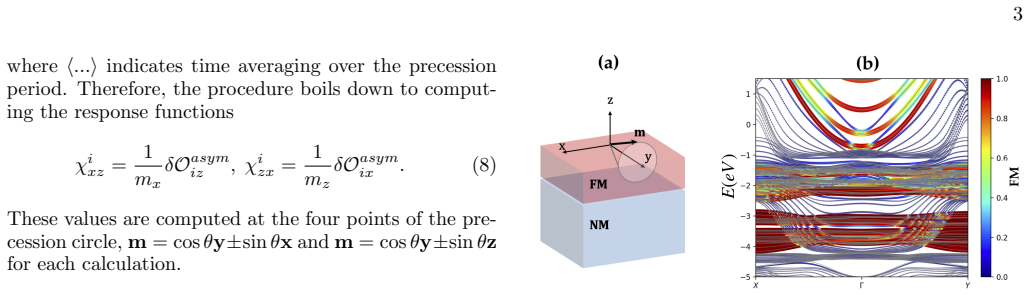
The machinery is the adiabatic pumping response tensor derived from the Keldysh formalism with Wigner expansion: for an observable $O_i$ and the torque operator $T_j = -\partial_{m_j}H$, the pumped density is $\delta O_{ij} = \sum_{n \neq m} \Im\{ \langle u_{mk}|O_i|u_{nk}\rangle \langle u_{nk}|T_j|u_{mk}\rangle\} G(\varepsilon_{nk},\varepsilon_{mk},\Gamma)$, with $G$ a known function of the band energies and the homogeneous broadening $\Gamma$. The argument rests on evaluating this formula on first-principles band structures of FM/NM slabs. This object carries the claim because it directly produces the spatial profile of pumped spin and orbital densities, and it makes explicit that the orbital response requires spin-orbit coupling to enter through the torque and orbital operators. The second key ingredient is the comparison of band character at the Fermi level between the normal metals, which the authors use to rationalize why orbital injection selectively survives in Ti, W, and Pt.
What would settle it
Measure the orbital-pumping-generated charge current (using the inverse orbital Hall effect) in Ni/Cu and Ni/Ti bilayers as a function of normal-metal thickness. If orbital injection into Cu does not decay far faster than into Ti, or if a diffusive transport calculation that includes spin-orbit-mediated relaxation changes the predicted ordering of injectors, the claimed $d$-state control of orbital pumping is falsified.
Extended reading notes
Core claim
The central discovery is that adiabatic spin pumping in a ferromagnet is inevitably accompanied by orbital pumping once spin-orbit coupling is included, and that the magnitude and penetration depth of the pumped orbital density in the normal metal are governed by two factors: the availability of $d$-like states at the Fermi level of the normal metal and the strength of spin-orbit coupling. In a model bilayer, the pumped orbital density vanishes without spin-orbit coupling and becomes comparable to the spin density when spin-orbit coupling is turned on in both layers. In realistic Fe, Co, and Ni bilayers with Ti, Cu, W, Pt, and Au, the first-principles calculations show that orbital injection is long-ranged into Ti, W, and Pt, but nearly absent into Cu and Au even though spin injection into Au is sizable. The paper attributes this to the orbital character of the Fermi states in the normal metal: without $d$ states at the Fermi energy, there is nothing for the orbital moment to couple to. It also finds that Ni-based bilayers are stronger spin and orbital sources than Fe-based ones, and proposes that the reported orbital-pumping signal in Ni/Ti may instead be explained by efficient spin pumping followed by spin-charge conversion in Ti.
Load-bearing premise
The predicted ranking of metals depends on the assumption that the availability of $d$ states at the Fermi level controls orbital injection more than the spin-orbit-mediated relaxation that the calculations omit, since disorder is treated only as a constant energy broadening and vertex corrections are disregarded.
Editorial extensions
If this is right
- Ni/Pt and Ni/W bilayers should show orbital-pumping signals comparable to their spin-pumping signals, making them prime candidates for orbital-torque experiments.
- In normal metals with filled $d$ shells (Cu, Au), orbital pumping is predicted to be strongly suppressed, so charge signals in such bilayers more likely come from spin-charge conversion rather than direct orbital injection.
- The decay length of the pumped orbital density is controlled by the presence of Fermi-level $d$ states, giving material designers a lever: choose a normal metal with $d$ states for long orbital penetration.
- The interfacial Rashba effect locally enhances the orbital density at the FM/NM interface, so interface engineering can add an orbital-pumping contribution on top of the bulk effect.
Reading between the lines
- Beyond the paper: comparing the thickness dependence of the orbital contribution in Ni/Ti versus Ni/Cu would directly test the predicted $d$-state control of penetration depth.
- Beyond the paper: because the calculations omit spin-orbit-mediated relaxation in the normal metal, including vertex corrections or diffusive disorder could reorder the injector ranking, especially for Pt and W where spin-orbit scattering is strong.
- Beyond the paper: the same adiabatic pumping response could be evaluated for other orbital-carrying excitations, such as phonon-driven pumping, by replacing the torque operator with the electron-phonon coupling, an extension the formalism already allows.
- Beyond the paper: the alternative explanation offered for the Ni/Ti experiment (spin pumping and subsequent spin-charge conversion) could be discriminated by measuring the sign of the inverse conversion signal as a function of Ti thickness.
Editorial analysis
A structured set of objections, weighed in public.
Referee Report
Summary. The manuscript studies DC spin and orbital pumping in ferromagnet/nonmagnet (FM/NM) bilayers using a Keldysh adiabatic-pumping formalism combined with first-principles tight-binding Hamiltonians extracted from DFT. After benchmarking on a model p-d bilayer, the authors compute current-driven and pumping-driven spin and orbital densities in Fe/NM, Co/NM, and Ni/NM heterostructures with NM = Ti, Cu, W, Pt, Au. The main claims are that orbital pumping is favored when d states are present near the Fermi level of the NM (as in Ti, Pt, W) and quenched when the Fermi electrons are mostly s-like (Cu, Au), and that strong spin-orbit coupling in the NM enhances orbital injection, leading to particularly large orbital pumping in Ni/(Pt,W). The paper also offers an alternative explanation of the Hayashi et al. experiment on Ni/Ti, based on large spin pumping in Ni/Ti rather than orbital-to-charge conversion in Ti.
Significance. If the central claims hold, the paper provides useful material-selection rules for orbital pumping experiments and clarifies that orbital injection into a nonmagnetic metal is governed by the availability of d states at the Fermi level and by interfacial spin-orbit coupling. The chemical-potential scan in Ni/Cu (Fig. 6) is a particularly direct and falsifiable test of the proposed d-state mechanism, and the comparison of spin versus orbital density profiles across several realistic interfaces goes beyond earlier bulk-only studies. The authors are also explicit about the main limitations of their approach, stating that self-consistent vertex corrections are disregarded and that the scalar broadening does not describe diffusive transport. These strengths give the qualitative picture considerable interest, but they also imply that the quantitative material ranking is less secure than the abstract suggests.
major comments (3)
- [Sec. II.B and Sec. V, Eqs. (3)-(5); Figs. 3(d), 5(d), 7] The quantitative ranking of injectors, especially the prediction of large orbital pumping in Ni/(Pt,W), is load-bearing on omitted relaxation processes. The calculation treats disorder only through a homogeneous broadening Γ and explicitly disregards self-consistent vertex corrections; as the authors state in Sec. V, this does not properly describe diffusive transport and 'can massively impact spin and orbital pumping.' Since Pt and W have the strongest spin-orbit coupling among the studied metals, they are also expected to have the strongest spin-orbit-mediated spin and orbital relaxation. The long decay lengths reported in Figs. 3(d) and 5(d), and the ordering of materials in Fig. 7, could therefore change substantially once such relaxation is included. I request that the authors either include vertex corrections or a diffusive-transport treatment, or explicitly restrict the central claims to the qualitative d-state-availability rule and present the Pt/W ranking only as indicative. This point must be addressed before the quantitative material-selection conclusions can be accepted.
- [Sec. IV, Figs. 3, 5, 7] The value of the energy broadening Γ is never stated for the first-principles calculations, although every density profile, decay length, and relative magnitude in Figs. 3, 5, and 7 depends on it. The authors should state the value of Γ used, justify it, and show that the qualitative conclusions (and, to the extent claimed, the quantitative ordering) are robust to a reasonable range of Γ. Without this information, the comparison of decay lengths across materials is not fully reproducible.
- [Sec. IV.B and Fig. 6] The d-state-availability rule is demonstrated most directly by the chemical-potential scan in Ni/Cu (Fig. 6), but for the other interfaces the evidence is mainly the projected band structures of Fe/Cu and Fe/Pt (Figs. 4(a,b,d,e)). To support the claim that the same mechanism explains the ranking of Ti, W, Pt, Au, and Cu, a more quantitative measure of d-orbital character at the Fermi level for each NM layer would be helpful, or at least projected band structures for the other interfaces. This is not a fatal flaw, but it would strengthen the link between the proposed mechanism and the material ordering.
minor comments (4)
- [Sec. II.B] There is a typo: 'impury scattering' should read 'impurity scattering.'
- [Sec. III heading] The heading 'ORBIT AL PUMPING IN A MODEL BILAYER' contains an unintended space in 'ORBIT AL.'
- [Sec. III.B] In the discussion of Figs. 2(b) and (d), the text refers to 'orbital density in Fig. 2(c)' where it presumably means Fig. 2(d), since the orbital density with t_FM = t_NM/3 is shown in panel (d).
- [Sec. IV.A and elsewhere] The text uses inconsistent notations such as 'V ASP' (missing space) and 'hExt sy' / 'hExt ly' for current-driven densities. Please unify the notation and provide a brief definition of the symbols used in Eqs. (12) and (13).
Circularity Check
No significant circularity: the material trends are obtained from first-principles DFT calculations, not from fitting or from a self-citation chain.
full rationale
The paper's central claims—that orbital pumping is favored in metals with d states near the Fermi level and that Ni/(Pt,W) gives large orbital pumping—are outputs of numerical simulations using a Keldysh/Wigner adiabatic-pumping formalism. The formalism is attributed to Ref. 40, which shares two authors with the present paper, but this is a method citation rather than a load-bearing import of the target result: the key equations (1)-(8) are restated and used to compute densities from DFT Hamiltonians, with no parameter fitted to the target data. The d-state rule is independently probed by a chemical-potential scan in Ni/Cu (Fig. 6), which is an internal falsifiable check, not an assumed conclusion. The comparison to Ref. 35 is used only as qualitative agreement, not as the basis of the claim. The paper explicitly discloses that self-consistent vertex corrections are disregarded (Sec. II.B) and that the disorder model does not properly describe diffusive transport and can massively impact spin and orbital pumping (Sec. V); these are limitations on quantitative predictive power, not evidence of circularity. No equation reduces by construction to its own input, and no fitted parameter is renamed as a prediction. Therefore no circular step is identified.
Assumptions & free parameters
free parameters (5)
- Energy broadening Gamma (impurity scattering) =
not reported
- Model hopping integral t =
0.5 (or tFM = tNM/3 in Fig. 2(b,d))
- Model exchange splitting Delta =
0.25t
- Model spin-orbit coupling strength lambda =
0 or 0.15t (lambda_FM and lambda_NM)
- Model onsite energy =
-1.5t
assumptions (4)
- domain assumption Keldysh adiabatic pumping formalism, including Eqs. (1)-(2) and the Wigner expansion, is valid for slow magnetization dynamics.
- domain assumption The pumped observable is the local spin/orbital density (not current) projected on layers.
- domain assumption Vertex corrections can be neglected and disorder is represented by a homogeneous broadening Gamma.
- domain assumption DFT with PBE, PAW, and NM-fixed lattice constants provides realistic band structures for the bilayers.
Cite this review
Pith. "Pith review of Adiabatic Spin and Orbital Pumping in Metallic Heterostructures." pith.science (2026). https://pith.science/paper/OBGBT6OB
@misc{pith2026241113319,
  author       = {Pith},
  title        = {Pith review of: Adiabatic Spin and Orbital Pumping in Metallic Heterostructures},
  year         = {2026},
  howpublished = {\url{https://pith.science/paper/OBGBT6OB}},
  note         = {Machine review of arXiv:2411.13319}
}
abstract
In this study, we investigate the spin and orbital densities induced by magnetization dynamics in a planar bilayer heterostructure. To do this, we employed a theory of adiabatic pumping using the Keldysh formalism and Wigner expansion. We first conduct simulations on a model system to determine the parameters that control the spin and orbital pumping into an adjacent non-magnetic metal. We conclude that, in principle, the orbital pumping can be as significant as spin pumping when the spin-orbit coupling is present in the ferromagnet. We extend the study to realistic heterostructures involving heavy metals (W, Pt, Au) and light metals (Ti, Cu) by using first-principles calculations. We demonstrate that orbital pumping is favored in metals with $d$ states close to the Fermi level, such as Ti, Pt, and W, but is quenched in materials lacking such states, such as Cu and Au. Orbital injection is also favored in materials with strong spin-orbit coupling, leading to large orbital pumping in Ni/(Pt, W) bilayers.
Figures


Figures from the paper (4 more)


Forward citations
Cited by 1 Pith paper
-
Phenomenology of orbital torque, pumping and mixing conductance in metallic bilayers
A drift-diffusion model predicts that orbital torque in metallic bilayers scales with the product of orbital injection, orbit-to-spin conversion, and spin backflow efficiencies.
Reference graph
Works this paper leans on
-
[1]
author author F. J. \ Jedema , author A. Filip , \ and\ author B. J. \ van Wees ,\ 10.1038/35066533 journal journal Nature \ volume 410 ,\ pages 345 ( year 2001 ) NoStop
doi:10.1038/35066533 2001
-
[2]
author author A. Brataas , author A. D. \ Kent , \ and\ author H. Ohno ,\ 10.1038/nmat3311 journal journal Nature Materials \ volume 11 ,\ pages 372 ( year 2012 ) NoStop
doi:10.1038/nmat3311 2012
-
[3]
author author J. Sinova , author S. O. \ Valenzuela , author J. Wunderlich , author C. H. \ Back , \ and\ author T. Jungwirth ,\ @noop journal journal Review of Modern Physics \ volume 87 ,\ pages 1213 ( year 2015 ) NoStop
work page 2015
-
[4]
author author A. Manchon , author H. C. \ Koo , author J. Nitta , author S. M. \ Frolov , \ and\ author R. A. \ Duine ,\ 10.1038/nmat4360 journal journal Nature Materials \ volume 14 ,\ pages 871 ( year 2015 ) NoStop
doi:10.1038/nmat4360 2015
-
[5]
author author A. Brataas , author Y. Tserkovnyak , author G. E. W. \ Bauer , \ and\ author B. Halperin ,\ 10.1103/PhysRevB.66.060404 journal journal Physical Review B \ volume 66 ,\ pages 060404 ( year 2002 ) NoStop
-
[6]
author author Y. Tserkovnyak , author A. Brataas , \ and\ author G. E. W. \ Bauer ,\ 10.1103/PhysRevLett.88.117601 journal journal Physical Review Letters \ volume 88 ,\ pages 117601 ( year 2002 a ) NoStop
-
[7]
author author Y. Tserkovnyak , author A. Brataas , \ and\ author G. E. W. \ Bauer ,\ 10.1103/PhysRevB.66.224403 journal journal Physical Review B \ volume 66 ,\ pages 224403 ( year 2002 b ) NoStop
-
[8]
author author S. Mizukami , author Y. Ando , \ and\ author T. Miyazaki ,\ 10.1103/PhysRevB.66.104413 journal journal Phys. Rev. B \ volume 66 ,\ pages 104413 ( year 2002 ) NoStop
Show all 53 references
-
[9]
Azevedo , author L
author author A. Azevedo , author L. H. V. \ Leao , author R. L. \ Rodriguez-Suarez , author A. B. \ Oliveira , \ and\ author S. M. \ Rezende ,\ 10.1063/1.1855251 journal journal Journal of Applied Physics \ volume 97 ,\ pages 10C715 ( year 2005 ) NoStop
-
[10]
Saitoh , author M
author author E. Saitoh , author M. Ueda , author H. Miyajima , \ and\ author G. Tatara ,\ 10.1063/1.2199473 journal journal Applied Physics Letters \ volume 88 ,\ pages 182509 ( year 2006 ) NoStop
2006 doi
-
[11]
author author C. W. \ Sandweg , author Y. Kajiwara , author a. V. \ Chumak , author a. a. \ Serga , author V. I. \ Vasyuchka , author M. B. \ Jungfleisch , author E. Saitoh , \ and\ author B. Hillebrands ,\ 10.1103/PhysRevLett.106.216601 journal journal Phys. Rev. Lett. \ volu...
-
[12]
Vaidya , author S
author author P. Vaidya , author S. A. \ Morley , author J. V. \ Tol , author Y. Liu , author R. Cheng , author A. Brataas , author D. Lederman , \ and\ author E. Barco ,\ @noop journal journal Science \ volume 368 ,\ pages 160 ( year 2020 ) NoStop
2020
-
[13]
author author B. A. \ Bernevig , author T. L. \ Hughes , \ and\ author S.-c. \ Zhang ,\ 10.1103/PhysRevLett.95.066601 journal journal Physical Review Letters \ volume 95 ,\ pages 066601 ( year 2005 ) NoStop
2005 doi
-
[14]
Go , author J.-p
author author D. Go , author J.-p. \ Hanke , author P. M. \ Buhl , author F. Freimuth , author G. Bihlmayer , author H.-w. \ Lee , author Y. Mokrousov , \ and\ author S. Bl \" u gel ,\ 10.1038/srep46742 journal journal Scientific Reports \ volume 7 ,\ pages 46742 ( year 2017 ) NoStop
-
[15]
Tanaka , author H
author author T. Tanaka , author H. Kontani , author M. Naito , author T. Naito , author D. Hirashima , author K. Yamada , \ and\ author J. Inoue ,\ 10.1103/PhysRevB.77.165117 journal journal Physical Review B \ volume 77 ,\ pages 165117 ( year 2008 ) NoStop
-
[16]
Jo , author D
author author D. Jo , author D. Go , \ and\ author H.-w. \ Lee ,\ 10.1103/PhysRevB.98.214405 journal journal Physical Review B \ volume 98 ,\ pages 214405 ( year 2018 ) NoStop
2018 doi
-
[17]
Bhowal \ and\ author S
author author S. Bhowal \ and\ author S. Satpathy ,\ 10.1103/PhysRevB.101.121112 journal journal Physical Review B \ volume 101 ,\ pages 121112(R) ( year 2020 ) NoStop
2020 doi
-
[18]
author author T. P. \ Cysne , author M. Costa , author L. M. \ Canonico , author M. Buongiorno Nardelli , author R. B. \ Muniz , \ and\ author T. G. \ Rappoport ,\ 10.1103/PhysRevLett.127.149701 journal journal Physical Review Letters \ volume 127 ,\ pages 056601 ( year 2021 )...
-
[19]
Pezo , author D
author author A. Pezo , author D. Garc\' a Ovalle , \ and\ author A. Manchon ,\ 10.1103/PhysRevB.106.104414 journal journal Phys. Rev. B \ volume 106 ,\ pages 104414 ( year 2022 ) NoStop
2022 doi
-
[20]
Pezo , author D
author author A. Pezo , author D. G. \ Ovalle , \ and\ author A. Manchon ,\ 10.1103/PhysRevB.108.075427 journal journal Physical Review B \ volume 108 ,\ pages 075427 ( year 2023 ) NoStop
2023 doi
-
[21]
Yoda , author T
author author T. Yoda , author T. Yokoyama , \ and\ author S. Murakami ,\ 10.1021/acs.nanolett.7b04300 journal journal Nano Letters \ volume 18 ,\ pages 916 ( year 2018 ) NoStop
2018 doi
-
[22]
Go \ and\ author H.-w
author author D. Go \ and\ author H.-w. \ Lee ,\ 10.1103/PhysRevResearch.2.013177 journal journal Physical Review Research \ volume 2 ,\ pages 13177 ( year 2020 ) NoStop
2020 doi
-
[23]
Go , author F
author author D. Go , author F. Freimuth , author J.-p. \ Hanke , author F. Xue , author O. Gomonay , author K.-j. \ Lee , author S. Bl \" u gel , author P. M. \ Haney , author H.-w. \ Lee , \ and\ author Y. Mokrousov ,\ 10.1103/PhysRevResearch.2.033401 journal journal Physica...
-
[24]
Lee , author D
author author D. Lee , author D. Go , author H. J. \ Park , author W. Jeong , author H. W. \ Ko , author D. Yun , author D. Jo , author S. Lee , author G. Go , author J. H. \ Oh , author K. J. \ Kim , author B. G. \ Park , author B. C. \ Min , author H. C. \ Koo , author H. W....
-
[25]
Hayashi , author D
author author H. Hayashi , author D. Jo , author D. Go , author T. Gao , author S. Haku , author Y. Mokrousov , author H. W. \ Lee , \ and\ author K. Ando ,\ 10.1038/s42005-023-01139-7 journal journal Communications Physics \ volume 6 ( year 2023 ),\ 10.1038/s42005-023-01139-7 NoStop
-
[26]
Ding , author A
author author S. Ding , author A. Ross , author D. Go , author L. Baldrati , author Z. Ren , author F. Freimuth , author S. Becker , author F. Kammerbauer , author J. Yang , author G. Jakob , author Y. Mokrousov , \ and\ author M. Kl \" a ui ,\ 10.1103/PhysRevLett.125.177201 j...
-
[27]
Ding , author Z
author author S. Ding , author Z. Liang , author D. Go , author C. Yun , author M. Xue , author Z. Liu , author S. Becker , author W. Yang , author H. Du , author C. Wang , author Y. Yang , author G. Jakob , author M. Kl \" a ui , author Y. Mokrousov , \ and\ author J. Yang ,\...
-
[28]
Sala \ and\ author P
author author G. Sala \ and\ author P. Gambardella ,\ 10.1103/PhysRevResearch.4.033037 journal journal Physical Review Research \ volume 4 ( year 2022 ),\ 10.1103/PhysRevResearch.4.033037 NoStop
2022 doi
-
[29]
Fukunaga , author S
author author R. Fukunaga , author S. Haku , author H. Hayashi , \ and\ author K. Ando ,\ 10.1103/PhysRevResearch.5.023054 journal journal Physical Review Research \ volume 5 ( year 2023 ),\ 10.1103/PhysRevResearch.5.023054 NoStop
2023 doi
-
[30]
Lyalin , author S
author author I. Lyalin , author S. Alikhah , author M. Berritta , author P. M. \ Oppeneer , \ and\ author R. K. \ Kawakami ,\ 10.1103/PhysRevLett.131.156702 journal journal Phys. Rev. Lett. \ volume 131 ,\ pages 156702 ( year 2023 ) NoStop
-
[31]
\ Choi , author D
author author Y.-G. \ Choi , author D. Jo , author K.-H. \ Ko , author D. Go , author K.-H. \ Kim , author H. G. \ Park , author C. Kim , author B.-C. \ Min , author G.-M. \ Choi , \ and\ author H.-W. \ Lee ,\ 10.1038/s41586-023-06101-9 journal journal Nature \ volume 619 ,\ p...
-
[32]
Han , author H
author author S. Han , author H. W. \ Lee , \ and\ author K. W. \ Kim ,\ 10.1103/PhysRevLett.128.176601 journal journal Physical Review Letters \ volume 128 ( year 2022 ),\ 10.1103/PhysRevLett.128.176601 NoStop
2022 doi
-
[33]
Ning , author A
author author X. Ning , author A. Pezo , author K.-W. \ Kim , author W. Zhao , author K.-J. \ Lee , \ and\ author A. Manchon ,\ http://arxiv.org/abs/2310.04763 journal journal arXiv:2310.04763 \ ( year 2023 ) NoStop
2023 arXiv
-
[34]
author author D. G. \ Ovalle , author A. Pezo , \ and\ author A. Manchon ,\ http://arxiv.org/abs/2311.11889 journal journal arXiv:2311.11889 \ ( year 2023 ) NoStop
2023 arXiv
-
[35]
Go , author K
author author D. Go , author K. Ando , author A. Pezo , author S. Blügel , author A. Manchon , \ and\ author Y. Mokrousov ,\ http://arxiv.org/abs/2309.14817 journal journal arXiv:2309.14817 \ ( year 2023 ) NoStop
2023 arXiv
-
[36]
Sohn , author J
author author J. Sohn , author J. M. \ Lee , \ and\ author H. W. \ Lee ,\ 10.1103/PhysRevLett.132.246301 journal journal Physical Review Letters \ volume 132 ,\ pages 246301 ( year 2024 ) NoStop
2024 doi
-
[37]
Han , author H.-W
author author S. Han , author H.-W. \ Ko , author J. H. \ Oh , author H.-W. \ Lee , author K.-J. \ Lee , \ and\ author K.-W. \ Kim ,\ http://arxiv.org/abs/2311.00362 journal journal arXiv:2311.00362v1 \ ( year 2023 ) NoStop
2023 arXiv
-
[38]
Hayashi , author D
author author H. Hayashi , author D. Go , author S. Haku , author Y. Mokrousov , \ and\ author K. Ando ,\ 10.1038/s41928-024-01193-1 journal journal Nature Electronics \ volume 7 ,\ pages 646 ( year 2024 ) NoStop
2024 doi
-
[39]
author author T. S. \ Seifert , author D. Go , author H. Hayashi , author R. Rouzegar , author F. Freimuth , author K. Ando , author Y. Mokrousov , \ and\ author T. Kampfrath ,\ 10.1038/s41565-023-01470-8 journal journal Nature Nanotechnology \ volume 18 ,\ pages 1132–1138 ( y...
-
[40]
Manchon \ and\ author A
author author A. Manchon \ and\ author A. Pezo ,\ 10.1103/PhysRevB.109.184409 journal journal Physical Review B \ volume 109 ,\ pages 184409 ( year 2024 ) NoStop
2024 doi
-
[41]
Mahfouzi , author B
author author F. Mahfouzi , author B. K. \ Nikolic , author S.-h. \ Chen , \ and\ author C.-r. \ Chang ,\ 10.1103/PhysRevB.82.195440 journal journal Physical Review B \ volume 82 ,\ pages 195440 ( year 2010 ) NoStop
2010 doi
-
[42]
Mahfouzi , author J
author author F. Mahfouzi , author J. Fabian , author N. Nagaosa , \ and\ author B. K. \ Nikoli \' c ,\ 10.1103/PhysRevB.85.054406 journal journal Physical Review B \ volume 85 ,\ pages 054406 ( year 2012 ) NoStop
2012 doi
-
[43]
Chen \ and\ author S
author author K. Chen \ and\ author S. Zhang ,\ 10.1103/PhysRevLett.114.126602 journal journal Physical Review Letters \ volume 114 ,\ pages 126602 ( year 2015 ) NoStop
2015 doi
-
[44]
Ly \ and\ author A
author author O. Ly \ and\ author A. Manchon ,\ 10.1103/PhysRevB.105.L180415 journal journal Physical Review B \ volume 105 ,\ pages L180415 ( year 2022 ) NoStop
2022 doi
-
[45]
Kresse \ and\ author J
author author G. Kresse \ and\ author J. Furthmüller ,\ 10.1016/0927-0256(96)00008-0 journal journal Comput. Mater. Sci. \ volume 6 ,\ pages 15 ( year 1996 ) NoStop
1996 doi
-
[46]
Kresse \ and\ author J
author author G. Kresse \ and\ author J. Furthm\"uller ,\ 10.1103/PhysRevB.54.11169 journal journal Phys. Rev. B \ volume 54 ,\ pages 11169 ( year 1996 ) NoStop
1996 doi
-
[47]
author author J. P. \ Perdew , author J. A. \ Chevary , author S. H. \ Vosko , author K. A. \ Jackson , author M. R. \ Pederson , author D. J. \ Singh , \ and\ author C. Fiolhais ,\ 10.1103/PhysRevB.46.6671 journal journal Phys. Rev. B \ volume 46 ,\ pages 6671 ( year 1992 ) NoStop
-
[48]
author author J. P. \ Perdew , author K. Burke , \ and\ author M. Ernzerhof ,\ 10.1103/PhysRevLett.77.3865 journal journal Phys. Rev. Lett. \ volume 77 ,\ pages 3865 ( year 1996 ) NoStop
1996 doi
-
[49]
Manchon , author S
author author G. Manchon , author S. Ghosh , author C. Barreteau , \ and\ author A. Manchon ,\ 10.1103/PhysRevB.101.174423 journal journal Physical Review B \ volume 101 ,\ pages 174423 ( year 2020 ) NoStop
2020 doi
-
[50]
Kresse \ and\ author D
author author G. Kresse \ and\ author D. Joubert ,\ 10.1103/PhysRevB.59.1758 journal journal Phys. Rev. B \ volume 59 ,\ pages 1758 ( year 1999 ) NoStop
1999 doi
-
[51]
Bonbien \ and\ author A
author author V. Bonbien \ and\ author A. Manchon ,\ 10.1103/PhysRevB.102.085113 journal journal Physical Review B \ volume 102 ,\ pages 085113 ( year 2020 ) NoStop
2020 doi
-
[52]
Manchon , author J
author author A. Manchon , author J. Zelezn \' y , author M. Miron , author T. Jungwirth , author J. Sinova , author A. Thiaville , author K. Garello , \ and\ author P. Gambardella ,\ 10.1103/RevModPhys.91.035004 journal journal Review of Modern Physics \ volume 91 ,\ pages 03...
-
[53]
Salemi \ and\ author P
author author L. Salemi \ and\ author P. M. \ Oppeneer ,\ 10.1103/physrevmaterials.6.095001 journal journal Physical Review Materials \ volume 6 ,\ pages 095001 ( year 2022 ) ,\ http://arxiv.org/abs/2203.17037 arXiv:2203.17037 NoStop
2022 arXiv
Reviewed August 12, 2026 · model on record in the stance chip above.
Discussion (0). Continue with ORCID to comment.