REVIEW 3 major objections 4 minor 1 cited by
From Pixel to Mask: A Survey of Out-of-Distribution Segmentation
T0 review · 3 major / 4 minor · reviewed 2026-08-05 · deepseek-v4-flash
Pith's one-line read This survey organizes pixel-level out-of-distribution segmentation for autonomous driving into four method families and compares their reported performance on standard benchmarks.
desk verdict A useful, current survey of OoD segmentation whose taxonomy is fine but whose comparative table is not standardized and whose citation errors need a cleanup. read the letter →
The pith
A machine-rendered reading of the paper's core claim, the machinery that carries it, and where it could break.
The reading
What carries the argument
The organizing machinery is the four-branch taxonomy plus the benchmark table. The common target is a binary mask M over pixels separating in-distribution from OoD regions; FPR95 (false positive rate when OoD recall reaches 95%) and mean F1 (component-level overlap averaged over thresholds) are the metrics used to compare methods across the families. The taxonomy claims each method's primary mechanism places it in exactly one branch, and Table 6 is the load-bearing comparison that lets the survey rank the families empirically.
What would settle it
Re-run every method in Table 6 on SMIYC-Anomaly and SMIYC-Obstacle under a single protocol — same backbone, same training data, same threshold rule — and check whether the powerful-model family still leads on FPR95; a different ordering would invalidate the survey's comparative conclusion. Alternatively, a complete 2015-2025 bibliography that surfaces a substantial approach outside the four categories would refute the taxonomy's exhaustiveness.
Extended reading notes
Core claim
The central claim is that OoD segmentation in autonomous driving has developed along four recognizable paths. Test-time methods score each pixel from a trained segmentation model's outputs or features, with no extra training. Outlier-exposure methods fabricate synthetic ID/OoD pairs by pasting known objects into driving scenes and train the model to give them low confidence. Reconstruction-based methods resynthesize the image from its predicted semantic map and treat the discrepancy as anomaly evidence. Powerful-model methods use mask-level segmenters (Mask2Former) or frozen foundation models (SAM, CLIP, DINOv2) to convert coarse anomaly cues into precise masks. The paper organizes the field
Load-bearing premise
The survey's usefulness rests on the assumption that its four categories exhaustively cover the field and that the reported numbers in Table 6 are comparable across papers despite differing backbones, training data, and evaluation protocols.
Editorial extensions
If this is right
- A researcher entering the field can use the four-category taxonomy as a map of the design space, ranging from training-free scoring functions to fully supervised outlier exposure.
- Reading Table 6 at face value, mask-level and foundation-model methods report the lowest FPR95 values, which points to mask classification plus a rejection score as the current high-performing line.
- The paper's list of open problems — larger realistic benchmarks, robustness to covariate shifts, and language-guided priors — defines a concrete agenda for the next wave of OoD segmentation research.
- The documentation that reconstruction methods have lost momentum suggests that further progress in that family would have to confront noisy or fragmented segmentation outputs directly.
Reading between the lines
- A natural extension the survey leaves implicit is to combine families in sequence — for example, using a reconstruction-based anomaly map as the prompt source for a SAM-based segmenter — rather than treating the four branches as competing alternatives.
- The same four-way taxonomy transfers to other pixel-level OoD settings such as medical imaging or warehouse robotics, where the benchmark landscape differs but the scoring mechanisms — output-based, trained, reconstruction, or foundation-model — are unchanged.
- Because Table 6 pools numbers from papers with different backbones and training protocols, the apparent category-level ranking should be read as provisional; a re-benchmark under one protocol would be needed to confirm it.
Editorial analysis
A structured set of objections, weighed in public.
Referee Report
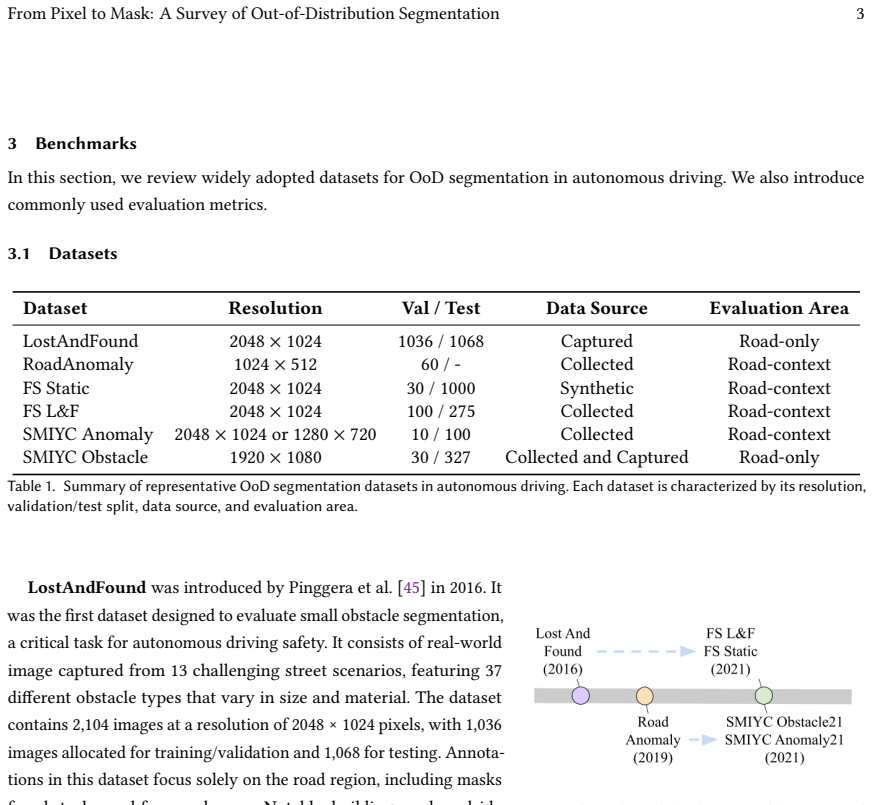
Summary. This survey reviews out-of-distribution (OoD) segmentation methods for autonomous driving. It formulates the pixel-level OoD segmentation problem, describes common datasets (LostAndFound, RoadAnomaly, Fishyscapes, SMIYC) and metrics (FPR95, mean F1), and organizes methods into four categories: test-time OoD segmentation (output- and representation-based), outlier exposure for supervised training, reconstruction-based methods, and approaches leveraging powerful models (Mask2Former, SAM, CLIP, DINOv2). A timeline and several comparison tables are provided, culminating in Table 6, which reports FPR and mean F1 on SMIYC-Anomaly and SMIYC-Obstacle for methods across all categories. The paper also lists future research directions, including larger benchmarks, robustness to covariate shift, and use of foundation models.
Significance. The survey addresses a timely and practically important topic. Its proposed four-category taxonomy is reasonable and the accompanying timeline gives a useful overview of the field's evolution. If the claims are well supported, the survey could serve as a convenient entry point for researchers and practitioners. However, the value rests on the reliability of its comparative evidence and the completeness of its coverage. The paper includes no systematic methodology for paper selection, and Table 6, which is the central comparative contribution, lacks essential experimental context. Several citation inaccuracies further reduce confidence in the survey's accuracy. These issues are fixable but require substantial revision before the survey can be considered dependable.
major comments (3)
- [Table 6] Table 6 reports FPR and mean F1 for methods on SMIYC-Anomaly and SMIYC-Obstacle but omits the segmentation backbone, in-distribution training set, outlier-exposure data, anomaly-score implementation, and threshold selection. Rows span very different architectures (score functions on unspecified segmenters, OE-trained models, Mask2Former-based, SAM-based, DINOv2-based), and these choices strongly affect FPR and mean F1. The source of each number (original paper or re-implementation) is not given, and DaCUP and LR are missing for SMIYC-Anomaly. As presented, the numbers are not directly comparable and cannot support the implied ranking. Please add columns for backbone/training setup/source, or clearly state that values are as-reported from heterogeneous protocols and avoid interpreting them as a standardized benchmark.
- [Section 1 (Introduction)] The paper claims to provide a 'comprehensive and systematic review,' but no search strategy, inclusion/exclusion criteria, or paper-selection methodology is described. The four-category taxonomy is an editorial choice and appears reasonable, yet without a documented selection process the reader cannot verify that the covered methods are representative or that significant works are not omitted. Please add a short methodology paragraph or explicitly scope the survey to a curated set of influential works.
- [§4.3 and §4.4.1] There are multiple concrete citation errors. In §4.3, the perceptual-difference equation in the SynBoost description is cited to [54] (PEBAL) instead of SynBoost [12] or the perceptual losses [13,26]. In §1, the overconfidence claim is cited to [3] (the Fishyscapes benchmark) rather than the original OoD detection work [22]. In §4.4.1, 'EAM, similar to RbA [19]' should cite RbA [41], not EAM's own reference [19]. These errors, particularly the self-citation in the EAM sentence, undermine the survey's reliability and should be corrected throughout.
minor comments (4)
- [Header / Front matter] The ACM reference format contains a template placeholder ('Make sure to enter the correct conference title from your rights confirmation email') and repeated 'Manuscript submitted to ACM' headers; the copyright year (2018) is also stale. These artifacts should be removed before submission.
- [Table 3] The legend for the 'Retrain backbone' column is incomplete: the text reads '✓, ✓–, and denote' with the third symbol missing. Please specify the symbol used for 'frozen backbone' (likely a dash or blank).
- [Equation (1)] The definition of FPR95 uses set notation that is ambiguous (e.g., the meaning of the intersection and the denominator). Please define P_in, P_hat_out(δ), and the denominator explicitly, or use the standard TP/FP formulation.
- [§4.2] In the sentence 'Liu et al. propose Residual Pattern Learning (RPL) [40] to fully the re-training impact,' the verb is missing; it should be 'fully address' or 'fully mitigate.'
Circularity Check
No circularity: the paper is a survey and taxonomy, not a derivation; its claims are editorial summaries of external work.
full rationale
This manuscript is a survey of out-of-distribution segmentation methods for autonomous driving. It contains no derivation chain, no fitted parameters, and no predictive claim generated from its own inputs. The four-category taxonomy (test-time, outlier exposure, reconstruction-based, powerful models) is an editorial organization of existing literature, not a mathematical consequence that could reduce to its own assumptions. The only self-citation is reference [66] (S2M, by two of the survey's authors), which is presented as one surveyed method among many and is not load-bearing: the survey's central contribution is the taxonomy and the comparative summary, and S2M's inclusion does not by itself establish any other claim. The cited S2M result is externally published (CVPR 2024) and is not used as an axiom to derive the taxonomy. Concerns about Table 6's comparability across different backbones, training protocols, and evaluation settings are legitimate quality/reliability issues but are not circularity: they do not amount to the survey predicting its own inputs or defining a result in terms of itself. The citation error in §4.4.1 ("EAM, similar to RbA [19]", where [19] is EAM) is a factual referencing mistake, not a circular argument. Accordingly, the circularity score is 0.
Assumptions & free parameters
assumptions (2)
- domain assumption The four proposed categories (test-time, outlier exposure, reconstruction, powerful models) are an exhaustive and meaningful partition of the current OoD segmentation literature in autonomous driving.
- domain assumption The numerical results in Table 6 are comparable across methods despite coming from different original papers with potentially different training regimes, backbones, and evaluation details.
Cite this review
Pith. "Pith review of From Pixel to Mask: A Survey of Out-of-Distribution Segmentation." pith.science (2026). https://pith.science/paper/OBVHLGZJ
@misc{pith2026250810309,
  author       = {Pith},
  title        = {Pith review of: From Pixel to Mask: A Survey of Out-of-Distribution Segmentation},
  year         = {2026},
  howpublished = {\url{https://pith.science/paper/OBVHLGZJ}},
  note         = {Machine review of arXiv:2508.10309}
}
read the original abstract
Out-of-distribution (OoD) detection and segmentation have attracted growing attention as concerns about AI security rise. Conventional OoD detection methods identify the existence of OoD objects but lack spatial localization, limiting their usefulness in downstream tasks. OoD segmentation addresses this limitation by localizing anomalous objects at pixel-level granularity. This capability is crucial for safety-critical applications such as autonomous driving, where perception modules must not only detect but also precisely segment OoD objects, enabling targeted control actions and enhancing overall system robustness. In this survey, we group current OoD segmentation approaches into four categories: (i) test-time OoD segmentation, (ii) outlier exposure for supervised training, (iii) reconstruction-based methods, (iv) and approaches that leverage powerful models. We systematically review recent advances in OoD segmentation for autonomous-driving scenarios, identify emerging challenges, and discuss promising future research directions.
Figures


Figures from the paper (3 more)


Forward citations
Cited by 1 Pith paper
-
CURE-OOD: Benchmarking Out-of-Distribution Detection for Survival Prediction
CURE-OOD is the first benchmark for evaluating OOD detection in survival prediction under controlled CT acquisition shifts, showing that standard detectors often fail and providing a survival-aware baseline.
Reference graph
Works this paper leans on
-
[19]
Matej Grcić, Josip Šarić, and Siniša Šegvić. 2023. On advantages of mask-level recognition for outlier-aware segmentation. In Proceedings of the IEEE/CVF Conference on Computer Vision and Pattern Recognition . 2937–2947
work page 2023
-
[54]
Yu Tian, Yuyuan Liu, Guansong Pang, Fengbei Liu, Yuanhong Chen, and Gustavo Carneiro. 2022. Pixel-wise energy-biased abstention learning for anomaly segmentation on complex urban driving scenes. In European Conference on Computer Vision . Springer, 246–263
work page 2022
-
[12]
Giancarlo Di Biase, Hermann Blum, Roland Siegwart, and Cesar Cadena. 2021. Pixel-wise anomaly detection in complex driving scenes. InProceedings of the IEEE/CVF conference on computer vision and pattern recognition . 16918–16927
work page 2021
-
[3]
Hermann Blum, Paul-Edouard Sarlin, Juan Nieto, Roland Siegwart, and Cesar Cadena. 2019. Fishyscapes: A benchmark for safe semantic segmentation in autonomous driving. In proceedings of the IEEE/CVF international conference on computer vision workshops . 0–0
work page 2019
-
[22]
Dan Hendrycks and Kevin Gimpel. 2016. A baseline for detecting misclassified and out-of-distribution examples in neural networks. arXiv preprint arXiv:1610.02136 (2016)
arXiv 2016
-
[41]
Nazir Nayal, Misra Yavuz, Joao F Henriques, and Fatma Güney. 2023. Rba: Segmenting unknown regions rejected by all. In Proceedings of the IEEE/CVF International Conference on Computer Vision . 711–722
work page 2023
-
[1]
Petra Bevandić, Ivan Krešo, Marin Oršić, and Siniša Šegvić. 2018. Discriminative out-of-distribution detection for semantic segmentation. arXiv preprint arXiv:1808.07703 (2018)
work page Pith review arXiv 2018
-
[2]
Petra Bevandić, Ivan Krešo, Marin Oršić, and Siniša Šegvić. 2019. Simultaneous semantic segmentation and outlier detection in presence of domain shift. In Pattern Recognition: 41st DAGM German Conference, DAGM GCPR 2019, Dortmund, Germany, September 10–13, 2019, Proceedings 41 . Springer, 33–47
work page 2019
Show all 67 references
-
[4]
Hermann Blum, Paul-Edouard Sarlin, Juan Nieto, Roland Siegwart, and Cesar Cadena. 2021. The fishyscapes benchmark: Measuring blind spots in semantic segmentation. International Journal of Computer Vision 129, 11 (2021), 3119–3135. Manuscript submitted to ACM 18 Zhao et al
2021
-
[5]
Mathilde Caron, Hugo Touvron, Ishan Misra, Hervé Jégou, Julien Mairal, Piotr Bojanowski, and Armand Joulin. 2021. Emerging properties in self-supervised vision transformers. In Proceedings of the IEEE/CVF international conference on computer vision . 9650–9660
2021
-
[6]
Robin Chan, Krzysztof Lis, Svenja Uhlemeyer, Hermann Blum, Sina Honari, Roland Siegwart, Pascal Fua, Mathieu Salzmann, and Matthias Rottmann
-
[7]
Robin Chan, Matthias Rottmann, and Hanno Gottschalk. 2021. Entropy maximization and meta classification for out-of-distribution detection in semantic segmentation. In Proceedings of the ieee/cvf international conference on computer vision . 5128–5137
2021
-
[8]
Bowen Cheng, Ishan Misra, Alexander G Schwing, Alexander Kirillov, and Rohit Girdhar. 2022. Masked-attention mask transformer for universal image segmentation. In Proceedings of the IEEE/CVF conference on computer vision and pattern recognition . 1290–1299
2022
-
[9]
Marius Cordts, Mohamed Omran, Sebastian Ramos, Timo Rehfeld, Markus Enzweiler, Rodrigo Benenson, Uwe Franke, Stefan Roth, and Bernt Schiele. 2016. The cityscapes dataset for semantic urban scene understanding. In Proceedings of the IEEE conference on computer vision and patter...
2016
-
[10]
Clement Creusot and Asim Munawar. 2015. Real-time small obstacle detection on highways using compressive RBM road reconstruction. In 2015 IEEE Intelligent Vehicles Symposium (IV) . 162–167. doi:10.1109/IVS.2015.7225680
2015
-
[11]
Anja Delić, Matej Grcić, and Siniša Šegvić. 2024. Outlier detection by ensembling uncertainty with negative objectness.arXiv preprint arXiv:2402.15374 (2024)
2024 arXiv
-
[13]
Alexey Dosovitskiy and Thomas Brox. 2016. Generating images with perceptual similarity metrics based on deep networks. Advances in neural information processing systems 29 (2016)
2016
-
[14]
Mark Everingham, Luc Van Gool, Christopher KI Williams, John Winn, and Andrew Zisserman. 2010. The pascal visual object classes (voc) challenge. International journal of computer vision 88 (2010), 303–338
2010
-
[15]
Yarin Gal et al. 2016. Uncertainty in deep learning. (2016)
2016
-
[16]
Zhengqing Gao, Xu-Yao Zhang, and Cheng-Lin Liu. 2024. Unified Entropy Optimization for Open-Set Test-Time Adaptation. arXiv:2404.06065 [cs.CV] https://arxiv.org/abs/2404.06065
2024 arXiv
-
[17]
Goodfellow, Jean Pouget-Abadie, Mehdi Mirza, Bing Xu, David Warde-Farley, Sherjil Ozair, Aaron Courville, and Yoshua Bengio
Ian J. Goodfellow, Jean Pouget-Abadie, Mehdi Mirza, Bing Xu, David Warde-Farley, Sherjil Ozair, Aaron Courville, and Yoshua Bengio. 2014. Generative Adversarial Networks. arXiv:1406.2661 [stat.ML] https://arxiv.org/abs/1406.2661
2014 arXiv
-
[18]
Matej Grcić, Petra Bevandić, and Siniša Šegvić. 2022. Densehybrid: Hybrid anomaly detection for dense open-set recognition. InEuropean Conference on Computer Vision. Springer, 500–517
2022
-
[20]
David Haldimann, Hermann Blum, Roland Siegwart, and Cesar Cadena. 2019. This is not what i imagined: Error detection for semantic segmentation through visual dissimilarity. arXiv preprint arXiv:1909.00676 (2019)
2019 arXiv
-
[21]
Dan Hendrycks, Steven Basart, Mantas Mazeika, Andy Zou, Joe Kwon, Mohammadreza Mostajabi, Jacob Steinhardt, and Dawn Song. 2019. Scaling out-of-distribution detection for real-world settings. arXiv preprint arXiv:1911.11132 (2019)
2019 arXiv
-
[23]
Dan Hendrycks, Mantas Mazeika, and Thomas Dietterich. 2018. Deep anomaly detection with outlier exposure. arXiv preprint arXiv:1812.04606 (2018)
2018 arXiv
-
[24]
Jens Henriksson, Christian Berger, Stig Ursing, and Markus Borg. 2023. Evaluation of out-of-distribution detection performance on autonomous driving datasets. In 2023 IEEE International Conference on Artificial Intelligence Testing (AITest) . IEEE, 74–81
2023
-
[25]
Phillip Isola, Jun-Yan Zhu, Tinghui Zhou, and Alexei A Efros. 2017. Image-to-image translation with conditional adversarial networks. InProceedings of the IEEE conference on computer vision and pattern recognition . 1125–1134
2017
-
[26]
Justin Johnson, Alexandre Alahi, and Li Fei-Fei. 2016. Perceptual losses for real-time style transfer and super-resolution. In Computer Vision–ECCV 2016: 14th European Conference, Amsterdam, The Netherlands, October 11-14, 2016, Proceedings, Part II 14 . Springer, 694–711
2016
-
[27]
Sanghun Jung, Jungsoo Lee, Daehoon Gwak, Sungha Choi, and Jaegul Choo. 2021. Standardized max logits: A simple yet effective approach for identifying unexpected road obstacles in urban-scene segmentation. In Proceedings of the IEEE/CVF International Conference on Computer Visi...
2021
-
[28]
Mert Keser, Halil Ibrahim Orhan, Niki Amini-Naieni, Gesina Schwalbe, Alois Knoll, and Matthias Rottmann. 2025. Benchmarking Vision Foundation Models for Input Monitoring in Autonomous Driving. arXiv preprint arXiv:2501.08083 (2025)
2025 arXiv
-
[29]
Alexander Kirillov, Eric Mintun, Nikhila Ravi, Hanzi Mao, Chloe Rolland, Laura Gustafson, Tete Xiao, Spencer Whitehead, Alexander C Berg, Wan-Yen Lo, et al. 2023. Segment anything. In Proceedings of the IEEE/CVF international conference on computer vision . 4015–4026
2023
-
[30]
Alex Krizhevsky, Ilya Sutskever, and Geoffrey E Hinton. 2012. ImageNet Classification with Deep Convolutional Neural Networks. In Advances in Neural Information Processing Systems , F. Pereira, C.J. Burges, L. Bottou, and K.Q. Weinberger (Eds.), Vol. 25. Curran Associates, Inc...
2012
-
[31]
Balaji Lakshminarayanan, Alexander Pritzel, and Charles Blundell. 2017. Simple and scalable predictive uncertainty estimation using deep ensembles. Advances in neural information processing systems 30 (2017). Manuscript submitted to ACM From Pixel to Mask: A Survey of Out-of-D...
2017
-
[32]
Jungsoo Lee, Debasmit Das, Jaegul Choo, and Sungha Choi. 2023. Towards open-set test-time adaptation utilizing the wisdom of crowds in entropy minimization. In Proceedings of the IEEE/CVF International Conference on Computer Vision . 16380–16389
2023
-
[33]
Kimin Lee, Kibok Lee, Honglak Lee, and Jinwoo Shin. 2018. A simple unified framework for detecting out-of-distribution samples and adversarial attacks. Advances in neural information processing systems 31 (2018)
2018
-
[34]
Yushu Li, Xun Xu, Yongyi Su, and Kui Jia. 2023. On the robustness of open-world test-time training: Self-training with dynamic prototype expansion. In Proceedings of the IEEE/CVF International Conference on Computer Vision . 11836–11846
2023
-
[35]
Shiyu Liang, Yixuan Li, and Rayadurgam Srikant. 2017. Enhancing the reliability of out-of-distribution image detection in neural networks. arXiv preprint arXiv:1706.02690 (2017)
2017 arXiv
-
[36]
Krzysztof Lis, Krishna Nakka, Pascal Fua, and Mathieu Salzmann. 2019. Detecting the unexpected via image resynthesis. In Proceedings of the IEEE/CVF International Conference on Computer Vision . 2152–2161
2019
-
[37]
Shilong Liu, Zhaoyang Zeng, Tianhe Ren, Feng Li, Hao Zhang, Jie Yang, Qing Jiang, Chunyuan Li, Jianwei Yang, Hang Su, et al. 2024. Grounding dino: Marrying dino with grounded pre-training for open-set object detection. In European Conference on Computer Vision . Springer, 38–55
2024
-
[38]
Weitang Liu, Xiaoyun Wang, John Owens, and Yixuan Li. 2020. Energy-based out-of-distribution detection.Advances in neural information processing systems 33 (2020), 21464–21475
2020
-
[39]
Xihui Liu, Guojun Yin, Jing Shao, Xiaogang Wang, et al. 2019. Learning to predict layout-to-image conditional convolutions for semantic image synthesis. Advances in neural information processing systems 32 (2019)
2019
-
[40]
Yuyuan Liu, Choubo Ding, Yu Tian, Guansong Pang, Vasileios Belagiannis, Ian Reid, and Gustavo Carneiro. 2023. Residual pattern learning for pixel-wise out-of-distribution detection in semantic segmentation. In Proceedings of the IEEE/CVF International Conference on Computer Vi...
2023
-
[42]
Alexey Nekrasov, Alexander Hermans, Lars Kuhnert, and Bastian Leibe. 2023. Ugains: Uncertainty guided anomaly instance segmentation. InDAGM German Conference on Pattern Recognition . Springer, 50–66
2023
-
[43]
Maxime Oquab, Timothée Darcet, Théo Moutakanni, Huy Vo, Marc Szafraniec, Vasil Khalidov, Pierre Fernandez, Daniel Haziza, Francisco Massa, Alaaeldin El-Nouby, Mahmoud Assran, Nicolas Ballas, Wojciech Galuba, Russell Howes, Po-Yao Huang, Shang-Wen Li, Ishan Misra, Michael Rabba...
2024 arXiv
-
[44]
Taesung Park, Ming-Yu Liu, Ting-Chun Wang, and Jun-Yan Zhu. 2019. Semantic image synthesis with spatially-adaptive normalization. InProceedings of the IEEE/CVF conference on computer vision and pattern recognition . 2337–2346
2019
-
[45]
Peter Pinggera, Sebastian Ramos, Stefan Gehrig, Uwe Franke, Carsten Rother, and Rudolf Mester. 2016. Lost and found: detecting small road hazards for self-driving vehicles. In 2016 IEEE/RSJ International Conference on Intelligent Robots and Systems (IROS) . IEEE, 1099–1106
2016
-
[46]
Alec Radford, Jong Wook Kim, Chris Hallacy, Aditya Ramesh, Gabriel Goh, Sandhini Agarwal, Girish Sastry, Amanda Askell, Pamela Mishkin, Jack Clark, et al. 2021. Learning transferable visual models from natural language supervision. In International conference on machine learni...
2021
-
[47]
Shyam Nandan Rai, Fabio Cermelli, Dario Fontanel, Carlo Masone, and Barbara Caputo. 2023. Unmasking anomalies in road-scene segmentation. In Proceedings of the IEEE/CVF International Conference on Computer Vision . 4037–4046
2023
-
[48]
David Ríos Insua, William N Caballero, and Roi Naveiro. 2022. Managing driving modes in automated driving systems. Transportation science 56, 5 (2022), 1259–1278
2022
-
[49]
Matthias Rottmann, Pascal Colling, Thomas Paul Hack, Robin Chan, Fabian Hüger, Peter Schlicht, and Hanno Gottschalk. 2020. Prediction error meta classification in semantic segmentation: Detection via aggregated dispersion measures of softmax probabilities. In 2020 Internationa...
2020
-
[50]
Olga Russakovsky, Jia Deng, Hao Su, Jonathan Krause, Sanjeev Satheesh, Sean Ma, Zhiheng Huang, Andrej Karpathy, Aditya Khosla, Michael Bernstein, et al. 2015. Imagenet large scale visual recognition challenge. International journal of computer vision 115 (2015), 211–252
2015
-
[51]
Youssef Shoeb, Robin Chan, Gesina Schwalbe, Azarm Nowzad, Fatma Güney, and Hanno Gottschalk. 2024. Have We Ever Encountered This Before? Retrieving Out-of-Distribution Road Obstacles from Driving Scenes. In Proceedings of the IEEE/CVF Winter Conference on Applications of Compu...
2024
-
[52]
Youssef Shoeb, Nazir Nayal, Azarm Nowzad, Fatma Güney, and Hanno Gottschalk. 2025. Segment-Level Road Obstacle Detection Using Visual Foundation Model Priors and Likelihood Ratios. arXiv:2412.05707 [cs.CV] https://arxiv.org/abs/2412.05707
2025 arXiv
-
[53]
Yiyou Sun, Chuan Guo, and Yixuan Li. 2021. React: Out-of-distribution detection with rectified activations. Advances in neural information processing systems 34 (2021), 144–157
2021
-
[55]
Tomáš Vojíř and Jiří Matas. 2023. Image-consistent detection of road anomalies as unpredictable patches. In Proceedings of the IEEE/CVF Winter Conference on Applications of Computer Vision . 5491–5500
2023
-
[56]
Tomas Vojir, Tomáš Šipka, Rahaf Aljundi, Nikolay Chumerin, Daniel Olmeda Reino, and Jiri Matas. 2021. Road anomaly detection by partial image reconstruction with segmentation coupling. In Proceedings of the IEEE/CVF international conference on computer vision . 15651–15660. Ma...
2021
-
[57]
Tomáš Vojíř, Jan Šochman, Rahaf Aljundi, and Jiří Matas. 2023. Calibrated out-of-distribution detection with a generic representation. In 2023 IEEE/CVF International Conference on Computer Vision Workshops (ICCVW) . IEEE, 4509–4518
2023
-
[58]
Tomáš Vojíř, Jan Šochman, and Jiří Matas. 2024. PixOOD: Pixel-level out-of-distribution detection. In European Conference on Computer Vision . Springer, 93–109
2024
-
[59]
Haoqi Wang, Zhizhong Li, Litong Feng, and Wayne Zhang. 2022. Vim: Out-of-distribution with virtual-logit matching. InProceedings of the IEEE/CVF conference on computer vision and pattern recognition . 4921–4930
2022
-
[60]
Ting-Chun Wang, Ming-Yu Liu, Jun-Yan Zhu, Andrew Tao, Jan Kautz, and Bryan Catanzaro. 2018. High-resolution image synthesis and semantic manipulation with conditional gans. In Proceedings of the IEEE conference on computer vision and pattern recognition . 8798–8807
2018
-
[61]
Zhou Wang, Eero P Simoncelli, and Alan C Bovik. 2003. Multiscale structural similarity for image quality assessment. InThe Thrity-Seventh Asilomar Conference on Signals, Systems & Computers, 2003 , Vol. 2. Ieee, 1398–1402
2003
-
[62]
Yingda Xia, Yi Zhang, Fengze Liu, Wei Shen, and Alan L Yuille. 2020. Synthesize then compare: Detecting failures and anomalies for semantic segmentation. In Computer Vision–ECCV 2020: 16th European Conference, Glasgow, UK, August 23–28, 2020, Proceedings, Part I 16 . Springer, 145–161
2020
-
[63]
Yongcan Yu, Lijun Sheng, Ran He, and Jian Liang. 2024. STAMP: Outlier-Aware Test-Time Adaptation with Stable Memory Replay. InEuropean Conference on Computer Vision . Springer, 375–392
2024
-
[64]
Longhui Yuan, Binhui Xie, and Shuang Li. 2023. Robust test-time adaptation in dynamic scenarios. In Proceedings of the IEEE/CVF Conference on Computer Vision and Pattern Recognition . 15922–15932
2023
-
[65]
Hao Zhang, Fang Li, Lu Qi, Ming-Hsuan Yang, and Narendra Ahuja. 2024. Csl: Class-agnostic structure-constrained learning for segmentation including the unseen. In Proceedings of the AAAI Conference on Artificial Intelligence , Vol. 38. 7078–7086
2024
-
[66]
Wenjie Zhao, Jia Li, Xin Dong, Yu Xiang, and Yunhui Guo. 2024. Segment Every Out-of-Distribution Object. InProceedings of the IEEE/CVF Conference on Computer Vision and Pattern Recognition . 3910–3920. Manuscript submitted to ACM
2024
-
[2021]
arXiv preprint arXiv:2104.14812 (2021)
Segmentmeifyoucan: A benchmark for anomaly segmentation. arXiv preprint arXiv:2104.14812 (2021)
2021 arXiv
Reviewed August 5, 2026 · model on record in the stance chip above.
Discussion (0). Sign in to comment.