Constraints on the Crystallinity of Water Ice in Planet-forming Disks from Infrared Scattered-Light Spectra
Pith reviewed 2026-05-20 03:15 UTC · model grok-4.3
pith:OCCKUSQZ Add to your LaTeX paper
What is a Pith Number?\usepackage{pith}
\pithnumber{OCCKUSQZ}
Prints a linked pith:OCCKUSQZ badge after your title and writes the identifier into PDF metadata. Compiles on arXiv with no extra files. Learn more
The pith
A portable formula converts the Fresnel peak strength in 3-micron scattered light into the crystallinity fraction of water ice grains.
A machine-rendered reading of the paper's core claim, the machinery that carries it, and where it could break.
Core claim
The authors present a portable expression that translates the strength of the Fresnel peak within the 3-micron water-ice absorption band into the degree of crystallinity of icy grains, calibrated specifically for scattered light observed at scattering angles near 90 degrees.
What carries the argument
The Fresnel feature inside the 3-micron ice absorption band, converted to crystallinity via a calibrated expression for 90-degree scattered light.
If this is right
- Crystallinity in the HD 181327 debris disk is 10-20 percent.
- The Fresnel feature is weaker in protoplanetary disks than in debris disks even at identical crystallinity.
- The protoplanetary disk d216-0939 shows a crystallinity of roughly 50 percent.
- Near-infrared spectroscopy of scattered light can track how crystalline ice evolves across different disk environments.
Where Pith is reading between the lines
- The same expression can be applied to additional spatially resolved disks observed at near-90-degree scattering angles without requiring knowledge of the disk's inclination.
- Deviations in grain porosity or size distribution from the calibration assumptions would shift the derived crystallinity values in a predictable direction.
Load-bearing premise
The expression assumes scattering angles near 90 degrees together with fixed grain sizes, shapes, and compositions; real disks that depart from these choices change the inferred crystallinity.
What would settle it
An independent crystallinity measurement obtained from the same icy grains via thermal emission spectroscopy or laboratory scattering experiments at matching wavelengths and angles would confirm or refute the formula's accuracy.
Figures




read the original abstract
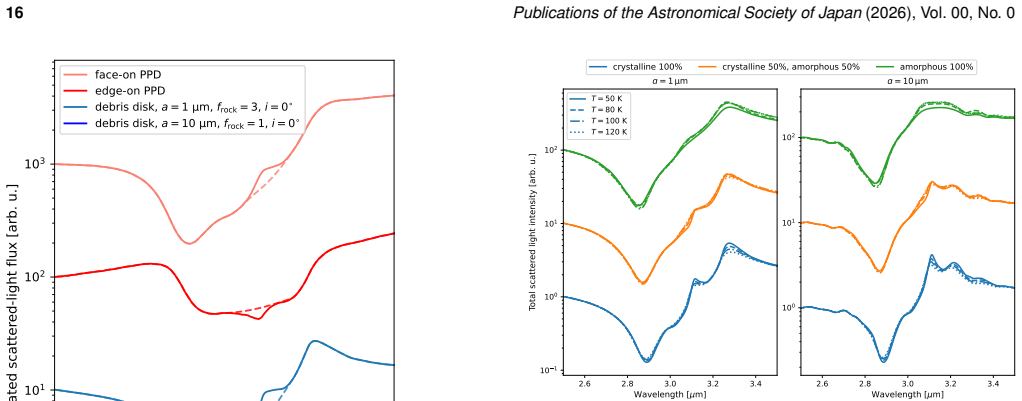
The crystallinity of water ice not only records the thermal history experienced by an astronomical body, but also affects the composition of forming planets by controlling the trapping of volatile materials in amorphous ice and their subsequent transport. An additional structure within the 3~$\rm \mu m$ water-ice absorption band, known as the Fresnel feature, may serve as a diagnostic of ice crystallinity. Recent observations with the James Webb Space Telescope have detected a Fresnel peak in a debris disk and in Trans-Neptunian Objects (TNOs). Here, we propose a portable expression that translates the observed Fresnel peak strength into the degree of crystallinity of icy grains in debris disks. Our formula targets scattered light at around 90$^{\circ}$ angles, which are easily accessible for spatially resolved debris disks regardless of the inclination angle. Applying this expression, we derive the degree of crystallinity of a debris disk around HD 181327 to be 10-20%. We also study the Fresnel feature in protoplanetary disks and find that it is generally weaker than in debris disks even for the same crystallinity. We then analyzed a scattered light spectrum of the protoplanetary disk around d216-0939, which shows a weak crystalline feature, and inferred a crystallinity of $\sim$50%. We conclude that the Fresnel feature is a reliable observational tracer for ice crystallinity, and future near-IR spectroscopic observations will be crucial to elucidate the crystalline ice evolution.
Editorial analysis
A structured set of objections, weighed in public.
Referee Report
Summary. The manuscript derives a portable expression from scattering models that converts the observed strength of the Fresnel peak within the 3 μm water-ice band in scattered light (targeting ~90° angles) into the crystallinity fraction of icy grains. The expression is applied to the debris disk HD 181327 to infer 10–20% crystallinity and to the protoplanetary disk d216-0939 to infer ~50% crystallinity; the paper also reports that the Fresnel feature is generally weaker in protoplanetary disks than in debris disks at fixed crystallinity.
Significance. If the central mapping holds under realistic grain conditions, the work supplies a practical, observationally accessible diagnostic for ice crystallinity that leverages JWST scattered-light spectra and scattering angles readily available in resolved disks. This has direct relevance to thermal processing histories and volatile trapping in planet-forming environments. The portable form of the expression is a clear strength for future applications.
major comments (2)
- [Derivation and calibration section] The portable expression is obtained by fitting single-scattering models over a narrow set of fixed grain size, shape, porosity, and composition parameters at ~90° scattering angle. No quantitative sensitivity analysis is provided to show how the inferred crystallinity fractions shift when these assumptions are varied within plausible ranges for real disks; this directly affects the robustness of the 10–20% (HD 181327) and ~50% (d216-0939) values reported in the applications.
- [Application to d216-0939] In the application to d216-0939, the weak Fresnel feature is mapped to ~50% crystallinity, but the manuscript does not propagate uncertainties arising from possible mismatches between the calibration grain model and the actual disk grains (e.g., silicate mixing or size distribution), leaving the central claim's quantitative support incomplete.
minor comments (2)
- [Abstract] The abstract states that the expression is 'portable' but does not display its explicit functional form; including the formula would allow immediate assessment by readers.
- [Figures] Figure captions and axis labels for the model spectra should explicitly note the fixed grain parameters used in the calibration runs to avoid ambiguity.
Simulated Author's Rebuttal
We thank the referee for their constructive comments on the robustness of the portable expression and its applications. We address each major comment below and indicate the revisions planned for the manuscript.
read point-by-point responses
-
Referee: [Derivation and calibration section] The portable expression is obtained by fitting single-scattering models over a narrow set of fixed grain size, shape, porosity, and composition parameters at ~90° scattering angle. No quantitative sensitivity analysis is provided to show how the inferred crystallinity fractions shift when these assumptions are varied within plausible ranges for real disks; this directly affects the robustness of the 10–20% (HD 181327) and ~50% (d216-0939) values reported in the applications.
Authors: We agree that a quantitative sensitivity analysis strengthens the presentation. The original derivation intentionally used a representative set of grain parameters to produce a simple, portable expression for ~90° scattering angles. In the revised manuscript we add a dedicated subsection that varies grain size distribution, porosity, shape, and silicate fraction over plausible ranges for both debris and protoplanetary disks. These tests show that the reported crystallinity intervals shift by at most ~10 percentage points, confirming that the 10–20% and ~50% estimates remain representative while clarifying the approximate character of the diagnostic. revision: yes
-
Referee: [Application to d216-0939] In the application to d216-0939, the weak Fresnel feature is mapped to ~50% crystallinity, but the manuscript does not propagate uncertainties arising from possible mismatches between the calibration grain model and the actual disk grains (e.g., silicate mixing or size distribution), leaving the central claim's quantitative support incomplete.
Authors: We acknowledge the value of explicit uncertainty estimates for the d216-0939 application. The revised manuscript now includes a short discussion of possible grain-property mismatches together with additional single-scattering calculations that quantify their effect. We report the ~50% crystallinity with an estimated uncertainty of order ±15% arising from variations in silicate content and size distribution, and we note that the portable expression assumes average grain properties; more detailed radiative-transfer modeling would be needed for higher precision. revision: yes
Circularity Check
No significant circularity in derivation of portable Fresnel-to-crystallinity expression
full rationale
The paper derives its portable expression by computing the Fresnel peak strength via scattering models for icy grains across a range of crystallinity fractions, then fitting a simple functional form to those model outputs under fixed assumptions (grain size, shape, composition, ~90° scattering). This is a standard forward-model calibration step that maps physical inputs to an observable diagnostic; the resulting formula is then applied to new observations (HD 181327, d216-0939) to infer crystallinity. No step reduces by construction to the target observations, no self-citation chain is load-bearing, and no ansatz or uniqueness theorem is smuggled in. The derivation remains self-contained against external scattering physics and does not equate the claimed prediction to its own fitted inputs.
Axiom & Free-Parameter Ledger
free parameters (1)
- scattering angle target
axioms (1)
- domain assumption Fresnel peak strength scales monotonically with crystallinity fraction under the adopted grain model
Lean theorems connected to this paper
-
IndisputableMonolith/Cost/FunctionalEquation.leanwashburn_uniqueness_aczel unclear?
unclearRelation between the paper passage and the cited Recognition theorem.
we propose a portable expression that translates the observed Fresnel peak strength into the degree of crystallinity... ΔFresnel = c ΔFresnel,bf exp[−(frock/frock,bf)^γ] ... [ΔFresnel,bf, frock,bf, γ] = [0.80, 6.8, 1.3]
-
IndisputableMonolith/Foundation/AlphaCoordinateFixation.leanJ_uniquely_calibrated_via_higher_derivative unclear?
unclearRelation between the paper passage and the cited Recognition theorem.
Our formula targets scattered light at around 90° angles... calibrated for scattering angles near 90 degrees and for specific assumptions about grain size, shape, and composition
What do these tags mean?
- matches
- The paper's claim is directly supported by a theorem in the formal canon.
- supports
- The theorem supports part of the paper's argument, but the paper may add assumptions or extra steps.
- extends
- The paper goes beyond the formal theorem; the theorem is a base layer rather than the whole result.
- uses
- The paper appears to rely on the theorem as machinery.
- contradicts
- The paper's claim conflicts with a theorem or certificate in the canon.
- unclear
- Pith found a possible connection, but the passage is too broad, indirect, or ambiguous to say the theorem truly supports the claim.
Reference graph
Works this paper leans on
-
[1]
, year = 2009, month = sep, volume =
Complex Organic Interstellar Molecules. , year = 2009, month = sep, volume =. doi:10.1146/annurev-astro-082708-101654 , adsurl =
-
[2]
On the water delivery to terrestrial embryos by ice pebble accretion
On the water delivery to terrestrial embryos by ice pebble accretion. , keywords =. doi:10.1051/0004-6361/201527069 , archivePrefix =. 1512.02414 , primaryClass =
work page internal anchor Pith review Pith/arXiv arXiv doi:10.1051/0004-6361/201527069
-
[3]
Water delivery by pebble accretion to rocky planets in habitable zones in evolving disks. , keywords =. doi:10.1051/0004-6361/201834556 , archivePrefix =. 1901.04611 , primaryClass =
-
[4]
Trapping and release of gases by water ice and implications for icy bodies. , keywords =. doi:10.1016/0019-1035(85)90048-X , adsurl =
-
[5]
Trapping of gas mixtures by amorphous water ice. , keywords =. doi:10.1103/PhysRevB.38.7749 , adsurl =
-
[6]
, year = 2007, month = oct, volume =
Trapping of N _ 2 , CO and Ar in amorphous ice Application to comets. , year = 2007, month = oct, volume =. doi:10.1016/j.icarus.2007.03.021 , adsurl =
-
[7]
Entrapment of Hypervolatiles in Interstellar and Cometary H _ 2 O and CO _ 2 Ice Analogs. , keywords =. doi:10.3847/1538-4357/aceaf8 , adsurl =
-
[8]
Jupiter's formation in the vicinity of the amorphous ice snowline
Jupiter s Formation in the Vicinity of the Amorphous Ice Snowline. , keywords =. doi:10.3847/1538-4357/ab0a72 , archivePrefix =. 1902.08924 , primaryClass =
work page internal anchor Pith review Pith/arXiv arXiv doi:10.3847/1538-4357/ab0a72 1902
-
[9]
The Physics of Dust Coagulation and the Structure of Dust Aggregates in Space. , keywords =. doi:10.1086/303996 , adsurl =
-
[10]
Collisional Growth Conditions for Dust Aggregates. , keywords =. doi:10.1088/0004-637X/702/2/1490 , adsurl =
-
[11]
Growth efficiency of dust aggregates through collisions with high mass ratios. , keywords =. doi:10.1051/0004-6361/201322259 , adsurl =
-
[12]
The edge-on protoplanetary disk HH 48 NE, seen with the Ice Age ERS program
A JWST inventory of protoplanetary disk ices. The edge-on protoplanetary disk HH 48 NE, seen with the Ice Age ERS program. , keywords =. doi:10.1051/0004-6361/202347512 , archivePrefix =. 2309.07817 , primaryClass =
-
[13]
The edge-on disc Tau 042021: Icy grains at high altitudes and a wind containing astronomical polycyclic aromatic hydrocarbons. , keywords =. doi:10.1051/0004-6361/202452966 , archivePrefix =. 2503.24309 , primaryClass =
-
[14]
Simple molecules and complex chemistry in a protoplanetary disk: A JWST investigation of the highly inclined disk d216-0939. , keywords =. doi:10.1051/0004-6361/202453385 , archivePrefix =. 2502.20472 , primaryClass =
-
[15]
JWST Edge-on Disk Ice (JEDIce): Program overview and ice survey results. arXiv e-prints , keywords =. doi:10.48550/arXiv.2603.18163 , archivePrefix =. 2603.18163 , primaryClass =
-
[16]
Water ice in the debris disk around HD 181327. , keywords =. doi:10.1038/s41586-025-08920-4 , archivePrefix =. 2505.08863 , primaryClass =
-
[17]
Nature Astronomy , year = 2025, month = feb, volume =
Thermal evolution of trans-Neptunian objects through observations of Centaurs with JWST. Nature Astronomy , year = 2025, month = feb, volume =. doi:10.1038/s41550-024-02417-2 , adsurl =
-
[18]
Nature Astronomy , year = 2025, month = feb, volume =
A JWST/DiSCo-TNOs portrait of the primordial Solar System through its trans-Neptunian objects. Nature Astronomy , year = 2025, month = feb, volume =. doi:10.1038/s41550-024-02433-2 , adsurl =
-
[19]
Composition and Physical Properties of Enceladus' Surface. Science , keywords =. doi:10.1126/science.1121031 , adsurl =
-
[20]
Science , year = 1994, month = aug, volume =
Structural Transitions in Amorphous Water Ice and Astrophysical Implications. Science , year = 1994, month = aug, volume =. doi:10.1126/science.11539186 , adsurl =
-
[21]
Journal of Crystal Growth , keywords =
Evaporation of H _ 2 O CO ice and its astrophysical implications. Journal of Crystal Growth , keywords =. doi:10.1016/S0022-0248(08)80112-1 , adsurl =
-
[22]
Amorphous Ice in Comets: Evidence and Consequences. Comets III , publisher =. doi:10.2458/azu_uapress_9780816553631-ch025 , adsurl =
-
[23]
Amorphization of cubic ice by ultraviolet irradiation. , keywords =. doi:10.1038/344134a0 , adsurl =
-
[24]
Journal of Geophysical Research (Planets) , keywords =
Amorphous and crystalline ice on the Galilean satellites: A balance between thermal and radiolytic processes. Journal of Geophysical Research (Planets) , keywords =. doi:10.1029/2003JE002149 , adsurl =
-
[25]
The characterization of water ice in debris discs: implications for JWST scattered light observations. , keywords =. doi:10.1093/mnras/stae1923 , archivePrefix =. 2408.03278 , primaryClass =
-
[26]
Absorption and scattering of light by small particles. 1983 , publisher =
work page 1983
- [27]
-
[28]
OpTool: Command-line driven tool for creating complex dust opacities
-
[29]
The Dielectric Function of ``Astrodust'' and Predictions for Polarization in the 3.4 and 10 m Features. , keywords =. doi:10.3847/1538-4357/abd6c6 , archivePrefix =. 2009.11314 , primaryClass =
-
[30]
The Astrodust+PAH Model: A Unified Description of the Extinction, Emission, and Polarization from Dust in the Diffuse Interstellar Medium. , keywords =. doi:10.3847/1538-4357/acc4c2 , archivePrefix =. 2208.12365 , primaryClass =
-
[31]
Optical Constants of Amorphous and Crystalline H _ 2 O-ice: 2.5-22 m (4000-455 cm ^ -1 ) Optical Constants of H _ 2 O-ice. , keywords =. doi:10.1088/0004-637X/701/2/1347 , adsurl =
-
[32]
A Circumstellar Disk around Pictoris. Science , keywords =. doi:10.1126/science.226.4681.1421 , adsurl =
-
[33]
Space Telescope Imaging Spectrograph Coronagraphic Observations of Pictoris. , keywords =. doi:10.1086/309188 , archivePrefix =. astro-ph/9911363 , primaryClass =
-
[34]
HST/ACS Multiband Coronagraphic Imaging of the Debris Disk around Beta Pictoris
Hubble Space Telescope ACS Multiband Coronagraphic Imaging of the Debris Disk around Pictoris. , keywords =. doi:10.1086/503801 , archivePrefix =. astro-ph/0602292 , primaryClass =
work page internal anchor Pith review Pith/arXiv arXiv doi:10.1086/503801
-
[35]
Observational Possibility of the ``Snow Line'' on the Surface of Circumstellar Disks with the Scattered Light. , keywords =. doi:10.1093/pasj/60.3.557 , archivePrefix =. 0802.0906 , primaryClass =
work page internal anchor Pith review Pith/arXiv arXiv doi:10.1093/pasj/60.3.557
-
[36]
The challenge of measuring the phase function of debris discs. Application to HR 4796 A. , keywords =. doi:10.1051/0004-6361/202038237 , archivePrefix =. 2006.08595 , primaryClass =
-
[37]
RADMC-3D: A multi-purpose radiative transfer tool
-
[38]
Opacity of fluffy dust aggregates
Opacity of fluffy dust aggregates. , keywords =. doi:10.1051/0004-6361/201323199 , archivePrefix =. 1312.1459 , primaryClass =
work page internal anchor Pith review Pith/arXiv arXiv doi:10.1051/0004-6361/201323199
-
[39]
The Water-ice Feature in Near-infrared Disk-scattered Light around HD 142527: Micron-sized Icy Grains Lifted up to the Disk Surface?. , keywords =. doi:10.3847/1538-4357/ac1f8c , archivePrefix =. 2108.08637 , primaryClass =
-
[40]
JWST Imaging of Edge-on Protoplanetary Disks. I. Fully Vertically Mixed 10 m Grains in the Outer Regions of a 1000 au Disk. , keywords =. doi:10.3847/1538-3881/acf9a7 , archivePrefix =. 2309.07040 , primaryClass =
-
[41]
Crystallization of Amorphous Water Ice in the Solar System. , keywords =. doi:10.1086/178220 , adsurl =
-
[42]
The abundance and thermal history of water ice in the disk surrounding HD 142527 from the DIGIT Herschel Key Program. , keywords =. doi:10.1051/0004-6361/201425432 , archivePrefix =. 1606.07266 , primaryClass =
work page internal anchor Pith review Pith/arXiv arXiv doi:10.1051/0004-6361/201425432
-
[43]
Discovery of Crystallized Water Ice in a Silhouette Disk in the M43 Region
Discovery of Crystallized Water Ice in a Silhouette Disk in the M43 Region. , keywords =. doi:10.1088/0004-637X/753/1/19 , archivePrefix =. 1204.5503 , primaryClass =
work page internal anchor Pith review Pith/arXiv arXiv doi:10.1088/0004-637x/753/1/19
-
[44]
Multi-epoch Detections of Water Ice Absorption in Edge-on Disks around Herbig Ae Stars: PDS 144N and PDS 453. , keywords =. doi:10.3847/1538-4357/834/2/115 , archivePrefix =. 1611.09800 , primaryClass =
work page internal anchor Pith review Pith/arXiv arXiv doi:10.3847/1538-4357/834/2/115
-
[45]
arXiv e-prints , volume = 1, keywords =
PRIMA General Observer Science Book. doi:10.48550/arXiv.2310.20572 , adsurl =
-
[46]
, year = 1996, month = jan, volume =
The FU Orionis Phenomenon. , year = 1996, month = jan, volume =. doi:10.1146/annurev.astro.34.1.207 , adsurl =
-
[47]
Episodic Accretion in Young Stars
Episodic Accretion in Young Stars. Protostars and Planets VI , year = 2014, editor =. doi:10.2458/azu_uapress_9780816531240-ch017 , archivePrefix =. 1401.3368 , primaryClass =
work page internal anchor Pith review Pith/arXiv arXiv doi:10.2458/azu_uapress_9780816531240-ch017 2014
-
[48]
Imaging the water-snow line during a protostellar outburst
Imaging the water snow-line during a protostellar outburst. , keywords =. doi:10.1038/nature18612 , archivePrefix =. 1607.03757 , primaryClass =
work page internal anchor Pith review Pith/arXiv arXiv doi:10.1038/nature18612
-
[49]
The impact of planet wakes on the location and shape of the water ice line in a protoplanetary disk. , keywords =. doi:10.1051/0004-6361/201936495 , archivePrefix =. 1910.08560 , primaryClass =
-
[50]
Modeling protoplanetary disk heating by planet-induced spiral shocks. , keywords =. doi:10.1093/pasj/psae106 , archivePrefix =. 2411.09940 , primaryClass =
-
[51]
Bridging the gap: Consistent modeling of protoplanetary disk heating and gap formation by planet-induced spiral shocks. , keywords =. doi:10.1093/pasj/psag010 , archivePrefix =. 2507.18283 , primaryClass =
-
[52]
Water and the interior structure of terrestrial planets and icy bodies
Water and the Interior Structure of Terrestrial Planets and Icy Bodies. , keywords =. doi:10.1007/s11214-018-0473-x , archivePrefix =. 1712.07539 , primaryClass =
work page internal anchor Pith review Pith/arXiv arXiv doi:10.1007/s11214-018-0473-x
-
[53]
Mid-infrared Spectrophotometric Observations of Fragments B and C of Comet 73P/Schwassmann-Wachmann 3. , keywords =. doi:10.1088/0004-6256/141/1/26 , archivePrefix =. 1011.4251 , primaryClass =
work page internal anchor Pith review Pith/arXiv arXiv doi:10.1088/0004-6256/141/1/26
-
[54]
Infrared Spectroscopy of Comet 73P/Schwassmann-Wachmann 3 using the Spitzer Space Telescope
Infrared Spectroscopy of Comet 73P/Schwassmann-Wachmann 3 Using the Spitzer Space Telescope. , keywords =. doi:10.1088/0004-6256/142/3/80 , archivePrefix =. 1107.2071 , primaryClass =
work page internal anchor Pith review Pith/arXiv arXiv doi:10.1088/0004-6256/142/3/80 2071
-
[55]
Mid-infrared Spectroscopic Observations of Comet 17P/Holmes Immediately After Its Great Outburst in 2007 October. , keywords =. doi:10.3847/1538-3881/aadfea , archivePrefix =. 1808.07606 , primaryClass =
work page internal anchor Pith review Pith/arXiv arXiv doi:10.3847/1538-3881/aadfea 2007
-
[56]
, year = 2002, month = jan, volume =
Color diversity among Kuiper belt objects: The collisional resurfacing model revisited. , year = 2002, month = jan, volume =. doi:10.1016/S0032-0633(01)00073-3 , adsurl =
-
[57]
The Active Centaurs. , keywords =. doi:10.1088/0004-6256/137/5/4296 , archivePrefix =. 0902.4687 , primaryClass =
work page internal anchor Pith review Pith/arXiv arXiv doi:10.1088/0004-6256/137/5/4296
-
[58]
Survival of Amorphous Water Ice on Centaurs. , keywords =. doi:10.1088/0004-6256/144/4/97 , adsurl =
-
[59]
Science , year = 1996, month = mar, volume =
Toward an Astrophysical Theory of Chondrites. Science , year = 1996, month = mar, volume =. doi:10.1126/science.271.5255.1545 , adsurl =
-
[60]
Radial mixing in protoplanetary accretion disks. I. Stationary disc models with annealing and carbon combustion. , keywords =. doi:10.1051/0004-6361:20011130 , adsurl =
-
[61]
Outward Transport of High-Temperature Materials Around the Midplane of the Solar Nebula. Science , keywords =. doi:10.1126/science.1147273 , adsurl =
-
[62]
Steps toward interstellar silicate mineralogy. II. Study of Mg-Fe-silicate glasses of variable composition. , keywords =
-
[63]
Evidence for sub-micron particles from scattered light observations
The polarisation properties of the HD 181327 debris ring. Evidence for sub-micron particles from scattered light observations. , keywords =. doi:10.1051/0004-6361/202347933 , adsurl =
-
[64]
A laboratory survey of the thermal desorption of astrophysically relevant molecules. , keywords =. doi:10.1111/j.1365-2966.2004.08272.x , adsurl =
-
[65]
SciPy 1.0--Fundamental Algorithms for Scientific Computing in Python
SciPy 1.0: fundamental algorithms for scientific computing in Python. Nature Medicine , keywords =. doi:10.1038/s41592-019-0686-2 , archivePrefix =. 1907.10121 , primaryClass =
work page internal anchor Pith review Pith/arXiv arXiv doi:10.1038/s41592-019-0686-2 1907
-
[66]
Research Synthesis Methods , volume=
Effect estimates can be accurately calculated with data digitally extracted from interrupted time series graphs , author=. Research Synthesis Methods , volume=. 2023 , publisher=
work page 2023
discussion (0)
Sign in with ORCID, Apple, or X to comment. Anyone can read and Pith papers without signing in.