REVIEW 4 major objections 5 minor 1 cited by
A Controllable Appearance Representation for Flexible Transfer and Editing
T0 review · 4 major / 5 minor · reviewed 2026-08-16 · deepseek-v4-flash
Pith's one-line read The paper claims that the appearance of a homogeneous object in a single image can be compressed without labels into a six-dimensional code — two hue axes, two light-direction axes, lightness, and gloss — that then conditions a diffusion…
desk verdict Solid self-supervised 6D appearance space with honest caveats, but geometry-independence is only tested on simple shapes and the diffusion part is proof-of-concept. read the letter →
The pith
A machine-rendered reading of the paper's core claim, the machinery that carries it, and where it could break.
The reading
What carries the argument
The load-bearing device is the six-dimensional latent vector $f\in\mathbb{R}^6$ produced by an adapted FactorVAE. The encoder maps an input image of a homogeneous object to this vector, while the decoder concatenates a normal map of the target geometry into its layers, so geometry is handed to the model rather than stored in the code. The training loss combines a smooth-L1 reconstruction term, a dimension-wise KL regularization term $\beta\,D_{KL}(q_\theta(z|x),p(z),n)$ with an order-$n$ norm and annealed weight, and a total-correlation term computed by a discriminator to encourage independent dimensions. A dimensionality sweep from 3 to 10 justifies the choice of 6, balancing the Mutual Information Ratio (interpretability) and Mutual Information Score (disentanglement). In the diffusion stage, the frozen encoder becomes the appearance-conditioning branch, with a lightweight cross-attention adapter translating $f$ into generation guidance and an edge-plus-depth conditioning branch supplying the target geometry.
What would settle it
A concrete check is to render the same measured material and lighting on several complex unseen shapes, encode each image, and compare the six-dimensional codes: if codes drift with geometry, or if stepping along the gloss or hue dimension changes shadows or shape-dependent highlights, then geometry has leaked into the appearance code. The supplement already reports a template for this, with mean cosine similarity 0.879 between same-material pairs on two different geometries versus 0.321 for different materials; repeating that measurement on complex geometries with a full latent-traversal inspection would settle the claim.
Extended reading notes
Core claim
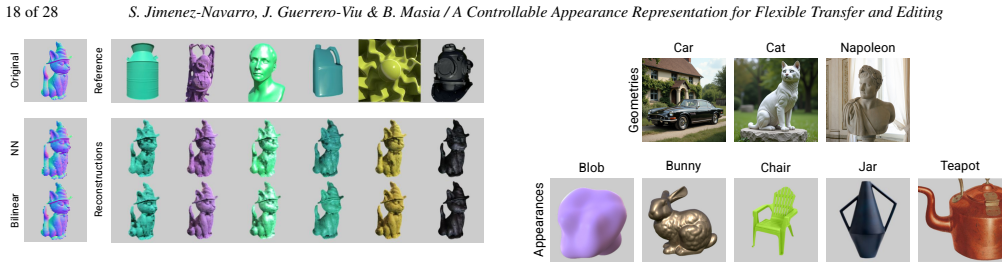
The central claim, stated by the authors, is that a variational autoencoder with a total-correlation disentanglement objective can learn an interpretable and disentangled image-space code for material appearance without explicit supervision, provided the decoder is given the target geometry as normal maps. The learned six dimensions turn out to be: lightness; two hue axes that the model aligns approximately perpendicular in the chromatic circle; two light-direction axes; and gloss. This code lives in a 6D space selected by sweeping dimensionality from three to ten and balancing interpretability and disentanglement metrics. The paper further shows that the same encoder can drive a diffusion-based inpainting pipeline, enabling appearance transfer, selective transfer of chosen dimensions from different images, interpolation between materials, and fine-grained editing of individual attributes in real photographs, even though training is synthetic. The authors acknowledge limits: the autoencoder alone degrades on geometries very different from training, and the representation covers only homogeneous opaque materials under moderate lighting.
Load-bearing premise
The load-bearing premise is that feeding the decoder the target geometry as normal maps keeps geometry out of the six-dimensional code, a premise that is only measured on simple blob and sphere test geometries (Section 4.1) while the paper itself reports artifacts when decoding very different geometries (Section 4.2, supplement S3.3).
Editorial extensions
If this is right
- A single photograph of a homogeneous object can be compressed to a 6D vector carrying material and lighting, so appearance transfer no longer needs a text prompt or human-annotated labels.
- Because the dimensions are independent, users can move one attribute at a time — gloss, hue, lightness, or light direction — while the other attributes stay fixed.
- Appearance can be assembled from several exemplars by taking different dimensions from different images, such as hue from one object and gloss and lightness from another.
- The image-space code transfers to real photographs even though training is synthetic, letting a real object's appearance be re-rendered on a new geometry.
- Edits remain local to the material and leave geometry and background intact, which is the advantage the paper claims over text-instruction editing methods.
Reading between the lines
- If the code is as geometry-free as claimed, the same encoder could serve as a retrieval descriptor for material search across arbitrary object shapes; the paper mentions retrieval only as future work, so this is an extension rather than a paper claim.
- The same self-supervised recipe, applied to render sets that vary texture, roughness, anisotropy, or translucency, could plausibly yield interpretable dimensions for those attributes; the paper does not test this.
- Because only two dimensions encode illumination direction, selective transfer between images with different environment colors or high-frequency lighting structures will likely fail; the paper itself reports degradation on high-frequency lighting, so the practical scope of the code is limited to moderate, roughly neutral lighting.
- The reported preference for the proposed transfer over a semantic-image-embedding baseline (61.5% versus 38.5% in a user study) suggests geometry leakage in the baseline is a real practical issue, but a larger study that varies geometry complexity would be needed to know how much the advantage generalizes.
Signed reviews
Editorial analysis
A structured set of objections, weighed in public.
Referee Report
Summary. The paper proposes a self-supervised method for learning a compact, interpretable appearance representation from images of homogeneous, opaque objects. A FactorVAE-based encoder maps an input image to a six-dimensional latent code, while the decoder is conditioned on normal maps to encourage the code to capture material and illumination rather than geometry. The loss is modified with a norm-based KL regularizer and beta-annealing to mitigate posterior collapse. The authors introduce a synthetic dataset of 98,550 renders (30 geometries, 365 measured BRDFs, 9 lighting conditions) and report quantitative disentanglement, interpretability, and reconstruction comparisons against betaVAE, betaTCVAE, and FactorVAE. They then use the frozen encoder to condition a diffusion pipeline via a lightweight IP-Adapter, enabling appearance transfer, selective attribute transfer, editing, and interpolation. Code, models, and dataset are released.
Significance. If the central claim holds, this is a useful contribution: a six-dimensional, self-supervised appearance code that separates hue, gloss, lightness, and illumination would enable fine-grained control in material transfer and editing without human labels. The paper's strengths include the public release of code, models, and dataset; the use of measured BRDFs; systematic ablations of the loss modifications; and quantitative comparisons to three VAE baselines. The compactness of the representation and the demonstration that it can condition a diffusion pipeline are also valuable. However, the geometry-independence claim--which is load-bearing for selective transfer--is not directly measured on complex geometry, and the application-level evaluation is mostly qualitative. These issues are addressable with additional experiments, so the contribution is defensible but needs revision.
major comments (4)
- [Sec. 4.1, Table 1; Sec. 5.2] The headline disentanglement and interpretability metrics are computed only on a test subset deliberately limited to blob and sphere geometries (Sec. 4.1). Complex geometry is used only for reconstruction quality, not for disentanglement or interpretability. This leaves the central claim that each latent dimension varies only with material/illumination and not with geometry untested exactly where it is hardest. Supplement S3.4 reports an aggregate cosine similarity of 0.879 between embeddings of the same material rendered on cylinder and statuette, but an aggregate value does not rule out a single latent dimension carrying geometry-dependent signal. Because Section 5's selective transfer recombines individual dimensions across images, any per-dimension geometry leakage would directly corrupt the application. Please provide per-dimension invariance statistics (e.g., per-dimension variance or consistency across geometry renderings) on complex unseen geometries, not only an aggregate similarity.
- [Sec. 3.1.2, Table 2] Conditioning the decoder on normal maps is presented as 'compelling' the latent space to focus on appearance, but it is a soft inductive bias rather than a constraint, and no direct measurement shows that geometry information is absent from the code. The 'Without Normals' ablation in Table 2 shows changes in PSNR and MIR, but it does not measure what geometry-dependent information remains in the six dimensions. I recommend a direct leakage test: train a simple linear classifier on the latent codes to predict geometry identity (with appearance and illumination held fixed), or compute per-dimension classification accuracy / mutual information with geometry. Without such a test, the architecture claim in Sec. 3.1.2 is supported only by indirect evidence.
- [Sec. 4.1] The test set overlaps with the training set in materials: 'some materials are both in our training and test sets' (Sec. 4.1). Since the interpretability metrics (Z-min, MIR) use ground-truth labels on exactly this test set, the model could partially memorize material identity rather than learning general attribute semantics, inflating the reported interpretability scores. The authors note that illuminations and scene configurations differ, which mitigates but does not eliminate the confound. I ask for a hold-out material split, or at least a breakdown of MIR/Z-min separately for materials seen and unseen during training, so readers can gauge generalization to genuinely new materials.
- [Sec. 5.2, S6.2] The diffusion-pipeline evaluation for appearance transfer and editing is largely qualitative. The only quantitative evidence is a two-alternative user study with 20 participants (61.5% vs. 38.5% preference over ZeST), reported in S6.2 without a significance test. Moreover, there is no measurement of whether traversing one latent dimension in the diffusion outputs changes only the intended attribute and leaves others unchanged. Given that the abstract and Section 5 claim 'fine-grained control' and 'strong disentanglement,' I recommend adding a quantitative or at least statistically sound evaluation of the diffusion outputs, for example an attribute-classification test on generated images or a significance test for the user preference data.
minor comments (5)
- [Eq. (1)] The definition of the norm-based KL term is difficult to parse as typeset: D_KL(Q,P,n) appears to be a scalar expression without an explicit index over latent dimensions, so the 'norm of order n' is not reproducible from the equation. Please give the explicit form, e.g., (sum_j KL_j^n)^{1/n} or the equivalent used in the implementation.
- [Table 1] The GTC column shows '-' for betaVAE and betaTCVAE. If GTC was not computed for these baselines, state why; otherwise provide the values for completeness.
- [Sec. 4.3, Fig. 6] The KL evolution plots are described as showing how much information each dimension stores. Since the y-axis is not labeled in the figure, please add a caption note that higher values correspond to larger KL distance from the standard normal prior, and clarify the scale used.
- [Sec. 4.2, Fig. 3] The semantic names of the dimensions (lightness, hue #1, hue #2, light direction #1/#2, gloss) are assigned after training. This is acceptable, but the figure caption should make explicit that these names are post hoc interpretations of traversal behavior, not learned labels.
- [S6.1] The diffusion-based posterior traversals omit the two illumination dimensions. This is a reasonable choice, but it should be stated in the main text or figure caption so readers do not infer that illumination traversals were validated in the diffusion pipeline.
Circularity Check
No significant circularity: the 6D latent code is trained without appearance labels, and the semantic attribute names are assigned and evaluated post hoc against external labels and traversals.
full rationale
The paper's central derivation is self-contained. The 6D latent representation is trained by minimizing Eq. 1, which combines a reconstruction term, a per-dimension KL regularizer, and a total-correlation term; no appearance labels enter the loss, and the semantic names (lightness, hue, light direction, gloss) are assigned a posteriori from traversal visualizations (Sec. 4.2, Fig. 3). Interpretability metrics Z-min and MIR are computed after training using ground-truth labels from the test dataset (Sec. 4.1); these labels are used for evaluation only and are not fitted parameters renamed as predictions. The choice of six latent dimensions is presented as a design decision analyzed in Sec. 4.3, not as a quantity predicted by the method. The normal-map conditioning of Sec. 3.1.2 is an inductive bias that encourages geometry to be handled by the decoder; it is a soft architectural choice, not a circular constraint, and the paper candidly documents its limitations, including failure on unseen geometries (S3.3), out-of-distribution illumination (Fig. 12), lack of perceptual linearity, and the absence of hard disentanglement constraints. The one citation to prior work by a coauthor, the Serrano dataset [SCW*21], supplies test images, measured BRDFs, and ground-truth labels as external published data; it is not invoked as a uniqueness theorem, nor does it justify the loss or the claimed disentanglement. The restriction of the headline disentanglement metrics to blob/sphere test geometries weakens the evidence for geometry-invariance on complex shapes, but that is a validity and generalization concern, not a circularity: no equation or construction reduces the claimed result to its inputs.
Assumptions & free parameters
free parameters (5)
- Latent dimensionality =
6
- Maximum KL weight beta =
2
- Total correlation weight gamma =
6
- KL norm order n =
3
- ControlNet weights =
D=0.2, C=0.9
assumptions (5)
- domain assumption The appearance of a homogeneous opaque object in an image is factorizable into six independent latent dimensions under a standard normal prior.
- domain assumption Feeding normal maps to the decoder removes geometry as a latent factor of variation.
- domain assumption The synthetic dataset of 365 measured BRDFs, 30 geometries, and 9 rotations of one environment map is representative enough for real-world homogeneous materials.
- domain assumption Ground-truth attribute labels in the Serrano test set are a valid measure of interpretability.
- domain assumption Pretrained generative components (RealisticVisionXL4.0, ControlNets, depth estimator) behave consistently when conditioned from a 6D latent via IP-Adapter.
Cite this review
Pith. "Pith review of A Controllable Appearance Representation for Flexible Transfer and Editing." pith.science (2026). https://pith.science/paper/OCPUQ3PJ
@misc{pith2026250415028,
  author       = {Pith},
  title        = {Pith review of: A Controllable Appearance Representation for Flexible Transfer and Editing},
  year         = {2026},
  howpublished = {\url{https://pith.science/paper/OCPUQ3PJ}},
  note         = {Machine review of arXiv:2504.15028}
}
read the original abstract
We present a method that computes an interpretable representation of material appearance within a highly compact, disentangled latent space. This representation is learned in a self-supervised fashion using an adapted FactorVAE. We train our model with a carefully designed unlabeled dataset, avoiding possible biases induced by human-generated labels. Our model demonstrates strong disentanglement and interpretability by effectively encoding material appearance and illumination, despite the absence of explicit supervision. Then, we use our representation as guidance for training a lightweight IP-Adapter to condition a diffusion pipeline that transfers the appearance of one or more images onto a target geometry, and allows the user to further edit the resulting appearance. Our approach offers fine-grained control over the generated results: thanks to the well-structured compact latent space, users can intuitively manipulate attributes such as hue or glossiness in image space to achieve the desired final appearance.
Figures


Figures from the paper (29 more)




Forward citations
Cited by 1 Pith paper
-
A Hybrid Neural-Microfacet BRDF Model for Real-Time Rendering
A hybrid BRDF model, combining a GGX analytical term with a tiny learned residual and gating network, fits measured materials more accurately than fully neural models at equal memory cost.
Reference graph
Works this paper leans on
-
[1]
Improv- ing image generation with better captions
[BGJ*23] B ETKER , J AMES , G OH, G ABRIEL , J ING, L I, et al. “Improv- ing image generation with better captions”. Computer Science. 2.3 (2023), 8
work page 2023
-
[2]
An Adaptive Pa- rameterization for Efficient Material Acquisition and Rendering
[DJ18] D UPUY , J ONATHAN and J AKOB , W ENZEL . “An Adaptive Pa- rameterization for Efficient Material Acquisition and Rendering”. ACM Transactions on Graphics (Proceedings of SIGGRAPH Asia)37.6 (Nov. 2018), 274:1–274:18 2, 4,
work page 2018
-
[3]
Instructpix2pix: Learning to follow image editing instruc- tions
[BHE23] B ROOKS , T IM, H OLYNSKI , A LEKSANDER , and E FROS , ALEXEI A. “Instructpix2pix: Learning to follow image editing instruc- tions”. Proceedings of the IEEE/CVF Conference on Computer Vision and Pattern Recognition. 2023, 18392–18402 2, 10,
work page 2023
-
[4]
Colorpeel: Color prompt learning with diffusion models via color and shape disentangle- ment
[BWVvdW24] B UTT, M UHAMMAD ATIF, W ANG, K AI, V AZQUEZ - CORRAL , J AVIER, and van de W EIJER , J OOST . “Colorpeel: Color prompt learning with diffusion models via color and shape disentangle- ment”. Proceedings of the European Conference on Computer Vision . Springer. 2024, 456–472
work page 2024
-
[5]
[CDH*16] C HEN, X I, D UAN, YAN, H OUTHOOFT , R EIN, et al. “Infogan: Interpretable representation learning by information maximizing gener- ative adversarial nets”. Advances in Neural Information Processing Sys- tems 29 (2016)
work page 2016
-
[6]
Isolating sources of disentanglement in varia- tional autoencoders
[CLGD18] C HEN, R ICKY TQ, L I, X UECHEN , G ROSSE , R OGER B, and DUVENAUD , DAVID K. “Isolating sources of disentanglement in varia- tional autoencoders”. Advances in Neural Information Processing Sys- tems 31 (2018) 3,
work page 2018
-
[7]
Zest: Zero-shot material transfer from a single image
[CSM*24] C HENG , T A-Y ING, S HARMA , P RAFULL , M ARKHAM , A N- DREW , et al. “Zest: Zero-shot material transfer from a single image”. Proceedings of the European Conference on Computer Vision. Springer. 2024, 370–386 2, 3, 8, 10,
work page 2024
-
[8]
Single-image svbrdf capture with a rendering-aware deep network
[DAD*18] D ESCHAINTRE , V ALENTIN , A ITTALA , M IIKA , D URAND , FREDO , et al. “Single-image svbrdf capture with a rendering-aware deep network”. ACM Transactions on Graphics (TOG)37.4 (2018), 1–15
work page 2018
Show all 66 references
-
[10]
Unsupervised learning predicts human percep- tion and misperception of gloss
[SAF21] S TORRS , K ATHERINE R, A NDERSON , B ARTON L, and F LEM - ING, R OLAND W. “Unsupervised learning predicts human percep- tion and misperception of gloss”. Nature Human Behaviour 5.10 (2021), 1402–1417 3,
2021
-
[11]
2022, 453–464 2–4,
Wiley Online Library. 2022, 453–464 2–4,
2022
-
[13]
Cyclical Annealing Schedule: A Simple Approach to Mitigating KL Vanishing
[FLL*19] F U, H AO, L I, C HUNYUAN , L IU, X IAODONG , et al. “Cyclical Annealing Schedule: A Simple Approach to Mitigating KL Vanishing”. NAACL. 2019
2019
-
[14]
2014, 91–99
Wiley On- line Library. 2014, 91–99
2014
-
[15]
Disentangling VAE
[DKLM19] D UBOIS , YANN, K ASTANOS , A LEXANDROS , L INES , DAVE, and M ELMAN , B ART. Disentangling VAE. http://github.com/ YannDubs/disentangling-vae/. Mar. 2019
2019
-
[16]
Texsliders: Diffusion-based texture editing in clip space
[GHR*24] G UERRERO -VIU, J ULIA , H ASAN , M ILOS , R OULLIER , ARTHUR , et al. “Texsliders: Diffusion-based texture editing in clip space”. ACM SIGGRAPH 2024 Conference Papers. 2024, 1–11
2024
-
[17]
Real-world illumination and the perception of surface re- flectance properties
[FDA03] F LEMING , R OLAND W., D ROR, R ON O., and A DELSON , E D- WARD H. “Real-world illumination and the perception of surface re- flectance properties”. Journal of Visual Communication and Image Rep- resentation 3.5 (2003). ISSN : 1534-7362
2003
-
[18]
Interpretable Disentangled Parametrization of Measured BRDF with β-V AE
[BSP22] B ENAMIRA , A LEXIS , S HAH, S ACHIN , and P ATTANAIK , SUMANTA . “Interpretable Disentangled Parametrization of Measured BRDF with β-V AE”.arXiv preprint arXiv:2208.03914 (2022)
2022 arXiv
-
[19]
Fast R-CNN
[Gir15] G IRSHICK , R OSS. “Fast R-CNN”. International Conference on Computer Vision (ICCV). 2015
2015
-
[20]
2024, e15037
Wiley Online Library. 2024, e15037
2024
-
[21]
2016, 1–12
Wiley Online Library. 2016, 1–12
2016
-
[22]
Deep- BRDF: A Deep Representation for Manipulating Measured BRDF
[HGC*20] H U, B INGYANG , G UO, J IE, C HEN, Y ANJUN , et al. “Deep- BRDF: A Deep Representation for Manipulating Measured BRDF”. Computer Graphics Forum 39.2 (2020), 157–166 2,
2020
-
[23]
Denoising diffusion probabilistic models
[HJA20] H O, JONATHAN , JAIN, AJAY, and ABBEEL , PIETER . “Denoising diffusion probabilistic models”. Advances in Neural Information Pro- cessing Systems 33 (2020), 6840–6851
2020
-
[24]
beta- vae: Learning basic visual concepts with a constrained variational frame- work
[HMP*17] H IGGINS , I RINA , M ATTHEY , L OIC, PAL, A RKA, et al. “beta- vae: Learning basic visual concepts with a constrained variational frame- work.” ICLR (Poster) 3 (2017) 3,
2017
-
[25]
LoRA: Low-Rank Adaptation of Large Language Models
[HSW*22] H U, E DWARD J, S HEN, Y ELONG , W ALLIS , P HILLIP , et al. “LoRA: Low-Rank Adaptation of Large Language Models”. The Tenth International Conference on Learning Representations, ICLR. 2022
2022
-
[26]
Mitsuba renderer
[Jak10] J AKOB , W ENZEL . Mitsuba renderer . http://www.mitsuba- renderer.org. 2010 5,
2010
-
[27]
A style- based generator architecture for generative adversarial networks
[KLA19] K ARRAS , T ERO, L AINE , S AMULI , and A ILA, T IMO. “A style- based generator architecture for generative adversarial networks”. Pro- ceedings of the IEEE/CVF Conference on Computer Vision and Pattern Recognition. 2019, 4401–4410
2019
-
[28]
Disentangling by fac- torising
[KM18] K IM, H YUNJIK and M NIH, A NDRIY . “Disentangling by fac- torising”. International Conference on Machine Learning . PMLR. 2018, 2649–2658 2–5. [KOF*23] K INOSHITA , YURI, OONO, KENTA, FUKUMIZU , KENJI , et al. “Controlling posterior collapse by an inverse Lipschitz con...
2018
-
[29]
Repurposing Diffusion-Based Image Generators for Monocular Depth Estimation
[KOH*24] K E, BINGXIN , OBUKHOV , ANTON , HUANG , SHENGYU , et al. “Repurposing Diffusion-Based Image Generators for Monocular Depth Estimation”. Proceedings of the IEEE/CVF Conference on Computer Vi- sion and Pattern Recognition. 2024
2024
-
[30]
Neumip: Multi-resolution neural materials
[Kuz21] K UZNETSOV , A LEXANDR . “Neumip: Multi-resolution neural materials”. ACM Transactions on Graphics (TOG)40.4 (2021)
2021
-
[31]
Deep convolutional inverse graphics network
[KWKT15] K ULKARNI , T EJAS D, W HITNEY , W ILLIAM F, K OHLI , PUSHMEET , and T ENENBAUM , J OSH. “Deep convolutional inverse graphics network”. Advances in Neural Information Processing Systems 28 (2015)
2015
-
[32]
[Lab23] L ABS, B LACK FOREST . FLUX. https : / / github . com / black-forest-labs/flux . 2023
2023
-
[33]
Challenging common assumptions in the unsupervised learning of disentangled representations
[LBL*19] L OCATELLO , FRANCESCO , BAUER , STEFAN , LUCIC , MARIO , et al. “Challenging common assumptions in the unsupervised learning of disentangled representations”. International Conference on Machine Learning. PMLR. 2019, 4114–4124
2019
-
[34]
A Similarity Measure for Material Appearance
[LMS*19] L AGUNAS , M ANUEL , M ALPICA , S ANDRA , S ERRANO , A NA, et al. “A Similarity Measure for Material Appearance”. ACM Transac- tions on Graphics (TOG) 38.4 (2019)
2019
-
[35]
The joint role of geometry and illumination on material recognition
S. Jimenez-Navarro, J. Guerrero-Viu & B. Masia / A Controllable Appearance Representation for Flexible Transfer and Editing 13 of 28 [LSGM21] L AGUNAS , MANUEL , SERRANO , ANA, GUTIERREZ , DIEGO , and M ASIA , B ELEN . “The joint role of geometry and illumination on material r...
2021
-
[36]
Unsupervised learning reveals interpretable latent representations for translucency perception
[LSX23] L IAO, C HENXI , S AWAYAMA, M ASATAKA , and X IAO, B EI. “Unsupervised learning reveals interpretable latent representations for translucency perception”. PLOS Computational Biology 19.2 (2023), e1010878
2023
-
[37]
Understanding Posterior Collapse in Gener- ative Latent Variable Models
[LTGN19] L UCAS , J AMES , T UCKER , G EORGE , G ROSSE , R OGER , and NOROUZI , M OHAMMAD . Understanding Posterior Collapse in Gener- ative Latent Variable Models. 2019
2019
-
[38]
A Data-Driven Reflectance Model
[MPBM03] M ATUSIK , W OJCIECH , P FISTER , H ANSPETER , B RAND , MATT, and M CMILLAN , L EONARD . “A Data-Driven Reflectance Model”. ACM Transactions on Graphics (TOG) 22.3 (July 2003), 759– 769 2, 4,
2003
-
[39]
T2I- Adapter: learning adapters to dig out more controllable ability for text- to-image diffusion models
[MWX*24] M OU, CHONG , WANG, XINTAO, XIE, LIANGBIN , et al. “T2I- Adapter: learning adapters to dig out more controllable ability for text- to-image diffusion models”.Proceedings of the Thirty-Eighth AAAI Con- ference on Artificial Intelligence and Thirty-Sixth Conference on I...
2024
-
[40]
PyTorch: An Imperative Style, High-Performance Deep Learning Li- brary
[PGM*19] P ASZKE , A DAM, G ROSS , S AM, M ASSA , F RANCISCO , et al. “PyTorch: An Imperative Style, High-Performance Deep Learning Li- brary”. Advances in Neural Information Processing Systems 32 . Curran Associates, Inc., 2019, 8024–8035 15,
2019
-
[41]
High-resolution image synthesis with latent diffusion models
[RBL*22] R OMBACH , R OBIN , B LATTMANN , A NDREAS , L ORENZ , D O- MINIK , et al. “High-resolution image synthesis with latent diffusion models”. Proceedings of the IEEE/CVF Conference on Computer Vision and Pattern Recognition. 2022, 10684–10695 3,
2022
-
[42]
2020, 167–178
Wiley Online Library. 2020, 167–178
2020
-
[43]
2019, 235– 244
Wiley Online Library. 2019, 235– 244
2019
-
[44]
Learning transferable visual models from natural language super- vision
[RKH*21] R ADFORD , A LEC, K IM, J ONG WOOK, H ALLACY , C HRIS , et al. “Learning transferable visual models from natural language super- vision”. International Conference on Machine Learning (2021), 8748– 8763 3, 6,
2021
-
[45]
Photorealistic text-to-image diffusion models with deep language understanding
[SCS*22] S AHARIA , CHITWAN , CHAN, WILLIAM , SAXENA , SAURABH , et al. “Photorealistic text-to-image diffusion models with deep language understanding”. Advances in Neural Information Processing Systems 35 (2022), 36479–36494
2022
-
[46]
The ef- fect of shape and illumination on material perception: model and appli- cations
[SCW*21] S ERRANO , A NA, C HEN, B IN, WANG, C HAO, et al. “The ef- fect of shape and illumination on material perception: model and appli- cations”. ACM Transactions on Graphics (TOG) 40.4 (2021) 2–5, 15,
2021
-
[47]
An intuitive control space for material appearance
[SGM*16] S ERRANO , A NA, G UTIERREZ , D IEGO , M YSZKOWSKI , KAROL , et al. “An intuitive control space for material appearance”. ACM Transactions on Graphics (TOG)35.6 (2016)
2016
-
[48]
A mathematical theory of com- munication
[Sha48] S HANNON , C LAUDE ELWOOD . “A mathematical theory of com- munication”. The Bell System Technical Journal27.3 (1948), 379–423
1948
-
[49]
Alchemist: Parametric control of material properties with diffusion models
[SJL*24] S HARMA , P RAFULL , J AMPANI , V ARUN , L I, Y UANZHEN , et al. “Alchemist: Parametric control of material properties with diffusion models”. Proceedings of the IEEE/CVF Conference on Computer Vision and Pattern Recognition. 2024, 24130–24141
2024
-
[50]
2023, 333–345 3, 10,
Wiley Online Library. 2023, 333–345 3, 10,
2023
-
[51]
Ladder variational autoencoders
[SRM*16] S ØNDERBY , C ASPER KAAE, R AIKO , T APANI , M AALØE , LARS, et al. “Ladder variational autoencoders”. Advances in Neural In- formation Processing Systems 29 (2016) 3,
2016
-
[52]
2018, 135–144 2,
Wiley Online Library. 2018, 135–144 2,
2018
-
[53]
A low-dimensional perceptual space for intuitive BRDF editing
[SWSR21] S HI, W EIQI , W ANG, Z EYU, S OLER , C YRIL , and R USH - MEIER , H OLLY. “A low-dimensional perceptual space for intuitive BRDF editing”. EGSR 2021-Eurographics Symposium on Rendering- DL-only Track. 2021, 1–13
2021
-
[54]
Three Perceptual Dimensions for Specu- lar and Diffuse Reflection
[TGG*20] T OSCANI , M ATTEO , G UARNERA , D AR’YA, G UARNERA , GIUSEPPE CLAUDIO , et al. “Three Perceptual Dimensions for Specu- lar and Diffuse Reflection”. ACM Transactions on Applied Perception 17.2 (May 2020). ISSN : 1544-3558
2020
-
[55]
Collaborative control for geometry-conditioned PBR image genera- tion
[VBP*24] V AINER , S HIMON , B OSS, M ARK, P ARGER , M ATHIAS , et al. “Collaborative control for geometry-conditioned PBR image genera- tion”. Proceedings of the European Conference on Computer Vision . Springer. 2024, 127–145
2024
-
[56]
ControlMat: A Controlled Generative Approach to Ma- terial Capture
[VMR*24] V ECCHIO , G IUSEPPE , M ARTIN , R OSALIE , R OULLIER , ARTHUR , et al. “ControlMat: A Controlled Generative Approach to Ma- terial Capture”. ACM Transactions on Graphics (TOG) 43.5 (2024) 2,
2024
-
[57]
Diffusers: State-of-the-art diffusion models
[vPPL*22] V on P LATEN , PATRICK , PATIL, S URAJ , L OZHKOV , A NTON , et al. Diffusers: State-of-the-art diffusion models. https://github. com/huggingface/diffusers. 2022
2022
-
[58]
Information Theoretical Analysis of Mul- tivariate Correlation
[Wat60] W ATANABE , SATOSI. “Information Theoretical Analysis of Mul- tivariate Correlation”. IBM Journal of Research and Development 4.1 (1960), 66–82 4,
1960
-
[59]
Image quality assessment: from error visibility to structural similarity
[WBSS04] W ANG, Z HOU, B OVIK , A.C., S HEIKH , H.R., and S IMON - CELLI , E.P. “Image quality assessment: from error visibility to structural similarity”. IEEE Transactions on Image Processing 13.4 (2004), 600– 612
2004
-
[60]
Disentangled representation learning
[WCWZ*24] W ANG, X IN, C HEN, H ONG, W U, Z IHAO , Z HU, W ENWU , et al. “Disentangled representation learning”. IEEE Transactions on Pat- tern Analysis and Machine Intelligence (2024)
2024
-
[61]
Disentanglement with Biological Constraints: A Theory of Functional Cell Types
[WDGB23] W HITTINGTON , JAMES C. R., D ORRELL , WILL, GANGULI , SURYA, and B EHRENS , T IMOTHY . “Disentanglement with Biological Constraints: A Theory of Functional Cell Types”. The Eleventh Interna- tional Conference on Learning Representations, ICLR. 2023
2023
-
[62]
DisDiff: unsupervised disentanglement of diffusion probabilistic models
[YWLZ23] Y ANG, TAO, WANG, YUWANG , LU, YAN, and ZHENG , NAN- NING . “DisDiff: unsupervised disentanglement of diffusion probabilistic models”. Proceedings of the 37th International Conference on Neural Information Processing Systems. 2023, 69130–69156
2023
-
[63]
Re- balancing variational autoencoder loss for molecule sequence genera- tion
[YWY*20] Y AN, CHAOCHAO , WANG, SHENG , YANG, JINYU , et al. “Re- balancing variational autoencoder loss for molecule sequence genera- tion”. Proceedings of the 11th ACM international conference on bioin- formatics, computational biology and health informatics. 2020, 1–7
2020
-
[64]
Ip-adapter: Text com- patible image prompt adapter for text-to-image diffusion models
[YZL*23] Y E, HU, ZHANG , JUN, LIU, SIBO, et al. “Ip-adapter: Text com- patible image prompt adapter for text-to-image diffusion models”. arXiv preprint arXiv:2308.06721 (2023) 2, 3, 8,
2023 arXiv
-
[65]
The unreasonable effectiveness of deep features as a perceptual met- ric
[ZIE*18] Z HANG , R ICHARD , I SOLA , P HILLIP , E FROS , A LEXEI A, et al. “The unreasonable effectiveness of deep features as a perceptual met- ric”. Proceedings of the IEEE/CVF Conference on Computer Vision and Pattern Recognition. 2018, 586–595
2018
-
[66]
Dreammat: High-quality pbr material generation with geometry-and light-aware dif- fusion models
14 of 28 S. Jimenez-Navarro, J. Guerrero-Viu & B. Masia / A Controllable Appearance Representation for Flexible Transfer and Editing [ZLX*24] Z HANG , YUQING , LIU, YUAN, XIE, ZHIYU , et al. “Dreammat: High-quality pbr material generation with geometry-and light-aware dif- fus...
2024
-
[67]
Adding conditional control to text-to-image diffusion models
[ZRA23] Z HANG , L VMIN , R AO, A NYI, and A GRAWALA , M ANEESH . “Adding conditional control to text-to-image diffusion models”. Pro- ceedings of the IEEE/CVF International Conference on Computer Vi- sion. 2023, 3836–3847 3, 8,
2023
-
[68]
A Compact Representation of Measured BRDFs Using Neural Pro- cesses
[ZZW*21] Z HENG , CHUANKUN , ZHENG , RUZHANG , WANG, RUI, et al. “A Compact Representation of Measured BRDFs Using Neural Pro- cesses”. ACM Transactions on Graphics (TOG) 41.2 (Nov. 2021). ISSN : 0730-0301 2,
2021
Reviewed August 16, 2026 · model on record in the stance chip above.
Discussion (0). Continue with ORCID to comment.