REVIEW 3 major objections 5 minor 114 references
Electroweak baryogenesis from charged current anomalies in $B$ meson decays
T0 review · 3 major / 5 minor · reviewed 2026-08-09 · deepseek-v4-flash
Pith's one-line read New physics behind B-meson flavor anomalies can also explain the universe's baryon asymmetry.
desk verdict A solid proof of principle that R(D(*))-fit lepton Yukawas can source the BAU, conditional on an uncomputed strong phase transition; worth refereeing, but needs the scalar potential work. read the letter →
The pith
A machine-rendered reading of the paper's core claim, the machinery that carries it, and where it could break.
The reading
What carries the argument
The engine is lepton-mediated electroweak baryogenesis in the G2HDM. The CP violation comes from a wall-position-dependent lepton mass matrix, with the tau-Yukawa phase $\theta$; as the bubble wall passes, the matrix element $\mathrm{Im}(A_{22})$—proportional to the Jarlskog invariant $\mathrm{Im}\,J_A = y_{\tau\tau}^2\sin\theta$, the standard rephasing-invariant measure of CP violation—acts as a semiclassical force in the WKB (Wentzel-Kramers-Brillouin) transport formalism. The resulting source term enters a single diffusion equation for the left-handed lepton number, obtained by decoupling the lepton-Higgs-quark system through the slow tau-Yukawa rate, and solved analytically with Green's functions. The same charged Higgs $H^\pm$ that mediates $b\to c\tau\nu$ and produces the $R(D^{(*)})$ deviation carries the phase that sources the asymmetry, which is why one model connects both observables.
What would settle it
A full computation of the electroweak phase transition for the benchmark point (charged-Higgs mass near $130$ GeV, $\tan\beta=0.6$, $c_{\beta-\alpha}=0.01$) that yields $\xi=v_n/T_n<1.5$ at nucleation or a wall thickness $L_w T_n<3$ would invalidate the predicted $Y_B\simeq 8.6\times10^{-11}$ for that point. Likewise, a null result from the next-generation electron-EDM experiment at sensitivity $\delta d_e \simeq 4\times10^{-31}\,e\,\mathrm{cm}$ would bound $|\tilde{\kappa}_\tau|\lesssim 0.0078$ and exclude most of the BAU-compatible parameter space shown in the paper.
Extended reading notes
Core claim
The paper's central claim is that the charged-current anomalies $R(D^{(*)})$ and the baryon asymmetry of the universe can both be explained by the lepton Yukawa sector of the general two-Higgs-doublet model. With the complex phase $\theta \simeq 2.15$, tau Yukawa $y_{\tau\tau}\simeq 0.05$, small off-diagonal muon-tau couplings, and a charged Higgs mass near $130$ GeV, the model passes the flavor and electron-EDM constraints and predicts $Y_B/Y_B^{\mathrm{obs}} = O(1)$ for strong first-order phase transition parameters $\xi = v_n/T_n \ge 1.5$ and $L_w T_n \ge 3$, with $\Delta\beta = 0.02$ and wall velocities around $0.25$–$0.4$. The paper emphasizes that the WKB source, being second order in derivatives, gives a conservative underestimate of the asymmetry compared with the VEV-resummation approach, so the quoted velocities are not meant as sharp bounds.
Load-bearing premise
The load-bearing premise is that the G2HDM scalar sector actually undergoes a sufficiently strong first-order electroweak phase transition—the paper assumes $\xi = v_n/T_n \ge 1.5$, $L_w T_n \ge 3$, and $\Delta\beta = 0.02$ rather than deriving them; if the real transition is weaker or the bubble wall thicker, the predicted baryon asymmetry falls below the observed value.
Editorial extensions
If this is right
- A confirmed deviation in $R(D^{(*)})$ would cease to be merely a flavor puzzle and would instead imply that the electroweak phase transition was strongly first order and CP-violating.
- At the best-fit point, the baryon asymmetry is reproduced for wall velocities near $v_w = 0.35$, with values above $v_w \simeq 0.4$ disfavored; lower velocities can be accommodated when other parameters vary.
- The next-generation electron-EDM search can probe almost all of the BAU-compatible parameter region, while future Higgs factories measuring CP violation in $h\to\tau\tau$ can test the same CP-violating Yukawa coupling.
- Because the WKB source underestimates the asymmetry relative to the VEV-resummation formalism, a less conservative transport calculation would generally allow smaller bubble-wall velocities and a wider allowed region.
- Benchmark points with $m_{H^\pm}\simeq 130$ GeV connect the scenario to existing searches for a light charged Higgs decaying to $c\bar{b}$, giving a collider handle independent of the B-meson data.
Reading between the lines
- The paper's proof-of-principle leaves one step undone: identifying which G2HDM scalar-potential parameters produce a strong first-order transition with $\xi\ge 1.5$, $L_w T_n \ge 3$, and $\Delta\beta=0.02$. A full calculation would turn the assumed thermal parameters into a model-level prediction and could shrink or eliminate the allowed region.
- If the same tau-Yukawa phase is responsible for both anomalies, the model correlates several future measurements: the electron EDM, the CP asymmetry in $h\to\tau\tau$, and lepton-flavor-violating tau decays should all point to the same magnitude of CP violation; a null result in just one channel would put tension on the connection.
- The mechanism does not require the neutral-current $b\to s\mu^+\mu^-$ anomalies, so a clean experimental test is the charged Higgs itself: discovering a $\sim130$ GeV $H^\pm$ with the predicted $b\to c\tau\nu$ couplings would independently confirm the flavor side of the connection, leaving the phase-transition strength as the remaining cosmological unknown.
Editorial analysis
A structured set of objections, weighed in public.
Referee Report
Summary. The paper claims that the general two-Higgs-doublet model with complex lepton Yukawa couplings, in the parameter region that fits the R(D^(*)) anomalies and the electron EDM bound, can also explain the observed baryon asymmetry of the universe through electroweak baryogenesis. The BAU is computed in the WKB/semiclassical transport formalism, reduced to a single lepton diffusion equation, using an analytic approximation for the source terms documented in the End Matter. For the best-fit point (y_mumu=0.001, y_mutau=0.01, y_tautau=0.05, theta=2.15, c_beta-alpha=0.01, m_H+ about 130 GeV) and assumed strong first-order phase transition parameters (xi=v_n/T_n at least 1.5, L_w T_n about 3, Delta beta=0.02), the authors obtain Y_B close to the Planck value for bubble wall velocities around v_w=0.35, and they identify future eEDM and Higgs-factory probes.
Significance. If the missing phase-transition calculation is supplied, this would be a notable connection between the R(D^(*)) flavor anomalies and electroweak baryogenesis, with falsifiable predictions for future eEDM and Higgs-factory measurements. The transport calculation is documented in the End Matter, uses the WKB source (second order in derivatives, hence conservative compared to the VEV-resummation approach), and checks the single-species and equal-diffusion approximations against prior work. The BAU comparison is a post-fit overlay rather than part of the likelihood, so the analysis is not circular. The central caveat, which is stated openly in the paper, is that the quantitative match depends on hand-selected thermal parameters that are not derived from the scalar potential of the benchmark; this is the load-bearing point that needs work before the headline claim can be accepted as demonstrated.
major comments (3)
- [Results (thermal parameters paragraph) and Fig. 2] The central quantitative result, Y_B/Y_B^obs = 1, is obtained for hand-selected thermal parameters xi = v_n/T_n in {1.5, 2}, L_w T_n in {3, 8}, Delta beta = 0.02, with v_w treated as a free parameter, rather than computed from the G2HDM scalar potential at the benchmark point. Because Eq. (4) is directly proportional to the CP-violating source built from the bubble profiles in Eqs. (A1), (C1), and (C6), the agreement with the observed BAU is conditional on the existence of a strong first-order phase transition with these properties in the same parameter region that fits R(D^(*)) and the eEDM. Prior 2HDM studies [39-41] establish strong first-order transitions in other parts of parameter space, but they do not demonstrate overlap with m_H+ about 130 GeV, tan beta = 0.6, c_beta-alpha = 0.01, and the lepton-Yukawa texture of Eq. (C2). The paper explicitly acknowledges this ('we simply select reasonable choices... future work'), so the issue is not hidden, but it is load-bearing: without a demonstration that the flavor-fit benchmark also yields xi >= 1.5 and L_w T_n about 3, the headline claim is a conditional proof of principle rather than a demonstration. I request either a finite-temperature calculation or scan showing that a point satisfying all flavor, eEDM, and stability constraints has a sufficiently strong first-order phase transition with the assumed wall properties, or an explicit reframing of the central claim as conditional on such a transition.
- [End Matter, Eqs. (C4)-(C6)] The normalization of the source term relies on the identity Im(J_A) = y_tautau^2 sin(theta), stated after Eq. (C6). As written, J_A in Eq. (C5) involves the scalar potential parameters v_a, mu_bc, and mu_HB12, so this identity cannot hold for arbitrary values of those parameters. Since Im(J_A) enters directly in Im(A22) and hence in the source S_j through Eq. (C6), the predicted Y_B scales with the assumed value. Please derive this identity and state the required conditions on the scalar potential parameters (e.g., reality conditions or basis choices) under which the combination in Eq. (C5) reduces to y_tautau^2 sin(theta) for the texture of Eq. (C2).
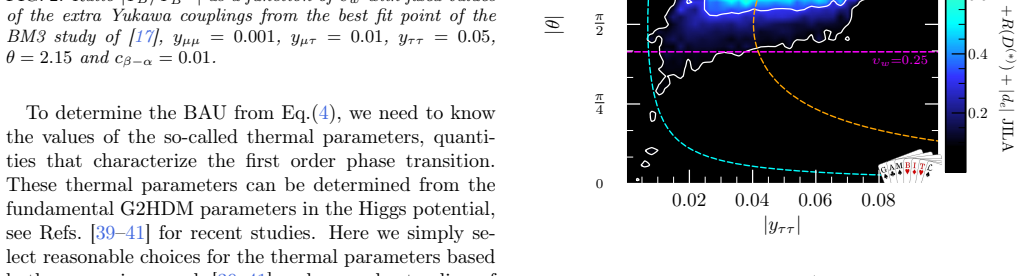
- [Results, Fig. 2 and Fig. 3] The bubble wall velocity v_w is treated as a free parameter, and Fig. 3 quotes v_w = 0.35 for the best-fit point. Since v_w is not computed from the model's microphysics and the BAU has a non-monotonic dependence on v_w (including a sharp dip near v_w = 0.1), the quoted match is partly a parameter choice. This is not by itself an error, but it should be stated explicitly that the paper makes no prediction for v_w and that the quoted value is one of several possible choices; the current text sometimes reads as if v_w = 0.35 is a prediction of the model.
minor comments (5)
- [Eq. (1)] There is a typo in 'dropped the the subscript' — it should read 'dropped the subscript'.
- [Results, source term sentence] The text says 'We obtain the source term on the right hand side of Eq. (3)', but the CP-violating source S_l appears in Eq. (1); Eq. (3) has n_L as the source. Please correct the cross-reference.
- [Fig. 3 caption and color bar] The color-bar label 'L/Lmaxflavour +R(D(*)) +|de|JILA' is difficult to parse; please define the components of the likelihood more clearly in the caption.
- [Introduction and abstract] The abstract and introduction state that the paper 'demonstrate[s] for the first time' the connection, but the quantitative result is obtained under the explicit assumption of a sufficiently strong first-order phase transition with specific thermal parameters. The abstract does include the assumption, but the wording 'demonstrate' is stronger than what is computed; consider softening to 'show, under the assumption of...' to match the actual scope.
- [References] Ref. [98] is the 2013 Planck release; the central value Y_B^obs = 8.59e-11 is still used, but a more recent Planck value and reference would be appropriate.
Circularity Check
No significant circularity: the flavor-fit parameters are independent inputs and the observed BAU is a post-fit overlay, not a fitted target.
full rationale
Walking the derivation chain from the G2HDM lepton Yukawa texture (Eq. C2) through the WKB source (Eqs. C4, C6) to the baryon asymmetry (Eq. 4), I find no step in which a predicted quantity is equivalent by construction to an input, nor any load-bearing self-citation that smuggles in the BAU conclusion. The parameters y_tau_tau, y_mu_tau, and theta are fixed by a separate published GAMBIT global fit to R(D(*)) and other flavor observables plus the JILA eEDM bound; the observed BAU does not appear in that likelihood. Figure 3 overlays Y_B/Y_B^obs = 1 contours on the flavor/eEDM profile-likelihood plane, so the agreement is a post-fit demonstration rather than a statistical fit to the BAU. The paper's phrase 'we fit the observed BAU' is loose, but the profile likelihood L is explicitly defined as the sum of flavor and eEDM likelihoods, confirming that the BAU was not fitted. The thermal parameters (xi >= 1.5, L_w T_n ~ 3, Delta beta = 0.02) are hand-selected and the paper explicitly defers their derivation from the scalar potential to future work; this is an acknowledged provenance and robustness limitation, not a circular reduction of Y_B to its inputs. Self-citations to Refs. [16,17,41] are present, but [17] is an independent code-based global fit and [41] is a separate phase-transition study; neither is an unverified assertion that already contains the target result. No specific circular step can be exhibited, so the appropriate finding is no significant circularity.
Assumptions & free parameters
free parameters (11)
- y_mumu =
0.001
- y_mutau =
0.01
- y_tautau =
0.05
- theta =
2.15
- c_beta_minus_alpha =
0.01
- m_H+ (charged Higgs mass) =
~130 GeV
- xi = vn/Tn =
1.5 or 2.0
- Lw Tn =
3 or 8
- Delta beta =
0.02
- vw (bubble wall velocity) =
scanned, e.g., 0.35
- vn =
200 GeV
assumptions (5)
- domain assumption The lepton-mediated EWBG transport can be reduced to a single diffusion equation for left-handed lepton density l_L, with l_L = -tau_R and equal diffusion constants Dl = 100/T, as established in Ref. [63].
- domain assumption The WKB semiclassical method gives a valid CP-violating source term at second order in derivatives (Eq. C6).
- domain assumption The bubble wall profiles are tanh kinks with the form of Eq. (C1), and only the lepton Yukawa sector provides the CP violation (Delta beta fixed at 0.02).
- ad hoc to paper The identity Im(JA) = y_tautau^2 sin(theta) (stated after Eq. C6) holds for the texture of Eq. (C2), implicitly fixing the scalar potential parameters (mu_ab, mu_HB12) that enter the Jarlskog invariant.
- domain assumption A sufficiently strong first-order electroweak phase transition with xi >= 1.5, LwTn >= 3 is realizable in the G2HDM parameter region that fits the flavor data.
Cite this review
Pith. "Pith review of Electroweak baryogenesis from charged current anomalies in $B$ meson decays." pith.science (2026). https://pith.science/paper/OCRDX7DK
@misc{pith2026250200445,
  author       = {Pith},
  title        = {Pith review of: Electroweak baryogenesis from charged current anomalies in $B$ meson decays},
  year         = {2026},
  howpublished = {\url{https://pith.science/paper/OCRDX7DK}},
  note         = {Machine review of arXiv:2502.00445}
}
abstract
We demonstrate for the first time that new physics explaining the long standing charged $B$ meson anomalies, $R(D^{(*)})$, can be the source of CP violation that explains the observed baryon asymmetry of the universe (BAU). We consider the general two Higgs doublet model with complex Yukawa couplings and compute the BAU in the semiclassical formalism, using a novel analytic approximation for the latter. After imposing constraints from both flavor observables and the electron electric dipole moment (eEDM), we find that a significant BAU can still be generated for a variety of benchmark points in the parameter space, assuming the occurrence of a sufficiently strong first order electroweak phase transition. These scenarios, which explain both the $R(D^{(*)})$ flavor anomalies and the BAU, can be probed with future eEDM experiments and Higgs factories measurements.
Figures


Reference graph
Works this paper leans on
-
[1]
A. D. Sakharov, Violation of CP Invariance, C asymme- try, and baryon asymmetry of the universe, Pisma Zh. Eksp. Teor. Fiz.5, 32 (1967)
1967
-
[2]
V.A.Kuzmin, V.A.Rubakov,andM.E.Shaposhnikov, On the Anomalous Electroweak Baryon Number Non- conservation in the Early Universe, Phys. Lett. B155, 36 (1985)
1985
-
[3]
M. E. Shaposhnikov, Possible Appearance of the Baryon Asymmetry of the Universe in an Electroweak Theory, JETP Lett. 44, 465 (1986)
1986
-
[4]
M. E. Shaposhnikov, Baryon Asymmetry of the Uni- verse in Standard Electroweak Theory, Nucl. Phys. B 287, 757 (1987)
1987
-
[5]
J. M. Cline, Baryogenesis, in Les Houches Summer School - Session 86: Particle Physics and Cosmology: The Fabric of Spacetime(2006) arXiv:hep-ph/0609145
arXiv 2006
-
[6]
D. E. Morrissey and M. J. Ramsey-Musolf, Elec- troweak baryogenesis, New J. Phys.14, 125003 (2012), arXiv:1206.2942 [hep-ph]
arXiv 2012
- [7]
- [8]
Show all 114 references
-
[9]
M.J.Ramsey-Musolf,Theelectroweakphasetransition: a collider target, JHEP09, 179, arXiv:1912.07189 [hep- ph]. 6
1912 arXiv
-
[10]
Capriniet al., Science with the space-based interfer- ometer eLISA
C. Capriniet al., Science with the space-based interfer- ometer eLISA. II: Gravitational waves from cosmologi- cal phase transitions, JCAP04, 001, arXiv:1512.06239 [astro-ph.CO]
-
[11]
F. P. Huang, Y. Wan, D.-G. Wang, Y.-F. Cai, and X. Zhang, Hearing the echoes of electroweak baryoge- nesis with gravitational wave detectors, Phys. Rev. D 94, 041702 (2016), arXiv:1601.01640 [hep-ph]
2016 arXiv
-
[12]
Beniwal, M
A. Beniwal, M. Lewicki, J. D. Wells, M. White, and A. G. Williams, Gravitational wave, collider and dark matter signals from a scalar singlet electroweak baryo- genesis, JHEP 08, 108, arXiv:1702.06124 [hep-ph]
-
[13]
N. S. Manton, Topology in the Weinberg-Salam Theory, Phys. Rev. D28, 2019 (1983)
1983
-
[14]
F. R. Klinkhamer and N. S. Manton, A Saddle Point Solution in the Weinberg-Salam Theory, Phys. Rev. D 30, 2212 (1984)
1984
-
[15]
Martinez, C
R. Martinez, C. Sierra, and G. Valencia, Beyond R(D(∗)) with the general type-III 2HDM forb → cτ ν, Phys. Rev. D98, 115012 (2018), arXiv:1805.04098 [hep- ph]
2018 arXiv
-
[16]
Crivellin and S
A. Crivellin and S. Iguro, Accumulating hints for flavor- violating Higgs bosons at the electroweak scale, Phys. Rev. D 110, 015014 (2024), arXiv:2311.03430 [hep-ph]
2024 arXiv
-
[17]
Athron, A
P. Athron, A. Crivellin, T. E. Gonzalo, S. Iguro, and C. Sierra, Global fit to the 2HDM with generic sources of flavour violation using GAMBIT, JHEP 11, 133, arXiv:2410.10493 [hep-ph]
-
[18]
Y. S. Amhiset al. (HFLAV), Averages of b-hadron, c- hadron, and τ-lepton properties as of 2021, Phys. Rev. D 107, 052008 (2023), arXiv:2206.07501 [hep-ex]
2023 arXiv
-
[19]
Aaij et al
R. Aaij et al. (LHCb), Measurement of CP-Averaged Observables in theB0 → K ∗0µ+µ− Decay, Phys. Rev. Lett. 125, 011802 (2020), arXiv:2003.04831 [hep-ex]
2020
-
[20]
Angular analysis of theB0 → K ∗0(892)µ+µ− decay at√s = 13 TeV, Tech. Rep. (CERN, Geneva, 2024)
2024
-
[21]
Greljo, J
A. Greljo, J. Salko, A. Smolkovič, and P. Stangl, Rare b decays meet high-mass Drell-Yan, JHEP 05, 087, arXiv:2212.10497 [hep-ph]
-
[22]
Algueró, A
M. Algueró, A. Biswas, B. Capdevila, S. Descotes- Genon, J. Matias, and M. Novoa-Brunet, To (b)e or not to (b)e: no electrons at LHCb, Eur. Phys. J. C83, 648 (2023), arXiv:2304.07330 [hep-ph]
2023 arXiv
-
[23]
Crivellin and B
A. Crivellin and B. Mellado, Anomalies in Particle Physics, Nature Rev.Phys. 10.1038/s42254-024-00703-6 (2024), arXiv:2309.03870 [hep-ph]
2024 arXiv
-
[24]
T.S.Roussy et al.,Animprovedboundontheelectron’s electric dipole moment, Science 381, adg4084 (2023), arXiv:2212.11841 [physics.atom-ph]
2023 arXiv
-
[25]
T. Liu, M. J. Ramsey-Musolf, and J. Shu, Electroweak Beautygenesis: From b →s CP-violation to the Cos- mic Baryon Asymmetry, Phys. Rev. Lett.108, 221301 (2012), arXiv:1109.4145 [hep-ph]
2012 arXiv
-
[26]
Tulin and P
S. Tulin and P. Winslow, Anomalous B meson mix- ing and baryogenesis, Phys. Rev. D84, 034013 (2011), arXiv:1105.2848 [hep-ph]
2011 arXiv
-
[27]
J. M. Cline, K. Kainulainen, and M. Trott, Electroweak Baryogenesis in Two Higgs Doublet Models and B me- son anomalies, JHEP11, 089, arXiv:1107.3559 [hep-ph]
-
[28]
A. E. Nelson and H. Xiao, Baryogenesis from B Me- son Oscillations, Phys. Rev. D 100, 075002 (2019), arXiv:1901.08141 [hep-ph]
2019 arXiv
-
[29]
W.-S. Hou, G. Kumar, and T. Modak, Probing baryo- genesis with radiative beauty decay and electron elec- tric dipole moment, Phys. Rev. D109, L011701 (2024), arXiv:2302.08847 [hep-ph]
2024 arXiv
-
[30]
Y.-Z. Li, M. J. Ramsey-Musolf, and J.-H. Yu, Does the Electron EDM Preclude Electroweak Baryogenesis ? (2024), arXiv:2404.19197 [hep-ph]
2024 arXiv
-
[31]
Kajantie, M
K. Kajantie, M. Laine, K. Rummukainen, and M. E. Shaposhnikov, Is there a hot electroweak phase transi- tion at mH ≳ mW?, Phys. Rev. Lett.77, 2887 (1996), arXiv:hep-ph/9605288
1996 arXiv
-
[32]
G. C. Dorsch, S. J. Huber, and J. M. No, A strong electroweak phase transition in the 2HDM after LHC8, JHEP 10, 029, arXiv:1305.6610 [hep-ph]
-
[33]
Basler, M
P. Basler, M. Krause, M. Muhlleitner, J. Wittbrodt, and A. Wlotzka, Strong First Order Electroweak Phase Transition in the CP-Conserving 2HDM Revisited, JHEP 02, 121, arXiv:1612.04086 [hep-ph]
-
[34]
Bernon, L
J. Bernon, L. Bian, and Y. Jiang, A new insight into the phase transition in the early Universe with two Higgs doublets, JHEP 05, 151, arXiv:1712.08430 [hep-ph]
-
[35]
G. C. Dorsch, S. J. Huber, K. Mimasu, and J. M. No, TheHiggsVacuumUplifted: RevisitingtheElectroweak Phase Transition with a Second Higgs Doublet, JHEP 12, 086, arXiv:1705.09186 [hep-ph]
-
[36]
J. O. Andersen, T. Gorda, A. Helset, L. Niemi, T. V. I. Tenkanen, A. Tranberg, A. Vuorinen, and D. J. Weir, Nonperturbative Analysis of the Electroweak Phase Transition in the Two Higgs Doublet Model, Phys. Rev. Lett. 121, 191802 (2018), arXiv:1711.09849 [hep-ph]
2018 arXiv
-
[37]
Kainulainen, V
K. Kainulainen, V. Keus, L. Niemi, K. Rummukainen, T. V. I. Tenkanen, and V. Vaskonen, On the validity of perturbative studies of the electroweak phase transi- tion in the Two Higgs Doublet model, JHEP06, 075, arXiv:1904.01329 [hep-ph]
1904 arXiv
-
[38]
W. Su, A. G. Williams, and M. Zhang, Strong first order electroweak phase transition in 2HDM con- fronting future Z & Higgs factories, JHEP 04, 219, arXiv:2011.04540 [hep-ph]
2011 arXiv
-
[39]
Gonçalves, A
D. Gonçalves, A. Kaladharan, and Y. Wu, Electroweak phase transition in the 2HDM: Collider and gravita- tional wave complementarity, Phys. Rev. D105, 095041 (2022), arXiv:2108.05356 [hep-ph]
2022 arXiv
-
[40]
Biekötter, S
T. Biekötter, S. Heinemeyer, J. M. No, M. O. Olea- Romacho, and G. Weiglein, The trap in the early Uni- verse: impact on the interplay between gravitational waves and LHC physics in the 2HDM, JCAP03, 031, arXiv:2208.14466 [hep-ph]
-
[41]
Gonçalves, A
D. Gonçalves, A. Kaladharan, and Y. Wu, Gravita- tional waves, bubble profile, and baryon asymmetry in the complex 2HDM, Phys. Rev. D108, 075010 (2023), arXiv:2307.03224 [hep-ph]
2023 arXiv
-
[42]
A. G. Cohen, D. B. Kaplan, and A. E. Nelson, Sponta- neous baryogenesis at the weak phase transition, Phys. Lett. B 263, 86 (1991)
1991
-
[43]
Joyce, T
M. Joyce, T. Prokopec, and N. Turok, Efficient elec- troweak baryogenesis from lepton transport, Phys. Lett. B 338, 269 (1994), arXiv:hep-ph/9401352
1994 arXiv
-
[44]
J. M. Cline, K. Kainulainen, and A. P. Vischer, Dynam- ics of two Higgs doublet CP violation and baryogenesis at the electroweak phase transition, Phys. Rev. D54, 2451 (1996), arXiv:hep-ph/9506284
1996 arXiv
-
[45]
Fromme, S
L. Fromme, S. J. Huber, and M. Seniuch, Baryogen- esis in the two-Higgs doublet model, JHEP 11, 038, 7 arXiv:hep-ph/0605242
-
[46]
Fromme and S
L. Fromme and S. J. Huber, Top transport in electroweak baryogenesis, JHEP 03, 049, arXiv:hep- ph/0604159
-
[47]
Cirigliano, Y
V. Cirigliano, Y. Li, S. Profumo, and M. J. Ramsey- Musolf, MSSM Baryogenesis and Electric Dipole Mo- ments: An Update on the Phenomenology, JHEP01, 002, arXiv:0910.4589 [hep-ph]
-
[48]
G. C. Dorsch, S. J. Huber, T. Konstandin, and J. M. No, A Second Higgs Doublet in the Early Universe: Baryogenesis and Gravitational Waves, JCAP05, 052, arXiv:1611.05874 [hep-ph]
-
[49]
Basler, L
P. Basler, L. Biermann, M. Mühlleitner, and J. Müller, Electroweak baryogenesis in the CP-violating two- Higgs doublet model, Eur. Phys. J. C 83, 57 (2023), arXiv:2108.03580 [hep-ph]
2023 arXiv
-
[50]
Enomoto, S
K. Enomoto, S. Kanemura, and Y. Mura, Electroweak baryogenesis in aligned two Higgs doublet models, JHEP 01, 104, arXiv:2111.13079 [hep-ph]
-
[51]
Enomoto, S
K. Enomoto, S. Kanemura, and Y. Mura, New benchmark scenarios of electroweak baryogenesis in aligned two Higgs double models, JHEP 09, 121, arXiv:2207.00060 [hep-ph]
-
[52]
D. J. H. Chung, B. Garbrecht, M. J. Ramsey-Musolf, and S. Tulin, Yukawa Interactions and Supersymmetric Electroweak Baryogenesis, Phys. Rev. Lett.102, 061301 (2009), arXiv:0808.1144 [hep-ph]
2009 arXiv
-
[53]
D. J. H. Chung, B. Garbrecht, M. J. Ramsey-Musolf, and S. Tulin, Lepton-mediated electroweak baryogene- sis, Phys. Rev. D 81, 063506 (2010), arXiv:0905.4509 [hep-ph]
2010 arXiv
-
[54]
Guo, Y.-Y
H.-K. Guo, Y.-Y. Li, T. Liu, M. Ramsey-Musolf, and J. Shu, Lepton-Flavored Electroweak Baryogene- sis, Phys. Rev. D96, 115034 (2017), arXiv:1609.09849 [hep-ph]
2017 arXiv
-
[55]
Chiang, K
C.-W. Chiang, K. Fuyuto, and E. Senaha, Electroweak Baryogenesis with Lepton Flavor Violation, Phys. Lett. B 762, 315 (2016), arXiv:1607.07316 [hep-ph]
2016 arXiv
-
[56]
Fuyuto, W.-S
K. Fuyuto, W.-S. Hou, and E. Senaha, Electroweak baryogenesis driven by extra top Yukawa couplings, Phys. Lett. B 776, 402 (2018), arXiv:1705.05034 [hep- ph]
2018 arXiv
-
[57]
Aad et al
G. Aad et al. (ATLAS), Search for a light charged Higgs boson in t → H ±b decays, with H ± → cb, in the lepton+jets final state in proton-proton collisions at√s = 13TeV with the ATLAS detector, JHEP09, 004, arXiv:2302.11739 [hep-ex]
-
[58]
Donget al
M. Donget al. (CEPC Study Group), CEPC Concep- tual Design Report: Volume 2 - Physics & Detector (2018), arXiv:1811.10545 [hep-ex]
2018 arXiv
-
[59]
Abadaet al
A. Abadaet al. (FCC), FCC-ee: The Lepton Collider: Future Circular Collider Conceptual Design Report Vol- ume 2, Eur. Phys. J. ST228, 261 (2019)
2019
-
[60]
J. M. Cline, M. Joyce, and K. Kainulainen, Super- symmetric electroweak baryogenesis, JHEP 07, 018, arXiv:hep-ph/0006119
-
[61]
J. M. Cline and K. Kainulainen, Electroweak baryoge- nesis at high bubble wall velocities, Phys. Rev. D101, 063525 (2020), arXiv:2001.00568 [hep-ph]
2020 arXiv
-
[62]
Kainulainen, CP-violating transport theory for elec- troweak baryogenesis with thermal corrections, JCAP 11 (11), 042, arXiv:2108.08336 [hep-ph]
K. Kainulainen, CP-violating transport theory for elec- troweak baryogenesis with thermal corrections, JCAP 11 (11), 042, arXiv:2108.08336 [hep-ph]
-
[63]
De Vries, M
J. De Vries, M. Postma, and J. van de Vis, The role of leptons in electroweak baryogenesis, JHEP04, 024, arXiv:1811.11104 [hep-ph]
-
[64]
Cirigliano, C
V. Cirigliano, C. Lee, M. J. Ramsey-Musolf, and S. Tulin, Flavored Quantum Boltzmann Equations, Phys. Rev. D81, 103503 (2010), arXiv:0912.3523 [hep- ph]
2010 arXiv
-
[65]
Cirigliano, C
V. Cirigliano, C. Lee, and S. Tulin, Resonant Flavor Oscillations in Electroweak Baryogenesis, Phys. Rev. D 84, 056006 (2011), arXiv:1106.0747 [hep-ph]
2011 arXiv
-
[66]
Huet and A
P. Huet and A. E. Nelson, Electroweak baryogenesis in supersymmetric models, Phys. Rev. D53, 4578 (1996), arXiv:hep-ph/9506477
1996 arXiv
-
[67]
C. Lee, V. Cirigliano, and M. J. Ramsey-Musolf, Reso- nant relaxation in electroweak baryogenesis, Phys. Rev. D 71, 075010 (2005), arXiv:hep-ph/0412354
2005 arXiv
-
[68]
Cirigliano, M
V. Cirigliano, M. J. Ramsey-Musolf, S. Tulin, and C. Lee, Yukawa and tri-scalar processes in elec- troweak baryogenesis, Phys. Rev. D73, 115009 (2006), arXiv:hep-ph/0603058
2006 arXiv
-
[69]
Xie, Lepton-mediated electroweak baryogenesis, gravitational waves and the 4τ final state at the col- lider, JHEP 02, 090, [Erratum: JHEP 8, 052 (2022)], arXiv:2011.04821 [hep-ph]
K.-P. Xie, Lepton-mediated electroweak baryogenesis, gravitational waves and the 4τ final state at the col- lider, JHEP 02, 090, [Erratum: JHEP 8, 052 (2022)], arXiv:2011.04821 [hep-ph]
2022 arXiv
-
[70]
A. G. Cohen, D. B. Kaplan, and A. E. Nelson, Diffusion enhances spontaneous electroweak baryogenesis, Phys. Lett. B 336, 41 (1994), arXiv:hep-ph/9406345
1994 arXiv
-
[71]
J. M. Cline and B. Laurent, Electroweak baryogenesis from light fermion sources: A critical study, Phys. Rev. D 104, 083507 (2021), arXiv:2108.04249 [hep-ph]
2021 arXiv
-
[72]
P. B. Arnold, G. D. Moore, and L. G. Yaffe, Transport coefficients in high temperature gauge theories. 1. Lead- ing log results, JHEP11, 001, arXiv:hep-ph/0010177
-
[73]
Preliminary average of R(D) and R(D∗) for Moriond 2024
“Preliminary average of R(D) and R(D∗) for Moriond 2024” at https://hflav-eos.web.cern. ch/hflav-eos/semi/moriond24/html/RDsDsstar/ RDRDs.html
2024
-
[74]
G. M. de Divitiis, R. Petronzio, and N. Tantalo, Quenched lattice calculation of semileptonic heavy-light meson form factors, JHEP 10, 062, arXiv:0707.0587 [hep-lat]
-
[75]
J. F. Kamenik and F. Mescia, B → Dτ νBranching Ratios: Opportunity for Lattice QCD and Hadron Col- liders, Phys. Rev. D78, 014003 (2008), arXiv:0802.3790 [hep-ph]
2008 arXiv
-
[76]
Mahmoudi, SuperIso: A Program for calculat- ing the isospin asymmetry of B →K* gamma in the MSSM, Comput
F. Mahmoudi, SuperIso: A Program for calculat- ing the isospin asymmetry of B →K* gamma in the MSSM, Comput. Phys. Commun. 178, 745 (2008), arXiv:0710.2067 [hep-ph]
2008 arXiv
-
[77]
Mahmoudi, SuperIso v2.3: A Program for calculat- ing flavor physics observables in Supersymmetry, Com- put
F. Mahmoudi, SuperIso v2.3: A Program for calculat- ing flavor physics observables in Supersymmetry, Com- put. Phys. Commun.180, 1579 (2009), arXiv:0808.3144 [hep-ph]
2009 arXiv
-
[78]
Mahmoudi, SuperIso v3.0, flavor physics observables calculations: Extension to NMSSM, Comput
F. Mahmoudi, SuperIso v3.0, flavor physics observables calculations: Extension to NMSSM, Comput. Phys. Commun. 180, 1718 (2009)
2009
-
[79]
Athron, C
P. Athron, C. Balazs, T. E. Gonzalo, D. Jacob, F. Mah- moudi, and C. Sierra, Likelihood analysis of the flavour anomalies and g – 2 in the general two Higgs doublet model, JHEP 01, 037, arXiv:2111.10464 [hep-ph]
-
[80]
Alonso-González, L
J. Alonso-González, L. Merlo, and S. Pokorski, A new bound on CP violation in the τ lepton Yukawa cou- pling and electroweak baryogenesis, JHEP 06, 166, arXiv:2103.16569 [hep-ph]
-
[81]
S.-F. Ge, G. Li, P. Pasquini, and M. J. Ramsey-Musolf, CP-violating Higgs Di-tau Decays: Baryogenesis and 8 Higgs Factories, Phys. Rev. D 103, 095027 (2021), arXiv:2012.13922 [hep-ph]
2021 arXiv
-
[82]
Hisano, K
J. Hisano, K. Tsumura, and M. J. S. Yang, QCD Corrections to Neutron Electric Dipole Moment from Dimension-six Four-Quark Operators, Phys. Lett. B 713, 473 (2012), arXiv:1205.2212 [hep-ph]
2012 arXiv
-
[83]
Hisano, J
J. Hisano, J. Y. Lee, N. Nagata, and Y. Shimizu, Reevaluation of Neutron Electric Dipole Moment with QCD Sum Rules, Phys. Rev. D 85, 114044 (2012), arXiv:1204.2653 [hep-ph]
2012 arXiv
-
[84]
Engel, M
J. Engel, M. J. Ramsey-Musolf, and U. van Kolck, Elec- tric Dipole Moments of Nucleons, Nuclei, and Atoms: The Standard Model and Beyond, Prog. Part. Nucl. Phys. 71, 21 (2013), arXiv:1303.2371 [nucl-th]
2013 arXiv
-
[85]
Bertolini, A
S. Bertolini, A. Maiezza, and F. Nesti, Kaon CP vi- olation and neutron EDM in the minimal left-right symmetric model, Phys. Rev. D 101, 035036 (2020), arXiv:1911.09472 [hep-ph]
2020 arXiv
-
[86]
Abelet al., Measurement of the Permanent Electric Dipole Moment of the Neutron, Phys
C. Abelet al., Measurement of the Permanent Electric Dipole Moment of the Neutron, Phys. Rev. Lett.124, 081803 (2020), arXiv:2001.11966 [hep-ex]
2020 arXiv
-
[87]
Fuchs, M
E. Fuchs, M. Losada, Y. Nir, and Y. Viernik,CP viola- tion from τ, t and b dimension-6 Yukawa couplings - in- terplay of baryogenesis, EDM and Higgs physics, JHEP 05, 056, arXiv:2003.00099 [hep-ph]
2003 arXiv
-
[88]
D. G. Ang,Progress towards an improved measurement of the electric dipole moment of the electron, Ph.D. the- sis, Harvard U. (2023)
2023
-
[89]
Kanemura and Y
S. Kanemura and Y. Mura, Electroweak baryogenesis via top-charm mixing, JHEP09, 153, arXiv:2303.11252 [hep-ph]
-
[90]
Navaset al.(Particle Data Group), Review of particle physics, Phys
S. Navaset al.(Particle Data Group), Review of particle physics, Phys. Rev. D110, 030001 (2024)
2024
-
[91]
Athronet al
P. Athronet al. (GAMBIT Collaboration), GAMBIT: The Global and Modular Beyond-the-Standard-Model Inference Tool, Eur. Phys. J. C77, 784 (2017), [Adden- dum: Eur.Phys.J.C 78, 98 (2018)]., arXiv:1705.07908 [hep-ph]
2017 arXiv
-
[92]
G. D. Martinez, J. McKay, B. Farmer, P. Scott, E. Roebber, A. Putze, and J. Conrad (GAMBIT), Com- parison of statistical sampling methods with Scanner- Bit, the GAMBIT scanning module, Eur. Phys. J. C 77, 761 (2017), arXiv:1705.07959 [hep-ph]
2017 arXiv
-
[93]
F. U. Bernlochner et al. (GAMBIT Flavour Work- group), FlavBit: A GAMBIT module for computing flavour observables and likelihoods, Eur. Phys. J. C77, 786 (2017), arXiv:1705.07933 [hep-ph]
2017 arXiv
-
[94]
Athron et al
P. Athron et al. (GAMBIT Models Workgroup), SpecBit, DecayBit and PrecisionBit: GAMBIT mod- ules for computing mass spectra, particle decay rates and precision observables, Eur. Phys. J. C78, 22 (2018), arXiv:1705.07936 [hep-ph]
2018 arXiv
-
[95]
Balázs et al
C. Balázs et al. (GAMBIT), ColliderBit: a GAMBIT module for the calculation of high-energy collider ob- servables and likelihoods, Eur. Phys. J. C 77, 795 (2017), arXiv:1705.07919 [hep-ph]
2017 arXiv
-
[96]
Eriksson, J
D. Eriksson, J. Rathsman, and O. Stal, 2HDMC: Two-Higgs-Doublet Model Calculator Physics and Manual, Comput. Phys. Commun. 181, 189 (2010), arXiv:0902.0851 [hep-ph]
2010 arXiv
-
[97]
Bhom and M
J. Bhom and M. Chrzaszcz, HEPLike: an open source framework for experimental likelihood evalua- tion, Comput. Phys. Commun. 254, 107235 (2020), arXiv:2003.03956 [physics.data-an]
2020 arXiv
-
[98]
P. A. R. Adeet al.(Planck), Planck 2013 results. XVI. Cosmological parameters, Astron. Astrophys.571, A16 (2014), arXiv:1303.5076 [astro-ph.CO]
2014 arXiv
-
[99]
Blanke, A
M. Blanke, A. Crivellin, S. de Boer, T. Kitahara, M. Moscati, U. Nierste, and I. Nišandžić, Impact of po- larization observables andBc → τ νon new physics ex- planations of the b → cτ νanomaly, Phys. Rev. D99, 075006 (2019), arXiv:1811.09603 [hep-ph]
2019 arXiv
-
[100]
Chen and Y
X. Chen and Y. Wu, Search for CP violation effects in the h → τ τdecay with e+e− colliders, Eur. Phys. J. C 77, 697 (2017), arXiv:1703.04855 [hep-ph]
2017 arXiv
-
[101]
Chen and Y
X. Chen and Y. Wu, Probing the CP-Violation effects in thehτ τcoupling at the LHC, Phys. Lett. B790, 332 (2019), arXiv:1708.02882 [hep-ph]
2019 arXiv
-
[102]
Jeans and G
D. Jeans and G. W. Wilson, Measuring the CP state of tau lepton pairs from Higgs decay at the ILC, Phys. Rev. D 98, 013007 (2018), arXiv:1804.01241 [hep-ex]
2018 arXiv
-
[103]
M. M. Altakach, P. Lamba, F. Maltoni, K. Mawatari, and K. Sakurai, Quantum information and CP measure- ment in H→τ+τ- at future lepton colliders, Phys. Rev. D 107, 093002 (2023), arXiv:2211.10513 [hep-ph]
2023 arXiv
-
[104]
A. V. Gritsanet al., Snowmass White Paper: Prospects of CP-violation measurements with the Higgs boson at future experiments (2022), arXiv:2205.07715 [hep-ex]
2022 arXiv
-
[105]
Aryshev et al
A. Aryshev et al. (ILC International Development Team), The International Linear Collider: Report to Snowmass 2021 (2022), arXiv:2203.07622 [physics.acc- ph]
2022
-
[106]
de Vries, M
J. de Vries, M. Postma, J. van de Vis, and G. White, Electroweak Baryogenesis and the Standard Model Ef- fective Field Theory, JHEP01, 089, arXiv:1710.04061 [hep-ph]
-
[107]
Postma and J
M. Postma and J. van de Vis, Source terms for electroweak baryogenesis in the vev-insertion ap- proximation beyond leading order, JHEP 02, 090, arXiv:1910.11794 [hep-ph]
1910 arXiv
-
[108]
Enqvist, A.Riotto, andI.Vilja, Damping rates in the MSSM and electroweak baryogenesis, Phys
P.Elmfors, K. Enqvist, A.Riotto, andI.Vilja, Damping rates in the MSSM and electroweak baryogenesis, Phys. Lett. B 452, 279 (1999), arXiv:hep-ph/9809529
1999 arXiv
-
[109]
Herrero-Garcia, M
J. Herrero-Garcia, M. Nebot, F. Rajec, M. White, and A. G. Williams, Higgs Quark Flavor Violation: Simpli- fied Models and Status of General Two-Higgs-Doublet Model, JHEP 02, 147, arXiv:1907.05900 [hep-ph]
1907 arXiv
-
[110]
J. M. Moreno, M. Quiros, and M. Seco, Bubbles in the supersymmetric standard model, Nucl. Phys. B 526, 489 (1998), arXiv:hep-ph/9801272
1998 arXiv
-
[111]
Funakubo and E
K. Funakubo and E. Senaha, Electroweak phase tran- sition, critical bubbles and sphaleron decoupling con- dition in the MSSM, Phys. Rev. D79, 115024 (2009), arXiv:0905.2022 [hep-ph]
2009 arXiv
-
[112]
Kainulainen, T
K. Kainulainen, T. Prokopec, M. G. Schmidt, and S. Weinstock, Semiclassical force for electroweak baryo- genesis: Three-dimensionalderivation,Phys.Rev.D 66, 043502 (2002), arXiv:hep-ph/0202177
2002 arXiv
-
[113]
Jarlskog, Commutator of the Quark Mass Matrices in theStandardElectroweakModelandaMeasureofMax- imal CP Nonconservation, Phys
C. Jarlskog, Commutator of the Quark Mass Matrices in theStandardElectroweakModelandaMeasureofMax- imal CP Nonconservation, Phys. Rev. Lett. 55, 1039 (1985)
1985
-
[114]
F. J. Botella and J. P. Silva, Jarlskog - like invariants for theories with scalars and fermions, Phys. Rev. D51, 3870 (1995), arXiv:hep-ph/9411288. 9 End Matter Diffusion equation. The explicit coefficients and source term of the diffusion equation in Eq.(1) are given by Dl =...
1995 arXiv
Reviewed August 9, 2026 · model on record in the stance chip above.
Discussion (0). Continue with ORCID to comment.