REVIEW 4 major objections 4 minor 104 references
GPS as a Control Signal for Image Generation
T0 review · 4 major / 4 minor · reviewed 2026-08-10 · deepseek-v4-flash
Pith's one-line read The paper claims that GPS coordinates stored in photo EXIF metadata are a useful conditioning signal for diffusion models, enabling location-aware image generation and GPS-guided 3D reconstruction of landmarks.
desk verdict GPS conditioning is a genuinely new control signal and the 3D lifting is clever, but the quantitative evidence is partly circular and needs external metrics before the strong conclusions are credible. read the letter →
The pith
A machine-rendered reading of the paper's core claim, the machinery that carries it, and where it could break.
The reading
What carries the argument
The load-bearing mechanism is a conditional diffusion score function. A pretrained latent text-to-image diffusion model is finetuned with a GPS branch: coordinates are passed through a positional encoding and a two-layer MLP into a 'GPS token' appended to the text embedding, so the denoiser is trained to predict noise from both prompt and location. For 3D extraction, the condition is changed to the discretized azimuth angle $\alpha = \arctan((x-x_o)/(y-y_o))$ relative to the landmark center, and a prior-preservation loss keeps the base model's generative diversity during finetuning. Score distillation sampling then turns the angle-conditioned score into gradients for a neural radiance field, so that every sampled camera pose is scored against the learned location-to-appearance association. The transformation that carries the argument is simple: raw GPS is converted into an azimuth angle, and that angle becomes a view-dependent condition, replacing text-only viewpoint prompts with a pose prior derived from photo metadata.
What would settle it
Take a set of photos whose GPS coordinates are shifted artificially by 50 meters and retrain the same model; if neighborhood-level appearance fidelity collapses, the GPS signal is genuinely load-bearing. Conversely, if images taken indoors, of people, or of screens saturate the training set, the learned GPS-to-image mapping will be corrupted, so measuring generation quality on a held-out set of such 'mismatched' photos would reveal how much the claim depends on clean geotags.
Extended reading notes
Core claim
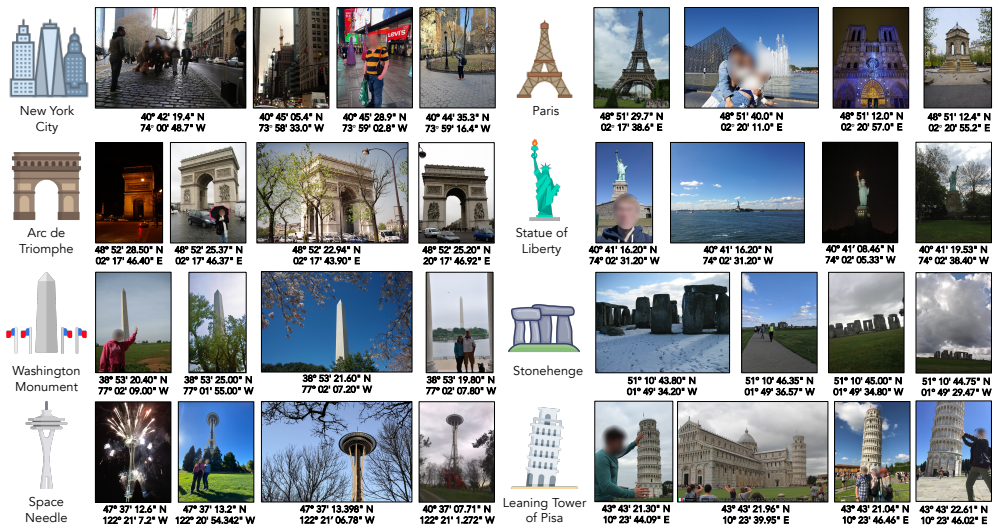
The paper's central claim is that GPS tags from EXIF metadata carry enough visual information to act as a conditioning signal for generative image models. A latent text-to-image diffusion model, finetuned on hundreds of thousands of geotagged city photos, learns to associate specific coordinates with visual content: the same text prompt produces different but contextually appropriate images depending on location, such as a modern sculpture for 'bagel' near one museum and an impressionist painting near another. A per-landmark variant replaces coordinates with the azimuth angle relative to the landmark center, learning viewpoint-dependent appearance; feeding that angle-conditioned score into score distillation sampling yields a neural radiance field whose renderings stay consistent with tourist photos from every direction. The paper concludes that GPS conditioning complements text conditioning for generation and that 3D structure can be lifted from 2D location-conditioned models without estimating camera poses.
Load-bearing premise
The method assumes that a photo's GPS tag reliably indicates what the photo shows—that the photographer stood there and the image depicts the surroundings or the landmark itself—and, for the 3D model, that the azimuth angle alone captures the viewpoint.
Editorial extensions
If this is right
- A user can specify a place by GPS and a subject by text, and the model will generate an image consistent with both, such as a costumed figure in Times Square or a statue inside a museum.
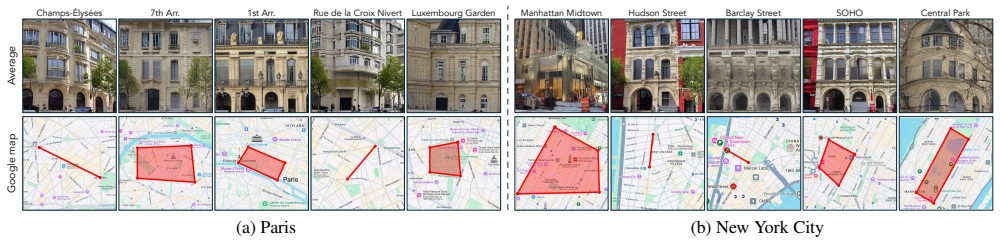
- Averaging the model's noise estimates over many GPS points in an area yields a single representative image for a concept like 'building', revealing architectural style differences across neighborhoods.
- Landmark 3D reconstruction becomes possible from 2D geotagged photos even where structure-from-motion fails, because the GPS-derived azimuth supplies a view prior that text prompts cannot.
- GPS and text act as complementary controls: attention maps show text steering foreground content while GPS steers background context, and both can be composed in one denoising step.
Reading between the lines
- If the GPS-tag-to-content association holds at the scale suggested here, geotagged photo archives worldwide become a free training signal for location-aware generative models, similar to how paired alt-text is used for vision-language models.
- The angle-conditioning recipe could generalize to many landmarks automatically: any site with enough photos could get a 3D model from metadata alone, without pose estimation; whether this scales beyond the six demonstrated landmarks is testable directly.
- Since the paper shows weather and lighting variation but does not use capture time, conditioning on EXIF timestamps is a natural next step that could produce 'same place, different season' images.
- The known saturation of score distillation outputs and the hard-to-disentangle semantics of GPS point toward future work that separates location-driven background from prompt-driven content more explicitly, for example through cross-attention control.
Editorial analysis
A structured set of objections, weighed in public.
Referee Report
Summary. The paper proposes using GPS coordinates extracted from EXIF metadata as a conditioning signal for text-to-image diffusion models. It trains a Stable Diffusion variant conditioned on both text and continuous GPS coordinates on large Flickr collections from Manhattan and Paris, and demonstrates that the model can generate images that reflect neighborhood- and landmark-specific appearance. The paper also introduces an angle-to-image diffusion model for individual landmarks, in which the apparent viewpoint is parameterized by the azimuth between the photographer's GPS position and the landmark center, and uses score distillation sampling to lift a NeRF from this model without explicit camera pose estimation. The central claims are that GPS tags provide a useful control signal for image generation and that GPS conditioning improves estimated 3D structure. The evaluation combines qualitative examples, automatic metrics (CLIP Score, a proposed GPS Score, and an angle classifier), and a user study.
Significance. If the central claims hold, the paper opens a useful new conditioning modality for generative models: ubiquitous EXIF GPS metadata can ground image generation in geographic context, and weakly supervised 3D reconstruction from unstructured tourist photos becomes possible without SfM. The method is simple (concatenating a learned GPS embedding to the text embedding of a pretrained latent diffusion model) and the qualitative results are often striking, including compositional effects such as generating a 'bagel' as a sculpture at MoMA versus a painting at the Met. The paper also contributes large-scale geotagged datasets and a systematic set of ablations. The main weakness is that the quantitative evidence for both GPS control and 3D improvement is partly circular or under-validated, which the paper itself partially acknowledges in Section 4.4. These issues are addressable with additional experiments, so the overall contribution is promising but not yet fully established.
major comments (4)
- [Sec. 4.2, Table 1; Appendix A.1.4] The GPS Score metric is circular. The GPS-CLIP model in Appendix A.1.4 is trained on the same Manhattan and Paris photo collections that are used to train the generative model, so a high GPS Score can reflect the generator reproducing its own training distribution rather than a generalizable association between GPS and image content. Moreover, in Table 1 the text-only baseline (SD Text) has a higher CLIP Score (29.13) than Ours (27.88), so the only metric favoring GPS conditioning is the circular GPS Score. Please report GPS Score using a GPS-CLIP model trained on held-out cities or disjoint time intervals, and add a retrieval-based evaluation against held-out geotagged photos.
- [Sec. 3.2, Sec. 4.4, Appendix A.2.1] The angle-to-image evaluation is circular and rests on an unvalidated labeling assumption. The classifier used in Table 2 is trained on the same landmark photos and the same GPS-derived 10° angle bins that define the generation condition, so the 22.36% accuracy partly measures whether the model memorized the training distribution, not whether it controls physical viewpoint. In addition, the method assumes that the azimuth between the photographer's GPS position and the landmark center is a faithful proxy for the camera's viewing direction, but the paper never reports how often the landmark is actually visible in the training photos or how well the GPS-derived azimuth matches the true camera yaw. Please validate the angle labels on a subset with SfM poses or manual annotation, and report the landmark-visibility rate and label-noise statistics.
- [Sec. 4.5, Table 3, Fig. 8] The 3D reconstruction claim is not supported by a non-circular quantitative comparison. The automatic metric in Table 3 is CLIP Score on renderings, which measures text alignment rather than geometric fidelity, and the user study compares against DreamFusion but does not compare against reconstructions from real photos. The ablation in Fig. 8(b) is described only qualitatively; if the reported CS/GS/TS values are computed with the same circular metrics or a small user pool, they cannot distinguish true angle control from the effect of prior preservation loss or text conditioning. Please report per-scene 3D metrics against ground-truth geometry (e.g., pose accuracy, Chamfer distance, or a view-consistency measure using held-out real photos), and provide the actual ablation numbers.
- [Sec. 4.5, Appendix A.2.3] The SfM/NeRF baseline comparison is presented in an 'all or nothing' manner without per-scene statistics. The paper states that COLMAP succeeds on 3 of 6 scenes and fails on 3, and that Nerfacto fails on 5, but it does not report the quantitative metrics separately for the successful scenes. On the scenes where SfM succeeds, NeRF-W/Nerfacto reconstruct actual photos and may be more faithful than SDS-generated geometry; collapsing successes and failures into a single average makes the comparison difficult to interpret. Please provide per-scene tables and clarify the evaluation protocol for the successful reconstructions.
minor comments (4)
- [Sec. 3.1, Eq. (4)] The word 'gudiance' should be 'guidance'.
- [Table 1] The 'Avg' column appears to average a CLIP Score and a GPS Score that are on different scales; please state how this average is computed and justify it. The row 'Ours (w/o text)' has no Avg value, which makes the comparison against GPS Nearest Neighbor less direct.
- [Table 2] Please state the number of angle bins explicitly (36 bins for 10° discretization) so that the random-chance baseline of 2.78% is transparent.
- [Sec. 4.4] The sentence 'we use this classifier trained on our training dataset to testify whether the finetuned diffusion model has successfully fit the training distribution' acknowledges the circularity, but fitting the training distribution is not evidence of physical viewpoint control; this distinction should be stated explicitly in the main text.
Circularity Check
Angle-control evaluation is a self-referential training-distribution fit; GPS-CLIP metric is also trained on the same data, so the location- and viewpoint-control claims partly reduce to in-distribution consistency checks.
-
fitted input called prediction
[Sec. 4.4 (Evaluation of angle-to-image generation)]
"We train a classifier on each landmark dataset individually to predict the discretized angle bins derived from GPS tags. For each angle bin of 10°, we ask generative models to synthesize 10 images and pair them up with input angle bins as ground truth. Then we apply the trained angle classifier to evaluate these images using accuracy as the metric. ... We use this classifier trained on our training dataset to testify whether the finetuned diffusion model has successfully fit the training distribution."
The classifier's training labels are the same GPS-derived angle bins that define the conditioning for the angle-to-image diffusion model, and both are trained on the same landmark photo sets. The evaluation pairs generated images with their input angle bins as 'ground truth'; since the classifier learned its angle-to-image association from the same noisy labels, high accuracy (22.36%) is a self-consistency check between two models fitted to the same distribution, not a validation that the azimuth equals the camera viewpoint. The paper itself frames it as testing whether the model 'has successfully fit the training distribution,' which is the definition of an in-distribution fit, not an external measure of viewpoint control.
-
fitted input called prediction
[Sec. 4.2 (Evaluation metrics) / Appendix A.1.4 (GPS-CLIP)]
"Analogously, we train a GPS-CLIP model on paired GPS-image data with contrastive loss [14, 30, 61, 65] and report GPS score (GS) which measures cosine similarity between image and GPS embeddings."
The GPS-CLIP is trained on the same paired GPS-image data (the city Flickr collections used to finetune the GPS-to-image diffusion model; no held-out or independently annotated set is described). The GPS score is therefore a measure of similarity to the authors' own fitted GPS-image embedding, i.e., whether generated images lie in the training distribution for that location. A model that memorizes training images near a GPS coordinate will score high. This makes the headline claim that GPS-conditioned models 'learn to generate images that vary based on location' rest, in part, on a metric that is itself fitted to the same data. The relative comparison to baselines remains informative, so this is a milder circularity than the angle classifier.
full rationale
The paper's core pipeline is self-contained: a diffusion model is finetuned on Flickr GPS-image pairs, and 3D structure is lifted via SDS using an angle-conditioned variant; the CLIP Score and the user study for 3D quality are external and not circular. No load-bearing self-citation or imported uniqueness theorem was found; citations to prior work by the same authors (InstructPix2Pix, 'What Makes Paris Look Like Paris', etc.) are standard technique references rather than proof of the central claim. The significant circularity is concentrated in the angle-to-image evaluation (Sec. 4.4). The classifier used to measure angle accuracy is trained on the same landmark images and the same GPS-derived angle bins that define the diffusion model's conditioning, and the paper explicitly says the classifier tests whether the model 'has successfully fit the training distribution.' Consequently, the 22.36% accuracy is a self-consistency measure between two models fitted to the same corrupted (GPS-as-viewpoint) labels; it does not establish that the azimuth α equals the actual camera viewpoint. The 3D reconstruction claim inherits this gap, since SDS is supervised by the same angle-to-image model. A milder form of the same issue affects the GPS Score in Table 1: the GPS-CLIP metric is trained on the same paired GPS-image data, so high scores partly reflect in-distribution fit rather than independent geospatial control. The unvalidated assumption that a photo's EXIF GPS position determines its content, and the azimuth-to-viewpoint parameterization, are non-circular correctness risks and are flagged in the Limitations section ('GPS tags carry certain semantic information that is difficult to fully disentangle'), but they are not themselves circular steps.
Assumptions & free parameters
free parameters (4)
- text guidance weight (omega_p) =
3.5
- GPS guidance weight (omega_g) =
7.5
- prior preservation loss weight (lambda) =
1.0
- elevation angle restriction for virtual cameras =
below 0 degrees
assumptions (4)
- domain assumption Flickr EXIF GPS tags are sufficiently accurate and content-relevant for geotagged tourist photos.
- domain assumption A landmark's appearance in a photo is determined primarily by the photographer's azimuth angle around a fixed center point (x_o, y_o).
- domain assumption Stable Diffusion v1.4 provides a strong enough image prior that finetuning on a few thousand photos preserves general generation ability.
- standard math Score distillation sampling gradients from DreamFusion are a valid supervision signal for NeRF optimization.
Cite this review
Pith. "Pith review of GPS as a Control Signal for Image Generation." pith.science (2026). https://pith.science/paper/OCZ5GKWN
@misc{pith2026250112390,
  author       = {Pith},
  title        = {Pith review of: GPS as a Control Signal for Image Generation},
  year         = {2026},
  howpublished = {\url{https://pith.science/paper/OCZ5GKWN}},
  note         = {Machine review of arXiv:2501.12390}
}
read the original abstract
We show that the GPS tags contained in photo metadata provide a useful control signal for image generation. We train GPS-to-image models and use them for tasks that require a fine-grained understanding of how images vary within a city. In particular, we train a diffusion model to generate images conditioned on both GPS and text. The learned model generates images that capture the distinctive appearance of different neighborhoods, parks, and landmarks. We also extract 3D models from 2D GPS-to-image models through score distillation sampling, using GPS conditioning to constrain the appearance of the reconstruction from each viewpoint. Our evaluations suggest that our GPS-conditioned models successfully learn to generate images that vary based on location, and that GPS conditioning improves estimated 3D structure.
Figures


Figures from the paper (12 more)




Reference graph
Works this paper leans on
-
[1]
Building rome in a day
Sameer Agarwal, Yasutaka Furukawa, Noah Snavely, Ian Simon, Brian Curless, Steven M Seitz, and Richard Szeliski. Building rome in a day. Communications of the ACM, 54(10):105–112, 2011. 2
2011
-
[2]
Cc3d: Layout-conditioned genera- tion of compositional 3d scenes
Sherwin Bahmani, Jeong Joon Park, Despoina Paschalidou, Xingguang Yan, Gordon Wetzstein, Leonidas Guibas, and Andrea Tagliasacchi. Cc3d: Layout-conditioned genera- tion of compositional 3d scenes. In Proceedings of the IEEE/CVF International Conference on Computer Vision , pages 7171–7181, 2023. 2
2023
-
[3]
4d-fy: Text-to-4d generation using hy- brid score distillation sampling
Sherwin Bahmani, Ivan Skorokhodov, Victor Rong, Gor- don Wetzstein, Leonidas Guibas, Peter Wonka, Sergey Tulyakov, Jeong Joon Park, Andrea Tagliasacchi, and David B Lindell. 4d-fy: Text-to-4d generation using hy- brid score distillation sampling. In Proceedings of the IEEE/CVF Conference on Computer Vision and Pattern Recognition, pages 7996–8006, 2024. 2
2024
-
[4]
Vd3d: Taming large video diffu- sion transformers for 3d camera control
Sherwin Bahmani, Ivan Skorokhodov, Aliaksandr Siarohin, Willi Menapace, Guocheng Qian, Michael Vasilkovsky, Hsin-Ying Lee, Chaoyang Wang, Jiaxu Zou, Andrea Tagliasacchi, et al. Vd3d: Taming large video diffu- sion transformers for 3d camera control. arXiv preprint arXiv:2407.12781, 2024. 2
arXiv 2024
-
[5]
Tc4d: Trajectory-conditioned text-to-4d generation
Sherwin Bahmani, Xian Liu, Wang Yifan, Ivan Sko- rokhodov, Victor Rong, Ziwei Liu, Xihui Liu, Jeong Joon Park, Sergey Tulyakov, Gordon Wetzstein, et al. Tc4d: Trajectory-conditioned text-to-4d generation. In European Conference on Computer Vision , pages 53–72. Springer,
-
[6]
Multidiffusion: Fusing diffusion paths for controlled image generation
Omer Bar-Tal, Lior Yariv, Yaron Lipman, and Tali Dekel. Multidiffusion: Fusing diffusion paths for controlled image generation. 2023. 2, 3
2023
-
[7]
Barron, Ben Mildenhall, Dor Verbin, Pratul P
Jonathan T. Barron, Ben Mildenhall, Dor Verbin, Pratul P. Srinivasan, and Peter Hedman. Mip-nerf 360: Unbounded anti-aliased neural radiance fields. CVPR, 2022. 4
2022
-
[8]
Sonicdiffusion: Audio-driven image generation and editing with pretrained diffusion models
Burak Can Biner, Farrin Marouf Sofian, Umur Berkay Karakas ¸, Duygu Ceylan, Erkut Erdem, and Aykut Er- dem. Sonicdiffusion: Audio-driven image generation and editing with pretrained diffusion models. arXiv preprint arXiv:2405.00878, 2024. 2
arXiv 2024
Show all 104 references
-
[9]
Stable video diffusion: Scaling latent video diffusion models to large datasets
Andreas Blattmann, Tim Dockhorn, Sumith Kulal, Daniel Mendelevitch, Maciej Kilian, Dominik Lorenz, Yam Levi, Zion English, Vikram V oleti, Adam Letts, et al. Stable video diffusion: Scaling latent video diffusion models to large datasets. arXiv preprint arXiv:2311.15127, 2023. 2 9
2023 arXiv
-
[10]
In- structpix2pix: Learning to follow image editing instruc- tions
Tim Brooks, Aleksander Holynski, and Alexei A Efros. In- structpix2pix: Learning to follow image editing instruc- tions. In Proceedings of the IEEE/CVF Conference on Computer Vision and Pattern Recognition , pages 18392– 18402, 2023. 2, 3
2023
-
[11]
Generative rendering: Controllable 4d-guided video generation with 2d diffusion models
Shengqu Cai, Duygu Ceylan, Matheus Gadelha, Chun- Hao Paul Huang, Tuanfeng Yang Wang, and Gordon Wet- zstein. Generative rendering: Controllable 4d-guided video generation with 2d diffusion models. In Proceedings of the IEEE/CVF Conference on Computer Vision and Pattern Recogn...
2024
-
[12]
Efficient geometry-aware 3d generative adversarial networks
Eric R Chan, Connor Z Lin, Matthew A Chan, Koki Nagano, Boxiao Pan, Shalini De Mello, Orazio Gallo, Leonidas J Guibas, Jonathan Tremblay, Sameh Khamis, et al. Efficient geometry-aware 3d generative adversarial networks. In Proceedings of the IEEE/CVF Conference on Computer Vis...
2022
-
[13]
Videocrafter2: Overcoming data limitations for high-quality video diffu- sion models
Haoxin Chen, Yong Zhang, Xiaodong Cun, Menghan Xia, Xintao Wang, Chao Weng, and Ying Shan. Videocrafter2: Overcoming data limitations for high-quality video diffu- sion models. In Proceedings of the IEEE/CVF Conference on Computer Vision and Pattern Recognition, pages 7310– 73...
2024
-
[14]
A simple framework for contrastive learning of visual representations
Ting Chen, Simon Kornblith, Mohammad Norouzi, and Ge- offrey Hinton. A simple framework for contrastive learning of visual representations. In International conference on machine learning, pages 1597–1607. PMLR, 2020. 6
2020
-
[15]
Images that sound: Composing images and sounds on a single can- vas
Ziyang Chen, Daniel Geng, and Andrew Owens. Images that sound: Composing images and sounds on a single can- vas. arXiv preprint arXiv:2405.12221, 2024. 3
2024 arXiv
-
[16]
Functional map of the world
Gordon Christie, Neil Fendley, James Wilson, and Ryan Mukherjee. Functional map of the world. In Proceedings of the IEEE Conference on Computer Vision and Pattern Recognition, pages 6172–6180, 2018. 2
2018
-
[17]
Mapping the world’s photos
David J Crandall, Lars Backstrom, Daniel Huttenlocher, and Jon Kleinberg. Mapping the world’s photos. In Pro- ceedings of the 18th international conference on World wide web, pages 761–770, 2009. 1, 2
2009
-
[18]
Streetscapes: Large-scale consistent street view gen- eration using autoregressive video diffusion
Boyang Deng, Richard Tucker, Zhengqi Li, Leonidas Guibas, Noah Snavely, and Gordon Wetzstein. Streetscapes: Large-scale consistent street view gen- eration using autoregressive video diffusion. In ACM SIGGRAPH 2024 Conference Papers, pages 1–11, 2024. 2
2024
-
[19]
Diffusion models beat gans on image synthesis
Prafulla Dhariwal and Alexander Nichol. Diffusion models beat gans on image synthesis. Advances in neural informa- tion processing systems, 34:8780–8794, 2021. 2, 3
2021
-
[20]
What makes paris look like paris? ACM Transactions on Graphics, 31(4), 2012
Carl Doersch, Saurabh Singh, Abhinav Gupta, Josef Sivic, and Alexei Efros. What makes paris look like paris? ACM Transactions on Graphics, 31(4), 2012. 1, 2, 6
2012
-
[21]
Reduce, reuse, recycle: Compositional generation with energy-based diffusion models and mcmc
Yilun Du, Conor Durkan, Robin Strudel, Joshua B Tenenbaum, Sander Dieleman, Rob Fergus, Jascha Sohl- Dickstein, Arnaud Doucet, and Will Sussman Grathwohl. Reduce, reuse, recycle: Compositional generation with energy-based diffusion models and mcmc. In International conference ...
-
[22]
Accurate, dense, and robust multiview stereopsis
Yasutaka Furukawa and Jean Ponce. Accurate, dense, and robust multiview stereopsis. IEEE transactions on pattern analysis and machine intelligence, 32(8):1362–1376, 2009. 2
2009
-
[23]
Motion guidance: Diffusion-based image editing with differentiable motion estimators
Daniel Geng and Andrew Owens. Motion guidance: Diffusion-based image editing with differentiable motion estimators. arXiv preprint arXiv:2401.18085, 2024. 2
2024 arXiv
-
[24]
Visual ana- grams: Generating multi-view optical illusions with diffu- sion models
Daniel Geng, Inbum Park, and Andrew Owens. Visual ana- grams: Generating multi-view optical illusions with diffu- sion models. In Proceedings of the IEEE/CVF Conference on Computer Vision and Pattern Recognition, pages 24154– 24163, 2024. 3
2024
-
[25]
Factorized diffusion: Perceptual illusions by noise decomposition
Daniel Geng, Inbum Park, and Andrew Owens. Factorized diffusion: Perceptual illusions by noise decomposition. In European Conference on Computer Vision, pages 366–384. Springer, 2025. 3
2025
-
[26]
Imagebind: One embedding space to bind them all
Rohit Girdhar, Alaaeldin El-Nouby, Zhuang Liu, Mannat Singh, Kalyan Vasudev Alwala, Armand Joulin, and Ishan Misra. Imagebind: One embedding space to bind them all. In Proceedings of the IEEE/CVF Conference on Computer Vision and Pattern Recognition, pages 15180–15190, 2023. 2
2023
-
[27]
Pigeon: Predicting image geolocations
Lukas Haas, Michal Skreta, Silas Alberti, and Chelsea Finn. Pigeon: Predicting image geolocations. In Proceedings of the IEEE/CVF Conference on Computer Vision and Pattern Recognition, pages 12893–12902, 2024. 2
2024
-
[28]
Multiple view ge- ometry in computer vision
Richard Hartley and Andrew Zisserman. Multiple view ge- ometry in computer vision . Cambridge university press,
-
[29]
Im2gps: estimating geo- graphic information from a single image
James Hays and Alexei A Efros. Im2gps: estimating geo- graphic information from a single image. In 2008 ieee con- ference on computer vision and pattern recognition , pages 1–8. IEEE, 2008. 2
2008
-
[30]
Momentum contrast for unsupervised visual rep- resentation learning
Kaiming He, Haoqi Fan, Yuxin Wu, Saining Xie, and Ross Girshick. Momentum contrast for unsupervised visual rep- resentation learning. In Proceedings of the IEEE/CVF con- ference on computer vision and pattern recognition , pages 9729–9738, 2020. 6
2020
-
[31]
Gaussian error linear units (gelus)
Dan Hendrycks and Kevin Gimpel. Gaussian error linear units (gelus). arXiv preprint arXiv:1606.08415, 2016. 15
2016 arXiv
-
[32]
Prompt-to-prompt im- age editing with cross attention control
Amir Hertz, Ron Mokady, Jay Tenenbaum, Kfir Aberman, Yael Pritch, and Daniel Cohen-Or. Prompt-to-prompt im- age editing with cross attention control. arXiv preprint arXiv:2208.01626, 2022. 8
2022 arXiv
-
[33]
Classifier-free diffusion guidance
Jonathan Ho and Tim Salimans. Classifier-free diffusion guidance. arXiv preprint arXiv:2207.12598, 2022. 5
2022 arXiv
-
[34]
Denoising dif- fusion probabilistic models
Jonathan Ho, Ajay Jain, and Pieter Abbeel. Denoising dif- fusion probabilistic models. Advances in neural informa- tion processing systems, 33:6840–6851, 2020. 2, 3
2020
-
[35]
Text2room: Extracting textured 3d meshes from 2d text-to-image models
Lukas H”ollein, Ang Cao, Andrew Owens, Justin Johnson, and Matthias Nießner. Text2room: Extracting textured 3d meshes from 2d text-to-image models. International Con- ference on Computer Vision (ICCV), 2023. 7
2023
-
[36]
Dreamtime: An improved optimization strategy for text-to-3d content creation
Yukun Huang, Jianan Wang, Yukai Shi, Xianbiao Qi, Zheng-Jun Zha, and Lei Zhang. Dreamtime: An improved optimization strategy for text-to-3d content creation. arXiv preprint arXiv:2306.12422, 2023. 5 10
2023 arXiv
-
[37]
Zero-shot text-guided object gen- eration with dream fields
Ajay Jain, Ben Mildenhall, Jonathan T Barron, Pieter Abbeel, and Ben Poole. Zero-shot text-guided object gen- eration with dream fields. In Proceedings of the IEEE/CVF Conference on Computer Vision and Pattern Recognition , pages 867–876, 2022. 2
2022
-
[38]
A stereo match- ing algorithm with an adaptive window: Theory and exper- iment
Takeo Kanade and Masatoshi Okutomi. A stereo match- ing algorithm with an adaptive window: Theory and exper- iment. IEEE transactions on pattern analysis and machine intelligence, 16(9):920–932, 1994. 2
1994
-
[39]
Diffusionsat: A generative foundation model for satellite imagery
Samar Khanna, Patrick Liu, Linqi Zhou, Chenlin Meng, Robin Rombach, Marshall Burke, David Lobell, and Ste- fano Ermon. Diffusionsat: A generative foundation model for satellite imagery. arXiv preprint arXiv:2312.03606 ,
-
[40]
Adam: A method for stochastic optimization
Diederik P Kingma and Jimmy Ba. Adam: A method for stochastic optimization. arXiv preprint arXiv:1412.6980 ,
-
[41]
Collaborative video diffusion: Consistent multi- video generation with camera control
Zhengfei Kuang, Shengqu Cai, Hao He, Yinghao Xu, Hongsheng Li, Leonidas Guibas, and Gordon Wet- zstein. Collaborative video diffusion: Consistent multi- video generation with camera control. arXiv preprint arXiv:2405.17414, 2024. 2
2024 arXiv
-
[42]
Customizing text-to-image diffusion with camera viewpoint control
Nupur Kumari, Grace Su, Richard Zhang, Taesung Park, Eli Shechtman, and Jun-Yan Zhu. Customizing text-to-image diffusion with camera viewpoint control. arXiv preprint arXiv:2404.12333, 2024. 2
2024 arXiv
-
[43]
Dragapart: Learning a part-level motion prior for articulated objects
Ruining Li, Chuanxia Zheng, Christian Rupprecht, and An- drea Vedaldi. Dragapart: Learning a part-level motion prior for articulated objects. arXiv preprint arXiv:2403.15382 ,
-
[44]
Climatenerf: Extreme weather synthesis in neural radiance field
Yuan Li, Zhi-Hao Lin, David Forsyth, Jia-Bin Huang, and Shenlong Wang. Climatenerf: Extreme weather synthesis in neural radiance field. In Proceedings of the IEEE/CVF International Conference on Computer Vision, pages 3227– 3238, 2023. 6
2023
-
[45]
Magic3d: High- resolution text-to-3d content creation
Chen-Hsuan Lin, Jun Gao, Luming Tang, Towaki Takikawa, Xiaohui Zeng, Xun Huang, Karsten Kreis, Sanja Fidler, Ming-Yu Liu, and Tsung-Yi Lin. Magic3d: High- resolution text-to-3d content creation. In Proceedings of the IEEE/CVF Conference on Computer Vision and Pattern Recogniti...
2023
-
[46]
Learning to factorize and relight a city
Andrew Liu, Shiry Ginosar, Tinghui Zhou, Alexei A Efros, and Noah Snavely. Learning to factorize and relight a city. In Computer Vision–ECCV 2020: 16th European Confer- ence, Glasgow, UK, August 23–28, 2020, Proceedings, Part IV 16, pages 544–561. Springer, 2020. 6
2020
-
[47]
Compositional visual generation with composable diffusion models
Nan Liu, Shuang Li, Yilun Du, Antonio Torralba, and Joshua B Tenenbaum. Compositional visual generation with composable diffusion models. In European Confer- ence on Computer Vision, pages 423–439. Springer, 2022. 3, 7
2022
-
[48]
Zero-1-to-3: Zero-shot one image to 3d object
Ruoshi Liu, Rundi Wu, Basile Van Hoorick, Pavel Tok- makov, Sergey Zakharov, and Carl V ondrick. Zero-1-to-3: Zero-shot one image to 3d object. In Proceedings of the IEEE/CVF International Conference on Computer Vision , pages 9298–9309, 2023. 2, 3
2023
-
[49]
Sgdr: Stochastic gradient descent with warm restarts
Ilya Loshchilov and Frank Hutter. Sgdr: Stochastic gradient descent with warm restarts. arXiv preprint arXiv:1608.03983, 2016. 15
2016 arXiv
-
[50]
Decoupled weight decay regularization
Ilya Loshchilov and Frank Hutter. Decoupled weight decay regularization. arXiv preprint arXiv:1711.05101, 2017. 5, 16
2017 arXiv
-
[51]
Match- miner: Efficient spanning structure mining in large image collections
Yin Lou, Noah Snavely, and Johannes Gehrke. Match- miner: Efficient spanning structure mining in large image collections. In Computer Vision–ECCV 2012: 12th Euro- pean Conference on Computer Vision, Florence, Italy, Oc- tober 7-13, 2012, Proceedings, Part II 12, 2012. 2
2012
-
[52]
Distinctive image features from scale- invariant keypoints
David G Lowe. Distinctive image features from scale- invariant keypoints. International journal of computer vi- sion, 60:91–110, 2004. 2
2004
-
[53]
Geostyle: Discovering fashion trends and events
Utkarsh Mall, Kevin Matzen, Bharath Hariharan, Noah Snavely, and Kavita Bala. Geostyle: Discovering fashion trends and events. In Proceedings of the IEEE/CVF in- ternational conference on computer vision, pages 411–420,
-
[54]
Discovering underground maps from fashion
Utkarsh Mall, Kavita Bala, Tamara Berg, and Kristen Grau- man. Discovering underground maps from fashion. In Pro- ceedings of the IEEE/CVF Winter Conference on Applica- tions of Computer Vision, pages 3114–3123, 2022. 2
2022
-
[55]
Nerf in the wild: Neural radiance fields for uncon- strained photo collections
Ricardo Martin-Brualla, Noha Radwan, Mehdi SM Sajjadi, Jonathan T Barron, Alexey Dosovitskiy, and Daniel Duck- worth. Nerf in the wild: Neural radiance fields for uncon- strained photo collections. InProceedings of the IEEE/CVF Conference on Computer Vision and Pattern Recogni...
2021
-
[56]
Ricardo Martin-Brualla, Noha Radwan, Mehdi S. M. Saj- jadi, Jonathan T. Barron, Alexey Dosovitskiy, and Daniel Duckworth. NeRF in the Wild: Neural Radiance Fields for Unconstrained Photo Collections. In CVPR, 2021. 5, 15, 16, 17
2021
-
[57]
Scene chronology
Kevin Matzen and Noah Snavely. Scene chronology. In Computer Vision–ECCV 2014: 13th European Conference, Zurich, Switzerland, September 6-12, 2014, Proceedings, Part VII 13, pages 615–630. Springer, 2014. 2
2014
-
[58]
Nerf: Representing scenes as neural radiance fields for view syn- thesis
Ben Mildenhall, Pratul P Srinivasan, Matthew Tancik, Jonathan T Barron, Ravi Ramamoorthi, and Ren Ng. Nerf: Representing scenes as neural radiance fields for view syn- thesis. Communications of the ACM, 65(1):99–106, 2021. 2, 4, 5, 8
2021
-
[59]
Instant neural graphics primitives with a multiresolution hash encoding
Thomas M ¨uller, Alex Evans, Christoph Schied, and Alexander Keller. Instant neural graphics primitives with a multiresolution hash encoding. ACM Transactions on Graphics (ToG), 41(4):1–15, 2022. 5
2022
-
[60]
Scalable recognition with a vocabulary tree
David Nister and Henrik Stewenius. Scalable recognition with a vocabulary tree. In 2006 IEEE Computer Society Conference on Computer Vision and Pattern Recognition (CVPR’06), pages 2161–2168. Ieee, 2006. 2
2006
-
[61]
Repre- sentation learning with contrastive predictive coding
Aaron van den Oord, Yazhe Li, and Oriol Vinyals. Repre- sentation learning with contrastive predictive coding. arXiv preprint arXiv:1807.03748, 2018. 6
2018 arXiv
-
[62]
Dinov2: Learning robust visual features without supervi- sion
Maxime Oquab, Timoth ´ee Darcet, Th ´eo Moutakanni, Huy V o, Marc Szafraniec, Vasil Khalidov, Pierre Fernandez, Daniel Haziza, Francisco Massa, Alaaeldin El-Nouby, et al. Dinov2: Learning robust visual features without supervi- sion. arXiv preprint arXiv:2304.07193, 2023. 15 11
2023 arXiv
-
[63]
Scalable diffusion mod- els with transformers
William Peebles and Saining Xie. Scalable diffusion mod- els with transformers. In Proceedings of the IEEE/CVF In- ternational Conference on Computer Vision , pages 4195– 4205, 2023. 2
2023
-
[64]
Dreamfusion: Text-to-3d using 2d diffusion
Ben Poole, Ajay Jain, Jonathan T Barron, and Ben Milden- hall. Dreamfusion: Text-to-3d using 2d diffusion. ICLR,
-
[65]
Learn- ing transferable visual models from natural language super- vision
Alec Radford, Jong Wook Kim, Chris Hallacy, Aditya Ramesh, Gabriel Goh, Sandhini Agarwal, Girish Sastry, Amanda Askell, Pamela Mishkin, Jack Clark, et al. Learn- ing transferable visual models from natural language super- vision. In International conference on machine learning...
2021
-
[66]
Hierarchical text-conditional image generation with clip latents
Aditya Ramesh, Prafulla Dhariwal, Alex Nichol, Casey Chu, and Mark Chen. Hierarchical text-conditional image generation with clip latents. arXiv preprint arXiv:2204.06125, 1(2):3, 2022. 2
2022 arXiv
-
[67]
High-resolution image synthesis with latent diffusion models
Robin Rombach, Andreas Blattmann, Dominik Lorenz, Patrick Esser, and Bj ¨orn Ommer. High-resolution image synthesis with latent diffusion models. In Proceedings of the IEEE/CVF conference on computer vision and pattern recognition, pages 10684–10695, 2022. 2, 3, 5, 6, 7, 8, 9, 16
2022
-
[68]
Dreambooth: Fine tuning text-to-image diffusion models for subject-driven generation
Nataniel Ruiz, Yuanzhen Li, Varun Jampani, Yael Pritch, Michael Rubinstein, and Kfir Aberman. Dreambooth: Fine tuning text-to-image diffusion models for subject-driven generation. In Proceedings of the IEEE/CVF Conference on Computer Vision and Pattern Recognition, pages 22500...
2023
-
[69]
Photorealistic text-to-image diffusion models with deep language understanding
Chitwan Saharia, William Chan, Saurabh Saxena, Lala Li, Jay Whang, Emily L Denton, Kamyar Ghasemipour, Raphael Gontijo Lopes, Burcu Karagol Ayan, Tim Sali- mans, et al. Photorealistic text-to-image diffusion models with deep language understanding. Advances in Neural In- forma...
2022
-
[70]
Clip-forge: Towards zero-shot text-to-shape genera- tion
Aditya Sanghi, Hang Chu, Joseph G Lambourne, Ye Wang, Chin-Yi Cheng, Marco Fumero, and Kamal Rahimi Malek- shan. Clip-forge: Towards zero-shot text-to-shape genera- tion. In Proceedings of the IEEE/CVF Conference on Com- puter Vision and Pattern Recognition, pages 18603–18613,
-
[71]
Zeronvs: Zero-shot 360-degree view synthesis from a single real im- age
Kyle Sargent, Zizhang Li, Tanmay Shah, Charles Her- rmann, Hong-Xing Yu, Yunzhi Zhang, Eric Ryan Chan, Dmitry Lagun, Li Fei-Fei, Deqing Sun, et al. Zeronvs: Zero-shot 360-degree view synthesis from a single real im- age. arXiv preprint arXiv:2310.17994, 2023. 2
-
[72]
Structure-from-motion revisited
Johannes Lutz Sch ¨onberger and Jan-Michael Frahm. Structure-from-motion revisited. In Conference on Com- puter Vision and Pattern Recognition (CVPR), 2016. 8, 16, 17
2016
-
[73]
Structure-from-motion revisited
Johannes L Schonberger and Jan-Michael Frahm. Structure-from-motion revisited. In Proceedings of the IEEE conference on computer vision and pattern recognition, pages 4104–4113, 2016. 2, 15, 16
2016
-
[74]
Mvdream: Multi-view diffusion for 3d generation
Yichun Shi, Peng Wang, Jianglong Ye, Mai Long, Kejie Li, and Xiao Yang. Mvdream: Multi-view diffusion for 3d generation. arXiv preprint arXiv:2308.16512, 2023. 2, 3, 4, 5
2023 arXiv
-
[75]
Dragdiffusion: Harnessing diffusion models for interac- tive point-based image editing
Yujun Shi, Chuhui Xue, Jun Hao Liew, Jiachun Pan, Han- shu Yan, Wenqing Zhang, Vincent YF Tan, and Song Bai. Dragdiffusion: Harnessing diffusion models for interac- tive point-based image editing. In Proceedings of the IEEE/CVF Conference on Computer Vision and Pattern Recogni...
2024
-
[76]
Data-driven visual similarity for cross- domain image matching
Abhinav Shrivastava, Tomasz Malisiewicz, Abhinav Gupta, and Alexei A Efros. Data-driven visual similarity for cross- domain image matching. ACM Trans. Graph., 30(6):154,
-
[77]
Diffusion models as data mining tools
Ioannis Siglidis, Aleksander Holynski, Alexei A Efros, Mathieu Aubry, and Shiry Ginosar. Diffusion models as data mining tools. arXiv preprint arXiv:2408.02752, 2024. 2
2024 arXiv
-
[78]
Photo tourism: exploring photo collections in 3d
Noah Snavely, Steven M Seitz, and Richard Szeliski. Photo tourism: exploring photo collections in 3d. In ACM sig- graph 2006 papers, pages 835–846. 2006. 1, 2
2006
-
[79]
Deep unsupervised learning using nonequilibrium thermodynamics
Jascha Sohl-Dickstein, Eric Weiss, Niru Maheswaranathan, and Surya Ganguli. Deep unsupervised learning using nonequilibrium thermodynamics. In International confer- ence on machine learning, pages 2256–2265. PMLR, 2015. 2, 3
2015
-
[80]
Denoising diffusion implicit models
Jiaming Song, Chenlin Meng, and Stefano Ermon. Denoising diffusion implicit models. arXiv preprint arXiv:2010.02502, 2020. 3
2010 arXiv
-
[81]
Generative modeling by estimating gradients of the data distribution
Yang Song and Stefano Ermon. Generative modeling by estimating gradients of the data distribution. Advances in neural information processing systems, 32, 2019. 3
2019
-
[82]
Score- based generative modeling through stochastic differential equations
Yang Song, Jascha Sohl-Dickstein, Diederik P Kingma, Abhishek Kumar, Stefano Ermon, and Ben Poole. Score- based generative modeling through stochastic differential equations. arXiv preprint arXiv:2011.13456, 2020. 2, 3
2011 arXiv
-
[83]
Location-aware vi- sual question generation with lightweight models
Nicholas Collin Suwono, Justin Chih-Yao Chen, Tun Min Hung, Ting-Hao Kenneth Huang, I-Bin Liao, Yung-Hui Li, Lun-Wei Ku, and Shao-Hua Sun. Location-aware vi- sual question generation with lightweight models. arXiv preprint arXiv:2310.15129, 2023. 2
-
[84]
Nerfstudio: A modular framework for neural radiance field development
Matthew Tancik, Ethan Weber, Evonne Ng, Ruilong Li, Brent Yi, Terrance Wang, Alexander Kristoffersen, Jake Austin, Kamyar Salahi, Abhik Ahuja, et al. Nerfstudio: A modular framework for neural radiance field development. In ACM SIGGRAPH 2023 Conference Proceedings, pages 1–12,...
2023
-
[85]
Improving image classification with lo- cation context
Kevin Tang, Manohar Paluri, Li Fei-Fei, Rob Fergus, and Lubomir Bourdev. Improving image classification with lo- cation context. In Proceedings of the IEEE international conference on computer vision, pages 1008–1016, 2015. 2
2015
-
[86]
Codi-2: In-context interleaved and interactive any-to-any generation
Zineng Tang, Ziyi Yang, Mahmoud Khademi, Yang Liu, Chenguang Zhu, and Mohit Bansal. Codi-2: In-context interleaved and interactive any-to-any generation. In Pro- ceedings of the IEEE/CVF Conference on Computer Vision and Pattern Recognition, pages 27425–27434, 2024. 2
2024
-
[87]
Any-to-any generation via composable diffusion
Zineng Tang, Ziyi Yang, Chenguang Zhu, Michael Zeng, and Mohit Bansal. Any-to-any generation via composable diffusion. Advances in Neural Information Processing Sys- tems, 36, 2024. 2 12
2024
-
[88]
Shape and motion from image streams under orthography: a factorization method
Carlo Tomasi and Takeo Kanade. Shape and motion from image streams under orthography: a factorization method. International journal of computer vision, 9:137–154, 1992. 2
1992
-
[89]
Statistics of natural im- age categories
Antonio Torralba and Aude Oliva. Statistics of natural im- age categories. Network: computation in neural systems ,
-
[90]
Geoclip: Clip-inspired alignment be- tween locations and images for effective worldwide geo- localization
Vicente Vivanco Cepeda, Gaurav Kumar Nayak, and Mubarak Shah. Geoclip: Clip-inspired alignment be- tween locations and images for effective worldwide geo- localization. Advances in Neural Information Processing Systems, 36, 2024. 2
2024
-
[91]
Score jacobian chaining: Lifting pretrained 2d diffusion models for 3d generation
Haochen Wang, Xiaodan Du, Jiahao Li, Raymond A Yeh, and Greg Shakhnarovich. Score jacobian chaining: Lifting pretrained 2d diffusion models for 3d generation. In Pro- ceedings of the IEEE/CVF Conference on Computer Vision and Pattern Recognition, pages 12619–12629, 2023. 2, 3, 4
2023
-
[92]
Prolificdreamer: High- fidelity and diverse text-to-3d generation with variational score distillation
Zhengyi Wang, Cheng Lu, Yikai Wang, Fan Bao, Chongx- uan Li, Hang Su, and Jun Zhu. Prolificdreamer: High- fidelity and diverse text-to-3d generation with variational score distillation. arXiv preprint arXiv:2305.16213, 2023. 3, 4
2023 arXiv
-
[93]
Motionctrl: A unified and flexible motion controller for video generation
Zhouxia Wang, Ziyang Yuan, Xintao Wang, Yaowei Li, Tianshui Chen, Menghan Xia, Ping Luo, and Ying Shan. Motionctrl: A unified and flexible motion controller for video generation. In ACM SIGGRAPH 2024 Conference Papers, pages 1–11, 2024. 2
2024
-
[94]
Planet- photo geolocation with convolutional neural networks
Tobias Weyand, Ilya Kostrikov, and James Philbin. Planet- photo geolocation with convolutional neural networks. In Computer Vision–ECCV 2016: 14th European Conference, Amsterdam, The Netherlands, October 11-14, 2016, Pro- ceedings, Part VIII 14, pages 37–55. Springer, 2016. 2
2016
-
[95]
Multicore bundle adjustment
Changchang Wu, Sameer Agarwal, Brian Curless, and Steven M Seitz. Multicore bundle adjustment. In CVPR 2011, pages 3057–3064. IEEE, 2011. 2
2011
-
[96]
Addressclip: Empowering vision-language models for city-wide image address local- ization
Shixiong Xu, Chenghao Zhang, Lubin Fan, Gaofeng Meng, Shiming Xiang, and Jieping Ye. Addressclip: Empowering vision-language models for city-wide image address local- ization. arXiv preprint arXiv:2407.08156, 2024. 2
2024 arXiv
-
[97]
xgen-mm (blip-3): A family of open large multimodal models
Le Xue, Manli Shu, Anas Awadalla, Jun Wang, An Yan, Senthil Purushwalkam, Honglu Zhou, Viraj Prabhu, Yu- tong Dai, Michael S Ryoo, et al. xgen-mm (blip-3): A family of open large multimodal models. arXiv preprint arXiv:2408.08872, 2024. 3, 5, 15
2024
-
[98]
Gen- erating visual scenes from touch
Fengyu Yang, Jiacheng Zhang, and Andrew Owens. Gen- erating visual scenes from touch. In Proceedings of the IEEE/CVF International Conference on Computer Vision , pages 22070–22080, 2023. 2
2023
-
[99]
Binding touch to everything: Learning unified multimodal tactile represen- tations
Fengyu Yang, Chao Feng, Ziyang Chen, Hyoungseob Park, Daniel Wang, Yiming Dou, Ziyao Zeng, Xien Chen, Rit Gangopadhyay, Andrew Owens, et al. Binding touch to everything: Learning unified multimodal tactile represen- tations. In Proceedings of the IEEE/CVF Conference on Compute...
2024
-
[100]
Dragnuwa: Fine-grained control in video generation by integrating text, image, and trajectory
Shengming Yin, Chenfei Wu, Jian Liang, Jie Shi, Houqiang Li, Gong Ming, and Nan Duan. Dragnuwa: Fine-grained control in video generation by integrating text, image, and trajectory. arXiv preprint arXiv:2308.08089, 2023. 2
2023 arXiv
-
[101]
Adding conditional control to text-to-image diffusion models
Lvmin Zhang, Anyi Rao, and Maneesh Agrawala. Adding conditional control to text-to-image diffusion models. In Proceedings of the IEEE/CVF International Conference on Computer Vision, pages 3836–3847, 2023. 2, 3
2023
-
[102]
Geodtr+: Toward generic cross- view geolocalization via geometric disentanglement
Xiaohan Zhang, Xingyu Li, Waqas Sultani, Chen Chen, and Safwan Wshah. Geodtr+: Toward generic cross- view geolocalization via geometric disentanglement. IEEE Transactions on Pattern Analysis and Machine Intelligence,
-
[2023]
2, 3, 4, 5, 7, 8, 15, 16
-
[2024]
aerialviewinoilpaintingstyle
2 13 “aerialviewinoilpaintingstyle” “yellow cab” “spiderman” “appleevent” “batman” “pedestrian” “tiger” “rubberduck” “car” “selfie” “eiffeltower” “aerialview” “restaurant” “vintage car” “building” “batman” “musicals” “breakfast” “aerialview” “spiderman” (a) New York City (b) P...
Reviewed August 10, 2026 · model on record in the stance chip above.
Discussion (0). Continue with ORCID to comment.