REVIEW 4 major objections 4 minor 2 cited by
Hidden charm pentaquarks with color-octet substructure in QCD Sum Rules
T0 review · 4 major / 4 minor · reviewed 2026-08-14 · deepseek-v4-flash
Pith's one-line read QCD sum rules built from two color-octet clusters predict hidden-charm pentaquarks with masses around 4.6, 5.1, and 6.1 GeV, and can describe the observed Pc(4312) if its quantum numbers are 1/2-.
desk verdict New color-octet cluster pentaquark currents with a real OPE calculation, but the headline mass extraction is undercut by an overcomplete two-pole parametrization and a resonance fraction below the conventional threshold. read the letter →
The pith
A machine-rendered reading of the paper's core claim, the machinery that carries it, and where it could break.
The reading
What carries the argument
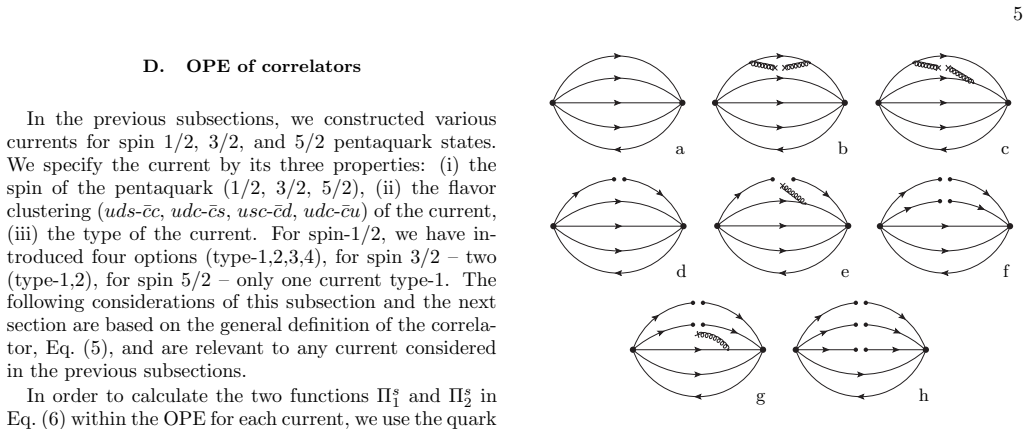
The load-bearing object is the local color-octet two-cluster interpolating current: a product of a three-quark current (uds-like flavor singlet, spin 1/2 or 3/2) and a quark-antiquark current taken to have spin 1, with both clusters in the adjoint (color-octet) representation of color SU(3) and all quarks at one point. The choice of a spin-1 q̄q cluster is taken from an earlier quark-model analysis where it gave the most stable binding, and the paper checks that spin-0 clusters yield higher masses. This current fixes the color-spin-flavor quantum numbers entering the correlator; the OPE spectral densities up to dimension-10 condensates, with heavy-quark propagators in α-representation, are then fed into Borel-transformed sum rules. A parity-decoupling combination R± = (R1 ± R2/√t)/2 isolates the positive- and negative-parity masses from the two coupled sum-rule equations.
What would settle it
Measure the spin and parity of the Pc(4312) resonance. If it is not 1/2 with negative parity, the paper's assignment of that state to a udc-c̄u color-octet cluster is ruled out; likewise, finding no narrow strangeness-carrying pentaquark near 4.6 GeV in Ξ_b decays would directly contradict the uds-c̄c prediction.
Extended reading notes
Core claim
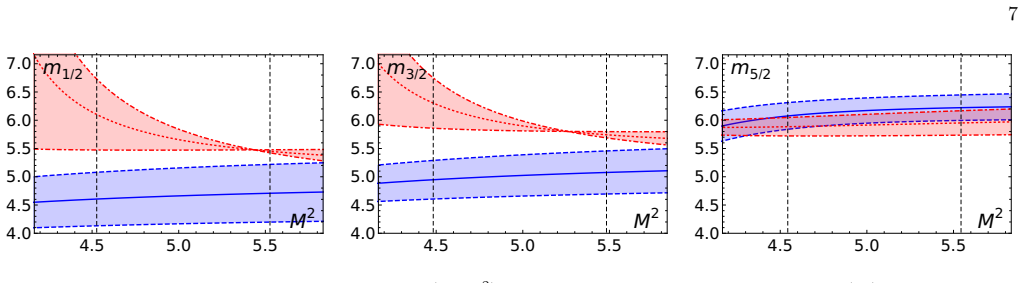
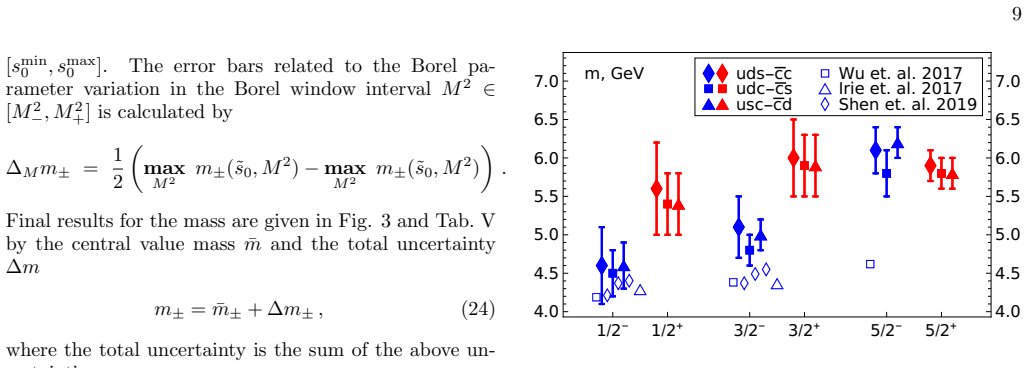
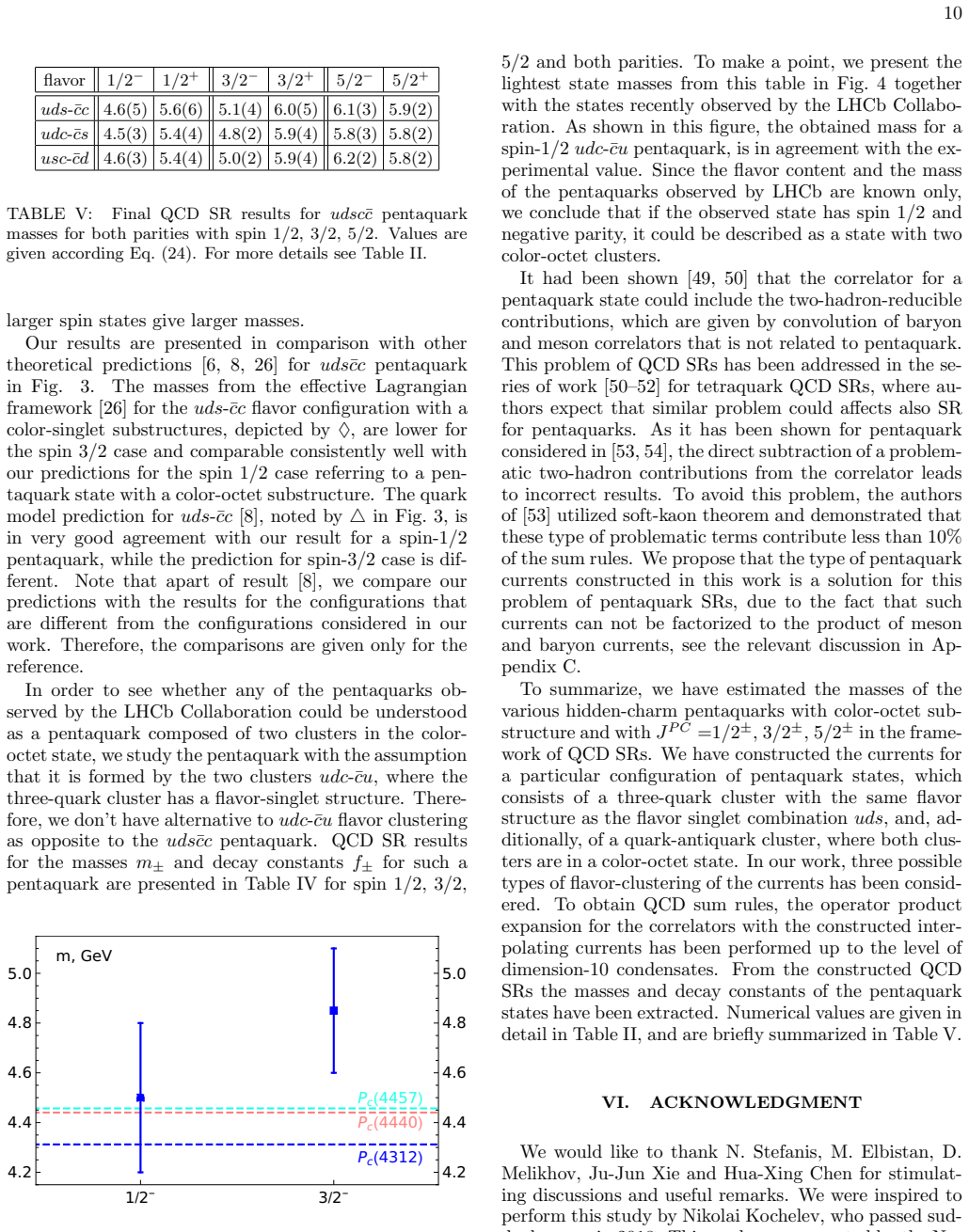
The central claim is that the mass spectrum of hidden-charm pentaquarks with quark content udsc̄c follows from a current of the form J5q = J3q^m J2q^m, a product of color-octet three-quark and quark-antiquark currents, once the operator product expansion is carried to dimension-10 condensates and the parity-doubled sum rules are decoupled. For the flavor-singlet uds cluster combined with a spin-1 c̄c cluster, the resulting masses are approximately 4.6, 5.1, and 6.1 GeV for 1/2-, 3/2-, and 5/2-, with positive-parity partners at 5.6, 6.0, and 5.9 GeV. Replacing the quark-antiquark pair by c̄s or c̄d leaves the masses essentially unchanged, so all three flavor configurations are equally viable candidates for observation. For the udc-c̄u configuration, the lightest 1/2- mass agrees with the observed Pc(4312) within errors. The paper's specific conclusion about the measured states is conditional: if the observed pentaquark has spin 1/2 and negative parity, then it could be described as a state of two color-octet clusters.
Load-bearing premise
The calculation assumes a real pentaquark is dominated by a configuration in which the three-quark cluster and the quark-antiquark cluster are each color octets, all five quarks sit in the lowest orbital state, and the quark-antiquark pair carries spin 1; if the true grouping of color, spin, and flavor is different, the computed masses do not describe the state.
Editorial extensions
If this is right
- If the color-octet cluster picture is correct, udsc̄c pentaquarks should exist near 4.6, 5.1, and 6.1 GeV for spins 1/2-, 3/2-, and 5/2-, and could be searched for in strangeness-changing bottom-baryon decays.
- Because uds-c̄c, udc-c̄s, and usc-c̄d come out with nearly equal masses within errors, no one flavor configuration is singled out; observation of any one of them would support the picture.
- States built on a spin-1 quark-antiquark cluster come out lighter than those built on a spin-0 cluster, so the correspondingly lower masses select spin-1 internal q̄q as the preferred configuration.
- The measured Pc(4312) can be accommodated as a udc-c̄u color-octet pentaquark if and only if it has spin 1/2 and negative parity, making its measured quantum numbers a direct test.
Reading between the lines
- Editorial extension: because the paper shows its color-octet current decomposes as the sum of color-singlet and color-anti-triplet currents with mismatched flavor-spin factorizations, the same sum rules could be re-expressed to compare molecular and diquark interpretations of the same states on equal footing.
- Editorial extension: if the spin of Pc(4312) is measured to be 3/2 or its parity positive, the color-octet assignment for that specific state fails, but the heavier udsc̄c predictions would remain untested; a dedicated search in Ξ_b decay would then be the cleanest check.
- Editorial extension: one could apply the same currents with the charm quark replaced by a bottom quark to predict hidden-bottom analogs, although the heavy-quark propagator and continuum analysis would need to be redone.
Signed reviews
Editorial analysis
A structured set of objections, weighed in public.
Referee Report
Summary. The paper constructs local interpolating currents for hidden-charm pentaquarks in which a three-quark cluster (uds, udc, or usc) and a quark-antiquark cluster (c-bar-c, c-bar-s, c-bar-d, or c-bar-u) are each in a color-octet state, with all quarks in S-wave and the quark-antiquark cluster carrying spin 1. Using QCD sum rules with the operator product expansion up to dimension-10 condensates and a two-pole-plus-continuum ansatz, the authors extract masses for both parities: around 4.6 GeV (5.6 GeV) for uds-c-bar-c 1/2^-, for example, and corresponding entries for spin 3/2 and 5/2. For the udc-c-bar-u configuration they obtain a 1/2^- state compatible with the LHCb Pc(4312) within the quoted errors, leading to the conditional conclusion that the observed pentaquark could be described as a state of two color-octet clusters if its spin-parity is 1/2^-.
Significance. If the central results hold, the paper offers genuinely new sum-rule predictions for a specific color-octet two-cluster configuration motivated by the quark model of Ref. [8]. Its strengths include closed-form OPE spectral densities for the uds-c-bar-c configuration (Appendix D), an explicit projector treatment for spin-3/2 and spin-5/2 correlators (Appendices A and B), and a discussion of two-hadron-reducible contributions, arguing that the constructed currents are not factorizable into meson and baryon currents. The falsifiable statement that a 1/2^- Pc(4312) could be a color-octet two-cluster state is a useful benchmark. However, the reliability of the extracted masses, especially the positive-parity partners and the low-resonance-ratio 1/2^- channel, is not currently established.
major comments (4)
- [Sec. IV.A and IV.B, Eq. (21), Tables II and IV] The parametrization uses a single continuum threshold s0 for both parities, but in the published fits the positive-parity pole lies above that threshold in several channels: Table II gives m_+ = 5.1 GeV (m_+^2 = 26.0 GeV^2) with s0 = 25.1 GeV^2 for uds-c-bar-c 1/2, and m_+^2 = 32.5 GeV^2 with s0 = 30.2 GeV^2 for the 3/2 channel; Table IV shows the same pattern for the udc-c-bar-u 1/2 and 3/2 states used in the LHCb comparison. Under quark-hadron duality, the region t > s0 is represented by the OPE continuum, so a narrow pole with m_+^2 > s0 is included both as an explicit resonance and inside the continuum; the two-pole-plus-continuum ansatz is overcomplete. The extracted positive-parity masses are therefore not trustworthy, and the positive-parity entries in Tables II, III, IV, and V are not established. Please either enforce s_+ > m_+^2 with parity-dependent thresholds in the decoupled equations, or remove the positive-parity pole in channels where it cannot be separated from the continuum.
- [Sec. IV.B, Table II, uds-c-bar-c 1/2 row] The last column reports r(s0) = 0.05 for the headline uds-c-bar-c 1/2^- state, meaning that at the upper Borel edge the resonance contributes only 5% of the total sum-rule integral with s0 replaced by infinity. The authors explicitly choose not to follow the standard criterion r_i(s0) > 1/10, but no alternative pole-dominance criterion is supplied. Since the 4.6 GeV spin-1/2^- result is the paper's central prediction, the extraction is only weakly supported; please quantify the pole contribution across the full Borel window and justify the threshold choice for this channel.
- [Sec. III.D and Appendix D, Tables II and IV] The OPE spectral densities are presented only for the uds-c-bar-c flavor configuration, as stated in Appendix D: 'Here, we present only the result for the uds-c-bar-c flavor configuration.' Yet Tables II and IV report numerical results for udc-c-bar-s, usc-c-bar-d, and udc-c-bar-u, including the configuration used for the Pc(4312) comparison. Without the corresponding spectral densities or an explicit, documented substitution rule for the heavy-quark propagator inside the three-quark cluster, these numerical results are not reproducible from the material in the paper. Please provide the modified OPE expressions or a detailed mapping from the uds-c-bar-c results.
- [Sec. IV.B, Eq. (25)] The quoted uncertainties include only the variation of the threshold s0 and the Borel parameter; the text explicitly states that they 'don't include the uncertainties of the condensates.' Since the OPE depends on quantities such as <q-bar-q>, m_0^2, m_c, and m_s, the error bars understate the parametric uncertainty, and the claimed compatibility of the udc-c-bar-u 1/2^- state with the LHCb Pc(4312) is not a full quantitative statement. Please provide an estimate of the condensate-parameter sensitivity, at least for the state used in the experimental comparison.
minor comments (4)
- [Sec. III.D] The statement that the gluon-condensate contribution is 'tiny in comparison with the quark-condensate contribution' is asserted without numerical support, even though the gluon-condensate spectral densities are given in Appendix D; a quantitative comparison would justify the truncation of the OPE.
- [Eq. (20) and Sec. IV.B] The notation s_+ and s_- appears in the decoupled sum rules in Eq. (20), but the preceding text states that a single threshold s0 is used for both parities; please either define s_± explicitly or replace them with s0 throughout.
- [Table II caption] The last column is described as 'the criteria of the resonance contribution r1(s0)', but the text defines r(s0) = min(r1(s0), r2(s0)); the caption should match the definition.
- [Sec. II and Appendix C] The claim that the suggested currents are 'unique and can't be presented by the sum of any other currents considered previously' is in tension with the decomposition J8 = J1 + J3-bar in Appendix C; please clarify that uniqueness refers to the combined color-spin-flavor factorization, not to the color structure alone.
Circularity Check
No significant circularity: the masses are extracted from OPE sum rules with only the continuum threshold fitted, and the LHCb comparison is conditional and post hoc.
full rationale
The derivation chain is self-contained: the pentaquark masses are obtained from Borel-transformed QCD sum-rule ratios of OPE spectral densities (Eq. (23)) with the standard phenomenological ansatz of two parity partners plus a continuum. The only fitted quantity is the continuum threshold s0, chosen by minimizing Borel-parameter dependence (delta(s0)), not by the experimental LHCb masses; hence no fitted input is renamed as a prediction. The color-octet clustering and the spin-1 two-quark cluster are openly stated assumptions imported from the quark model of Ref. [8] and are tested against alternative spin-0 cluster currents (Table III), so the ansatz is not smuggled in through a self-citation. The LHCb comparison in Sec. V is explicitly conditional ('if the observed state has spin 1/2 and negative parity') and is a postdiction rather than a fit, so it does not reduce to an input. Self-citations ([45,46,16]) concern OPE technique and current classification and are not load-bearing for the mass predictions. The skeptic's concern that m_+^2 > s0 in several channels is a reliability issue of the two-pole-plus-continuum parametrization, but it is not a circular identification of the output with an input.
Assumptions & free parameters
free parameters (2)
- Continuum threshold s0 =
25.1 GeV^2 for the main 1/2 uds-c̄c case; 26.1, 26.5, 30.2, 30.8, 31.8, 46.3, 45.5, 50.0 GeV^2 for other rows in Table…
- Borel window upper offset Delta M^2 =
1 GeV^2
assumptions (4)
- domain assumption Quark-hadron duality: the phenomenological spectral density is a single resonance plus a continuum starting at s0, with the same threshold for both parities and both densities.
- domain assumption Vacuum dominance factorization (HVD): higher-dimensional condensates are factorized into products of lower-dimensional ones, such as <q̄q>^2 and <q̄Gq><q̄q>, allowing the OPE to be truncated at dimension 10.
- ad hoc to paper Color-octet two-cluster structure: the pentaquark consists of a flavor-singlet three-quark cluster and a spin-1 quark-antiquark cluster, both in color-octet, with all quarks in S-wave.
- domain assumption Gluon condensate and dimension-7 contributions are negligible compared with quark-condensate contributions.
invented entities (1)
-
Color-octet two-cluster pentaquark states (uds-c̄c, udc-c̄s, usc-c̄d, udc-c̄u)
independent evidence
Cite this review
Pith. "Pith review of Hidden charm pentaquarks with color-octet substructure in QCD Sum Rules." pith.science (2026). https://pith.science/paper/OD5NHTMZ
@misc{pith2026190804459,
  author       = {Pith},
  title        = {Pith review of: Hidden charm pentaquarks with color-octet substructure in QCD Sum Rules},
  year         = {2026},
  howpublished = {\url{https://pith.science/paper/OD5NHTMZ}},
  note         = {Machine review of arXiv:1908.04459}
}
abstract
We study the hidden-charm pentaquark states $udsc\bar{c}$ with spins 1/2, 3/2, and 5/2 within the QCD sum-rule approach. First, we construct the currents for the particular configuration of pentaquark states that consist of the flavor singlet three-quark cluster $uds$ of spins 1/2 and 3/2 and the two-quark cluster $\bar cc$ of spin 1, where both clusters are in a color-octet state. From the QCD sum rules obtained by the operator product expansion up to dimension-10 condensates, the extracted masses for the pentaquark states $uds$-$\bar{c}c$ are about 4.6 GeV (5.6 GeV) for spin 1/2$^\pm$, about 5.1 GeV (6.0 GeV) for spin 3/2$^\pm$, about 6.1 GeV (5.9 GeV) for spin 5/2$^\pm$, where the masses of the positive parity states are given in parentheses. Additionally, based on the flavor singlet pentaquark states, it is also shown that other pentaquark states of clusters like $udc$-$\bar{c}s$ and $usc$-$\bar cd$ lead to masses similar to the $uds$-$\bar cc$ case within error bars. Furthermore, in order to see whether any of the states, observed by the LHCb Collaboration, could be understood as the pentaquark of two clusters in the color-octet state, we study the pentaquark formed by the two clusters $udc$-$\bar cu$, where the three-quark cluster is assumed to have the same flavor structure as the above $uds$ cluster. We come to the conclusion that if the observed pentaquark will be found to have spin 1/2 and negative parity, then it could be described as a state of two color-octet clusters.
Figures
Figures from the paper (1 more)
Forward citations
Cited by 2 Pith papers
-
Charting doubly strange hidden-charm pentaquarks: An electromagnetic mapping of spin-$\frac{1}{2}$ and $\frac{3}{2}$ states
LCSR calculations of magnetic, quadrupole and octupole moments for S=-2 hidden-charm pentaquarks yield large current-dependent ranges (-4.25 to 5.74 μ_N) dominated by the charm quark in most diquark configurations.
-
A study on the properties of hidden-charm pentaquarks with double strangeness
Five hidden-charm double-strange pentaquark resonances are predicted in the QDCSM with masses between 4600 and 4772 MeV, along with widths and dominant decay channels.
Reference graph
Works this paper leans on
- [8]
- [1]
-
[2]
In this section, we omit for simplicity the index s in all formulas as far as the involved expressions are valid for any considered spin s. In the framework of QCD SR [36], the Borel transfor- mation ˆB ˆBQ2→M 2 [ Π(Q2) ] = lim n→∞ (−Q2)n Γ(n) [ dn dQ2n Π(Q2) ] Q2=nM 2 , is applied to both sides of Eq. (7). This transformation helps to reduce the SR uncer...
- [3]
- [4]
-
[5]
X. Cao, F. K. Guo, Y. T. Liang, J. J. Wu, J. J. Xie, Y. P. Xie, Z. Yang and B. S. Zou, arXiv:1912.12054
arXiv 1912
-
[6]
X. Y. Wang, X. R. Chen and J. He, Phys. Rev. D 99, no. 11, 114007 (2019)
work page 2019
- [7]
Show all 55 references
-
[9]
Y. Irie, M. Oka, and S. Yasui, Phys. Rev. D97, 034006 (2018)
2018
-
[10]
Maiani, A
L. Maiani, A. D. Polosa, and V. Riquer, Phys. Lett. B749, 289 (2015)
2015
-
[11]
R. F. Lebed, Phys. Lett. B749, 454 (2015)
2015
-
[12]
Li, X.-G
G.-N. Li, X.-G. He, and M. He, JHEP 12, 128 (2015)
2015
-
[13]
Zhu and C.-F
R. Zhu and C.-F. Qiao, Phys. Lett. B756, 259 (2016)
2016
-
[14]
Wang, Eur
Z.-G. Wang, Eur. Phys. J. C76, 70 (2016)
2016
-
[15]
R. L. Jaffe and F. Wilczek, Phys. Rev. Lett. 91, 232003 (2003)
2003
-
[16]
Sugiyama, T
J. Sugiyama, T. Doi, and M. Oka, Phys. Lett. B581, 167 (2004)
2004
-
[17]
H.-J. Lee, N. I. Kochelev, and V. Vento, Phys. Rev. D73, 014010 (2006)
2006
-
[18]
Karliner and H
M. Karliner and H. J. Lipkin, Phys. Lett. B575, 249 (2003)
2003
-
[19]
Zhu, Phys
S.-L. Zhu, Phys. Rev. Lett. 91, 232002 (2003)
2003
-
[20]
Chen et al
H.-X. Chen et al. , Phys. Rev. Lett. 115, 172001 (2015)
2015
-
[21]
L. Roca, J. Nieves, and E. Oset, Phys. Rev. D92, 094003 15 (2015)
2015
-
[22]
He, Phys
J. He, Phys. Lett. B753, 547 (2016)
2016
-
[23]
Azizi, Y
K. Azizi, Y. Sarac, and H. Sundu, Phys. Rev. D95, 094016 (2017)
2017
-
[24]
Guo et al
F.-K. Guo et al. , Rev. Mod. Phys. 90, 015004 (2018)
2018
-
[25]
J.-J. Wu, R. Molina, E. Oset, and B. S. Zou, Phys. Rev. Lett. 105, 232001 (2010)
2010
-
[26]
J.-J. Wu, R. Molina, E. Oset, and B. S. Zou, Phys. Rev. C84, 015202 (2011)
2011
- [27]
-
[28]
Liu et al
M.-Z. Liu et al. , Phys. Rev. Lett. 122, 242001 (2019)
2019
-
[29]
M. I. Eides, V. Yu. Petrov, and M. V. Polyakov, Eur. Phys. J. C78, 36 (2018)
2018
-
[30]
H.-X. Chen, W. Chen, X. Liu, and S.-L. Zhu, Phys. Rept. 639, 1 (2016)
2016
-
[31]
Mironov and A
A. Mironov and A. Morozov, JETP Lett. 102, 271 (2015). Teor. Fiz.102,no.5,302(2015)]
2015
-
[32]
Takeuchi and M
S. Takeuchi and M. Takizawa, Phys. Lett. B764, 254 (2017)
2017
-
[33]
B. L. Ioffe, Nucl. Phys. B188, 317 (1981). Phys.B191,591(1981)]
1981
-
[34]
B. L. Ioffe, V. S. Fadin, and L. N. Lipatov, Quantum chromodynamics: Perturbative and nonperturbative as- pects(Cambridge Univ. Press, ADDRESS, 2010), Vol. 30
2010
-
[35]
Gursey and L
F. Gursey and L. A. Radicati, Phys. Rev. Lett. 13, 173 (1964)
1964
-
[36]
F. E. Close, An introduction to quarks and partons, (Academic press, 1982)
1982
-
[37]
M. A. Shifman, A. I. Vainshtein, and V. I. Zakharov, Nucl. Phys. B147, 385 (1979)
1979
-
[38]
Chung, H
Y. Chung, H. G. Dosch, M. Kremer, and D. Schall, Nucl. Phys. B197, 55 (1982)
1982
-
[39]
D. Jido, N. Kodama, and M. Oka, Phys. Rev. D54, 4532 (1996)
1996
-
[40]
D. B. Leinweber, Annals Phys. 198, 203 (1990)
1990
-
[41]
R. M. Albuquerque, Ph.D. thesis, Sao Paulo U., 2013. arXiv:1306.4671
2013 arXiv
-
[42]
S. V. Mikhailov and A. V. Radyushkin, JETP Lett. 43, 712 (1986). Fiz.43,551(1986)]
1986
-
[43]
S. V. Mikhailov and A. V. Radyushkin, Phys. Rev. D45, 1754 (1992)
1992
-
[44]
A. G. Grozin and Yu. F. Pinelis, Phys. Lett. 166B, 429 (1986)
1986
-
[45]
A. G. Grozin, Int. J. Mod. Phys. A10, 3497 (1995)
1995
-
[46]
A. P. Bakulev and A. V. Pimikov, Acta Phys. Polon. B37, 3627 (2006)
2006
-
[47]
A. P. Bakulev, A. V. Pimikov, and N. G. Stefanis, Phys. Rev. D79, 093010 (2009)
2009
-
[48]
Xiang et al
J.-B. Xiang et al. , Chin. Phys. C43, 034104 (2019)
2019
-
[49]
Ohtani, P
K. Ohtani, P. Gubler, and M. Oka, Phys. Rev. D87, 034027 (2013)
2013
-
[50]
Kondo, O
Y. Kondo, O. Morimatsu, and T. Nishikawa, Phys. Lett. B611, 93 (2005)
2005
-
[51]
Lucha, D
W. Lucha, D. Melikhov, and H. Sazdjian, Phys. Rev. D100, 014010 (2019)
2019
- [52]
- [53]
-
[54]
S. H. Lee, H. Kim, and Y. Kwon, Phys. Lett. B609, 252 (2005)
2005
-
[55]
S. S. Agaev, K. Azizi, and H. Sundu, Phys. Rev. D99, 114016 (2019)
2019
Reviewed August 14, 2026 · model on record in the stance chip above.
Discussion (0). Continue with ORCID to comment.