The Bright Future of the Dark and Dim Universe
Pith reviewed 2026-06-29 01:48 UTC · model grok-4.3
The pith
SKA observations will resolve starless HI clouds and constrain galaxy mass functions down to 10^6 solar masses to test LambdaCDM.
A machine-rendered reading of the paper's core claim, the machinery that carries it, and where it could break.
Core claim
The Square Kilometre Array (SKA) in its mid-frequency Array Assembly 4 (AA4) configuration will, for the first time, resolve the internal gas structure of nearby RELHICs and build deep, wide-area datasets that definitively constrain the HIMF, HIVF, and bTFR down to masses of 10^6 Msol -- offering a complete observational framework to test the ΛCDM paradigm and the baryonic processes that shape the faint end of galaxy formation.
What carries the argument
Reionization-Limited HI Clouds (RELHICs) as pristine laboratories for the distribution of dark matter on sub-galactic scales, together with the low-mass ends of the neutral-hydrogen mass function (HIMF), neutral-hydrogen velocity function (HIVF), and baryonic Tully-Fisher relation (bTFR) as statistical observables.
If this is right
- Clean RELHIC samples will enable direct tests of LambdaCDM predictions for dark matter halos on sub-galactic scales.
- Measurements of the HIMF, HIVF, and bTFR will place quantitative limits on the combined effects of cosmology and baryonic physics at low masses.
- Identification strategies for RELHICs amid contaminants will produce observational predictions that guide future survey design.
- The resulting datasets will supply a unified test of both the dark-matter distribution and the processes that shape the faint end of galaxy formation.
Where Pith is reading between the lines
- If RELHIC counts match LambdaCDM forecasts, this would reduce the room for alternative dark-matter models that suppress small-scale structure.
- Cross-matching SKA detections with optical or UV surveys could test whether any RELHICs host extremely low levels of star formation missed in current data.
- Extending the same analysis to higher redshifts with future SKA phases would probe whether the low-mass frontier evolves as expected under reionization models.
Load-bearing premise
RELHICs exist in sufficient numbers and can be reliably distinguished from tidal or pressure-confined contaminants using the identification strategies outlined.
What would settle it
SKA AA4 data that either fail to detect RELHICs at the predicted surface densities or show no downturn in the HIMF below 10^7 solar masses while matching LambdaCDM expectations for the dim population.
Figures
read the original abstract
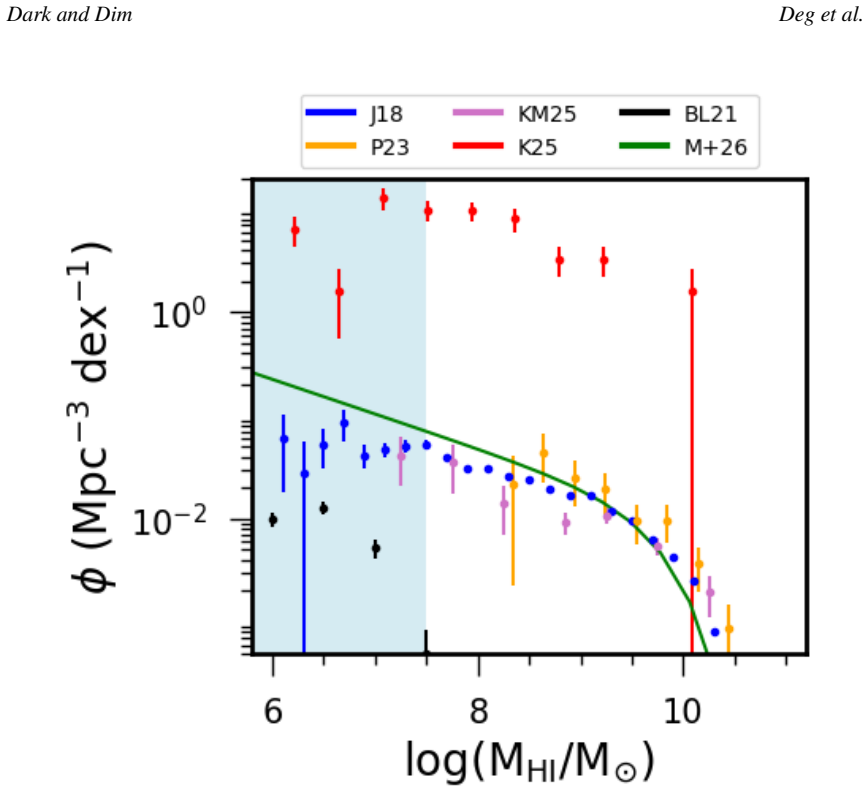
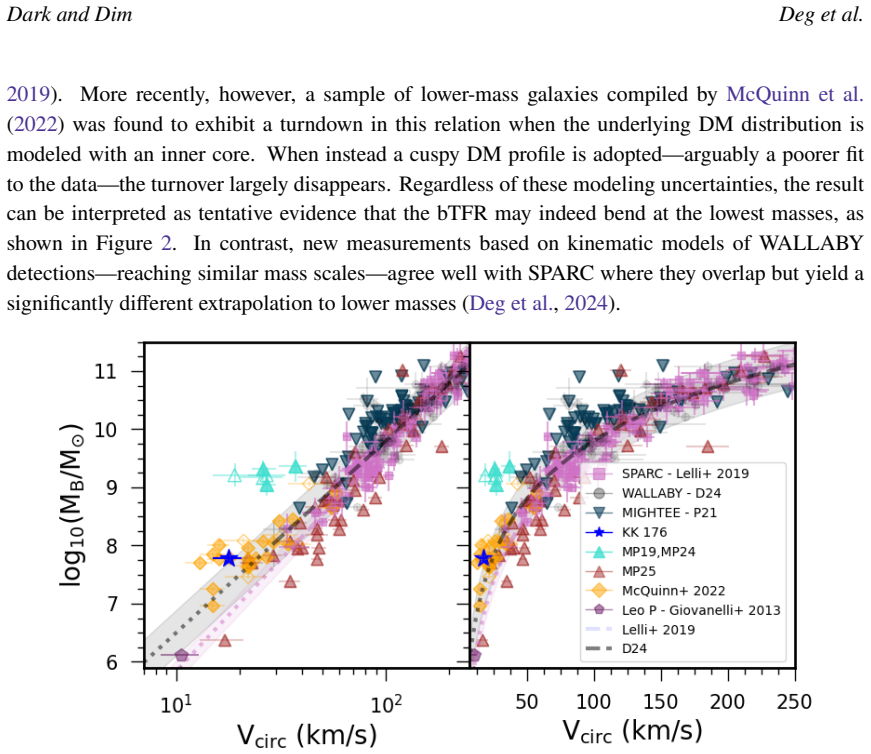
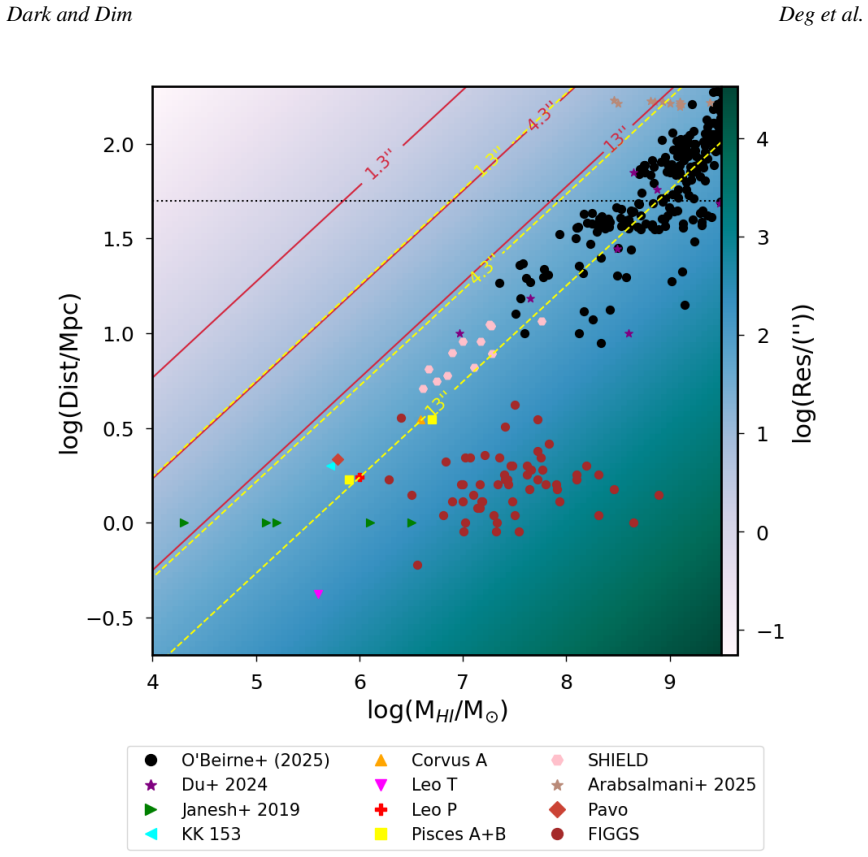
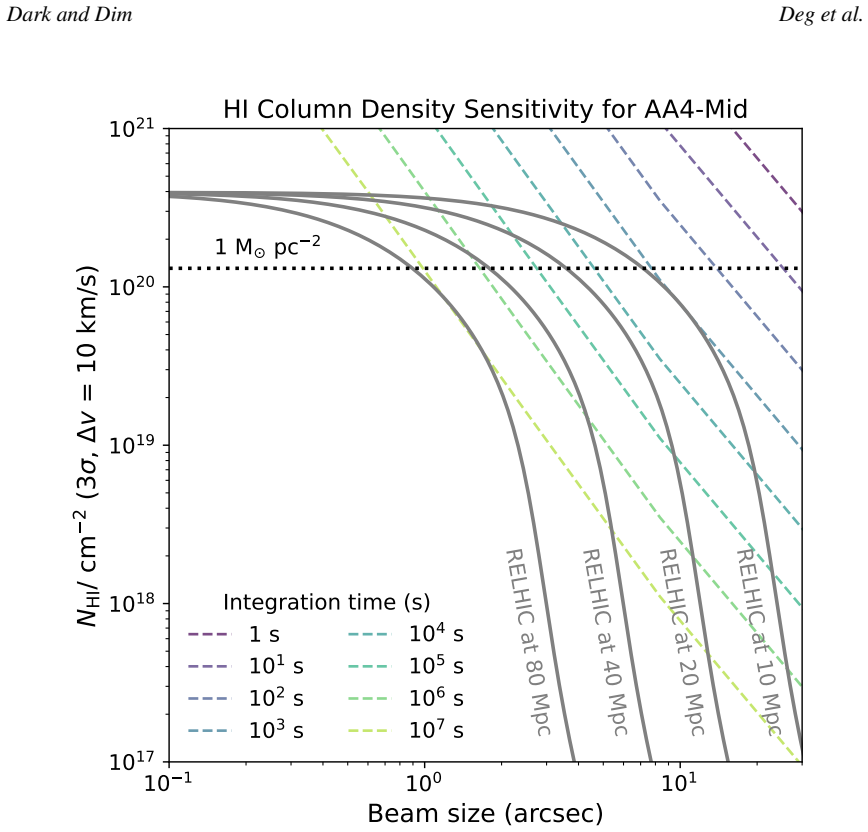
This chapter investigates the low-mass frontier of galaxy formation through two complementary populations: the starless Reionization-Limited HI Clouds (RELHICs) that trace the ``dark'' Universe, and the faint, gas-rich galaxies that define the ``dim'' Universe. RELHICs offer pristine laboratories for probing the distribution of DM on sub-galactic scales, providing a direct test of the Lambda Cold Dark Matter ($\Lambda$CDM) model predictions. The dim Universe provides statistical constraints on cosmology, galaxy formation and evolution, as well as baryoninc physics through key observables including the low-mass end of the neutral-hydrogen mass function (HIMF), the neutral-hydrogen velocity function (HIVF), and the low-mass end of the baryonic Tully-Fisher relation (bTFR). This chapter outlines core science questions that can be tackled leveraging radio observations of both the dark and dim Universe. Additionally, it outlines strategies to identify RELHICs amid tidal or pressure-confined contaminants, while providing observational predictions for the dim Universe. The Square Kilometre Array (SKA) in its mid-frequency Array Assembly 4 (AA4) configuration will, for the first time, resolve the internal gas structure of nearby RELHICs and build deep, wide-area datasets that definitively constrain the HIMF, HIVF, and bTFR down to masses of $10^{6}~\msol$ -- offering a complete observational framework to test the $\Lambda$CDM paradigm and the baryonic processes that shape the faint end of galaxy formation.
Editorial analysis
A structured set of objections, weighed in public.
Referee Report
Summary. This review chapter examines the low-mass frontier of galaxy formation via two populations: starless Reionization-Limited HI Clouds (RELHICs) as probes of the dark universe and faint gas-rich galaxies as the dim universe. It outlines core science questions addressable by radio observations, describes strategies for identifying RELHICs amid contaminants, and presents observational predictions. The central claim is that the SKA in its mid-frequency AA4 configuration will resolve internal gas structure in nearby RELHICs and deliver deep, wide-area datasets that definitively constrain the low-mass HIMF, HIVF, and bTFR down to 10^6 Msol, thereby testing LambdaCDM and baryonic physics.
Significance. If the outlined identification strategies achieve the required purity and RELHICs are sufficiently abundant, the synthesis provides a useful roadmap for using SKA observations to test LambdaCDM predictions on sub-galactic scales and to place statistical constraints on the faint end of galaxy formation. The manuscript draws on established LambdaCDM models and prior literature without introducing new derivations or simulations, so its value lies in framing the observational case rather than in novel quantitative forecasts.
major comments (1)
- [Abstract and RELHIC identification section] Abstract and section on RELHIC identification strategies: the claim that SKA AA4 will 'definitively constrain' the HIMF, HIVF, and bTFR down to 10^6 Msol rests on the assumption that RELHICs can be cleanly separated from tidal debris and pressure-confined clouds at high purity. No quantitative completeness calculations, contamination rates, or surface-density forecasts are supplied in the manuscript to support this; the strategies are described qualitatively.
minor comments (2)
- [Introduction] The manuscript would benefit from explicit cross-references between the science questions listed in the introduction and the specific observables (HIMF, HIVF, bTFR) discussed later.
- [Observational predictions] Notation for mass limits (e.g., 10^6 Msol) is used consistently but could be accompanied by a brief reminder of the corresponding HI column-density thresholds assumed in the predictions.
Simulated Author's Rebuttal
We thank the referee for their constructive comments on this review chapter. We address the major comment below and will revise the manuscript accordingly.
read point-by-point responses
-
Referee: [Abstract and RELHIC identification section] Abstract and section on RELHIC identification strategies: the claim that SKA AA4 will 'definitively constrain' the HIMF, HIVF, and bTFR down to 10^6 Msol rests on the assumption that RELHICs can be cleanly separated from tidal debris and pressure-confined clouds at high purity. No quantitative completeness calculations, contamination rates, or surface-density forecasts are supplied in the manuscript to support this; the strategies are described qualitatively.
Authors: We agree that the identification strategies are described qualitatively and that the strong claim of 'definitively constrain' requires better support. As this is a review synthesizing prior literature rather than presenting new calculations, we will revise the manuscript to incorporate quantitative estimates of completeness, contamination rates, and surface densities drawn from existing HI survey studies (e.g., ALFALFA and targeted RELHIC simulations in the literature). We will also moderate the abstract language to 'provide robust constraints' to align with the available quantitative foundation from prior work. revision: yes
Circularity Check
No circularity: review chapter relies on external LambdaCDM predictions and literature without self-referential derivations
full rationale
The manuscript is a forward-looking review chapter that summarizes existing LambdaCDM expectations for RELHICs, outlines identification strategies drawn from prior work, and states observational forecasts for SKA AA4. No new equations, fitted parameters, or uniqueness theorems are introduced within the paper itself. All load-bearing claims (e.g., SKA resolving internal structure and constraining HIMF/HIVF/bTFR) rest on cited external simulations and observations rather than any reduction to quantities defined or fitted inside this text. The derivation chain is therefore self-contained against external benchmarks.
Axiom & Free-Parameter Ledger
axioms (2)
- domain assumption LambdaCDM model predictions for sub-galactic dark matter distribution hold and can be tested via HI observations.
- domain assumption RELHICs trace pristine dark matter halos without significant baryonic contamination.
Reference graph
Works this paper leans on
-
[1]
2019 , eprint=
Anticipated Performance of the Square Kilometre Array -- Phase 1 (SKA1) , author=. 2019 , eprint=
2019
-
[2]
2015 , publisher=
Advancing Astrophysics with the Square Kilometre Array (AASKA14) , author=. 2015 , publisher=
2015
-
[3]
WALLABY Pilot Survey: Gas-rich Galaxy Scaling Relations from Marginally Resolved Kinematic Models. , keywords =. doi:10.3847/1538-4357/ad84ba , archivePrefix =. 2411.06993 , primaryClass =
-
[4]
An extremely optically dim tidal feature in the gas-rich interacting galaxy group NGC 871/NGC 876/NGC 877. , keywords =. doi:10.1093/mnras/stu1345 , archivePrefix =. 1407.1732 , primaryClass =
work page internal anchor Pith review Pith/arXiv arXiv doi:10.1093/mnras/stu1345
-
[5]
A large HI cloud near the centre of the Virgo cluster
A large H I cloud near the centre of the Virgo cluster. , keywords =. doi:10.1051/0004-6361:200500127 , archivePrefix =. astro-ph/0505397 , primaryClass =
work page internal anchor Pith review Pith/arXiv arXiv doi:10.1051/0004-6361:200500127
-
[6]
Tidal dwarf galaxies in the Stephan's Quintet?. , keywords =. doi:10.1023/A:1019597904278 , adsurl =
-
[7]
Exploring the Diversity of Faint Satellites in the M81 Group. , keywords =. doi:10.3847/1538-4357/ad8c3a , archivePrefix =. 2412.02697 , primaryClass =
-
[8]
HI Observations of the Stephan's Quintet
The VLA H I Observations of Stephan's Quintet (HCG 92). , keywords =. doi:10.1086/339839 , archivePrefix =. astro-ph/0201459 , primaryClass =
work page internal anchor Pith review Pith/arXiv arXiv doi:10.1086/339839
-
[9]
A blind HI survey of the M81 group
A Blind H I Survey of the M81 Group. , keywords =. doi:10.1086/324176 , archivePrefix =. astro-ph/0109086 , primaryClass =
work page internal anchor Pith review Pith/arXiv arXiv doi:10.1086/324176
-
[10]
The Arecibo Galaxy Environment Survey. XII. Optically Dark H I Clouds in the Leo I Group. , keywords =. doi:10.3847/1538-3881/ac96e8 , archivePrefix =. 2209.10994 , primaryClass =
-
[11]
Dark galaxies or tidal debris? Kinematical clues to the origin of massive isolated HI clouds. , keywords =. doi:10.1111/j.1745-3933.2005.00076.x , archivePrefix =. astro-ph/0505580 , primaryClass =
-
[12]
NGC 4254: An Act of Harassment Uncovered by the Arecibo Legacy Fast ALFA Survey
NGC 4254: An Act of Harassment Uncovered by the Arecibo Legacy Fast ALFA Survey. , keywords =. doi:10.1086/521188 , archivePrefix =. 0707.0113 , primaryClass =
work page internal anchor Pith review Pith/arXiv arXiv doi:10.1086/521188
-
[13]
Tidal debris from high-velocity collisions as fake dark galaxies: A numerical model of VirgoHI21
Tidal Debris from High-Velocity Collisions as Fake Dark Galaxies: A Numerical Model of VIRGOHI 21. , keywords =. doi:10.1086/524868 , archivePrefix =. 0710.3867 , primaryClass =
work page internal anchor Pith review Pith/arXiv arXiv doi:10.1086/524868
-
[14]
Searching for Dark Galaxies with H I Detection from the Arecibo Legacy Fast ALFA (ALFALFA) Survey. , keywords =. doi:10.3847/1538-4365/ade0b8 , archivePrefix =. 2506.03678 , primaryClass =
-
[15]
A Dark Hydrogen Cloud in the Virgo Cluster
A Dark Hydrogen Cloud in the Virgo Cluster. , keywords =. doi:10.1086/429538 , archivePrefix =. astro-ph/0502312 , primaryClass =
work page internal anchor Pith review Pith/arXiv arXiv doi:10.1086/429538
-
[16]
A multibeam HI survey of the Virgo cluster - two isolated HI clouds?. , keywords =. doi:10.1111/j.1365-2966.2004.07568.x , archivePrefix =. astro-ph/0312531 , primaryClass =
-
[17]
WALLABY pilot survey: an 'almost' dark cloud near the Hydra cluster. , keywords =. doi:10.1093/mnras/stae215 , archivePrefix =. 2401.09738 , primaryClass =
-
[18]
Tidal dwarf galaxies in the nearby Universe. , keywords =. doi:10.1111/j.1365-2966.2011.19673.x , archivePrefix =. 1108.4410 , primaryClass =
-
[19]
The Turndown of the Baryonic Tully-Fisher Relation and Changing Baryon Fraction at Low Galaxy Masses. , keywords =. doi:10.3847/1538-4357/ac9285 , archivePrefix =. 2203.10105 , primaryClass =
-
[20]
Off the Baryonic Tully-Fisher Relation: A Population of Baryon-dominated Ultra-diffuse Galaxies. , keywords =. doi:10.3847/2041-8213/ab40c7 , archivePrefix =. 1909.01363 , primaryClass =
-
[21]
ALFALFA Discovery of the Nearby Gas-rich Dwarf Galaxy Leo P. I. H I Observations. , keywords =. doi:10.1088/0004-6256/146/1/15 , archivePrefix =. 1305.0272 , primaryClass =
work page internal anchor Pith review Pith/arXiv arXiv doi:10.1088/0004-6256/146/1/15
-
[22]
The baryonic Tully-Fisher relation for different velocity definitions and implications for galaxy angular momentum. , keywords =. doi:10.1093/mnras/stz205 , archivePrefix =. 1901.05966 , primaryClass =
-
[23]
Robust H I kinematics of gas-rich ultra-diffuse galaxies: hints of a weak-feedback formation scenario. , keywords =. doi:10.1093/mnras/staa1256 , archivePrefix =. 2004.14392 , primaryClass =
-
[24]
The impact of gas disc flaring on rotation curve decomposition and revisiting baryonic and dark matter relations for nearby galaxies. , keywords =. doi:10.1093/mnras/stac1508 , archivePrefix =. 2205.12977 , primaryClass =
-
[25]
Exploring the nature of dark matter with the extreme galaxy AGC 114905. , keywords =. doi:10.1051/0004-6361/202450230 , archivePrefix =. 2404.06537 , primaryClass =
-
[26]
Almost Optically Dark Galaxies in DECaLS (I): Detection, Optical Properties, and Possible Origins. , keywords =. doi:10.3847/1538-4357/ad234f , archivePrefix =. 2403.12130 , primaryClass =
-
[27]
Global Dynamic Scaling Relations of H I-rich Ultra-diffuse Galaxies. , keywords =. doi:10.3847/2041-8213/acc7a4 , archivePrefix =. 2303.16232 , primaryClass =
-
[28]
The ultradiffuse galaxy AGC 114905 needs dark matter. , keywords =. doi:10.1093/mnras/stac1604 , archivePrefix =. 2202.08678 , primaryClass =
-
[29]
A Shallow Dark Matter Halo in Ultra-diffuse Galaxy AGC 242019: Are UDGs Structurally Similar to Low-surface-brightness Galaxies?. , keywords =. doi:10.3847/2041-8213/ac236a , archivePrefix =. 2109.01402 , primaryClass =
-
[30]
Gas-rich ``ultra-diffuse'' galaxies are consistent with the baryonic Tully Fisher relation and with Milgromian dynamics. , keywords =. doi:10.1051/0004-6361/202451289 , archivePrefix =. 2408.05269 , primaryClass =
-
[31]
Are Gas-rich Ultra-diffuse Galaxies and Field Dwarfs Distinct?. arXiv e-prints , keywords =. doi:10.48550/arXiv.2502.14971 , archivePrefix =. 2502.14971 , primaryClass =
-
[32]
DDO 161 and UGCA 319: an isolated pair of nearby dwarf galaxies
DDO 161 and UGCA 319: an isolated pair of nearby dwarf galaxies. , keywords =. doi:10.1093/mnrasl/slx061 , archivePrefix =. 1704.07648 , primaryClass =
work page internal anchor Pith review Pith/arXiv arXiv doi:10.1093/mnrasl/slx061
-
[33]
The ALFALFA HI mass function: A dichotomy in the low-mass slope and a locally suppressed 'knee' mass
The ALFALFA H I mass function: a dichotomy in the low-mass slope and a locally suppressed `knee' mass. , keywords =. doi:10.1093/mnras/sty521 , archivePrefix =. 1802.00053 , primaryClass =
work page internal anchor Pith review Pith/arXiv arXiv doi:10.1093/mnras/sty521
-
[34]
Corvus A: A Low-mass, Isolated Galaxy at 3.5 Mpc. , keywords =. doi:10.3847/2041-8213/ad676e , archivePrefix =. 2407.03393 , primaryClass =
-
[35]
WALLABY Pilot Survey: Public release of HI kinematic models for more than 100 galaxies from phase 1 of ASKAP pilot observations. , keywords =. doi:10.1017/pasa.2022.43 , archivePrefix =. 2211.07333 , primaryClass =
-
[36]
New Lessons from the HI Size-Mass Relation of Galaxies
New lessons from the H I size-mass relation of galaxies. , keywords =. doi:10.1093/mnras/stw1099 , archivePrefix =. 1605.01489 , primaryClass =
work page internal anchor Pith review Pith/arXiv arXiv doi:10.1093/mnras/stw1099
-
[37]
MIGHTEE-H I: the first MeerKAT H I mass function from an untargeted interferometric survey. , keywords =. doi:10.1093/mnras/stad1249 , archivePrefix =. 2304.13051 , primaryClass =
-
[38]
The H I mass function of the Local Universe: Combining measurements from HIPASS, ALFALFA, and FASHI. , keywords =. doi:10.1051/0004-6361/202452976 , archivePrefix =. 2411.09903 , primaryClass =
-
[39]
Looking at the Distant Universe with the MeerKAT Array: The H I Mass Function in the Local Universe. , keywords =. doi:10.3847/1538-4357/ad9f3f , archivePrefix =. 2412.11426 , primaryClass =
-
[40]
The H I mass function of group galaxies in the ALFALFA survey. , keywords =. doi:10.1093/mnras/staa810 , archivePrefix =. 2003.09302 , primaryClass =
-
[41]
The ALFALFA H I velocity width function. , keywords =. doi:10.1093/mnras/stab3164 , archivePrefix =. 2108.08856 , primaryClass =
-
[42]
Is there a "too big to fail" problem in the field?
Is there a ``too big to fail'' problem in the field?. , keywords =. doi:10.1051/0004-6361/201424909 , archivePrefix =. 1407.4665 , primaryClass =
work page internal anchor Pith review Pith/arXiv arXiv doi:10.1051/0004-6361/201424909
-
[43]
An assessment of the ``too big to fail'' problem for field dwarf galaxies in view of baryonic feedback effects. , keywords =. doi:10.1051/0004-6361/201527854 , archivePrefix =. 1511.08741 , primaryClass =
work page internal anchor Pith review Pith/arXiv arXiv doi:10.1051/0004-6361/201527854
-
[44]
NIHAO XVII: The diversity of dwarf galaxy kinematics and implications for the HI velocity function
NIHAO - XVII. The diversity of dwarf galaxy kinematics and implications for the H I velocity function. , keywords =. doi:10.1093/mnras/sty3064 , archivePrefix =. 1807.10518 , primaryClass =
work page internal anchor Pith review Pith/arXiv arXiv doi:10.1093/mnras/sty3064
-
[45]
Abundance of field galaxies. , keywords =. doi:10.1093/mnras/stv2040 , archivePrefix =. 1405.4523 , primaryClass =
work page internal anchor Pith review Pith/arXiv arXiv doi:10.1093/mnras/stv2040
-
[46]
The velocity function in the local environment from LCDM and LWDM constrained simulations
The Velocity Function in the Local Environment from CDM and WDM Constrained Simulations. , keywords =. doi:10.1088/0004-637X/700/2/1779 , archivePrefix =. 0906.0585 , primaryClass =
work page internal anchor Pith review Pith/arXiv arXiv doi:10.1088/0004-637x/700/2/1779
-
[47]
The velocity function of gas-rich galaxies. , keywords =. doi:10.1111/j.1365-2966.2009.16188.x , archivePrefix =. 0912.1754 , primaryClass =
-
[48]
The H I mass function and velocity width function of void galaxies in the Arecibo Legacy Fast ALFA Survey. , keywords =. doi:10.1093/mnras/stu1674 , archivePrefix =. 1408.3392 , primaryClass =
work page internal anchor Pith review Pith/arXiv arXiv doi:10.1093/mnras/stu1674
-
[49]
How to Reconcile the Observed Velocity Function of Galaxies with Theory
How to Reconcile the Observed Velocity Function of Galaxies with Theory. , keywords =. doi:10.3847/1538-4357/aa9576 , archivePrefix =. 1701.07835 , primaryClass =
work page internal anchor Pith review Pith/arXiv arXiv doi:10.3847/1538-4357/aa9576
-
[50]
The H I velocity function: a test of cosmology or baryon physics?. , keywords =. doi:10.1093/mnras/stz2069 , archivePrefix =. 1906.06130 , primaryClass =
-
[51]
NIHAO X: reconciling the local galaxy velocity function with cold dark matter via mock H I observations. , keywords =. doi:10.1093/mnrasl/slw147 , adsurl =
-
[52]
Iorio, G. and Fraternali, F. and Nipoti, C. and Di Teodoro, E. and Read, J. I. and Battaglia, G. , year=. LITTLE THINGS in 3D: robust determination of the circular velocity of dwarf irregular galaxies. , ISSN=. doi:10.1093/mnras/stw3285 , journal=
-
[53]
WALLABY - an SKA Pathfinder HI survey. , keywords =. doi:10.1007/s10509-020-03831-4 , archivePrefix =. 2002.07311 , primaryClass =
-
[54]
SPARC: Mass Models for 175 Disk Galaxies with Spitzer Photometry and Accurate Rotation Curves
SPARC: Mass Models for 175 Disk Galaxies with Spitzer Photometry and Accurate Rotation Curves. , keywords =. doi:10.3847/0004-6256/152/6/157 , archivePrefix =. 1606.09251 , primaryClass =
work page internal anchor Pith review Pith/arXiv arXiv doi:10.3847/0004-6256/152/6/157
-
[55]
The Local Volume H I Survey (LVHIS). , keywords =. doi:10.1093/mnras/sty479 , archivePrefix =. 1904.09648 , primaryClass =
-
[56]
MIGHTEE-H I: the baryonic Tully-Fisher relation over the last billion years. , keywords =. doi:10.1093/mnras/stab2654 , archivePrefix =. 2109.04992 , primaryClass =
-
[57]
FIGGS: Faint Irregular Galaxies GMRT Survey - overview, observations and first results. , keywords =. doi:10.1111/j.1365-2966.2008.13150.x , archivePrefix =. 0802.3982 , primaryClass =
-
[58]
Baryonic Tully-Fisher relation for extremely low mass Galaxies. , keywords =. doi:10.1111/j.1365-2966.2008.13010.x , archivePrefix =. 0801.3606 , primaryClass =
-
[59]
WALLABY Pilot Survey: Public data release of 1800 H I sources and high-resolution cut-outs from Pilot Survey Phase 2. , keywords =. doi:10.1017/pasa.2024.91 , archivePrefix =. 2409.13130 , primaryClass =
-
[60]
MARTINI: Mock spatially resolved spectral line observations of simulated galaxies
-
[61]
The Shapes of the HI Velocity Profiles of the THINGS Galaxies
The Shapes of the H I Velocity Profiles of the THINGS Galaxies. , keywords =. doi:10.1088/0004-6256/144/4/96 , archivePrefix =. 1207.5041 , primaryClass =
work page internal anchor Pith review Pith/arXiv arXiv doi:10.1088/0004-6256/144/4/96
-
[62]
Exploring the potential for kinematically colder H I component as a tracer for star-forming gas in nearby galaxies. , keywords =. doi:10.1093/mnras/staf902 , archivePrefix =. 2506.01620 , primaryClass =
-
[63]
Kinematic Decomposition of the H I Gaseous Component in the Large Magellanic Cloud. , keywords =. doi:10.3847/1538-4357/ac5905 , adsurl =
-
[64]
MIGHTEE-H I: the H I size-mass relation over the last billion years. , keywords =. doi:10.1093/mnras/stac693 , archivePrefix =. 2203.06149 , primaryClass =
-
[65]
Origin of the galaxy H I size-mass relation. , keywords =. doi:10.1093/mnras/stz2513 , archivePrefix =. 1908.11149 , primaryClass =
-
[66]
21-cm line studies of spiral galaxies. II. The distribution and kinematics of neutral hydrogen in spiral galaxies of various morphological types. , keywords =. doi:10.1086/113063 , adsurl =
-
[67]
The impact of environment on size: Galaxies are 50\. , keywords =. doi:10.1051/0004-6361/202348536 , archivePrefix =. 2311.10144 , primaryClass =
-
[68]
A Break in the Size Stellar Mass Relation: Evidence for Quenching and Feedback in Dwarf Galaxies. , keywords =. doi:10.3847/1538-4357/ad7377 , archivePrefix =. 2408.13311 , primaryClass =
-
[69]
VERTICO V: The environmentally driven evolution of the inner cold gas discs of Virgo cluster galaxies. , keywords =. doi:10.1017/pasa.2023.14 , archivePrefix =. 2303.07549 , primaryClass =
-
[70]
Diving into dangerous tides: The impact of galaxy cluster tidal environments on satellite galaxy mass densities. , keywords =. doi:10.1051/0004-6361/202449520 , archivePrefix =. 2505.21713 , primaryClass =
-
[71]
Breathing FIRE: How Stellar Feedback Drives Radial Migration, Rapid Size Fluctuations, and Population Gradients in Low-mass Galaxies. , keywords =. doi:10.3847/0004-637X/820/2/131 , archivePrefix =. 1512.01235 , primaryClass =
work page internal anchor Pith review Pith/arXiv arXiv doi:10.3847/0004-637x/820/2/131
-
[72]
EDGE: What shapes the relationship between H I and stellar observables in faint dwarf galaxies?. , keywords =. doi:10.1093/mnras/stac502 , archivePrefix =. 2112.03280 , primaryClass =
-
[73]
Properties of HI discs in the Auriga cosmological simulations
Properties of H I discs in the Auriga cosmological simulations. , keywords =. doi:10.1093/mnras/stw3366 , archivePrefix =. 1610.01594 , primaryClass =
work page internal anchor Pith review Pith/arXiv arXiv doi:10.1093/mnras/stw3366
-
[74]
A physically motivated definition for the size of galaxies in an era of ultradeep imaging. , keywords =. doi:10.1093/mnras/staa236 , archivePrefix =. 2001.02689 , primaryClass =
-
[75]
The edges of galaxies: Tracing the limits of star formation. , keywords =. doi:10.1051/0004-6361/202243612 , archivePrefix =. 2209.05497 , primaryClass =
-
[76]
It's a Breeze: The Circumgalactic Medium of a Dwarf Galaxy Is Easy to Strip. , keywords =. doi:10.3847/1538-4357/ad6c3f , archivePrefix =. 2404.00129 , primaryClass =
-
[77]
Are ultra-diffuse galaxies Milky Way-sized?. , keywords =. doi:10.1051/0004-6361/201936821 , archivePrefix =. 2001.02691 , primaryClass =
-
[78]
Pavo: Stellar feedback in action in a low-mass dwarf galaxy. arXiv e-prints , keywords =. doi:10.48550/arXiv.2506.06424 , archivePrefix =. 2506.06424 , primaryClass =
-
[79]
Truncated Star Formation and Ram Pressure Stripping in the Coma Cluster. , keywords =. doi:10.3847/1538-4357/add739 , archivePrefix =. 2505.10633 , primaryClass =
-
[80]
Halpha Morphologies and Environmental Effects in Virgo Cluster Spiral Galaxies
H Morphologies and Environmental Effects in Virgo Cluster Spiral Galaxies. , keywords =. doi:10.1086/423191 , archivePrefix =. astro-ph/0406243 , primaryClass =
work page internal anchor Pith review Pith/arXiv arXiv doi:10.1086/423191
discussion (0)
Sign in with ORCID, Apple, or X to comment. Anyone can read and Pith papers without signing in.