Magnetic Cloud Boundary Identification Using a Local-Normalized Magnetic Field Parameter
Pith reviewed 2026-06-26 01:57 UTC · model grok-4.3
The pith
A local-normalized magnetic field parameter identifies magnetic cloud boundaries through variability contrast.
A machine-rendered reading of the paper's core claim, the machinery that carries it, and where it could break.
Core claim
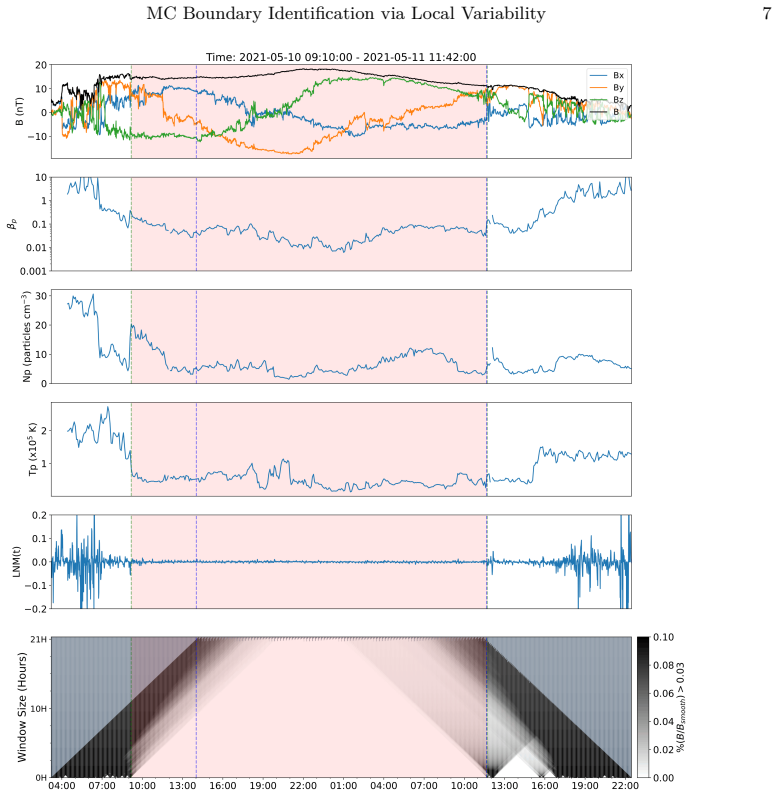
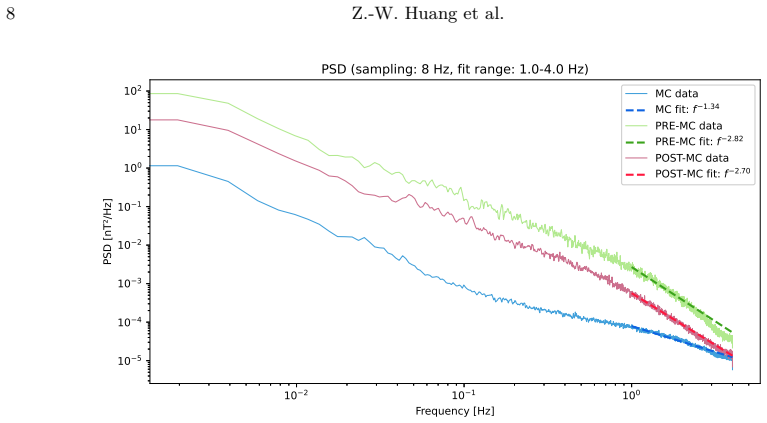
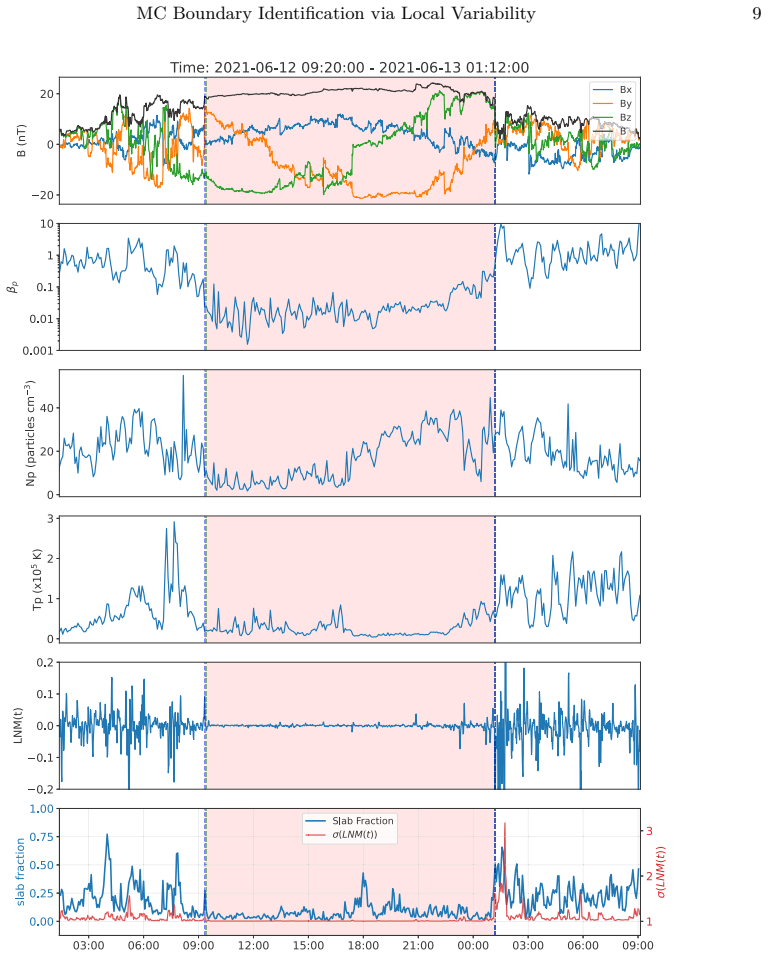
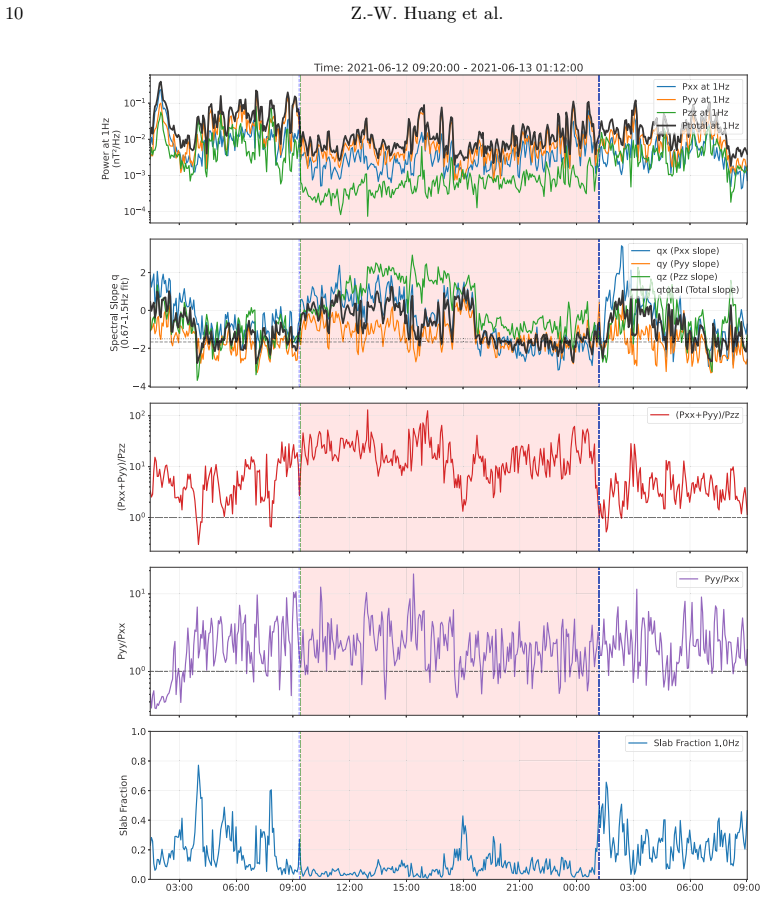
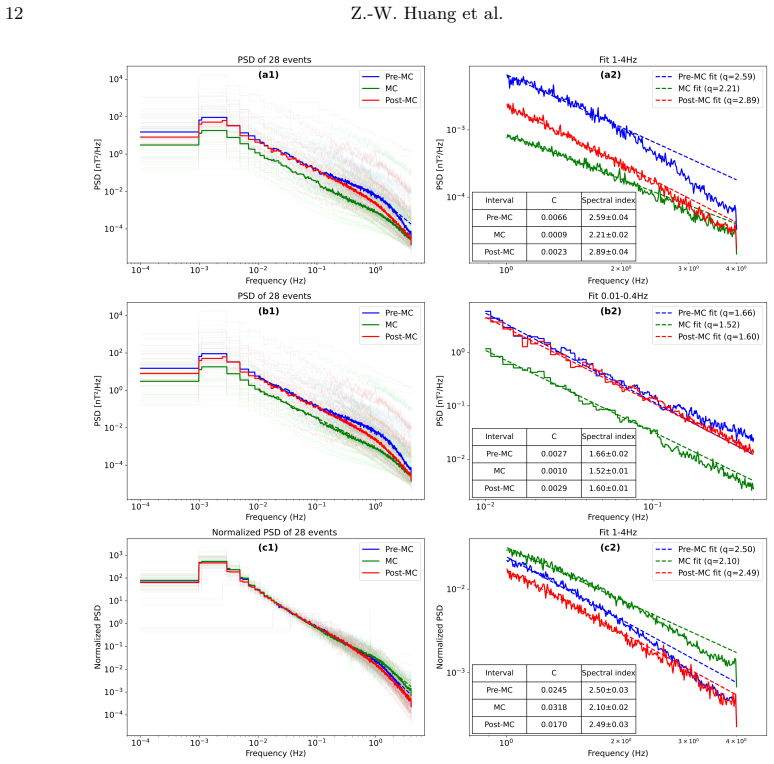
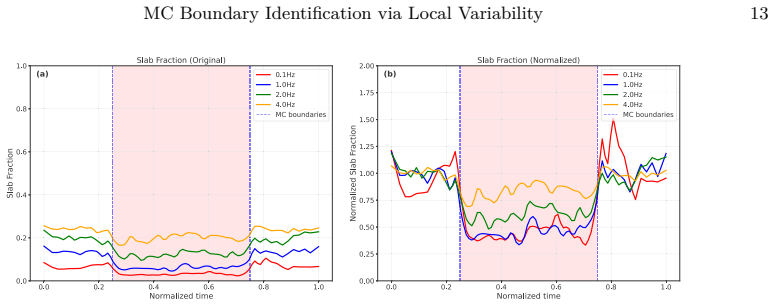
The central claim is that LNM(t) equals log base ten of B(t) divided by the five-minute running median of B ending at t, and that this quantity remains small inside magnetic clouds because their field magnitude stays close to the local background while varying more outside; the resulting contrast supplies a reproducible way to locate boundaries, as corroborated by the finding that the dissipation-range spectral index is approximately minus 2.21 inside versus minus 2.59 and minus 2.89 outside, with reduced slab fraction indicating greater anisotropy.
What carries the argument
The Local-Normalized Magnetic field parameter (LNM), which measures short-timescale deviation of total field strength from its local five-minute median to mark the transition from coherent cloud interior to variable wind.
If this is right
- Magnetic cloud boundaries acquire quantitative and reproducible criteria based on field-magnitude variability.
- Inside identified clouds the dissipation-range spectral index remains near minus 2.21 while exterior values are steeper.
- Slab fraction drops inside the clouds, consistent with reduced small-scale variability and increased anisotropy.
- Time-series scalograms provide visual support for the automated boundary placements.
Where Pith is reading between the lines
- The same normalization approach could be tested on other coherent solar-wind structures such as stream interaction regions.
- Better boundary locations may tighten estimates of magnetic cloud expansion rates and geoeffectiveness.
- The observed change in spectral slope across the boundary invites direct comparison with in-situ turbulence models.
- Applying the parameter to simulated magnetic clouds would test whether the contrast arises purely from the imposed coherence.
Load-bearing premise
The five-minute running median accurately captures the local background magnetic field without being substantially altered by the magnetic cloud structure itself.
What would settle it
Absence of a systematic difference in dissipation-range spectral index or slab fraction between LNM-identified interior and exterior regions across the seventy-six events would falsify the claim that the parameter reliably isolates magnetic clouds.
Figures
read the original abstract
Due to the lack of quantitative and reproducible criteria for identifying magnetic cloud (MC) boundaries, we propose a parameter that characterizes short-timescale variability in magnetic field strength. The parameter, referred to as the Local-Normalized Magnetic field parameter (LNM), is defined as $\mathrm{LNM}(t)=\log_{10}\left(B(t)/\langle B \rangle_{\mathrm{5m\text{-}med}}(t)\right)$, where $B(t)$ is the total magnetic field strength and $\langle B \rangle_{\mathrm{5m\text{-}med}}(t)$ is its 5-minute running median ending at time $t$. This parameter measures the deviation of the magnetic field magnitude from its local background and reveals a clear contrast between the coherent magnetic structure inside MCs and the more variable ambient solar wind. Based on this parameter, we develop a semi-automated method for MC boundary identification, supported by Time Series Scalogram visualization. We further analyze 76 MC events using power spectral density (PSD) and slab fraction diagnostics. The results show that the dissipation-range spectral index inside MCs ($\sim f^{-2.21}$) is systematically smaller than that outside ($\sim f^{-2.59}$ and $f^{-2.89}$), and the slab fraction is reduced, indicating suppressed small-scale variability and enhanced anisotropy. These results support the applicability of the proposed parameter for MC boundary identification.
Editorial analysis
A structured set of objections, weighed in public.
Referee Report
Summary. The paper introduces the Local-Normalized Magnetic field parameter (LNM(t) = log10(B(t) / <B>_{5m-med}(t))) to characterize short-timescale variability in magnetic field strength for identifying magnetic cloud (MC) boundaries. Using this, a semi-automated method is developed and applied to 76 MC events. Power spectral density analysis reveals dissipation-range spectral indices inside MCs (~f^{-2.21}) systematically smaller than outside (~f^{-2.59} and f^{-2.89}), with reduced slab fraction, claimed to support the parameter's applicability.
Significance. The proposed LNM parameter offers a quantitative approach to MC boundary identification, which is currently lacking reproducible criteria. The reported differences in spectral properties could inform understanding of turbulence in MCs versus ambient wind. However, the strength is limited by potential circularity in the validation and lack of independent checks.
major comments (3)
- [Abstract] Abstract: The statement that PSD and slab-fraction results support LNM applicability is not independent evidence, as LNM is defined from |B| deviations from the 5-min median (low variability), and the diagnostics directly measure suppressed small-scale variability and anisotropy inside the identified intervals. This risks tautology; independent validation against existing MC boundary lists is needed.
- [Methods/Results] Methods/Results: No error bars, uncertainties, or statistical significance tests are mentioned for the reported spectral indices (~f^{-2.21}, etc.) or slab fractions across the 76 events.
- [Abstract] Definition of LNM (abstract): The assumption that the 5-minute running median accurately captures the local background without substantial alteration by the MC coherent structure is invoked but not tested for its effect on boundary placement.
minor comments (2)
- [Abstract] Abstract: The outside spectral indices are given as ~f^{-2.59} and f^{-2.89}; clarify if these correspond to specific regions (e.g., sheath vs. ambient wind) or different events.
- Consider adding a figure showing example LNM time series with identified boundaries for one or more events to illustrate the semi-automated method.
Simulated Author's Rebuttal
We thank the referee for their constructive comments, which help clarify the validation and statistical presentation of our work. We respond to each major comment below and indicate planned revisions.
read point-by-point responses
-
Referee: [Abstract] Abstract: The statement that PSD and slab-fraction results support LNM applicability is not independent evidence, as LNM is defined from |B| deviations from the 5-min median (low variability), and the diagnostics directly measure suppressed small-scale variability and anisotropy inside the identified intervals. This risks tautology; independent validation against existing MC boundary lists is needed.
Authors: We acknowledge the risk of circularity, as both LNM and the PSD/slab diagnostics are sensitive to variability levels. While the spectral results align with prior expectations for MC turbulence, they do not constitute fully independent validation. We will revise the abstract and add a new subsection comparing our identified boundaries against published MC catalogs to provide external checks. revision: yes
-
Referee: [Methods/Results] Methods/Results: No error bars, uncertainties, or statistical significance tests are mentioned for the reported spectral indices (~f^{-2.21}, etc.) or slab fractions across the 76 events.
Authors: We agree that quantitative uncertainties and significance testing are necessary. In the revised manuscript we will report standard errors derived from the event-to-event distribution, include error bars on the mean indices and slab fractions, and add results from paired statistical tests assessing the inside-versus-outside differences. revision: yes
-
Referee: [Abstract] Definition of LNM (abstract): The assumption that the 5-minute running median accurately captures the local background without substantial alteration by the MC coherent structure is invoked but not tested for its effect on boundary placement.
Authors: The 5-minute window is motivated by the separation between typical fluctuation timescales and MC durations, but we have not quantified sensitivity. We will expand the methods section with a short sensitivity test using alternative window lengths and discuss its impact on boundary locations. revision: partial
Circularity Check
No significant circularity in derivation chain
full rationale
The paper explicitly defines LNM(t) = log10(B(t) / <B>_{5m-med}(t)) from the magnitude time series and a fixed running median. Boundaries are placed via this parameter plus scalogram. PSD spectral indices and slab fractions are computed separately on the resulting intervals as an external diagnostic of turbulence properties. No equation reduces to its own input by construction, no parameter is fitted then relabeled as prediction, and no self-citation chain carries the central claim. The diagnostics are statistically independent of the LNM definition itself.
Axiom & Free-Parameter Ledger
free parameters (1)
- 5-minute median window
axioms (1)
- domain assumption The 5-minute running median supplies an appropriate local background against which deviations inside magnetic clouds can be measured.
Reference graph
Works this paper leans on
-
[1]
1993, Marks standard handbook for mechanical engineers 6
A vellone, E., Baumeister III, T., & Saunders, H. 1993, Marks standard handbook for mechanical engineers 6
1993
-
[2]
W., & Davis, Jr., L
Belcher, J. W., & Davis, Jr., L. 1971, J. Geophys. Res., 76, 3534 7
1971
-
[3]
W., Matthaeus, W
Bieber, J. W., Matthaeus, W. H., Smith, C. W., et al. 1994, ApJ, 420, 294 7
1994
-
[4]
W., Wanner, W., & Matthaeus, W
Bieber, J. W., Wanner, W., & Matthaeus, W. H. 1996, J. Geophys. Res., 101, 2511 7, 8
1996
-
[5]
Burlaga, L. F. 1995, International Series in Astronomy and Astrophysics 2
1995
-
[6]
Burlaga, L., Sittler, E., Mariani, F., & Schwenn, R. 1981, J. Geophys. Res., 86, 6673 2
1981
-
[7]
2023, ApJ, 957, 38 2
Dhamane, O., Pawaskar, V., Raghav, A., et al. 2023, ApJ, 957, 38 2
2023
-
[8]
1998, Geophys
Henke, T., Woch, J., Mall, U., et al. 1998, Geophys. Res. Lett., 25, 3465 2
1998
-
[9]
2024, ApJ, 973, L26 5
Huang, Z., Shi, C., Velli, M., et al. 2024, ApJ, 973, L26 5
2024
-
[10]
H., Osman, K
Kiyani, K. H., Osman, K. T., & Chapman, S. C. 2015, Philosophical Transactions of the Royal Society of London Series A, 373, 20140155 6
2015
-
[11]
2024, ApJ, 965, 139 2
Kumbhar, K., Raghav, A., Dhamane, O., et al. 2024, ApJ, 965, 139 2
2024
-
[12]
J., Smith, C
Leamon, R. J., Smith, C. W., Ness, N. F., Matthaeus, W. H., & Wong, H. K. 1998, J. Geophys. Res., 103, 4775 8, 11
1998
-
[13]
P., Jones, J
Lepping, R. P., Jones, J. A., & Burlaga, L. F. 1990, J. Geophys. Res., 95, 11957 2
1990
-
[14]
T., & Zurbuchen, T
Lepri, S. T., & Zurbuchen, T. H. 2004, Journal of Geophysical Research (Space Physics), 109, A01112 2
2004
-
[15]
D., Hu, H., Zhao, X., Chen, C., & Wang, R
Liu, Y. D., Hu, H., Zhao, X., Chen, C., & Wang, R. 2024, ApJ, 974, L8 13
2024
-
[16]
Lugaz, N., & Farrugia, C. J. 2014, Geophys. Res. Lett., 41, 769 13 Möstl, C., Weiss, A. J., Bailey, R. L., et al. 2020, ApJ, 903, 92 3
2014
-
[17]
N., & Kule, A
Raghav, A. N., & Kule, A. 2018, MNRAS, 480, L6 2, 14 Vörös, Z., Varsani, A., Yordanova, E., et al. 2021, Journal of Geophysical Research (Space Physics), 126, e29415 2
2018
-
[18]
2026, ApJ, 1002, L23 13
Wang, R., Hu, H., Zhao, X., et al. 2026, ApJ, 1002, L23 13
2026
-
[19]
2016, Journal of Geophysical Research (Space Physics), 121, 9316 14
Wang, Y., Zhuang, B., Hu, Q., et al. 2016, Journal of Geophysical Research (Space Physics), 121, 9316 14
2016
-
[20]
2006, Journal of Geophysical Research (Space Physics), 111, A03102 2 16 Z.-W
Wei, F., Feng, X., Yang, F., & Zhong, D. 2006, Journal of Geophysical Research (Space Physics), 111, A03102 2 16 Z.-W. Huang et al
2006
-
[21]
2003, Journal of Geophysical Research (Space Physics), 108, 1263 2
Wei, F., Liu, R., Fan, Q., & Feng, X. 2003, Journal of Geophysical Research (Space Physics), 108, 1263 2
2003
-
[22]
2005, Science Bulletin, 50, 2051 2
Wei, F., Zhong, D., Feng, X., Yang, F., & Liu, R. 2005, Science Bulletin, 50, 2051 2
2005
-
[23]
N., Gallagher, B
Youngworth, R. N., Gallagher, B. B., & Stamper, B. L. 2005, in Society of Photo-Optical Instrumentation Engineers (SPIE) Conference Series, Vol. 5869, Optical Manufacturing and Testing VI, ed. H. P. Stahl, 206 6
2005
-
[24]
G., Webb, D
Zhang, J., Richardson, I. G., Webb, D. F., et al. 2007, Journal of Geophysical Research (Space Physics), 112, A10102 13
2007
-
[25]
H., & Richardson, I
Zurbuchen, T. H., & Richardson, I. G. 2006, Space Sci. Rev., 123, 31 14
2006
discussion (0)
Sign in with ORCID, Apple, or X to comment. Anyone can read and Pith papers without signing in.