Colour changes of Jupiter's Oval BA through microphysical modelling
Pith reviewed 2026-07-02 05:43 UTC · model grok-4.3
The pith
Jupiter's Oval BA color changes result from shifts in downward vertical transport within its annulus.
A machine-rendered reading of the paper's core claim, the machinery that carries it, and where it could break.
Core claim
The transition is best reproduced by changes in tropospheric vertical transport within a subsiding annulus, corresponding to preferred downwelling velocities of order 10^{-4}-10^{-3} m s^{-1} at chromophore-bearing pressures. These small vertical velocities may help explain why no clear dynamical signature has yet been identified.
What carries the argument
One-dimensional microphysical model of the upper chromophore haze layer constrained by retrieved aerosol properties for the red and whiter annulus states.
Load-bearing premise
Color changes occur solely via decrease in optical depth of the upper chromophore haze with no significant change in particle size or haze altitude.
What would settle it
Retrievals or direct observations showing significant changes in particle size or haze altitude during a color transition, or vertical velocities outside the 10^{-4} to 10^{-3} m s^{-1} range, would disprove the explanation.
Figures
read the original abstract
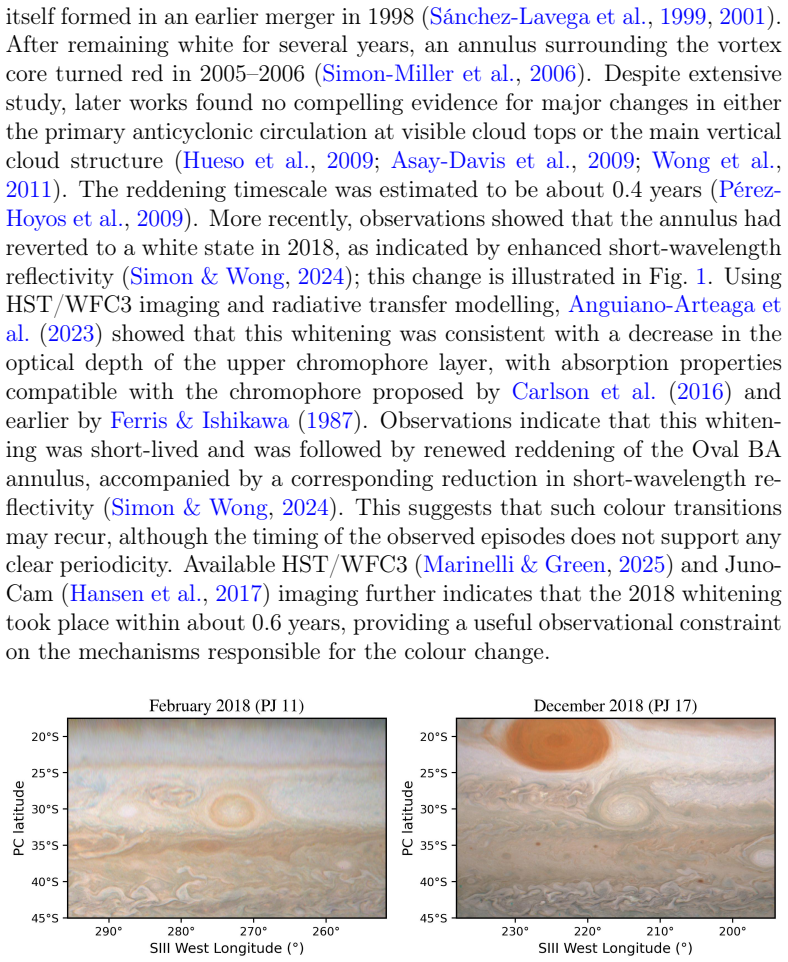
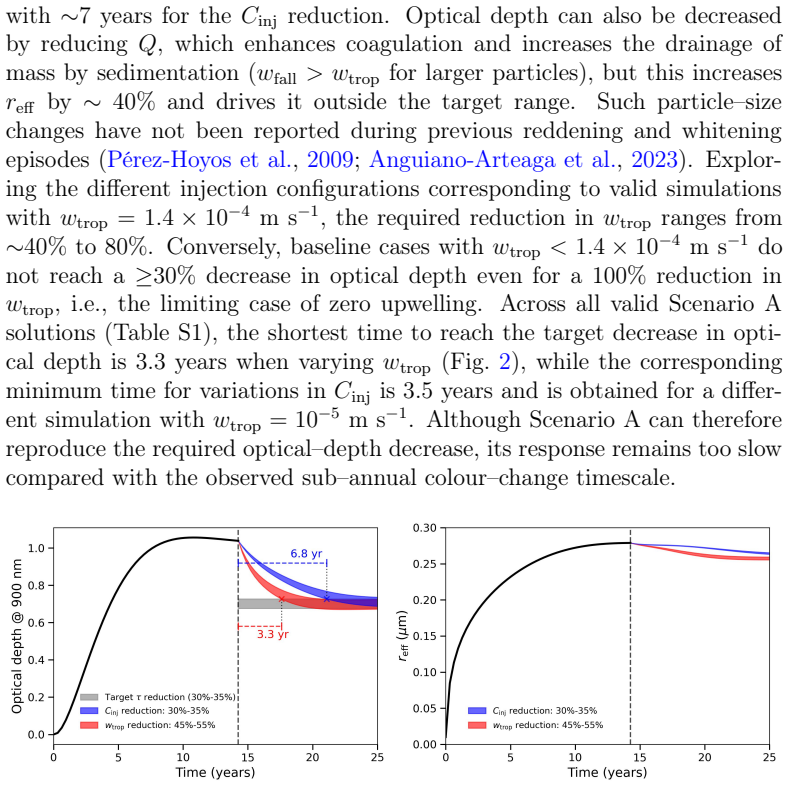
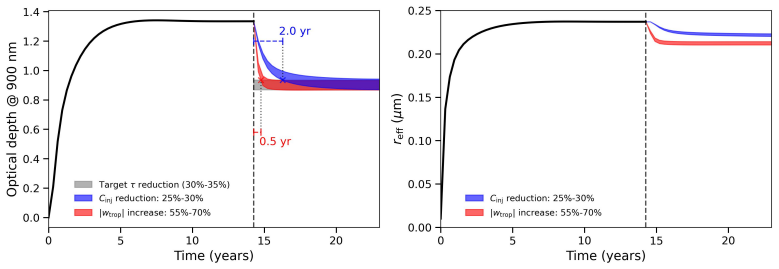
Jupiter's Oval BA undergoes recurrent colour changes whose physical origin remains uncertain. Radiative transfer retrievals indicate that these changes occur in the upper chromophore haze of the vortex annulus, around and above the 0.2-bar level, and are primarily associated with a decrease in optical depth, with no significant change in particle size or haze altitude. We apply a one-dimensional microphysical model to this haze layer, constrained by the retrieved aerosol properties of the red annulus in 2016 and the whiter annulus in 2020, and use it to reproduce the observed colour-change timescale of approximately 0.5 years. Our results indicate that this transition is best reproduced by changes in tropospheric vertical transport within a subsiding annulus, corresponding to preferred downwelling velocities of order $10^{-4}-10^{-3}$ m s$^{-1}$ at chromophore-bearing pressures. These small vertical velocities may help explain why no clear dynamical signature has yet been identified.
Editorial analysis
A structured set of objections, weighed in public.
Referee Report
Summary. The paper applies a one-dimensional microphysical model to the upper chromophore haze in Jupiter's Oval BA, constrained by radiative transfer retrievals of aerosol properties for the red annulus in 2016 and the whiter annulus in 2020. It concludes that the observed ~0.5-year color transition timescale is best reproduced by changes in tropospheric vertical transport within a subsiding annulus, with preferred downwelling velocities of order 10^{-4}–10^{-3} m s^{-1} at chromophore-bearing pressures.
Significance. If the central claim holds, the work supplies a quantitative microphysical link between subtle dynamical subsidence and recurrent color changes in Jovian vortices, offering a plausible account for the absence of clear dynamical signatures in existing observations. Constraining the model directly with epoch-specific retrievals is a constructive approach.
major comments (2)
- [Abstract] Abstract: The conclusion that downwelling velocities of 10^{-4}–10^{-3} m s^{-1} best reproduce the transition rests on the assumption, taken from prior retrievals, that color changes occur solely via a decrease in optical depth of the upper haze with no significant change in particle size or altitude. This assumption is load-bearing; the manuscript does not test whether modest size or altitude shifts within retrieval uncertainties could produce the observed color shift, which would alter the required velocities.
- [Abstract] Abstract: The velocities are characterized as 'preferred' values chosen to reproduce the 0.5-year timescale. This renders the result circular by construction, as the model is tuned to match the input observation rather than predicting the timescale from independent dynamical constraints or first-principles microphysics.
minor comments (1)
- The manuscript would benefit from explicit presentation of the microphysical model equations, any validation tests, and a sensitivity analysis of timescale versus vertical velocity to improve reproducibility and reader assessment.
Simulated Author's Rebuttal
We thank the referee for their constructive comments, which highlight important aspects of our modeling assumptions and methodology. We address each major comment below and outline revisions that will be incorporated into the manuscript.
read point-by-point responses
-
Referee: [Abstract] Abstract: The conclusion that downwelling velocities of 10^{-4}–10^{-3} m s^{-1} best reproduce the transition rests on the assumption, taken from prior retrievals, that color changes occur solely via a decrease in optical depth of the upper haze with no significant change in particle size or altitude. This assumption is load-bearing; the manuscript does not test whether modest size or altitude shifts within retrieval uncertainties could produce the observed color shift, which would alter the required velocities.
Authors: Our analysis is grounded in the radiative transfer retrievals, which indicate that the color transition is driven primarily by a decrease in optical depth with negligible changes in particle size or altitude. To directly address this point, we will add a sensitivity analysis to the revised manuscript. This will quantify how modest variations in particle size and altitude, within the reported retrieval uncertainties, influence the downwelling velocities needed to match the observed timescale. The results of this test will be presented to demonstrate the robustness of the derived velocity range. revision: yes
-
Referee: [Abstract] Abstract: The velocities are characterized as 'preferred' values chosen to reproduce the 0.5-year timescale. This renders the result circular by construction, as the model is tuned to match the input observation rather than predicting the timescale from independent dynamical constraints or first-principles microphysics.
Authors: The microphysical model is used to identify the vertical velocities that reproduce the observed 0.5-year transition timescale given the retrieved aerosol properties and microphysical processes. This yields a quantitative constraint on the dynamical subsidence required, rather than a first-principles prediction of the timescale itself. The principal finding is that these velocities are small (10^{-4}–10^{-3} m s^{-1}), which is consistent with the absence of clear dynamical signatures in existing observations. We will revise the abstract and discussion to clarify that the velocities represent the values required to match the observed transition under the model assumptions, avoiding any implication of independent prediction. revision: partial
Circularity Check
Vertical velocities fitted to match observed 0.5 yr timescale by construction
specific steps
-
fitted input called prediction
[Abstract]
"Our results indicate that this transition is best reproduced by changes in tropospheric vertical transport within a subsiding annulus, corresponding to preferred downwelling velocities of order $10^{-4}-10^{-3}$ m s$^{-1}$ at chromophore-bearing pressures."
The model is run with the retrieved 2016/2020 aerosol properties as fixed inputs and the vertical velocity is adjusted specifically to reproduce the observed 0.5-year timescale, so the quoted 'preferred' velocities are the fitted parameter values that match the input observation by construction.
full rationale
The paper constrains the 1-D microphysical model with aerosol properties retrieved for the 2016 red and 2020 white states (taken as given from prior retrievals) and varies only the vertical velocity parameter until the model reproduces the observed ~0.5 yr color-change timescale. The reported 'preferred' downwelling velocities are therefore the fitted values that match the input observation by construction rather than an independent derivation from first principles. This matches the fitted-input-called-prediction pattern. The assumption that color change occurs solely via optical-depth decrease (with fixed particle size and altitude) is load-bearing but is imported from the cited retrievals; no self-citation chain or equation-level reduction is exhibited in the provided text.
Axiom & Free-Parameter Ledger
free parameters (1)
- downwelling velocity =
10^{-4} to 10^{-3} m s^{-1}
axioms (1)
- domain assumption Color changes are driven exclusively by optical-depth variations in the chromophore haze with fixed particle size and altitude.
Reference graph
Works this paper leans on
-
[1]
Anguiano-Arteaga, A., Pérez-Hoyos, S., Sánchez-Lavega, A., Sanz-Requena, J. F., & Irwin, P. G. J. (2021). Vertical Distribution of Aerosols and Hazes Over Jupiter’s Great Red Spot and Its Surroundings in 2016 From HST/WFC3 Imaging.Journal of Geophysical Research: Planets, 126(11). https://doi.org/10.1029/2021JE006996
-
[2]
Anguiano-Arteaga, A., Pérez-Hoyos, S., Sánchez-Lavega, A., Sanz-Requena, J. F., & Irwin, P. G. J. (2023). Temporal Variations in Vertical Cloud StructureofJupiter’sGreatRedSpot, ItsSurroundingsandOvalBAFrom HST/WFC3 Imaging.Journal of Geophysical Research: Planets, 128(9). https://doi.org/10.1029/2022JE007427
-
[3]
Anguiano-Arteaga, A., Pérez-Hoyos, S., Sánchez-Lavega, A., Irwin, P.G.J. (2026). Microphysical model of Jupiter’s Great Red Spot upper chro- mophore haze.Icarus, 117008.https://doi.org/10.1016/j.icarus. 2026.117008
-
[4]
Asay-Davis, X.S., Marcus, P.S., Wong, M.H., de Pater, I. (2009). Jupiter’s shrinking Great Red Spot and steady Oval BA: Velocity measurements with the ‘Advection Corrected Correlation Image Velocimetry’ automated cloud-tracking method.Icarus, 203, 164–188.https://doi.org/10.1016/ j.icarus.2009.05.001
2009
-
[5]
Baines, K.H., Sromovsky, L.A., Carlson, R.W., Momary, T.W., Fry, P.M. (2019). The visual spectrum of Jupiter’s Great Red Spot accurately mod- eled with aerosols produced by photolyzed ammonia reacting with acety- lene.Icarus, 330, 217–229.https://doi.org/10.1016/j.icarus.2019. 04.008
- [6]
-
[7]
Cabane, M., Chassefière, E., Israel, G. (1992). Formation and growth of photochemical aerosols in Titan’s atmosphere.Icarus, 96(2), 176–189. https://doi.org/10.1016/0019-1035(92)90071-E 13
-
[8]
Carlson, R.W., Baines, K.H., Anderson, M.S., Filacchione, G., Simon, A.A. (2016). Chromophores from photolyzed ammonia reacting with acetylene: Application to Jupiter’s Great Red Spot.Icarus, 274, 106–115.https: //doi.org/10.1016/j.icarus.2016.03.008
-
[9]
Catling, D. C. & Kasting, J. F. (2017). The Structure of Planetary Atmo- spheres. InAtmospheric Evolution on Inhabited and Lifeless Worlds. Cam- bridge University Press
2017
-
[10]
Cheng, A. F., Simon-Miller, A. A., Weaver, H. A., Baines, K. H., Or- ton, G. S., Yanamandra-Fisher, P. A., Mousis, O., Pantin, E., Vanzi, L., Fletcher, L. N., Spencer, J. R., Stern, S. A., Clarke, J. T., Mutch- ler, M. J., & Noll, K. S. (2008). Changing characteristics of Jupiter’s Little Red Spot.The Astronomical Journal, 135(6), 2446–2452.https: //doi.o...
-
[11]
Conrath, B. J., Flasar, F. M., Pirraglia, J. A., Gierasch, P. J., Hunt, G. E. (1981). Thermal structure and dynamics of the Jovian atmosphere. II. Visible cloud features.Journal of Geophysical Research: Space Physics, 86(A10), 8769–8775.https://doi.org/10.1029/JA086iA10p08769
-
[12]
Ferris, J.P., & Ishikawa, Y. (1987). HCN and chromophore formation on Jupiter.Nature, 326, 777–778.https://doi.org/10.1038/326777a0
-
[13]
Simon-Miller, A. A., Edkins, E., Hayward, T. L., & De Buizer, J. (2010). Thermal structure and composition of Jupiter’s Great Red Spot from high- resolution thermal imaging.Icarus, 208(1), 306–328.https://doi.org/ 10.1016/j.icarus.2010.01.005
-
[15]
N., Kaspi, Y., Guillot, T., & Showman, A
Fletcher, L. N., Kaspi, Y., Guillot, T., & Showman, A. P. (2020). How well do we understand the belt/zone circulation of giant planet atmo- spheres?Space Science Reviews, 216, 30.https://doi.org/10.1007/ s11214-019-0631-9 14
2020
-
[16]
Bolton, S., & Orton, G. (2017). JunoCam: Juno’s outreach cam- era.Space Science Reviews, 213, 475–506.https://doi.org/10.1007/ s11214-014-0079-x
2017
-
[17]
Ovalle, P., Fry, P.M., & Showalter, M.R. (2024). The thermal structure and composition of Jupiter’s Great Red Spot from JWST/MIRI.JGR Planets, 129, e2024JE008415.https://doi.org/10.1029/2024JE008415
-
[18]
Hueso, R., Legarreta, J., García-Melendo, E., Sánchez-Lavega, A., & Pérez-Hoyos, S. (2009). The jovian anticyclone BA: II. Circulation and interaction with the zonal jets.Icarus, 203, 499–515.https://doi.org/ 10.1016/j.icarus.2009.05.004
-
[19]
F., Erard, S., Cecconi, B., & Le Sidaner, P
Hueso, R., Juaristi, J., Legarreta, J., Sánchez-Lavega, A., Rojas, J. F., Erard, S., Cecconi, B., & Le Sidaner, P. (2018). The Planetary Virtual Observa- tory and Laboratory (PVOL) and its integration into the Virtual European Solar and Planetary Access (VESPA).Planetary and Space Science, 150, 22–35.https://doi.org/10.1016/j.pss.2017.03.014
-
[20]
P., Dowling, T
Ingersoll, A. P., Dowling, T. E., Gierasch, P. J., Orton, G. S., Read, P. L., Sánchez-Lavega, A., Showman, A. P., Simon-Miller, A. A., & Vasavada, A. R. (2004). Dynamics of Jupiter’s atmosphere. In F. Bagenal, W. McK- innon, & T. Dowling (Eds.),Jupiter: The Planet, Satellites and Magneto- sphere(pp. 105–128). Cambridge University Press
2004
-
[21]
Springer Science & Business Media
Irwin, P.G.J.(2009).Giant Planets of Our Solar System: Atmospheres, Com- position, and Structure. Springer Science & Business Media
2009
-
[22]
Marcus, P.S. (2004). Prediction of a global climate change on Jupiter.Nature, 428, 828–831.https://doi.org/10.1038/nature02470
-
[23]
Marcus, P.S., Asay-Davis, X., Wong, M.H., de Pater, I. (2013). Jupiter’s Red Oval BA: Dynamics, color, and relationship to Jovian climate change. Journal of Heat Transfer, 135(1), 011007.https://doi.org/10.1115/1. 4007666 15
work page doi:10.1115/1 2013
-
[24]
(2025).Wide Field Camera 3 Instrument Hand- book, Version 18.0
Marinelli, M., & Green, J. (2025).Wide Field Camera 3 Instrument Hand- book, Version 18.0. Baltimore: STScI
2025
-
[25]
Moreno, F. (1996). The structure of the stratospheric aerosol layer in the equatorial and south polar regions of Jupiter.Icarus, 124(2), 632–644. https://doi.org/10.1006/icar.1996.0237 de Pater, I., Wong, M. H., Marcus, P., Luszcz-Cook, S., Ádámkovics, M.,
-
[26]
Conrad, A., Asay-Davis, X., & Go, C. (2010). Persistent rings in and around Jupiter’s anticyclones – Observations and theory.Icarus, 210(2), 742–762.https://doi.org/10.1016/j.icarus.2010.07.027 Pérez-Hoyos, S., Sánchez-Lavega, A., Hueso, R., García-Melendo, E., &
-
[28]
Pollack, J.B., Rages, K., Pope, S.K., Tomasko, M.G., Romani, P.N., Atreya, S.K. (1987). Nature of the stratospheric haze on Uranus: Evidence for condensed hydrocarbons.J. Geophys. Res., 92(A13), 15037–15065.https: //doi.org/10.1029/JA092iA13p15037 Sánchez-Lavega, A., Rojas, J. F., Hueso, R., Lecacheux, J., Colas, F., Acar- reta, J. R., Miyazaki, I., & Par...
-
[29]
Fisher, B., Fukumura-Sawada, P., Golisch, W., Griep, D., Kaminski, C., Baines, K., Rages, K., & West, R. (2001). The merger of two gi- ant anticyclones in the atmosphere of Jupiter.Icarus, 149, 491–495. https://doi.org/10.1006/icar.2000.6548
-
[30]
Simon, A. A., & Wong, M. H. (2024). Zonal and Regional Jupiter Bright- ness Trends from the Hubble Outer Planet Atmospheres Legacy Program. The Planetary Science Journal, 5, 259.https://doi.org/10.3847/PSJ/ ad8c23
-
[31]
Simon-Miller, A. A., Chanover, N. J., Orton, G. S., Sussman, M., Tsavaris, I. G., & Karkoschka, E. (2006). Jupiter’s White Oval turns red.Icarus, 185, 558–562.https://doi.org/10.1016/j.icarus.2006.08.002 16
-
[32]
Sitarski, M., Seinfeld, J. H. (1977). Brownian coagulation in the transition regime.Journal of Colloid and Interface Science, 61(2), 261–271.https: //doi.org/10.1016/0021-9797(77)90389-7
-
[33]
Toon, O.B., Turco, R.P., Pollack, J.B. (1980). A physical model of Titan’s cloud.Icarus, 43, 260–282.https://doi.org/10.1016/0019-1035(80) 90173-6
-
[34]
Toon, O.B., Turco, R.P., Westphal, D., Malone, R., Liu, M.S. (1988). A Multidimensional Model for Aerosols – Description of Computational Analogs.J. Atmos. Sci., 45, 2123–2143.https://doi.org/10.1175/ 1520-0469(1988)045<2123:AMMFAD>2.0.CO;2
1988
-
[35]
B., McKay, C
Toon, O. B., McKay, C. P., Griffith, C. A., & Turco, R. P. (1992). A physi- cal model of Titan’s aerosols.Icarus, 95(1), 24–53.https://doi.org/10. 1016/0019-1035(92)90188-D
1992
-
[36]
Wong, M. H., de Pater, I., Asay-Davis, X., Marcus, P. S., & Go, C. Y. (2011).VerticalstructureofJupiter’sOvalBAbeforeandafteritreddened: What changed?Icarus, 215(1), 211–225.https://doi.org/10.1016/j. icarus.2011.06.032
work page doi:10.1016/j 2011
-
[37]
Yu, X., Hörst, S.M., He, C., McGuiggan, P., Kristiansen, K., & Zhang, X. (2020). Surface energy of the Titan aerosol analog “tholin”.The Astrophys- ical Journal, 905, 88.https://doi.org/10.3847/1538-4357/abc55d 17
discussion (0)
Sign in with ORCID, Apple, or X to comment. Anyone can read and Pith papers without signing in.