Traversable Wormholes Supported by Entropy-Inspired Effective Matter Sectors
Pith reviewed 2026-06-28 21:25 UTC · model grok-4.3
The pith
Modified entropy profiles from Barrow, Tsallis, Kaniadakis, logarithmic, and exponential deformations can serve as effective sources for traversable wormholes.
A machine-rendered reading of the paper's core claim, the machinery that carries it, and where it could break.
Core claim
The entropy-geometry correspondence maps each modified Bekenstein-Hawking entropy to an effective radial density profile; when these profiles are inserted into the Morris-Thorne line element together with the barotropic relation p_r = w ho, the resulting configurations satisfy the Einstein equations at the throat for the Barrow, Tsallis, Kaniadakis, logarithmic, and exponential cases, with energy-condition behavior and hydrostatic balance determined by the specific entropy deformation.
What carries the argument
The entropy-geometry correspondence that converts a chosen modified Bekenstein-Hawking entropy into an effective anisotropic matter sector, here supplying only the radial density profile for Morris-Thorne reconstruction.
If this is right
- Barrow and Tsallis entropies produce algebraic negative-density sources.
- Kaniadakis and exponential entropies produce localized density profiles.
- The logarithmic sector admits both negative-density and positive-density phantom-like regimes.
- In every regular solution the radial null-energy-condition violation at the throat is required by the flare-out condition.
- The Tolman-Oppenheimer-Volkoff balance exhibits sector-dependent reversals of the signs of the gravitational and compensating-pressure terms.
Where Pith is reading between the lines
- If the correspondence is robust, similar entropy deformations could be tested as sources for other exotic spacetimes whose field equations also demand negative energy densities.
- Stability analysis under linear perturbations would reveal which entropy sectors produce wormholes that persist long enough to be astrophysically relevant.
- Observational constraints on the redshift function or the flare-out parameter could be translated back into bounds on the deformation parameters of the underlying entropies.
Load-bearing premise
The radial density profiles obtained from the modified entropies via the entropy-geometry correspondence can be used directly as phenomenological sources in the Morris-Thorne geometry once a barotropic equation of state is supplied.
What would settle it
An explicit calculation showing that none of the five derived density profiles simultaneously satisfies the Einstein equations and the flare-out condition at the throat would falsify the claim that these entropy sectors provide viable sources.
Figures
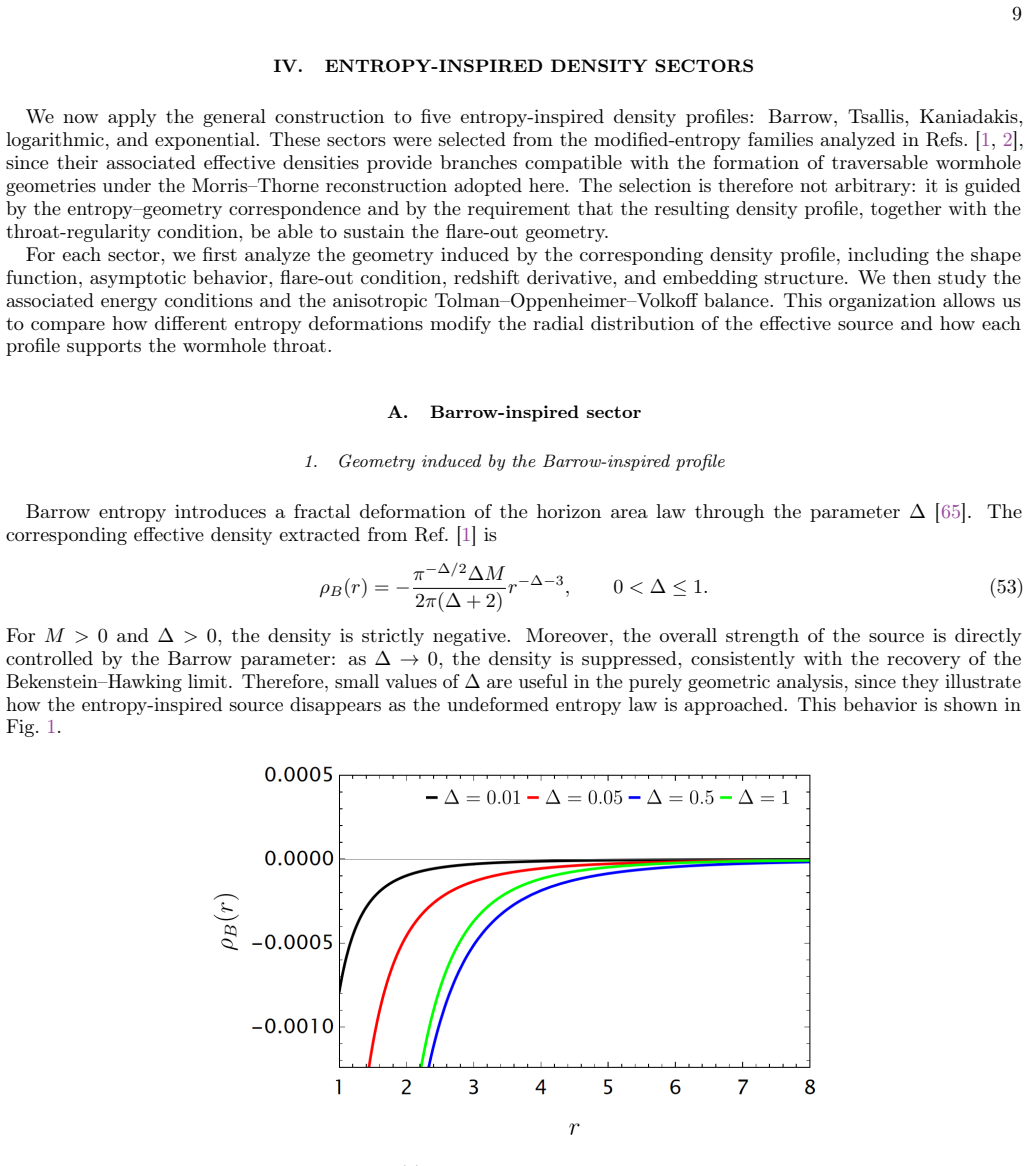
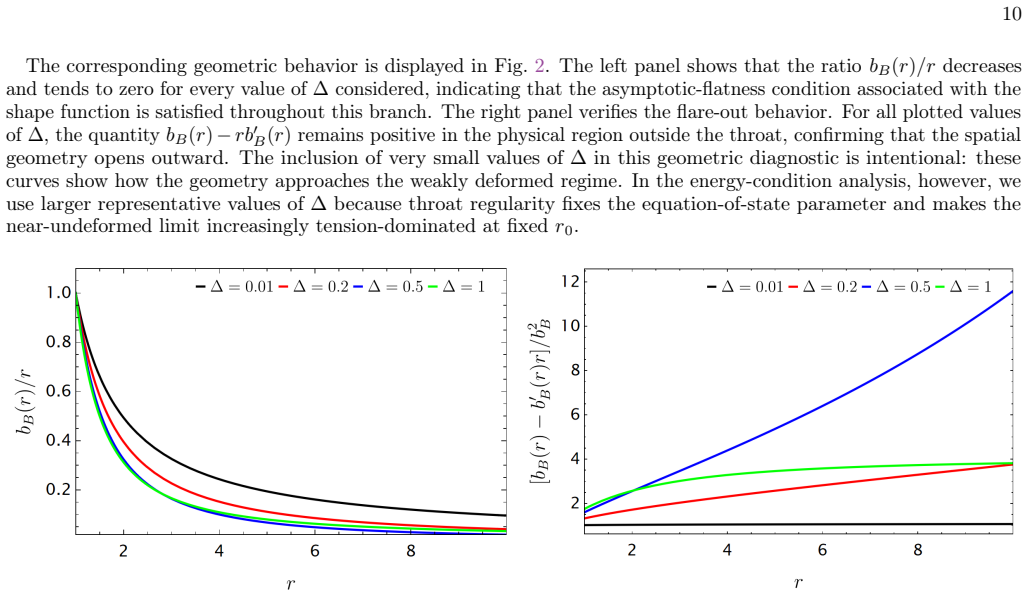
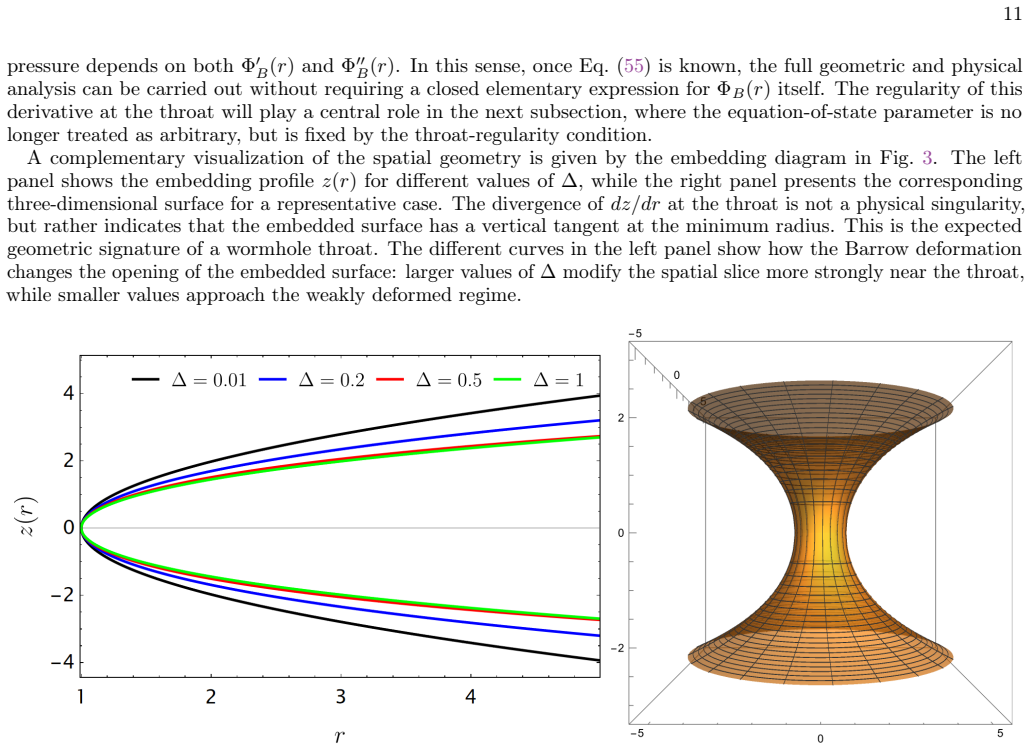
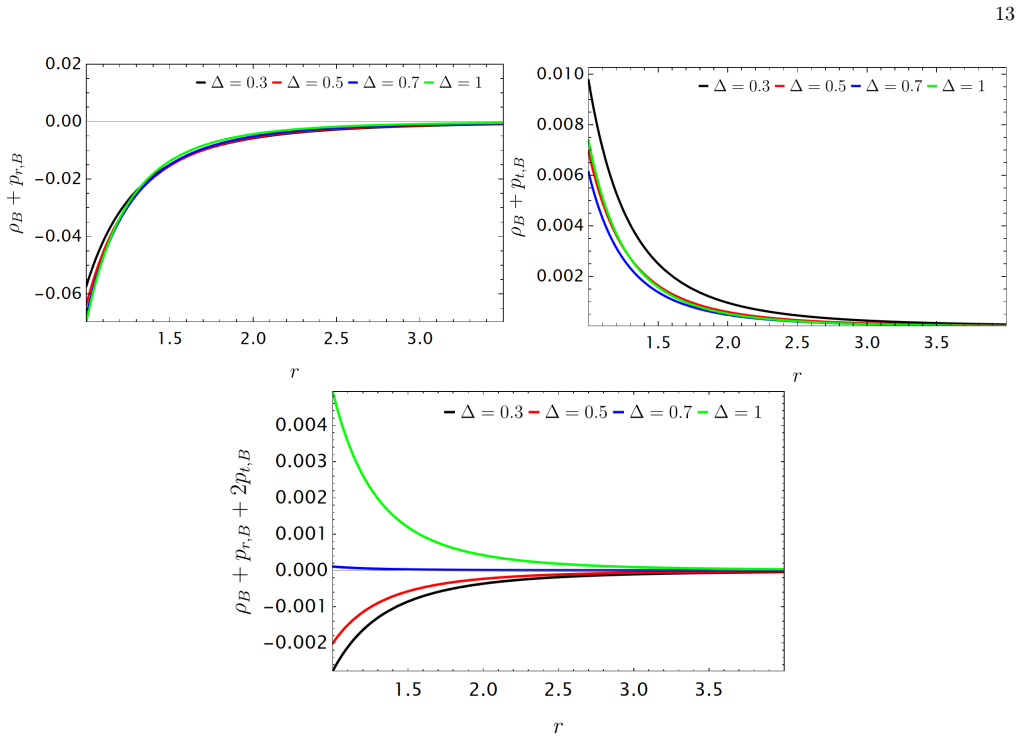
read the original abstract
The entropic interpretation of gravity suggests that spacetime geometry may encode thermodynamic information associated with microscopic degrees of freedom. In this context, the entropy--geometry correspondence of Refs.[1,2] links modified Bekenstein--Hawking entropies to deformed black-hole geometries and effective anisotropic matter sectors. Motivated by this result, we test whether these entropy-induced density profiles can act as phenomenological sources for traversable wormholes. Here we use the density sector as the thermodynamic input for a Morris--Thorne reconstruction, thereby isolating the role of the entropy-induced radial profile. The radial pressure follows from a barotropic equation of state, $p_r=w\rho$, while the remaining variables are determined by the wormhole field equations and anisotropic equilibrium. We analyze five entropy-inspired sectors: Barrow, Tsallis, Kaniadakis, logarithmic, and exponential. Barrow and Tsallis are algebraic negative-density sources; Kaniadakis and exponential profiles are localized; and the logarithmic sector admits negative-density and positive-density phantom-like regimes. In all regular configurations, radial null-energy-condition violation at the throat is tied to the flare-out condition, while the tangential null energy condition and the strong-energy-condition combination diagnose the anisotropic redistribution of exoticity. The TOV balance is sector dependent: in the Barrow and Kaniadakis branches, the gravitational and compensating pressure contributions can reverse their signs together while remaining balanced; the other branches retain a common sign pattern with different degrees of near-throat localization. This framework shows that modified entropy profiles can provide viable effective sources for traversable wormholes, with the supporting mechanism depending sensitively on the underlying entropy deformation.
Editorial analysis
A structured set of objections, weighed in public.
Referee Report
Summary. The paper claims that density profiles obtained from modified Bekenstein-Hawking entropies (Barrow, Tsallis, Kaniadakis, logarithmic, and exponential sectors) via the entropy-geometry correspondence can serve as viable phenomenological sources for Morris-Thorne traversable wormholes. With radial density fixed by each entropy sector, a barotropic EOS p_r = w ρ imposed, the shape function b(r) integrated from the Einstein (tt) equation, the redshift Φ(r) solved from the (rr) equation, and p_t determined from anisotropic equilibrium, the authors report regular solutions satisfying b(r0) = r0, b'(r0) < 1 (linked to radial NEC violation at the throat), and TOV balance in all five sectors, with sector-dependent patterns in energy-condition violation and gravitational/pressure contributions.
Significance. If the constructions hold, the work supplies a concrete phenomenological bridge between entropic gravity modifications and wormhole spacetimes, showing that entropy-deformed radial densities can support traversable configurations without further ad-hoc fields. The explicit sector-by-sector verification of flare-out, NEC violation tied to b'(r0)<1, and TOV equilibrium constitutes a strength, as does the demonstration that supporting mechanisms (sign patterns of gravitational vs. pressure terms) vary sensitively with the entropy deformation. This adds falsifiable, sector-specific predictions to the literature on exotic-matter sources.
minor comments (3)
- [Abstract] Abstract: the statement that 'all sectors yield regular configurations' would be strengthened by a brief indication of the range of w values that produce regularity, since the barotropic parameter is the sole free parameter listed in the axiom ledger.
- The manuscript should include a compact table (perhaps in §4 or §5) summarizing, for each entropy sector, the adopted w, the resulting b'(r0), and the sign pattern of the TOV terms near the throat; this would make the sector-dependent claims immediately verifiable.
- Notation: the entropy-geometry correspondence is invoked from Refs.[1,2] without restating the explicit map from entropy to ρ(r); a short appendix or paragraph recalling the functional form of ρ(r) for each sector would improve self-contained readability.
Simulated Author's Rebuttal
We thank the referee for the positive and accurate summary of our manuscript, as well as for the favorable assessment of its significance. The report correctly identifies the central construction (entropy-deformed radial densities as sources for Morris-Thorne wormholes) and the sector-dependent features we report. No major comments were raised.
Circularity Check
No significant circularity; phenomenological test with independent inputs
full rationale
The derivation takes modified-entropy density profiles as external inputs from the entropy-geometry correspondence, adopts the standard barotropic ansatz p_r = w ρ with sector-specific constant w, integrates the Morris-Thorne shape function b(r) from the Einstein (tt) equation, solves for the redshift function from the (rr) equation, and obtains p_t from the anisotropic TOV equation. It then verifies that regular solutions satisfying b(r0)=r0, b'(r0)<1, and the flare-out condition exist for appropriate w choices, with energy-condition behavior following directly from the Einstein equations and the chosen ρ(r). No step reduces the target wormhole viability to a fit or self-definition of the output quantities; the construction is a standard phenomenological reconstruction rather than a closed loop. Self-citations to the prior correspondence supply the input densities but do not bear the load of the wormhole-supporting mechanism or the reported energy-condition diagnostics.
Axiom & Free-Parameter Ledger
free parameters (1)
- w
axioms (2)
- domain assumption Morris-Thorne metric ansatz for static spherically symmetric wormholes
- domain assumption Entropy-geometry correspondence of Refs.[1,2] yields valid effective density profiles
Reference graph
Works this paper leans on
-
[1]
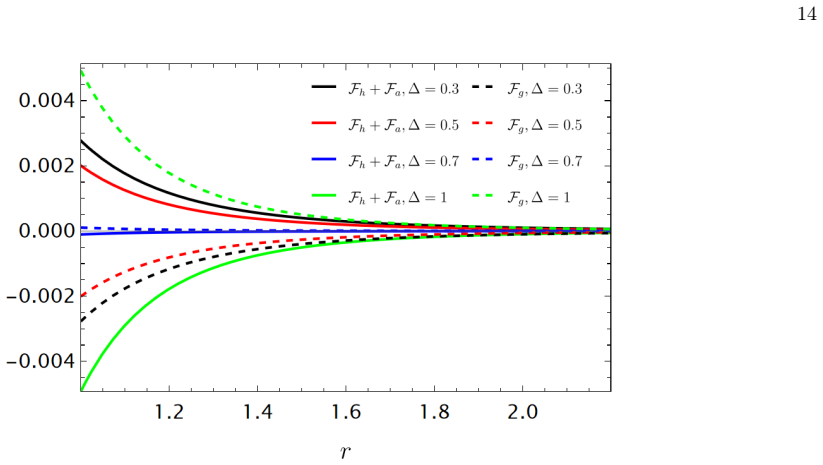
Energy conditions and equilibrium in the Barrow-inspired sector The radial pressure is fixed by the chosen equation of state, pr,B(r) =w BρB(r).(59) However, as discussed in the general construction, the parameterwB cannot be chosen independently if the redshift function is required to be regular at the throat. For the Barrow-inspired shape function, one ...
-
[2]
In the entropy–geometry correspondence of Ref
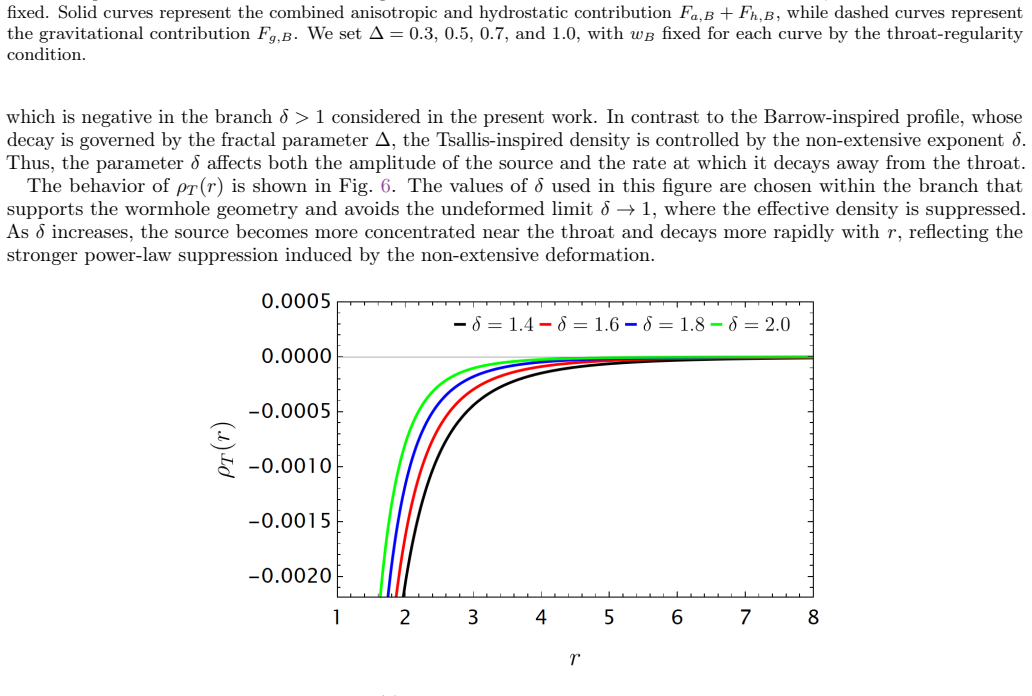
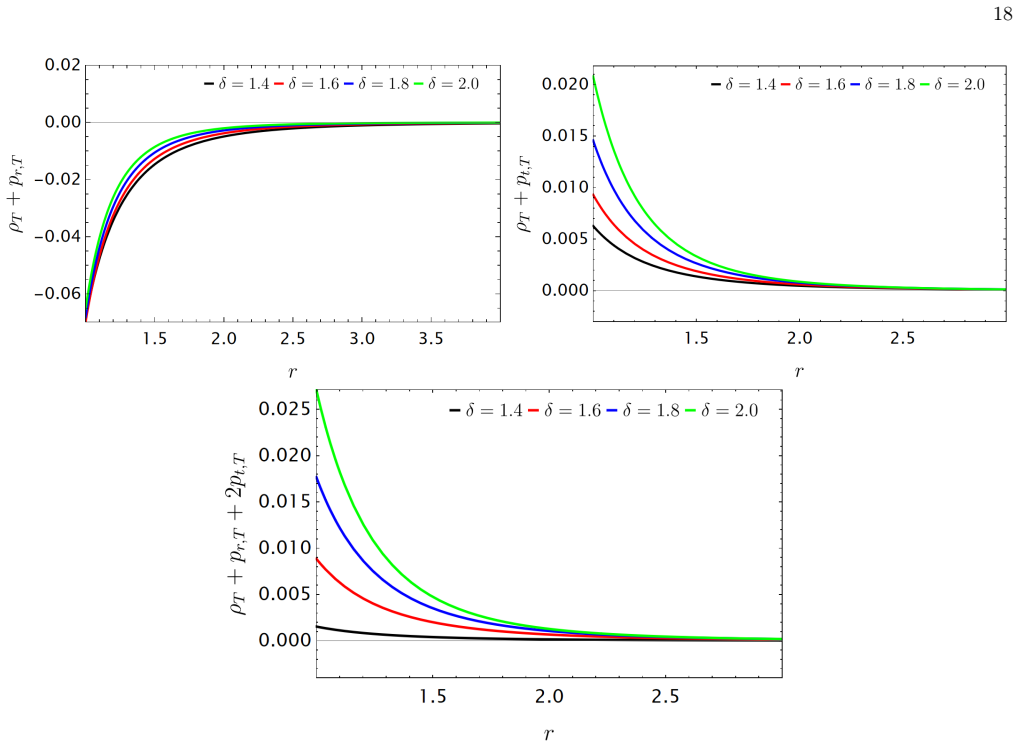
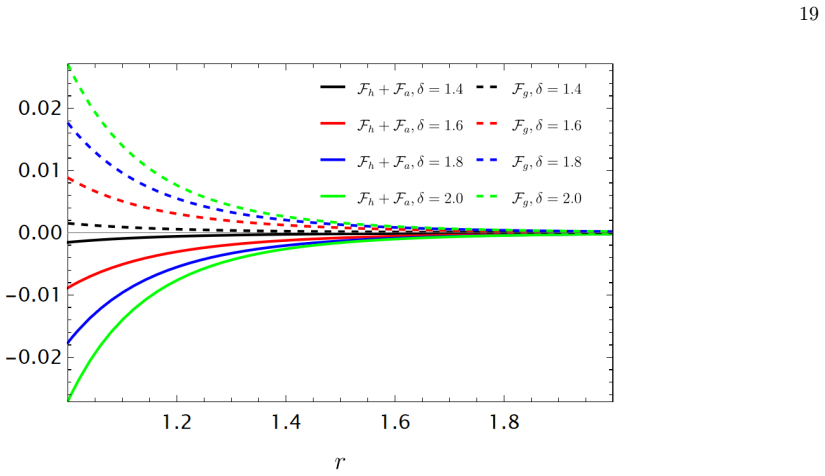
Geometry induced by the Tsallis-inspired profile The Tsallis entropy modifies the standard additive structure of horizon thermodynamics through the non-extensive parameterδ[62]. In the entropy–geometry correspondence of Ref. [1], the associated effective density is ρT (r) =− M π−δ(δ−1) 2δ r−2δ−1,(68) 14 FIG. 5. Equilibrium forces for the Barrow-inspired w...
-
[3]
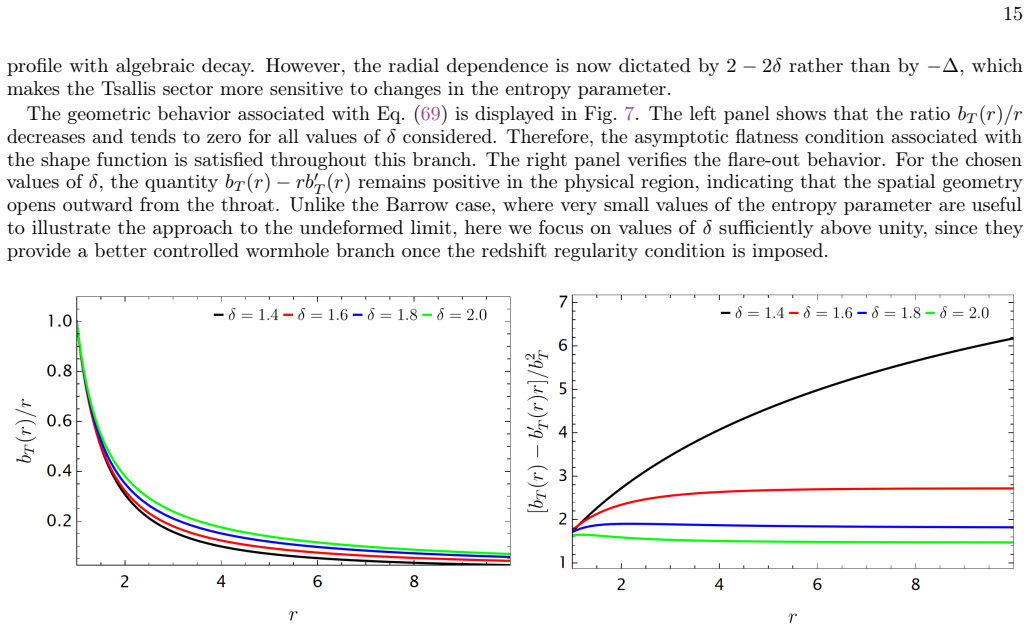
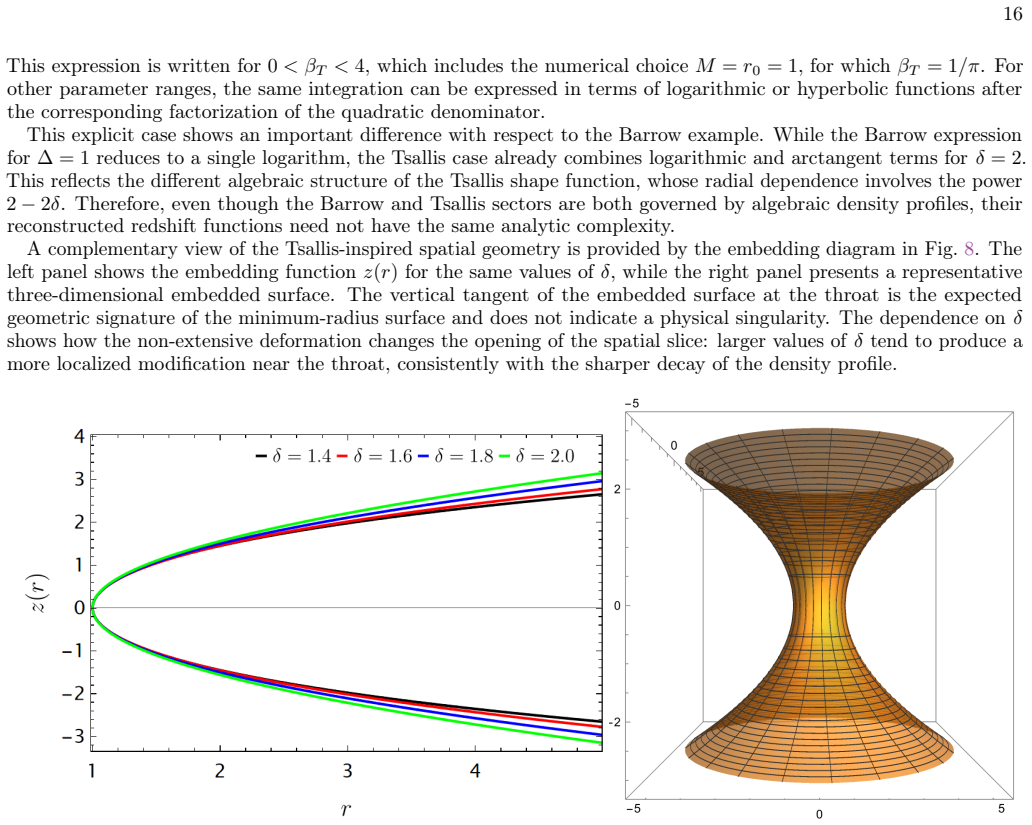
Energy conditions and equilibrium in the Tsallis-inspired sector The radial pressure is fixed by the chosen equation of state, pr,T(r) =w T ρT (r).(72) As in the Barrow-inspired sector, the equation-of-state parameter cannot be chosen independently if the redshift function is required to be regular at the throat. For the Tsallis-inspired shape function, o...
-
[4]
In the entropy–geometry correspondence of Ref
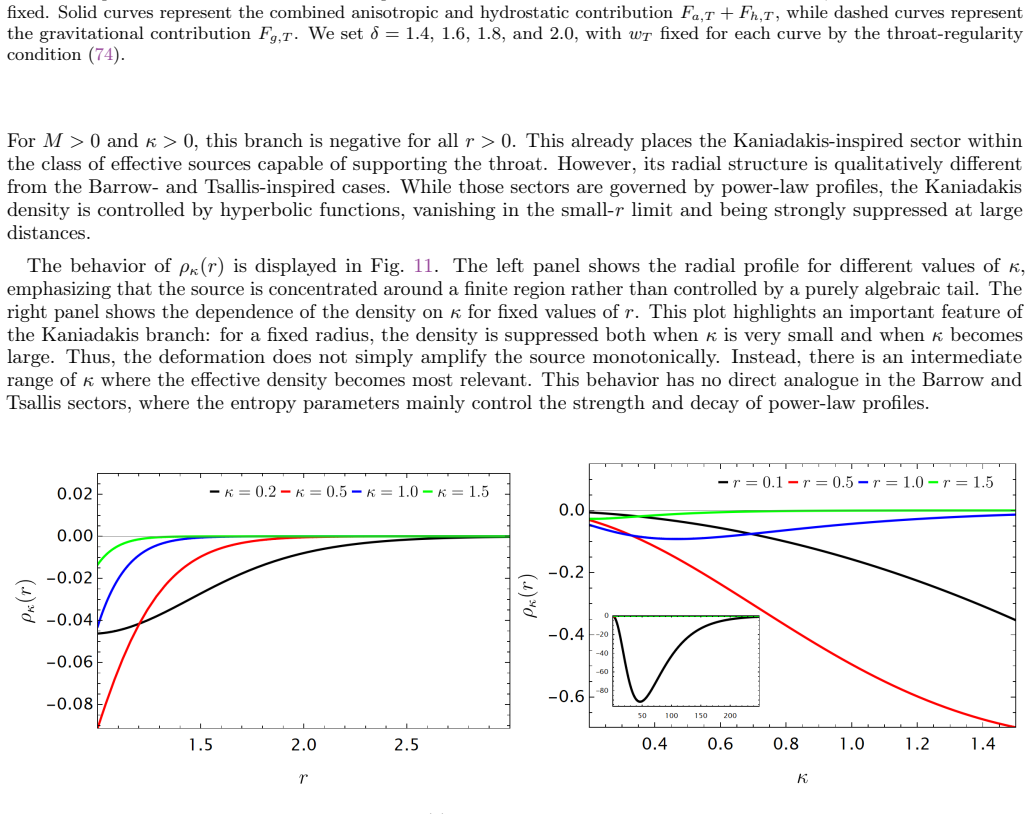
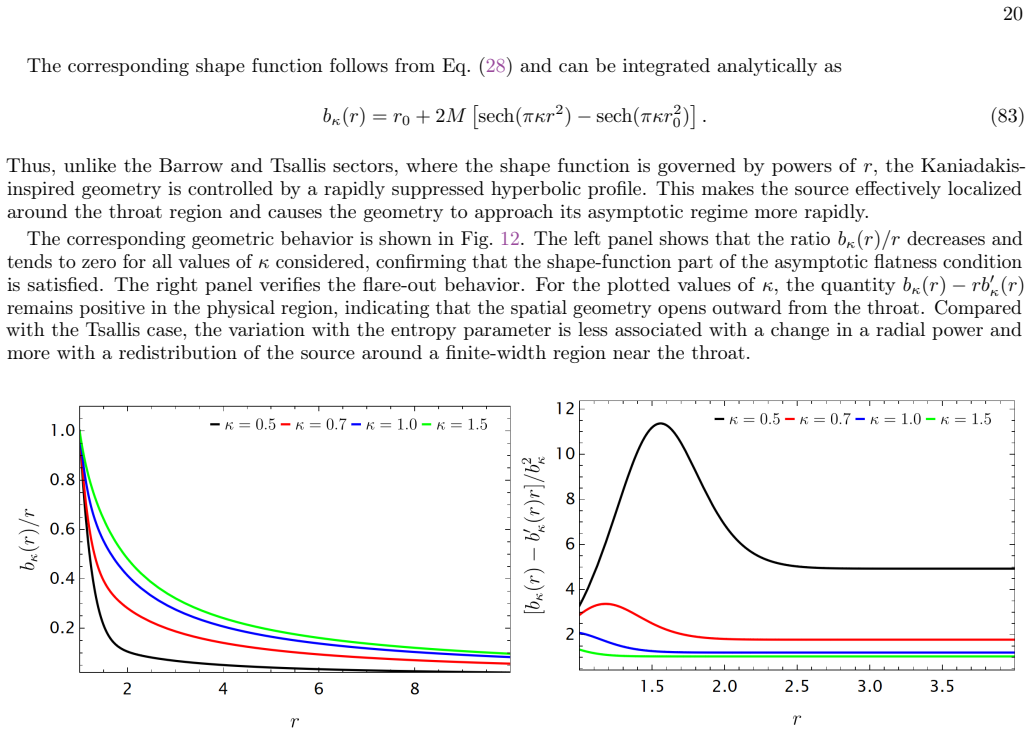
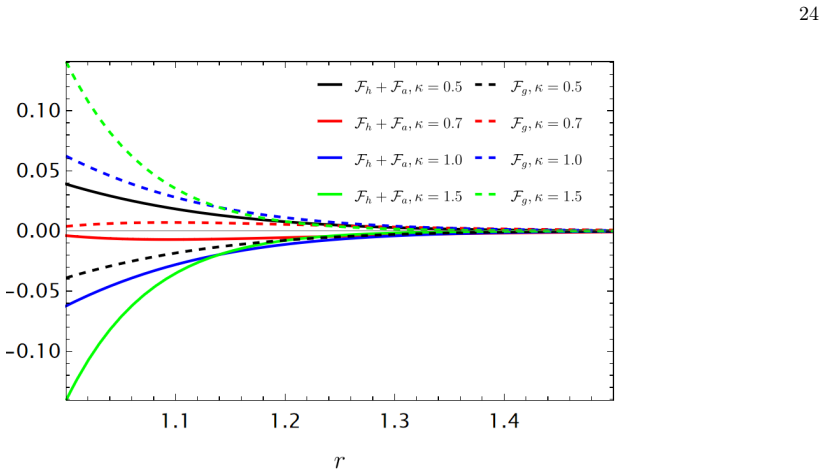
Geometry induced by the Kaniadakis-inspired profile The Kaniadakis entropy introduces a relativistically motivated deformation of the standard statistical framework through the parameterκ[64]. In the entropy–geometry correspondence of Ref. [1], the associated effective density is ρκ(r) =− κM 2r tanh(πκr2) sech(πκr2), κ >0.(82) 19 FIG. 10. Equilibrium forc...
-
[5]
Energy conditions and equilibrium in the Kaniadakis-inspired sector The radial pressure is fixed by the chosen equation of state, pr,κ(r) =w κρκ(r).(85) As in the previous sectors, the equation-of-state parameter is not arbitrary once the regularity of the redshift derivative at the throat is imposed. For the Kaniadakis-inspired shape function, one has b′...
-
[6]
Since ρκ < 0, this corresponds again to a negative radial pressure, namely a radial tension
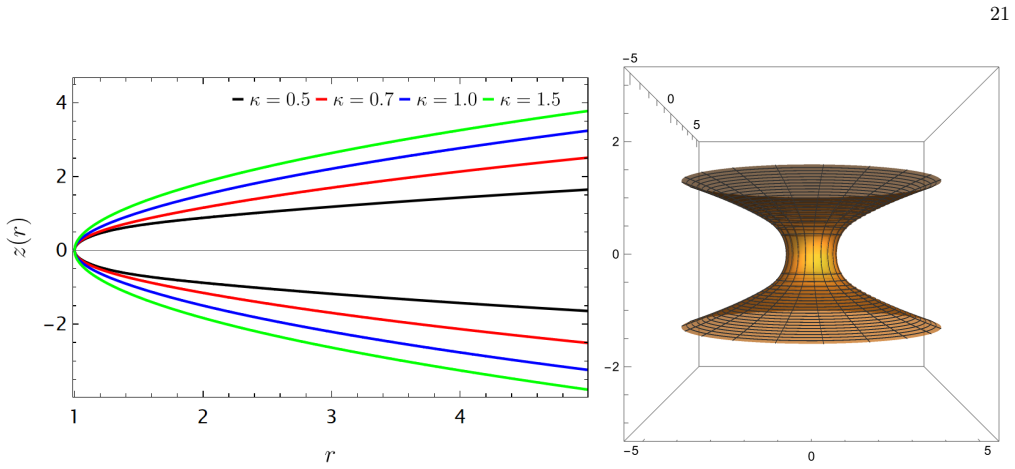
(87) For M > 0, r0 > 0, and κ > 0, one findswκ > 0. Since ρκ < 0, this corresponds again to a negative radial pressure, namely a radial tension. However, differently from the Barrow and Tsallis branches, the dependence ofwκ on the entropy parameter is not governed by a simple algebraic factor. The same hyperbolic functions that localize the density also d...
-
[7]
sech(πκr2 0) 1 + 4πκM r0 tanh(πκr2
-
[8]
At the throat, this violation is again geometrically tied to the flare-out condition, (ρκ +p r,κ)|r0 =− 1 + 4πκM r0 tanh(πκr2
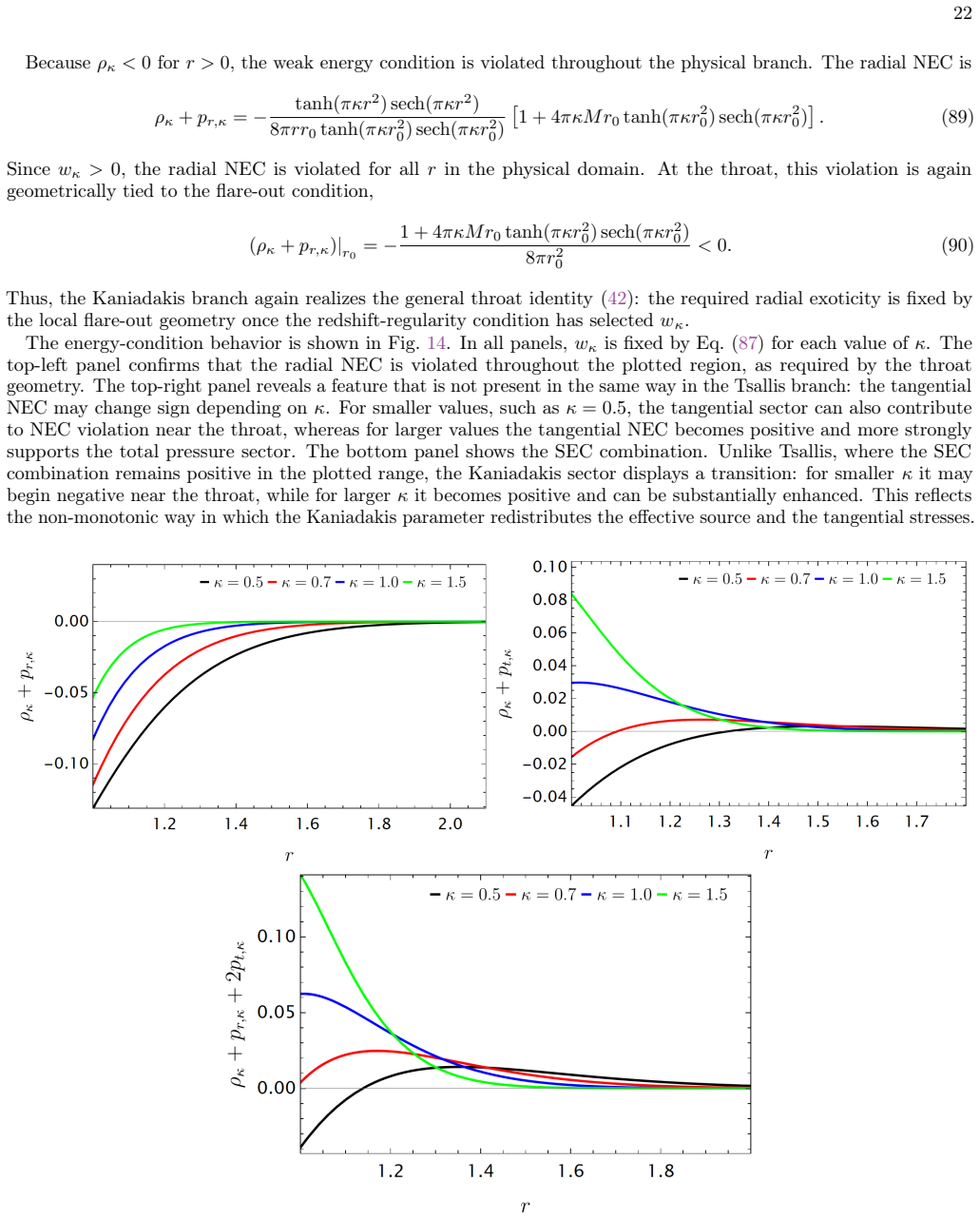
sech(πκr2 0) .(89) Since wκ > 0, the radial NEC is violated for allr in the physical domain. At the throat, this violation is again geometrically tied to the flare-out condition, (ρκ +p r,κ)|r0 =− 1 + 4πκM r0 tanh(πκr2
-
[9]
The energy-condition behavior is shown in Fig
sech(πκr2 0) 8πr2 0 <0.(90) Thus, the Kaniadakis branch again realizes the general throat identity(42): the required radial exoticity is fixed by the local flare-out geometry once the redshift-regularity condition has selectedwκ. The energy-condition behavior is shown in Fig. 14. In all panels,wκ is fixed by Eq.(87) for each value ofκ. The top-left panel ...
-
[10]
In the entropy–geometry correspondence of Ref
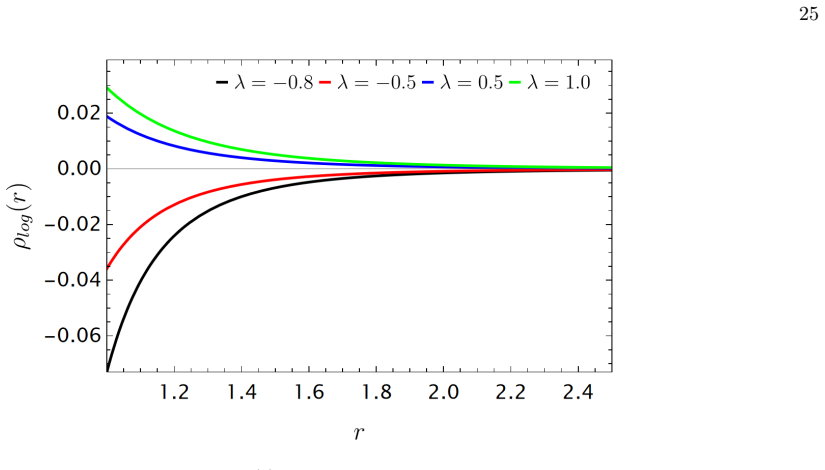
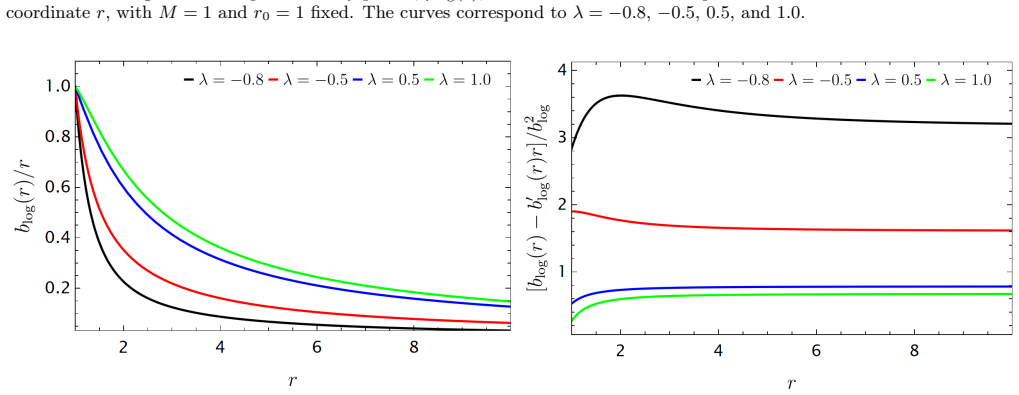
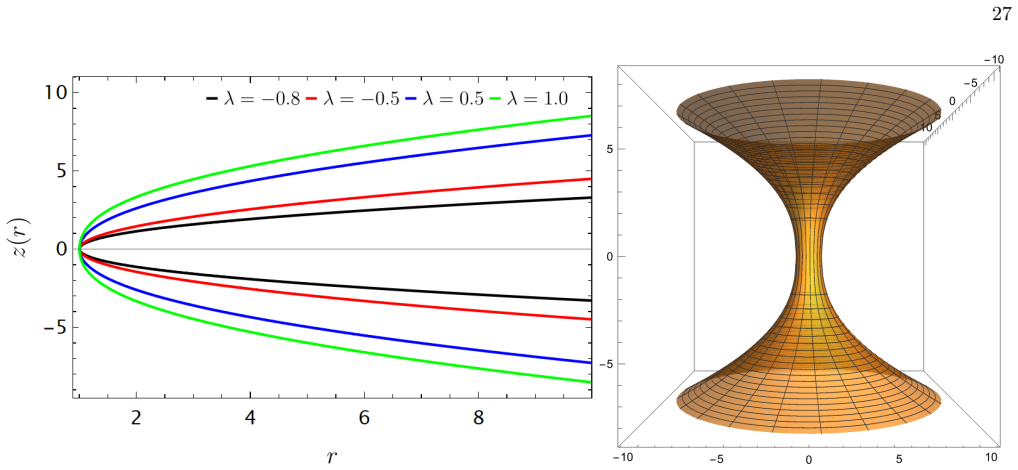
Geometry induced by the logarithmic-inspired profile Logarithmic corrections arise naturally in several approaches to quantum gravity and horizon-state counting [61]. In the entropy–geometry correspondence of Ref. [1], the associated effective density takes the form ρlog(r) = λM 2r(λ+πr 2)2 .(95) The sign of the density is controlled by the parameterλ. Fo...
-
[11]
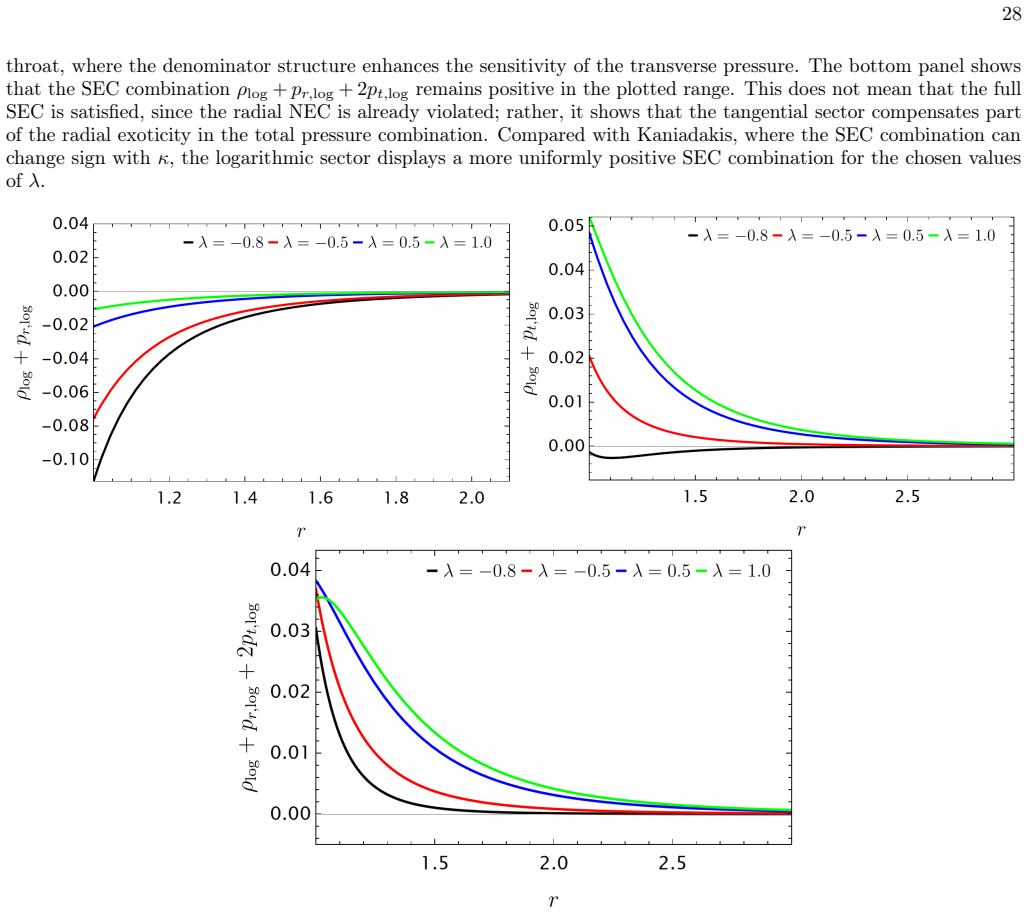
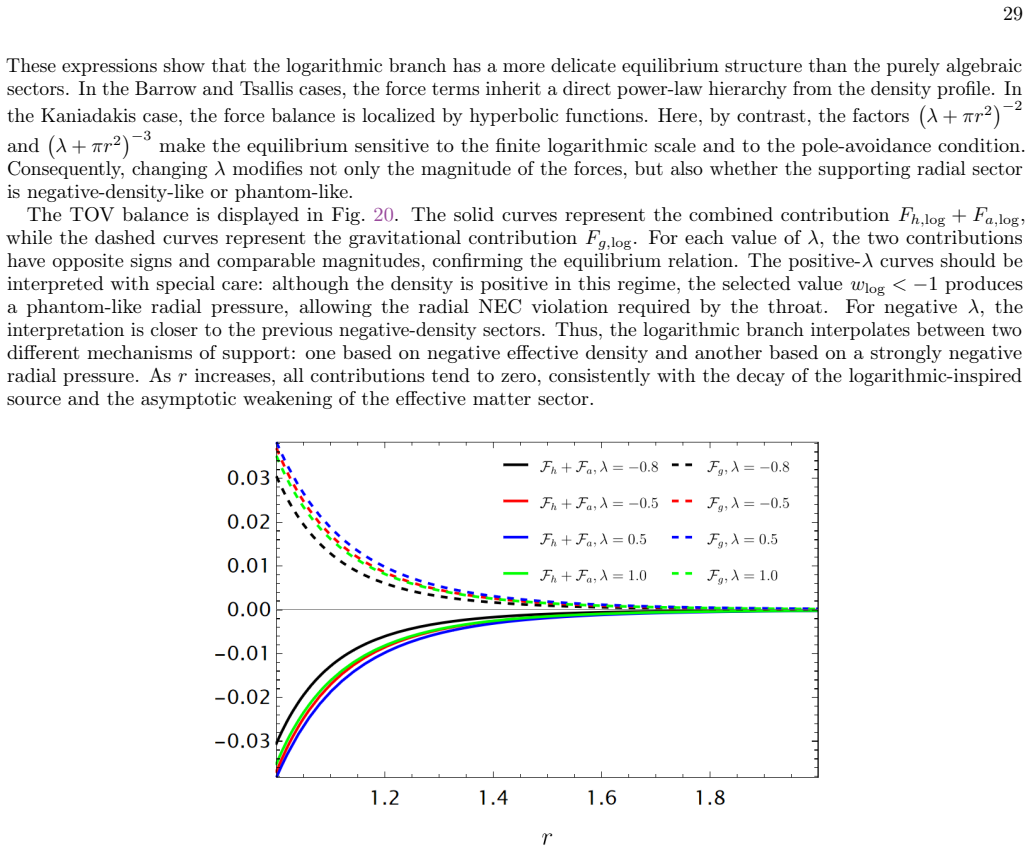
Energy conditions and equilibrium in the logarithmic-inspired sector The radial pressure is fixed by the chosen equation of state, pr,log(r) =w logρlog(r).(104) As in the previous sectors, the equation-of-state parameter is fixed by the requirement that the redshift derivative be regular at the throat. For the logarithmic-inspired shape function, one obta...
-
[12]
In the entropy–geometry correspondence of Ref
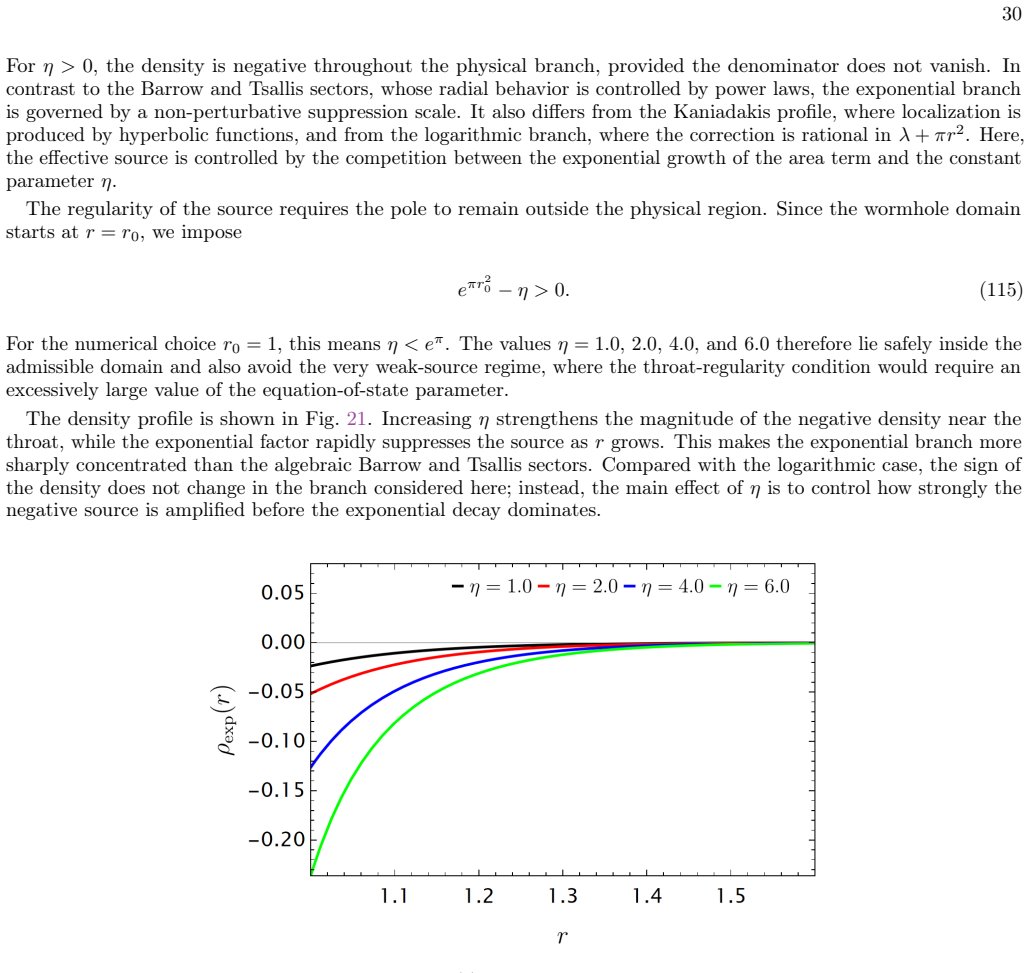
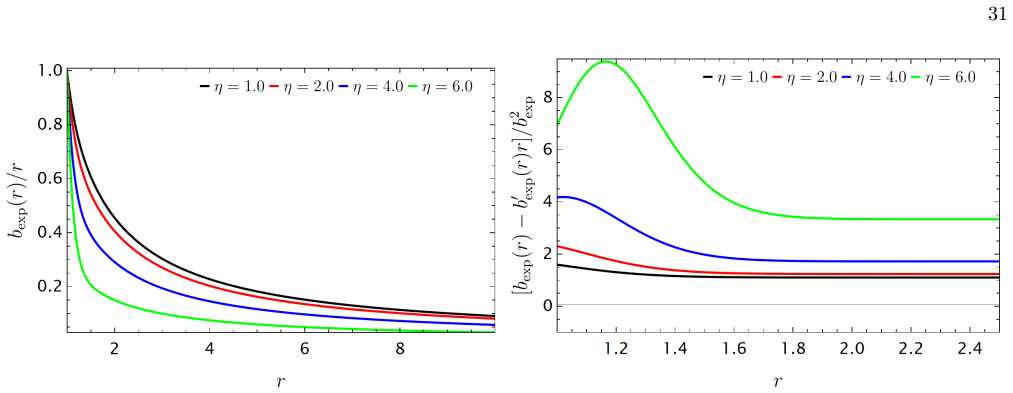
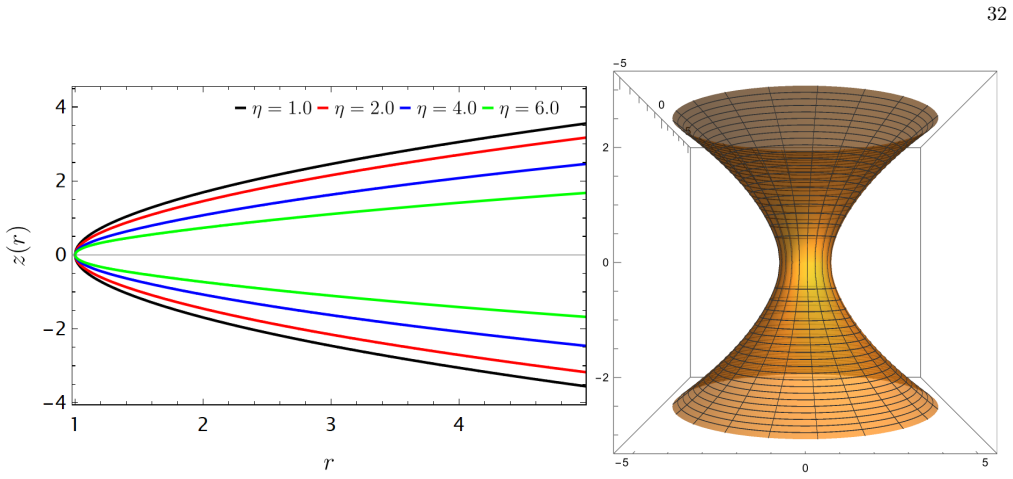
Geometry induced by the exponential-inspired profile The exponentially corrected entropy introduces a non-perturbative deformation of the Bekenstein–Hawking law through the parameterη. In the entropy–geometry correspondence of Ref. [1], the associated density reads ρexp(r) =− ηM eπr2 2r eπr2 −η 2 .(114) 30 For η > 0, the density is negative throughout the...
-
[13]
For the exponential-inspired shape function, one obtains b′ exp(r) =− 4πηM reπr2 eπr2 −η 2 .(119) 32 FIG
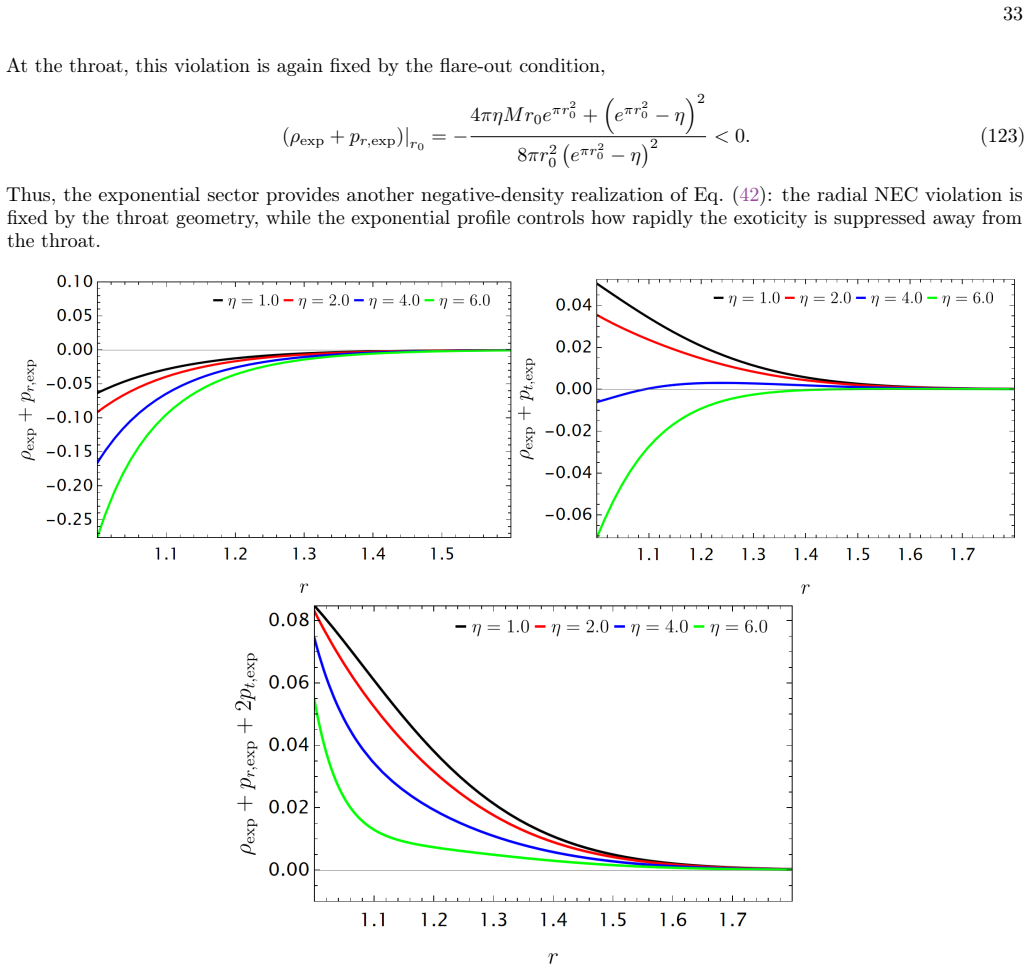
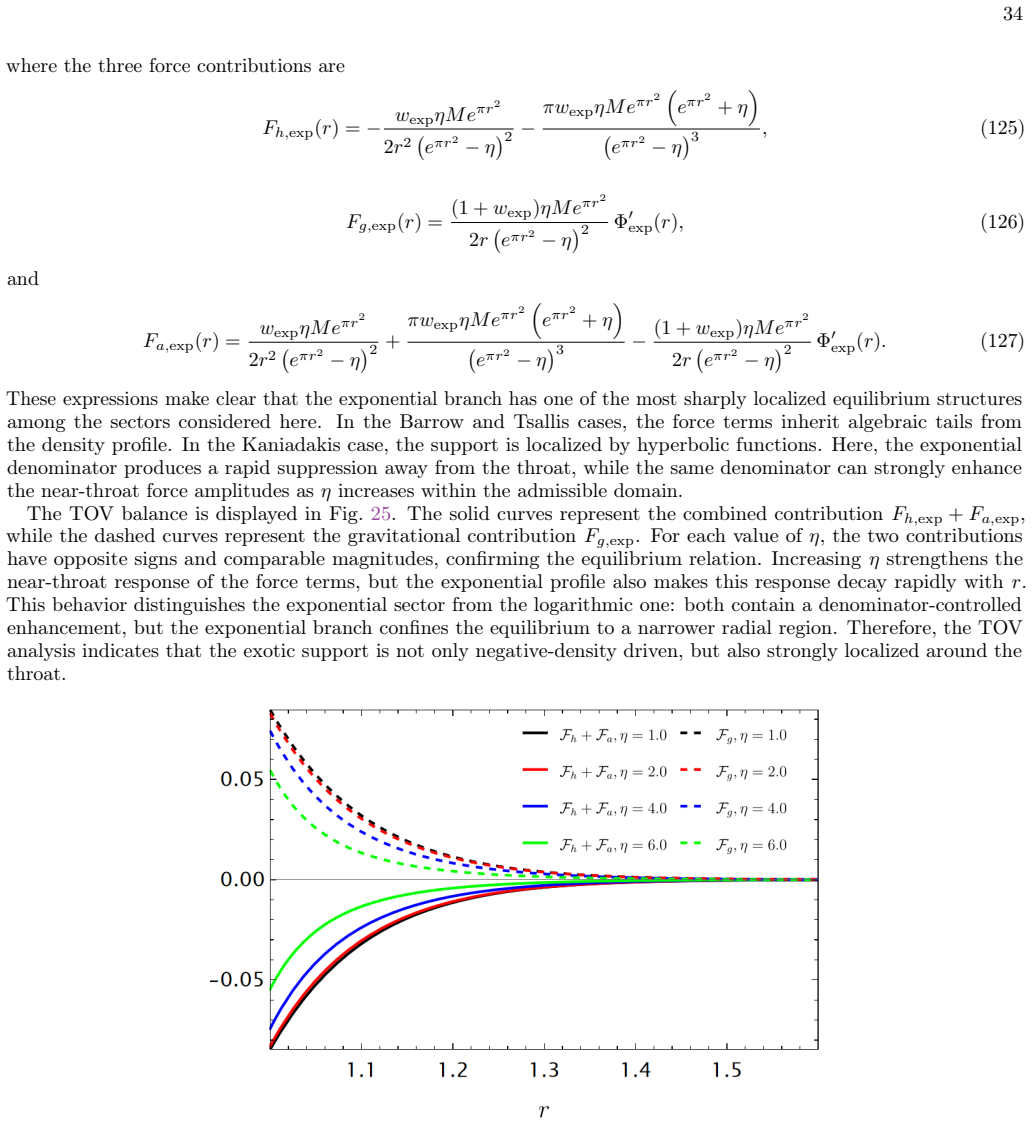
Energy conditions and equilibrium in the exponential-inspired sector The radial pressure is fixed by the chosen equation of state, pr,exp(r) =w expρexp(r).(118) As in the previous sectors, the equation-of-state parameter is selected by the regularity of the redshift derivative at the throat. For the exponential-inspired shape function, one obtains b′ exp(...
2025
-
[14]
Anand, S
A. Anand, S. Devdutt, K. Jusufi, and E. N. Saridakis, The European Physical Journal C86, 534 (2026)
2026
-
[15]
Anand, K
A. Anand, K. Jusufi, S. Basilakos, and E. N. Saridakis, The European Physical Journal C86, 126 (2026)
2026
-
[16]
Einstein and N
A. Einstein and N. Rosen, Physical Review48, 73 (1935)
1935
-
[17]
H. G. Ellis, Journal of Mathematical Physics14, 104 (1973)
1973
-
[18]
K. A. Bronnikov, Acta Physica Polonica B4, 251 (1973)
1973
-
[19]
M. S. Morris and K. S. Thorne, American Journal of Physics56, 395 (1988)
1988
-
[20]
Visser, Physical Review D39, 3182 (1989)
M. Visser, Physical Review D39, 3182 (1989)
1989
-
[21]
Visser,Lorentzian Wormholes: From Einstein to Hawking(AIP Press, New York, 1995)
M. Visser,Lorentzian Wormholes: From Einstein to Hawking(AIP Press, New York, 1995)
1995
-
[22]
T. M. Crispim, G. Alencar, and C. R. Muniz, Classical and Quantum Gravity43, 115013 (2026)
2026
-
[23]
M. S. Morris, K. S. Thorne, and U. Yurtsever, Physical Review Letters61, 1446 (1988)
1988
-
[24]
J. L. Friedman, K. Schleich, and D. M. Witt, Physical Review Letters71, 1486 (1993), erratum: Physical Review Letters 75, 1872 (1995)
1993
-
[25]
L. H. Ford and T. A. Roman, Physical Review D53, 5496 (1996), arXiv:gr-qc/9510071
Pith/arXiv arXiv 1996
-
[26]
D. Hochberg and M. Visser, Physical Review Letters81, 746 (1998), arXiv:gr-qc/9802048
Pith/arXiv arXiv 1998
-
[27]
M. Visser, S. Kar, and N. Dadhich, Physical Review Letters90, 201102 (2003), arXiv:gr-qc/0301003
Pith/arXiv arXiv 2003
-
[28]
F. S. N. Lobo, Physical Review D71, 084011 (2005), arXiv:gr-qc/0502099
Pith/arXiv arXiv 2005
-
[29]
S. V. Sushkov, Physical Review D71, 043520 (2005), arXiv:gr-qc/0502084
Pith/arXiv arXiv 2005
-
[30]
F. S. N. Lobo and M. A. Oliveira, Physical Review D80, 104012 (2009), arXiv:0909.5539 [gr-qc]
Pith/arXiv arXiv 2009
-
[31]
F. S. N. Lobo, AIP Conf. Proc.1458, 447 (2012)
2012
-
[32]
R. Radhakrishnan, P. Brown, J. Mutulevich, E. Davis, D. Mirfendereski, and G. Cleaver, Symmetry16, 1007 (2024), arXiv:2405.05476 [gr-qc]
arXiv 2024
-
[33]
R. A. Konoplya and A. Zhidenko, Physical Review Letters128, 091104 (2022), arXiv:2106.05034 [gr-qc]
arXiv 2022
-
[34]
S. Nojiri and S. D. Odintsov, Physics Reports505, 59 (2011), arXiv:1011.0544 [gr-qc]
Pith/arXiv arXiv 2011
-
[35]
S. Capozziello and M. De Laurentis, Physics Reports509, 167 (2011), arXiv:1108.6266 [gr-qc]
Pith/arXiv arXiv 2011
-
[36]
T. Harko, F. S. N. Lobo, M. K. Mak, and S. V. Sushkov, Physical Review D87, 067504 (2013), arXiv:1301.6878 [gr-qc]
Pith/arXiv arXiv 2013
-
[37]
C. G. Böhmer, T. Harko, and F. S. N. Lobo, Physical Review D85, 044033 (2012), arXiv:1110.5756 [gr-qc]
Pith/arXiv arXiv 2012
-
[38]
P. Kanti, B. Kleihaus, and J. Kunz, Physical Review Letters107, 271101 (2011), arXiv:1108.3003 [gr-qc]
Pith/arXiv arXiv 2011
-
[39]
E. Battista, E. Di Grezia, M. Manfredonia, and G. Miele, The European Physical Journal Plus132, 537 (2017), arXiv:1707.01508 [gr-qc]
Pith/arXiv arXiv 2017
-
[40]
V. De Falco, E. Battista, S. Capozziello, and M. De Laurentis, The European Physical Journal C81, 157 (2021), arXiv:2102.01123 [gr-qc]
arXiv 2021
-
[41]
E. Battista, S. Capozziello, and A. Errehymy, The European Physical Journal C84, 1314 (2024), arXiv:2409.09750 [gr-qc]
arXiv 2024
-
[42]
M. B. Cruz, R. M. P. Neves, and C. R. Muniz, Journal of Cosmology and Astroparticle Physics2024, 016 (2024), arXiv:2401.08885 [gr-qc]. 37
arXiv 2024
-
[43]
P. Nicolini, A. Smailagic, and E. Spallucci, Physics Letters B632, 547 (2006), arXiv:gr-qc/0510112
Pith/arXiv arXiv 2006
-
[44]
R. Garattini and F. S. N. Lobo, Physics Letters B671, 146 (2009), arXiv:0811.0919 [gr-qc]
Pith/arXiv arXiv 2009
-
[45]
F. Rahaman, S. Karmakar, I. Karar, and S. Ray, Physics Letters B746, 73 (2015), arXiv:1406.3045 [gr-qc]
Pith/arXiv arXiv 2015
-
[46]
Garattini, European Physical Journal C79, 951 (2019), arXiv:1907.03623 [gr-qc]
R. Garattini, European Physical Journal C79, 951 (2019), arXiv:1907.03623 [gr-qc]
arXiv 2019
-
[47]
J. F. Navarro, C. S. Frenk, and S. D. M. White, Astrophysical Journal462, 563 (1996), arXiv:astro-ph/9508025
Pith/arXiv arXiv 1996
-
[48]
F. Rahaman, G. C. Shit, B. Sen, and S. Ray, Astrophysics and Space Science361, 37 (2016), arXiv:1609.00155 [gr-qc]
Pith/arXiv arXiv 2016
-
[49]
A. C. L. Santos, R. V. Maluf, and C. R. Muniz, Annals of Physics469, 169775 (2024), arXiv:2405.08774 [gr-qc]
arXiv 2024
-
[50]
J. A. Rebouças, C. R. Muniz, F. B. Lustosa, and E. Otoniel, The European Physical Journal C86, 407 (2026)
2026
-
[51]
J. A. Rebouças, F. T. B. Sampaio, F. B. Lustosa, L. T. d. Oliveira, and C. R. Muniz, Annalen der Physik538, e00636 (2026)
2026
-
[52]
V. De Falco, E. Battista, S. Capozziello, and M. De Laurentis, Physical Review D101, 104037 (2020), arXiv:2004.14849 [gr-qc]
arXiv 2020
-
[53]
V. De Falco, E. Battista, S. Capozziello, and M. De Laurentis, Physical Review D103, 044007 (2021), arXiv:2101.04960 [gr-qc]
arXiv 2021
-
[54]
J. D. Bekenstein, Physical Review D7, 2333 (1973)
1973
-
[55]
S. W. Hawking, Communications in Mathematical Physics43, 199 (1975)
1975
-
[56]
G. W. Gibbons and S. W. Hawking, Physical Review D15, 2752 (1977)
1977
-
[57]
R. M. Wald, Physical Review D48, R3427 (1993)
1993
-
[58]
Iyer and R
V. Iyer and R. M. Wald, Physical Review D50, 846 (1994)
1994
-
[59]
’t Hooft, (1993), arXiv:gr-qc/9310026
G. ’t Hooft, (1993), arXiv:gr-qc/9310026
Pith/arXiv arXiv 1993
-
[60]
Susskind, Journal of Mathematical Physics36, 6377 (1995), arXiv:hep-th/9409089
L. Susskind, Journal of Mathematical Physics36, 6377 (1995), arXiv:hep-th/9409089
Pith/arXiv arXiv 1995
-
[61]
Bousso, Reviews of Modern Physics74, 825 (2002), arXiv:hep-th/0203101
R. Bousso, Reviews of Modern Physics74, 825 (2002), arXiv:hep-th/0203101
Pith/arXiv arXiv 2002
-
[62]
Jacobson, Physical Review Letters75, 1260 (1995), arXiv:gr-qc/9504004
T. Jacobson, Physical Review Letters75, 1260 (1995), arXiv:gr-qc/9504004
Pith/arXiv arXiv 1995
-
[63]
Padmanabhan, Reports on Progress in Physics73, 046901 (2010), arXiv:0911.5004 [gr-qc]
T. Padmanabhan, Reports on Progress in Physics73, 046901 (2010), arXiv:0911.5004 [gr-qc]
Pith/arXiv arXiv 2010
-
[64]
E. P. Verlinde, Journal of High Energy Physics2011, 029 (2011), arXiv:1001.0785 [hep-th]
Pith/arXiv arXiv 2011
-
[65]
Visser, Journal of High Energy Physics2011, 140 (2011), arXiv:1108.5240 [hep-th]
M. Visser, Journal of High Energy Physics2011, 140 (2011), arXiv:1108.5240 [hep-th]
Pith/arXiv arXiv 2011
- [66]
-
[67]
S. Nojiri and S. D. Odintsov, Physics of the Dark Universe48, 101899 (2025), arXiv:2502.15272 [gr-qc]
arXiv 2025
- [68]
-
[69]
Van Raamsdonk, General Relativity and Gravitation42, 2323 (2010), arXiv:1005.3035 [hep-th]
M. Van Raamsdonk, General Relativity and Gravitation42, 2323 (2010), arXiv:1005.3035 [hep-th]
arXiv 2010
-
[70]
T. Faulkner, M. Guica, T. Hartman, R. C. Myers, and M. Van Raamsdonk, Journal of High Energy Physics2014, 051 (2014), arXiv:1312.7856 [hep-th]
Pith/arXiv arXiv 2014
-
[71]
Jacobson, Physical Review Letters116, 201101 (2016), arXiv:1505.04753 [gr-qc]
T. Jacobson, Physical Review Letters116, 201101 (2016), arXiv:1505.04753 [gr-qc]
Pith/arXiv arXiv 2016
-
[72]
R. K. Kaul and P. Majumdar, Physical Review Letters84, 5255 (2000), arXiv:gr-qc/0002040
Pith/arXiv arXiv 2000
-
[73]
S. Das, P. Majumdar, and R. K. Bhaduri, Classical and Quantum Gravity19, 2355 (2002), arXiv:hep-th/0111001
Pith/arXiv arXiv 2002
-
[74]
Sen, Journal of High Energy Physics2013, 1 (2013)
A. Sen, Journal of High Energy Physics2013, 1 (2013)
2013
-
[75]
Tsallis, Journal of Statistical Physics52, 479 (1988)
C. Tsallis, Journal of Statistical Physics52, 479 (1988)
1988
-
[76]
C. Tsallis and L. J. L. Cirto, European Physical Journal C73, 2487 (2013), arXiv:1202.2154 [cond-mat.stat-mech]
Pith/arXiv arXiv 2013
-
[77]
Kaniadakis, Physical Review E66, 056125 (2002)
G. Kaniadakis, Physical Review E66, 056125 (2002)
2002
-
[78]
J. D. Barrow, Physics Letters B808, 135643 (2020)
2020
-
[79]
E. N. Saridakis, Journal of Cosmology and Astroparticle Physics2020, 031 (2020), arXiv:2006.01105 [gr-qc]
arXiv 2020
-
[80]
A. Chatterjee and A. Ghosh, Physical Review Letters125, 041302 (2020), arXiv:2007.15401 [gr-qc]
arXiv 2020
discussion (0)
Sign in with ORCID, Apple, or X to comment. Anyone can read and Pith papers without signing in.