REVIEW 4 major objections 5 minor 36 references
Optimizing Wealth by a Game within Cellular Automata
T0 review · 4 major / 5 minor · reviewed 2026-08-08 · deepseek-v4-flash
Pith's one-line read Local CA rule reaches global wealth optimum on odd and even grids
desk verdict An honest, clearly written method paper whose central exactness claim for odd grid sizes rests on an unproved extrapolation—and whose own n=27 runs never reach the predicted optimum. read the letter →
The pith
A machine-rendered reading of the paper's core claim, the machinery that carries it, and where it could break.
The reading
What carries the argument
The load-bearing object is the template: a 3x3 local configuration, one representative per symmetry class, extracted by gliding a window over the genetic algorithm's optimal master patterns. The probabilistic CA rule tests every template except its center at the selected cell; if any template matches, the cell is set to the template's center value, and if none matches, the cell is flipped from 0 to 1 with probability 0.04 or from 1 to 0 with probability 1.0. Rule 8 uses templates T0-T7 for even grids, Rule 36 adds T8-T35, and Rule 52 adds the singularity templates J0-J7 and K0-K7. The singularity templates are what allow odd grids to stabilize with exactly one 2x2 cooperator block.
What would settle it
Find a single odd-n configuration with total payoff above the claimed TPS = 265 + 128m + 43m(m+2), for example a 27x27 pattern with TPS greater than 7822, or an odd-size optimal pattern with zero or two singularities; any such configuration would disprove the claimed exact optimum and the one-singularity rule.
Extended reading notes
Core claim
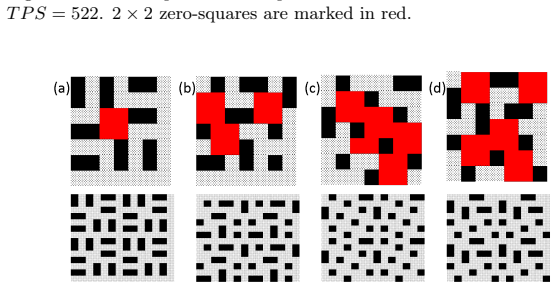
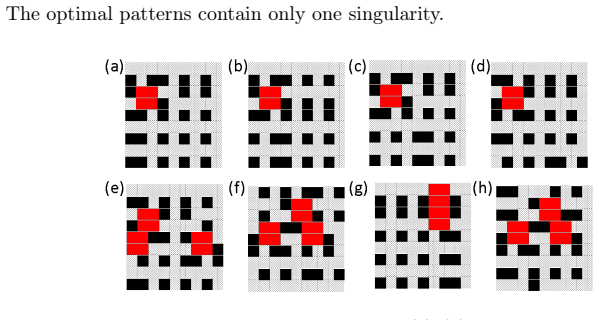
The constructed cellular automaton rule finds optimal and near-optimal patterns for even and odd grid sizes. For even n, optimal patterns are dense arrangements of isolated defector points surrounded by zeroes, and the paper shows that eight 3x3 templates suffice to evolve them stably. For odd n, optimal patterns mix isolated points with dominoes and contain exactly one singularity, a framed 2x2 square of cooperators; the paper asserts that optimal patterns of odd size have n-1 dominoes along two neighboring border sides and points elsewhere, and that the total payoff of an optimal solution is exactly TPS = 265 + 128m + 43m(m+2) with m=(n-5)/2, so that wealth approaches the even-size limit 43/36 = 1.19444 as n grows. The rule variants depend on the template set: Rule 8 uses templates T0-T7 for even grids, Rule 36 adds T8-T35 for transient odd-size patterns, and Rule 52 adds the singularity templates J0-J7 and K0-K7 to stabilize odd-size patterns.
Load-bearing premise
The load-bearing premise is that the genetic algorithm's winners for sizes 5, 6, and 7 are truly the best possible patterns, and that the regularity seen in them, one 2x2 block of cooperators and a border seam of dominoes on odd grids, continues to hold at every larger size; the authors state this odd-size relation was concluded without giving a proof.
Editorial extensions
If this is right
- For even grid sizes, an optimal pattern can be built entirely from isolated points, and the 8-template Rule 8 reaches wealth 1.1944, with measured average convergence times growing rapidly from 34 generations for 6x6 to 1421 generations for 10x10.
- For odd sizes, Rule 52 stabilizes optimal or near-optimal patterns quickly, averaging 11 generations for 9x9 and finding the optimum 34 of 100 runs, while Rule 36 finds the optimum 96 times but only as a transient.
- The odd-size formula predicts the exact optimum, and for large odd n wealth tends to 43/36 and defector density to 1/4, matching the even-size limit.
- Optimal odd patterns always contain exactly one singularity, but near-optimal 7x7 patterns show that one singularity is necessary, not sufficient, for optimality.
- At n=27 the CA rules did not find the claimed optimum with TPS=7822 in 100 runs, though Rule 36 reached 99.65% of the optimum on average.
- If the TPS formula is exact for every odd n, the optimal-wealth problem reduces to a tiling statement: a lattice of isolated points with a single seam of n-1 dominoes and one 2x2 cooperator block, a characterization that could be proved or refuted by an exchange argument on the payoff sum.
- The same template-extraction pipeline could be tested on other utility functions, and the paper itself leaves open the effects of other payoff parameters and the minimal template size needed.
- A direct exact-search certificate for n=5,6,7, for example by integer programming, would close the weakest link, because the singularity observation and the recurrences are currently extrapolated from those genetic-algorithm masters.
Signed reviews
Editorial analysis
A structured set of objections, weighed in public.
Referee Report
Summary. The paper addresses the global-to-local problem for a two-dimensional binary grid: after fixing a utility function derived from a spatial Prisoner's Dilemma (Section 3), it uses a Genetic Algorithm to obtain "optimal" patterns for small grids (Section 5), extracts 3x3 templates from these patterns (Section 6), and inserts the templates into a probabilistic cellular automaton rule (Section 7). The resulting rules (Rule 8, Rule 36, Rule 52) are evaluated on even and odd sizes up to 27x27 (Section 8). The paper claims that the CA rules evolve optimal or near-optimal patterns for even and odd grid sizes, that optimal odd patterns contain exactly one 2x2 cooperation singularity, and that the maximal TPS for odd n is 265 + 128m + 43m(m+2) with m=(n-5)/2, so that the wealth tends to 43/36 = 1.19444.
Significance. If the optimality claims were supported by proofs or by certified exhaustive search for each size, the four-step template-extraction method would be a useful demonstration of constructing a local rule from small optimal masters. The paper also makes crisp, falsifiable predictions: the explicit TPS formula and the one-singularity observation for odd sizes. The experimental sections are transparent, and the authors honestly report the n=27 shortfall. However, because the template set is reverse-engineered from GA solutions of the same objective, the small-size success is partly by construction; the independent content lies in extrapolation to larger sizes, and that is exactly where the evidence stops short of the stated optimality claims.
major comments (4)
- [§5.4, §8.2] Section 5.4 and Section 8.2 give two different TPS formulas. Section 5.4 states TPS = 265 + 128m + 43m(m+1), while Section 8.2 states TPS = 265 + 128m + 43m(m+2). For n=7 (m=1) the former gives 436 and the latter gives 522; Table 1 lists 522, so at least the Section 5.4 expression is wrong as written. The larger issue is that Section 8.2's formula is obtained by counting a single recursively constructed pattern family (Fig. 16) and is called "the exact value of an optimal solution" without a matching upper bound over all odd-size patterns. The formula therefore certifies a constructed family, not global optimality, and the abstract's and conclusion's "optimal" claims depend on this missing upper bound.
- [§5.4, §6] Section 5.4 says the odd-size relations are concluded "without giving a proof", and Section 6 says a proof of the one-singularity observation "would be welcome". Despite these caveats, the abstract and conclusion assert as fact that optimal patterns of odd size contain exactly one singularity. The supporting evidence is GA runs only up to n=15 and visual or CA-based inspection; no exhaustive search or analytic argument rules out odd sizes with zero or multiple singularities. If a counterexample exists, the template set T0-T51 may be incomplete, and the CA rule's failure to reach TPS=7822 at n=27 would be a natural consequence rather than a performance shortfall. The paper should either prove the one-singularity statement for all odd n or explicitly label it as an empirical conjecture.
- [§8.2, Fig. 18] The n=27 simulations do not support the claim that the CA rule finds optimal patterns for larger odd sizes. Section 8.2 reports that neither Rule 36 nor Rule 52 ever achieves the claimed optimum TPS=7822 (W=1.1922): Rule 36 reaches at most TPS=7807 (W=1.1899) and Rule 52 reaches at most TPS=7786 (W=1.1867). In addition, the caption of Fig. 18 calls a pattern with TPS=7821 "optimal", yet 7821 is one below the formula's optimum, and the stated W=1.11921 does not match TPS=7821 (which gives W approximately 1.1920). The abstract's statement that the constructed CA rule "finds optimal and near-optimal patterns" is therefore not supported for n=27; the data support only near-optimality, and the figure caption must be corrected.
- [§8.1] The even-size optimality claim is also not backed by an upper bound. Section 8.1 reports that Rule 8 reaches TPS=387 at n=6 and gives run-time statistics for n=8 and n=10, but no exact TPS formula or global upper bound is provided for even n. The word "optimal" for even sizes therefore rests on the GA's having found the best pattern at n=6 and on the assumption that templates T0-T7 remain sufficient for all larger even n. Since the paper's central claim covers even sizes as well, the authors should either add a proof or upper bound for the even case or explicitly state that even-size optimality is verified only up to the sizes simulated.
minor comments (5)
- [§3.2] The displayed formula utotal_ij = (aij + T aij) NC is inconsistent with the preceding definitions: with C=0 and D=1 the correct expression is ((1 - aij) + T aij) NC. The numerical examples (e.g., a defector with eight cooperating neighbors scoring 24) use the correct expression, so this appears to be a typo, but it should be fixed.
- [Fig. 15] The caption of Fig. 15 gives W=1.16615 for the 9x9 optimal patterns, but Table 1 gives TPS=865, which implies W=865/729 approximately 1.18656. Please correct the caption.
- [Fig. 18] As noted in the major comments, the Fig. 18 caption's W=1.11921 and TPS=7821 are internally inconsistent, and TPS=7821 is not the claimed optimum of 7822. The caption should be corrected and the word "optimal" replaced by "near-optimal".
- [§7] In the evaluation line of Section 7, "STP(A) and W(A)" should presumably read "TPS(A) and W(A)" for consistency with the notation defined in Section 3.3.
- [General] The paper does not state whether the GA and CA programs are publicly available. Given that the results are empirical and the template list is central to the method, an availability statement or supplementary code would materially help reproducibility.
Circularity Check
Mild construction-fitted circularity for even-size templates; odd-size claims rest on unproved extrapolation rather than circular reduction.
-
fitted input called prediction
[Section 6 (The templates for n even) and Section 8.1 (Application of Rule 8)]
"Note that other optimal patterns differ only slightly (lines of points can be shifted against each other), but it is obvious that the set of found templates is complete in the sense that we can construct any optimal pattern with them by overlaying them without conflict and thereby covering the whole area."
Rule 8 is assembled from the template set that the paper itself says is 'complete' for optimal even patterns: any optimal pattern can be constructed by overlaying these templates. The CA update rule writes TQ_center whenever a template matches except at the center, so the rule's fixed-point set is, by design, the set of patterns composed of these templates. Thus the observation that Rule 8 'drives the evolution to a stable optimal pattern' (Sec. 8.1) is a consequence of fitting the rule's building blocks to the GA optima of the same fitness function, not an independent test of an optimality claim.
full rationale
The derivation chain is a transparent constructive method: define the SPD utility, find small master patterns with a GA, extract 3x3 templates from those masters, and insert the templates into a probabilistic CA rule evaluated on the same wealth objective. The even-size result is mildly construction-fitted, as detailed in the step above. The odd-size claims are not circular: the one-singularity observation and the TPS formulas come from GA patterns and constructed families, not from the CA rule, and the CA rule itself fails at n=27 to reach the claimed optimum (best TPS 7807 vs predicted 7822), showing the outcome is not forced by the fit. The paper itself flags the main missing support: Section 5.4 derives the odd-size relations 'without giving a proof', and Section 6 says of the one-singularity observation 'A proof would be welcome'. In addition, the two TPS formulas disagree (Section 5.4: 265+128m+43m(m+1); Section 8.2: 265+128m+43m(m+2)), so the claimed exact optimum for odd n is not established. These are correctness risks from unproved extrapolation, not circular reductions; no load-bearing self-citation or uniqueness theorem is invoked, and no known result is renamed. Score 2 reflects the mild construction-fitted character of the even-size template demonstration while keeping the odd-size central claim independent in content.
Assumptions & free parameters
free parameters (7)
- CA noise probability π01 =
0.04
- CA flip probability π10 =
1.0
- GA crossover probability p1 =
0.2
- GA mutation probability p2 =
0.05
- GA population size M =
40
- Initial CA density of ones =
1/4
- Template set T0-T51 =
52 templates for odd sizes; 8 templates for even sizes
assumptions (4)
- domain assumption GA solutions for small grids are global optima
- domain assumption Template set is complete under symmetries and sufficient for all optimal patterns
- domain assumption 3x3 templates are large enough
- ad hoc to paper Odd-size structural formulas extrapolate to all n
Cite this review
Pith. "Pith review of Optimizing Wealth by a Game within Cellular Automata." pith.science (2026). https://pith.science/paper/OEKM32AW
@misc{pith2026250205246,
  author       = {Pith},
  title        = {Pith review of: Optimizing Wealth by a Game within Cellular Automata},
  year         = {2026},
  howpublished = {\url{https://pith.science/paper/OEKM32AW}},
  note         = {Machine review of arXiv:2502.05246}
}
read the original abstract
The objective is to find a Cellular Automata (CA) rule that can evolve 2D patterns that are optimal with respect to a global fitness function. The global fitness is defined as the sum of local computed utilities. A utility or value function computes a score depending on the states in the local neighborhood. First the method is explained that was followed to find such a CA rule. Then this method is applied to find a rule that maximizes social wealth. Here wealth is defined as the sum of the payoffs that all players (agents, cells) receive in a prisoner's dilemma game, and then shared equally among them. The problem is solved in four steps: (0) Defining the utility function, (1) Finding optimal master patterns with a Genetic Algorithm, (2) Extracting templates (local neighborhood configurations), (3) Inserting the templates in a general CA rule. The constructed CA rule finds optimal and near-optimal patterns for even and odd grid sizes. Optimal patterns of odd size contain exactly one singularity, a 2 x 2 block of cooperators.
Figures


Figures from the paper (15 more)




Reference graph
Works this paper leans on
-
[1]
Axelrod, R., The Evolution of Cooperation, Basic Books, Inc., New York (1984)
work page 1984
-
[2]
Cellular Automata Pattern Recognition and Rule Evolution Through a Neuro–Genetic Approach
Bandini, Stefania, et al. Cellular Automata Pattern Recognition and Rule Evolution Through a Neuro–Genetic Approach. J. Cell. Autom. 4.3 (2009): 171–181
work page 2009
-
[3]
An overview of genetic algorithms: Part 1, funda- mentals
Beasley, D.; Bull, D.R.; Martin, R.R. An overview of genetic algorithms: Part 1, funda- mentals. Univ. Comput. 1993, 15, 56-–69
work page 1993
-
[4]
Von Neumann’s 29-state cellular automaton: a hardware implementation
Beuchat, J-L., and Jacques-Olivier Haenni. Von Neumann’s 29-state cellular automaton: a hardware implementation. IEEE Transactions on Education 43.3 (2000): 300–308
work page 2000
-
[5]
Cellular automata and other cellular systems: design and evolu- tion
Capcarrere, Mathieu. Cellular automata and other cellular systems: design and evolu- tion. No. 2541. EPFL, 2002
work page 2002
-
[6]
Grim, P., The greater generosity of the Spatialized Prisoner’s Dilemma, J. Theor. Biol. 173(4) (1995) 353–359
work page 1995
-
[7]
Hoffmann, R. (2014). How Agents Can Form a Specific Pattern. ACRI Conf. 2014, LNCS 8751, pp. 660–669
work page 2014
-
[8]
Hoffmann, R. (2016). Cellular Automata Agents form Path Patterns Effectively. Acta Physica Polonica B Proceedings Supplement, Vol. 9 (2016) No.1
work page 2016
Show all 36 references
-
[9]
and Désérable, D
Hoffmann, R. and Désérable, D. (2016). Line Patterns Formed by Cellular Automata Agents. ACRI Conf. 2016, LNCS 9863, pp. 424–434
2016
-
[10]
Hoffmann, R., Désérable, D. (2017). Generating Maximal Domino Patterns by Cellular Automata Agents. PaCT 2017, Malyshkin, V., ed., LNCS 10421 (2017) 18–31
2017
-
[11]
Hoffmann R., Désérable D., Seredyński F. (2019). A Probabilistic Cellular Automata Rule Forming Domino Patterns. In: Malyshkin V. (eds) Parallel Computing Technolo- gies. PaCT 2019. Lecture Notes in Computer Science, vol 11657, pp. 334–344. Springer
2019
-
[12]
and Seredyński, F
Hoffmann, R. and Seredyński, F. (2020). Covering the space with sensor tiles. In In- ternational Conference on Cellular Automata for Research and Industry (pp. 156–168). Springer, Cham
2020
-
[13]
and Seredyński, F
Hoffmann, R., Désérable, D. and Seredyński, F. (2021). A cellular automata rule placing a maximal number of dominoes in the square and diamond. J Supercomput 77, 9069 — 9087
2021
-
[14]
Désérable, D., Hoffmann, R., Seredyński, F. (2023). Maximal Arrangement of Dominos in the Diamond. arXiv preprint arXiv:2305.04544
2023 arXiv
-
[15]
Hoffmann, R., Désérable, D., and Seredyński, F. (2021). Minimal Covering of the Space by Domino Tiles. In International Conference on Parallel Computing Technologies (pp. 453–465). Springer, Cham
2021
-
[16]
Ar- ticle arXiv:2202.06656 (2022)
Hoffmann, R., Forming Point Patterns by a Probabilistic Cellular Automata Rule. Ar- ticle arXiv:2202.06656 (2022)
2022 arXiv
-
[17]
Algorithms 16.7 (2023): 352
Hoffmann, R., Generating Loop Patterns with a Genetic Algorithm and a Probabilistic Cellular Automata Rule. Algorithms 16.7 (2023): 352
2023
-
[18]
Genetic algorithms
Holland, J.H. Genetic algorithms. Sci. Am. 1992, 267, 66–73
1992
-
[19]
Genetic algorithms
Holland, J.H. Genetic algorithms. Scholarpedia 2012, 7, 1482
2012
-
[20]
(eds) LNCS 5191 (2008) 60–66
Katsumata, Y., Ishida, Y., On a membrane formation in a spatio–temporally general- ized Prisoner’s Dilemma, Cellular Automata, Umeo, H., Morishita, S., Nishinari, K., Komatsuzaki, T., Bandini, S. (eds) LNCS 5191 (2008) 60–66
2008
-
[21]
Genetic algorithms: An overview
Mitchell, M. Genetic algorithms: An overview. In Complex; Wiley: Hoboken, NJ, USA, 1995; Volume 1, pp. 31–39 32
1995
-
[22]
Crutchfield, and Rajarshi Das
Mitchell, Melanie, James P. Crutchfield, and Rajarshi Das. Evolving cellular automata with genetic algorithms: A review of recent work. Proceedings of the First international conference on evolutionary computation and its applications (EvCA’96). Vol. 8. 1996
1996
-
[23]
Nagpal, R., Programmablepattern–formationandscale–independence, UnifyingThemes in Complex Systems IV, Minai, A.A, Bar–Yam, Y., eds., (2008) 275–282
2008
-
[24]
Nash, J.F., Equilibrium points in n-–person games, PNAS USA 36(1) (1950) 48–49
1950
-
[25]
Nowak, M., May, R., Evolutionary games and spatial chaos, Nature 359 (1992) 826–829
1992
-
[26]
Nowak, M., Sigmund, K., Tit—for—Tatinheterogeneouspopulations, Nature355(1992) 250–253
1992
-
[27]
The spatial dilemmas of evolution
Nowak, M.A., May, R.M. The spatial dilemmas of evolution. Int. J. of Bifurcation and Chaos 3(1), 35–78 (1993)
1993
-
[28]
Nowak, M., Five rules for the evolution of cooperation, Science 314 (2006) 1560–1563
2006
-
[29]
Michigan Press (1965)
Rapoport, A., Chammah, PL., Prisoner’s Dilemma, Univ. Michigan Press (1965)
1965
-
[30]
Tretyakova, A., Seredyński, F., Bouvry, P., Cellular automata approach to maximum lifetime coverage problem in wireless sensor networks, Cellular Automata, W¸as, J., Sirakoulis, G., Bandini, S., (eds.) LNCS 8751 (2014) 437–446
2014
-
[31]
Seredyński, F., Kulpa, T., Hoffmann, R., and Désérable, D., Coverage and Lifetime Optimization by Self–optimizing Sensor Networks,Sensors 23(8): 3930 (2023)
2023
-
[32]
Computational Science 68 (2023) 101994
Seredyński, F., Kulpa, T., Hoffmann, R., Evolutionary self–optimization of large CA– based multi–agent systems, J. Computational Science 68 (2023) 101994
2023
-
[33]
and Seredyński, F
Szaban, M., Seredyński, M., Hoffmann, R., Désérable, D. and Seredyński, F. Pattern Formation by Collective Behavior of Competing Cellular Automata-Based Agents. In International Conference on Cellular Automata for Research and Industry ACRI (pp. 34-44). (2024, September). Cham...
2024
-
[34]
Cooperative and competitive multi-agent systems: From optimiza- tion to games
Wang, Jianrui, et al. Cooperative and competitive multi-agent systems: From optimiza- tion to games. IEEE/CAA Journal of Automatica Sinica 9.5 (2022): 763–783
2022
-
[35]
Wolfram, S. (2002). A New Kind of Science. Wolfram Media, Champaign, IL
2002
-
[36]
Yamins, D., Nagpal, R., Automated Global—to—Local programming in 1D spatial multi–agent systems, Proc. 7th Int. Conf. AAMAS (2008) 615–622 33
2008
Reviewed August 8, 2026 · model on record in the stance chip above.
Discussion (0). Continue with ORCID to comment.