REVIEW 3 major objections 4 minor 59 references
Systematic Evaluation of Knowledge Graph Repair with Large Language Models
T0 review · 3 major / 4 minor · reviewed 2026-08-06 · deepseek-v4-flash
Pith's one-line read Knowledge-graph repair can be measured systematically by generating SHACL violations whose correct fixes are known, and concise prompts repair best in LLM-based systems.
desk verdict A genuinely new VIO-based benchmark generator for SHACL repair with a solid LLM study, but the metrics equate 'revert the corruption' with 'repair well' and no code/data currently exists. read the letter →
The pith
A machine-rendered reading of the paper's core claim, the machinery that carries it, and where it could break.
The reading
What carries the argument
The central object is the violation-inducing operation (VIO), defined as a mapping from a SHACL constraint and a set of focus nodes to SPARQL add/remove operations that break that constraint. Because some constraints are shape-based — they refer to other shapes — the generator expands them with an abstract rewriting system whose expressions combine operations simultaneously (·) or as alternatives (+), producing an expansion tree whose leaves are directly executable SPARQL edits. A depth-first traversal over the tree collects one path per constraint, and each path is applied to a fresh copy of the valid graph, so the correct repair for every test case is the inverse of that path. The termination proof, Theorem 1, relies on the manifest being finite and free of recursive shapes, which makes the shape-dependency graph acyclic; the VIO construction is what gives the evaluation its ground truth.
What would settle it
Take a sample of test cases in which an LLM repair is semantically valid but not isomorphic to $G$, and ask domain experts whether each repair is acceptable; if experts accept a substantial share, the recovery-based metrics are measuring conformity to one particular repair choice rather than repair quality itself.
Extended reading notes
Core claim
The central claim is that knowledge-graph repair can be evaluated systematically by generating SHACL violations whose repairs are known in advance, and that this framework can separate which parts of an LLM prompt help or hurt. A VIO takes a constraint and a set of focus nodes and returns SPARQL operations guaranteed to violate that constraint; shape-based constraints are expanded through an abstract rewriting system into combinations of simpler operations, and the paper proves the expansion terminates when the manifest is finite and contains no recursive shapes. Each minimal expansion is applied to a copy of the valid graph to produce an invalid test case, and a repair system is scored on whether it produces parseable SPARQL, whether the repaired graph conforms, and whether it recovers the original graph, with a relaxed isomorphism step that abstracts away literal strings. The experiments show that the best LLM-based repair systems use a manifest slice limited to the source shape and its dependencies plus a knowledge-graph context restricted to the triples involved in validation, augmented with one positive example; full-manifest prompts reduce quality, and removing graph context reduces the strict recovery scores. The paper thus establishes both a methodology and a concrete evidence base for how to prompt LLM repair systems.
Load-bearing premise
The scoring treats the original graph $G$ as the only correct repair, so a repair that eliminates all violations but changes a value or adds a different-but-valid triple is penalized even if it is semantically fine.
Editorial extensions
If this is right
- Repair systems can be compared on reproducible test suites where every invalid graph has a known correct fix, making scores comparable across methods and datasets.
- For LLM-based repair, the full SHACL manifest is counterproductive: a slice containing the source shape and its dependent shapes improves or matches quality while costing fewer tokens.
- Restricting the knowledge-graph context to validation-relevant triples improves violation elimination but lowers exact-recovery scores; adding one positive example largely restores those scores.
- The four-tiered metrics separate parse errors, failure to remove violations, and deviation from the original graph, so developers can target the weakest stage of a repair pipeline.
- Cost scales with context size, and the cheapest successful configurations are also the most accurate, which matters for deploying LLM repair at scale.
Reading between the lines
- Editorial inference: the same VIO-generated test cases could be reused as training data for fine-tuned repair models, since every test case pairs an invalid graph with a known correct repair.
- Editorial inference: relaxing the uniqueness assumption on $G$ — by annotating alternative acceptable repairs — would make the isomorphism tiers a measure of repair quality rather than conformity to one choice.
- Editorial inference: the positive-example result points to retrieval-augmented generation, where a repair prompt is augmented with a similar conforming subgraph, as a natural extension likely to improve the strict metrics.
- Editorial inference: the amplification factor $\alpha$, which counts how many violations a single VIO triggers, could be used to generate cascading-multi-violation test cases and stress-test repair systems beyond the single-violation setting reported here.
Editorial analysis
A structured set of objections, weighed in public.
Referee Report
Summary. The paper proposes an evaluation framework for knowledge-graph repair under SHACL. Starting from a valid KG G and manifest S, it generates invalid graphs G' by applying violation-inducing operations (VIOs), then evaluates a repair pi with four tiered metrics (syntactic validity, semantic validity, relaxed isomorphism, exact isomorphism) plus generation cost. The authors instantiate the framework with nine prompt-strategy variants and four LLMs on three datasets (Brick, LUBM, QUDT), using linear mixed-effects models to compare context and model choices. They report that concise manifest context (S) and KG context with a positive example (F+) yield the best trade-off, and they prove strong normalization of the VIO rewriting system under finiteness and non-recursive shapes.
Significance. The VIO formalism is a useful step toward controlled, configurable benchmark generation for SHACL repair, and the paper is transparent about coverage limits (sh:xone and sh:not deferred; recursive shapes excluded). The empirical study is unusually detailed: it reports token costs, per-cell results, and LMM diagnostics rather than a single accuracy number. The termination proof in App. C is plausible and carefully scoped, and the framework makes no fitted-parameter claims. The central results are conditional, however, on two protocol choices whose validity is not established: the original graph as the unique gold-standard repair, and the single-violation prompting protocol with global validity scoring. If those are addressed, the framework could serve as a reproducible benchmark; as it stands, the reported ranking should be read as a VIO-inversion benchmark rather than a general measure of repair quality.
major comments (3)
- [Sec. 6, Fig. 1, Sec. 4] The relaxed-isomorphism and exact-isomorphism tiers score a repair by whether applying it to G' recovers the original graph G. Because every test case is built by applying a VIO to a valid G, G is a correct repair by construction, but nothing in SHACL semantics makes it the only correct repair. A repair that removes the focus node, substitutes a different-but-valid value, or adds a different conforming triple is semantically valid yet fails both isomorphism tiers. The headline result in Sec. 7 (Tables 3-5 and Fig. 8) is computed over metrics that include these tiers, so the comparison conflates 'inverts the injected VIO' with 'repairs the graph well.' This concern is load-bearing: the reported ranking of prompting strategies may be an artifact of the unique-correct-repair assumption. Please reframe the isomorphism tiers explicitly as a VIO-inversion test and report semantic-validity results separately, or justify the uniqueness assumption with additional evidence such as alternative gold repairs or human evaluation.
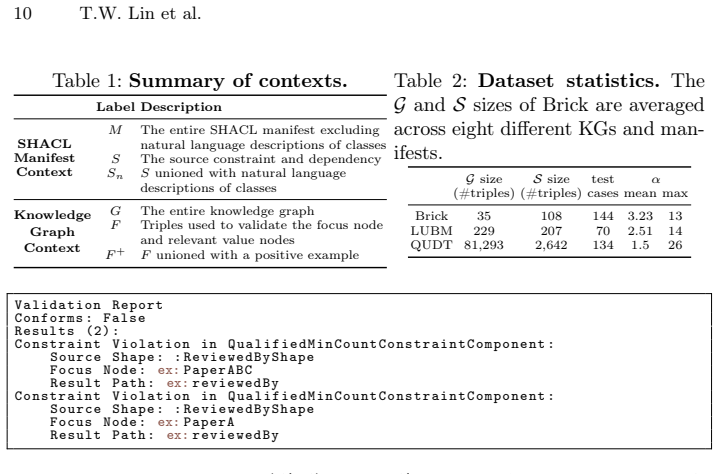
- [Sec. 7.1, Sec. 6, Table 2] Section 7.1 states that, given a validation report, the system randomly chooses one validation result to construct the prompt, while Section 6 defines semantic validity globally as G'_pi |= S. A single VIO expression can produce multiple validation results (the amplification factor alpha in Table 2 has mean up to 3.23 and max 13). In such cases the LLM is asked to repair only one of several violations but is scored on the whole graph, which mechanically deflates semantic validity and all higher tiers. The paper's deferral to future work for 'multiple VIO expressions' does not cover the single-expression/multiple-result case, which is common in the reported data. Please either provide the full validation report and instruct the LLM to repair all reported violations, or evaluate the targeted violation separately from the rest of the graph.
- [Sec. 7, App. E, Tables 3-5] The evaluation skips queries when the average input cost exceeds $0.5, which for the large QUDT dataset removes or leaves blank the high-cost entire-graph (G) context cells in App. E. Tables 3 and 5 and Fig. 8 then average over the available cells and fit linear mixed-effects models without describing how this missingness is handled. Because expensiveness correlates with context type (G is the most expensive) and dataset size, the missingness is not at random and can bias the estimated G->F and M->S effects, including the overall averages that support the paper's main conclusions. Please report the pattern of missing cells, use a method that accounts for missing data, or restrict the affected comparisons to datasets where all cells are observed.
minor comments (4)
- [Abstract, Sec. 4.3] The abstract claims that VIOs 'systematically enumerate all violations,' but the DFS in Sec. 4.3 chooses one child randomly when multiple children exist and stops once each constraint is encountered; this generates a sample of violations, not an enumeration. Please align the wording with the algorithm.
- [Sec. 4.4, Rule 2] The SPARQL remove((f, ps, v)) operation assumes that the sh:path ps is a simple predicate; for complex SHACL property paths the operation is not well-defined. Please state this restriction explicitly or specify the expansion for path expressions.
- [Sec. 5, Table 1] The definition of the F+ context presupposes that a node satisfying the source shape exists in G; if no such positive example exists in a given test case, the prompting strategy is undefined. Please specify the fallback behavior for such cases.
- [Table 3, App. E] Table 3 reports averages 'for all LLMs and prompting strategies' without noting in the caption that high-cost QUDT cells were not queried, making the domain of the reported average ambiguous.
Circularity Check
No significant circularity: the VIO benchmark defines its gold standard by construction, and the empirical ranking comes from held-out LLM responses rather than from fitted inputs or a self-citation chain.
full rationale
The evaluation framework is self-contained as a benchmark generator: each test case is produced by applying a VIO to a known-valid graph G (Sec. 3, Fig. 1), and the top metrics explicitly require reverting that operation ('Third, π should revert the VIO and recover the original KG G'). This is a definition of the benchmark's gold standard, not a fitted parameter renamed as a prediction; the LLM responses are held out and scored against that definition. The central empirical ranking (Tables 5 and 6) is computed from those held-out responses, so it does not reduce to the training data or to the VIO construction. The only self-citation is the subgraph monomorphism search of Fierro et al. [20] used in App. A to locate candidate reviewer nodes for sh:qualifiedMaxCount; that is a modular subroutine, and the paper's claims do not depend on a self-cited uniqueness theorem. Theorem 1 is proved in App. C with a decreasing complexity measure and an external reference for recursive shapes. The 'unique correct repair' assumption is a genuine validity threat for real-world SHACL repair, but it is a limitation, not a circular derivation.
Assumptions & free parameters
assumptions (3)
- domain assumption The SHACL manifest S and knowledge graph G are finite and contain no recursive shapes, ensuring the rewriting system terminates.
- ad hoc to paper The original graph G is the unique gold-standard repair for every VIO-induced violation, so exact/relaxed isomorphism to G measures repair quality.
- domain assumption The LLM's output can be safely parsed as a single SPARQL operation; the evaluation assumes syntactic validity is binary and that applying the operation to G' is well-defined.
invented entities (1)
-
Artificial node and property shapes (Sigma_v_node, Sigma_f_v_prop)
Cite this review
Pith. "Pith review of Systematic Evaluation of Knowledge Graph Repair with Large Language Models." pith.science (2026). https://pith.science/paper/OEO52PY2
@misc{pith2026250722419,
  author       = {Pith},
  title        = {Pith review of: Systematic Evaluation of Knowledge Graph Repair with Large Language Models},
  year         = {2026},
  howpublished = {\url{https://pith.science/paper/OEO52PY2}},
  note         = {Machine review of arXiv:2507.22419}
}
read the original abstract
We present a systematic approach for evaluating the quality of knowledge graph repairs with respect to constraint violations defined in shapes constraint language (SHACL). Current evaluation methods rely on \emph{ad hoc} datasets, which limits the rigorous analysis of repair systems in more general settings. Our method addresses this gap by systematically generating violations using a novel mechanism, termed violation-inducing operations (VIOs). We use the proposed evaluation framework to assess a range of repair systems which we build using large language models. We analyze the performance of these systems across different prompting strategies. Results indicate that concise prompts containing both the relevant violated SHACL constraints and key contextual information from the knowledge graph yield the best performance.
Figures


Figures from the paper (5 more)


Reference graph
Works this paper leans on
-
[1]
Resource description framework (rdf).https://www.w3.org/RDF/, accessed: 2025- 05-05
work page 2025
-
[2]
https://www.w3.org/TR/ sparql11-query/, accessed: 2025-05-05
Simple protocol and rdf query language, (sparql). https://www.w3.org/TR/ sparql11-query/, accessed: 2025-05-05
work page 2025
-
[3]
https://www.w3.org/TR/turtle/, accessed: 2025-05-05
Turtle syntax. https://www.w3.org/TR/turtle/, accessed: 2025-05-05
work page 2025
-
[4]
World wide web consortium (w3c).https://www.w3.org/, accessed: 2025-05-05
work page 2025
-
[5]
In: International Semantic Web Conference
Ahmetaj, S., David, R., Polleres, A., Šimkus, M.: Repairing shacl constraint viola- tions using answer set programming. In: International Semantic Web Conference. pp. 375–391. Springer (2022)
work page 2022
-
[6]
Arenas, M., Bertossi, L., Chomicki, J.: Consistent query answers in inconsistent databases. In: Proceedings of the eighteenth ACM SIGMOD-SIGACT-SIGART symposium on Principles of database systems. pp. 68–79 (1999)
work page 1999
-
[7]
Arnaout,H.,Tran,T.K.,Stepanova,D.,Gad-Elrab,M.H.,Razniewski,S.,Weikum, G.:Utilizinglanguagemodelprobesforknowledgegraphrepair.In:WikiWorkshop 2022 (2022)
work page 2022
-
[8]
American Society of Heating, Refrigerating and Air-Conditioning Engineers, At- lanta (2018)
ASHRAE, G.: 36: High performance sequences of operation for hvac systems. American Society of Heating, Refrigerating and Air-Conditioning Engineers, At- lanta (2018)
work page 2018
Show all 59 references
-
[9]
In: Proceedings of the 3rd ACM International Conference on Systems for Energy-Efficient Built Environments
Balaji, B., Bhattacharya, A., Fierro, G., Gao, J., Gluck, J., Hong, D., Johansen, A., Koh, J., Ploennigs, J., Agarwal, Y., et al.: Brick: Towards a unified metadata schema for buildings. In: Proceedings of the 3rd ACM International Conference on Systems for Energy-Efficient Bu...
2016
-
[10]
ACM Transactions on Asian and Low-Resource Language Information Processing23(3), 1–16 (2024)
Bi,Z.,Chen,J.,Jiang,Y.,Xiong,F.,Guo,W.,Chen,H.,Zhang,N.:Codekgc:Code language model for generative knowledge graph construction. ACM Transactions on Asian and Low-Resource Language Information Processing23(3), 1–16 (2024)
2024
-
[11]
In: Proceedings of the 2008 ACM SIGMOD international conference on Management of data
Bollacker, K., Evans, C., Paritosh, P., Sturge, T., Taylor, J.: Freebase: a collabo- ratively created graph database for structuring human knowledge. In: Proceedings of the 2008 ACM SIGMOD international conference on Management of data. pp. 1247–1250 (2008)
2008
- [12]
-
[13]
https://github.com/RDFLib/pySHACL (2024)
Car, N.: pyshacl. https://github.com/RDFLib/pySHACL (2024). https://doi. org/10.5281/zenodo.4750840, for all versions/latest version
2024 doi
-
[14]
In: The Semantic Web–ISWC 2018: 17th International Semantic Web Conference, Monterey, CA, USA, October 8–12, 2018, Proceedings, Part I 17
Corman,J.,Reutter,J.L.,Savković,O.:Semanticsandvalidationofrecursiveshacl. In: The Semantic Web–ISWC 2018: 17th International Semantic Web Conference, Monterey, CA, USA, October 8–12, 2018, Proceedings, Part I 17. pp. 318–336. Springer (2018)
2018
-
[15]
FAIRsharing.org: Qudt; quantities, units, dimensions and types (2022),https:// doi.org/10.25504/FAIRsharing.d3pqw7, last Edited: Friday, May 6th 2022, 2:03, Last Accessed: Friday, December 13th 2024, 11:47, Last Reviewed: Monday, May 2nd 2022, 3:22
2022 doi
-
[16]
Proceedings of the VLDB Endowment12(7), 752–765 (2019)
Fan, W., Lu, P., Tian, C., Zhou, J.: Deducing certain fixes to graphs. Proceedings of the VLDB Endowment12(7), 752–765 (2019)
2019
-
[17]
In: Companion Proceedings of the ACM Web Conference 2023
Farzana,S.,Zhou,Q.,Ristoski,P.:Knowledgegraph-enhancedneuralqueryrewrit- ing. In: Companion Proceedings of the ACM Web Conference 2023. pp. 911–919 (2023)
2023
-
[18]
In: Proceed- ings of the 7th ACM International Conference on Systems for Energy-Efficient Buildings, Cities, and Transportation
Fierro, G., Prakash, A.K., Mosiman, C., Pritoni, M., Raftery, P., Wetter, M., Culler, D.E.: Shepherding Metadata Through the Building Lifecycle. In: Proceed- ings of the 7th ACM International Conference on Systems for Energy-Efficient Buildings, Cities, and Transportation. pp....
2020
-
[19]
ACM Trans
Fierro, G., Pritoni, M., Abdelbaky, M., Lengyel, D., Leyden, J., Prakash, A., Gupta, P., Raftery, P., Peffer, T., Thomson, G., Culler, D.E.: Mortar: An open testbed for portable building analytics. ACM Trans. Sen. Netw.16(1) (Dec 2019). https://doi.org/10.1145/3366375, https:/...
2019 doi
-
[20]
In: Proceedings of the 9th ACM International Conference on Systems for Energy-Efficient Buildings, Cities, and Transportation
Fierro, G., Saha, A., Shapinsky, T., Steen, M., Eslinger, H.: Application-driven creation of building metadata models with semantic sufficiency. In: Proceedings of the 9th ACM International Conference on Systems for Energy-Efficient Buildings, Cities, and Transportation. pp. 2...
2022
-
[21]
In: Proceedings of the Web Conference 2021
Figuera, M., Rohde, P.D., Vidal, M.E.: Trav-shacl: Efficiently validating networks of shacl constraints. In: Proceedings of the Web Conference 2021. pp. 3337–3348 (2021)
2021
-
[22]
Gayo, J.E.L., Knublauch, H., Kontokostas, D.: Data Shapes Test Suite.https:// w3c.github.io/data-shapes/data-shapes-test-suite/ (2025), accessed: 2025- 04-23
2025
-
[23]
Journal of Web Semantics3(2-3), 158–182 (2005)
Guo, Y., Pan, Z., Heflin, J.: Lubm: A benchmark for owl knowledge base systems. Journal of Web Semantics3(2-3), 158–182 (2005)
2005
-
[24]
Hammar, K., Wallin, E.O., Karlberg, P., Halleberg, D.: The RealEstateCore On- tology. p. 16
-
[25]
In: Proceedings of the 24th International Conference on World Wide Web
Hogan, A.: Skolemising blank nodes while preserving isomorphism. In: Proceedings of the 24th International Conference on World Wide Web. pp. 430–440 (2015)
2015
-
[26]
Centrum voor Wiskunde en Infor- matica (1990)
Klop, J.W., Klop, J.: Term rewriting systems. Centrum voor Wiskunde en Infor- matica (1990)
1990
-
[27]
Lin et al
Liang, P., Bommasani, R., Lee, T., Tsipras, D., Soylu, D., Yasunaga, M., Zhang, Y., Narayanan, D., Wu, Y., Kumar, A., Newman, B., Yuan, B., Yan, B., Zhang, C., Cosgrove, C., Manning, C.D., Ré, C., Acosta-Navas, D., Hudson, D.A., Zelikman, E., Durmus, E., Ladhak, F., Rong, F., ...
-
[28]
In: Proceedings of the AAAI conference on artificial intelligence
Malaviya, C., Bhagavatula, C., Bosselut, A., Choi, Y.: Commonsense knowledge base completion with structural and semantic context. In: Proceedings of the AAAI conference on artificial intelligence. vol. 34, pp. 2925–2933 (2020)
2020
-
[29]
arXiv preprint arXiv:2211.10511 (2022)
Melnyk, I., Dognin, P., Das, P.: Knowledge graph generation from text. arXiv preprint arXiv:2211.10511 (2022)
2022 arXiv
-
[30]
In: Interna- tional Semantic Web Conference
Mihindukulasooriya, N., Tiwari, S., Enguix, C.F., Lata, K.: Text2kgbench: A benchmark for ontology-driven knowledge graph generation from text. In: Interna- tional Semantic Web Conference. pp. 247–265. Springer (2023)
2023
-
[31]
arXiv preprint arXiv:2307.04721 (2023)
Mirchandani, S., Xia, F., Florence, P., Ichter, B., Driess, D., Arenas, M.G., Rao, K., Sadigh, D., Zeng, A.: Large language models as general pattern machines. arXiv preprint arXiv:2307.04721 (2023)
2023 arXiv
-
[32]
Reasoning Web International Summer School pp
Pareti, P., Konstantinidis, G.: A review of shacl: from data validation to schema reasoning for rdf graphs. Reasoning Web International Summer School pp. 115–144 (2021)
2021
-
[33]
In: The World Wide Web Conference
Pellissier Tanon, T., Bourgaux, C., Suchanek, F.: Learning how to correct a knowl- edge base from the edit history. In: The World Wide Web Conference. pp. 1465– 1475 (2019)
2019
-
[34]
PellissierTanon,T.,Suchanek,F.:Neuralknowledgebaserepairs.In:TheSemantic Web: 18th International Conference, ESWC 2021, Virtual Event, June 6–10, 2021, Proceedings 18. pp. 287–303. Springer (2021)
2021
-
[35]
Mixed-effects models in S and S-Plus pp
Pinheiro, J.C., Bates, D.M.: Linear mixed-effects models: basic concepts and ex- amples. Mixed-effects models in S and S-Plus pp. 3–56 (2000)
2000
-
[36]
Rodríguez-Muro, M., Kontchakov, R., Zakharyaschev, M.: Ontology-Based Data Access: Ontop of Databases. In: Hutchison, D., Kanade, T., Kittler, J., Kleinberg, J.M., Mattern, F., Mitchell, J.C., Naor, M., Nierstrasz, O., Pandu Rangan, C., Steffen, B., Sudan, M., Terzopoulos, D.,...
2013
-
[37]
https://doi
Ryen, V., Soylu, A., Roman, D.: Building Semantic Knowledge Graphs from (Semi- )StructuredData:AReview.FutureInternet 14(5), 129(Apr2022). https://doi. org/10.3390/fi14050129
-
[38]
SDM-TIB: Tracedsparql (2023), https://github.com/SDM-TIB/TracedSPARQL, accessed: 2024-12-13
2023
-
[39]
Knowledge-Based Systems255, 109597 (2022)
Shen, T., Zhang, F., Cheng, J.: A comprehensive overview of knowledge graph completion. Knowledge-Based Systems255, 109597 (2022)
2022
-
[40]
Annals of Mathematics and Artificial In- telligence 64(2), 209–246 (2012)
Staworko, S., Chomicki, J., Marcinkowski, J.: Prioritized repairing and consistent query answering in relational databases. Annals of Mathematics and Artificial In- telligence 64(2), 209–246 (2012)
2012
-
[41]
In: Proceedings of the 47th International ACM SIGIR Conference on Research and Development in Information Retrieval
Suchanek, F.M., Alam, M., Bonald, T., Chen, L., Paris, P.H., Soria, J.: YAGO 4.5: A Large and Clean Knowledge Base with a Rich Taxonomy. In: Proceedings of the 47th International ACM SIGIR Conference on Research and Development in Information Retrieval. pp. 131–140. ACM, Washi...
2024
-
[42]
Com- munications of the ACM 57(10), 78–85 (Sep 2014)
Vrandečić, D., Krötzsch, M.: Wikidata: A free collaborative knowledgebase. Com- munications of the ACM 57(10), 78–85 (Sep 2014). https://doi.org/10.1145/ 2629489 Title Suppressed Due to Excessive Length 19
2014
-
[43]
arXiv preprint arXiv:2203.02167 (2022)
Wang, L., Zhao, W., Wei, Z., Liu, J.: Simkgc: Simple contrastive knowledge graph completion with pre-trained language models. arXiv preprint arXiv:2203.02167 (2022)
2022 arXiv
-
[44]
In: International Semantic Web Conference
Wright,J.,RodríguezMéndez,S.J.,Haller,A.,Taylor,K.,Omran,P.G.:Schimatos: a shacl-based web-form generator for knowledge graph editing. In: International Semantic Web Conference. pp. 65–80. Springer (2020)
2020
-
[45]
In: Proceedings of the 47th International ACM SIGIR Conference on Research and Development in Information Retrieval
Xu, Z., Cruz, M.J., Guevara, M., Wang, T., Deshpande, M., Wang, X., Li, Z.: Retrieval-augmented generation with knowledge graphs for customer service ques- tion answering. In: Proceedings of the 47th International ACM SIGIR Conference on Research and Development in Information...
2024
-
[46]
In: International Conference on Learning Representations (ICLR) (2023)
Yao, S., Zhao, J., Yu, D., Du, N., Shafran, I., Narasimhan, K., Cao, Y.: React: Synergizing reasoning and acting in language models. In: International Conference on Learning Representations (ICLR) (2023)
2023
-
[47]
Nucleic Acids Research 44(5), 2255–2265 (Mar 2016).https://doi.org/10.1093/nar/gkw100
Yu, N., Nützmann, H.W., MacDonald, J.T., Moore, B., Field, B., Berriri, S., Trick, M., Rosser, S.J., Kumar, S.V., Freemont, P.S., Osbourn, A.: Delineation of metabolic gene clusters in plant genomes by chromatin signatures. Nucleic Acids Research 44(5), 2255–2265 (Mar 2016).ht...
2016 doi
-
[48]
In: Encyclopedia of quality of life and well-being research, pp
Zdaniuk, B.: Ordinary least-squares (ols) model. In: Encyclopedia of quality of life and well-being research, pp. 4867–4869. Springer (2024)
2024
-
[49]
Lin et al
Zhao, S., Yang, Y., Wang, Z., He, Z., Qiu, L.K., Qiu, L.: Retrieval Augmented Generation (RAG) and Beyond: A Comprehensive Survey on How to Make your LLMs use External Data More Wisely (Sep 2024).https://doi.org/10.48550/ arXiv.2409.14924 20 T.W. Lin et al. A VIO Definition fo...
-
[50]
(ex:Alice, a, ex:Professor, ex:CommitteeMember) ,
-
[51]
(ex:Bob, a, ex:Professor, ex:CommitteeMember) ,
-
[52]
answer”:your answer, “is URIRef
(ex:Dan, a, ex:Professor, ex:CommitteeMember) Title Suppressed Due to Excessive Length 21 Generate an entity name to replaceurn:___param___#name in the following graph. urn:___param___#name a ex:Professor, ex:ComitteeMember. Your answer must be semantically similar to the corr...
-
[53]
All paths are of finite length
-
[54]
Let Ξ(Σs) denote the set of all shape sequences starting withΣs
There are finitely many distinct finite paths. Let Ξ(Σs) denote the set of all shape sequences starting withΣs. By the DAG properties,Ξ(Σs) is finite and contains only finite sequences. To prove the strong normalization property ofA, we define a decreasing complexity measure χ...
2025
-
[55]
In our example, the fixed effect is the manifest contextM vs
Fixedeffectscapturetheaverageinfluenceofvariablesofprimaryinterestthat are consistent across all observations. In our example, the fixed effect is the manifest contextM vs. S, whereM is the reference andS is the comparison
-
[56]
These effects capture the correlation and heterogeneity within groups
Random effects account for random variation attributable to grouping factors, such as datasets, LLMs, and metrics. These effects capture the correlation and heterogeneity within groups. Mathematically,foranoutcome yijkl measuredformanifestcontext i,dataset j, LLM k, and metric...
-
[57]
Arcsine Square Root Transformation:arcsin √x
-
[58]
Logit Transformation: ln x+ϵ 1−p+ϵ, where ϵ = 10−6 is used to avoid numerical error
-
[59]
Here, λ is optimized to best approximate a normal distribution
Box-Cox Transformation: ( yλ−1 y ,if λ ̸= 0 ln y, else . Here, λ is optimized to best approximate a normal distribution. 26 T.W. Lin et al. If none of the transformations results in normal residuals after refitting the model, we proceed without any transformation and report th...
Reviewed August 6, 2026 · model on record in the stance chip above.
Discussion (0). Sign in to comment.