REVIEW 3 major objections 5 minor 34 references
Meta-Learning Approaches for Speaker-Dependent Voice Fatigue Models
T0 review · 3 major / 5 minor · reviewed 2026-08-07 · deepseek-v4-flash
Pith's one-line read This paper tries to establish that meta-learning can replace retraining-based speaker adaptation for voice-fatigue monitoring, with a transformer model reaching an AUC of 0.777 and a correlation of 0.546 from at least six prior recordings…
desk verdict A useful meta-learning benchmark, but the headline comparison against mixed-effects is confounded by unequal information access. read the letter →
The pith
A machine-rendered reading of the paper's core claim, the machinery that carries it, and where it could break.
The reading
What carries the argument
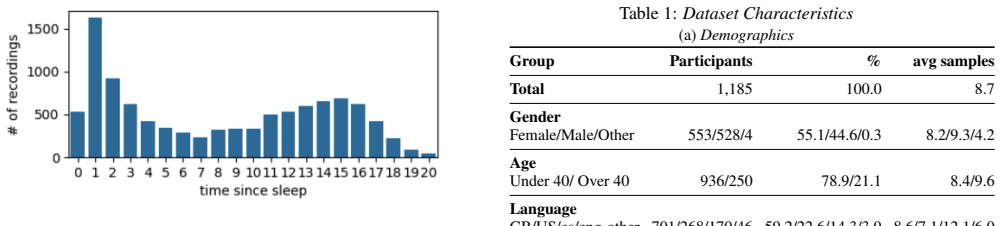
The load-bearing mechanism is the support set: a small collection of (speech embedding, fatigue label) pairs from the target speaker. The paper trains models to predict a new sample's fatigue from the current embedding plus this support set. For the transformer, sequences are formed as $[x_0, y_0, x_1, y_1, \ldots, x_t]$ with $y$ values augmented to match feature dimensionality by sampling from $\mathcal{N}(y, 0.1^2)$; a GPT2-style architecture (15 layers, 8 heads) performs next-token prediction with mean squared error loss at the target positions. This allows in-context adaptation without gradient updates or per-speaker retraining. Two simpler meta-learners accompany it: a distance model that learns fatigue differences from paired embeddings and averages predictions over the support set, and a prototypical network that projects embeddings into a metric space and compares to class prototypes.
What would settle it
Re-run the transformer and mixed-effects models under strictly chronological support sets (predicting each time point only from observations before it) for every speaker, and compare AUC and correlation. If the transformer's advantage over the mixed-effects baseline disappears or reverses under chronological evaluation, the paper's claim of superiority depends on the random-ordering evaluation rather than on genuine speaker adaptation.
Extended reading notes
Core claim
The paper's central discovery is that a transformer-based meta-learner can adapt to a new speaker's fatigue patterns from a few labelled recordings in-context, without retraining, and that this matches or beats conventional speaker-adaptive baselines. Across 25 evaluation iterations with random sequence orderings, all meta-learning approaches surpassed both a cross-sectional baseline (AUC 0.679, correlation 0.373) and a mixed-effects model (AUC 0.721, correlation 0.442). The transformer reached an AUC of 0.777 and a Pearson correlation of 0.546 with at least six prior observations per speaker, improving over cross-sectional modelling by 14% in AUC and 46% in correlation, and over mixed-effects modelling by 8% and 23% respectively. The paper also shows that randomising sequence ordering removes periodic pre/post-shift patterns, and it reports demographic disparities: performance is lower for female speakers, speakers under 40, and US English speakers across all methods.
Load-bearing premise
The central assumption is that training and evaluating with randomly shuffled recordings per speaker—so future observations can enter the support set—fairly represents a deployment scenario where only past calibration recordings are available.
Editorial extensions
If this is right
- With at least six labelled recordings per speaker, the transformer reaches an AUC of 0.777 and a Pearson correlation of 0.546, outperforming cross-sectional modelling by 14% in AUC and 46% in correlation, and mixed-effects modelling by 8% and 23% respectively.
- Meta-learning models require no per-speaker retraining; the transformer additionally provides cold-start predictions for speakers with no prior observations, making it more flexible in deployment.
- The transformer handles both classification and regression in a single model, whereas the prototypical network only supports classification and the distance model requires ensembling over all previous observations.
- Randomly ordering sequences eliminates periodic pre/post-shift patterns, so the reported performance gains reflect learning from speech content rather than temporal structure; the null model drops to chance accuracy (AUC about 0.50) under random ordering.
- Demographic disparities persist across all methods, with lower performance for female speakers, speakers under 40, and US English speakers; the prototype model shows the widest spread in AUC across demographic groups.
Reading between the lines
- The evaluation uses random sequence orderings, so a speaker's future recordings can appear in the support set when predicting an earlier time point; a strictly chronological deployment evaluation—using only past calibration recordings—might shrink the reported advantage over the chronological mixed-effects baseline.
- The same meta-learning framing could transfer to other symptom targets with slow temporal dynamics, such as depression severity or chronic pain, where personalised monitoring matters and per-person labelled data are scarce.
- The requirement of at least six prior recordings per speaker corresponds to about three days of twice-daily calibration; systems aiming for same-day personalisation would need to test whether smaller or differently sampled support sets still work.
- The transformer's cold-start ability suggests a possible deployment pattern: use it as an initial uncalibrated screener, then refine predictions as the first few user-reported fatigue labels arrive.
Editorial analysis
A structured set of objections, weighed in public.
Referee Report
Summary. The paper proposes meta-learning approaches (ensemble distance model, prototypical network, transformer sequence model) for speaker-dependent prediction of time since sleep (as a proxy for fatigue) from pre-trained speech embeddings, using a longitudinal dataset of 1,185 shift workers. The authors compare these methods against cross-sectional and mixed-effects baselines and report that all meta-learners outperform both baselines, with a transformer achieving AUC 0.777 and Pearson correlation 0.546 after at least six prior observations per speaker. The paper also reports a sensitivity analysis using a null model and a demographic fairness analysis.
Significance. If the central claim were established, this work would be practically valuable: it would show that personalized voice-based fatigue monitoring can be achieved with a small calibration period and without per-speaker retraining, which is important for real-world health monitoring. The paper has several strengths: it uses a large longitudinal dataset, reports standard deviations over 25 evaluation iterations, includes a null-model control experiment, and presents a careful demographic fairness analysis. However, the headline comparison is undermined by a temporal leakage problem in the evaluation protocol and by an apparent mismatch between the described mixed-effects baseline and its actual implementation. These issues are load-bearing for the main claim that meta-learning outperforms conventional mixed-effects models, so the current evidence does not support the conclusions as stated.
major comments (3)
- [Section 3.1 and Section 4.2] The random sequence ordering used for all meta-learning experiments allows future observations to appear in the support set: in Section 3.1, five random orderings per speaker are created, and Section 4.2 states that random ordering is used in all previous experiments. Under a random permutation, the support set S_i_t defined in Section 3.3 with j < t has no temporal meaning; it can contain recordings made after the test recording in real time. The mixed-effects baseline, by contrast, is evaluated chronologically (Section 3.2). This gives the meta-learners access to future labels that the baseline cannot use, inflating the reported advantages (8% AUC and 23% correlation in Section 4.1). The paper's statement that this methodological difference is 'acceptable' is not justified. The evaluation must be redone with chronological orderings for all methods, or with support sets restricted to actual past observations.
- [Section 3.2] The baseline is described as a 'mixed-effects approach' with random effects for participants, but the implementation described is a per-speaker ridge regression trained on that speaker's previous observations ('For each speaker i and time point t, we train a separate ridge regression model using all previous observations'). This is not a mixed-effects model: it does not estimate random effects or share information across speakers. Therefore, the abstract's and Section 4.1's claims of outperforming 'conventional mixed-effects models' are not supported by the experiments. The authors should either implement a proper linear mixed-effects model (e.g., with random intercepts and slopes) or rename the baseline and adjust the claims accordingly.
- [Section 4.2] The null-model control is used to justify random sequence ordering, but it conflates two separate issues. The null model's high AUC on periodic sequences shows that temporal periodicity could be exploited, but the correct response is to control for periodicity in a chronological evaluation (e.g., by adding time-of-day or sequence-position features) rather than to discard temporal order entirely. As written, the control demonstrates that random ordering removes exploitability of periodicity, but it does not demonstrate that random ordering is a valid proxy for the deployment scenario described in the Introduction, where an initial calibration period is followed by prediction on future recordings. This is a critical validity gap.
minor comments (5)
- [Section 3.1] The text says 'speaker stratified 70%/10%/20% train/validation/test splits' but then describes 25 total evaluation iterations as the product of 5 folds and 5 orderings; it would be clearer to explicitly state that the 5-fold splitting and the 5 random orderings are crossed, not nested.
- [Section 3.2] The mixed-effects baseline paragraph is internally inconsistent: it first says 'we implement a mixed-effects approach' and then describes fitting a separate ridge regression per speaker; these are different models and the text should be revised to avoid ambiguity.
- [Section 4.2] In Table 3, the entry 'Random.519 [.047]' is missing a space before the standard deviation, and the table formatting should be made consistent with the other rows.
- [Section 1] The phrase 'A transformer-based sequence model' begins with a capital 'A' while the other two method descriptions start with lowercase; the capitalization should be made consistent.
- [Section 5] The conclusion repeats '46% over cross-sectional, 23% over mixed-effects' without noting that these percentages depend on the flawed evaluation protocol; this should be revised once the evaluation is corrected.
Circularity Check
No derivation-level circularity; central claim is an empirical benchmark. Minor self-citations plus a non-circular evaluation-protocol confound.
full rationale
The paper's central claim (meta-learning, especially the transformer, outperforms cross-sectional and mixed-effects baselines) is an empirical result from a 5-fold speaker-stratified evaluation on held-out speakers, not a quantity derived from fitted parameters or from the cited prior work. The self-citations to [7] and [27] supply the dataset, the fatigue threshold, the mixed-effects evaluation convention, and the fairness metric; these are external empirical resources rather than conclusions imported into the derivation. No equation in the paper reduces a reported quantity to its own input: the support-set formulas (Eq. 1-4) use only previous sequence observations to predict held-out targets, and the reported AUC and correlation are computed on test data. The main methodological concern is the evaluation asymmetry flagged in Section 3.2: meta-learners use five random sequence orderings, so support sets may contain future real-time observations, while the mixed-effects baseline is evaluated chronologically, and the paper states 'we deem this methodological difference acceptable' without justification. This is a potential information-access confound and a correctness risk, but it is not circular: the learning procedure is not equivalent to its input by construction, and no parameter is renamed as a prediction. Under the circularity-only criteria, no circular step is present, so the score is low (2) rather than elevated.
Assumptions & free parameters
free parameters (6)
- Fatigue threshold =
S >= 10 hours
- Target augmentation noise std =
0.1
- Prototype projection dimension =
64
- Prototype hidden dimension =
32
- Distance model ridge alpha =
1000
- Transformer layers and heads =
15 layers, 8 heads
assumptions (5)
- domain assumption Time since sleep is a valid operationalization of fatigue
- domain assumption Trillsson-5 embeddings capture paralinguistic speaker state relevant to fatigue
- domain assumption Standardized reading passages isolate paralinguistic content
- ad hoc to paper Random sequence ordering is a valid proxy for chronological calibration-period evaluation
- domain assumption Mixed-effects retraining is computationally prohibitive in production
Cite this review
Pith. "Pith review of Meta-Learning Approaches for Speaker-Dependent Voice Fatigue Models." pith.science (2026). https://pith.science/paper/OEX34YA3
@misc{pith2026250523378,
  author       = {Pith},
  title        = {Pith review of: Meta-Learning Approaches for Speaker-Dependent Voice Fatigue Models},
  year         = {2026},
  howpublished = {\url{https://pith.science/paper/OEX34YA3}},
  note         = {Machine review of arXiv:2505.23378}
}
read the original abstract
Speaker-dependent modelling can substantially improve performance in speech-based health monitoring applications. While mixed-effect models are commonly used for such speaker adaptation, they require computationally expensive retraining for each new observation, making them impractical in a production environment. We reformulate this task as a meta-learning problem and explore three approaches of increasing complexity: ensemble-based distance models, prototypical networks, and transformer-based sequence models. Using pre-trained speech embeddings, we evaluate these methods on a large longitudinal dataset of shift workers (N=1,185, 10,286 recordings), predicting time since sleep from speech as a function of fatigue, a symptom commonly associated with ill-health. Our results demonstrate that all meta-learning approaches tested outperformed both cross-sectional and conventional mixed-effects models, with a transformer-based method achieving the strongest performance.
Figures


Reference graph
Works this paper leans on
-
[1]
Introduction Fatigue is a common symptom in many physical and mental health conditions and is especially widespread in occupational settings known for high rates of health problems, such as shift work [1, 2]. Monitoring fatigue through readily available de- vices such as smartphones could enable earlier intervention and better outcomes through more target...
-
[2]
Data and Preprocessing 2.1. Dataset Our analysis uses data from a large-scale longitudinal study of shift workers [7], comprising 1,185 participants monitored over a two-week period. Study procedures were reviewed by an inde- pendent research ethics expert (Dr. David Carpenter) working under the auspices of the Association of Research Managers and Adminis...
-
[3]
Methods Given a speech embeddingx i j ∈R d from speakeriat timej, our goal is to predict the associated fatigue levely i j. The target yi j can represent either time since sleep (regression) or a bi- nary fatigued/non-fatigued state (classification). Each speaker iprovides a sequence of ordered observations(x i j, yi j)with j= 0, ..., T. We aim to learn a...
-
[4]
Results 4.1. Model Performance We observed that, overall, prediction accuracy increases with the number of available observations per speaker (Figure 2). The cross-sectional baseline, having no speaker adaptation, maintains constant performance (AUC∼0.68, correlation∼ 0.37). The prototype model and mixed-effects approaches re- quire at least one or two pr...
-
[5]
Conclusions and Future Work In this work, we reformulate speaker-dependent fatigue mon- itoring as a meta-learning problem to eliminate the need for constant model retraining. We demonstrate that meta-learning approaches can effectively create personalized fatigue detec- tion models for individual users while maintaining practical feasibility for real-wor...
-
[6]
S. Vekkot, S. Teja Chavali, C. Tej Kandavalli, R. Sai Ab- hishek Podila, D. Gupta, M. Zakariah, and Y . Ajami Alotaibi, “Continuous speech-based fatigue detection and transition state prediction for air traffic controllers,”IEEE Access, vol. 13, pp. 3298–3319, 2025
work page 2025
-
[7]
Is fatigue a disease- specific or generic symptom in chronic medical conditions?
J. Menting, C. J. Tack, G. Bleijenberg, R. Donders, H. A. Droogleever Fortuyn, J. Fransen, M. M. Goedendorp, J. S. Kalk- man, R. Strik-Albers, N. van Alfenet al., “Is fatigue a disease- specific or generic symptom in chronic medical conditions?” Health Psychology, vol. 37, no. 6, pp. 530–543, 2018
work page 2018
-
[8]
Mental health consequences of shift work: an updated review,
J. P. Brown, D. Martin, Z. Nagaria, A. C. Verceles, S. L. Jobe, and E. M. Wickwire, “Mental health consequences of shift work: an updated review,”Current Psychiatry Reports, vol. 22, no. 2, pp. 1–7, 2020
work page 2020
Show all 34 references
-
[9]
Fatigue monitoring through wearables: A state-of-the-art review,
N. R. Ad ˜ao Martins, S. Annaheim, C. M. Spengler, and R. M. Rossi, “Fatigue monitoring through wearables: A state-of-the-art review,”Frontiers in Physiology, vol. 12, p. 790292, 2021
2021
-
[10]
Smartphone- based human fatigue level detection using machine learning ap- proaches,
S. Karvekar, M. Abdollahi, and E. Rashedi, “Smartphone- based human fatigue level detection using machine learning ap- proaches,”Ergonomics, vol. 64, no. 5, pp. 600–612, 2021
2021
-
[11]
Prediction of sleepi- ness ratings from voice by man and machine,
M. Huckvale, A. Beke, and M. Ikushima, “Prediction of sleepi- ness ratings from voice by man and machine,” inInterspeech 2020, 2020, pp. 4571–4575
2020
-
[12]
Meta-learning in healthcare: A survey,
A. Rafiei, R. Moore, S. Jahromi, F. Hajati, and R. Kamaleswaran, “Meta-learning in healthcare: A survey,”SN Computer Science, vol. 5, no. 6, p. 791, 2024
2024
-
[13]
Predicting different dimensions of fatigue from speech data: a longitudinal study in shift workers,
A. Norbury, A. L. Georgescu, E. Molimpakis, S. Goria, and N. Cummins, “Predicting different dimensions of fatigue from speech data: a longitudinal study in shift workers,” https://doi. org/10.1101/2024.06.17.24308769, 2024
2024 doi
-
[14]
Random-effects models for longitu- dinal data,
N. M. Laird and J. H. Ware, “Random-effects models for longitu- dinal data,”Biometrics, vol. 38, no. 4, pp. 963–974, 1982
1982
-
[15]
Federated learning in mobile edge networks: A comprehensive survey,
W. Y . B. Lim, N. C. Luong, D. T. Hoang, Y . Jiao, Y .-C. Liang, Q. Yang, D. Niyato, and C. Miao, “Federated learning in mobile edge networks: A comprehensive survey,”IEEE Communications Surveys & Tutorials, vol. 22, no. 3, pp. 2031–2063, 2020
2020
-
[16]
Meta- learning in neural networks: A survey,
T. Hospedales, A. Antoniou, P. Micaelli, and A. Storkey, “Meta- learning in neural networks: A survey,”IEEE transactions on pat- tern analysis and machine intelligence, vol. 44, no. 9, pp. 5149– 5169, 2021
2021
-
[17]
Learning to gen- eralize: Meta-learning for domain generalization,
D. Li, Y . Yang, Y .-Z. Song, and T. Hospedales, “Learning to gen- eralize: Meta-learning for domain generalization,” inProceedings of the AAAI conference on artificial intelligence, vol. 32, no. 1, 2018, pp. 3490–3497
2018
-
[18]
Fatigue and its management in the workplace,
J. A. Caldwell, J. L. Caldwell, L. A. Thompson, and H. R. Lieberman, “Fatigue and its management in the workplace,” Neuroscience & Biobehavioral Reviews, vol. 96, pp. 272– 289, 2019. [Online]. Available: https://www.sciencedirect.com/ science/article/pii/S0149763418305220
2019
-
[19]
Meta-health: learning-to-learn (meta- learning) as a next generation of deep learning exploring health- care challenges and solutions for rare disorders: a systematic anal- ysis,
K. Singh and D. Malhotra, “Meta-health: learning-to-learn (meta- learning) as a next generation of deep learning exploring health- care challenges and solutions for rare disorders: a systematic anal- ysis,”Archives of Computational Methods in Engineering, vol. 30, no. 7, pp. 4...
2023
-
[20]
Meta- learning for low-resource speech emotion recognition,
S. Chopra, P. Mathur, R. Sawhney, and R. R. Shah, “Meta- learning for low-resource speech emotion recognition,” inICASSP 2021-2021 IEEE International Conference on Acoustics, Speech and Signal Processing (ICASSP). IEEE, 2021, pp. 6259–6263
2021
-
[21]
Prototypical networks for few-shot learning,
J. Snell, K. Swersky, and R. Zemel, “Prototypical networks for few-shot learning,” inProceedings of the 31st International Con- ference on Neural Information Processing Systems. Long Beach, California, USA: Curran Associates Inc., 2017, p. 4080–4090
2017
-
[22]
Pretraining data mixtures enable narrow model selection capabilities in trans- former models,
S. Yadlowsky, L. Doshi, and N. Tripuraneni, “Pretraining data mixtures enable narrow model selection capabilities in trans- former models,” https://arxiv.org/abs/2311.00871, 2023
2023 arXiv
-
[23]
Linear mixed effects models,
A. L. Oberg and D. W. Mahoney, “Linear mixed effects models,” Methods in Molecular Biology, vol. 404, pp. 213–234, 2007
2007
-
[24]
Universal paralinguistic speech representations using self-supervised con- formers,
J. Shor, A. Jansen, W. Han, D. Park, and Y . Zhang, “Universal paralinguistic speech representations using self-supervised con- formers,” inICASSP 2022 - 2022 IEEE International Conference on Acoustics, Speech and Signal Processing (ICASSP), 2022, pp. 3169–3173
2022
-
[25]
Cambridge, UK: Cambridge Univer- sity Press, 1999
International Phonetic Association,Handbook of the Interna- tional Phonetic Association: A guide to the use of the Interna- tional Phonetic Alphabet. Cambridge, UK: Cambridge Univer- sity Press, 1999
1999
-
[26]
The north wind versus a wolf: Short texts for the description and measurement of english pronunciation,
D. Deterding, “The north wind versus a wolf: Short texts for the description and measurement of english pronunciation,”Journal of the International Phonetic Association, vol. 36, pp. 187 – 196, 12 2006
2006
-
[27]
Fairbanks,Voice and Articulation Drillbook
G. Fairbanks,Voice and Articulation Drillbook. Harper,
-
[29]
Analysis of phonetic balance in standard english passages,
A. C. Lammert, J. Melot, D. E. Sturim, D. J. Hannon, R. DeLaura, J. R. Williamson, G. Ciccarelli, and T. F. Quatieri, “Analysis of phonetic balance in standard english passages,”Journal of Speech, Language, and Hearing Research, vol. 63, no. 4, pp. 917–930, 2020. [Online]. Ava...
2020 doi
-
[30]
Trillsson: Distilled universal par- alinguistic speech representations,
J. Shor and S. Venugopalan, “Trillsson: Distilled universal par- alinguistic speech representations,” inInterspeech 2022. In- cheon, Korea: ISCA, 2022, pp. 356–360
2022
-
[32]
Ridge regression: Biased estima- tion for nonorthogonal problems,
A. E. Hoerl and R. W. Kennard, “Ridge regression: Biased estima- tion for nonorthogonal problems,”Technometrics, vol. 12, no. 1, pp. 55–67, 1970
1970
-
[33]
Language models are few-shot learners,
T. Brown, B. Mann, N. Ryder, M. Subbiah, J. D. Kaplan, P. Dhariwal, A. Neelakantan, P. Shyam, G. Sastry, A. Askell, S. Agarwal, A. Herbert-V oss, G. Krueger, T. Henighan, R. Child, A. Ramesh, D. Ziegler, J. Wu, C. Winter, C. Hesse, M. Chen, E. Sigler, M. Litwin, S. Gray, B. Ch...
2020
-
[34]
Revealing con- founding biases: A novel benchmarking approach for aggregate- level performance metrics in health assessments,
S. Goria, R. Polle, S. Fara, and N. Cummins, “Revealing con- founding biases: A novel benchmarking approach for aggregate- level performance metrics in health assessments,” inInterspeech 2024, 2024, pp. 1440–1444
2024
-
[1960]
Available: https://books.google.co.uk/books?id= qN1ZAAAAMAAJ
[Online]. Available: https://books.google.co.uk/books?id= qN1ZAAAAMAAJ
-
[2023]
Access to the dataset can be obtained through reasonable requests to the senior author
All participants gave written informed consent. Access to the dataset can be obtained through reasonable requests to the senior author. During the study, participants completed speech recordings and self-report assessments twice daily on their personal de- vices, coinciding wi...
2025 arXiv
Reviewed August 7, 2026 · model on record in the stance chip above.
Discussion (0). Sign in to comment.