Error Probability Analysis of Quantum Communication with Phase-squeezed M-PSK
Pith reviewed 2026-06-27 05:41 UTC · model grok-4.3
The pith
Phase squeezing reduces symbol error probability in M-PSK and nearly doubles photon efficiency.
A machine-rendered reading of the paper's core claim, the machinery that carries it, and where it could break.
Core claim
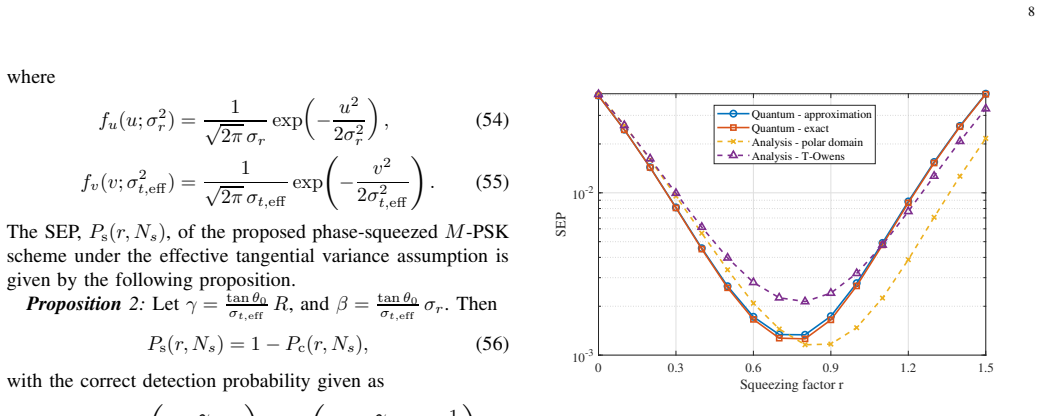
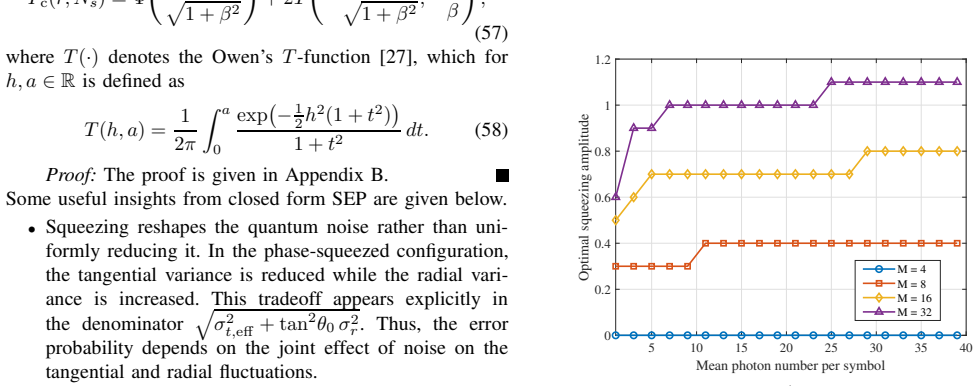
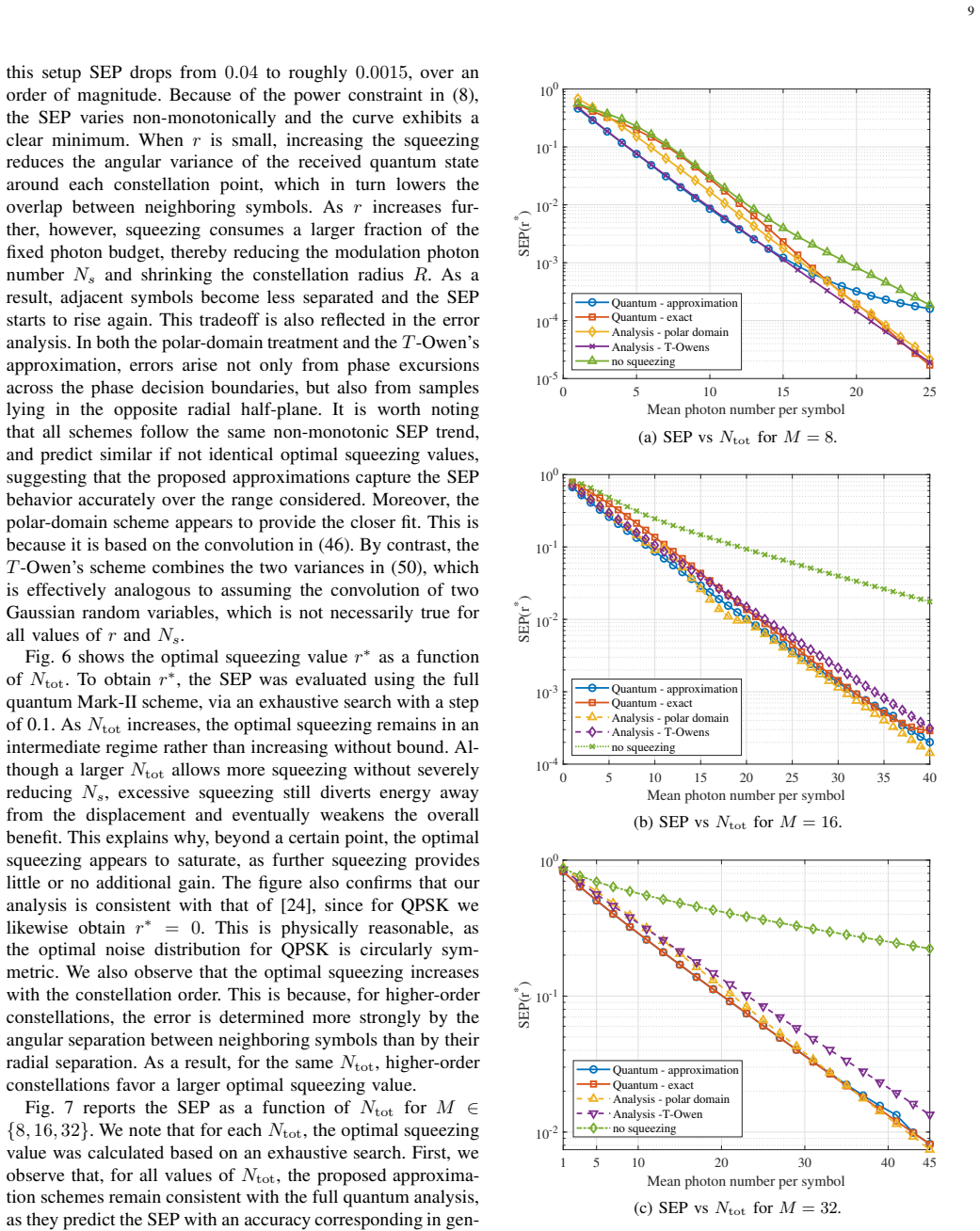
The paper establishes that phase-squeezed M-PSK yields substantially lower symbol error probability than coherent-state M-PSK when detected via the adaptive Mark-II receiver, that the improvement increases with constellation order M, and that squeezing can almost double photon efficiency with rising mean photon number. The analysis proceeds from the phase POM of the Mark-II scheme, develops a phase-density convolution method, and supplies the tangential-variance approximation for tractable computation.
What carries the argument
The adaptive Mark-II receiver's phase probability operator measure (POM) together with the effective tangential-variance model that converts the squeezed-state phase statistics into a closed-form SEP expression via Owen's T-function.
If this is right
- Phase squeezing substantially reduces SEP of M-PSK relative to coherent-state transmission.
- The reduction grows with constellation order.
- Squeezing nearly doubles photon efficiency of M-PSK as mean transmitted photon number increases.
- The tangential-variance and convolution approximations match the exact POM calculation within 2-4 photons.
Where Pith is reading between the lines
- The same receiver model could be applied to analyze squeezing benefits in other phase-sensitive quantum modulation formats.
- System designers might use the closed-form SEP expression to optimize constellation size jointly with squeezing level.
- Laboratory tests with real squeezed-light sources would directly test whether the predicted efficiency gain appears at practical photon numbers.
Load-bearing premise
The adaptive Mark-II receiver supplies the physically relevant phase observable and the tangential-variance model stays accurate over the photon-number range where the efficiency doubling is reported.
What would settle it
An experiment that measures symbol error probability for phase-squeezed 8-PSK or 16-PSK at increasing mean photon numbers and checks whether the observed photon efficiency approaches twice the coherent-state value.
Figures
read the original abstract
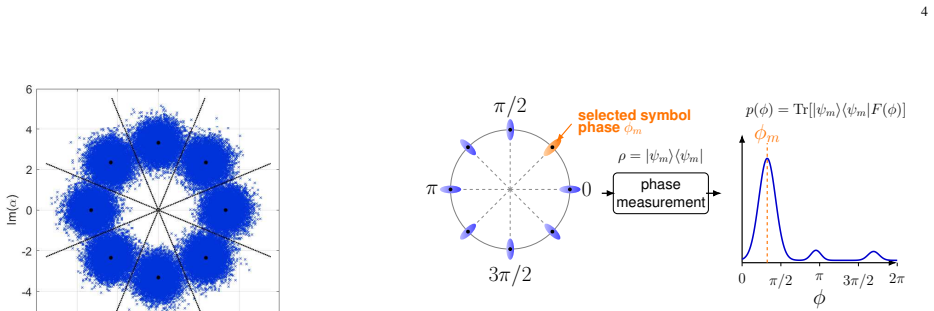
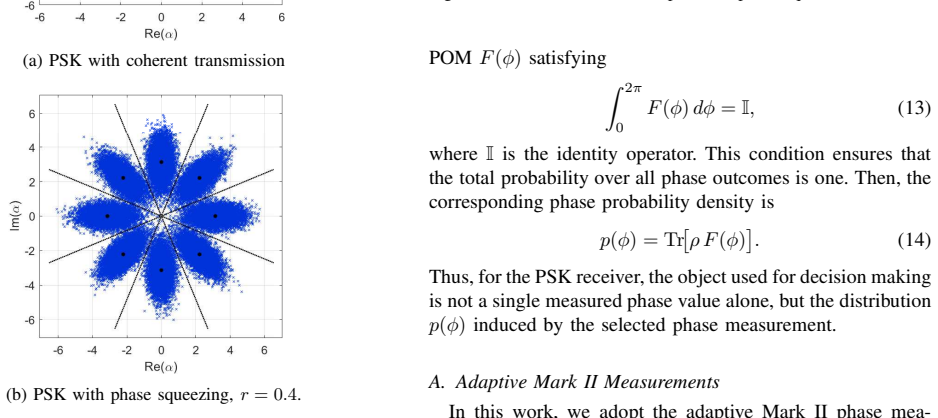
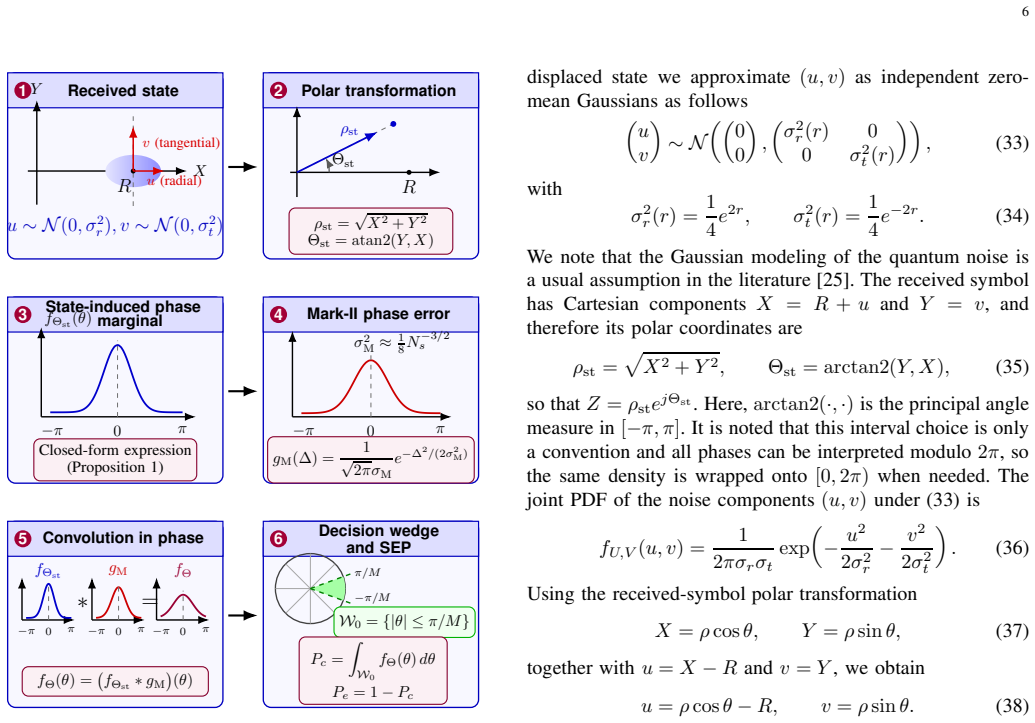
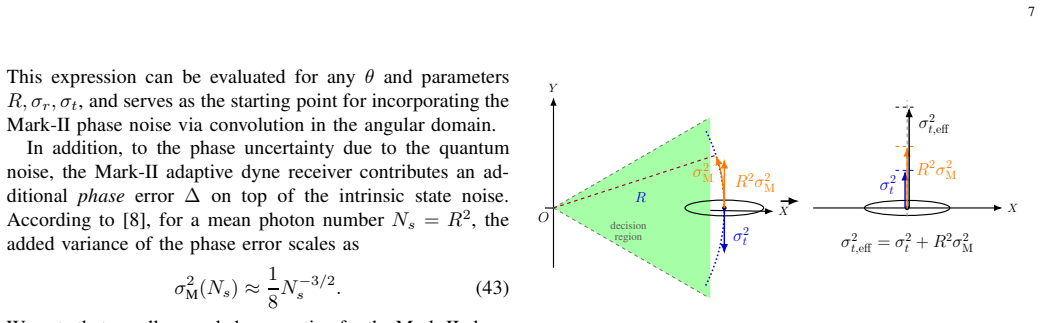
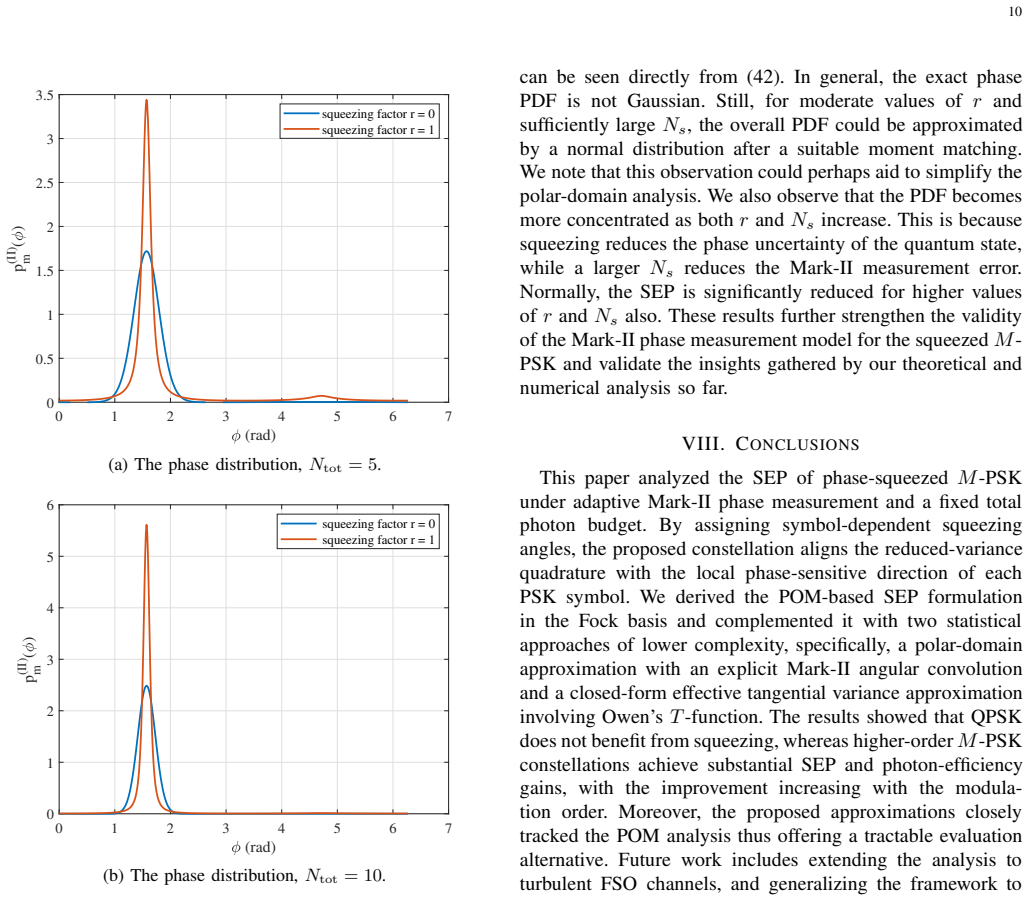
In this paper, we investigate the symbol error probability (SEP) of phase-squeezed M-ary phase-shift keying (M-PSK). Since the relevant observable for M-PSK detection is the optical phase, we adopt the adaptive Mark-II receiver which is a physically realizable phase measurement. First, we develop a theoretical analysis based on the phase probability operator measure (POM) of the Mark-II scheme in the Fock basis. Then, we develop two SEP methods based on the statistics of the received PSK symbol and the error introduced by the Mark-II measurement. The first method derives the phase probability density induced by the squeezed state noise and incorporates the additional Mark-II phase uncertainty through an angular convolution. Since this convolution does not admit a simple closed form, we also introduce an effective tangential-variance model, which yields a closed form SEP expression in terms of the Owen's T-function. Numerical results show that phase squeezing substantially reduces the SEP of M-PSK compared to coherent state transmission, with greater gains for higher constellation orders. Notably, for the investigated scenario, squeezing can almost double the photon efficiency of M-PSK as the mean number of transmitted photons increases. Finally, the proposed approximations closely follow the Mark-II POM analysis, typically within an accuracy of 2-4 photons, and therefore provide accurate and computationally efficient tools for analyzing phase squeezed quantum M-PSK communication.
Editorial analysis
A structured set of objections, weighed in public.
Referee Report
Summary. The paper analyzes the symbol error probability (SEP) of phase-squeezed M-PSK using the adaptive Mark-II receiver as the phase observable. It develops a Fock-basis phase POM analysis, followed by two approximation methods: an angular convolution of the phase PDF induced by squeezed-state noise with Mark-II uncertainty, and an effective tangential-variance model that produces a closed-form SEP via Owen's T-function. Numerical results claim that squeezing substantially lowers SEP relative to coherent states (with larger gains at higher M) and can nearly double photon efficiency as mean photon number grows; the approximations track the exact POM within 2-4 photons.
Significance. If the reported accuracy of the tangential-variance model holds across the relevant photon-number range, the closed-form expression supplies a practical tool for squeezed-state M-PSK analysis and quantifies a potentially significant photon-efficiency gain. The explicit comparison to the Mark-II POM and the provision of both convolution and closed-form routes are positive features.
minor comments (2)
- [Abstract] Abstract: the statement that the approximations 'closely follow the Mark-II POM analysis, typically within an accuracy of 2-4 photons' should specify whether the error is measured in mean photon number, in SEP, or in the derived efficiency metric, and whether the bound remains uniform as mean photon number and M increase.
- The definition and normalization of the 'effective tangential variance' used to obtain the Owen's T-function expression should be stated explicitly so that readers can verify it does not introduce hidden fitting parameters.
Simulated Author's Rebuttal
We thank the referee for the positive summary, significance assessment, and recommendation of minor revision. No specific major comments were provided in the report.
Circularity Check
No significant circularity; approximation explicitly validated against exact POM
full rationale
The derivation begins with the phase POM of the adaptive Mark-II receiver in the Fock basis, then forms two SEP expressions: one via angular convolution of the squeezed-state phase PDF with Mark-II uncertainty, and a second via an explicitly introduced effective tangential-variance model that yields a closed-form expression in Owen's T-function. The paper states that the model tracks the exact POM within 2-4 photons and presents the efficiency-doubling claim as a numerical outcome of this approximation. No quoted step reduces a prediction to its inputs by construction, no parameter is fitted and then relabeled as a prediction, and no self-citation chain is load-bearing. The central results therefore remain independent of the inputs they are derived from.
Axiom & Free-Parameter Ledger
Reference graph
Works this paper leans on
-
[1]
The Quantum Theory of Optical Communicat ions,
J. H. Shapiro, “The Quantum Theory of Optical Communicat ions,” IEEE Journal of Selected Topics in Quantum Electronics , vol. 15, no. 6, pp. 1547–1569, 2009
2009
-
[2]
Progress in sa tellite quantum key distribution,
R. Bedington, J. M. Arrazola, and A. Ling, “Progress in sa tellite quantum key distribution,” npj Quantum Inf. , vol. 3, no. 1, p. 30, 2017
2017
-
[3]
Quantum Information Pr ocess- ing, Sensing, and Communications: Their Myths, Realities, and Futures,
L. Hanzo, Z. Babar, Z. Cai, D. Chandra, I. B. Djordjevic, B . Koczor, S. Xin Ng, M. Razavi, and O. Simeone, “Quantum Information Pr ocess- ing, Sensing, and Communications: Their Myths, Realities, and Futures,” Proceedings of the IEEE , vol. 113, no. 9, pp. 1024–1074, 2025
2025
-
[4]
Atmospheric Qu antum Channels with Weak and Strong Turbulence,
D. V asylyev, A. A. Semenov, and W. V ogel, “Atmospheric Qu antum Channels with Weak and Strong Turbulence,” Phys. Rev. Lett. , vol. 117, p. 090501, Aug 2016
2016
-
[5]
Non-Orthogonality Measure for a Collection of Pure Quantum States,
K. Kato, “Non-Orthogonality Measure for a Collection of Pure Quantum States,” Entropy, vol. 24, no. 5, 2022. [Online]. Available: https://www.mdpi.com/1099-4300/24/5/581
2022
-
[6]
Non-Orthogonality of QAM and Sunflower-like Modula ted Coherent-State Signals,
——, “Non-Orthogonality of QAM and Sunflower-like Modula ted Coherent-State Signals,” Entropy, vol. 27, no. 1, 2025. [Online]. Available: https://www.mdpi.com/1099-4300/27/1/30
2025
-
[7]
Gaussian quantum information,
C. Weedbrook, S. Pirandola, R. Garc´ ıa-Patr´ on, N. J. Ce rf, T. C. Ralph, J. H. Shapiro, and S. Lloyd, “Gaussian quantum information, ” Rev. Mod. Phys., vol. 84, pp. 621–669, May 2012
2012
-
[8]
Adaptive single-shot pha se measure- ments: The full quantum theory,
H. M. Wiseman and R. B. Killip, “Adaptive single-shot pha se measure- ments: The full quantum theory,” Phys. Rev. A , vol. 57, pp. 2169–2185, Mar 1998
1998
-
[9]
Optimum testing of multi ple hypotheses in quantum detection theory,
H. Y uen, R. Kennedy, and M. Lax, “Optimum testing of multi ple hypotheses in quantum detection theory,” IEEE Transactions on Infor- mation Theory , vol. 21, no. 2, pp. 125–134, 1975
1975
-
[10]
C. W. Helstrom, Quantum Detection and Estimation Theory . New Y ork, NY , USA: Academic Press, 1976
1976
-
[11]
A near-optimum receiver for the binary c oherent state quantum channel,
R. S. Kennedy, “A near-optimum receiver for the binary c oherent state quantum channel,” Research Laboratory of Electronics, MIT, Quarterly Progress Report, vol. 108, pp. 219–225, 1973
1973
-
[12]
An Optimum Receiver for the Binary Coher ent State Quantum Channel,
S. J. Dolinar, “An Optimum Receiver for the Binary Coher ent State Quantum Channel,” no. 111, pp. 115–120, 1973
1973
-
[13]
Quantum det ection and mutual information for QAM and PSK signals,
K. Kato, M. Osaki, M. Sasaki, and O. Hirota, “Quantum det ection and mutual information for QAM and PSK signals,” IEEE Trans. Commun. , vol. 47, no. 2, pp. 248–254, 1999
1999
-
[14]
Discrimination of the binary coherent signal: Gaussian-operation limit and simple non-Gaussian near-optimal receivers,
M. Takeoka and M. Sasaki, “Discrimination of the binary coherent signal: Gaussian-operation limit and simple non-Gaussian near-optimal receivers,” Phys. Rev. A , vol. 78, p. 022320, Aug 2008
2008
-
[15]
Quantum Receiver beyond the Standard Quantum Li mit of Coherent Optical Communication,
K. Tsujino, D. Fukuda, G. Fujii, S. Inoue, M. Fujiwara, M . Takeoka, and M. Sasaki, “Quantum Receiver beyond the Standard Quantum Li mit of Coherent Optical Communication,” Phys. Rev. Lett., vol. 106, p. 250503, Jun 2011
2011
-
[16]
Experimental Demonstration of a Receiver Beating the Standard Quantum Limit for Multiple Nonorthogo nal State Discrimination,
F. E. Becerra, J. Fan, G. Baumgartner, S. V . Polyakov, J. Goldhar, J. T. Kosloski, and A. Migdall, “Experimental Demonstration of a Receiver Beating the Standard Quantum Limit for Multiple Nonorthogo nal State Discrimination,” Nature Photonics, vol. 7, no. 2, pp. 147–152, 2013
2013
-
[17]
Photon number resol ution enables quantum receiver for realistic coherent optical communica tions,
F. Becerra, J. Fan, and A. Migdall, “Photon number resol ution enables quantum receiver for realistic coherent optical communica tions,” Nature Photonics, vol. 9, no. 1, pp. 48–53, 2015
2015
-
[18]
Quantum information with contin- uous variables,
S. L. Braunstein and P . van Loock, “Quantum information with contin- uous variables,” Rev. Mod. Phys. , vol. 77, pp. 513–577, Jun 2005
2005
-
[19]
Two-photon coherent states of the radiatio n field,
H. P . Y uen, “Two-photon coherent states of the radiatio n field,” Phys. Rev. A, vol. 13, pp. 2226–2243, Jun 1976
1976
-
[20]
Quantum-mechanical noise in an interfero meter,
C. M. Caves, “Quantum-mechanical noise in an interfero meter,” Phys. Rev. D, vol. 23, pp. 1693–1708, Apr 1981
1981
-
[21]
Observation of Squeezed States Generated by Four-Wave Mix ing in an Optical Cavity,
R. E. Slusher, L. W. Hollberg, B. Y urke, J. C. Mertz, and J . F. V alley, “Observation of Squeezed States Generated by Four-Wave Mix ing in an Optical Cavity,” Phys. Rev. Lett. , vol. 55, pp. 2409–2412, Nov 1985
1985
-
[22]
Squeezing-en hanced phase- shift-keyed binary communication in noisy channels,
G. Chesi, S. Olivares, and M. G. A. Paris, “Squeezing-en hanced phase- shift-keyed binary communication in noisy channels,” Phys. Rev. A , vol. 97, p. 032315, Mar 2018
2018
-
[23]
Quantum Quadrature Am plitude Modulation with Photon-Added Gaussian States,
A. Giani, M. Z. Win, and A. Conti, “Quantum Quadrature Am plitude Modulation with Photon-Added Gaussian States,” in Proc. IEEE Global Commun. Conf. (GLOBECOM) , 2023, pp. 5469–5474
2023
-
[24]
Optimized Squeezing O peration for Phase-Shift Keying Quantum State Discrimination,
R. Bhadani and I. B. Djordjevic, “Optimized Squeezing O peration for Phase-Shift Keying Quantum State Discrimination,” IEEE Access , vol. 10, pp. 63 383–63 393, 2022
2022
-
[25]
Quantum Rotation Diversity in Displaced Squeezed Binary Phase-Shift Keying,
I. Krikidis, “Quantum Rotation Diversity in Displaced Squeezed Binary Phase-Shift Keying,” IEEE Trans. Quantum Eng. , vol. 7, pp. 1–7, 2026
2026
-
[26]
Experimental direct quantum communication with squeezed states,
I. Paparelle, F. Mousavi, F. Scazza, A. Bassi, M. Paris, and A. Zavatta, “Experimental direct quantum communication with squeezed states,” Opt. Express , vol. 33, no. 14, pp. 28 917–28 934, Jul 2025
2025
-
[27]
Tables for computing bivariate normal prob abilities,
D. B. Owen, “Tables for computing bivariate normal prob abilities,” Ann. Math. Stat. , vol. 27, no. 4, pp. 1075–1090, 1956
1956
-
[28]
Constellation Design and Detection under Generalized Hardware Impairments,
T. K. Oikonomou, D. Tyrovolas, S. A. Tegos, P . D. Diamant oulakis, P . Sarigiannidis, and G. K. Karagiannidis, “Constellation Design and Detection under Generalized Hardware Impairments,” arXiv preprint arXiv:2511.09234, 2025
arXiv 2025
-
[29]
A table of normal integrals,
D. B. Owen, “A table of normal integrals,” Commun. Stat. Simul. Comput., vol. 9, no. 4, pp. 389–419, 1980
1980
-
[30]
The bivariate normal integral via owen’s T function as a modified euler’s arctangent series,
J. Komelj, “The bivariate normal integral via owen’s T function as a modified euler’s arctangent series,” Amer . J. Comput. Math. , vol. 13, no. 4, pp. 476–504, 2023
2023
-
[31]
I. S. Gradshteyn and I. M. Ryzhik, Table of Integrals, Series, and Products, 8th ed., D. Zwillinger and V . Moll, Eds. Amsterdam, The Netherlands: Elsevier/Academic Press, 2015
2015
discussion (0)
Sign in with ORCID, Apple, or X to comment. Anyone can read and Pith papers without signing in.