Iterative quantum phase estimation with cQED encoding
Pith reviewed 2026-06-26 11:51 UTC · model grok-4.3
The pith
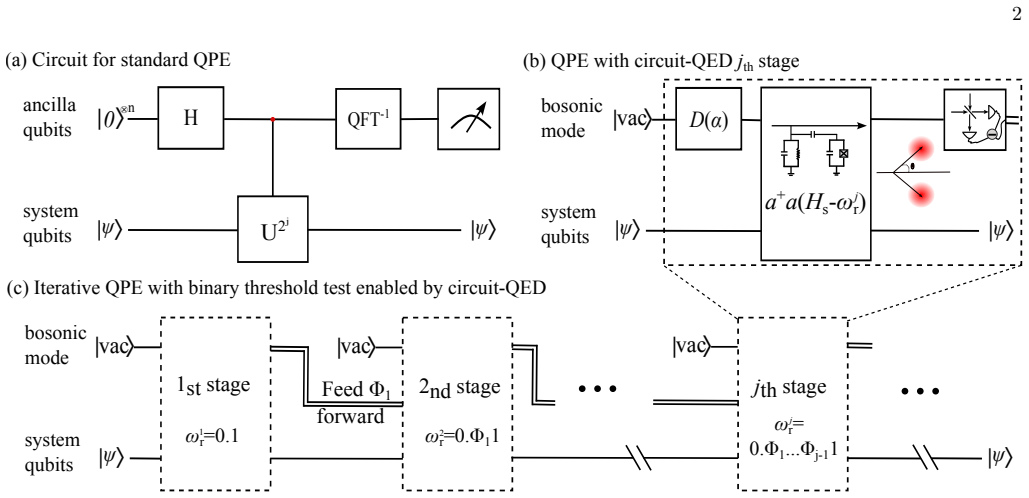
A bosonic mode encodes the binary digits of an unknown phase as directions of phase-space rotations that are read out sequentially by homodyne measurements.
A machine-rendered reading of the paper's core claim, the machinery that carries it, and where it could break.
Core claim
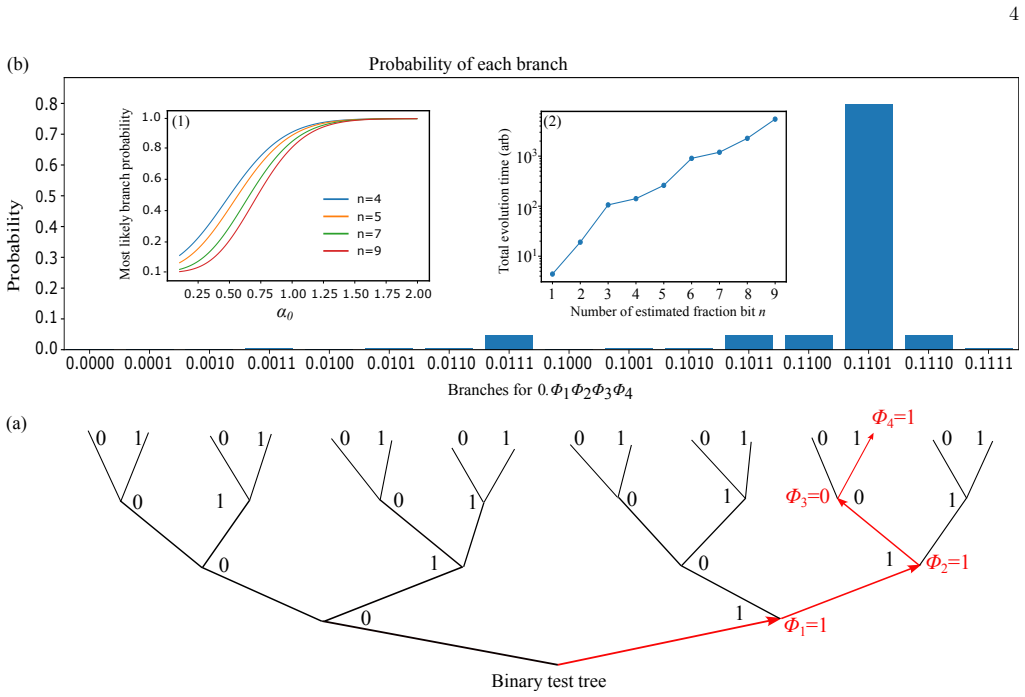
A bosonic mode serves as an efficient quantum memory in which the binary digits of the phase are encoded into the direction of phase-space rotations that can be read out sequentially via high-fidelity homodyne measurements. The protocol achieves Heisenberg scaling in estimation precision while simultaneously providing exponentially suppressed failure probability.
What carries the argument
Bosonic mode used as quantum memory that encodes each binary phase digit as the sense of a phase-space rotation, extracted by sequential homodyne threshold tests.
If this is right
- Estimation precision reaches the Heisenberg limit rather than the standard quantum limit.
- Probability of an incorrect phase estimate decreases exponentially with the number of extracted bits.
- No inverse quantum Fourier transform is needed, shortening the required circuit depth.
- Hardware overhead is reduced by substituting a bosonic mode for a register of ancillary qubits.
Where Pith is reading between the lines
- The sequential readout may relax the coherence-time requirements compared with fully coherent multi-qubit implementations.
- Similar phase-space encodings could be tested for other quantum algorithms that extract eigenvalues or phases.
- Noise models specific to superconducting cavities could be used to quantify how the exponential error suppression behaves under realistic loss.
Load-bearing premise
The bosonic mode must hold the encoded phase information with high fidelity across the full sequence of controlled rotations and homodyne readouts.
What would settle it
A laboratory run in which the achieved precision does not improve linearly with the number of iterations or in which the observed failure rate fails to drop exponentially as more bits are extracted.
Figures
read the original abstract
Quantum phase estimation is a cornerstone algorithm for determining eigenvalues of unitary operators or Hamiltonians with Heisenberg-limited precision. Conventional implementations rely on deep controlled-unitary operations together with an inverse quantum Fourier transform, resulting in substantial circuit depth and hardware overhead. Here, we propose a conceptually simple and experimentally feasible alternative that exploits the toolbox of circuit quantum electrodynamics. The protocol extracts the phase through a sequence of binary threshold tests, eliminating the need for an inverse quantum Fourier transform. A bosonic mode serves as an efficient quantum memory in which the binary digits of the phase are encoded into the direction of phase-space rotations. These digits are then read out sequentially via high-fidelity homodyne measurements. We show that the protocol achieves Heisenberg scaling in estimation precision while simultaneously providing exponentially suppressed failure probability. By replacing the ancillary circuit with a bosonic degree of freedom, the scheme significantly reduces hardware complexity and offers a practical route toward implementing high-precision quantum phase estimation on circuit quantum electrodynamics platforms.
Editorial analysis
A structured set of objections, weighed in public.
Referee Report
Summary. The manuscript proposes an iterative quantum phase estimation protocol tailored to circuit quantum electrodynamics (cQED). It encodes the binary digits of an unknown phase into the direction of phase-space rotations of a bosonic mode, which serves as a quantum memory, and reads these digits sequentially via high-fidelity homodyne measurements. The protocol dispenses with the inverse quantum Fourier transform and controlled-unitary ladders of conventional QPE, claiming to achieve Heisenberg-limited estimation precision together with exponentially suppressed failure probability while lowering hardware overhead.
Significance. If the central claims hold under realistic cQED noise models, the work would supply a concrete, experimentally accessible route to Heisenberg scaling in phase estimation that exploits the native bosonic degree of freedom rather than additional qubits. This could materially reduce circuit depth and ancillary resources on superconducting platforms, addressing a key bottleneck in near-term quantum algorithms that rely on eigenvalue estimation.
major comments (2)
- [Abstract, §1] Abstract and §1: the assertion of Heisenberg scaling together with exponentially suppressed failure probability is stated without an accompanying derivation, error budget, or explicit bound on the failure probability. The central claim therefore rests on an unshown analysis; a concrete derivation (or reference to a supplementary section containing it) is required to substantiate the scaling statements.
- [Abstract] The bosonic-mode encoding premise (binary digits mapped to phase-space rotation directions read by homodyne) is presented as enabling both the scaling and the error suppression, yet no quantitative model of readout fidelity, decoherence during storage, or propagation of phase errors through the iterative sequence is supplied. This assumption is load-bearing for the claimed exponential failure suppression.
Simulated Author's Rebuttal
We thank the referee for their careful reading and constructive comments on our manuscript. We address each major comment below with references to the relevant sections of the paper.
read point-by-point responses
-
Referee: [Abstract, §1] Abstract and §1: the assertion of Heisenberg scaling together with exponentially suppressed failure probability is stated without an accompanying derivation, error budget, or explicit bound on the failure probability. The central claim therefore rests on an unshown analysis; a concrete derivation (or reference to a supplementary section containing it) is required to substantiate the scaling statements.
Authors: The derivations of Heisenberg-limited scaling and the explicit bound on failure probability (exponentially suppressed as O(2^{-k}) for k binary digits) are given in Section III, including the full error budget and threshold analysis. We will add forward references to Section III in both the abstract and §1 to make this explicit. revision: yes
-
Referee: [Abstract] The bosonic-mode encoding premise (binary digits mapped to phase-space rotation directions read by homodyne) is presented as enabling both the scaling and the error suppression, yet no quantitative model of readout fidelity, decoherence during storage, or propagation of phase errors through the iterative sequence is supplied. This assumption is load-bearing for the claimed exponential failure suppression.
Authors: A quantitative model of homodyne readout fidelity, bosonic decoherence during storage, and phase-error propagation through the iterative sequence appears in Section IV, where we derive the per-step error rates under realistic cQED parameters and show that the exponential suppression holds provided individual measurement errors remain below a fixed threshold. We will add a brief pointer to this analysis in the abstract. revision: partial
Circularity Check
No significant circularity
full rationale
The abstract and available description present a protocol for iterative quantum phase estimation via bosonic encoding of phase digits into phase-space rotations, read out by homodyne measurements. No equations, derivations, or self-citations are supplied that reduce the Heisenberg scaling claim or failure-probability bound to a fitted parameter, self-defined quantity, or load-bearing self-citation chain. The central performance claims rest on the stated bosonic-memory construction and sequential readout, which are independent of the target results and not shown to be equivalent to inputs by construction. This is the common case of a self-contained proposal without detectable circularity in the given text.
Axiom & Free-Parameter Ledger
axioms (1)
- domain assumption Standard assumptions of quantum mechanics and circuit QED toolbox, including controllable phase-space rotations and high-fidelity homodyne measurements on bosonic modes.
Reference graph
Works this paper leans on
-
[1]
The result is positive with the probability Pr(Pj >0) = 1 2(1+Erf( ¯Pj)) where ¯Pj = √ 2Im(α(tj)). Obviously, the discrimination error is minimized when the coherent state undergoes a phase-space rotation ofπ/2, which maximizes the sepa- ration of the two hypotheses along the measured quadra- ture. In the numerical calculation, we assume the evolu- tion t...
-
[2]
P. W. Shor, Algorithms for quantum computation: dis- crete logarithms and factoring, inProceedings 35th an- nual symposium on foundations of computer science (Ieee, 1994) pp. 124–134
1994
-
[3]
J. Eisert and J. Preskill, Mind the gaps: The fraught road to quantum advantage, arXiv preprint arXiv:2510.19928 (2025)
Pith/arXiv arXiv 2025
-
[4]
Monroe and J
C. Monroe and J. Kim, Scaling the ion trap quantum processor, Science339, 1164 (2013)
2013
-
[5]
Bluvstein, A
D. Bluvstein, A. A. Geim, S. H. Li, S. J. Evered, J. P. Bonilla Ataides, G. Baranes, A. Gu, T. Manovitz, M. Xu, M. Kalinowski,et al., A fault-tolerant neutral-atom ar- chitecture for universal quantum computation, Nature 649, 39 (2026)
2026
-
[6]
Aspuru-Guzik, A
A. Aspuru-Guzik, A. D. Dutoi, P. J. Love, and M. Head- Gordon, Simulated quantum computation of molecular energies, Science309, 1704 (2005)
2005
-
[7]
Babbush, C
R. Babbush, C. Gidney, D. W. Berry, N. Wiebe, J. Mc- Clean, A. Paler, A. Fowler, and H. Neven, Encoding elec- tronic spectra in quantum circuits with linear t complex- ity, Phys. Rev. X8, 041015 (2018)
2018
-
[8]
A. W. Harrow, A. Hassidim, and S. Lloyd, Quantum al- gorithm for linear systems of equations, Phys. Rev. Lett. 103, 150502 (2009)
2009
-
[9]
Roushan, C
P. Roushan, C. Neill, J. Tangpanitanon, V. M. Bastidas, A. Megrant, R. Barends, Y. Chen, Z. Chen, B. Chiaro, A. Dunsworth,et al., Spectroscopic signatures of localiza- tion with interacting photons in superconducting qubits, Science358, 1175 (2017)
2017
-
[10]
Biamonte, P
J. Biamonte, P. Wittek, N. Pancotti, P. Rebentrost, N. Wiebe, and S. Lloyd, Quantum machine learning, Na- ture549, 195 (2017)
2017
-
[11]
Watrous,The theory of quantum information(Cam- bridge university press, 2018)
J. Watrous,The theory of quantum information(Cam- bridge university press, 2018)
2018
-
[12]
Hayashi, S
M. Hayashi, S. Ishizaka, A. Kawachi, G. Kimura, and T. Ogawa,Introduction to quantum information science (Springer, 2014)
2014
-
[13]
D. W. Berry, A. M. Childs, and R. Kothari, 2015 ieee 56th annual symposium on foundations of computer science (2015)
2015
-
[14]
G. H. Low and I. L. Chuang, Hamiltonian simulation by qubitization, Quantum3, 163 (2019)
2019
-
[15]
Wiebe and C
N. Wiebe and C. Granade, Efficient bayesian phase esti- mation, Phys. Rev. Lett.117, 010503 (2016)
2016
-
[16]
A. E. Russo, K. M. Rudinger, B. C. A. Morrison, and A. D. Baczewski, Evaluating energy differences on a quantum computer with robust phase estimation, Phys. Rev. Lett.126, 210501 (2021)
2021
-
[17]
Y. Gu, Y. Ma, N. Forcellini, and D. E. Liu, Noise-resilient phase estimation with randomized compiling, Phys. Rev. Lett.130, 250601 (2023)
2023
-
[18]
A. Y. Kitaev, Quantum measurements and the abelian stabilizer problem, arXiv preprint quant-ph/9511026 (1995)
Pith/arXiv arXiv 1995
-
[19]
Blais, A
A. Blais, A. L. Grimsmo, S. M. Girvin, and A. Wallraff, Circuit quantum electrodynamics, Rev. Mod. Phys.93, 025005 (2021)
2021
-
[20]
F. m. c. Swiadek, R. Shillito, P. Magnard, A. Remm, C. Hellings, N. Lacroix, Q. Ficheux, D. C. Zanuz, G. J. Norris, A. Blais, S. Krinner, and A. Wallraff, Enhanc- ing dispersive readout of superconducting qubits through dynamic control of the dispersive shift: Experiment and theory, PRX Quantum5, 040326 (2024)
2024
-
[21]
Hatridge, S
M. Hatridge, S. Shankar, M. Mirrahimi, F. Schackert, K. Geerlings, T. Brecht, K. Sliwa, B. Abdo, L. Frunzio, S. M. Girvin,et al., Quantum back-action of an indi- vidual variable-strength measurement, Science339, 178 (2013)
2013
-
[22]
V. K. Rohatgi and A. M. E. Saleh,An introduction to probability and statistics(John Wiley & Sons, 2015)
2015
-
[23]
Walter, P
T. Walter, P. Kurpiers, S. Gasparinetti, P. Mag- nard, A. Potoˇ cnik, Y. Salath´ e, M. Pechal, M. Mondal, M. Oppliger, C. Eichler, and A. Wallraff, Rapid high- fidelity single-shot dispersive readout of superconducting qubits, Phys. Rev. Appl.7, 054020 (2017)
2017
-
[24]
Hazra, W
S. Hazra, W. Dai, T. Connolly, P. D. Kurilovich, Z. Wang, L. Frunzio, and M. H. Devoret, Benchmark- ing the readout of a superconducting qubit for repeated measurements, Phys. Rev. Lett.134, 100601 (2025)
2025
-
[25]
Touzard, A
S. Touzard, A. Kou, N. E. Frattini, V. V. Sivak, S. Puri, A. Grimm, L. Frunzio, S. Shankar, and M. H. Devoret, Gated conditional displacement readout of superconduct- ing qubits, Phys. Rev. Lett.122, 080502 (2019)
2019
discussion (0)
Sign in with ORCID, Apple, or X to comment. Anyone can read and Pith papers without signing in.