REVIEW 3 major objections 4 minor 37 references
Frustration phenomenon in the spin-1/2 Ising-Heisenberg planar model of inter-connected trigonal bipyramid structures
T0 review · 3 major / 4 minor · reviewed 2026-08-14 · deepseek-v4-flash
Pith's one-line read The paper claims that in a trigonal-bipyramid Ising-Heisenberg lattice, Heisenberg-triangle frustration can persist above the critical temperature and can alternate with non-frustrated states up to three times near criticality.
desk verdict The new lattice and ground-state analysis are solid, but Eq. (4) misses a factor of two in the trimer trace, so the finite-temperature results as printed do not follow. read the letter →
The pith
A machine-rendered reading of the paper's core claim, the machinery that carries it, and where it could break.
The reading
What carries the argument
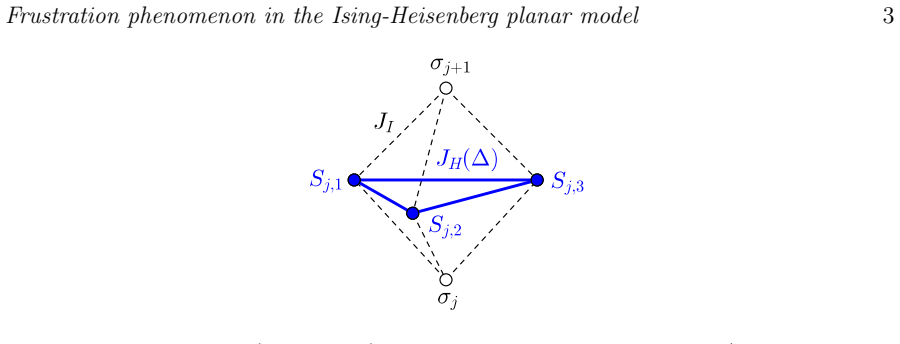
The load-bearing object is the decoration-iteration Boltzmann weight of Eq. (4): tracing out the three Heisenberg spins in each bipyramid leaves a weight $A e^{\beta J_{\rm eff}\sigma_j\sigma_{j+1}}$ that depends only on the two neighbouring Ising spins. That single identity converts the hybrid lattice into a pure Ising model, making the critical temperature, free energy, internal energy, entropy, specific heat, magnetization, and correlation functions all inheritable from known Ising solutions. The second ingredient is the plaquette-product frustration criterion: a triangle is called frustrated when the product of pair correlation functions around it is negative, which the paper uses to identify the QF and CHF phases and to define frustration temperatures as sign changes of $C^{zz}_\Delta$.
What would settle it
Check the decoration weight at $\beta=0$: a complete trace over three spin-1/2 sites must give the dimension 8, while the expression in Eq. (4) sums to 6. Recomputing the specific-heat curve or the frustration temperatures by exact diagonalization of the 8-state bipyramid cluster for a representative parameter set would settle whether the effective Ising mapping and the derived re-entrance are exact.
Extended reading notes
Core claim
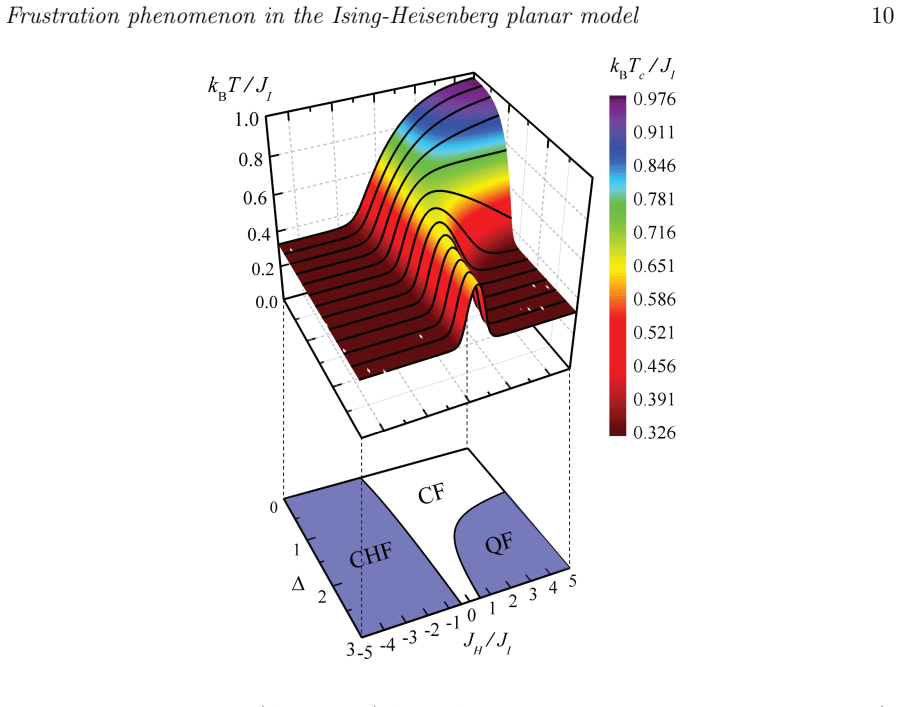
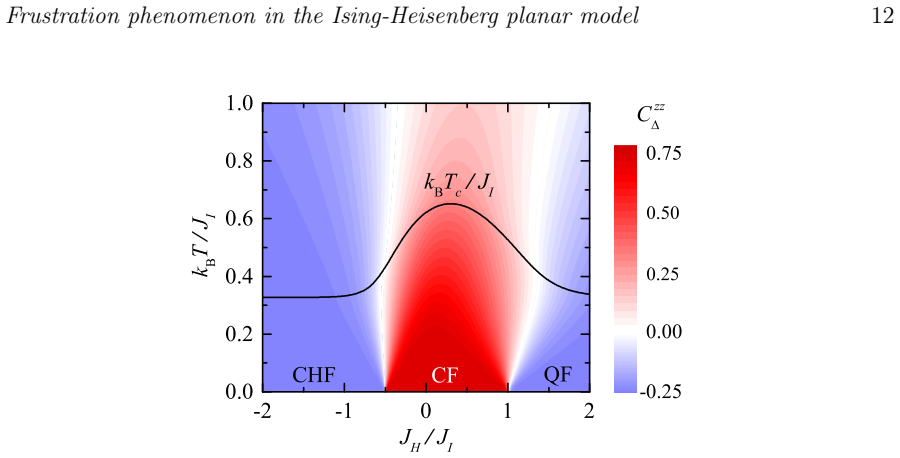
On the paper's own terms, the central discovery is that the mixed spin-1/2 Ising-Heisenberg model on bond-decorated archimedean lattices is exactly solvable: applying the decoration-iteration transformation to each trigonal bipyramid reduces the full partition function to that of a pure Ising lattice with an effective coupling $J_{\rm eff}$. For the representative square lattice the ground state consists of a classical ferromagnetic phase and two frustrated quantum phases (one chiral and macroscopically degenerate), and the paper uses exact Ising critical temperatures to locate the phase boundaries. The distinctive finite-temperature finding is that the longitudinal Heisenberg correlation function $C^{zz}_\Delta$ changes sign one, two, or three times as temperature rises, so frustrated and non-frustrated spin arrangements can alternate around the critical point and frustration can survive above the ordering transition.
Load-bearing premise
The load-bearing premise is that Eq. (4) is the complete Boltzmann trace over the three Heisenberg spins; if the trace is incomplete, the effective Ising coupling and every finite-temperature quantity derived from it are unreliable.
Editorial extensions
If this is right
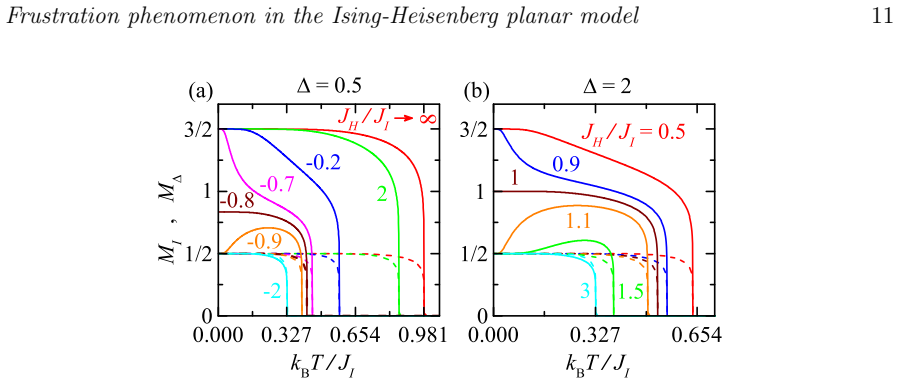
- The square-lattice model has exact critical temperatures $k_BT_c/J_I \approx 0.981$ in the classical phase and $k_BT_c/J_I \approx 0.327$ in the two quantum phases, three times lower because the Heisenberg magnetization is reduced to one third.
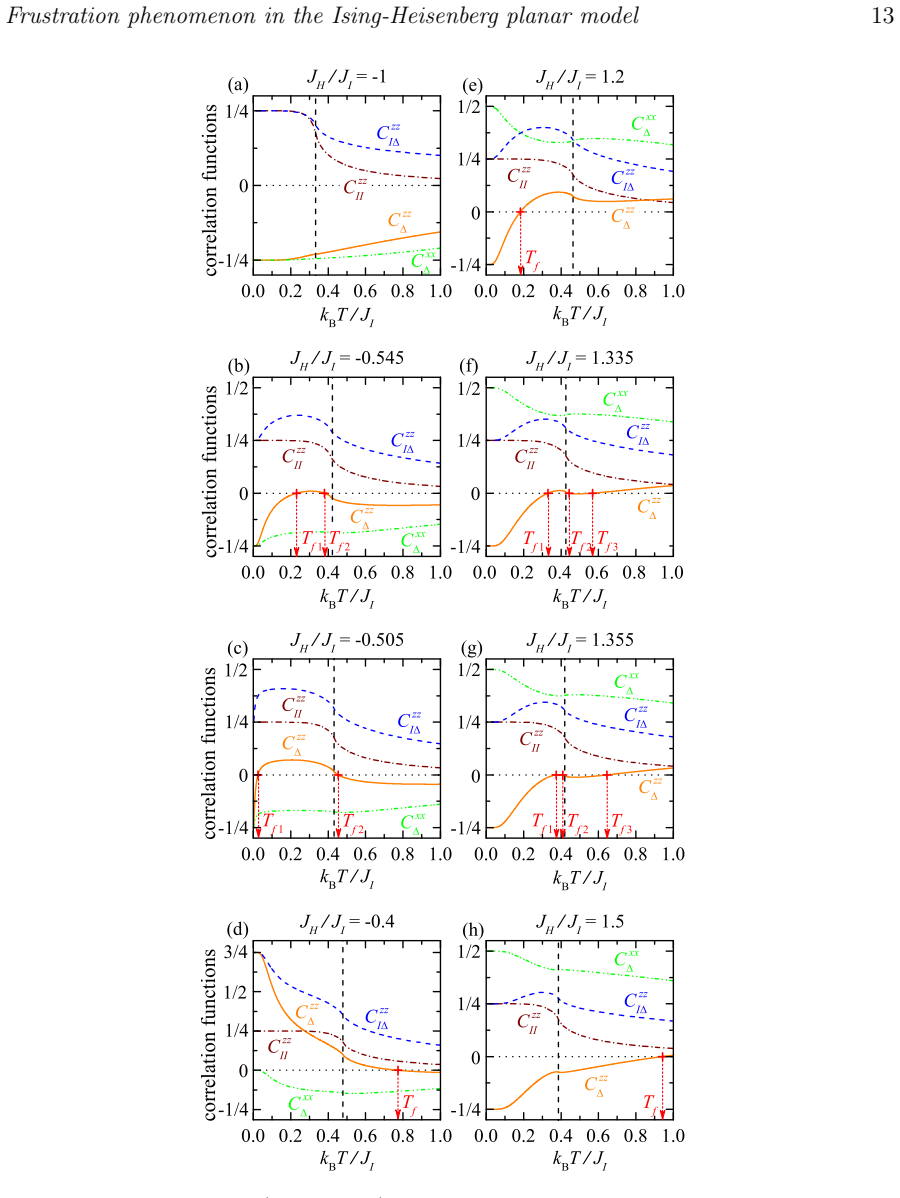
- Heisenberg-triangle frustration, signalled by $C^{zz}_\Delta < 0$, can survive well above $T_c$ in the chiral ferromagnetic region and can be only temporarily suppressed near the boundary to the classical phase.
- For anisotropy $\Delta=2$ and interaction ratios in $J_H/J_I \in (1.328, 1.358)$, the model shows three consecutive frustration temperatures around $T_c$, a re-entrant alternation of frustrated and non-frustrated Heisenberg arrangements.
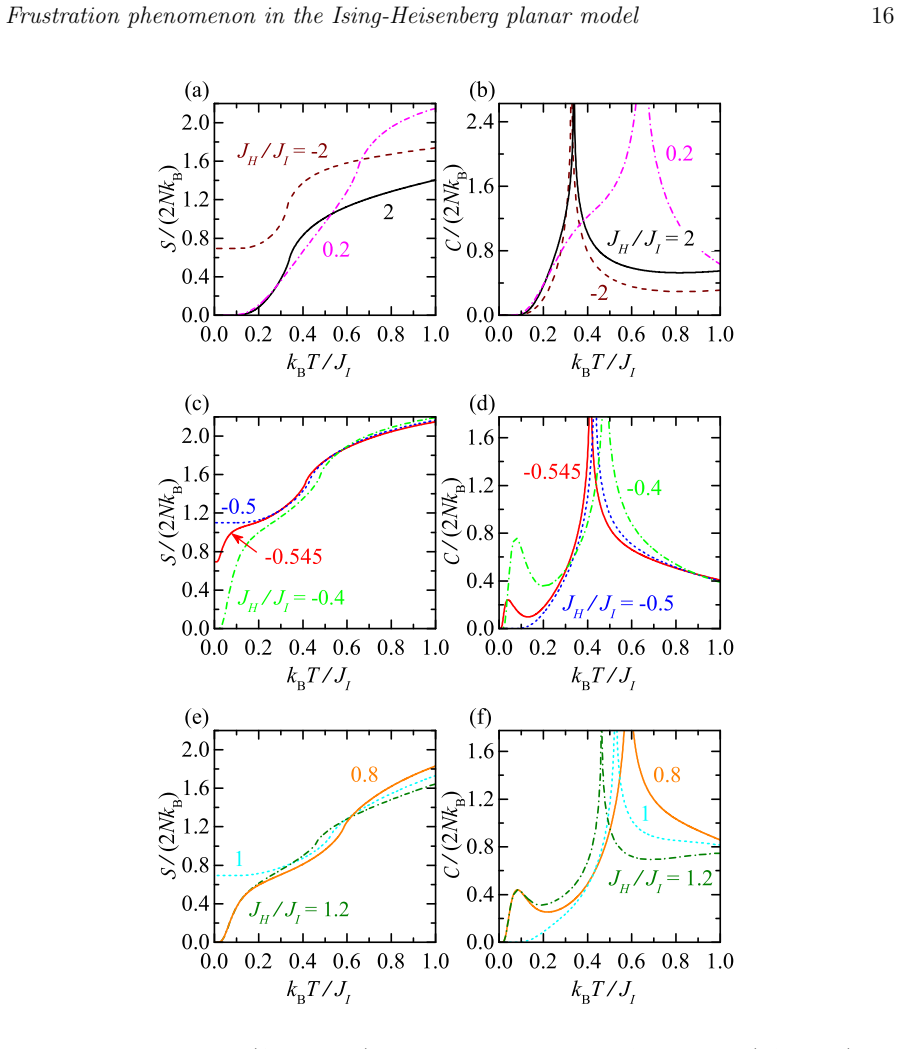
- Near ground-state phase boundaries, entropy acquires low-temperature plateaus and specific heat develops Schottky-type maxima because the neighbouring phases have almost equal energies and become thermally accessible at low temperature.
- Because the mapping is exact for any $q$-coordinated archimedean lattice, the same set of thermodynamic identities applies to hexagonal and triangular versions with only the Ising critical point changed.
Reading between the lines
- Editorial inference: the finite-temperature phase diagram is only as reliable as the cluster trace, so an independent 8-state diagonalization of the bipyramid would be a natural check on the quoted re-entrance windows and would show whether the quantitative positions of the frustration temperatures change.
- Editorial inference: applying the same decoration-iteration route to triangular or hexagonal versions of the bipyramid lattice would test whether the three-sign-change re-entrance is specific to the square lattice or generic to this decoration scheme.
- Editorial inference: the paper's frustration criterion is a sufficient indicator, not a direct order parameter; measuring chiral order or a plaquette loop variable would provide a stronger test of whether frustration genuinely persists above the ordering temperature.
Signed reviews
Editorial analysis
A structured set of objections, weighed in public.
Referee Report
Summary. The manuscript studies a mixed spin-1/2 Ising-Heisenberg model on bond-decorated square lattices, with each elementary unit containing a Heisenberg spin trimer coupled to Ising spins. The author applies a decoration-iteration transformation, Eq. (4), to trace out the Heisenberg degrees of freedom and map the model to a pure Ising model with an effective coupling Jeff. On this basis the paper derives ground-state phases, critical temperatures, finite-temperature correlation functions, frustration temperatures, entropy, and specific heat. The central claims are that spin frustration of the Heisenberg trimers persists far above Tc and that re-entrant frustrated/non-frustrated arrangements can occur around the critical temperature.
Significance. If the decoration-iteration mapping were correct, the paper would provide a useful exactly solvable example of frustration in a two-dimensional quantum-classical hybrid system, with falsifiable predictions for correlation functions and thermodynamic quantities. The ground-state classification and the general strategy of combining a cluster trace with an exactly solved Ising lattice are sensible, and the manuscript is self-contained in the sense that no fitted parameters enter the derivation. However, the central algebraic step is wrong: Eq. (4) is not the complete trace over the three spin-1/2 Heisenberg degrees of freedom. Because every finite-temperature result in Sections 3.2–3.4 is built on this weight, the main physical claims are not supported by the printed derivation.
major comments (3)
- [§2, Eq. (4)] The effective Boltzmann weight is not the full trace over the three spin-1/2 Heisenberg degrees of freedom. At β=0 the right-hand side evaluates to 2+2+2=6, whereas the trace over an eight-dimensional Hilbert space must equal 8. The missing contribution is the second S=1/2 doublet of the Heisenberg trimer. For Δ=1, the exact cluster trace contains a quartet contribution 2e^{3βJ_H/4}[cosh(βJ_I/2)+cosh(3βJ_I/2)] and two degenerate S=1/2 doublet contributions 2e^{-3βJ_H/4}cosh(βJ_I/2) each; Eq. (4) keeps only one of the two doublet contributions. Since the omitted factor multiplies a temperature-dependent term, it does not cancel in the ratio w+w-/w0^2 that defines Jeff in Eq. (6).
- [§3.2–§3.4] All finite-temperature results are derived from the incorrect weight in Eq. (4), directly or through Eq. (6). This includes the critical temperatures in Eqs. (20)–(21), the frustration temperatures and sign changes shown in Figs. 4–5, the entropy and specific heat in Figs. 6–7, and the correlation functions in Eqs. (13)–(16) through the auxiliary functions fγ, gγ, hγ. The ground-state classification in Eqs. (17)–(19) may survive, but the central abstract claims — that frustration persists far above Tc and that re-entrant frustrated/non-frustrated arrangements appear — are unsupported unless the mapping is rederived with the correct cluster trace.
- [§2.2, Eqs. (13)–(16)] The Callen-Suzuki-type identities used for the Heisenberg-spin correlation functions inherit the same omission, because the quantities fγ, gγ, and hγ are computed from the truncated cluster trace. In particular, the sign-change analysis of Czz_Δ in Fig. 4, which is the main evidence for finite-temperature frustration, is based on these incomplete expressions and must be recomputed.
minor comments (4)
- [Throughout] The text contains many typographical errors, including 'Hamitonian', 'spontanoeous', 'aniferromagnetic', 'demostrates', and 'tree consecutive frustration temperatures'.
- [Figures 3–7] Several figure labels appear as garbled symbol sequences such as '/s48/s46/s48/...' rather than readable axis or curve labels; these should be fixed.
- [§2.3] The critical-temperature criterion is described only verbally with a reference to an external table; giving the explicit general equation would improve reproducibility.
- [§2.1, Eq. (10)] The entropy and specific heat are left to the reader with 'rather extensive' formulas; for an exactly solvable model paper it would be helpful to include at least the explicit expressions in supplementary material.
Circularity Check
No significant circularity: the decoration-iteration mapping is a self-contained exact reduction to the solved 2D Ising model, with no fitted parameters or target results assumed.
full rationale
The paper's derivation chain is self-contained: it starts from the cluster Hamiltonian (Eq. 2), writes the partition function as a product of cluster traces (Eq. 3), evaluates the trace over the three Heisenberg spins to obtain the Boltzmann weight (Eq. 4), and then applies the standard decoration-iteration transformation to map the model onto a pure spin-1/2 Ising model with effective coupling Jeff given by Eq. (6). The quantities A and Jeff are closed-form functions of the interaction parameters, temperature, and lattice coordination; they are not fitted to any datum or to the later predictions. The ground-state phases (Eqs. 17-19) are obtained from direct eigenvector/eigenenergy analysis, and the finite-temperature magnetization, correlation functions, frustration temperatures, entropy, and specific heat follow from exact Ising results and Callen-Suzuki identities. The citations to the author's prior works (refs. 13, 14, 19, 20, 36) are lineage and tool citations for the algebraic mapping technique and exact Ising critical data; they are not invoked as a uniqueness theorem and they do not supply the central physical conclusion. Frustration temperatures are identified as zeros of the computed longitudinal correlation function Czz_Delta, not as inputs. Consequently, none of the paper's predictions reduce by construction to its inputs. A separate concern exists about the normalization of Eq. (4) (the cluster trace appears to give 6 rather than 8 at infinite temperature), but that is a possible mathematical error in the stated weight, not a circularity of the derivation.
Assumptions & free parameters
assumptions (3)
- standard math Exact free energy and correlation functions of the 2D Ising square lattice are valid inputs.
- domain assumption The decoration-iteration transformation maps the hybrid model to the effective Ising lattice exactly.
- domain assumption Square-lattice results are representative of other Archimedean lattices.
Cite this review
Pith. "Pith review of Frustration phenomenon in the spin-1/2 Ising-Heisenberg planar model of inter-connected trigonal bipyramid structures." pith.science (2026). https://pith.science/paper/OFAVR2HV
@misc{pith2026190801721,
  author       = {Pith},
  title        = {Pith review of: Frustration phenomenon in the spin-1/2 Ising-Heisenberg planar model of inter-connected trigonal bipyramid structures},
  year         = {2026},
  howpublished = {\url{https://pith.science/paper/OFAVR2HV}},
  note         = {Machine review of arXiv:1908.01721}
}
read the original abstract
Ground-state and finite-temperature properties of the exactly solvable mixed spin-1/2 Ising-Heisenberg planar model composed of identical trigonal bipyramids that are arranged into a regular archimedean lattice are examined with the aim to clarify the frustration phenomenon at zero and finite temperatures. It is shown that the ground-state spin frustration persists even far above the second-order phase transition. If the interaction ratio between the Heisenberg and Ising exchange interactions is close enough to the ground-state boundaries between the neighboring phases, a remarkable re-entrance of the (non-)frustrated spin arrangement of the Heisenberg spins can be observed around the critical temperature of the model. It is also evidenced that entropy and specific heat show pronounced temperature variations not only around the critical temperature, but also in low-temperature regime if values of the interaction parameters are taken from neighborhood of the ground-state phase transitions, where energies of the neighboring phases are very close.
Figures
Figures from the paper (3 more)
Reference graph
Works this paper leans on
-
[1]
Lecture Notes in Physics vol 595 ed C Berthier et al (Berlin: Springer) pp 161–90
Lhuillier C and Misguich G 2002 Frustrated Quantum Magnets High Magnetic Fields. Lecture Notes in Physics vol 595 ed C Berthier et al (Berlin: Springer) pp 161–90. Frustration phenomenon in the Ising-Heisenberg planar model 18
work page 2002
-
[2]
Misguich G and Lhuillier C 2004 Two-dimensional quantum antiferromagnets Frustrated Spin Systems ed H T Diep (Singapore: World Scientific) pp 229–306
work page 2004
-
[3]
Lecture Notes in Physics vol 645 ed U Schollw¨ ock et al (Berlin: Springer) pp 85–153
Richter J, Schulenburg J and Honecker A 2004 Quantum magnetism in two dimensions: From semi-classical N´ eel order to magnetic disorder Quantum magnetism. Lecture Notes in Physics vol 645 ed U Schollw¨ ock et al (Berlin: Springer) pp 85–153
work page 2004
-
[4]
Introduction to Frustrated Magnetism: Materials, Experiments, Theory 2011 ed C Lacroix et al. (Berlin: Springer)
work page 2011
-
[5]
Tanaka H, Ono T, Aruga Katori H, Mitamura H, Ishikawa F and Goto T 2002 Progr. Theor. Phys. Suppl. 145 101–6
work page 2002
-
[6]
Svistov L E, Smirnov A I, Prozorova L A, Petrenko O A, Micheler A, B¨ uttgen N, Shapiro A Ya and Demianets L N 2006 Phys. Rev. B 74 024412
work page 2006
-
[7]
Kageyama H, Yoshimura K, Stern R, Mushnikov N V, Onizuka K, Kato M, Kosuge K, Slichter C P, Goto T and Ueda Y 1999 Phys. Rev. Lett. 82 3168
work page 1999
-
[8]
Iga F, Shigekawa A, Hasegawa Y, Michimura S, Takabatake T, Yoshii S, Yamamoto T, Hagiwara M and Kindo K 2007 J. Magn. Magn. Mater. 310 e443–5
work page 2007
Show all 37 references
-
[9]
Narumi Y, Honda Z, Katsumata K, Domenge J -C, Sindzingre P, Lhuillier P, Matsuo P, Suga K and Kindo K 2004 J. Magn. Magn. Mater. 272-276 878–9
2004
-
[10]
Grohol D, Matan K, Cho J H, Lee S H, Lynn J W, Nocera D G and Lee Y S 2005 Nature Materials 4 323–8
2005
-
[11]
Okubo S, Hayashi M, Kimura S, Ohta H, Motokawa M, Kikuchi H and Nagasawa H 1998 Physica B 246–247 553-6
1998
-
[12]
Streˇ cka J,ˇCanov´ a L, Jaˇ sˇ cur M and Hagiwara M 2008Phys. Rev. B 78 024427
-
[13]
Status Solidi B 247 433–43
G´ alisov´ a and Streˇ cka J 2010Phys. Status Solidi B 247 433–43
-
[14]
Matter Phys
G´ alisov´ a and Streˇ cka J 2011Condens. Matter Phys. 14 13002
-
[15]
ˇCis´ arov´ a J, Michaud F, Mila F and Streˇ cka J 2013Phys. Rev. B 87 054419
-
[16]
ˇCis´ arov´ a J and Streˇ cka J 2013Phys. Rev. B 87 024421
-
[17]
Streˇ cka J, Ekiz C 2015Phys. Rev. E 91 052143
-
[18]
Rojas O 2019 J. Magn. Magn. Mater. 473 442–8
2019
-
[19]
Streˇ cka J 2010Phys. Lett. A 36 3718–22
-
[20]
Rojas O and de Souza S M 2011 J. Phys. A: Math. Theor. 44 245001
2011
-
[21]
Onsager L 1944 Phys. Rev. 65 117
1944
-
[22]
Houtappel R M F 1950 Physica 16 425-55
1950
-
[23]
Domb C 1960 Adv. Phys. 9 149-244
1960
-
[24]
McCoy B M, Wu T T 1973 The Two-Dimensional Ising Model (Cambridge: Harvard University Press)
1973
-
[25]
Lavis D A, Bell G M 1999 Statistical Mechanics of Lattice Systems (Berlin: Springer)
1999
-
[26]
Barry J H, Khatun M, Tanaka T 1988 Phys. Rev. B 37 5193
1988
-
[27]
Khatun M, Barry J H, Tanaka T 1990 Phys. Rev. B 42 4398
1990
-
[28]
Barry J H, Khatun M 1995 Phys. Rev. B 51 5840
1995
-
[29]
Yang C N 1952 Phys. Rev. 85 808
1952
-
[30]
Potts R B 1952 Phys. Rev. 88 352
1952
-
[31]
Naya S 1954 Prog. Theor. Phys. 11 53–62
1954
-
[32]
Barry J H, Tanaka T, Khatun M and M´ unera C H 1991 Phys. Rev. B 44 2595
1991
-
[33]
Callen H B 1963 Phys. Lett. 4 161
1963
-
[34]
Suzuki M 1965 Phys. Lett. 19 267–8
1965
-
[35]
Balcerzak T 2002 J. Magn. Magn. Mater. 246 213–22
2002
-
[36]
Streˇ cka J and Jaˇ sˇ cur M 2015Acta Physica Slovaca 65 235–367
-
[37]
dos Santos R J V, Lyra M L 1992 Physica A 182 133–44
1992
Reviewed August 14, 2026 · model on record in the stance chip above.
Discussion (0). Continue with ORCID to comment.