REVIEW 3 major objections 5 minor 118 references
The Effect of Pearl Vortices on the Shape and Position of N\'eel-Type Skyrmions in Superconductor-Chiral Ferromagnet Heterostructures
T0 review · 3 major / 5 minor · reviewed 2026-08-06 · deepseek-v4-flash
Pith's one-line read A Pearl vortex's stray field can inflate a Néel-type skyrmion up to a hard size ceiling, flip its chirality, deform and shift it, and bind a vortex–antivortex pair — all backed by micromagnetic simulations.
desk verdict Self-review of the authors' own prior work: honest and useful, central effects credible, but the unquantified variational truncation should make you treat the phase-boundary numbers as approximate. read the letter →
The pith
A machine-rendered reading of the paper's core claim, the machinery that carries it, and where it could break.
The reading
What carries the argument
The load-bearing object is the variational magnetization ansatz, which restricts the skyrmion profile to a small functional family and then minimizes the free energy within it. For coaxial geometry the profile is $\theta^\gamma_{R\delta}(r) = \theta_{R\delta}(r) + \gamma\theta_b(r)\cos\theta_{R\delta}(r)$, where $\theta_{R\delta}(r) = 2\arctan[\sinh(R/\delta)/\sinh(r/\delta)]$ is the 360-degree domain-wall profile, $\gamma = M_s\phi_0/(8\pi\lambda\sqrt{AK})$ is the effective vortex strength, and $\theta_b(r)$ is the magnetization tilt of the vortex-perturbed uniform background; minimizing the free energy in the two parameters $R$ and $\delta$ without anchoring them near the free-skyrmion values is what lets weak fields produce large radius changes and chirality inversion. For eccentric geometry the ansatz is $\mathbf{m} \approx \bar{\mathbf{m}} + \gamma\tilde{\mathbf{m}}$, with $\bar{\mathbf{m}}$ the radially symmetric profile in the angular-averaged vortex field and $\tilde{\mathbf{m}}$ a first-order deformation built from the difference between the local and the averaged field; the free energy is expanded to second order in $\gamma \ll 1$ and minimized over the radius, the domain-wall width, and the center distance $a$. The Pearl vortex itself — a vortex in a superconducting film much thinner than the London penetration depth, with stray-field scale $\lambda = \lambda_L^2/d_S$ — supplies the inhomogeneous field through Eqs. (14)–(17).
What would settle it
Measure or simulate the radius of a Néel-type skyrmion coaxially pinned to a Pearl vortex while sweeping the vortex coupling $\gamma = \zeta\ell_w d_S/\lambda_L^2$ (tunable experimentally through the superconducting film thickness $d_S$): the theory predicts a non-monotonic $R(\gamma)$ that peaks near $\gamma = 4\gamma^\pm_\infty$ and never exceeds $|R^\pm_{\max}| = \zeta\ell_w/(2\mp\epsilon\pi)$, a ceiling set only by ferromagnet constants; a monotonically growing radius, or any measured radius above the ceiling, would falsify the central bound. Independently, a fine-grained micromagnetic scan of the parameter region near the predicted shallow minimum at $a \approx 0.2\ell_w$, which the authors' own simulations did not confirm, would settle whether the ansatz hides a stable eccentric state.
Extended reading notes
Core claim
The central claim is that the interaction between a Néel-type skyrmion and a Pearl vortex's inhomogeneous magnetic field produces a set of controllable effects rather than a small correction. In a coaxial configuration the skyrmion radius can grow strongly — for the parameters shown in the paper from $R_0 \approx 0.41\ell_w$ in the free case to $R \approx 5.7\ell_w$, a factor near fourteen — and, for fixed positive DMI, a small-radius skyrmion with opposite chirality $\chi = -1$ can be stabilized. The radius as a function of vortex strength is non-monotonic and strictly bounded by $|R^\pm_{\max}| = \zeta\ell_w/(2\mp\epsilon\pi)$, a ceiling that does not depend on the superconductor. In eccentric configurations the vortex deforms the skyrmion away from cylindrical symmetry, and the equilibrium center-to-center distance follows from terms of second order in the small parameter $\gamma$, yielding a phase diagram with coaxial-only, eccentric-only, and coexistence regimes. Finally, a positive-chirality skyrmion stabilizes a repelling vortex–antivortex pair within a triangular region of that phase diagram. The paper presents these results as predictions confirmed by micromagnetic simulations and qualitatively consistent with recent experiments.
Load-bearing premise
Every prediction in the paper rests on the assumption that the true skyrmion profile is always well described by the two-parameter ansatz $\theta(r) \approx \theta_{R\delta}(r) + \gamma\theta_b(r)\cos\theta_{R\delta}(r)$, so that no free-energy minimum is missed by searching only within that family; the paper validates the ansatz for several parameter sets with micromagnetic simulations but provides no general error bound, its shallow predicted minimum at $a \approx 0.2\ell_w$ was not confirmed by simulations, and the higher-order-skyrmion analysis of Sec. VI relies on an even simpler domain-wall profile that the text itself warns may be quantitatively inaccurate.
Editorial extensions
If this is right
- There is a hard upper bound on vortex-inflated skyrmion size, $|R^\pm_{\max}| = \zeta\ell_w/(2\mp\epsilon\pi)$, fixed only by ferromagnet material constants; no amount of vortex strength inflates a given film's skyrmion beyond this ceiling.
- Skyrmion radius versus vortex strength is non-monotonic: it grows, peaks near $\gamma \approx 4\gamma^\pm_\infty$, and then shrinks, so a single heterostructure can tune a skyrmion through a maximum size by varying the superconducting film thickness.
- Chirality is not locked to the DMI sign in the vortex field: a coaxial vortex can stabilize a small-radius skyrmion with reversed chirality $\chi = -1$, and for $\epsilon \lesssim 0.49$ with weak vortices the natural-chirality skyrmion is repelled from the vortex core to a finite off-center distance.
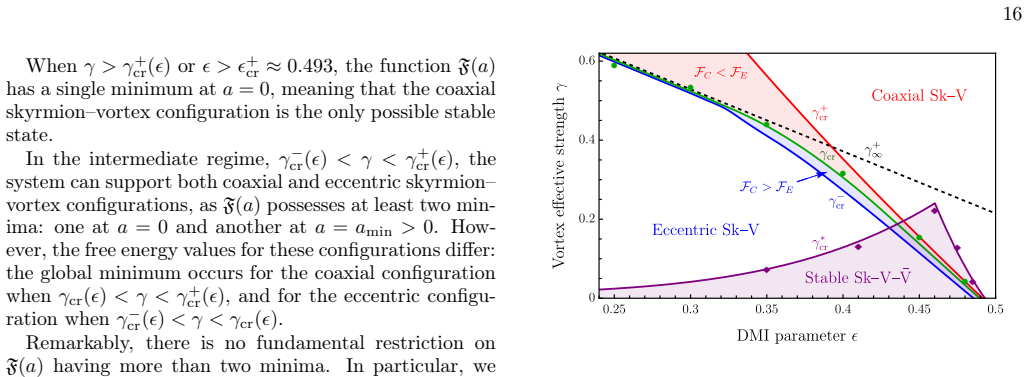
- Eccentric and coaxial states can coexist: in the parameter wedge between $\gamma^-_{cr}(\epsilon)$ and $\gamma^+_{cr}(\epsilon)$ the free energy has two minima in the separation $a$, so either configuration can be realized in the same sample.
- A skyrmion can act as a binder for a vortex–antivortex pair: in a triangular region of the $(\epsilon, \gamma)$ phase diagram the three-object complex is stable even though vortex and antivortex repel each other, and beyond $\gamma^*_{cr}(\epsilon)$ one member is expelled to a separation set by the superconducting energy balance.
Reading between the lines
- Editorial inference: the radius ceiling depending only on ferromagnet constants suggests a materials-characterization application — measure the maximal skyrmion inflation while sweeping vortex strength (via superconducting film thickness) and extract $\epsilon$ and $\zeta$ from the observed ceiling.
- Editorial inference: because the variational framework is stated to apply to any field profile, the same inflation, chirality-flip, and displacement effects should appear for a vortex in a thick superconducting film or for other stray-field sources such as a magnetic-force-microscope tip; the paper itself calls this extrapolation an open question.
- Editorial inference: the shallow free-energy minimum at $a \approx 0.2\ell_w$ that the authors report to fall below the precision of their second-order expansion, and that micromagnetic simulations did not reproduce, is the natural stress test for the ansatz — a dedicated simulation sweep near that spot would reveal whether a stable eccentric state was missed.
- Editorial inference: if chirality reversal is as robust as predicted, the vortex becomes a local 'write' operation that flips a skyrmion's handedness, a degree of freedom of direct interest for skyrmion-based information storage.
Signed reviews
Editorial analysis
A structured set of objections, weighed in public.
Referee Report
Summary. The manuscript reviews and extends the authors' previous theoretical work on the magnetostatic interaction between Néel-type skyrmions in a thin chiral ferromagnet and Pearl vortices in an adjacent thin superconductor. The central technical tool is a variational ansatz for the skyrmion magnetization in a weak inhomogeneous magnetic field, constructed as the free-skyrmion 360-degree domain-wall profile plus a linear-order correction built from the no-skyrmion response to the vortex field (Eqs. 33 and 44). Using this ansatz, the authors analyze coaxial configurations, obtaining radius blow-up, chirality inversion, and a maximum radius Rmax = ζℓw/(2∓επ) at finite Pearl length (Eq. 41); eccentric configurations, where second-order terms in the effective vortex strength determine the equilibrium skyrmion-vortex distance and lead to a phase diagram with coaxial/eccentric coexistence (Fig. 8); and stabilization of a vortex-antivortex pair by a skyrmion (Sec. V). The paper also discusses higher-order skyrmions and compares with micromagnetic simulations (OOMMF, Ubermag) and with three recent experiments. The presentation is structured as a review of Refs. [42-44] with additional context, a table of material parameters, and a discussion of experimental status.
Significance. If the results are robust, the manuscript provides a usable analytical framework for a system of current interest: coupled skyrmion-vortex complexes are a proposed platform for Majorana bound states and topological quantum computing. The paper's strengths are the transparency of the derivation, the explicit cross-checks against direct numerical solution of the Euler-Lagrange equation and against micromagnetic simulation in selected parameter regions, and the parameter-free nature of the maximum-radius expression (41), which is a falsifiable prediction depending only on ferromagnetic material constants. The review also usefully quantifies the regime of validity of the Pearl approximation and provides a table of experimental parameters that allow estimating the dimensionless coupling γ. The principal weakness is that the quantitative phase diagram and the critical values γcr(ϵ), γ±cr(ϵ), and γ*cr(ϵ) are all derived from a free-energy functional truncated at second order in γ, and the paper itself identifies a located example (the additional minimum at a_add ≈ 0.2ℓw in Sec. IVB2) where this truncation produces an uncertified feature that micromagnetic simulations do not confirm.
major comments (3)
- [Sec. IVB2 and Eq. (58)] The paper explicitly states that the additional local minimum at a_add ≈ 0.2ℓw lies "outside the precision of our second-order expansion in γ" and that micromagnetic simulations did not confirm its presence. This is a concrete instance in which the truncated free-energy functional (58) predicts a metastable feature that the authors themselves do not certify. The same functional, with the same truncation and no error estimate, is used to construct the phase boundaries γ−cr(ϵ), γcr(ϵ), and γ+cr(ϵ) in Fig. 8 and the radius/distance curves in Fig. 6. While the authors compare some of these curves with simulations (green circles and diamonds in Fig. 8), the comparison is limited to a few parameter points. The quantitative positions of the boundaries therefore inherit an unquantified uncertainty from the γ^2 truncation. I ask the authors to provide an estimate of the truncation error, for example by evaluating the magnitude of the leading omitted O(γ^3) terms or by performing a convergence check at selected (ϵ, γ) points, and to state explicitly how this error affects the reported critical values. Without such an estimate, the claim that the phase diagram is quantitatively reliable is stronger than the evidence supports.
- [Sec. IIIB and Sec. IVA] The variational ansatz (33)/(44) restricts the skyrmion profile to a two-parameter family (R, δ) and a fixed functional form for the γ-correction. The paper validates this ansatz against exact Euler-Lagrange solutions and micromagnetic simulations at a few parameter sets, for example ϵ = 0.325, γ = 0.479 in Fig. 3, and states that the method "yields reliable results over a wide range of parameters ϵ and γ." This claim is not backed by a systematic scan. In particular, the phase diagram in Fig. 8 covers a range of ϵ from about 0.2 to 0.6 and γ from 0 to 0.7, but the comparison points are sparse. Given that the ansatz is exactly the kind of restricted functional that can miss true minima or create spurious ones, as shown by the a_add minimum, the paper should either provide a denser benchmark of the variational results against direct ELE solving across the (ϵ, γ) plane, or explicitly delimit the parameter region in which the two-parameter ansatz is controlled. A short statement of expected error bounds would turn this from a caveat into a quantitative validation.
- [Sec. V, especially Sec. VB and Fig. 10] The prediction that a skyrmion can stabilize a vortex-antivortex pair relies on the same variational machinery and on the neglect of the superconducting interaction energy for β ≪ 1 (Eqs. 74-79). The latter approximation is stated and reasoned, but the former inherits the truncation issue identified above. The critical curve γ*cr(ϵ) in Fig. 8 is compared with only a few micromagnetic points, and the bounded and discontinuous behavior of the antivortex distance a_Vbar in Fig. 10 is a strong qualitative prediction that depends on the existence of a maximum in the energy as a function of a_Vbar. The paper would be strengthened by showing that this maximum and the associated criticality survive when the O(γ^3) terms are included or when the ansatz is relaxed. At minimum, the authors should state the expected sensitivity of the vortex-antivortex phase region to the variational truncation, and distinguish which aspects of Fig. 10 are robust (qualitative) versus sensitive (quantitative).
minor comments (5)
- [Eqs. (5), (32), (55)] The first term in these Euler-Lagrange equations appears as "ℓ2w r ∂r(r∂rθ)", which seems to be missing the division by r; the standard form is (ℓ_w^2/r) ∂_r (r ∂_r θ). Please check and correct the typesetting in these equations.
- [Eq. (40)] The displayed expression for |R| contains a formatting artifact "1p γγ ±∞ − 1"; it should read sqrt(γ/γ±∞ − 1). Please correct the equation.
- [Reference [72]] Reference [72] (C. Tanguy, arXiv:cond-mat/0106184) appears unrelated to the field approximation quoted in Eq. (38). If the approximation is from another source, please cite the correct reference; otherwise the citation is misleading.
- [Sec. IVB2] The sentence describing the a_add minimum is honest and important, but it is placed parenthetically in the middle of the results. Since this is a known limitation of the method, it deserves a more prominent discussion, perhaps in a dedicated paragraph on the validity of the variational approach, where the implications for other results are stated clearly.
- [Fig. 3 caption] The phrase "with sign corrected by multiplication by the skyrmion chirality" is ambiguous. Define whether the plotted quantity is χθ(r) or θ(r)/χ, and explain the reason for the correction.
Circularity Check
No circularity found: the variational predictions are obtained by minimizing a stated free-energy functional and are independently benchmarked against exact Euler-Lagrange solutions, OOMMF/Ubermag micromagnetic simulations, and external experimental data.
full rationale
The claimed derivation chain is self-contained. The free skyrmion profile follows from the Euler-Lagrange equation (5) for the free-energy functional (1); the Pearl vortex field is taken from the standard Pearl expression (14)-(17); the no-skyrmion response theta_b is obtained by solving the linearized Euler-Lagrange equation (22) in the same field; the coaxial ansatz (33) and eccentric ansatz (45)-(48) are constructed from the physical rotation of the magnetization by gamma*mu_b, not fitted to the quantities later predicted. The parameters R, delta, and a are then determined by minimizing the truncated free energy (54), (58), (61) rather than by regression to simulation or experiment. The resulting predictions, including the radius increase, chirality inversion, eccentric displacements, and vortex-antivortex stabilization, are checked against exact Euler-Lagrange solutions and independent OOMMF/Ubermag simulations, and qualitatively against external experiments [18-20]. Self-citations [41-44] refer to the authors' own prior derivations, but the review reproduces those derivations and anchors them to independent codes and measurements, so no load-bearing assertion rests on an unverified self-citation. The paper's explicit limitation in Sec. IVB2, that the shallow minimum at a_add about 0.2*l_w lies outside the precision of the second-order expansion and is not confirmed by micromagnetic simulations, is a stated robustness caveat rather than a circular reduction: it does not make the phase boundaries or radius-distance curves identical to an input by construction. Accordingly, no circular step can be exhibited, and the circularity score is 0.
Assumptions & free parameters
free parameters (3)
- R (skyrmion radius parameter)
- δ (domain-wall width parameter)
- a (skyrmion-vortex separation)
assumptions (5)
- ad hoc to paper The 360° domain-wall ansatz θ(r)=θRδ(r)+γθb(r)cosθRδ(r) remains a valid approximation for the skyrmion profile in the vortex field for both chiralities and for strongly enlarged radii.
- domain assumption The effective vortex strength γ is small, γ≪1, and the free energy expansion to second order in γ is sufficient to determine skyrmion positions and stability.
- domain assumption The Pearl vortex magnetic field is described by the thin-film expressions (16)-(17) for all radii r, including the core region r≲dS where the approximation deviates.
- domain assumption Characteristic scales satisfy dS∼dF≪ℓw∼δ∼|R|≪λ=λL^2/dS (Eq. 18), so the vortex field simplifies and the Pearl length can be taken as infinite in most analytical results.
- domain assumption The magnetic energy of the ferromagnet is given by the standard exchange, anisotropy, and interfacial DMI of Cnv symmetry (Eqs. (1)-(2)), with demagnetization absorbed into effective K.
Cite this review
Pith. "Pith review of The Effect of Pearl Vortices on the Shape and Position of N\'eel-Type Skyrmions in Superconductor-Chiral Ferromagnet Heterostructures." pith.science (2026). https://pith.science/paper/OFDNNDYH
@misc{pith2026250710199,
  author       = {Pith},
  title        = {Pith review of: The Effect of Pearl Vortices on the Shape and Position of N\'eel-Type Skyrmions in Superconductor-Chiral Ferromagnet Heterostructures},
  year         = {2026},
  howpublished = {\url{https://pith.science/paper/OFDNNDYH}},
  note         = {Machine review of arXiv:2507.10199}
}
read the original abstract
This review presents recent work carried out at the Landau Institute for Theoretical Physics of the Russian Academy of Sciences on the study of the effect of superconducting vortices on the shape and position of N\'eel-type skyrmions in superconductor--chiral ferromagnet heterostructures. Based on analytical and numerical approaches, a number of effects caused by the inhomogeneous magnetic field of the vortex have been predicted: a significant increase in the skyrmion radius, a change in its chirality in the case of a coaxial configuration of the vortex and skyrmion, and modification of the skyrmion shape in the case of an eccentric configuration. Recent experiments studying these effects are discussed.
Figures


Figures from the paper (7 more)




Reference graph
Works this paper leans on
-
[1]
As a result, the shifted ex- ternal magnetic field depends on a as a parameter, Ba(r) = B(ra), where ra = r + a
Formulation of the magnetization ansatz For convenience in the subsequent derivation, we shift the origin of coordinates to the center of the skyrmion, denoted by the point a. As a result, the shifted ex- ternal magnetic field depends on a as a parameter, Ba(r) = B(ra), where ra = r + a. 12 The central idea of the ansatz construction is to find a leading-...
-
[2]
no- skyrmion
First-order approximation In this subsection, we compute and minimize the free energy up to terms linear in the effective strengthγ ≪ 1 of the external magnetic field. In this case, as indicated in Sec. IVA1, the leading-order approximation for the skyrmion magnetizationmis the radially symmetric unit vector function ¯m, see Eq. (42). The skyrmion deforma...
-
[3]
For this purpose, we must extend the expan- sion of m to include second-order terms inγ
Second-order approximation To accurately determine the dependence of the skyrmion positiona on the effective field strengthγ ≪ 1, it is necessary to evaluate the total energyFferro[m, Ba] up to second order inγ, and then minimize it with re- spect to a. For this purpose, we must extend the expan- sion of m to include second-order terms inγ. Formally, we a...
-
[4]
Solid lines cor- respond to the results obtained from minimizing Eq
Skyrmion radius and distance in the eccentric configuration Figure 6 shows the skyrmion radius R (lower panel) and the distance a between the centers of the skyrmion and the vortex (upper panel) in stable eccentric configu- rations as functions of the effective vortex strengthγ, for different values of the DMI parameterϵ. Solid lines cor- respond to the r...
-
[5]
Free energy vs. distance: multiple minima Let us analyze the dependence of the free energy on the distance a in detail to determine which configura- tion—eccentric or coaxial—is energetically favorable for given values ofϵ and γ. To this end, we define the func- tion F(a) as F(a) ≡ min R,δ Fferro[m, Ba] 2πdF A , (68) which represents the total free energy...
-
[6]
no-skyrmion
Phase diagram The results of the previous subsection are summa- rized in the phase diagram on the (ϵ, γ) plane shown in Fig. 8. This diagram identifies four distinct phases of skyrmion–vortex configurations (indicated by solid monotonic curves corresponding to the critical values γ− cr(ϵ), γcr(ϵ), and γ+ cr(ϵ)), as well as the phase of sta- ble skyrmion–v...
-
[7]
For ϵ < ϵ∗ cr ≈ 0.46, the vortex moves away from the skyrmion–antivortex pair asγ increases
-
[8]
ordi- nary
For ϵ > ϵ∗ cr ≈ 0.46, the antivortex moves away from the skyrmion–vortex pair asγ increases. 19 2 3 4 2.5 3.5 0 0.1 0.2 1 0.5 0 0.1 0.2 1 0 0.5 Figure 10. Dependence of the displacements of the vortex center aV (top panel) and the antivortex centera ¯V (bottom panel) relative to the skyrmion center, as well as the skyrmion radius R (inset), on the effecti...
Show all 118 references
-
[9]
T. H. R. Skyrme, A non-linear field theory, Proc. R. Soc. Lond.260, 127 (1961)
1961
-
[10]
T. H. R. Skyrme, Particle states of a quantized meson field, Proc. R. Soc. Lond.262, 237 (1961). 23
1961
-
[11]
T. H. R. Skyrme, A unified field theory of mesons and baryons, Nucl. Phys.31, 556 (1962)
1962
-
[12]
S. L. Sondhi, A. Karlhede, S. A. Kivelson, and E. H. Rezayi, Skyrmions and the crossover from the integer to fractional quantum Hall effect at small Zeeman energies, Phys. Rev. B47, 16419 (1993)
1993
-
[13]
U. A. Khawaja and H. Stoof, Skyrmions in a ferro- magnetic Bose–Einstein condensate, Nature 411, 918 (2001)
2001
-
[14]
G. E. Volovik,The Universe in a Helium Droplet(Ox- ford: Clarendon Press, 2003)
2003
-
[15]
vortices
A. N. Bogdanov and D. Yablonskii, Thermodynami- cally stable “vortices” in magnetically ordered crystals. The mixed state of magnets, Sov. Phys. JETP68, 101 (1989)
1989
-
[16]
A. B. Borisov, Localized structures in magnetic sys- tems without the center of inversion, Physics-Uspekhi 63, 269–288 (2020)
2020
-
[17]
A. A. Abrikosov,Fundamentals of the Theory of Metals (North-Holland, Amsterdam, 1988)
1988
-
[18]
V. V. Ryazanov, V. A. Oboznov, A. S. Prokofiev, V. V. Bolginov, and A. K. Feofanov, Superconductor- ferromagnet-superconductor π-junctions, J. Low Temp. Phys. 136, 385 (2004)
2004
-
[19]
I. F. Lyuksyutov and V. L. Pokrovsky, Ferromagnet- superconductor hybrids, Adv. Phys.54, 67 (2005)
2005
-
[20]
A. I. Buzdin, Proximity effects in superconductor- ferromagnet heterostructures, Rev. Mod. Phys.77, 935 (2005)
2005
-
[21]
F. S. Bergeret, A. F. Volkov, and K. B. Efetov, Odd triplet superconductivity and related phenomena in superconductor-ferromagnet structures, Rev. Mod. Phys. 77, 1321 (2005)
2005
-
[22]
Eschrig, Spin-polarized supercurrents for spintron- ics: A review of current progress, Rep
M. Eschrig, Spin-polarized supercurrents for spintron- ics: A review of current progress, Rep. Prog. Phys.78, 104501 (2015)
2015
-
[23]
C. Back, V. Cros, H. Ebert, K. Everschor-Sitte, A. Fert, M. Garst, T. Ma, S. Mankovsky, T. L. Monchesky, M. Mostovoy, N. Nagaosa, S. S. P. Parkin, C. Pflei- derer, N. Reyren, A. Rosch, Y. Taguchi, Y. Tokura, K. von Bergmann, and J. Zang, The 2020 skyrmionics roadmap, J. Phys. ...
2020
-
[24]
G¨ obel, I
B. G¨ obel, I. Mertig, and O. A. Tretiakov, Beyond skyrmions: Review and perspectives of alternative mag- netic quasiparticles, Phys. Rep.895, 1 (2021)
2021
-
[25]
A. O. Zlotnikov, M. S. Shustin, and A. D. Fedoseev, Aspects of topological superconductivity in 2D systems: Non-collinear magnetism, skyrmions, and higher-order topology, J. Supercond. Nov. Magn.34, 3053 (2021)
2021
-
[26]
A. P. Petrovi´ c, M. Raju, X. Y. Tee, A. Louat, I. Maggio- Aprile, R. M. Menezes, M. J. Wyszy´ nski, N. K. Duong, M. Reznikov, C. Renner, M. V. Milosevi´ c, and C. Panagopoulos, Skyrmion-(Anti)vortex coupling in a chiral magnet-superconductor heterostructure, Phys. Rev. Lett.1...
2021
-
[27]
Machain, Skyrmion-vortex interactions in chiral- magnet/superconducting hybrid systems, Nanyang Technological University (2021)
P. Machain, Skyrmion-vortex interactions in chiral- magnet/superconducting hybrid systems, Nanyang Technological University (2021)
2021
-
[28]
Y. Xie, A. Qian, B. He, Y. Wu, S. Wang, B. Xu, G. Yu, X. Han, and X. Qiu, Visualization of skyrmion- superconducting vortex pairs in a chiral magnet- superconductor heterostructure, Phys. Rev. Lett133, 166706 (2024)
2024
-
[29]
Yokoyama and J
T. Yokoyama and J. Linder, Josephson effect through magnetic skyrmions, Phys. Rev. B 92, 060503(R) (2015)
2015
-
[30]
S. S. Pershoguba, S. Nakosai, and A. V. Balatsky, Skyrmion-induced bound states in a superconductor, Phys. Rev. B94, 064513 (2016)
2016
-
[31]
P¨ oyh¨ onen, T
K. P¨ oyh¨ onen, T. O. A. Weststr¨ om, S. S. Pershoguba, and A. V. Balatsky, Skyrmion-induced bound states in a p-wave superconductor, Phys. Rev. B94, 214509 (2016)
2016
-
[32]
V. A. Tumanov, V. E. Zaitseva, and Y. N. Proshin, Critical temperature of a superconductor/ferromagnet nanostructure near a magnetic skyrmion, JETP Letters 116, 449 (2022)
2022
-
[33]
Chen and A
W. Chen and A. P. Schnyder, Majorana edge states insuperconductor-noncollinearmagnetinterfaces,Phys. Rev. B92, 214502 (2015)
2015
-
[34]
G. Yang, P. Stano, J. Klinovaja, and D. Loss, Majorana bound states in magnetic skyrmions, Phys. Rev. B93, 224505 (2016)
2016
-
[35]
G¨ ung¨ ord¨ u, S
U. G¨ ung¨ ord¨ u, S. Sandhoefner, and A. A. Kovalev, Sta- bilization and control of majorana bound states with elongated skyrmions, Phys. Rev. B97, 115136 (2018)
2018
-
[36]
Mascot, S
E. Mascot, S. Cocklin, S. Rachel, and D. K. Morr, Di- mensional tuning of majorana fermions and real space countingofthechernnumber,Phys.Rev.B 100,184510 (2019)
2019
-
[37]
S. Rex, I. V. Gornyi, and A. D. Mirlin, Majorana bound states in magnetic skyrmions imposed onto a supercon- ductor, Phys. Rev. B100, 064504 (2019)
2019
-
[38]
Garnier, A
M. Garnier, A. Mesaros, and P. Simon, Topological su- perconductivity with deformable magnetic skyrmions, Commun. Phys.2, 126 (2019)
2019
-
[39]
S. Rex, I. V. Gornyi, and A. D. Mirlin, Majorana modes in emergent-wire phases of helical and cycloidal magnet- superconductor hybrids, Phys. Rev. B 102, 224501 (2020)
2020
-
[40]
G¨ ung¨ ord¨ u and A
U. G¨ ung¨ ord¨ u and A. A. Kovalev, Majorana bound stateswithchiralmagnetictextures,J.Appl.Phys. 132, 041101 (2022)
2022
-
[41]
Nothhelfer, S
J. Nothhelfer, S. A. D´iaz, S. Kessler, T. Meng, M. Rizzi, K. M. D. Hals, and K. Everschor-Sitte, Steering ma- jorana braiding via skyrmion-vortex pairs: A scalable platform, Phys. Rev. B105, 224509 (2022)
2022
-
[42]
S. T. Konakanchi, J. I. V¨ ayrynen, Y. P. Chen, P. Upad- hyaya, and L. P. Rokhinson, Platform for braiding Ma- jorana modes with magnetic skyrmions, Phys. Rev. Res. 5, 033109 (2023)
2023
-
[43]
K. M. D. Hals, M. Schecter, and M. S. Rud- ner, Composite topological excitations in ferromagnet- superconductor heterostructures, Phys. Rev. Lett.117, 017001 (2016)
2016
-
[44]
Baumard, J
J. Baumard, J. Cayssol, F. S. Bergeret, and A. Buzdin, Generation of a superconducting vortex via N´ eel skyrmions, Phys. Rev. B99, 014511 (2019)
2019
-
[45]
Dahir, Ferromagnetic superconducting heterostruc- tures with magnetic skyrmions, Master’s thesis, Bochum (2018)
S. Dahir, Ferromagnetic superconducting heterostruc- tures with magnetic skyrmions, Master’s thesis, Bochum (2018)
2018
-
[46]
S. M. Dahir, A. F. Volkov, and I. M. Eremin, Interac- tion of skyrmions and Pearl vortices in superconductor- chiral ferromagnet heterostructures, Phys. Rev. Lett. 122, 097001 (2019)
2019
-
[47]
R. M. Menezes, J. F. S. Neto, C. C. de Souza Silva, and M. V. Miloˇ sevi´ c, Manipulation of magnetic 24 skyrmions by superconducting vortices in ferromagnet- superconductor heterostructures, Phys. Rev. B 100, 014431 (2019)
2019
-
[48]
S. M. Dahir, A. F. Volkov, and I. M. Eremin, Meiss- ner currents induced by topological magnetic textures in hybrid superconductor/ferromagnet structures, Phys. Rev. B102, 014503 (2020)
2020
-
[49]
E. S. Andriyakhina and I. S. Burmistrov, Interaction of a N´ eel-type skyrmion with a superconducting vortex, Phys. Rev. B103 (2021)
2021
-
[50]
E. S. Andriyakhina, S. Apostoloff, and I. S. Burmistrov, Repulsion of a N´ eel-type skyrmion from a Pearl vortex in thin ferromagnet–superconductor heterostructures, JETP Letters116, 825 (2022)
2022
-
[51]
S. S. Apostoloff, E. S. Andriyakhina, P. A. Vorobyev, O. A. Tretiakov, and I. S. Burmistrov, Chirality inver- sion and radius blowup of a N´ eel-type skyrmion by a Pearl vortex, Phys. Rev. B107, L220409 (2023)
2023
-
[52]
S. S. Apostoloff, E. S. Andriyakhina, and I. S. Bur- mistrov, Deformation of a N´ eel-type skyrmion in a weak inhomogeneous magnetic field: Magnetization ansatz and interaction with a Pearl vortex, Phys. Rev. B109 (2024)
2024
-
[53]
Nayak, S
C. Nayak, S. H. Simon, A. Stern, M. Freedman, and S. Das Sarma, Non-abelian anyons and topologi- cal quantum computation, Rev. Mod. Phys.80, 1083 (2008)
2008
-
[54]
A. Y. Kitaev, Unpaired Majorana fermions in quantum wires, Physics-Uspekhi44, 131 (2001)
2001
-
[55]
Kitaev, Fault-tolerant quantum computation by anyons, Annals of Physics303, 2 (2003)
A. Kitaev, Fault-tolerant quantum computation by anyons, Annals of Physics303, 2 (2003)
2003
-
[56]
Y. Oreg, G. Refael, and F. von Oppen, Helical liquids and Majorana bound states in quantum wires, Phys. Rev. Lett.105, 177002 (2010)
2010
-
[57]
R. M. Lutchyn, J. D. Sau, and S. Das Sarma, Ma- jorana fermions and a topological phase transition in semiconductor-superconductor heterostructures, Phys. Rev. Lett.105, 077001 (2010)
2010
-
[58]
J. D. Sau, R. M. Lutchyn, S. Tewari, and S. Das Sarma, Generic new platform for topological quantum compu- tation usingsemiconductor heterostructures, Phys. Rev. Lett. 104, 040502 (2010)
2010
-
[59]
Mourik, K
V. Mourik, K. Zuo, S. M. Frolov, S. R. Plissard, E. P. A. M. Bakkers, and L. P. Kouwenhoven, Signa- tures of Majorana fermions in hybrid superconductor- semiconductor nanowire devices, Science 336, 1003 (2012)
2012
-
[60]
A. Das, Y. Ronen, Y. Most, Y. Oreg, M. Heiblum, and H. Shtrikman, Zero-bias peaks and splitting in an Al–InAs nanowire topological superconductor as a sig- nature of majorana fermions, Nature Physics8, 887–895 (2012)
2012
-
[61]
Sun and N
K. Sun and N. Shah, General framework for transport in spin-orbit-coupled superconducting heterostructures: Nonuniformspin-orbitcouplingandspin-orbit-activein- terfaces, Phys. Rev. B91, 144508 (2015)
2015
-
[62]
Sato and Y
M. Sato and Y. Ando, Topological superconductors: a review, Reports on Progress in Physics 80, 076501 (2017)
2017
-
[63]
Nakosai, Y
S. Nakosai, Y. Tanaka, and N. Nagaosa, Two- dimensional p-wave superconducting states with mag- netic moments on a conventionals-wave superconduc- tor, Phys. Rev. B88, 180503 (2013)
2013
-
[64]
Everschor-Sitte, J
K. Everschor-Sitte, J. Masell, R. M. Reeve, and M. Kl¨ aui, Perspective: Magnetic skyrmions—overview of recent progress in an active research field, Journal of Applied Physics124, 240901 (2018)
2018
-
[65]
Hassan, S
M. Hassan, S. Koraltan, A. Ullrich, F. Bruckner, R. O. Serha, K. V. Levchenko, G. Varvaro, N. S. Kiselev, M. Heigl, C. Abert, D. Suess, and M. Albrecht, Dipo- lar skyrmions and antiskyrmions of arbitrary topolog- ical charge at room temperature, Nature Physics 20, 615–622 (2024)
2024
-
[66]
M. A. Kuznetsov, K. R. Mukhamatchin, and A. A. Fraerman, Effective interfacial dzyaloshinskii-moriya interaction and skyrmion stabilization in ferromag- net/paramagnet and ferromagnet/superconductor hy- brid systems, Physical Review B 107, 10.1103/phys- revb.107.184428 (2023)
2023 doi
-
[67]
Pearl, Current distribution in superconducting films carrying quantized fluxoids, Appl
J. Pearl, Current distribution in superconducting films carrying quantized fluxoids, Appl. Phys. Lett. 5, 65 (1964)
1964
-
[68]
Carneiro and E
G. Carneiro and E. H. Brandt, Vortex lines in films: Fields and interactions, Phys. Rev. B61, 6370 (2000)
2000
-
[69]
B. Seng, D. Sch¨ onke, J. Yeste, R. M. Reeve, N. Kerber, D. Lacour, J.-L. Bello, N. Bergeard, F. Kammerbauer, M. Bhukta, T. Fert´ e, C. Boeglin, F. Radu, R. Abrudan, T. Kachel, S. Mangin, M. Hehn, and M. Kl¨ aui, Direct imaging of chiral domain walls and N´ eel-type skyrmio- n...
2021
-
[70]
L. Yang, A. S. Savchenko, F. Zheng, N. S. Kiselev, F. N. Rybakov, X. Han, S. Bl¨ ugel, and R. E. Dunin- Borkowski, Embedded skyrmion bags in thin films of chiral magnets, Advanced Materials (2024)
2024
-
[71]
D. S. Kathyat and P. Sengupta, Stabilization of biskyrmions by chiral interaction in centrosymmetric magnets (2024)
2024
-
[72]
M. S. Shustin, V. A. Stepanenko, and D. M. Dzebisas- hvili, Higher-order magnetic skyrmions in nonuniform magnetic fields, Phys. Rev. B107, 195428 (2023)
2023
-
[73]
A. D. Fedoseev, M. S. Shustin, and D. M. Dzebisas- hvili, Bound states of high-order magnetic skyrmions and a superconducting Pearl vortex, JETP Letters120, 517–524 (2024)
2024
-
[74]
J. E. Miltat and M. J. Donahue, Numerical micromag- netics: Finite difference methods, inHandbook of Mag- netism and Advanced Magnetic Materials(John Wiley & Sons, Ltd, 2007)
2007
-
[75]
M. J. Donahue and D. G. Porter, OOMMF user’s guide, version 1.0, Interagency Report NISTIR6376 (1999)
1999
-
[76]
M. Beg, M. Lang, and H. Fangohr, Ubermag: Towards more effective micromagnetic workflows, IEEE Transac- tions on Magnetics58, 1 (2022)
2022
-
[77]
W. F. Brown,Micromagnetics (Interscience Publishers, New York, London, 1963)
1963
-
[78]
Landau and E
L. Landau and E. Lifshitz, On the theory of the dis- persion of magnetic permeability inferroagnetic bodies, Phys. Z. Sowj.8, 153 (1935)
1935
-
[79]
Gilbert, A phenomenological theory of damping in ferromagnetic materials, IEEE Transactions on Magnet- ics 40, 3443 (2004)
T. Gilbert, A phenomenological theory of damping in ferromagnetic materials, IEEE Transactions on Magnet- ics 40, 3443 (2004)
2004
-
[80]
Tanguy, Counting the number of bound states of two- dimensional screened Coulomb potentials: A semiclas- sical approach (2001), arXiv:cond-mat/0106184 [cond- mat.mtrl-sci]
C. Tanguy, Counting the number of bound states of two- dimensional screened Coulomb potentials: A semiclas- sical approach (2001), arXiv:cond-mat/0106184 [cond- mat.mtrl-sci]. 25
2001 arXiv
-
[81]
A. D. Fedoseev, M. S. Shustin, and D. M. Dzebisashvili, Configurations of high-order magnetic skyrmions and a superconducting Pearl vortex in a bound state, Physics of the Solid State (2025), accepted for publication
2025
-
[82]
M. A. Kuznetsov and A. A. Fraerman, Magnetostatic mechanism of chiral symmetry breaking in multilayer magnetic structures, Journal of Experimental and The- oretical Physics137, 442–452 (2023)
2023
-
[83]
Pizzini, J
S. Pizzini, J. Vogel, S. Rohart, L. D. Buda-Prejbeanu, E. Ju´ e, O. Boulle, I. M. Miron, C. K. Safeer, S. Auffret, G. Gaudin, and A. Thiaville, Chirality-induced asym- metric magnetic nucleation inPt/Co/alox ultrathin mi- crostructures, Phys. Rev. Lett.113, 047203 (2014)
2014
-
[84]
Moreau-Luchaire, C
C. Moreau-Luchaire, C. Moutafis, N. Reyren,et al., Ad- ditive interfacial chiral interaction in multilayers for sta- bilization of small individual skyrmions at room tem- perature, Nature Nanotechnology11, 444 (2016), issue Date: May 2016
2016
-
[85]
Pollard, J
S. Pollard, J. Garlow, J. Yu,et al., Observation of sta- ble n´ eel skyrmions in cobalt/palladium multilayers with lorentz transmission electron microscopy, Nature Com- munications 8, 14761 (2017)
2017
-
[86]
J. Cao, Y. Chen, T. Jin,et al., Spin orbit torques in- duced magnetization reversal through asymmetric do- main wall propagation in Ta/CoFeB/MgO structures, Scientific Reports8, 1355 (2018)
2018
-
[87]
Ryu, S.-H
K.-S. Ryu, S.-H. Yang, L. Tomas, and S. S. P. Parkin, Chiral spin torque arising from proximity-induced mag- netization, Nat. Commun.5, 3910 (2014)
2014
-
[88]
A. P. Petrovi´ c, C. Psaroudaki, P. Fischer, M. Garst, and C. Panagopoulos, Colloquium: Quantum proper- ties and functionalities of magnetic skyrmions (2024), arXiv:2410.11427
2024 arXiv
-
[89]
B. W. Maxfield and W. L. McLean, Superconducting penetration depth of niobium, Phys. Rev.119, A1515 (1965)
1965
-
[90]
L. Liu, W. Chen, and Y. Zheng, Emergent mechanics of magnetic skyrmions deformed by defects, Physical Review Letters131 (2023)
2023
-
[91]
C. S. Davies, A. Francis, A. V. Sadovnikov, S. V. Cher- topalov, M. T. Bryan, S. V. Grishin, D. A. Allwood, Y. P. Sharaevskii, S. A. Nikitov, and V. V. Kruglyak, Towards graded-index magnonics: Steering spin waves in magnonic networks, Phys. Rev. B92, 020408 (2015)
2015
-
[92]
Braun, Fluctuations and instabilities of ferromag- netic domain-wall pairs in an external magnetic field, Phys
H.-B. Braun, Fluctuations and instabilities of ferromag- netic domain-wall pairs in an external magnetic field, Phys. Rev. B50, 16485 (1994)
1994
-
[93]
Hertel, W
R. Hertel, W. Wulfhekel, and J. Kirschner, Domain-wall induced phase shifts in spin waves, Phys. Rev. Lett.93, 257202 (2004)
2004
-
[94]
S. J. H¨ am¨ al¨ ainen, M. Madami, H. Qin, G. Gubbiotti, and S. van Dijken, Control of spin-wave transmission by a programmable domain wall, Nat. Commun.9, 4853 (2018)
2018
-
[95]
Laliena, A
V. Laliena, A. Athanasopoulos, and J. Campo, Scatter- ing of spin waves by a Bloch domain wall: Effect of the dipolar interaction, Phys. Rev. B105, 214429 (2022)
2022
-
[96]
Iwasaki, A
J. Iwasaki, A. J. Beekman, and N. Nagaosa, Theory of magnon-skyrmion scattering in chiral magnets, Phys. Rev. B89, 064412 (2014)
2014
-
[97]
Sch¨ utte and M
C. Sch¨ utte and M. Garst, Magnon-skyrmion scattering in chiral magnets, Phys. Rev. B90, 094423 (2014)
2014
-
[98]
D. N. Aristov, S. S. Kravchenko, and A. O. Sorokin, Magnon spectrum in ferromagnets with a skyrmion, JETP Lett.102, 511 (2015)
2015
-
[99]
I. A. Golovchanskiy, N. N. Abramov, V. S. Stolyarov, V. V. Bolginov, V. V. Ryazanov, A. A. Golubov, and A. V. Ustinov, Ferromagnet/superconductor hybridiza- tion for magnonic applications, Adv. Func. Mater.28, 1802375 (2018)
2018
-
[100]
I. A. Golovchanskiy, N. N. Abramov, V. S. Stolyarov, V. V. Bolginov, V. V. Ryazanov, A. A. Golubov, and A. V. Ustinov, Nonlinear spin waves in ferro- magnetic/superconductor hybrids, J. Appl. Phys.127, 093903 (2020)
2020
-
[101]
Yu and G
T. Yu and G. E. W. Bauer, Efficient gating of magnons by proximity superconductors, Phys. Rev. Lett. 129, 117201 (2022)
2022
-
[102]
Silaev, Anderson-Higgs mass of magnons in superconductor-ferromagnet-superconductor systems, Phys
M. Silaev, Anderson-Higgs mass of magnons in superconductor-ferromagnet-superconductor systems, Phys. Rev. Appl.18, L061004 (2022)
2022
-
[103]
Golovchanskiy, N
I. Golovchanskiy, N. Abramov, O. Emelyanova, I. Shchetinin, V. Ryazanov, A. Golubov, and V. Stol- yarov, Magnetization dynamics in proximity-coupled superconductor-ferromagnet-superconductor multilay- ers. II. Thickness dependence of the superconducting torque, Phys. Rev. Appl...
2023
-
[104]
Borst, P
M. Borst, P. H. Vree, A. Lowther, A. Teepe, S. Kurdi, I. Bertelli, B. G. Simon, Y. M. Blanter, and T. van der Sar, Observation and control of hybrid spin-wave- Meissner-current transport modes, Science 382, 430 (2023)
2023
-
[105]
Kharlan, K
J. Kharlan, K. Sobucki, K. Szulc, S. Memarzadeh, and J. W. K los, Spin-wave confinement in a hybrid superconductor-ferrimagnet nanostructure, Phys. Rev. Appl. 21, 064007 (2024)
2024
-
[106]
O. V. Dobrovolskiy, R. Sachser, T. Br¨ acher, T. B¨ ottcher, V. Kruglyak, R. V. Vovk, V. A. Shklovskij, M. Huth, B. Hillebrands, and A. V. Chumak, Magnon–fluxon interaction in a ferromag- net/superconductor heterostructure, Nat. Phys. 15, 477 (2019)
2019
-
[107]
Niedzielski, C
B. Niedzielski, C. Jia, and J. Berakdar, Magnon-fluxon interaction in coupled superconductor/ferromagnet hy- brid periodic structures, Phys. Rev. Appl.19, 024073 (2023)
2023
-
[108]
I. V. Bobkova, A. M. Bobkov, A. Kamra, and W. Belzig, Magnon-cooparons in magnet-superconductor hybrids, Commun. Mater.3, 95 (2022)
2022
-
[109]
D. S. Katkov, S. S. Apostoloff, and I. S. Burmistrov, Bound states and scattering of magnons on a super- conducting vortex in ferromagnet–superconductor het- erostructures, JETP Lett.120, 655 (2024)
2024
-
[110]
J. F. Neta and C. C. de Souza Silva, Mesoscale phase separation of skyrmion-vortex matter in chiral magnet- superconductor heterostructures, Phys. Rev. Lett.128, 057001 (2022)
2022
-
[111]
V.E.Timofeev, A.O.Sorokin,andD.N.Aristov,Triple helix versus skyrmion lattice in two-dimensional non- centrosymmetric magnets, Phys. Rev. B 103, 094402 (2021)
2021
-
[112]
V. E. Timofeev and D. N. Aristov, Magnon band struc- ture of skyrmion crystals and stereographic projection approach, Phys. Rev. B105, 024422 (2022)
2022
-
[113]
V. G. Bar’yakhtar, V. A. L’vov, and D. A. Yablon- skii, Inhomogeneous magnetoelectric effect, JETP Let- ters 37, 673 (1983). 26
1983
-
[114]
Mostovoy, Ferroelectricity in spiral magnets, Phys
M. Mostovoy, Ferroelectricity in spiral magnets, Phys. Rev. Lett.96, 067601 (2006)
2006
-
[115]
Dzyaloshinskii, Magnetoelectricity in ferromagnets, EPL 83, 67001 (2008)
I. Dzyaloshinskii, Magnetoelectricity in ferromagnets, EPL 83, 67001 (2008)
2008
-
[116]
A. S. Logginov, G. A. Meshkov, A. V. Nikolaev, E. P. Nikolaeva, A. P. Pyatakov, and A. K. Zvezdin, Room temperature magnetoelectric control of micromagnetic structure in iron garnet films, Appl. Phys. Lett. 93, 182510 (2008)
2008
-
[117]
A. P. Pyatakov, A. S. Sergeev, E. P. Nikolaeva, T. B. Kosykh, A. V. Nikolaev, K. A. Zvezdin, and A. K. Zvezdin, Micromagnetism and topologic defects in mag- netoelectric media, Uspekhi Fizicheskih Nauk 185, 1077–1088 (2015)
2015
-
[118]
Pyatakov, A
A. Pyatakov, A. Sergeev, F. Mikailzade, and A. Zvezdin, Spin flexoelectricity and chiral spin structures in mag- netic films, Journal of Magnetism and Magnetic Mate- rials 383, 255–258 (2015)
2015
Reviewed August 6, 2026 · model on record in the stance chip above.
Discussion (0). Continue with ORCID to comment.