REVIEW 3 major objections 5 minor 31 references
Mip-NeWRF reduces wireless channel prediction error by 14.3 dB with a hybrid encoding scheme, converging about ten times faster than prior radiance-field baselines.
Reviewed by Pith at T0; open to challenge. T0 means a machine referee read the full paper against a public rubric. the ladder, T0–T4 →
Mip-NeWRF predicts indoor channel frequency responses from sparse measurements using scale-normalized hybrid positional encoding and Fresnel-aware synthesis, beating NeWRF by 14.3 dB NMSE in ray-traced simulations.
T0 review reviewed 2026-08-03 challenge →
load-bearing objection Plausible WRF encoding upgrade, but the headline 14.3 dB gain probably leaks ground-truth ray-tracer attenuation into synthesis; worth peer review with demands for decoupled evidence. the 3 major comments →
Mip-NeWRF: Enhanced Wireless Radiance Field with Hybrid Encoding for Channel Prediction
The pith
A machine-rendered reading of the paper's core claim, the machinery that carries it, and where it could break.
The reading
Core claim
The central claim is that scale consistency in positional encoding is the key to making wireless radiance fields robust to environment size and fast to train. The authors replace point sampling with frustum sampling and construct a hybrid encoding: standard positional encoding (PE) captures sharp virtual-transmitter peaks, while integrated positional encoding (IPE) averages over the frustum and supplies stable low-frequency features that prevent gradient noise. An adaptive normalization rescales scene coordinates so that the encoding frequencies correspond to a fixed physical resolution regardless of room dimensions. Together with a shared coarse-fine network, curricular training, and physic
What carries the argument
The load-bearing object is the scale-consistent hybrid positional encoding. PE maps each frustum's mean position through sinusoids of increasing frequency; IPE does the same for the frustum's Gaussian moment-matching distribution, which acts as a spatial low-pass filter that smooths away high-frequency noise. The scale-consistent normalization divides each coordinate by a power of two determined by the scene range, ensuring that the same physical feature size (here 0.02 m) is always represented at the same encoding frequency. The two encodings are concatenated and fed into a single MLP that predicts virtual-transmitter presence weights and complex amplitudes; these are then combined with Fre
Load-bearing premise
The pipeline requires that the directions of arrival of incoming multipath components are known in advance (modeled as perfect DoAs plus uniform noise of at most 0.1°), so the entire sparse-ray sampling strategy depends on an accurate DoA estimator that the paper does not validate.
What would settle it
Train Mip-NeWRF on an indoor measurement campaign where DoA estimates come from an actual antenna array (e.g., MUSIC or compressed sensing) with realistic errors, and compare the NMSE to NeWRF. If the 14.3 dB advantage shrinks to a few dB or disappears, the central claim is falsified. Alternatively, instrument the training run: if convergence requires many more than about 3,000 iterations in a dense-multipath scene, the tenfold speedup claim fails.
If this is right
- Learned channel prediction from sparse measurements becomes viable without environment maps: the network can be trained directly on pilot measurements.
- The rapid convergence, about one tenth of the baseline iterations, makes online training and adaptation in dynamic indoor venues more practical.
- Scale robustness means a single trained model can be applied to rooms of different sizes, easing deployment.
- The physics-aware synthesis reduces the burden on the network to learn propagation effects, potentially improving generalization to new materials and frequencies with only light fine-tuning.
Where Pith is reading between the lines
- The paper assumes near-ideal DoA estimates (true DoAs plus noise within 0.1°); a direct extension is to couple the framework with an explicit DoA estimator, which would test whether the 14.3 dB gain survives realistic angle errors from compact antenna arrays.
- Because the network learns virtual transmitter locations and the Fresnel-based fusion is frequency-dependent, the same architecture could be applied to reconfigurable intelligent surface placement or to estimate material electromagnetic parameters from observed channels.
- The hybrid encoding trick is not specific to wireless; it could be imported into other neural field tasks (e.g., ultrasound or ground-penetrating radar imaging) where scale changes and sharp specular features coexist.
Editorial analysis
A structured set of objections, weighed in public.
Referee Report
Summary. Mip-NeWRF extends NeWRF for indoor channel prediction by replacing point sampling with conical-frustum sampling, applying a scale-consistent hybrid PE+IPE encoding, using a single shared MLP with curriculum learning, and synthesizing the CFR by combining predicted VA signals with modeled path loss and surface interaction attenuation. The method is evaluated on MATLAB ray-traced channels in two indoor scenes (8×5×3 m and 25×25×5 m), reporting a 14.3 dB NMSE improvement over NeWRF in the typical scene, roughly one-tenth of the training iterations, and only slight degradation with scene scale. Ablations attribute the gains to scale-consistent normalization, IPE, and interaction compensation.
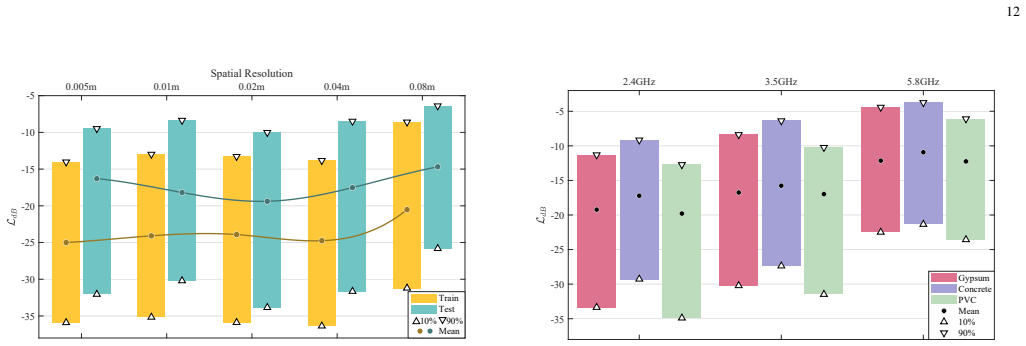
Significance. The manuscript makes a plausible and potentially useful engineering contribution: the scale-consistent normalization and PE+IPE hybrid encoding are well-motivated adaptations of Mip-NeRF to sparse wireless radiance fields, and the moment derivations (Eqs. 25–31) are careful and internally consistent. The ablation suite (Fig. 9) is also coherent and gives credit to the proposed components. If the headline gain survives removal of oracle terms, the paper would be a solid advance in WRF training efficiency and accuracy. However, the central claim of measurement-only sparse channel prediction is not yet evidenced: the synthesis uses a physical attenuation term whose estimator is deferred, and the ray directions are assumed near-oracle. The significance is therefore conditional on clarifying and re-evaluating these points.
major comments (3)
- [Section III-E, Eq. (36)] ζ_k, the interface-interaction attenuation, multiplies every predicted VA signal, but the paper never states how ζ_k is obtained in the experiments. The network inputs in Eq. (32) do not include material identity, incidence angle, or interaction history, and Section II-B explicitly says the multipath SLAM instantiation is 'beyond the scope ... forthcoming publication.' Since the dataset is generated with a ray tracer using the same Fresnel model, the natural reading is that ground-truth ζ_k is injected at synthesis time. If so, the 'w/o interaction' ablation (Fig. 9b/c, roughly 16 dB) and a large part of the 14.3 dB gain over NeWRF measure an oracle term, not the proposed encoding/network. Please state explicitly how ζ_k was set in each experiment, and either present results with an estimated ζ_k or clearly reframe the claims as supervised simulation with known physical parameters.
- [Section III-B3] The sparse-ray formulation assumes 'the estimated DoAs are known and modeled as the sum of the true DoAs and uniformly distributed noise ϑ∈U(−0.1°,0.1°).' This is a near-oracle assumption: 0.1° is very small relative to typical indoor angular spreads, and the negative-sample training depends on having reliable ray directions. The 14.3 dB claim is therefore not evidence for measurement-only operation under realistic DoA estimation errors. Please include a sensitivity study over DoA-noise magnitude and model, or explicitly qualify the Abstract/conclusion claims as applying under this assumption.
- [Section IV-B, Fig. 9(a)] The headline 14.3 dB improvement is a single-seed point estimate of NMSE, with no confidence intervals or repeated experiments. WRF training is known to be sensitive to initialization, sampling, and data partitioning; without variance information, the reader cannot judge whether the reported gain is robust. Please report mean ± std (or box plots) over multiple seeds, and define the criterion used to measure 'convergence iterations' in Fig. 10.
minor comments (5)
- [Section III-C2, Eq. (30)] The sentence 'By symmetry the radial mean is zero, i.e., E[t] = 0' should read 'E[r] = 0'.
- [Section III-C3] The statement that frequency levels satisfy l_x=1,...,L_x−1 is inconsistent with Eq. (17), where the highest frequency is 2^{L_x−1}π. Please align the indexing notation.
- [Section IV-C2] When stating that PE-only or IPE-only are given more samples 'to match the hybrid's input dimensionality,' please clarify exactly how dimensionality was matched and confirm that the comparison remains fair in parameter count.
- [Section IV-B] Typo: 'larger sacle' should be 'larger scale.' The legend of Fig. 9(b/c) is also difficult to parse; please split train/test legends explicitly.
- [Section I-A] The parenthetical 'note:renderindicating operations...' is typographically garbled and should be cleaned.
Circularity Check
No circular derivation: channel synthesis is a supervised rendering equation trained against an external ray tracer; the ζ_k and DoA assumptions are privileged-input caveats, not definitional reductions.
full rationale
No circular step can be exhibited. Eq. (36) is a rendering equation: the predicted CFR is a sum over rays of free-space pathloss, known interaction attenuation ζ_k, volume-rendered visibility ν_k, and network output x_k. The target H is produced independently by MATLAB ray tracing (Sec. IV-A1). The terms c/(4π μ f_c), ζ_k, and the Fresnel coefficients (Eqs. 4, 8, 12) are standard physics from external EM theory, not fitted quantities; the scale-consistent PE/IPE (Eqs. 16-23) are architectural choices, and no equation defines H in terms of them. The only self-citations ([27], [28], used for multipath SLAM to instantiate ζ_k in Sec. II-B) are deferred implementation pointers, not the source of the reported 14.3 dB gain; under the review rules they are not load-bearing. The near-oracle assumptions — known DoAs with ±0.1° noise (Sec. III-B3) and the unestimated ζ_k in Eq. 36 — are evidence/correctness caveats: the experiments never state how ζ_k is obtained, and the practical estimator is postponed to a 'forthcoming publication.' That means the sparse-measurement-only claim is not fully evidenced, but it is not a case of a prediction being equal, by construction, to its input. Hence the circularity score is 0.
Axiom & Free-Parameter Ledger
free parameters (6)
- target spatial resolution d_min =
0.02 m
- cone aspect ratio dot_r =
0.0017
- coarse/fine loss weights w_c, w_f =
0.1, 0.9
- base sampling density epsilon =
0.01
- negative ray count per receiver =
5 (Scene B) / 10 (Scene A)
- polarization power weights omega_perp, omega_para =
0.5, 0.5
axioms (5)
- domain assumption Transmission, scattering, and diffraction attenuation coefficients are set to zero; only specular reflection paths are modeled.
- domain assumption Surfaces are uniform non-magnetic dielectrics with mu_r=1 and no birefringence or anisotropy; Fresnel coefficients describe reflections.
- domain assumption The distribution of points inside each conical frustum is approximated by a moment-matched multivariate Gaussian.
- ad hoc to paper Estimated DoAs are known as true DoAs plus uniform noise in [-0.1,0.1] degrees.
- domain assumption Matlab SBR ray tracing provides trustworthy ground-truth channels for the scenes studied.
Cite this review
Pith. "Pith review of Mip-NeWRF: Enhanced Wireless Radiance Field with Hybrid Encoding for Channel Prediction." pith.science (2026). https://pith.science/paper/OFNAUR54
@misc{pith2026251109150,
  author       = {Pith},
  title        = {Pith review of: Mip-NeWRF: Enhanced Wireless Radiance Field with Hybrid Encoding for Channel Prediction},
  year         = {2026},
  howpublished = {\url{https://pith.science/paper/OFNAUR54}},
  note         = {Machine review of arXiv:2511.09150}
}
read the original abstract
Recent work on wireless radiance fields represents a promising deep learning approach for channel prediction, however, in complex environments these methods still exhibit limited robustness, slow convergence, and modest accuracy due to insufficiently refined modeling. To address this issue, we propose Mip-NeWRF, a physics-informed neural framework for accurate indoor channel prediction based on sparse channel measurements. The framework operates in a ray-based pipeline with coarse-to-fine importance sampling: frustum samples are encoded, processed by a shared multilayer perceptron (MLP), and the outputs are synthesized into the channel frequency response (CFR). Prior to MLP input, Mip-NeWRF performs conical-frustum sampling and applies a scale-consistent hybrid positional encoding to each frustum. The scale-consistent normalization aligns positional encodings across scene scales, while the hybrid encoding supplies both scale-robust, low-frequency stability to accelerate convergence and fine spatial detail to improve accuracy. During training, a curriculum learning schedule is applied to stabilize and accelerate convergence of the shared MLP. During channel synthesis, the MLP outputs, including predicted virtual transmitter presence probabilities and amplitudes, are combined with modeled pathloss and surface interaction attenuation to enhance physical fidelity and further improve accuracy. Simulation results demonstrate the effectiveness of the proposed approach: in typical scenarios, the normalized mean square error (NMSE) is reduced by 14.3 dB versus state-of-the-art baselines.
Figures


Reference graph
Works this paper leans on
-
[1]
On the road to 6G: Visions, requirements, key technologies, and testbeds,
C.-X. Wang, X. You, X. Gao, X. Zhu, Z. Li, C. Zhang, et al., “On the road to 6G: Visions, requirements, key technologies, and testbeds,” IEEE Commun. Surv. Tutorials, vol. 25, no. 2, pp. 905–974, Feb. 2023
2023
-
[2]
A survey of beam management for mmWave and THz communications towards 6G,
Q. Xue, C. Ji, S. Ma, J. Guo, Y . Xu, Q. Chen, and W. Zhang, “A survey of beam management for mmWave and THz communications towards 6G,”IEEE Commun. Surv. Tutorials, vol. 26, no. 3, pp. 1520–1559, Feb. 2024
2024
-
[3]
6G com- munication new paradigm: The integration of unmanned aerial vehicles and intelligent reflecting surfaces,
Z. Ning, T. Li, Y . Wu, X. Wang, Q. Wu, F. R. Yu, and S. Guo, “6G com- munication new paradigm: The integration of unmanned aerial vehicles and intelligent reflecting surfaces,”IEEE Commun. Surv. Tutorials, pp. 1–1, Jan. 2025
2025
-
[4]
A cluster-based statistical channel model for integrated sensing and communication channels,
Z. Zhang, R. He, B. Ai, M. Yang, Y . Niu, Z. Zhong, Y . Li, X. Zhang, and J. Li, “A cluster-based statistical channel model for integrated sensing and communication channels,”IEEE Trans. Wireless Commun., vol. 23, no. 9, pp. 11 597–11 611, Apr. 2024
2024
-
[5]
Deterministic ray tracing: A promising approach to THz channel modeling in 6G deployment scenarios,
J. Zhang, J. Lin, P. Tang, W. Fan, Z. Yuan, X. Liu, H. Xu, Y . Lyu, L. Tian, and P. Zhang, “Deterministic ray tracing: A promising approach to THz channel modeling in 6G deployment scenarios,”IEEE Commun. Mag., vol. 62, no. 2, pp. 48–54, Feb. 2024
2024
-
[6]
A new sensing channel modeling approach based on ray tracing and stochastic methods for vehicle-to-everything applications,
T. Liu, K. Guan, D. He, P. Takis Mathiopoulos, Y . Wang, F. Liu, and Y . Ma, “A new sensing channel modeling approach based on ray tracing and stochastic methods for vehicle-to-everything applications,”IEEE Internet Things J., vol. 11, no. 21, pp. 34 991–35 006, Aug. 2024
2024
-
[7]
Hybrid channel model for low terahertz links in a data center,
J. M. Eckhardt, T. Doeker, and T. K ¨urner, “Hybrid channel model for low terahertz links in a data center,”IEEE Open J. Commun. Soc., vol. 5, pp. 4731–4745, Jul. 2024
2024
-
[8]
RadioUNet: Fast radio map estimation with convolutional neural networks,
R. Levie, C. Yapar, G. Kutyniok, and G. Caire, “RadioUNet: Fast radio map estimation with convolutional neural networks,”IEEE Trans. Wireless Commun., vol. 20, no. 6, pp. 4001–4015, Feb. 2021
2021
-
[9]
Machine learning-based urban canyon path loss prediction using 28 ghz manhattan measurements,
A. Gupta, J. Du, D. Chizhik, R. A. Valenzuela, and M. Sellathurai, “Machine learning-based urban canyon path loss prediction using 28 ghz manhattan measurements,”IEEE Trans. Wireless Commun., vol. 70, no. 6, pp. 4096–4111, Feb. 2022
2022
-
[10]
Radio map estimation: A data-driven approach to spectrum cartography,
D. Romero and S.-J. Kim, “Radio map estimation: A data-driven approach to spectrum cartography,”IEEE Signal Process Mag., vol. 39, no. 6, pp. 53–72, Oct. 2022
2022
-
[11]
How much data is needed for channel knowledge map construction?
X. Xu and Y . Zeng, “How much data is needed for channel knowledge map construction?”IEEE Trans. Wireless Commun., vol. 23, no. 10, pp. 13 011–13 021, May 2024
2024
-
[12]
A gan-gru based space-time predictive channel model for 6g wireless communications,
Z. Li, C.-X. Wang, C. Huang, J. Huang, J. Li, W. Zhou, and Y . Chen, “A gan-gru based space-time predictive channel model for 6g wireless communications,”IEEE Transactions on Vehicular Technology, vol. 73, no. 7, pp. 9370–9386, 2024
2024
-
[13]
WiNeRT: Towards neural ray tracing for wireless channel modelling and differentiable simulations,
T. Orekondy, P. Kumar, S. Kadambi, H. Ye, J. Soriaga, and A. Behboodi, “WiNeRT: Towards neural ray tracing for wireless channel modelling and differentiable simulations,” inProc. 11th Int. Conf. Learn. Rep., Feb. 2023
2023
-
[14]
Generalizable neural ray tracing towards physics-informed intelligent channel modeling,
K. Bian, M. Tao, and S. Sun, “Generalizable neural ray tracing towards physics-informed intelligent channel modeling,” inProc. IEEE/CIC Int. Conf. Commun. (ICCC), Shanghai, China, 2025, pp. 1–6
2025
-
[15]
SANDWICH: Towards an offline, differentiable, fully-trainable wire- less neural ray-tracing surrogate,
Y . Jin, A. Maatouk, S. Girdzijauskas, S. Xu, L. Tassiulas, and R. Ying, “SANDWICH: Towards an offline, differentiable, fully-trainable wire- less neural ray-tracing surrogate,” inIEEE Int. Conf. Mach. Learn. Commun. Netw. ICMLCN), Barcelona, Spain, May 2025, pp. 1–7
2025
-
[16]
Learnable wireless digital twins: Reconstructing electromagnetic field with neural representations,
S. Jiang, Q. Qu, X. Pan, A. K. Agrawal, R. Newcombe, and A. Alkha- teeb, “Learnable wireless digital twins: Reconstructing electromagnetic field with neural representations,”IEEE Open J. Commun. Soc., vol. 6, pp. 1568–1590, Feb. 2025
2025
-
[17]
NeRF: Representing scenes as neural radiance fields for view synthesis,
B. Mildenhall, P. P. Srinivasan, M. Tancik, J. T. Barron, R. Ramamoorthi, and R. Ng, “NeRF: Representing scenes as neural radiance fields for view synthesis,”Commun. ACM, vol. 65, no. 1, pp. 99–106, Dec. 2021
2021
-
[18]
NeRF2: Neural radio-frequency radiance fields,
X. Zhao, Z. An, Q. Pan, and L. Yang, “NeRF2: Neural radio-frequency radiance fields,” inProc. 29th Annu. Int. Conf. Mobile Comput. Netw., Madrid, Spain, Oct. 2023, pp. 1–15
2023
-
[19]
NeRA: Neural reflectance and atten- uation fields for radio map reconstruction,
Y . Li, Y . Wang, and C. Huang, “NeRA: Neural reflectance and atten- uation fields for radio map reconstruction,” inProc. 100th IEEE Veh. Technol. Conf. (VTC2024-Fall), Washington DC, USA, Oct. 2024, pp. 1–5
2024
-
[20]
V oxelRF: V oxelized radiance field for fast wireless channel modeling,
Z. Zeng, S. Sun, M. Tao, Y . Xu, and X. Yu, “V oxelRF: V oxelized radiance field for fast wireless channel modeling,”arXiv:2507.09987, 2025
arXiv 2025
-
[21]
WRF-GS: Wireless radiation field reconstruction with 3D Gaussian splatting,
C. Wen, J. Tong, Y . Hu, Z. Lin, and J. Zhang, “WRF-GS: Wireless radiation field reconstruction with 3D Gaussian splatting,” inProc. IEEE INFOCOM 2025, London, United Kingdom, May 2025, pp. 1–10
2025
-
[22]
RF-3DGS: Wireless channel modeling with radio radiance field and 3D Gaussian splatting,
L. Zhang, H. Sun, S. Berweger, C. Gentile, and R. Q. Hu, “RF-3DGS: Wireless channel modeling with radio radiance field and 3D Gaussian splatting,”arXiv:2411.19420, 2024
Pith/arXiv arXiv 2024
-
[23]
Photon splatting: A physics- guided neural surrogate for real-time wireless channel prediction,
G. Cao, G. Gradoni, and Z. Peng, “Photon splatting: A physics- guided neural surrogate for real-time wireless channel prediction,” arXiv:2507.04595, 2025
Pith/arXiv arXiv 2025
-
[24]
RF-PGS: Fully-structured spa- tial wireless channel representation with planar Gaussian splatting,
L. Zhang, Z. Li, and H. Sun, “RF-PGS: Fully-structured spa- tial wireless channel representation with planar Gaussian splatting,” arXiv:2508.16849, 2025
Pith/arXiv arXiv 2025
-
[25]
NeWRF: A deep learning framework for wireless radiation field reconstruction and channel prediction,
H. Lu, C. Vattheuer, B. Mirzasoleiman, and O. Abari, “NeWRF: A deep learning framework for wireless radiation field reconstruction and channel prediction,” inProc. 41st Int. Conf. on Machine Learning (ICML), Vienna, Austria, Jul. 2024, pp. 1–13
2024
-
[26]
Mip-NeRF: A multiscale representation for anti- aliasing neural radiance fields,
J. T. Barron, B. Mildenhall, M. Tancik, P. Hedman, R. Martin-Brualla, and P. P. Srinivasan, “Mip-NeRF: A multiscale representation for anti- aliasing neural radiance fields,” inProc. IEEE/CVF Int. Conf. Comput. Vis. (ICCV), Virtual Conf., Oct. 2021, pp. 5855–5864
2021
-
[27]
Message passing based wire- less multipath SLAM with continuous measurements correction,
J. Gao, J. Fan, S. Zhai, and G. Dai, “Message passing based wire- less multipath SLAM with continuous measurements correction,”IEEE Trans. Signal Process., vol. 72, pp. 1691–1705, Mar. 2024
2024
-
[28]
Multipath-based SLAM exploiting extended object estimation and classification,
S. Zhai, J. Fan, J. Gao, and G. Dai, “Multipath-based SLAM exploiting extended object estimation and classification,”IEEE Trans. Wireless Commun., vol. 24, no. 8, pp. 7029–7045, Apr. 2025
2025
-
[29]
Real-valued sparse Bayesian learning for doa estimation with arbitrary linear arrays,
J. Dai and H. C. So, “Real-valued sparse Bayesian learning for doa estimation with arbitrary linear arrays,”IEEE Trans. Signal Process., vol. 69, pp. 4977–4990, Aug. 2021
2021
-
[30]
Single-receiver DOA estimation for wideband signals using space-time coding antenna and compressed sensing,
Z. Fang, Z. J. Qi, J. Ma, Q. Cheng, and T. J. Cui, “Single-receiver DOA estimation for wideband signals using space-time coding antenna and compressed sensing,”IEEE Antennas Wirel. Propag. Lett., vol. 24, no. 10, pp. 3744–3748, Aug. 2025
2025
-
[31]
A DOA estimation algorithm based on eigenvalues ranking problem,
F. Chen, D. Yang, and S. Mo, “A DOA estimation algorithm based on eigenvalues ranking problem,”IEEE Trans. Instrum. Meas., vol. 72, pp. 1–15, Jan. 2023
2023
This paper was first reviewed by deepseek-v4-flash on August 3, 2026.
discussion (0)
Sign in with ORCID, Apple, or X to comment. Anyone can read and Pith papers without signing in.