Measured-Subspace Consistency: A Plug-and-Play Operator for Diffusion Posterior Sampling in Accelerated MRI Reconstruction
Pith reviewed 2026-06-30 01:23 UTC · model grok-4.3
The pith
A terminal consistency lock applied to any diffusion posterior sampler for accelerated MRI confines all sample differences to the measurement null space.
A machine-rendered reading of the paper's core claim, the machinery that carries it, and where it could break.
Core claim
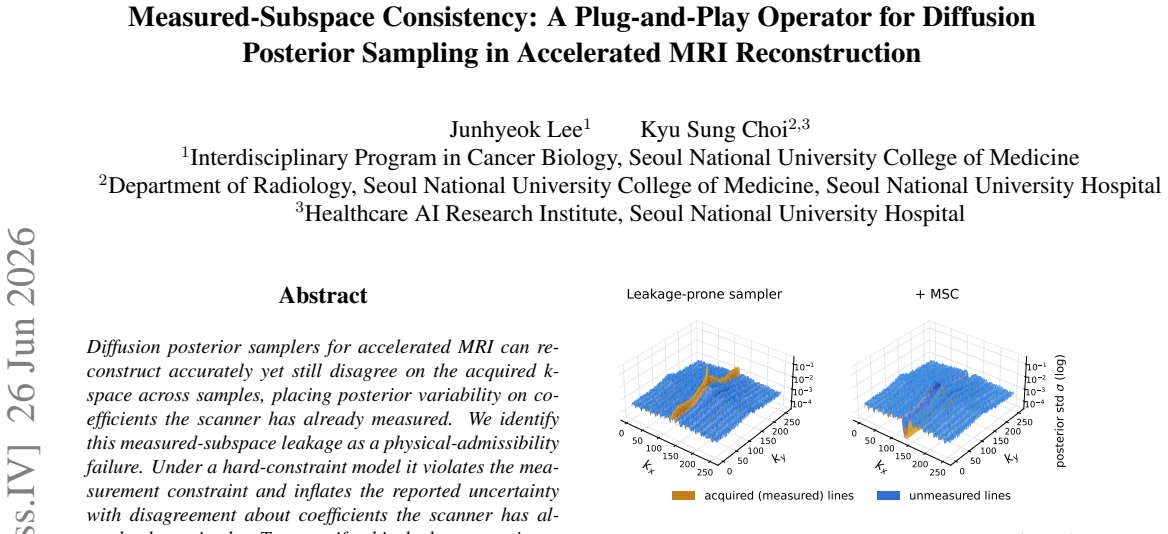
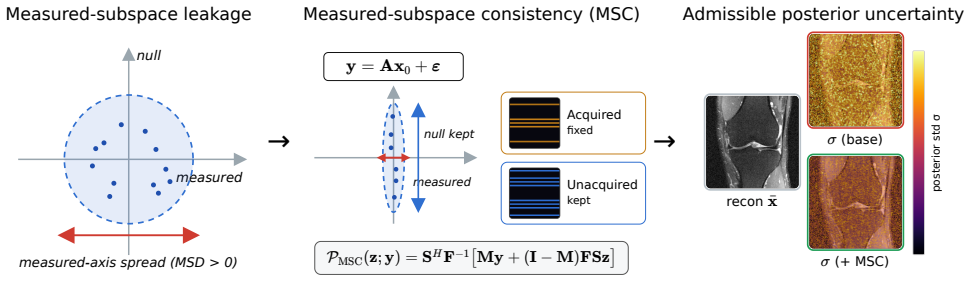
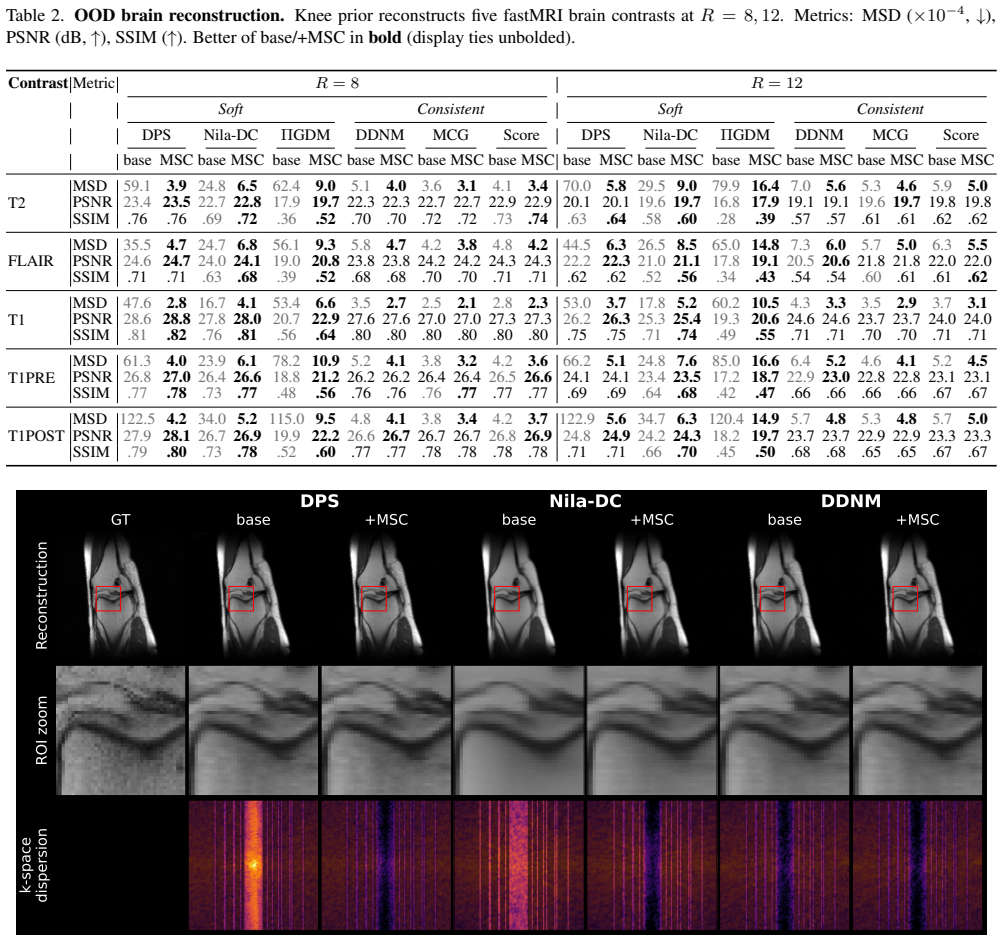
Measured-Subspace Consistency is a plug-and-play terminal correction that applies the standard range-null space multi-coil consistency transform to the output of any image-space posterior sampler. The ideal form of this transform confines all pairwise differences between samples strictly to the MRI null space. Practical sensitivity-weighted versions leave only a bounded residual cross-subspace coupling. Across base samplers this correction reduces measured-subspace k-space dispersion by a median 16.5 times for soft samplers such as DPS, up to 29 times on brain data, while acting as a near-identity map for already-consistent samplers and preserving unmeasured-subspace diversity.
What carries the argument
Measured-Subspace Consistency (MSC), the training-free operator that repurposes the classical multi-coil range-null space consistency lock as a black-box posterior audit and correction step rather than a new reconstructor.
If this is right
- MSC reduces measured-subspace dispersion by a median 16.5 times for DPS across five brain contrasts and up to 29 times.
- Unmeasured-subspace diversity remains intact after the correction.
- PSNR and SSIM are maintained or modestly improved with no retraining or retuning.
- The operator works across six different base samplers and two anatomies, including out-of-distribution transfer from knee prior to brain data.
- Computational overhead is negligible and the method acts as a near-identity map on already-consistent samplers.
Where Pith is reading between the lines
- The bounded residual coupling could serve as a quantitative diagnostic for the quality of coil sensitivity maps in deployed systems.
- Because MSC is sampler-agnostic it could be inserted into existing clinical pipelines that already use multiple diffusion models without requiring code changes.
- The same null-space confinement idea might apply to other linear inverse problems that use diffusion posterior sampling under partial measurements.
- Repeated application of MSC after each diffusion step rather than only at the end could further tighten the bound on measured leakage.
Load-bearing premise
Wrapping any compatible image-space posterior sampler with the standard multi-coil consistency lock does not alter the intended posterior distribution or introduce artifacts beyond the bounded residual coupling.
What would settle it
A direct check showing that after MSC the pairwise sample differences in measured k-space exceed the theoretical bound derived from the null-space projection, or that the distribution of unmeasured coefficients changes measurably compared with the base sampler.
Figures
read the original abstract
Diffusion posterior samplers for accelerated MRI can reconstruct accurately yet still disagree on the acquired k-space across samples, placing posterior variability on coefficients the scanner has already measured. We identify this measured-subspace leakage as a physical-admissibility failure. Under a hard-constraint model it violates the measurement constraint and inflates the reported uncertainty with disagreement about coefficients the scanner has already determined. To quantify this leakage, we introduce complementary measured- and unmeasured-subspace k-space dispersion metrics (MSD/USD). We then present Measured-Subspace Consistency (MSC), a training-free terminal correction that wraps any compatible image-space posterior sampler with a standard multi-coil consistency lock. The ideal lock follows classical range/null-space data consistency. Our contribution is to repurpose it as a black-box posterior audit and correction rather than a new reconstructor or learned sampler. Theoretically, we prove that the ideal transform confines pairwise sample differences to the MRI null space and bound the residual cross-subspace coupling left by practical sensitivity-weighted implementations. Across six base samplers and two MRI anatomies, including out-of-distribution transfer where a knee prior reconstructs brain, MSC substantially reduces measured-subspace dispersion for Soft samplers (a median 16.5x reduction for DPS across five brain contrasts, up to ~29x), while preserving unmeasured-subspace diversity and acting as a near-identity map for Consistent ones. Furthermore, MSC maintains or modestly improves PSNR/SSIM, with no retraining, retuning, or significant computational overhead.
Editorial analysis
A structured set of objections, weighed in public.
Referee Report
Summary. The paper identifies measured-subspace leakage in diffusion posterior samplers for accelerated MRI reconstruction, where samples disagree on already-acquired k-space coefficients. It introduces measured- and unmeasured-subspace dispersion metrics (MSD/USD), proposes Measured-Subspace Consistency (MSC) as a training-free plug-and-play terminal correction that wraps any compatible image-space sampler with a multi-coil consistency lock, proves that the ideal transform confines pairwise differences to the null space while bounding residual coupling from sensitivity-weighted implementations, and reports empirical MSD reductions (median 16.5x for DPS across five brain contrasts, up to ~29x) across six samplers and two anatomies while preserving USD and maintaining or improving PSNR/SSIM.
Significance. If the theoretical bound on residual coupling holds and the empirical preservation of unmeasured-subspace statistics is confirmed, MSC provides a lightweight, sampler-agnostic way to enforce physical admissibility in posterior sampling without retraining or altering the core sampler. This could improve the trustworthiness of uncertainty estimates in MRI applications. The repurposing of classical range/null data consistency as a black-box audit step, together with the OOD transfer results, represents a practical contribution to the field.
major comments (2)
- [Theoretical analysis] Theoretical proof (section on ideal MSC transform): the claim that the ideal transform confines pairwise sample differences to the MRI null space and that MSC acts purely as an audit-and-correction step without altering the intended posterior rests on the assumption that the multi-coil encoding admits an exact range/null decomposition. The paper must explicitly state the conditions under which sensitivity maps produce no residual leakage, because any deviation directly affects whether the bounded residual cross-subspace coupling preserves the original posterior distribution.
- [Experimental evaluation] Empirical results (section reporting MSD reductions): the median 16.5x MSD reduction for DPS (and up to ~29x) is central to the claim of substantial improvement for Soft samplers. To substantiate that this reduction does not introduce hidden projection bias, the manuscript should report direct before/after comparisons of unmeasured-subspace sample statistics or diversity metrics (e.g., variance or pairwise distances in the null space) rather than relying solely on the preservation statement.
minor comments (2)
- [Abstract] The abstract states results across 'six base samplers' but does not name them; adding the list (even in a footnote) would aid reproducibility.
- [Method] Notation for the measured- and unmeasured-subspace dispersion metrics (MSD/USD) should be defined at first use with explicit formulas, as the current description leaves the precise computation of dispersion ambiguous.
Simulated Author's Rebuttal
We thank the referee for their constructive comments. We address each major comment point by point below.
read point-by-point responses
-
Referee: [Theoretical analysis] Theoretical proof (section on ideal MSC transform): the claim that the ideal transform confines pairwise sample differences to the MRI null space and that MSC acts purely as an audit-and-correction step without altering the intended posterior rests on the assumption that the multi-coil encoding admits an exact range/null decomposition. The paper must explicitly state the conditions under which sensitivity maps produce no residual leakage, because any deviation directly affects whether the bounded residual cross-subspace coupling preserves the original posterior distribution.
Authors: We agree that the conditions for exact decomposition should be stated explicitly. In the revised manuscript we will add a dedicated paragraph in the theoretical analysis section clarifying that the ideal MSC transform assumes perfectly known coil sensitivity maps and noiseless measurements, under which the range/null decomposition is exact with zero residual leakage and MSC functions strictly as an audit-and-correction operator that leaves the intended posterior unchanged. For the practical sensitivity-weighted case already analyzed in the paper, the provided bound on residual cross-subspace coupling quantifies the approximation error, ensuring the posterior is preserved up to that explicitly bounded term. This addition directly addresses the concern. revision: yes
-
Referee: [Experimental evaluation] Empirical results (section reporting MSD reductions): the median 16.5x MSD reduction for DPS (and up to ~29x) is central to the claim of substantial improvement for Soft samplers. To substantiate that this reduction does not introduce hidden projection bias, the manuscript should report direct before/after comparisons of unmeasured-subspace sample statistics or diversity metrics (e.g., variance or pairwise distances in the null space) rather than relying solely on the preservation statement.
Authors: We agree that explicit before/after metrics would strengthen the empirical claim. Although the USD metric and qualitative preservation statements are already present, the revised manuscript will include additional tables and text reporting direct before-and-after comparisons of unmeasured-subspace variance and mean pairwise Euclidean distances within the null space for the primary samplers (including DPS). These will confirm that the observed MSD reductions occur without measurable contraction of null-space diversity, thereby ruling out hidden projection bias. revision: yes
Circularity Check
No significant circularity detected
full rationale
The paper's derivation relies on the classical range-null space decomposition of the MRI forward operator, an external linear-algebra fact, to prove that the ideal consistency lock confines sample differences to the null space; the reported bounds on residual coupling follow from the same standard sensitivity-weighted operator properties without self-definition or fitted parameters. MSD/USD metrics quantify an observable effect of applying this operator, and the empirical reduction factors are direct measurements of that effect rather than predictions that reduce to the method by construction. No self-citations, uniqueness theorems imported from prior author work, ansatzes smuggled via citation, or renamings of known results appear as load-bearing steps. The contribution is the repurposing of an existing consistency lock as a black-box audit, which remains independent of the inputs it acts upon.
Axiom & Free-Parameter Ledger
axioms (1)
- standard math Classical range/null-space data consistency in multi-coil MRI reconstruction
Reference graph
Works this paper leans on
-
[1]
Aggarwal, Merry P
Hemant K. Aggarwal, Merry P. Mani, and Mathews Jacob. MoDL: Model-based deep learning architecture for inverse problems.IEEE Transactions on Medical Imaging, 38(2): 394–405, 2019. 1
2019
-
[2]
Angelopoulos, Amit Pal Kohli, Stephen Bates, Michael Jordan, Jitendra Malik, Thayer Alshaabi, Srigokul Upadhyayula, and Yaniv Romano
Anastasios N. Angelopoulos, Amit Pal Kohli, Stephen Bates, Michael Jordan, Jitendra Malik, Thayer Alshaabi, Srigokul Upadhyayula, and Yaniv Romano. Image-to-image regres- sion with distribution-free uncertainty quantification and ap- plications in imaging. InInternational Conference on Ma- chine Learning (ICML), pages 717–730, 2022. 3
2022
-
[3]
Vegard Antun, Francesco Renna, Clarice Poon, Ben Adcock, and Anders C. Hansen. On instabilities of deep learning in image reconstruction and the potential costs of AI.Proceed- ings of the National Academy of Sciences, 117(48):30088– 30095, 2020. 2
2020
-
[4]
Kelkar, Frank J
Sayantan Bhadra, Varun A. Kelkar, Frank J. Brooks, and Mark A. Anastasio. On hallucinations in tomographic im- age reconstruction.IEEE Transactions on Medical Imaging, 40(11):3249–3260, 2021. 2
2021
-
[5]
Score-based diffusion models for accelerated MRI.Medical Image Analysis, 80: 102479, 2022
Hyungjin Chung and Jong Chul Ye. Score-based diffusion models for accelerated MRI.Medical Image Analysis, 80: 102479, 2022. 1, 2, 3, 6
2022
-
[6]
Improving diffusion models for inverse prob- lems using manifold constraints
Hyungjin Chung, Byeongsu Sim, Dohoon Ryu, and Jong Chul Ye. Improving diffusion models for inverse prob- lems using manifold constraints. InAdvances in Neural Information Processing Systems 35, pages 25683–25696. Neural Information Processing Systems Foundation, Inc. (NeurIPS), 2022. 2, 6
2022
-
[7]
McCann, Marc L
Hyungjin Chung, Jeongsol Kim, Michael T. McCann, Marc L. Klasky, and Jong Chul Ye. Diffusion posterior sam- pling for general noisy inverse problems. InInternational Conference on Learning Representations (ICLR), 2023. 2, 6
2023
-
[8]
Decom- posed diffusion sampler for accelerating large-scale inverse problems
Hyungjin Chung, Suhyeon Lee, and Jong Chul Ye. Decom- posed diffusion sampler for accelerating large-scale inverse problems. InInternational Conference on Learning Repre- sentations (ICLR), 2024. 3
2024
-
[9]
SPIRiT-diffusion: Self- consistency driven diffusion model for accelerated MRI
Zhuoxu Cui, Chentao Cao, Jing Cheng, Seng Jia, Hairong Zheng, Dong Liang, and Yanjie Zhu. SPIRiT-diffusion: Self- consistency driven diffusion model for accelerated MRI. IEEE Transactions on Medical Imaging, 44(2):1019–1031,
-
[10]
Vineet Edupuganti, Morteza Mardani, Shreyas Vasanawala, and John M. Pauly. Uncertainty quantification in deep MRI reconstruction.IEEE Transactions on Medical Imaging, 40 (1):239–250, 2021. 3
2021
-
[11]
Griswold, Peter M
Mark A. Griswold, Peter M. Jakob, Robin M. Heidemann, Mathias Nittka, Vladimir Jellus, Jianmin Wang, Berthold Kiefer, and Axel Haase. Generalized autocalibrating par- tially parallel acquisitions (GRAPPA).Magnetic Resonance in Medicine, 47(6):1202–1210, 2002. 3
2002
-
[12]
Wein- berger
Chuan Guo, Geoff Pleiss, Yu Sun, and Kilian Q. Wein- berger. On calibration of modern neural networks. InIn- ternational Conference on Machine Learning (ICML), pages 1321–1330, 2017. 3
2017
-
[13]
Recht, Daniel K
Kerstin Hammernik, Teresa Klatzer, Erich Kobler, Michael P. Recht, Daniel K. Sodickson, Thomas Pock, and Florian Knoll. Learning a variational network for recon- struction of accelerated MRI data.Magnetic Resonance in Medicine, 79(6):3055–3071, 2018. 1
2018
-
[14]
Denoising dif- fusion probabilistic models
Jonathan Ho, Ajay Jain, and Pieter Abbeel. Denoising dif- fusion probabilistic models. InAdvances in Neural Informa- tion Processing Systems (NeurIPS), pages 6840–6851, 2020. 1, 7
2020
-
[15]
Noise level adaptive diffusion model for robust reconstruction of accelerated MRI
Shoujin Huang, Guanxiong Luo, Xi Wang, Ziran Chen, Yuwan Wang, Huaishui Yang, Pheng-Ann Heng, Lingyan Zhang, and Mengye Lyu. Noise level adaptive diffusion model for robust reconstruction of accelerated MRI. InIn- ternational Conference on Medical Image Computing and Computer-Assisted Intervention, pages 498–508. Springer Nature Switzerland, 2024. 2, 6, 7
2024
-
[16]
Measurement-consistent langevin corrector for stabilizing latent diffusion inverse problem solvers, 2026
Lee Hyoseok, Sohwi Lim, Eunju Cha, and Tae-Hyun Oh. Measurement-consistent langevin corrector for stabilizing latent diffusion inverse problem solvers, 2026. Preprint. 2
2026
-
[17]
Tursunova, G
Fabian Isensee, Marianne Schell, I. Tursunova, G. Brugnara, D. Bonekamp, U. Neuberger, A. Wick, H. Schlemmer, S. Heiland, W. Wick, et al. Automated brain extraction of multi- sequence MRI using artificial neural networks.Human Brain Mapping, 40(17):4952–4964, 2019. 8
2019
-
[18]
Dimakis, and Jon Tamir
Ajil Jalal, Marius Arvinte, Giannis Daras, Eric Price, Alexandros G. Dimakis, and Jon Tamir. Robust compressed sensing MRI with deep generative priors. InAdvances in Neural Information Processing Systems (NeurIPS), pages 14938–14954, 2021. 1, 2, 3
2021
-
[19]
Denoising diffusion restoration models
Bahjat Kawar, Michael Elad, Stefano Ermon, and Jiaming Song. Denoising diffusion restoration models. InAd- vances in Neural Information Processing Systems (NeurIPS), pages 23593–23606. Neural Information Processing Sys- tems Foundation, Inc. (NeurIPS), 2022. 2, 4
2022
-
[20]
Sodickson, and Mehmet Akcakaya
Florian Knoll, Kerstin Hammernik, Chi Zhang, Steen Moeller, Thomas Pock, Daniel K. Sodickson, and Mehmet Akcakaya. Deep-learning methods for parallel magnetic res- onance imaging reconstruction: A survey of the current ap- proaches, trends, and issues.IEEE Signal Processing Maga- zine, 37(1):128–140, 2020. 1
2020
-
[21]
Accurate uncertainties for deep learning using calibrated re- gression
V olodymyr Kuleshov, Nathan Fenner, and Stefano Ermon. Accurate uncertainties for deep learning using calibrated re- gression. InInternational Conference on Machine Learning (ICML), pages 2801–2809, 2018. 3
2018
-
[22]
Michael Lustig and John M. Pauly. SPIRiT: Iterative self- consistent parallel imaging reconstruction from arbitrary k- space.Magnetic Resonance in Medicine, 64(2):457–471,
-
[23]
Michael Lustig, David Donoho, and John M. Pauly. Sparse MRI: The application of compressed sensing for rapid MR imaging.Magnetic Resonance in Medicine, 58(6):1182– 1195, 2007. 1
2007
-
[24]
Baumgartner, and Matthias Hein
Jan Nikolas Morshuis, Christian Schlarmann, Thomas K¨ustner, Christian F. Baumgartner, and Matthias Hein. Mind the detail: Uncovering clinically relevant image details in ac- celerated MRI with semantically diverse reconstructions. In International Conference on Medical Image Computing and Computer-Assisted Intervention, pages 356–366. Springer Nature Swi...
2025
-
[25]
Bayesian uncertainty estimation of learned variational MRI recon- struction.IEEE Transactions on Medical Imaging, 41(2): 279–291, 2022
Dominik Narnhofer, Alexander Effland, Erich Kobler, Ker- stin Hammernik, Florian Knoll, and Thomas Pock. Bayesian uncertainty estimation of learned variational MRI recon- struction.IEEE Transactions on Medical Imaging, 41(2): 279–291, 2022. 3
2022
-
[26]
Kevin Zhou, Vishal M
Cheng Peng, Pengfei Guo, S. Kevin Zhou, Vishal M. Pa- tel, and Rama Chellappa. Towards performant and reliable undersampled MR reconstruction via diffusion model sam- pling. InLecture Notes in Computer Science, pages 623–633. Springer Nature Switzerland, 2022. 2
2022
-
[27]
Pruessmann, Markus Weiger, Markus B
Klaas P. Pruessmann, Markus Weiger, Markus B. Scheideg- ger, and Peter Boesiger. SENSE: Sensitivity encoding for fast MRI.Magnetic Resonance in Medicine, 42(5):952–962,
-
[28]
Samsonov, Eugene G
Alexei A. Samsonov, Eugene G. Kholmovski, Dennis L. Parker, and Chris R. Johnson. POCSENSE: POCS-based reconstruction for sensitivity encoded magnetic resonance imaging.Magnetic Resonance in Medicine, 52(6):1397– 1406, 2004. 3, 4
2004
-
[29]
Solving inverse problems with latent diffusion models via hard data consistency
Bowen Song, Soo Min Kwon, Zecheng Zhang, Xinyu Hu, Qing Qu, and Liyue Shen. Solving inverse problems with latent diffusion models via hard data consistency. InInter- national Conference on Learning Representations (ICLR),
-
[30]
Pseudoinverse-guided diffusion models for inverse problems
Jiaming Song, Arash Vahdat, Morteza Mardani, and Jan Kautz. Pseudoinverse-guided diffusion models for inverse problems. InInternational Conference on Learning Repre- sentations (ICLR), 2023. 2, 6
2023
-
[31]
Generative modeling by estimating gradients of the data distribution
Yang Song and Stefano Ermon. Generative modeling by estimating gradients of the data distribution. InAdvances in Neural Information Processing Systems (NeurIPS), pages 11895–11907, 2019. 1
2019
-
[32]
Kingma, Ab- hishek Kumar, Stefano Ermon, and Ben Poole
Yang Song, Jascha Sohl-Dickstein, Diederik P. Kingma, Ab- hishek Kumar, Stefano Ermon, and Ben Poole. Score-based generative modeling through stochastic differential equa- tions. InInternational Conference on Learning Represen- tations (ICLR), 2021. 1
2021
-
[33]
Solv- ing inverse problems in medical imaging with score-based generative models
Yang Song, Liyue Shen, Lei Xing, and Stefano Ermon. Solv- ing inverse problems in medical imaging with score-based generative models. InInternational Conference on Learning Representations (ICLR), 2022. 1, 2, 6
2022
-
[34]
Webster Stayman, and Jeremias Sulam
Jacopo Teneggi, Matthew Tivnan, J. Webster Stayman, and Jeremias Sulam. How to trust your diffusion model: A con- vex optimization approach to conformal risk control. InIn- ternational Conference on Machine Learning (ICML), pages 33940–33960, 2023. 3
2023
-
[35]
Murphy, Patrick Virtue, Michael Elad, John M
Martin Uecker, Peng Lai, Mark J. Murphy, Patrick Virtue, Michael Elad, John M. Pauly, Shreyas S. Vasanawala, and Michael Lustig. ESPIRiT—an eigenvalue approach to au- tocalibrating parallel MRI: where SENSE meets GRAPPA. Magnetic Resonance in Medicine, 71(3):990–1001, 2014. 5
2014
-
[36]
Zero-shot im- age restoration using denoising diffusion null-space model
Yinhuai Wang, Jiwen Yu, and Jian Zhang. Zero-shot im- age restoration using denoising diffusion null-space model. InInternational Conference on Learning Representations (ICLR), 2023. 2, 4, 6
2023
-
[37]
Bovik, Hamid R
Zhou Wang, Alan C. Bovik, Hamid R. Sheikh, and Eero P. Simoncelli. Image quality assessment: From error visibility to structural similarity.IEEE Transactions on Image Pro- cessing, 13(4):600–612, 2004. 3
2004
-
[38]
fastMRI: An Open Dataset and Benchmarks for Accelerated MRI
Jure Zbontar, Florian Knoll, Anuroop Sriram, Tullie Mur- rell, Zhengnan Huang, Matthew J. Muckley, Aaron Defazio, Ruben Stern, Patricia Johnson, Mary Bruno, et al. fastMRI: An open dataset and benchmarks for accelerated MRI.arXiv preprint arXiv:1811.08839, abs/1811.08839, 2018. 5 10
work page internal anchor Pith review Pith/arXiv arXiv 2018
discussion (0)
Sign in with ORCID, Apple, or X to comment. Anyone can read and Pith papers without signing in.