REVIEW 3 major objections 5 minor 117 references
When the Shadow Meets Its Measure: Assessing the Feasibility of Submillimeter Black Hole Shadow Imaging in Megamaser Disk AGN
T0 review · 3 major / 5 minor · reviewed 2026-08-03 · deepseek-v4-flash
Pith's one-line read Among megamaser disk AGN, only NGC 4258 offers a black hole shadow resolvable with Earth–L2 space VLBI baselines, and its spin-offset test is blocked by 22 GHz maser astrometry precision.
desk verdict Useful, honest feasibility study; the geometry is solid, but the flux-based detectability conclusions rest on an unverified compactness assumption the authors themselves flag. read the letter →
The pith
A machine-rendered reading of the paper's core claim, the machinery that carries it, and where it could break.
The reading
What carries the argument
The machinery that carries the argument is a bridge from water-maser geometry to an observing program: a 21-galaxy sample whose 22 GHz masers pin down mass, distance, inclination, and dynamical center; the shadow formula θ_BHS = sqrt(27) R_S / D; the diffraction limit θ_VLBI = λ/D_BL for Earth-diameter, Earth–Moon, Earth–L2, and Earth–L4/L5 baselines; 200–400 GHz continuum fluxes with dust (α=+4.5) and jet (α=−0.5) extrapolations bounding contamination; and the astrometric relation σ_θ ∝ θ_VLBI/SNR paired with the maximal Kerr shadow offset ≈0.725 R_S (≈0.14 θ_BHS). The last element isolates the bottleneck: the 22 GHz dynamical center must be located ~55 times more precisely than today.
What would settle it
Measure NGC 4258 at ~230 GHz with the finest resolution available (a space-ground VLBI baseline, or a phased ground array with sub-milliarcsecond resolution) and compare the compact core flux with the ~7 mJy beam^-1 value measured at arcsecond resolution; if the resolved core is well below ~1 mJy, the claimed detectability and ADAF excess are unsupported. Alternatively, a multi-epoch monitoring campaign at matched beam sizes would test whether the apparent submillimeter excess is intrinsic or an artifact of variability and resolution mismatch.
Extended reading notes
Core claim
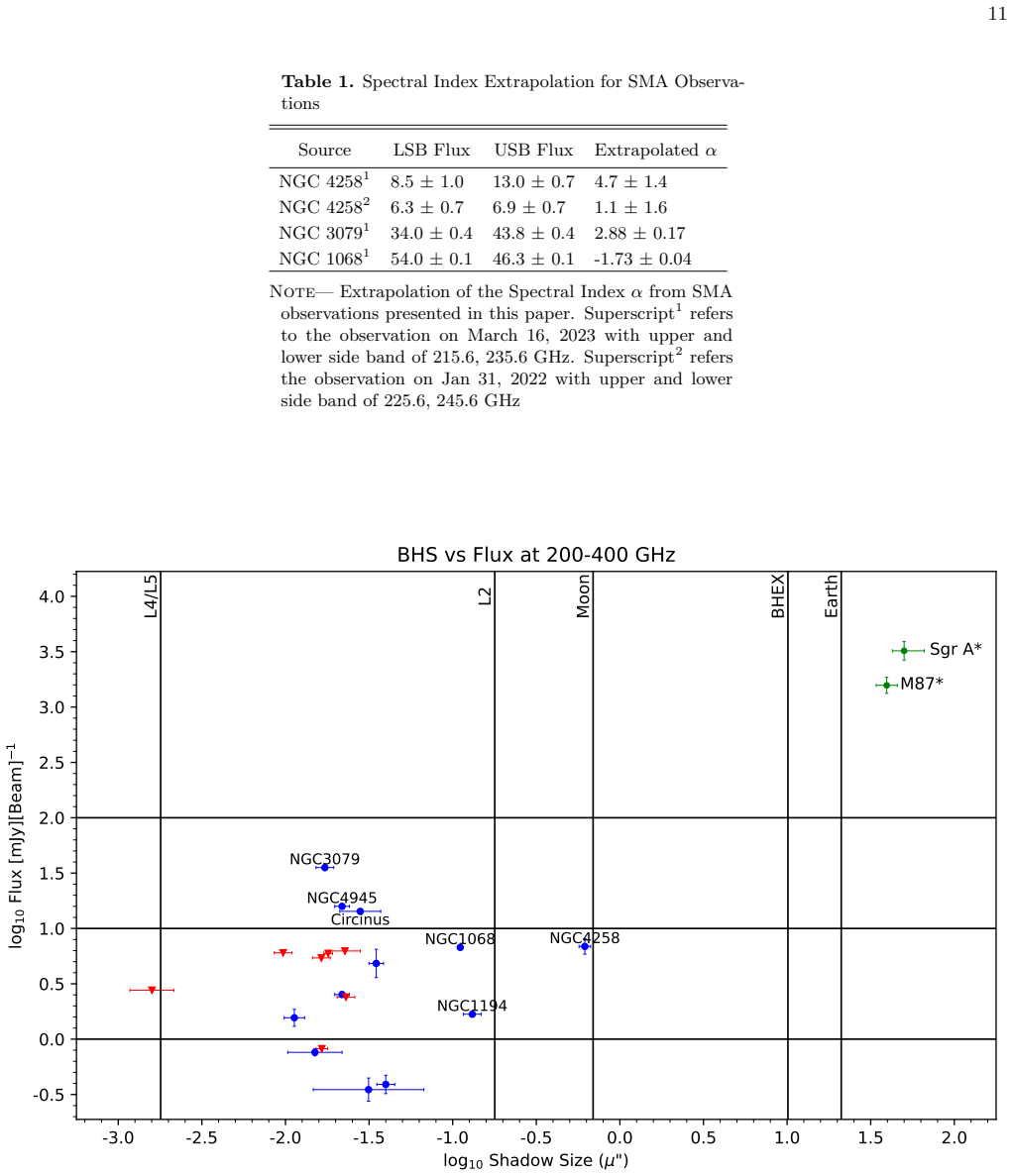
On its own terms, the paper establishes a feasibility ranking: NGC 4258 is the only megamaser disk AGN whose predicted shadow (0.617 ± 0.049 microarcseconds) is resolved by an Earth–L2 baseline and whose ~7 mJy beam^-1 core at 230 GHz is detectable; the next-largest targets (NGC 1194, NGC 1068) need baselines about 1.4–1.6× Earth–L2, and most of the 21-source sample needs Earth–L4/L5. It further finds a submillimeter excess in NGC 4258, bounded against dust and jet contamination, which it interprets as a thin disk persisting to ≲100 Schwarzschild radii with an advection-dominated flow inside. The third result is that the spin-dependent offset between the shadow and the maser dynamical center
Load-bearing premise
The load-bearing premise is that the arcsecond-resolution 200–400 GHz continuum measurements trace the AGN core rather than extended emission—a compactness check the paper explicitly did not perform (Sec 2.4, 5)—so if a large share of the measured flux is dust or jet emission, the detectability rankings, the ~7–10 mJy flux levels, and the submillimeter-excess/ADAF interpretation all weaken.
Editorial extensions
If this is right
- NGC 4258 is the only known megamaser disk AGN whose black hole shadow could be resolved with an Earth–L2 space-ground baseline; proposed missions at that baseline would be the natural first attempt.
- All other megamaser disk AGN in the sample—including NGC 1194 and NGC 1068, the next-largest shadows—require baselines beyond Earth–L2, approaching Earth–L4/L5, so they are out of reach for the near-term space VLBI concepts considered.
- Only a handful of sources (NGC 3079, NGC 4945, Circinus, NGC 1068) have 230 GHz core fluxes ≳10 mJy, so sensitivity is not the sole gate; angular size is the dominant selection criterion.
- The measured submillimeter excess in NGC 4258, with thermal-dust and jet contamination bounded low, supports a thin disk that survives to ≲100 Schwarzschild radii before transitioning to an advection-dominated flow—and implies the ADAF turnover frequency lies above 22 GHz.
- Detecting spin through the shadow–dynamical-center offset is formally possible with an Earth–Moon baseline at 230 GHz (SNR ≈ 3.6), but requires ~55× better 22 GHz maser dynamical-center astrometry than current measurements; without that, the spin measurement is infeasible.
Reading between the lines
- Because the paper leaves compactness untested at 200–400 GHz (it says so in Sec 2.4 and Sec 5), a high-resolution follow-up that resolves the NGC 4258 core at ~230 GHz would either confirm the ~7 mJy compact flux or invalidate the detectability and ADAF claims; this is the cheapest decisive experiment.
- The same shadow-size-versus-flux ranking could be applied to non-megamaser AGN with any precise dynamical-center tracer, turning this into a general target-selection template for space VLBI; the paper's method, not just its sample, is reusable.
- If submillimeter water maser transitions (183, 321, 439 GHz) are found in NGC 4258—which has not yet been searched—the cross-band 22-to-230 GHz registration problem disappears, and the spin-offset measurement becomes much more tractable than the 55× astrometry gain implied here.
Editorial analysis
A structured set of objections, weighed in public.
Referee Report
Summary. The paper assesses whether water megamaser disk AGN are viable targets for black hole shadow imaging with future space VLBI. Using published mass/distance/inclination measurements for 21 sources, new SMA observations, and archival ALMA/VLA data, it computes expected BHS angular sizes, estimates 230 GHz core flux densities with thermal-dust and extended-jet contamination bounds and variability systematics, and evaluates the astrometric precision needed to detect a spin-dependent BHS offset for NGC 4258. The main claims are that NGC 4258 is the only megamaser disk AGN resolvable on Earth-L2 baselines, that only a handful of sources have S230 ≳ 10 mJy/beam, and that the spin-offset measurement is currently limited by 22 GHz maser dynamical-center astrometry, not by BHS centroid precision.
Significance. If the flux estimates hold, this is a valuable target-selection reference for next-decade space VLBI missions: it combines a homogeneous Gaussian-fitting pipeline, new SMA observations, machine-readable continuum and variability tables, and an explicit astrometric-error budget for the spin-offset observable. The angular resolvability ranking follows directly from independently measured masses/distances and the diffraction limit, so the conclusion that NGC 4258 is by far the most favorable target in angular size is robust. The spin-offset argument is well posed and shows convincingly that maser dynamical-center astrometry, not BHS centroid noise, is the bottleneck. However, the flux-based detectability conclusions rest on an untested compactness assumption that the paper itself flags, and this must be resolved or reframed before the central claims can be accepted.
major comments (3)
- [§2.4, §5, Tables 5–10] The fluxes used as 'AGN-core' measurements are peak fluxes from Gaussians fixed to the synthesized beam at 3–6 arcsec resolution (e.g., NGC 4258: 6.9±1.1 mJy/beam in a 3.32 arcsec beam, Table 5). Such data do not distinguish a compact core from extended dust or jet/kpc-scale emission, and the paper explicitly states that a compactness analysis has not been performed and is 'an aspect neglected in this paper' (§5; see also the degeneracy between variability and compactness in §2.4). Because the detectability thresholds in Fig. 1 and the 'only NGC 4258 detectable on Earth-L2 baselines' claim require S230 to be core flux, this is load-bearing. Please either add a compactness analysis (e.g., uv-modeling, high-resolution archival data) or re-label these as upper limits and make the NGC 4258 detectability and ADAF statements explicitly conditional.
- [Table 1 and §4.1] The two SMA spectral indices of NGC 4258, α=4.7±1.4 and α=1.1±1.6, are mutually inconsistent—the text itself calls the discrepancy 'difficult to explain using any plausible physical mechanism'—yet the paper adopts α=2.9±2.1 and uses this average to support the submm-excess/ADAF interpretation. Averaging two discrepant values does not produce a reliable spectral index. The claimed thin-disk-to-ADAF transition should be presented as tentative pending additional SMA epochs, or the analysis should quantify the systematic origin of the discrepancy rather than simply combining the two measurements.
- [§3.4] In the Rayleigh-Jeans limit of the modified blackbody Sν=Aν^{β+3}/(e^{hν/kT}-1), with β=1.5 and T≳2000 K, the spectral index is α=β+2=3.5, not α=4.5; the quoted 4.5 appears to omit the factor ν in the Planck denominator. Using α=4.5 biases the thermal-dust upper limits low by roughly 30–40% over the frequency offsets used. Please correct the model and recompute the dust extrapolation entries in Tables 5–10. The changes are likely small for the currently listed sources, but the method as stated is incorrect.
minor comments (5)
- [Abstract vs §3.3/§6] The abstract says the required maser dynamical-center improvement is 'roughly seventy times,' while §3.3 and §6 state a factor of '~55' (5 µas / 0.09 µas ≈ 56). Please harmonize these numbers.
- [Table 2 note] The table note says '20 best known SMBH-Hosting Galaxies' while the text says 21; the table lists 21 megamaser systems plus Sgr A* and M87*. Correct the caption and note.
- [Table 4] The machine-readable variability table contains invalid dates such as 2017/06/31 and 1998/02/31. Correct or clarify these entries.
- [Figure 1 caption] The caption reads '• symbols represent detections, and ▼ symbols represent upper limits. • symbols represent M87, Sgr A* for comparison.' The second sentence is redundant/confusing and should be cleaned up.
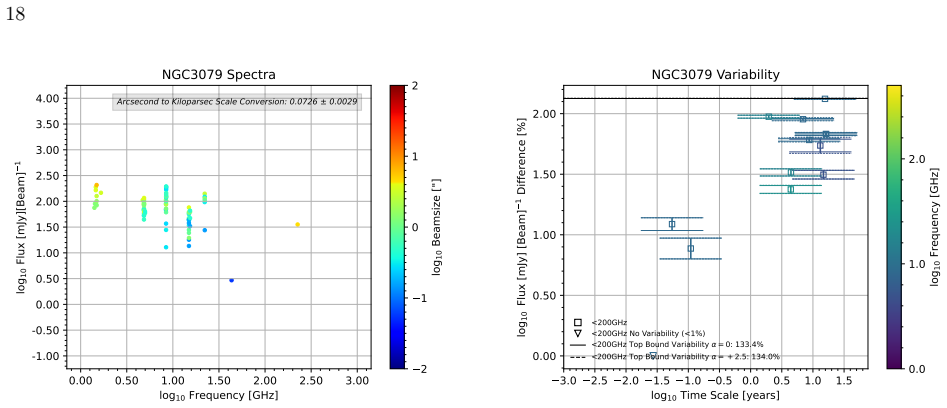
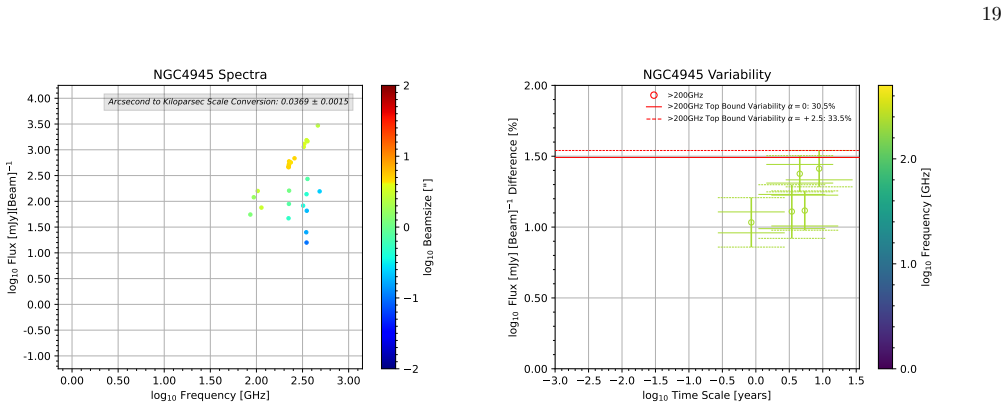
- [§3.5] The variability-pair selection thresholds (1.4% frequency, 2.6% beam size) are described as 'chosen empirically.' Please state the optimization criterion or provide a sensitivity test showing that the derived variability upper bounds do not depend strongly on the precise thresholds.
Circularity Check
No material circularity: BHS sizes, fluxes, and spin-offset feasibility use independent measurements and external theory; the self-flagged compactness caveat is a correctness risk, not a circular reduction.
full rationale
Walking the derivation chain: (1) BHS angular diameters come from Eq. 1 using published masses and distances (Greene et al. 2016; Pesce et al. 2018/2020; Reid et al. 2019); (2) baseline resolutions come from Eq. 2 and VLBI sensitivity from Eq. 3 with external SEFD/bandwidth parameters; (3) source flux densities are new SMA and archival ALMA/VLA Gaussian-fit measurements, not model predictions recycled into the feasibility claims; (4) the spin-offset requirement uses the theoretical 0.725 R_S offset (Takahashi 2004; Bronzwaer et al. 2020), the astrometric error relation of Reid et al. 1988, and the maser-center precision of Reid et al. 2019. The ~55x needed gain in maser astrometry is arithmetic from these independent inputs, not an identity. The paper explicitly flags the compactness of the arcsecond-scale fluxes as untested: Sec. 2.4 states 'a compactness analysis would need to be conducted; however, the sparse sampling of time and beam-size in our dataset introduces degeneracy between variability and compactness,' and Sec. 5 lists compactness as 'an aspect neglected in this paper.' This is a genuine threat to the flux-based conclusions if extended emission dominates, but it is an assumption about what was measured, not a circular reduction of a prediction to its inputs. Similarly, the internally inconsistent spectral indices for NGC 4258 (Table 1: alpha=4.7 +/- 1.4 vs 1.1 +/- 1.6) weaken the ADAF interpretation but are data-quality concerns, not circularity. The only self-citations (Burt et al. 2025; Burridge 2026) are peripheral; the coherence-time claim is corroborated by demonstrated 7-s integrations and independent Millimetron assumptions. Overall: self-contained against external benchmarks; no fitted parameter is renamed as a prediction; score 1 reflects only a minor, non-load-bearing self-citation.
Assumptions & free parameters
free parameters (4)
- thermal dust spectral index α_dust =
+4.5 (assumed)
- extended-jet spectral index α_jet =
−0.5 (assumed)
- optically thick AGN spectral index α_AGN =
+2.5 (assumed)
- variability pair-selection thresholds =
1.4% frequency, 2.6% beam-size
assumptions (6)
- standard math Schwarzschild shadow angular size θ_BHS = sqrt(27) R_S / D (Eq. 1)
- standard math Diffraction-limited fringe spacing θ_VLBI = λ / D_BL (Eq. 2)
- standard math VLBI thermal noise and astrometric centroid uncertainty formulas (Eqs. 3–4)
- domain assumption Water maser disk dynamical center coincides with the SMBH position and traces Keplerian rotation
- domain assumption Arcsecond-scale 200–400 GHz continuum emission is dominated by the AGN core
- domain assumption Thermal-dust contamination modeled as a 2000 K warm modified blackbody with β=1.5; jets/AGN follow α=-0.5/+2.5
Cite this review
Pith. "Pith review of When the Shadow Meets Its Measure: Assessing the Feasibility of Submillimeter Black Hole Shadow Imaging in Megamaser Disk AGN." pith.science (2026). https://pith.science/paper/OGKHLR64
@misc{pith2026260101763,
  author       = {Pith},
  title        = {Pith review of: When the Shadow Meets Its Measure: Assessing the Feasibility of Submillimeter Black Hole Shadow Imaging in Megamaser Disk AGN},
  year         = {2026},
  howpublished = {\url{https://pith.science/paper/OGKHLR64}},
  note         = {Machine review of arXiv:2601.01763}
}
abstract
Active galactic nuclei (AGN) hosting water megamaser disks provide precise geometric measurements of black hole mass, distance, maser disk orientation, and dynamical center. In anticipation of space-based very long baseline interferometry, these systems offer a path to black hole shadow (BHS) imaging beyond Sgr A* and M87*. We present new Submillimeter Array continuum observations of water megamaser galaxies, supplemented by archival ALMA and VLA measurements, to assess whether their AGN cores are bright enough for BHS-scale imaging. For a 21-source parent sample, we map the predicted BHS diameters of systems with published SMBH masses to submillimeter/millimeter (submm-mm) baseline requirements, estimate AGN core flux densities at 230 GHz while bounding thermal dust and extended-jet contamination and checking whether variability could affect the continuum estimates, and evaluate the astrometric precision required to detect spin-dependent BHS offsets for NGC 4258. NGC 4258 is the only source resolvable on Earth-L2 baselines; other targets require longer baselines approaching Earth-L4/L5 distances, and only a handful have $S_{230} \gtrsim 10$ mJy beam$^{-1}$. We also find a submillimeter excess in NGC 4258, suggesting that its disk remains geometrically thin to $\lesssim 100$ Schwarzschild radii before transitioning to an advection-dominated flow. Even for maximal spin, the formal 230 GHz BHS centroid precision is not the limiting term: the measurement would require locating the 22 GHz water maser dynamical center and registering it to the 230 GHz BHS image roughly seventy times more precisely than current maser astrometry allows, making the spin-offset measurement infeasible with present data.
Figures


Figures from the paper (4 more)


Reference graph
Works this paper leans on
-
[1]
2024, in Space Telescopes and Instrumentation 2024: Optical, Infrared, and Millimeter Wave, ed
Akiyama, K., Niinuma, K., Hada, K., et al. 2024, in Space Telescopes and Instrumentation 2024: Optical, Infrared, and Millimeter Wave, ed. L. E. Coyle, M. D. Perrin, & S. Matsuura (SPIE), 91, doi: 10.1117/12.3019968
-
[2]
D., Allende Prieto, C., Almeida, A., et al
Albareti, F. D., Allende Prieto, C., Almeida, A., et al. 2017, ApJS, 233, 25, doi: 10.3847/1538-4365/aa8992
-
[3]
Andrianov, A. S., Baryshev, A. M., Falcke, H., et al. 2020, Monthly Notices of the Royal Astronomical Society, 500, 4866, doi: 10.1093/mnras/staa2709
-
[4]
2024, ApJ, 964, 172, doi: 10.3847/1538-4357/ad2175 Bardeen
Baer-Way, R., DeGraw, A., Zheng, W., et al. 2024, ApJ, 964, 172, doi: 10.3847/1538-4357/ad2175 Bardeen. 1973, Black Holes (New York: Gordon and Breach)
-
[5]
Bendo, G. J., Henkel, C., D’Cruze, M. J., et al. 2016, Monthly Notices of the Royal Astronomical Society, 463, 252, doi: 10.1093/mnras/stw1659
-
[6]
Blandford, R. D., & K¨ onigl, A. 1979, ApJ, 232, 34, doi: 10.1086/157262
doi:10.1086/157262 1979
-
[7]
Blandford, R. D., & Ostriker, J. P. 1978, ApJL, 221, L29, doi: 10.1086/182658
doi:10.1086/182658 1978
-
[8]
Bolatto, A. D., Wolfire, M., & Leroy, A. K. 2013, ARA&A, 51, 207, doi: 10.1146/annurev-astro-082812-140944
Show all 117 references
-
[9]
C., Dexter, J., Markoff, S., et al
Bower, G. C., Dexter, J., Markoff, S., et al. 2015, ApJL, 811, L6, doi: 10.1088/2041-8205/811/1/L6
2015 doi
-
[10]
2011, Monthly Notices of the Royal Astronomical Society, 413, 1206, doi: 10.1111/j.1365-2966.2011.18207.x
Brightman, M., & Nandra, K. 2011, Monthly Notices of the Royal Astronomical Society, 413, 1206, doi: 10.1111/j.1365-2966.2011.18207.x
2011
-
[11]
2020, Monthly Notices of the Royal Astronomical Society, 501, 4722, doi: 10.1093/mnras/staa3430
Bronzwaer, T., Davelaar, J., Younsi, Z., et al. 2020, Monthly Notices of the Royal Astronomical Society, 501, 4722, doi: 10.1093/mnras/staa3430
2020 doi
-
[12]
2026, RomanBurridge/Burridge2025-WM-AGN-Analysis, Zenodo, doi: 10.5281/zenodo.18135781 24
Burridge, R. 2026, RomanBurridge/Burridge2025-WM-AGN-Analysis, Zenodo, doi: 10.5281/zenodo.18135781 24
2026 doi
-
[13]
2025, Frequency Standard Contributions to Limitations on the Signal-to-Noise Ratio in Very Long Baseline Interferometric (VLBI) Observations
Burt, E., Ely, T., Bower, G., et al. 2025, Frequency Standard Contributions to Limitations on the Signal-to-Noise Ratio in Very Long Baseline Interferometric (VLBI) Observations. https://arxiv.org/abs/2508.19123
2025 arXiv
-
[14]
M., Bentz, M
Cackett, E. M., Bentz, M. C., & Kara, E. 2021, iScience, 24, 102557, doi: 10.1016/j.isci.2021.102557
2021
-
[15]
Casey, C. M. 2012, MNRAS, 425, 3094, doi: 10.1111/j.1365-2966.2012.21455.x
2012
-
[16]
C., Dexter, J., et al
Chen, B.-Y., Bower, G. C., Dexter, J., et al. 2023, The Astrophysical Journal, 951, 93, doi: 10.3847/1538-4357/acd250
2023 doi
-
[17]
2019, Science, 365, 664, doi: 10.1126/science.aav8137
Do, T., Hees, A., Ghez, A., et al. 2019, Science, 365, 664, doi: 10.1126/science.aav8137
2019 doi
-
[18]
2005, Monthly Notices of the Royal Astronomical Society, 363, 692, doi: 10.1111/j.1365-2966.2005.09471.x
Doi, A., Kameno, S., Kohno, K., Nakanishi, K., & Inoue, M. 2005, Monthly Notices of the Royal Astronomical Society, 363, 692, doi: 10.1111/j.1365-2966.2005.09471.x
2005
-
[19]
2021, Monthly Notices of the Royal Astronomical Society, 512, 5183–5213, doi: 10.1093/mnras/stab3642
Efstathiou, A., Farrah, D., Afonso, J., et al. 2021, Monthly Notices of the Royal Astronomical Society, 512, 5183–5213, doi: 10.1093/mnras/stab3642
2021 doi
-
[21]
L., Bolatto, A
Emig, K. L., Bolatto, A. D., Leroy, A. K., et al. 2020, The Astrophysical Journal, 903, 50, doi: 10.3847/1538-4357/abb67d Event Horizon Telescope Collaboration, Akiyama, K.,
2020 doi
-
[22]
2019b, The Astrophysical Journal Letters, 875, L2, doi: 10.3847/2041-8213/ab0c96 —
Alberdi, A., et al. 2019b, The Astrophysical Journal Letters, 875, L2, doi: 10.3847/2041-8213/ab0c96 —. 2019f, The Astrophysical Journal Letters, 875, L6, doi: 10.3847/2041-8213/ab1141 —. 2021b, ApJL, 910, L13, doi: 10.3847/2041-8213/abe4de —. 2022d, The Astrophysical Journal ...
-
[23]
Fabian, A. C. 2012, ARA&A, 50, 455, doi: 10.1146/annurev-astro-081811-125521
2012 doi
-
[24]
C., Barcons, X., Almaini, O., & Iwasawa, K
Fabian, A. C., Barcons, X., Almaini, O., & Iwasawa, K. 1998, Monthly Notices of the Royal Astronomical Society, 297, L11, doi: 10.1046/j.1365-8711.1998.01645.x
1998
-
[25]
C., Johnson, M
Fischer, T. C., Johnson, M. C., Secrest, N. J., Crenshaw, D. M., & Kraemer, S. B. 2023, The Astrophysical Journal, 953, 87, doi: 10.3847/1538-4357/ace1f0
2023 doi
-
[26]
F., Baum, S
Gallimore, J. F., Baum, S. A., & O’Dea, C. P. 2004, ApJ, 613, 794, doi: 10.1086/423167
2004 doi
-
[27]
F., & Impellizzeri, C
Gallimore, J. F., & Impellizzeri, C. M. V. 2023, The Astrophysical Journal, 951, 109, doi: 10.3847/1538-4357/acd846
2023 doi
-
[28]
F., Impellizzeri, C
Gallimore, J. F., Impellizzeri, C. M. V., Aghelpasand, S., et al. 2024, The Discovery of Polarized Water Vapor Megamaser Emission in a Molecular Accretion Disk. https://arxiv.org/abs/2410.10569
2024 arXiv
-
[29]
A., Reid, M
Gao, F., Braatz, J. A., Reid, M. J., et al. 2016b, The Astrophysical Journal, 834, 52, doi: 10.3847/1538-4357/834/1/52
-
[30]
2011, The Astrophysical Journal, 729, 119, doi: 10.1088/0004-637X/729/2/119
Gebhardt, K., Adams, J., Richstone, D., et al. 2011, The Astrophysical Journal, 729, 119, doi: 10.1088/0004-637X/729/2/119
2011 doi
-
[31]
2021, ARA&A, 59, 21, doi: 10.1146/annurev-astro-111720-030029
Gezari, S. 2021, ARA&A, 59, 21, doi: 10.1146/annurev-astro-111720-030029
2021 doi
-
[32]
K., & Michel, D
Gliozzi, M., Williams, J. K., & Michel, D. A. 2021, Monthly Notices of the Royal Astronomical Society, 502, 3329–3342, doi: 10.1093/mnras/stab181
2021 doi
-
[33]
D., & Alexander, D
Goulding, A. D., & Alexander, D. M. 2009, Monthly Notices of the Royal Astronomical Society, 398, 1165, doi: 10.1111/j.1365-2966.2009.15194.x GRA VITY Collaboration, Abuter, R., Aimar, N., et al. 2022, A&A, 657, L12, doi: 10.1051/0004-6361/202142465
2009
-
[34]
D., Baudry, A., Richards, A
Gray, M. D., Baudry, A., Richards, A. M. S., et al. 2015, Monthly Notices of the Royal Astronomical Society, 456, 374, doi: 10.1093/mnras/stv2437
2015 doi
-
[35]
E., Seth, A., Kim, M., et al
Greene, J. E., Seth, A., Kim, M., et al. 2016, The Astrophysical Journal Letters, 826, L32, doi: 10.3847/2041-8205/826/2/L32
2016 doi
-
[36]
J., Gwinn, C
Greenhill, L. J., Gwinn, C. R., Antonucci, R., & Barvainis, R. 1996, The Astrophysical Journal, 472, L21, doi: 10.1086/310346
1996 doi
-
[37]
J., Moran, J
Greenhill, L. J., Moran, J. M., & Herrnstein, J. R. 1997, ApJL, 481, L23, doi: 10.1086/310643
1997 doi
-
[38]
J., Booth, R
Greenhill, L. J., Booth, R. S., Ellingsen, S. P., et al. 2003, ApJ, 590, 162, doi: 10.1086/374862
2003 doi
-
[39]
Hagiwara, Y., Horiuchi, S., Imanishi, M., & Edwards, P. G. 2021, The Astrophysical Journal, 923, 251, doi: 10.3847/1538-4357/ac3089
2021 doi
-
[40]
M., & Best, P
Heckman, T. M., & Best, P. N. 2014, ARA&A, 52, 589, doi: 10.1146/annurev-astro-081913-035722
2014 doi
-
[41]
R., Greenhill, L
Herrnstein, J. R., Greenhill, L. J., Moran, J. M., et al. 1998b, The Astrophysical Journal, 497, L69, doi: 10.1086/311284
-
[42]
R., Moran, J
Herrnstein, J. R., Moran, J. M., Greenhill, L. J., & Trotter, A. S. 2005, ApJ, 629, 719, doi: 10.1086/431421 25
2005 doi
-
[43]
2025, Lunar Orbital VLBI Experiment: motivation, scientific purposes and status
Hong, X., Wu, W., Liu, Q., et al. 2025, Lunar Orbital VLBI Experiment: motivation, scientific purposes and status. https://arxiv.org/abs/2507.16317
2025
-
[44]
2007, Astronomy & Astrophysics, 469, 899–912, doi: 10.1051/0004-6361:20077529
Hovatta, T., Tornikoski, M., Lainela, M., et al. 2007, Astronomy & Astrophysics, 469, 899–912, doi: 10.1051/0004-6361:20077529
2007 doi
-
[45]
P., Vogeley, M
Huchra, J. P., Vogeley, M. S., & Geller, M. J. 1999, ApJS, 121, 287, doi: 10.1086/313194
1999 doi
-
[46]
Humphreys, E. M. L., Greenhill, L. J., Reid, M. J., et al. 2005, ApJL, 634, L133, doi: 10.1086/498890
2005 doi
-
[47]
Humphreys, E. M. L., Reid, M. J., Greenhill, L. J., Moran, J. M., & Argon, A. L. 2008, ApJ, 672, 800, doi: 10.1086/523637
2008 doi
-
[48]
Humphreys, E. M. L., Vlemmings, W. H. T., Impellizzeri, C. M. V., et al. 2016, Astronomy & Astrophysics, 592, L13, doi: 10.1051/0004-6361/201629168
2016 doi
-
[49]
2014, Publications of the Astronomical Society of Japan, 66, L8, doi: 10.1093/pasj/psu079
Inoue, Y., & Doi, A. 2014, Publications of the Astronomical Society of Japan, 66, L8, doi: 10.1093/pasj/psu079
2014 doi
- [50]
-
[51]
2024, in Space Telescopes and Instrumentation 2024: Optical, Infrared, and Millimeter Wave, ed
Issaoun, S., Alonso, K., Akiyama, K., et al. 2024, in Space Telescopes and Instrumentation 2024: Optical, Infrared, and Millimeter Wave, ed. L. E. Coyle, M. D. Perrin, & S. Matsuura (SPIE), 193, doi: 10.1117/12.3020041
2024 doi
-
[52]
2022, Applications of the source-frequency phase-referencing technique for ngEHT observations
Jiang, W., Zhao, G.-Y., Shen, Z.-Q., et al. 2022, Applications of the source-frequency phase-referencing technique for ngEHT observations. https://arxiv.org/abs/2212.08994
2022 arXiv
-
[53]
2024, in Space Telescopes and Instrumentation 2024: Optical, Infrared, and Millimeter Wave, ed
Johnson, M., Akiyama, K., Baturin, R., et al. 2024, in Space Telescopes and Instrumentation 2024: Optical, Infrared, and Millimeter Wave, ed. L. E. Coyle, M. D. Perrin, & S. Matsuura (SPIE), 90, doi: 10.1117/12.3019835
2024 doi
-
[54]
2017, A&A, 605, A84, doi: 10.1051/0004-6361/201730899
Kamali, F., Henkel, C., Brunthaler, A., et al. 2017, A&A, 605, A84, doi: 10.1051/0004-6361/201730899
2017 doi
-
[55]
J., Pawlowski, M
Kanehisa, K. J., Pawlowski, M. S., M¨ uller, O., & Sohn, S. T. 2023, MNRAS, 519, 6184, doi: 10.1093/mnras/stad061
2023 doi
-
[56]
I., & Pauliny-Toth, I
Kellermann, K. I., & Pauliny-Toth, I. I. K. 1981, ARA&A, 19, 373, doi: 10.1146/annurev.aa.19.090181.002105
1981
-
[57]
C., & Evans, N
Kennicutt, R. C., & Evans, N. J. 2012, ARA&A, 50, 531, doi: 10.1146/annurev-astro-081811-125610
2012 doi
-
[58]
T., Greenhill, L
Kondratko, P. T., Greenhill, L. J., & Moran, J. M. 2005, ApJ, 618, 618, doi: 10.1086/426101
2005 doi
-
[59]
Kormendy, J., & Ho, L. C. 2013, ARA&A, 51, 511, doi: 10.1146/annurev-astro-082708-101811
2013 doi
-
[60]
J., Trakhtenbrot, B., Ricci, C., et al
Koss, M. J., Trakhtenbrot, B., Ricci, C., et al. 2022, ApJS, 261, 6, doi: 10.3847/1538-4365/ac650b
2022 doi
-
[61]
2006, A&A, 446, 113, doi: 10.1051/0004-6361:20053729
Krips, M., Eckart, A., Neri, R., et al. 2006, A&A, 446, 113, doi: 10.1051/0004-6361:20053729
2006 doi
-
[62]
Y., Braatz, J
Kuo, C. Y., Braatz, J. A., Condon, J. J., et al. 2010, The Astrophysical Journal, 727, 20, doi: 10.1088/0004-637X/727/1/20
2010 doi
-
[63]
P., Abramowicz, M
Lasota, J. P., Abramowicz, M. A., Chen, X., et al. 1996, ApJ, 462, 142, doi: 10.1086/177137
1996 doi
-
[64]
Lenc, E., & Tingay, S. J. 2009, AJ, 137, 537, doi: 10.1088/0004-6256/137/1/537
2009 doi
-
[65]
R., Ma, C.-P., & Walsh, J
Liepold, E. R., Ma, C.-P., & Walsh, J. L. 2023, The Astrophysical Journal Letters, 945, L35, doi: 10.3847/2041-8213/acbbcf
2023 doi
-
[66]
F., Rudnitskiy, A
Likhachev, S. F., Rudnitskiy, A. G., Shchurov, M. A., et al. 2022, Monthly Notices of the Royal Astronomical Society, 511, 668–682, doi: 10.1093/mnras/stac079
2022 doi
-
[67]
L., Cohen, M
Lister, M. L., Cohen, M. H., Homan, D. C., et al. 2009, AJ, 138, 1874, doi: 10.1088/0004-6256/138/6/1874
2009 doi
-
[68]
Lo, K. Y. 2005, ARA&A, 43, 625, doi: 10.1146/annurev.astro.41.011802.094927
2005 arXiv
-
[69]
1993, ApJS, 88, 383, doi: 10.1086/191826
Lamphier, C. 1993, ApJS, 88, 383, doi: 10.1086/191826
1993 doi
-
[70]
1997, ApJ, 477, 585, doi: 10.1086/303727
Mahadevan, R. 1997, ApJ, 477, 585, doi: 10.1086/303727
1997 doi
- [71]
- [72]
-
[73]
P., Roy, A
Middelberg, E., Krichbaum, T. P., Roy, A. L., Witzel, A., & Zensus, J. A. 2003, Approaching NGC3079 with VLBI. https://arxiv.org/abs/astro-ph/0309382
2003 arXiv
-
[74]
1996, A&A, 308, L1
Marconi, A., & Oliva, E. 1996, A&A, 308, L1
1996
-
[75]
2022, Publications of the Astronomical Society of Japan, 75, 71, doi: 10.1093/pasj/psac092
Nakai, N. 2022, Publications of the Astronomical Society of Japan, 75, 71, doi: 10.1093/pasj/psac092
2022 doi
-
[76]
J., Condon, J
Murphy, E. J., Condon, J. J., Schinnerer, E., et al. 2011, ApJ, 737, 67, doi: 10.1088/0004-637X/737/2/67
2011 doi
-
[77]
M., del Palacio, S., Beswick, R
Mutie, I. M., del Palacio, S., Beswick, R. J., et al. 2025, Monthly Notices of the Royal Astronomical Society, 539, 808, doi: 10.1093/mnras/staf524
2025 doi
-
[78]
M., Williams-Baldwin, D., Beswick, R
Mutie, I. M., Williams-Baldwin, D., Beswick, R. J., et al. 2024, Monthly Notices of the Royal Astronomical Society, 527, 11756, doi: 10.1093/mnras/stad3864
2024 doi
-
[79]
Muxlow, T. W. B., Pedlar, A., Holloway, A. J., Gallimore, J. F., & Antonucci, R. R. J. 1996, MNRAS, 278, 854, doi: 10.1093/mnras/278.3.854
1996 doi
-
[80]
1995, ApJ, 444, 231, doi: 10.1086/175599 26
Narayan, R., & Yi, I. 1995, ApJ, 444, 231, doi: 10.1086/175599 26
1995 doi
-
[81]
Nesterenok, A. V. 2015, Monthly Notices of the Royal Astronomical Society, 449, 2875, doi: 10.1093/mnras/stv485
2015 doi
-
[82]
D., Likhachev, S
Novikov, I. D., Likhachev, S. F., Shchekinov, Y. A., et al. 2021, Physics Uspekhi, 64, 386, doi: 10.3367/UFNe.2020.12.038898 P´ erez-Beaupuits, J. P., Spoon, H. W. W., Spaans, M., &
2021 doi
-
[83]
Smith, J. D. 2011, A&A, 533, A56, doi: 10.1051/0004-6361/201117153
2011 doi
- [84]
-
[85]
W., Braatz, J
Pesce, D. W., Braatz, J. A., Condon, J. J., et al. 2015, The Astrophysical Journal, 810, 65, doi: 10.1088/0004-637X/810/1/65
2015 doi
-
[86]
W., Braatz, J
Pesce, D. W., Braatz, J. A., Condon, J. J., & Greene, J. E. 2018, ApJ, 863, 149, doi: 10.3847/1538-4357/aad3c2
2018 doi
-
[87]
W., Braatz, J
Pesce, D. W., Braatz, J. A., Henkel, C., et al. 2023, The Astrophysical Journal, 948, 134, doi: 10.3847/1538-4357/acc57a
2023 doi
-
[88]
W., Braatz, J
Pesce, D. W., Braatz, J. A., & Impellizzeri, C. M. V. 2016, The Astrophysical Journal, 827, 68, doi: 10.3847/0004-637X/827/1/68
2016 doi
-
[89]
W., Braatz, J
Pesce, D. W., Braatz, J. A., Reid, M. J., et al. 2020a, ApJ, 890, 118, doi: 10.3847/1538-4357/ab6bcd —. 2020b, The Astrophysical Journal Letters, 891, L1, doi: 10.3847/2041-8213/ab75f0
-
[90]
W., Palumbo, D
Pesce, D. W., Palumbo, D. C. M., Narayan, R., et al. 2021, The Astrophysical Journal, 923, 260, doi: 10.3847/1538-4357/ac2eb5
2021 doi
-
[91]
A., Meisenheimer, K., Marco, O., et al
Prieto, M. A., Meisenheimer, K., Marco, O., et al. 2004, The Astrophysical Journal, 614, 135, doi: 10.1086/423422
2004 doi
-
[92]
J., Pesce, D
Reid, M. J., Pesce, D. W., & Riess, A. G. 2019, ApJL, 886, L27, doi: 10.3847/2041-8213/ab552d
2019 doi
-
[93]
J., Schneps, M
Reid, M. J., Schneps, M. H., Moran, J. M., et al. 1988, ApJ, 330, 809, doi: 10.1086/166514
1988 doi
-
[94]
M., White, C
Ressler, S. M., White, C. J., & Quataert, E. 2023, Monthly Notices of the Royal Astronomical Society, 521, 4277, doi: 10.1093/mnras/stad837
2023 doi
-
[95]
2013, MNRAS, 430, 2002, doi: 10.1093/mnras/stt026
Riffel, R., Rodr ´ ıguez-Ardila, A., Aleman, I., et al. 2013, MNRAS, 430, 2002, doi: 10.1093/mnras/stt026
2013 doi
-
[96]
B., & Lightman, A
Rybicki, G. B., & Lightman, A. P. 1979, Radiative processes in astrophysics
1979
-
[97]
K., Chang, D., & Kocherlakota, P
Salehi, K., Walia, R. K., Chang, D., & Kocherlakota, P. 2024, Influence of Observer Inclination and Spacetime Structure on Photon Ring Observables. https://arxiv.org/abs/2411.15310
2024 arXiv
-
[98]
M., et al
Sawada-Satoh, S., Inoue, M., Shibata, K. M., et al. 2000, PASJ, 52, 421, doi: 10.1093/pasj/52.3.421
2000 doi
-
[99]
F., & Finkbeiner, D
Schlafly, E. F., & Finkbeiner, D. P. 2011, ApJ, 737, 103, doi: 10.1088/0004-637X/737/2/103
2011 doi
-
[100]
S., Santoso, J
Shabala, S. S., Santoso, J. S., & Godfrey, L. E. H. 2012, The Astrophysical Journal, 756, 161, doi: 10.1088/0004-637x/756/2/161
2012 doi
-
[101]
A., Cappellari, M., & Hartke, J
Simon, D. A., Cappellari, M., & Hartke, J. 2024, MNRAS, 527, 2341, doi: 10.1093/mnras/stad3309
2024 doi
-
[102]
Spoon, H. W. W., Moorwood, A. F. M., Pontoppidan, K. M., et al. 2003, A&A, 402, 499, doi: 10.1051/0004-6361:20030290
2003 doi
-
[103]
M., Haynes, M
Springob, C. M., Haynes, M. P., Giovanelli, R., & Kent, B. R. 2005, ApJS, 160, 149, doi: 10.1086/431550
2005 doi
-
[104]
A., & Zapevalin, P
Shchurov, M. A., & Zapevalin, P. R. 2024, Orbit Design for the Millimetron Space Observatory. https://arxiv.org/abs/2410.20847
2024 arXiv
-
[105]
2004, ApJ, 611, 996, doi: 10.1086/422403
Takahashi, R. 2004, ApJ, 611, 996, doi: 10.1086/422403
2004 doi
-
[106]
M., et al
Thater, S., Krajnovi´ c, D., Weilbacher, P. M., et al. 2021, Monthly Notices of the Royal Astronomical Society, 509, 5416, doi: 10.1093/mnras/stab3210
2021 doi
-
[107]
2017, A&A, 599, A104, doi: 10.1051/0004-6361/201629813
Poulain, M. 2017, A&A, 599, A104, doi: 10.1051/0004-6361/201629813
2017 doi
-
[108]
S., Greenhill, L
Trotter, A. S., Greenhill, L. J., Moran, J. M., et al. 1998, ApJ, 495, 740, doi: 10.1086/305335 Trze´ sniewski, T., Czerny, B., Karas, V., et al. 2011, A&A, 530, A136, doi: 10.1051/0004-6361/201016369
1998 doi
-
[109]
B., Rizzi, L., Shaya, E
Tully, R. B., Rizzi, L., Shaya, E. J., et al. 2009, The Astronomical Journal, 138, 323, doi: 10.1088/0004-6256/138/2/323
2009 doi
-
[110]
S., Neff, S
Ulvestad, J. S., Neff, S. G., & Wilson, A. S. 1987, AJ, 93, 22, doi: 10.1086/114286
1987 doi
-
[111]
2022, Monthly Notices of the Royal Astronomical Society, 517, 4213, doi: 10.1093/mnras/stac2973
Villaraos, D., Herrera-Aguilar, A., Nucamendi, U., Gonz´ alez-Ju´ arez, G., & Lizardo-Castro, R. 2022, Monthly Notices of the Royal Astronomical Society, 517, 4213, doi: 10.1093/mnras/stac2973
2022 doi
-
[112]
Walker, R. C. 1995, in Astronomical Society of the Pacific Conference Series, Vol. 82, Very Long Baseline Interferometry and the VLBA, ed. J. A. Zensus, P. J. Diamond, & P. J. Napier, 133
1995
-
[113]
L., Barth, A
Walsh, J. L., Barth, A. J., Ho, L. C., & Sarzi, M. 2013, The Astrophysical Journal, 770, 86, doi: 10.1088/0004-637X/770/2/86
2013 doi
-
[114]
2022, ApJL, 930, L19, doi: 10.3847/2041-8213/ac6428
Wielgus, M., Marchili, N., Mart ´ ı-Vidal, I., et al. 2022, ApJL, 930, L19, doi: 10.3847/2041-8213/ac6428
2022 doi
-
[115]
S., & Reynolds, C
Yang, Y., Li, B., Wilson, A. S., & Reynolds, C. S. 2007, ApJ, 660, 1106, doi: 10.1086/512966
2007 doi
-
[116]
D., et al
Zhang, H., Bureau, M., Smith, M. D., et al. 2024, Monthly Notices of the Royal Astronomical Society, 530, 3240, doi: 10.1093/mnras/stae1106 27
2024 doi
-
[117]
A., Ricarte, A., Pesce, D
Zhang, X. A., Ricarte, A., Pesce, D. W., et al. 2025, The Astrophysical Journal, 985, 41, doi: 10.3847/1538-4357/adbd45
2025 doi
-
[118]
A., Condon, J
Zhao, W., Braatz, J. A., Condon, J. J., et al. 2018, ApJ, 854, 124, doi: 10.3847/1538-4357/aaa95c
2018 doi
Reviewed August 3, 2026 · model on record in the stance chip above.
Discussion (0). Sign in to comment.