REVIEW 2 major objections 3 minor 29 references
Acoustic vortex beams in synthetic magnetic fields
T0 review · 2 major / 3 minor · reviewed 2026-08-14 · deepseek-v4-flash
Pith's one-line read Rotating fluid acts as a magnetic field for sound vortex beams, splitting the response of pressure and velocity.
desk verdict The uniform-field central claim fails on a sign error in Eq. (25); the Bessel-beam half survives and the paper deserves a referee but with major revisions. read the letter →
The pith
A machine-rendered reading of the paper's core claim, the machinery that carries it, and where it could break.
The reading
What carries the argument
The central object is the four-component acoustic wavefunction |Ψ⟩ = (P, v)ᵀ and the coupled first-order equations for pressure and velocity, rather than the scalar velocity-potential equation alone. The load-bearing identity is the kinetic momentum decomposition Π/c² = p + (1/4)∇×S - (W/ω)A, with spin density S = (ρ/2ω) Im(v* × v). This identity makes the vectorial effects visible: the ∇×S term suppresses the longitudinal kinetic momentum near vortex cores, and the W A term couples momentum to the background flow. The two exact solution families—Laguerre-Gauss modes for a uniform synthetic field and Bessel beams for a synthetic flux tube—carry the paper's concrete predictions.
What would settle it
Measure, in a Couette-flow waveguide, the pressure and velocity profiles of Bessel beams with orbital angular momentum l and -l at fixed cylinder rotation, in the moderately non-paraxial regime. The paper predicts the beam radius shifts with sgn(αl) and the peak spin density S_z/W changes sign and magnitude with α; observing no such asymmetry, or finding that W depends on sgn(lΩ), would falsify the central claim.
Extended reading notes
Core claim
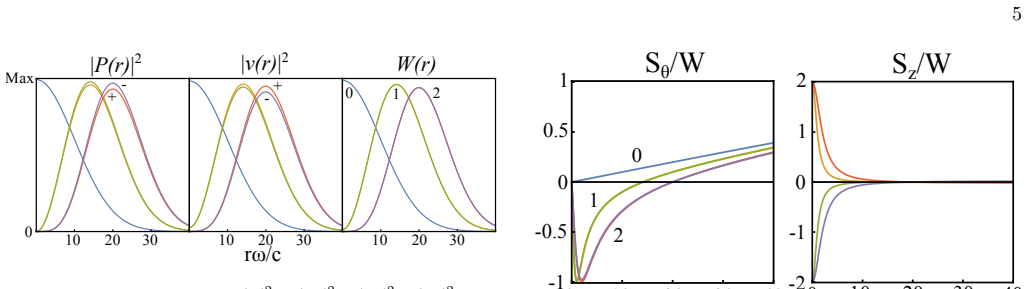
The paper shows that in a background flow u much slower than the sound speed c, the acoustic velocity potential obeys an effective Schrödinger equation with vector potential A = -ω u/c². In a cylindrical waveguide filled with Couette flow, two exact mode families solve this equation. A uniform synthetic field gives Laguerre-Gauss beams whose dispersion contains the Zeeman-like term 2lΩ₂/ω. The modal profiles and total energy density W are independent of sgn(lΩ₂), but the pressure density |P|² and the longitudinal velocity density |v_z|² shift in opposite directions, so a detector sensitive only to one field component can register the relative sign of orbital angular momentum and field. For an Aharonov-Bohm flux line, the Bessel beam solutions have velocity potential determined by l+α, yet the pressure, velocity, and energy profiles depend on l and α separately; the flux tunes both the beam radius and the magnitude and sign of the acoustic spin density. The paper concludes that synthetic magnetic fields provide a new control handle on acoustic spin and local momentum densities, with effects that are invisible in the scalar Schrödinger picture.
Load-bearing premise
The results rest on the approximation that the background flow is slow and slowly varying compared with the sound wave, so that the acoustic field obeys the effective Schrödinger equation with neglected terms of order (u/c)² and gradient corrections; if those terms matter for the moderately non-paraxial beams, the predicted component asymmetries could be modified.
Editorial extensions
If this is right
- A pressure-only detector and a velocity-sensitive probe would observe different sign-dependent shifts for the same acoustic vortex beam in a rotating-fluid waveguide.
- The Aharonov-Bohm flux provides a continuous knob for the beam radius and for the sign and magnitude of the longitudinal spin density, not just for the phase of the wavefunction.
- Synthetic magnetic fields allow spin and kinetic momentum densities to be controlled near zeros of the pressure field, where canonical and spin momentum point in opposite directions.
- Because the total energy density is sign-insensitive while the component densities are not, measurements of W alone cannot reveal the sign of the field-beam interaction.
- The comparison with electron vortex beams shows that vectorial field structure can break otherwise robust analogies between optical, electron, and acoustic waves.
Reading between the lines
- A differential measurement of |P|² and |v_z|² could act as a compact rotation-direction sensor in fluids, since the two components shift oppositely with sgn(lΩ₂).
- The same formalism suggests that acoustic surface waves in rotating fluids should exhibit unidirectional propagation and spin-momentum locking, extending the waveguide analysis to open geometries.
- The flux-dependent spin density might be exploitable for acoustic tweezers, as radiation forces on small particles couple to momentum and spin densities.
- A concrete testable extension: measure the beam radius and spin density of a non-paraxial Bessel beam while reversing the cylinder rotation direction; the paper's formalism predicts the radius increases for sgn(αl) > 0 relative to sgn(αl) < 0.
Signed reviews
Editorial analysis
A structured set of objections, weighed in public.
Referee Report
Summary. The paper studies acoustic vortex beams propagating through a fluid with a background azimuthal flow that acts as a synthetic vector potential. The authors derive an effective Schrödinger-like equation for the velocity potential, analyze two cylindrical geometries (a uniform synthetic magnetic field supporting Laguerre-Gauss modes and a synthetic Aharonov-Bohm flux tube supporting Bessel beams), and compute the acoustic pressure, velocity, energy, spin, and momentum densities. The main advertised finding is that, for non-paraxial beams, the individual pressure and velocity components are sensitive to the relative sign of the beam orbital angular momentum and the synthetic magnetic field, even when the total energy density is not, illustrating a qualitative difference from scalar electron vortex beams.
Significance. The paper is clearly written and the analytical framework is attractive: it connects acoustic vortex beams to the well-developed formalism of electron beams in magnetic fields and aims to expose genuine vectorial effects of acoustic fields. The Aharonov-Bohm flux-tube analysis, in particular, appears self-contained and yields concrete predictions for flux-dependent spin and momentum densities. The strengths are the explicit derivations and the care taken to state the validity constraints on the background flow. However, the uniform-field section contains a sign error in the dispersion relation that undermines the central claim of energy-density independence from the sign of the product lΩ2. Since this claim is highlighted in the introduction, figure captions, and conclusions, the paper cannot be accepted in its current form. The error is correctable by revision, and the remaining formalism and AB analysis may form a solid basis for a revised manuscript.
major comments (2)
- [Sec. IIIA, Eqs. (23)-(27)] Equation (25) has the wrong sign for the lΩ2 term. Direct substitution of the n=0, l=1 Laguerre-Gauss mode ψ = (r/w)e^{-r²/w²} with w² = 2c²/(ωΩ2) into Eq. (23) for Ω2 > 0 yields the eigenvalue (ω²/c² - 6ωΩ2/c²)ψ, so (ckz/ω)² = 1 - 6Ω2/ω, whereas Eq. (25) gives 1 - 2Ω2/ω. Repeating for l = -1 gives (ckz/ω)² = 1 - 2Ω2/ω, not 1 - 6Ω2/ω. The correct dispersion is (ckz/ω)² = 1 - 2lΩ2/ω - 2|Ω2|/ω(2n+|l|+1). Consequently Eq. (27) carries the wrong sign in its lΩ2 term: with the correct kz², the lΩ2 terms in β|P|² and ρ|vz|² add rather than cancel, and W is sensitive to sgn(lΩ2). The claimed W-independence in the text and in Fig. 3 is therefore not established. This is a load-bearing error for the uniform-field section.
- [Sec. II, Eq. (4) and Sec. IIIA] The paper states that Eq. (4) follows from Eq. (1) under u²/c² << 1, but Eq. (4) retains the |A|² term while dropping the (u·∇)² term. For the uniform-flow profile u = Ω2 r eθ these two terms are of different parametric order: at the beam waist, |A|² contributes at order Ω2/ω to the dispersion relation, whereas (u·∇)² = -(lΩ2)² is of order (Ω2/ω)². Since the localization of the Laguerre-Gauss modes and the l-dependent cutoff in Eq. (25) rely on the |A|² term, the paper should explicitly state the ordering that justifies retaining this term while neglecting (u·∇)². As written, the derivation of Eq. (4) is presented as a direct recasting and leaves this point unclear.
minor comments (3)
- [Sec. IIIB, after Eq. (29)] The numerical values Ω1 = 0.02 and R1 = 5 are quoted without units; since the figures use rω/c as the radial unit, please state R1 in units of c/ω and Ω1 in units of ω.
- [Eq. (22)] The typeset expression for the Couette flow profile is difficult to parse; please check the spacing and parentheses so that the two terms in Eq. (22) are unambiguous.
- [Sec. IIIA, discussion after Eq. (25)] Once the sign in Eq. (25) is corrected, the sentence describing the l-dependent modal cutoff should be revisited, since the condition for guided modes depends on the corrected dispersion.
Circularity Check
No significant circularity: the pressure/velocity asymmetries are derived from explicit exact solutions of the stated model, with no fitted parameters or load-bearing self-citations.
full rationale
The paper's derivation chain is self-contained and non-circular. It starts from the effective Schrödinger-type equation (4) for the acoustic velocity potential, obtained under explicitly stated weak-flow assumptions from prior acoustic literature; the target results are not used as inputs. The Laguerre-Gauss and Bessel solutions are standard exact solutions of the radial equations (23) and (28), and the subsequent field expressions (20)-(21) are direct definitions. Equations (26)-(27) for the pressure and longitudinal velocity densities are evaluations of |P|^2 = ρ^2(ω - u_θ l/r)^2 ψ^2 and |v_z|^2 = k_z^2 ψ^2 using the explicit dispersion relation (25); there is no parameter fitted to these profiles or to the claimed W-independence. The chosen cylinder radii and rotation speeds are illustrative operating points satisfying the stated validity constraints, not free parameters adjusted to force a conclusion. References to prior work, including the electron vortex beam formalism [22] and the acoustic vector-potential approximation [3,24], are external and are not self-citations by the present authors; no uniqueness theorem or ansatz is imported from the authors' own previous work. The skeptic's concern about the sign of the lΩ_2 term in Eq. (25) is a possible correctness or calculation error and would affect the validity of the uniform-field claim, but it is not circularity: the dispersion relation is an explicitly solved input, not a hidden restatement of the pressure/velocity asymmetry it is used to explain.
Assumptions & free parameters
free parameters (5)
- Omega_2/omega =
0.005
- R_2 omega/c =
40
- Omega_1 =
0.02 (in units omega=1)
- R_1 =
5 (in units c/omega)
- beam angle phi =
pi/8
assumptions (6)
- domain assumption Acoustic wave equation in a moving fluid, Eq. (1), with D_t = partial_t + u dot grad, from Refs. [3,24].
- domain assumption The effective Schrödinger equation (4) with vector potential A = -omega u/c^2 is valid when u^2/c^2 << 1 and u varies slowly compared with the acoustic wavelength.
- domain assumption Couette flow profile (22) between concentric rotating cylinders, including stability limit against Taylor instabilities.
- domain assumption Hard-wall Neumann boundary condition partial_r psi(R_1,2) = 0 for the velocity potential at the cylinder walls.
- standard math Definitions of energy, canonical momentum, spin, and angular momentum densities from the four-component acoustic wavefunction in Ref. [13].
- standard math Standard properties of Laguerre polynomials and Bessel functions, including linear dependence of J_n and J_{-n} for integer orders.
Cite this review
Pith. "Pith review of Acoustic vortex beams in synthetic magnetic fields." pith.science (2026). https://pith.science/paper/OGN4QSWH
@misc{pith2026190808278,
  author       = {Pith},
  title        = {Pith review of: Acoustic vortex beams in synthetic magnetic fields},
  year         = {2026},
  howpublished = {\url{https://pith.science/paper/OGN4QSWH}},
  note         = {Machine review of arXiv:1908.08278}
}
read the original abstract
We analyze propagation of acoustic vortex beams in longitudinal synthetic magnetic fields. We show how to generate two field configurations using a fluid contained in circulating cylinders: a uniform synthetic magnetic field hosting Laguerre-Gauss modes, and an Aharonov-Bohm flux tube hosting Bessel beams. For non-paraxial beams we find qualitative differences from the well-studied case of electron vortex beams in magnetic fields, arising due to the vectorial nature of the acoustic wave's velocity field. In particular, the pressure and velocity components of the acoustic wave can be individually sensitive to the relative sign of the beam orbital angular momentum and the magnetic field. Our findings illustrate how analogies between optical, electron, and acoustic vortex beams can break down in the presence of external vector potentials.
Figures


Figures from the paper (3 more)


Reference graph
Works this paper leans on
-
[1]
M. Z. Hasan and C. L. Kane, Colloquium: Topological insulators, Rev. Mod. Phys. 82, 3045 (2010)
2010
-
[2]
Ozawa, H
T. Ozawa, H. M. Price, A. Amo, N. Goldman, M. Hafezi, L. Lu, M. C. Rechtsman, D. Schuster, J. Simon, O. Zil- berberg, and I. Carusotto, Topological photonics, Rev. Mod. Phys. 91, 015006 (2019)
2019
-
[3]
Z. Yang, F. Gao, X. Shi, X. Lin, Z. Gao, Y. D. Chong, and B. Zhang, Topological acoustics, Phys. Rev. Lett. 114, 114301 (2015)
work page 2015
-
[4]
H. Ge, X. Ni, Y. Tian, S. K. Gupta, M.-H. Lu, X. Lin, W.-D. Huang, C. T. Chan, and Y.-F. Chen, Experimen- tal observation of acoustic Weyl points and topological surface states, Phys. Rev. Appl. 10, 014017 (2018)
work page 2018
-
[5]
S. Wang, G. Ma, and C. T. Chan, Topological transport of sound mediated by spin-redirection geometric phase , Science Adv. 4, eaaq1475 (2018)
work page 2018
-
[6]
G. Ma, M. Xiao, and C. T. Chan, Topological phases in acoustic and mechanical systems , Nature Rev. Phys. 1, 281 (2019)
work page 2019
-
[7]
D. L. Andrews and M. Babiker, The Angular Momentum of Light, Cambridge University Press (2013)
work page 2013
-
[8]
K. Y. Bliokh, I. P. Ivanov, G. Guzzinati, L. Clark, R. Van Boxem, A. Beche, R. Juchtmans, M. A. Alonso, P. Schattschneider, F. Nori, and J. Verbeeck, Theory and applications of free-electron vortex states , Physics Re- ports 690, 1 (2017)
work page 2017
Show all 29 references
-
[9]
K. Y. Bliokh, F. J. Rodriguez-Fortuno, F. Nori, and A. V. Zayats, Spin-orbit interactions of light , Nature Photon. 9, 796 (2015)
2015
-
[10]
Y. Long, J. Ren and H. Chen, Intrinsic spin of elastic waves, Proc. Natl. Acad. Sci. 115, 9951 (2018)
2018
-
[11]
C. Shi, R. Zhao, Y. Long, S. Yang, Y. Wang, H. Chen, H. Ren, and X. Zhang, Observation of acoustic spin , Na- tional Science Review nwz059, (2019)
2019
-
[12]
K. Y. Bliokh and F. Nori, Transverse spin and sur- face waves in acoustic metamaterials , Phys. Rev. B 99, 020301(R) (2018)
2018
-
[13]
K. Y. Bliokh and F. Nori, Spin and orbital angular mo- mentum of acoustic beams , Phys. Rev. B 99, 174310 (2019)
2019
-
[14]
K. Y. Bliokh and F. Nori, Klein-Gordon representation of acoustic waves and topological origin of acoustic surface modes, Phys. Rev. Lett. 123, 054301 (2019)
2019
-
[15]
Baresch, J.-L
D. Baresch, J.-L. Thomas, and R. Marchiano, Orbital angular momentum transfer to stably trapped elastic par- ticles in acoustical vortex beams , Phys. Rev. Lett. 121, 074301 (2018)
2018
-
[16]
Lekner, Acoustic beams with orbital angular momen- tum, J
J. Lekner, Acoustic beams with orbital angular momen- tum, J. Acous. Soc. Am. 120, 3475 (2006)
2006
-
[17]
K. Y. Bliokh, M. A. Alonso, E. A. Ostrovskaya, and A. Aiello, Angular momentum and spin-orbit interaction of nonparaxial light in free space , Phys. Rev. A 82, 063825 (2010)
2010
-
[18]
Zhang and P
L. Zhang and P. L. Marston, Angular momentum flux of nonparaxial acoustic vortex beams and torques on ax- isymmetric objects, Phys. Rev. E 84, 065601(R) (2011)
2011
-
[19]
F. Liu, W. Li, Z. Pu, and M. Ke, Acoustic waves splitter employing orbital angular momentum , Appl. Phys. Lett. 114, 193501 (2019)
2019
-
[20]
M. V. Berry, R. G. Chambers, M. D. Large, C. Up- still, and J. C. Walmsley, Wavefront dislocations in the Aharonov-Bohm effect and its water wave analogue , Eur. J. Phys. 1, 154 (1980)
1980
-
[21]
Fleury, D
R. Fleury, D. L. Sounas, C. F. Sieck, M. R. Haberman, and A. Alu, Sound isolation and giant linear nonreciproc- ity in a compact acoustic circulator , Science 343, 516 (2014)
2014
-
[22]
K. Y. Bliokh, P. Schattschneider, J. Verbeeck, and F. Nori, Electron vortex beams in a magnetic field: a new twist on Landau levels and Aharonov-Bohm states , Phys. Rev. X 2, 041011 (2012)
2012
-
[23]
C. D. Andereck, S. S. Liu, and H. L. Swinney, Flow regimes in a circular Couette system with independently rotating cylinders, J. Fluid Mechanics 164, 155 (1986)
1986
-
[24]
A. D. Pierce, Wave equation for sound in fluids with un- steady inhomogeneous flow, J. Acoust. Soc. Am. 87, 2292 (1990)
1990
-
[25]
Aharonov and D
Y. Aharonov and D. Bohm, Significance of electromag- netic potentials in the quantum theory , Phys. Rev. 115, 485 (1959)
1959
-
[26]
K. Y. Bliokh, F. J. Rodriguez-Fortuno, A. Y. Bekshaev, Y. S. Kivshar, and F. Nori, Electric-current-induced unidirectional propagation of surface plasmon-polaritons, Opt. Lett. 43, 963 (2018)
2018
-
[27]
I. D. Toftul, K. Y. Bliokh, M. I. Petrov, and F. Nori, Acoustic radiation force and torque on small particles , arXiv:1905.12216
1905 arXiv
-
[28]
Jiang, Y.-Y
Z.-Q. Jiang, Y.-Y. Wang, J. Yao, D.-J. Wu, and X.-J. Liu, Acoustic radiation forces on three-layered drug particles in focused Gaussian beams , J. Acoust. Soc. Am. 145, 1331 (2019)
2019
-
[29]
M. V. Berry and P. Shukla, Geometry of 3D monochro- matic light: local wavevectors, phases, curl forces, and superoscillations, J. Opt. 21, 064002 (2019)
2019
Reviewed August 14, 2026 · model on record in the stance chip above.
Discussion (0). Continue with ORCID to comment.