The antiferromagnetic transition in the frustrated bixbyite β-Fe₂O₃ magnet
Pith reviewed 2026-06-26 22:50 UTC · model grok-4.3
The pith
The antiferromagnetic transition in β-Fe₂O₃ proceeds via activation of the mH₁⁺ irrep at the H-point with antitranslation symmetry, yielding a primitive magnetic cell of non-polar type-IV symmetry.
A machine-rendered reading of the paper's core claim, the machinery that carries it, and where it could break.
Core claim
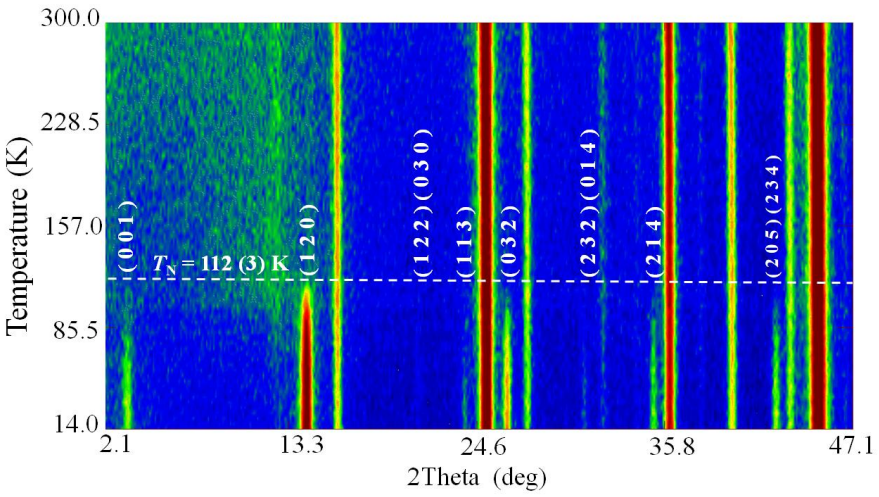
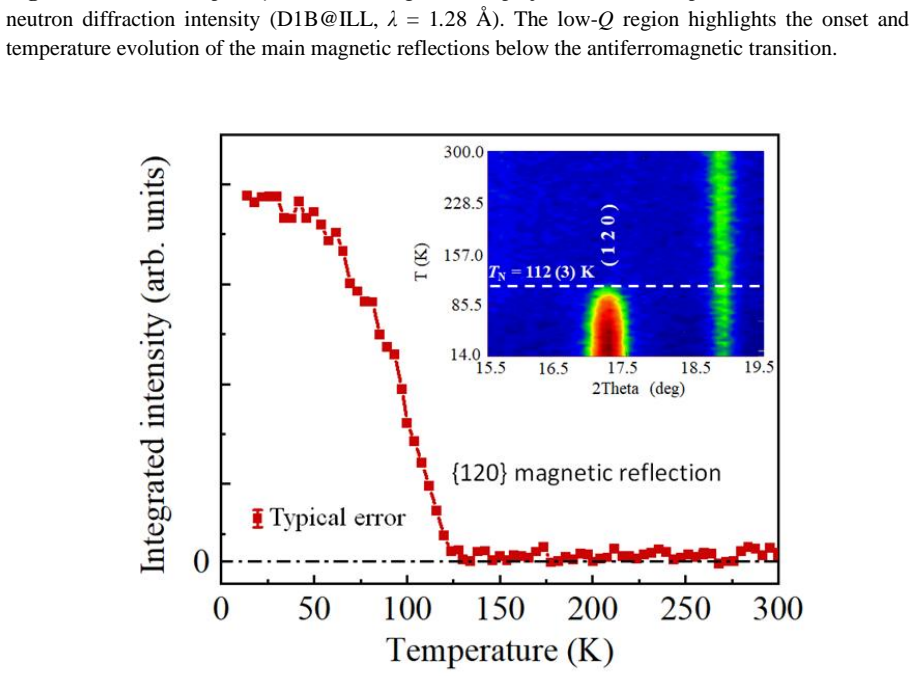
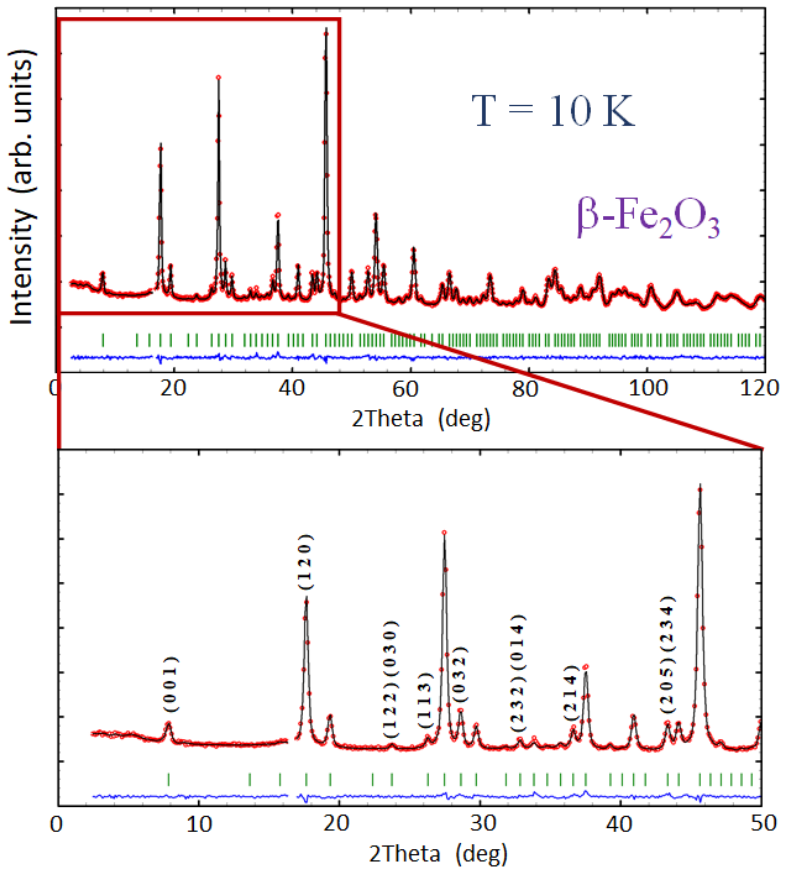
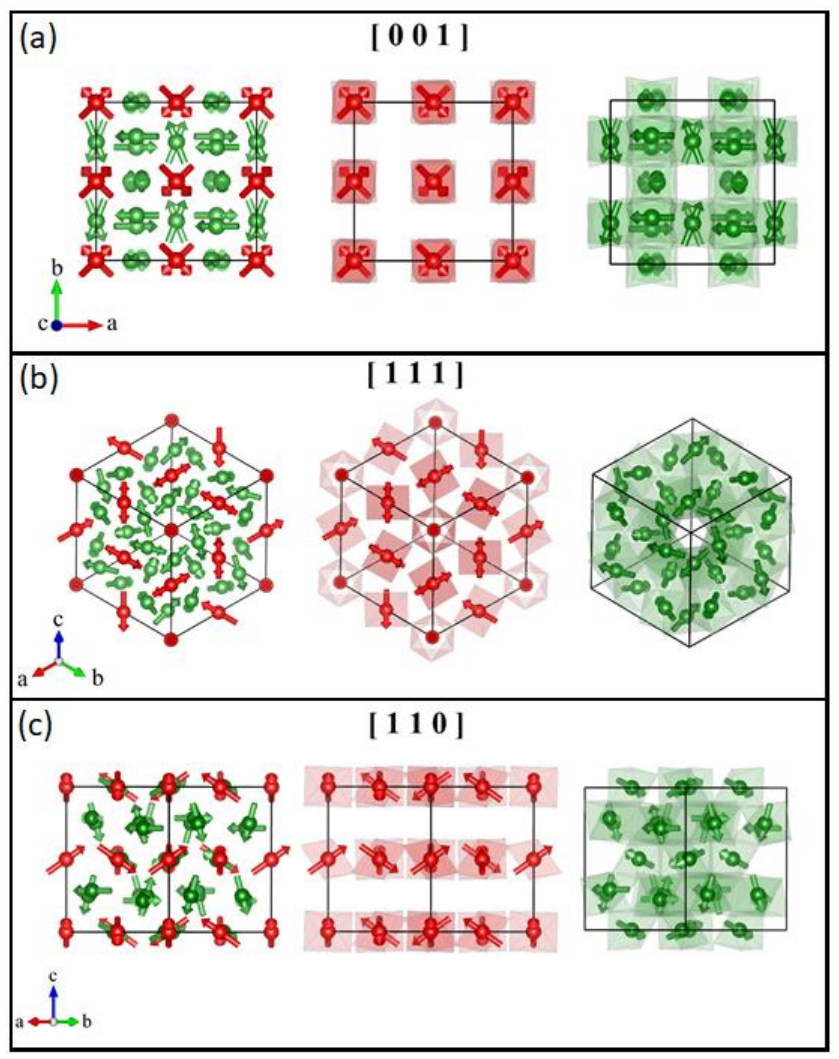
A noncollinear antiferromagnetic structure sets in abruptly via activation of irrep mH₁⁺ at the H-point [k=(1,1,1)] together with antitranslation (1'|½,½,½). Below T_N, the magnetic cell becomes primitive (P_I a3̄), yielding two interpenetrating primitive cubic subcells with inverted moments and non-polar type-IV symmetry. All Fe³⁺-O-Fe³⁺ exchanges are antiferromagnetic, and the bixbyite structure promotes geometric frustration and noncollinear magnetism through coexisting magnetic sublattices with distinct symmetries and easy axes.
What carries the argument
The mH₁⁺ irreducible representation at the H-point combined with the antitranslation symmetry operation, which determines the noncollinear spin arrangement and reduces the magnetic cell to primitive symmetry.
If this is right
- All Fe³⁺-O-Fe³⁺ superexchange interactions are antiferromagnetic.
- The magnetic structure has non-polar type-IV symmetry.
- The frustration index reaches f ≃ 7.6, among the highest for binary magnetic oxides.
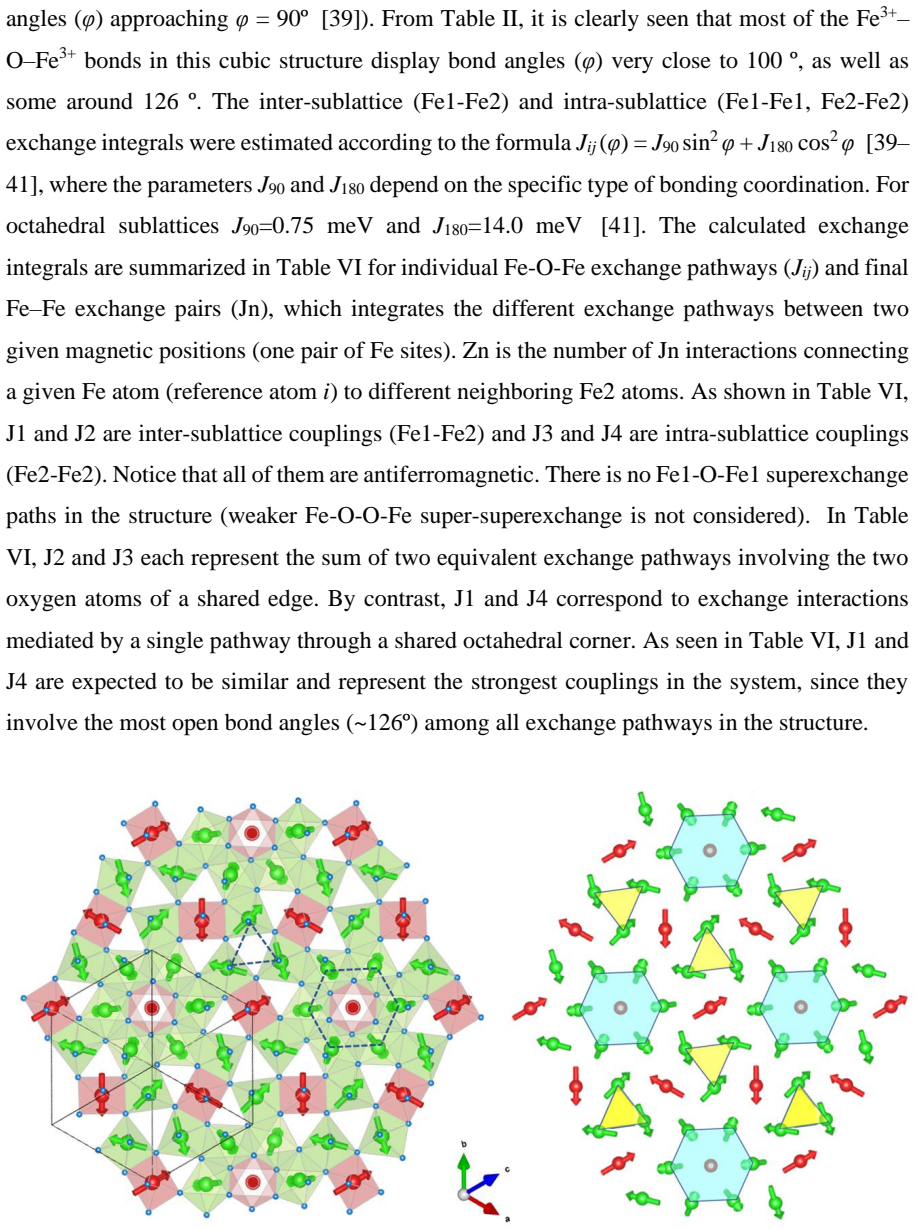
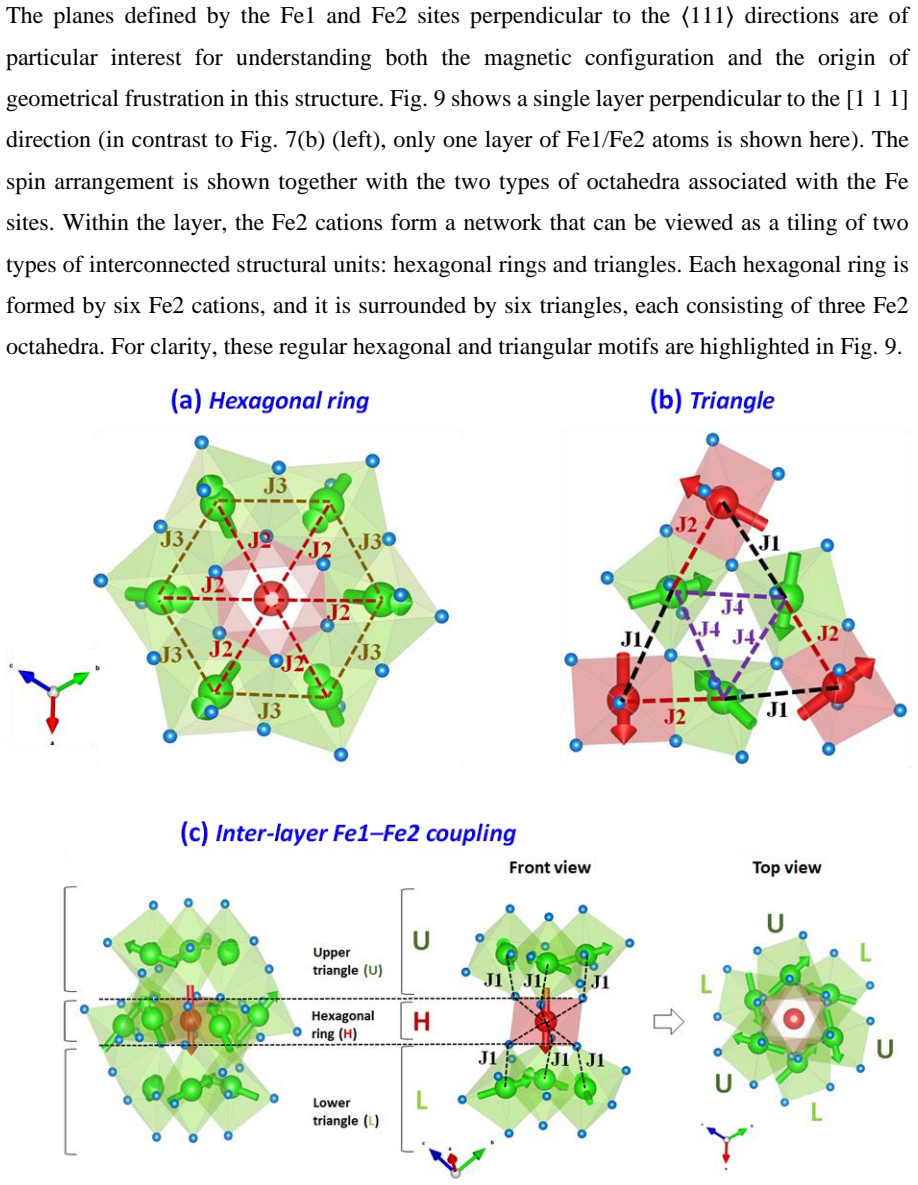
- Distorted Fe2O₆ octahedra form hexagonal rings in {111} planes that could host switchable magnetic states via central Fe1 ions with Ising-like anisotropy.
Where Pith is reading between the lines
- The high frustration may imply degenerate ground states or slow relaxation that could be tested with low-temperature susceptibility or muon spin rotation measurements.
- Analogous noncollinear structures and frustration might occur in other bixbyite compounds containing multiple distinct magnetic sublattices.
- The identified symmetry and anisotropy features could be used to engineer magnetoelectric coupling or tunable magnetic switching in related oxide lattices.
Load-bearing premise
The neutron and synchrotron diffraction intensities uniquely select the mH₁⁺ irrep and the associated antitranslation symmetry, with no significant contribution from other irreps or magnetic domains that could produce equivalent or better fits to the same data.
What would settle it
A different magnetic structure model that fits the observed neutron and synchrotron diffraction intensities at least as well as mH₁⁺ plus the antitranslation, or the detection of additional Bragg peaks inconsistent with the proposed propagation vector and symmetry.
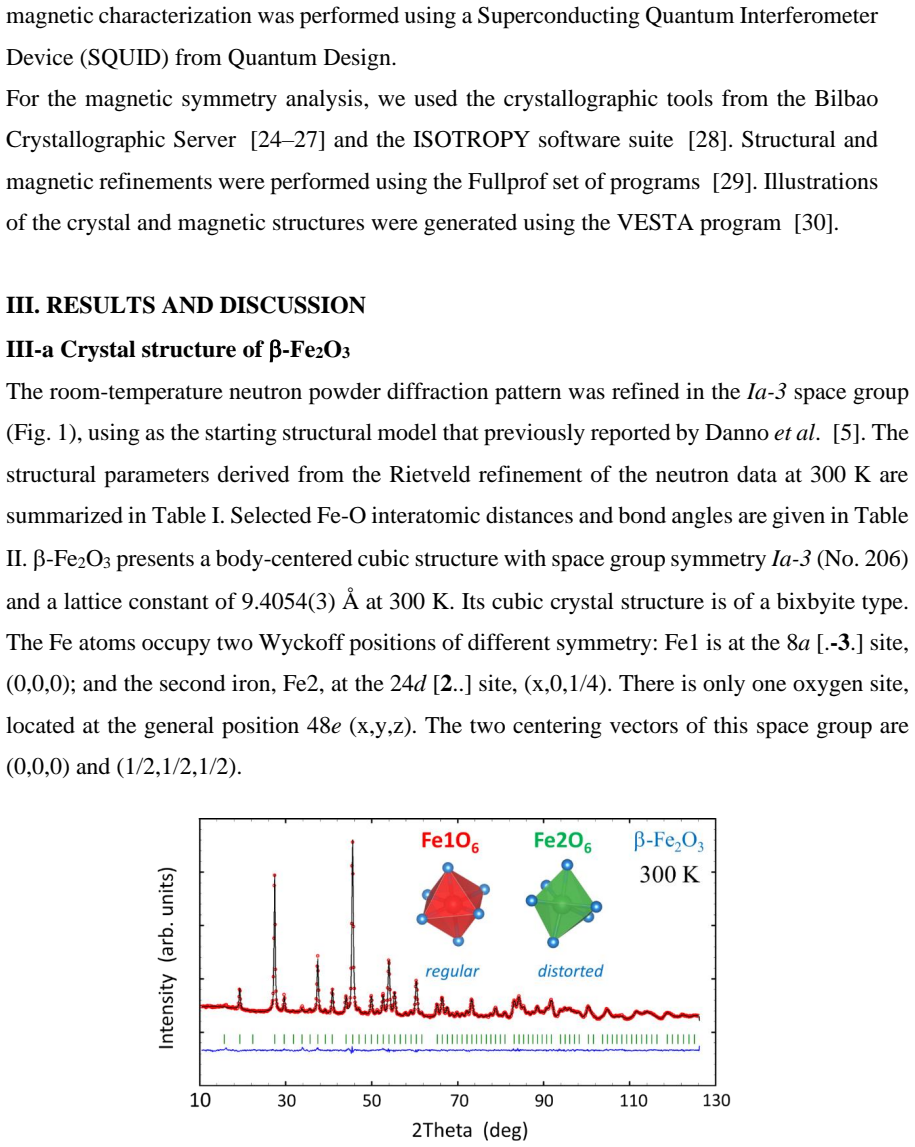
Figures
read the original abstract
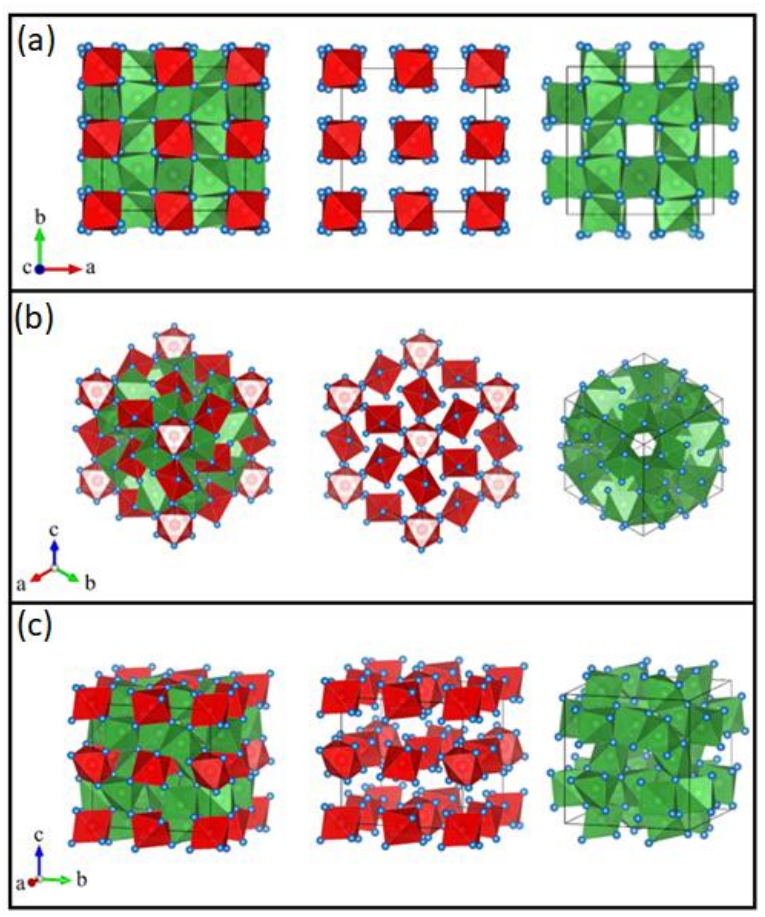
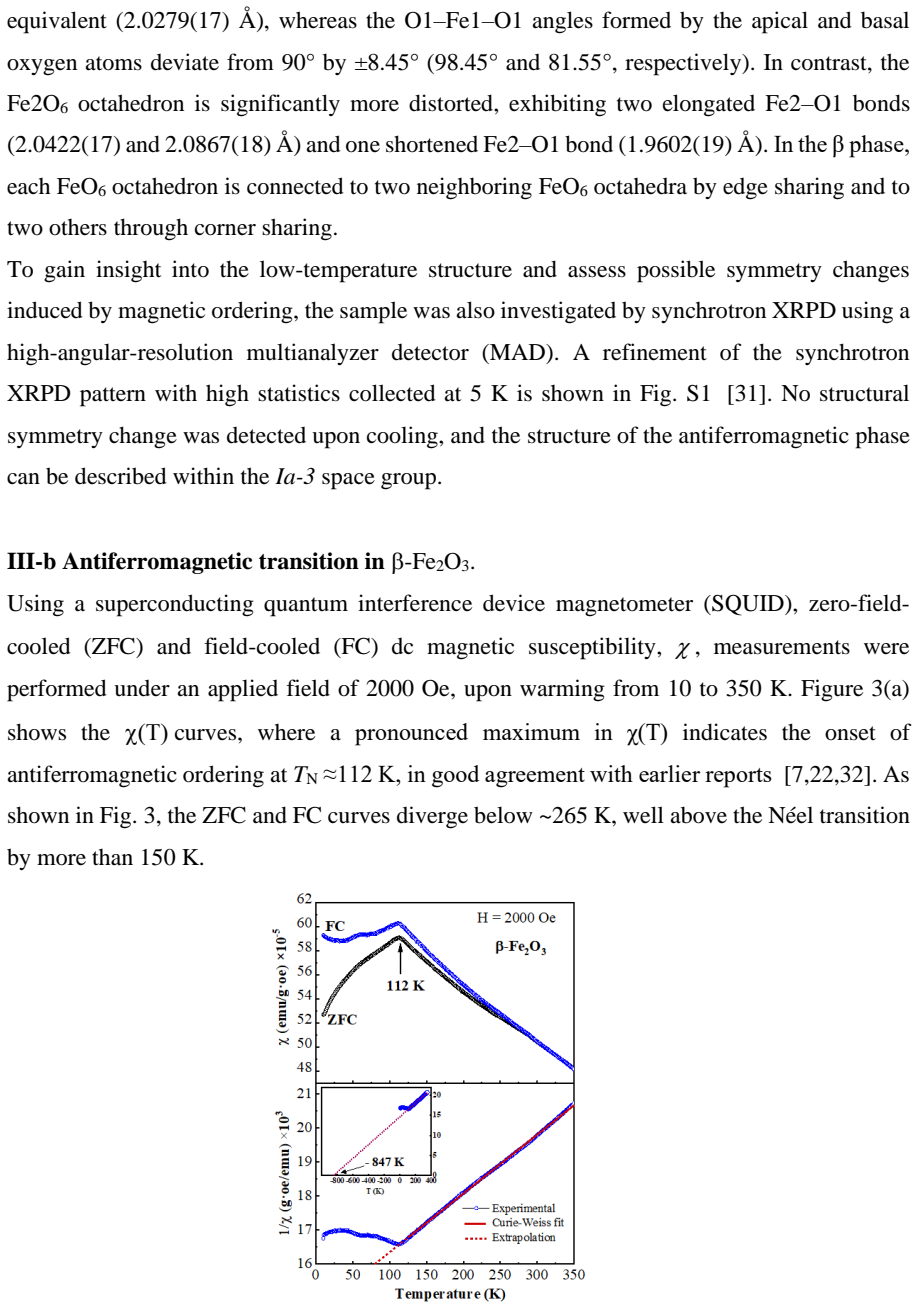
Although Fe$_2$O$_3$ compounds are among the most extensively studied transition-metal oxides, the magnetic properties of $\beta$-Fe$_2$O$_3$ remain poorly characterized. Using neutron and synchrotron X-ray diffraction, we investigate the temperature-driven magnetic transition in $\beta$-Fe$_2$O$_3$. A noncollinear antiferromagnetic structure sets in abruptly via activation of irrep $mH_1^{+}$ at the H-point [$\mathbf{k}=(1,1,1)$] together with antitranslation $(1'|\tfrac{1}{2},\tfrac{1}{2},\tfrac{1}{2})$. Below $T_{\mathrm{N}}$, the magnetic cell becomes primitive $(P_I a \bar{3})$, yielding two interpenetrating primitive cubic subcells with inverted moments and non-polar type-IV symmetry. All Fe$^{3+}$-O-Fe$^{3+}$ exchanges are antiferromagnetic, and the bixbyite structure promotes geometric frustration and noncollinear magnetism through coexisting magnetic sublattices with distinct symmetries and easy axes. Its frustration index $f \simeq 7.6$ is among the highest reported for binary magnetic oxides. In $\{111\}$ planes, distorted Fe2O$_6$ octahedra form hexagonal rings interconnected by triangular units. Notably, hexagonal Fe2 rings host a central Fe1 ion with strong Ising-like anisotropy, which could act as a switching element for the rings' magnetic state. These features point to routes for functional design.
Editorial analysis
A structured set of objections, weighed in public.
Referee Report
Summary. The manuscript uses neutron and synchrotron X-ray diffraction to characterize the antiferromagnetic transition in β-Fe₂O₃. It reports that a noncollinear AFM structure onsets abruptly below T_N via activation of the mH₁⁺ irrep at the H-point k=(1,1,1) together with the antitranslation (1'|½,½,½), producing a primitive magnetic cell (P_I a3̄) consisting of two interpenetrating cubic subcells with inverted moments and type-IV symmetry. All Fe³⁺-O-Fe³⁺ superexchanges are antiferromagnetic; the bixbyite lattice yields geometric frustration (f ≃ 7.6) with distinct Fe1/Fe2 sublattice symmetries, easy axes, and {111} hexagonal rings that may be switched by central Fe1 Ising anisotropy.
Significance. If the irrep assignment holds, the work supplies a well-documented example of high-frustration noncollinear order in a binary oxide, with one of the largest reported f values, and identifies concrete structural motifs (interpenetrating subcells, ring-triangular units) that could guide functional design. The use of combined diffraction plus standard symmetry analysis is a standard but useful contribution to the catalog of frustrated magnets.
major comments (2)
- [Magnetic structure section] Magnetic structure section: the claim that intensities uniquely select mH₁⁺ plus the stated antitranslation (producing P_I a3̄) is load-bearing for all subsequent statements about sublattice symmetries and frustration. The manuscript must supply explicit goodness-of-fit metrics (χ², R_wp, or equivalent) comparing this model against other H-point irreps, linear combinations, and domain-averaged alternatives; without those comparisons the uniqueness step is not demonstrated.
- [Results on temperature dependence] Results on temperature dependence: the abruptness of the transition and the reported frustration index f ≃ 7.6 rely on the chosen propagation vector and basis; if alternative models fit the same Bragg intensities within error, both the cell description and the numerical value of f become model-dependent.
minor comments (2)
- Provide the precise T_N value extracted from the diffraction data together with any observed thermal hysteresis.
- Clarify whether the synchrotron X-ray data were used only for nuclear structure or also contributed to magnetic intensity constraints.
Simulated Author's Rebuttal
We thank the referee for their careful reading of the manuscript and for highlighting the need for quantitative support of the magnetic structure assignment. We address the two major comments point by point below.
read point-by-point responses
-
Referee: [Magnetic structure section] the claim that intensities uniquely select mH₁⁺ plus the stated antitranslation (producing P_I a3̄) is load-bearing for all subsequent statements about sublattice symmetries and frustration. The manuscript must supply explicit goodness-of-fit metrics (χ², R_wp, or equivalent) comparing this model against other H-point irreps, linear combinations, and domain-averaged alternatives; without those comparisons the uniqueness step is not demonstrated.
Authors: We agree that explicit quantitative comparisons are required to substantiate the uniqueness of the mH₁⁺ assignment. In the revised manuscript we will add a dedicated paragraph and table in the magnetic structure section that reports χ² and R_wp values for the mH₁⁺ + antitranslation model versus the other H-point irreps (mH₂⁺, mH₃⁺), their linear combinations, and domain-averaged alternatives. These fits will be performed on the same neutron data set used in the original analysis. revision: yes
-
Referee: [Results on temperature dependence] the abruptness of the transition and the reported frustration index f ≃ 7.6 rely on the chosen propagation vector and basis; if alternative models fit the same Bragg intensities within error, both the cell description and the numerical value of f become model-dependent.
Authors: The frustration index f ≃ 7.6 is obtained from the ratio |Θ_CW|/T_N, where Θ_CW is determined solely from bulk susceptibility data via a Curie-Weiss fit above T_N; this quantity is therefore independent of any magnetic structure model. The abruptness of the transition is directly observed in the temperature dependence of the integrated intensity of the magnetic Bragg peaks, which appear discontinuously below T_N. Nevertheless, the detailed description of the magnetic cell and sublattice symmetries does depend on the irrep choice. The goodness-of-fit comparisons we will add (see response to the first comment) will demonstrate that alternative H-point models do not reproduce the observed intensities within error, thereby removing model dependence from the cell description. revision: partial
Circularity Check
No circularity: experimental structure solution from diffraction data
full rationale
The paper determines the magnetic structure (irrep mH₁⁺ plus antitranslation) directly from neutron and synchrotron intensities via standard symmetry analysis. No derivation chain reduces a claimed prediction or uniqueness result to a fitted parameter, self-citation, or ansatz by construction. The frustration index is a standard empirical ratio computed from measured T_N and θ_CW. All load-bearing steps are external data fits, not internal redefinitions.
Axiom & Free-Parameter Ledger
axioms (1)
- standard math Standard representation theory of magnetic space groups can be used to label the observed ordering as irrep mH₁⁺ plus antitranslation.
Reference graph
Works this paper leans on
-
[1]
C. J. Tartaj, P., Morales, M.P., Gonzalez-Carreño, T., Veintemillas-Verdaguer, S. and Serna, The Iron Oxides Strike Back: From Biomedical Applications to Energy Storage Devices and Photoelectrochemical Water Splitting, Adv. Mater. 23, 5243 (2011)
2011
-
[2]
Pullar, Hexagonal Ferrites: A Review of the Synthesis, Properties and Applications of Hexaferrite Ceramics, Prog
Robert C. Pullar, Hexagonal Ferrites: A Review of the Synthesis, Properties and Applications of Hexaferrite Ceramics, Prog. Mater. Sci. 57, 1191 (2012)
2012
-
[3]
J. H. Jeong, H. H. Kim, J. Lee, and Y. Baek, Epsilon Iron Oxide ( ε-Fe2O3 ) as an Electromagnetic Functional Material : Properties , Synthesis , and Applications, 31, 465 (2024)
2024
-
[4]
Zboril, M
R. Zboril, M. Mashlan, and D. Petridis, Iron ( III ) Oxides from Thermal Processes s Synthesis , Chem. Mater. 14, 969 (2002)
2002
-
[5]
Danno, D
T. Danno, D. Nakatsuka, Y. Kusano, H. Asaoka, M. Nakanishi, T. Fujii, Y. Ikeda, and J. Takada, Crystal Structure of β-Fe2O3 and Topotactic Phase Transformation to α- Fe2O3, Cryst. Growth Des. 13, 770 (2013)
2013
-
[6]
Malina et al., Magnetic Ground State of Nanosized β-Fe2O3 and Its Remarkable Electronic Features, RSC Adv
O. Malina et al., Magnetic Ground State of Nanosized β-Fe2O3 and Its Remarkable Electronic Features, RSC Adv. 5, 49719 (2015)
2015
-
[7]
E. R. Bauminger, L. Ben-Dor, I. Felner, E. Fischbein, I. Nowik, and S. Ofer, Mössbauer Effect Studies of β-Fe2O3, Phys. B+C 86–88, 910 (1977)
1977
-
[8]
Sakurai, A
S. Sakurai, A. Namai, K. Hashimoto, and S. I. Ohkoshi, First Observation of Phase Transformation of All Four Fe2O 3 Phases (γ → ε → β → α-Phase), J. Am. Chem. 21 Soc. 131, 18299 (2009)
2009
-
[9]
Tuček, L
J. Tuček, L. Machala, S. Ono, A. Namai, M. Yoshikiyo, K. Imoto, H. Tokoro, S. I. Ohkoshi, and R. Zbořil, Zeta-Fe2O3 - A New Stable Polymorph in Iron(III) Oxide Family, Sci. Rep. 5, 15091 (2015)
2015
-
[10]
J. L. García-Muñoz, A. Romaguera, F. Fauth, J. Nogués, and M. Gich, Unveiling a New High-Temperature Ordered Magnetic Phase in ϵ-Fe2O3, Chem. Mater. 29, 9705 (2017)
2017
-
[11]
MacHala, J
L. MacHala, J. Tuček, and R. Zbořil, Polymorphous Transformations of Nanometric Iron(III) Oxide: A Review, Chem. Mater. 23, 3255 (2011)
2011
-
[13]
Grau-crespo, A
R. Grau-crespo, A. Y. Al-baitai, and I. Saadoune, Vacancy Ordering and Electronic Structure of γ -Fe 2 O 3 ( Maghemite ): A Theoretical Investigation, J. Phys. Condens. Matter 22, 255401 (2010)
2010
-
[14]
Lebrun et al., Anisotropies and Magnetic Phase Transitions in Insulating Antiferromagnets Determined by a Spin-Hall Magnetoresistance Probe, Commun
R. Lebrun et al., Anisotropies and Magnetic Phase Transitions in Insulating Antiferromagnets Determined by a Spin-Hall Magnetoresistance Probe, Commun. Phys. 2, 50 (2019)
2019
-
[15]
Lebrun, A
R. Lebrun, A. Ross, O. Gomonay, V. Baltz, U. Ebels, A. L. Barra, A. Qaiumzadeh, A. Brataas, J. Sinova, and M. Kläui, Long-Distance Spin-Transport across the Morin Phase Transition up to Room Temperature in Ultra-Low Damping Single Crystals of the Antiferromagnet α-Fe2O3, Nat Commun 11, 6332 (2020)
2020
-
[16]
Greaves, A Powder Neutron Diffraction Investigation of Vacancy Ordering and Covalence in γ-Fe2O3, J
C. Greaves, A Powder Neutron Diffraction Investigation of Vacancy Ordering and Covalence in γ-Fe2O3, J. Solid State Chem. 49, 325 (1983)
1983
-
[17]
W. E. Henry and M. J. Boehm, Intradomain Magnetic Saturation and Magnetic Structure of γ-Fe2O3, Phys. Rev. 101, 1253 (1956)
1956
-
[18]
G. A. Ferguson and M. Bass, Magnetic Structure and Vacancy Distribution in γ-Fe203 by Neutron Diffraction, Phys. Rev. 112, 1130 (1958)
1958
-
[19]
Tronc, C
E. Tronc, C. Chanéac, and J. P. Jolivet, Structural and Magnetic Characterization of ε- Fe2O3, J. Solid State Chem. 139, 93 (1998)
1998
-
[20]
Gich et al., High- and Low-Temperature Crystal and Magnetic Structures of ε-Fe 2O3 and Their Correlation to Its Magnetic Properties, Chem
M. Gich et al., High- and Low-Temperature Crystal and Magnetic Structures of ε-Fe 2O3 and Their Correlation to Its Magnetic Properties, Chem. Mater. 18, 3889 (2006)
2006
-
[21]
Bonnevie Svendsen, Beta-Fe2O3- Eine Neue Eisen(Lll) Oxyd-Struktur, Die Natur- Wissenschaften 542 (1958)
M. Bonnevie Svendsen, Beta-Fe2O3- Eine Neue Eisen(Lll) Oxyd-Struktur, Die Natur- Wissenschaften 542 (1958)
1958
-
[22]
Wiarda and G
D. Wiarda and G. Weyer, Mössbauer Investigations of the Antiferromagnetic Phase in 22 the Metastable β–Fe2O3, Int. J. Mod. Phys. B 7, 353 (1993)
1993
-
[23]
Fauth, R
F. Fauth, R. Boer, F. Gil-Ortiz, C. Popescu, O. Vallcorba, I. Peral, D. Fullà, J. Benach, and J. Juanhuix, The Crystallography Stations at the Alba Synchrotron, Eur. Phys. J. Plus 130, 160 (2015)
2015
-
[24]
J. M. Perez-Mato, S. V. Gallego, E. S. Tasci, L. Elcoro, G. de la Flor, and M. I. Aroyo, Symmetry-Based Computational Tools for Magnetic Crystallography, Annu. Rev. Mater. Res. 45, 217 (2015)
2015
-
[25]
J. M. Perez-Mato, D. Orobengoa, and M. I. Aroyo, Mode Crystallography of Distorted Structures, Acta Cryst. A66, 558 (2010)
2010
-
[26]
Elcoro, B
L. Elcoro, B. J. Wieder, B. A. Bernevig, and B. Bradlyn, Magnetic Topological Quantum Chemistry, Nat. Commun. 12, 5965 (2021)
2021
-
[27]
J. M. Perez-Mato, S. V. Gallego, L. Elcoro, E. Tasci, and M. I. Aroyo, Symmetry Conditions for Type II Multiferroicity in Commensurate Magnetic Structures, J. Phys. Condens. Matter 28, 286001 (2016)
2016
-
[28]
B. J. Campbell, H. T. Stokes, D. E. Tanner, and D. M. Hatch, ISODISPLACE: A Web- Based Tool for Exploring Structural Distortions, J. Appl. Crystallogr. 39, 607 (2006)
2006
-
[29]
Rodríguez-Carvajal, Recent Advances in Magnetic Structure Determination by Neutron Powder Diffraction, Phys
J. Rodríguez-Carvajal, Recent Advances in Magnetic Structure Determination by Neutron Powder Diffraction, Phys. B Phys. Condens. Matter 192, 55 (1993)
1993
-
[30]
Momma and F
K. Momma and F. Izumi, VESTA 3 for Three-Dimensional Visualization of Crystal, Volumetric and Morphology Data, J. Appl. Crystallogr. 44, 1272 (2011)
2011
-
[31]
Supplemental Material, (2026)
2026
-
[32]
Ikeda, M
Y. Ikeda, M. Takano, and Y. Barmo, Formation Mechanism of Needle-like α-Fe₂O₃ Particles Grown Along the c Axis and Characterization of Precursorily Formed β- Fe₂O₃, Bull. Inst. Chem. Res. 64, 249 (1986)
1986
-
[33]
A. P. Ramirez, Strongly Geometrically Frustrated Magnets, Annu. Rev. Mater. Sci. 24, 453 (1994)
1994
-
[34]
J. M. D. \thinspac. Coey, Magnetic Oxides and Other Compounds, in Handbook of Magnetism and Magnetic Materials, edited by M. Coey and S. Parkin (Springer International Publishing, Cham, 2020), pp. 1–76
2020
-
[35]
V Belov, N
N. V Belov, N. N. Neronova, and T. S. Smirnova, Shubnikov Groups, Kristallografiya 2, 315 (1957)
1957
-
[36]
V Gallego, J
S. V Gallego, J. Etxebarria, L. Elcoro, E. S. Tasci, and J. M. Perez-Mato, Automatic Calculation of Symmetry-Adapted Tensors in Magnetic and Non-Magnetic Materials: A New Tool of the Bilbao Crystallographic Server, Acta Crystallogr. Sect. A 75, 438 23 (2019)
2019
-
[37]
Kanamori, Superexchange Interaction and Symmetry Properties of Electron Orbitals, J
J. Kanamori, Superexchange Interaction and Symmetry Properties of Electron Orbitals, J. Phys. Chem. Solids 10, 87 (1959)
1959
-
[38]
J. B. Goodenough, Magnetism and the Chemical Bond ((New York: Interscience (Wiley-Interscience)), 1963)
1963
-
[39]
Motida and S
K. Motida and S. Miyahara, On the 90° Exchange Interaction between Cations (Cr3+, Mn2+, Fe3+ and Ni2+) in Oxides, J. Phys. Soc. Jpn. 28, 1188 (1970)
1970
-
[40]
Ohkoshi, A
S. Ohkoshi, A. Namai, and S. Sakurai, The Origin of Ferromagnetism in ε-Fe2O3 and ε-GaxFe2-XO3 Nanomagnets, Society 11235 (2009)
2009
-
[41]
Knížek, P
K. Knížek, P. Novák, and Z. Jirák, Exchange Interactions in ϵ-Fe2O3: GGA + U Calculations, J. Phys. Condens. Matter 33, 155502 (2021). 24 Table I . Refined crystal structure (cell parameters, atomic coordinates and isotropic displacement parameters (B )) for β-Fe₂O₃ obtained from Rietveld refinement of neutron powder diffraction data at 300 K and 10 K (sp...
2021
discussion (0)
Sign in with ORCID, Apple, or X to comment. Anyone can read and Pith papers without signing in.