REVIEW 3 major objections 6 minor 1 cited by
Playing in the Sandbox: A Study on the Usability of Seccomp
T0 review · 3 major / 6 minor · reviewed 2026-08-07 · deepseek-v4-flash
Pith's one-line read Even experienced Seccomp developers cannot reliably sandbox a simple program.
desk verdict First empirical Seccomp usability study with honest methods; the novelty claim is too broad and the minimal-syscall metric needs grounding, but the core finding — divergent sandbox designs from experienced developers — holds. read the letter →
The pith
A machine-rendered reading of the paper's core claim, the machinery that carries it, and where it could break.
The reading
What carries the argument
The paper's central object is Seccomp's filter model: developers initialize a seccomp context, add rules that allow or deny individual syscalls (optionally checking argument values), and load the filter at some point in the program. The study uses a 115-line C watchdog as the common task and traces participants' rule-building against strace output, source reading, and documentation. The load-bearing mechanism is the mapping from program behavior to syscall names—participants had to figure out which syscalls the program made, where, and which were setup-only—and the paper shows this mapping, not the BPF syntax, is what makes Seccomp hard.
What would settle it
Run the same 115-line watchdog sandboxing task with a larger random sample of experienced Seccomp developers in a routine, unobserved work setting; if most of them independently produced similar, correctly-scoped sandboxes and could name where each allowed syscall is used, the paper's central claim would fail.
Extended reading notes
Core claim
The paper's central claim is that Seccomp is flexible to a fault: for a simple, statically-behaving program, experienced developers do not converge on a sandbox, and the main source of difficulty is not writing BPF rules but deciding which syscalls the program actually needs and where they occur. The seven participants all stated the goal of least privilege, yet their allowed syscall sets, filter placement, use of argument checking, and code structure differed completely. P2 was the only participant to restrict syscall arguments. P5 outsourced filter generation to ChatGPT; P5 and P7 allowed unneeded syscalls such as execv and mmap because they trusted strace output. P4 could not finish. The paper takes this divergence and confusion as evidence that the syscall interface is a poor place to impose a sandbox policy for ordinary developers, and that a more abstract, automated, or function-local model would make sandboxing something developers can do reliably.
Load-bearing premise
The study assumes that the behavior of seven self-selected, all-male, compensated developers working for one observed hour on a contrived watchdog task tells us how developers in general would use Seccomp in real production settings.
Editorial extensions
If this is right
- Even simple programs produce divergent sandbox designs, so without standard patterns the security of a sandboxed program depends heavily on the individual developer's approach.
- Developers' difficulty mapping syscalls to program functionality leads to over-privileged sandboxes, which weakens the least-privilege guarantee that motivates sandboxing in the first place.
- Abstraction layers, automation, and function-local sandbox rules align with the mental models participants described and could make sandboxing more reliable.
- The system call interface itself is a questionable enforcement point for security policy, as participants could not always tell which syscalls were needed, which were setup-only, and which were architecture variations.
- Without verification tools or standard design patterns, developers cannot easily tell whether their Seccomp policy is correct, and several participants reported low confidence even in working solutions.
Reading between the lines
- Going beyond the paper, the finding that some developers blindly trusted strace output suggests that automated Seccomp filter generators should be evaluated not only for functional correctness but also for over-privilege relative to the program's actual needs.
- One testable extension is to compare over-privilege rates in LLM-generated Seccomp policies against expert-written policies on the same program, using the watchdog task as a benchmark.
- The function-local sandboxing idea proposed by one participant could be prototyped as a library or language extension that derives each function's required syscalls automatically, then tested with a larger and more diverse developer sample.
- The paper's recruitment through security mailing lists and freelancing platforms may have selected for unusually security-conscious developers, which would make the observed struggles a lower bound for the general developer population.
Signed reviews
Editorial analysis
A structured set of objections, weighed in public.
Referee Report
Summary. This paper reports a qualitative usability study of the Linux Seccomp sandboxing API. Seven developers with prior Seccomp experience were asked to sandbox a 115-line C watchdog program under observation, using a think-aloud protocol, a System Usability Scale questionnaire, and a participatory design exercise. The paper finds that participants arrived at very different sandbox implementations, struggled to map syscalls to program functionality, commonly over-privileged their sandboxes (notably by trusting strace output), and one participant could not produce a working filter. The authors conclude that Seccomp's flexibility and low-level interface create usability challenges and argue for higher-level abstractions and design patterns.
Significance. The paper is a useful and timely contribution to the small but growing literature on usable security APIs. Its strengths include a transparent study protocol (Appendix B), direct participant quotes, a detailed description of participants' implementations (Table 2), and what appears to be the first empirical usability study of Seccomp. The qualitative findings are plausible and contribute new evidence about why sandboxing adoption is low. The paper is appropriately cautious about generalizability, but a key security-relevant claim—that two participants' sandboxes were over-privileged by allowing unnecessary syscalls—currently lacks a documented ground-truth analysis and needs strengthening before publication.
major comments (3)
- [Section 4.1.2, Table 2] The claim that P5 and P7's sandboxes were over-privileged and allowed '15 syscalls that were not needed by the watchdog program' is not supported by a reported minimal-syscall analysis. The paper does not state how the authors determined that ioctl, mmap, access, and execv are unnecessary, nor does it report the test conditions (libc version, compile flags, network reachability, signal handling, log-rotation paths) under which a ground-truth syscall set was obtained. Because the watchdog program uses glibc I/O and allocation functions whose syscall usage can vary at runtime (e.g., mmap for large malloc chunks or access for permission checks), a single strace run is insufficient to establish that these syscalls are never required in a correct execution. Without this analysis, the conclusion that strace-based workflows lead to 'somewhat ineffective' sandboxes is overstated; I recommend either adding a systematic enumeration of required syscalls under varied execution conditions or tempering the security-effectiveness claim.
- [Section 3.3 and Appendix B.2] The study did not record participants' screens, yet Table 2 reports counts such as 'Times documentation referred to' and 'Attempts running the code', and Figure 1 constructs a detailed timeline of participant steps. The threats-to-validity section does not explain how these data were captured reliably without screen recording, nor what information may have been missed or misattributed. Please describe the real-time note-taking and verification process used during the sessions and discuss the potential impact of this limitation on the process-level findings.
- [Section 4.1 (P4 case)] The interpretation of P4's failure as a Seccomp usability problem is somewhat confounded by P4's choice to work with raw BPF filters, which is a particularly low-level interface, rather than the libseccomp wrapper that other participants used. While raw BPF is part of the Seccomp ecosystem, the authors should clarify whether the task instructions encouraged any particular API and discuss how much of P4's struggle is attributable to Seccomp versus to the specific programming interface P4 selected.
minor comments (6)
- [Section 3.1 vs Appendix C] The session length and compensation are described inconsistently: Section 3.1 says 1.5 hours and 'approximately $250', while Appendix C says '2 hours' and '£200'. Align these details.
- [Section 4.2.3] The typo 'SMPT_ACT_ALLOW' should be 'SCMP_ACT_ALLOW'.
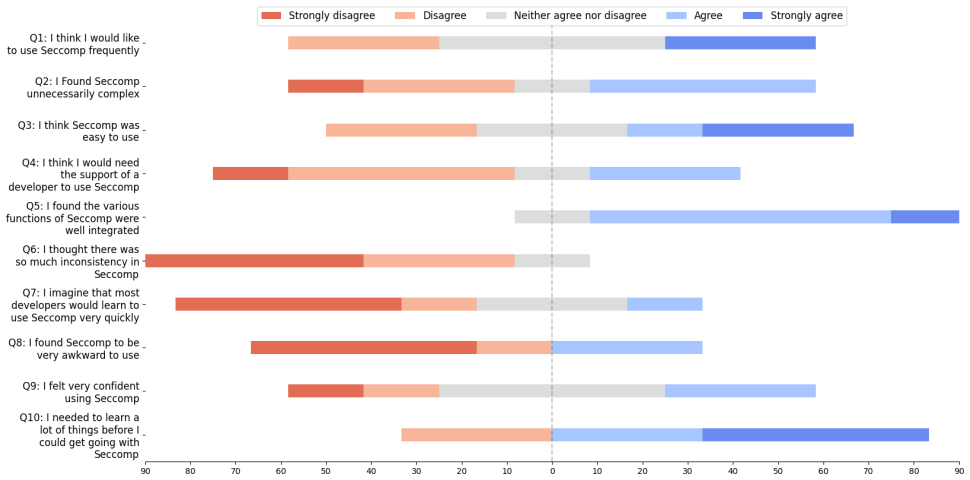
- [Section 4.4] The SUS responses are presented only as individual item ratings (Figure 2); reporting the aggregate SUS score would allow comparison with other usability benchmarks.
- [Section 2.2] The authors' prior work [2] is cited for background; please make the self-citation more explicit in the text.
- [Section 4.3.2] The discussion of P3's 'time' syscall and VDSO should clarify whether VDSO syscalls are subject to seccomp filtering and whether omitting them from the filter is safe.
- [Section 4.1.2] The list of essential syscalls includes 'clock_nanosleep' but the program calls sleep(); clarify whether this is the libc wrapper behavior and whether variants such as 'nanosleep' were also observed.
Circularity Check
No circularity: the study's findings are direct empirical observations; the only self-citation is background and not load-bearing.
full rationale
This paper is an observational usability study, not a derivation or prediction chain. Its central findings—that seven experienced developers produced different Seccomp implementations, that they struggled to map syscalls to program functionality, and that some over-privileged their sandboxes—are grounded in recorded sessions, code artifacts, and think-aloud transcripts, not in a fitted model or prior theoretical framework. The only self-citation (Alhindi and Hallett 2024, ref. [2]) is used as background motivation to describe low sandboxing adoption in Linux packages; it does not supply the paper's conclusions or define its outcome measures. The authors' characterization of P5 and P7 as over-privileged relies on an implicit judgment about which syscalls the watchdog program actually needs; this judgment is contestable on evidentiary grounds and could weaken a specific empirical claim if the minimal syscall set is wrong, but it is not circular—the finding is not defined in terms of itself, nor is any claimed result equivalent to its own input by construction. The paper explicitly acknowledges validity limitations such as the tiny, non-generalizing sample and potential Hawthorne effects (Section 3.3), which further confirms that the authors treat their results as observed phenomena rather than as consequences of their assumptions. No equation, parameter, or construction reduces a claimed result to an input, so there is no significant circularity.
Assumptions & free parameters
assumptions (4)
- domain assumption Think-aloud verbalizations reflect actual reasoning processes.
- domain assumption The watchdog task is representative of real-world sandboxing tasks.
- domain assumption The researchers' classification of sandboxes as functional or over-privileged is accurate.
- domain assumption The SUS adapted to Seccomp is a meaningful usability measure.
Cite this review
Pith. "Pith review of Playing in the Sandbox: A Study on the Usability of Seccomp." pith.science (2026). https://pith.science/paper/OHAALOEF
@misc{pith2026250610234,
  author       = {Pith},
  title        = {Pith review of: Playing in the Sandbox: A Study on the Usability of Seccomp},
  year         = {2026},
  howpublished = {\url{https://pith.science/paper/OHAALOEF}},
  note         = {Machine review of arXiv:2506.10234}
}
read the original abstract
Sandboxing restricts what applications do, and prevents exploited processes being abused; yet relatively few applications get sandboxed: why? We report a usability trial with 7 experienced Seccomp developers exploring how they approached sandboxing an application and the difficulties they faced. The developers each approached sandboxing the application differently and each came to different solutions. We highlight many challenges of using Seccomp, the sandboxing designs by the participants, and what developers think would make it easier for them to sandbox applications effectively.
Figures

Forward citations
Cited by 1 Pith paper
-
A Measurement Study on the Adoption of Pledges and Unveils in the OpenBSD Operating System
Longitudinal counts over 19 OpenBSD releases show continuous growth in pledge and unveil use, weak size correlation, and heavy but not exclusive reliance on I/O promises.
Reference graph
Works this paper leans on
-
[1]
Com- paring the usability of cryptographic APIs
Yasemin Acar, Michael Backes, Sascha Fahl, Simson Garfinkel, Doowon Kim, Michelle L Mazurek, and Christian Stransky. Com- paring the usability of cryptographic APIs. In 2017 IEEE Symposium on Security and Privacy (SP), pages 154–171. IEEE, 2017
work page 2017
-
[2]
Sandboxing adoption in open source ecosystems
Maysara Alhindi and Joseph Hallett. Sandboxing adoption in open source ecosystems. In SESoS-ICSE 2024: 12th ACM/IEEE Interna- tional Workshop on Software Engineering for Systems-of-Systems and Software Ecosystems. Association for Computing Machinery (ACM), 2024
work page 2024
-
[3]
A comparison of UNIX sandboxing techniques
Jonathan Anderson. A comparison of UNIX sandboxing techniques. FreeBSD Journal, 2017
work page 2017
-
[4]
Nigel Bevan, James Carter, and Susan Harker. ISO 9241-11 revised: What have we learnt about usability since 1998? In Human-Computer Interaction: Design and Evaluation: 17th International Conference, HCI International 2015, Los Angeles, CA, USA, August 2-7, 2015, Pro- ceedings, Part I 17, pages 143–151. Springer, 2015
work page 1998
-
[5]
Automating Seccomp filter generation for Linux applications
Claudio Canella, Mario Werner, Daniel Gruss, and Michael Schwarz. Automating Seccomp filter generation for Linux applications. In Pro- ceedings of the 2021 on Cloud Computing Security Workshop, pages 139–151, 2021
work page 2021
-
[6]
Sysfilter: Automated system call filtering for commodity software
Nicholas DeMarinis, Kent Williams-King, Di Jin, Rodrigo Fonseca, and Vasileios P Kemerlis. Sysfilter: Automated system call filtering for commodity software. In 23rd International Symposium on Research in Attacks, Intrusions and Defenses (RAID 2020), pages 459–474, 2020
work page 2020
-
[7]
Aligning usability and security: a usability study of Polaris
Alexander J DeWitt and Jasna Kuljis. Aligning usability and security: a usability study of Polaris. In Proceedings of the second symposium on Usable privacy and security, pages 1–7, 2006
work page 2006
-
[8]
No good reason to remove features
Steve Dodier-Lazaro, Ingolf Becker, Jens Krinke, and M Angela Sasse. “No good reason to remove features" expert users value useful apps over secure ones. In Human Aspects of Information Security, Pri- vacy and Trust: 5th International Conference, HAS 2017, Held as Part of HCI International 2017, Vancouver, BC, Canada, July 9-14, 2017, Proceedings 5, pages...
work page 2017
Show all 55 references
-
[9]
Traps and pitfalls: Practical problems in system call interposition based security tools
Tal Garfinkel. Traps and pitfalls: Practical problems in system call interposition based security tools. In In Proc. Network and Distributed Systems Security Symposium, 2003
2003
-
[10]
Seccomp filters from fuzzing
Marcus Gelderie, Valentin Barth, Maximilian Luff, and Julian Birami. Seccomp filters from fuzzing. In SECRYPT, pages 507–512, 2022
2022
-
[11]
Developers are not the enemy!: The need for usable security APIs
Matthew Green and Matthew Smith. Developers are not the enemy!: The need for usable security APIs. IEEE Security & Privacy, 14(5):40– 46, 2016
2016
-
[12]
Social desirability bias
Pamela Grimm. Social desirability bias. Wiley international encyclo- pedia of marketing, 2010
2010
-
[13]
Why don’t software developers use static analysis tools to find bugs? In 2013 35th International Conference on Software Engineering (ICSE), pages 672–681
Brittany Johnson, Yoonki Song, Emerson Murphy-Hill, and Robert Bowdidge. Why don’t software developers use static analysis tools to find bugs? In 2013 35th International Conference on Software Engineering (ICSE), pages 672–681. IEEE, 2013
2013
-
[14]
Was there a Hawthorne effect? American Journal of sociology, 98(3):451–468, 1992
Stephen RG Jones. Was there a Hawthorne effect? American Journal of sociology, 98(3):451–468, 1992
1992
-
[15]
I have no idea what I’m doing
Katharina Krombholz, Wilfried Mayer, Martin Schmiedecker, and Edgar Weippl. “I have no idea what I’m doing” — on the usabil- ity of deploying HTTPS. In Proceedings of the 26th USENIX Security Symposium. USENIX, 2017
2017
-
[16]
thinking-aloud
Clayton Lewis. Using the “thinking-aloud” method in cognitive inter- face design. Technical Report RC 9265, IBM, 1982
1982
-
[17]
The system usability scale: past, present, and future
James R Lewis. The system usability scale: past, present, and future. International Journal of Human–Computer Interaction, 34(7):577–590, 2018
2018
-
[18]
On the critical path to implant backdoors and the effectiveness of potential mitigation techniques: Early learnings from xz
Mario Lins, René Mayrhofer, Michael Roland, Daniel Hofer, and Mar- tin Schwaighofer. On the critical path to implant backdoors and the effectiveness of potential mitigation techniques: Early learnings from xz. arXiv preprint arXiv:2404.08987, 2024
2024 arXiv
-
[19]
A theory and tools for applying sandboxes effectively
Michael Maass. A theory and tools for applying sandboxes effectively. page 166, 2016
2016
-
[20]
A systematic analysis of the science of sandboxing
Michael Maass, Adam Sales, Benjamin Chung, and Joshua Sunshine. A systematic analysis of the science of sandboxing. PeerJ Computer Science, 2:e43, 2016
2016
-
[21]
seccomp - secure computing mode, 2024
Linux man pages. seccomp - secure computing mode, 2024. Accessed: 2024-07-14
2024
-
[22]
pledge - restrict system operations, 2024
OpenBSD man pages. pledge - restrict system operations, 2024. Ac- cessed: 2024-07-14
2024
-
[23]
Why you only need to test with 5 users, 2000
Jakob Nielsen. Why you only need to test with 5 users, 2000
2000
-
[24]
Usability smells: An analysis of developers’ struggle with crypto libraries
Nikhil Patnaik, Joseph Hallett, and Awais Rashid. Usability smells: An analysis of developers’ struggle with crypto libraries. In Fifteenth Symposium on Usable Privacy and Security (SOUPS 2019) , pages 245–257, 2019
2019
-
[25]
If you build it, will they come? developer recruitment for security studies
Nikhil Patnaik, Joseph Hallett, Mohammad Tahaei, and Awais Rashid. If you build it, will they come? developer recruitment for security studies. ROPES-ICSE 202, 2022
2022
-
[26]
A usability evalua- tion of afl and libfuzzer with cs students
Stephan Plöger, Mischa Meier, and Matthew Smith. A usability evalua- tion of afl and libfuzzer with cs students. In Proceedings of the 2023 CHI Conference on Human Factors in Computing Systems, 2023
2023
-
[27]
Measuring, assessing and improving software quality based on object- oriented design principles
Reinhold Plösch, Johannes Bräuer, Christian Körner, and Matthias Saft. Measuring, assessing and improving software quality based on object- oriented design principles. Open Computer Science , 6(1):187–207, 2016
2016
-
[28]
Brief note on the origins, evolution, and meaning of the qualitative research concept thick description
Joseph G Ponterotto. Brief note on the origins, evolution, and meaning of the qualitative research concept thick description. The qualitative report, 11(3):538–549, 2006
2006
-
[29]
Saltzer and M.D
J.H. Saltzer and M.D. Schroeder. The protection of information in computer systems. Proceedings of the IEEE, 63(9):1278–1308, Sep 1975
1975
-
[30]
Towards usable application-oriented access controls: qualitative results from a usability study of SELinux, AppArmor and FBAC-LSM
Z Cliffe Schreuders, Tanya McGill, and Christian Payne. Towards usable application-oriented access controls: qualitative results from a usability study of SELinux, AppArmor and FBAC-LSM. International Journal of Information Security and Privacy (IJISP), 6(1):57–76, 2012
2012
-
[31]
The state of the art of application restrictions and sandboxes: A survey of application-oriented access controls and their shortfalls
Z Cliffe Schreuders, Tanya McGill, and Christian Payne. The state of the art of application restrictions and sandboxes: A survey of application-oriented access controls and their shortfalls. Computers & Security, 32:219–241, 2013
2013
-
[32]
The methodology of participatory design
Clay Spinuzzi. The methodology of participatory design. Technical communication, 52(2):163–174, 2005
2005
-
[33]
Open coding
Anselm L Strauss and Juliet Corbin. Open coding. Social research methods: A reader, pages 303–306, 2004
2004
-
[34]
A usability evaluation of Let’s Encrypt and Certbot: Usable security done right
Christian Tiefenau, Emanuel von Zezschwitz, Maximilian Häring, Katharina Krombholz, and Matthew Smith. A usability evaluation of Let’s Encrypt and Certbot: Usable security done right. In Proceedings of the ACM SIGSAC Conference on Computer and Communications Security, 2019
2019
-
[35]
Enable ftrace-based system call filtering, 2011
Linus Torvalds. Enable ftrace-based system call filtering, 2011. Kernel mailing list
2011
-
[36]
The use of triangulation in qualitative research
Data Source Triangulation. The use of triangulation in qualitative research. In Oncology Nursing forum, volume 41, pages 545–7, 2014
2014
-
[37]
Refining the test phase of usability evaluation: How many subjects is enough? Human factors, 34(4):457–468, 1992
Robert A Virzi. Refining the test phase of usability evaluation: How many subjects is enough? Human factors, 34(4):457–468, 1992
1992
-
[38]
Martucci, and Stefan Lindskog
Artem V oronkov, Leonardo A. Martucci, and Stefan Lindskog. Mea- suring the usability of firewall rule sets. IEEE Access, 2020
2020
-
[39]
Capsicum: practical capabilities for UNIX
Robert N M Watson, Jonathan Anderson, Kris Kennaway, and Ben Laurie. Capsicum: practical capabilities for UNIX. page 17, 2010
2010
-
[40]
/tmp/watchdog.log
Ka-Ping Yee. Aligning security and usability.IEEE Security & Privacy, 2(5):48–55, 2004. A Watchdog script code Listing 4: Interview task code 1 #include <stdio.h> 2 #include <stdlib.h> 3 #include <unistd.h> 4 #include <signal.h> 5 #include <sys/types.h> 6 #include <sys/socket....
2004
-
[41]
I will start the audio recording now
“I will start the audio recording now”
-
[42]
Read the task scenario
-
[43]
• Every time participants modify the Seccomp sandbox (initialize the sandbox, change rules/examine arguments)
Take note of and keep a timeline of: • Every time participants refer to the documentation. • Every time participants modify the Seccomp sandbox (initialize the sandbox, change rules/examine arguments). • Every time participants run the code and how they run it. B.2.1 Scenario ...
-
[44]
Why did you choose the allow/deny listing approach in your solution? What is your reasoning behind this decision?
When the participants reach a solution they are happy with, or at the end of the task time ask about: • Decision on allow/deny list approach. “Why did you choose the allow/deny listing approach in your solution? What is your reasoning behind this decision?” • Decision on exami...
-
[45]
When seems to be stuck for a while
-
[46]
When the participant exhibits an interesting behaviour, ask about the reasoning behind this behaviour and try to note their train of thoughts
-
[47]
Can you tell me what are you looking for and why
When the participant refers to a documentation, ask about what they are looking for exactly and why? “Can you tell me what are you looking for and why”? B.3 Filling in the SUS form ( ∼15 minutes)
-
[48]
I will send you the form link in the meeting chat
“The next stage of the interview will be filling a form. I will send you the form link in the meeting chat. Please let me know if you can access the form. The form has 10 statements, you can rank each statement with a number from 0-5, 0 means that you strongly disagree, while ...
-
[49]
B.4 Design exercise ( ∼15 min)
Let the participants describe their answers fully and ask follow up questions if any interesting point came up or if answers seemed vague. B.4 Design exercise ( ∼15 min)
-
[50]
The last stage of the interview is a design exercise. I will share a white board with you now. Can you check if you can draw on the white board and access it without any problems?
“The last stage of the interview is a design exercise. I will share a white board with you now. Can you check if you can draw on the white board and access it without any problems?”
-
[51]
The sandbox should be able to restrict what your code can do
“I am going to ask you to design a sandboxing model that can be used within a codebase (API), a sandboxing model that you would use frequently, the perfect sandbox. The sandbox should be able to restrict what your code can do. It is up to you how to design the sandbox, you can...
-
[52]
Can you tell me why you chose this model of sandbox- ing?
After the participants reach an initial design, ask about why they chose this model? “Can you tell me why you chose this model of sandbox- ing?”
-
[53]
Can you expand more on . . . please?
Ask participants clarifying questions if their design seems unclear. “Can you expand more on . . . please?” “What do you mean by. . . ? B.5 End of the interview • Thank the participant and start the process of issuing the voucher. • Make sure the audio recording is saved. • Ma...
-
[54]
Tell us more about your C programming experience, what kind of projects have you worked on before that required C programming?
-
[55]
Have you used Seccomp before? What kind of projects and why you used Seccomp there? This study aims to evaluate the usability of Seccomp and is part of a PhD project
Reviewed August 7, 2026 · model on record in the stance chip above.
Discussion (0). Continue with ORCID to comment.