REVIEW 44 references
BAR: A Backward Reasoning based Agent for Complex Minecraft Tasks
T0 review · reviewed 2026-08-07 · deepseek-v4-flash
Pith's one-line read A backward-reasoning LLM agent with recursive goal decomposition, state-consistency repair, and stage memory outperforms forward-planning baselines on Minecraft task planning.
The pith
A machine-rendered reading of the paper's core claim, the machinery that carries it, and where it could break.
The reading
Backward planning can ignore the physical world, so BAR includes a repair step. It rates the steps of the backward plan, picks suspicious segments, and asks a forward-planning prompt to fill in the missing steps, for example adding 'dig down' before 'mine stone' because stone is underground. A third module, stage memory, stores previous decomposition results whose plans executed successfully in the Minecraft environment, and reuses them when the same sub-goal appears in a new task.
In static tests with no environment interaction, BAR with GPT-4 improves accuracy, F1, and edit distance over chain-of-thought, reverse chain, self-refine, tree-of-thought, DEPS, plan-and-solve, and o1. In dynamic tests, BAR with stage memory performs even better. However, the dynamic evaluation builds memory from the same 53 tasks it then re-plans, so the gains may partly come from memorizing the test set rather than from a generalizable memory mechanism.
Extended reading notes
Core claim
The load-bearing claim is that backward reasoning from the terminal state is superior to forward reasoning for complex planning: 'our agent achieves SOTA performance on all 5 groups under all three metrics' (Table 1) in static planning, and the dynamic agent with stage memory further improves these results. If the paper is correct, an LLM planner can substantially improve long-horizon Minecraft planning by recursively decomposing goals from the end, then repairing state conflicts with forward reasoning.
Load-bearing premise
The dynamic planning evaluation assumes that storing decomposition results from executing plans on the 53 evaluation tasks and then re-planning the same 53 tasks is a valid test of memory-augmented planning. If stage memory is only helpful because the target goals appeared during memory construction, the reported dynamic gains (Table 2) do not generalize to novel tasks; the paper does not hold out tasks during memory building.
Editorial analysis
A structured set of objections, weighed in public.
Assumptions & free parameters
free parameters (3)
- anchor threshold t =
5
- anchor interval k =
3
- stage memory success threshold =
0.3
assumptions (4)
- domain assumption The LLM's parametric knowledge of Minecraft recipes and spatial constraints is sufficiently accurate for backward decomposition.
- domain assumption Expert-annotated ground-truth plans for the 53 tasks are correct, unique, and complete.
- domain assumption Execution success rate of a plan in the Minecraft environment reflects the accuracy of the corresponding goal decomposition.
- domain assumption High-level step encapsulation (craft, smelt, equip, mine, dig down) preserves the semantics of plans so that plan quality on steps transfers to execution quality.
Cite this review
Pith. "Pith review of BAR: A Backward Reasoning based Agent for Complex Minecraft Tasks." pith.science (2026). https://pith.science/paper/OHHKOHAZ
@misc{pith2026250514079,
  author       = {Pith},
  title        = {Pith review of: BAR: A Backward Reasoning based Agent for Complex Minecraft Tasks},
  year         = {2026},
  howpublished = {\url{https://pith.science/paper/OHHKOHAZ}},
  note         = {Machine review of arXiv:2505.14079}
}
read the original abstract
Large language model (LLM) based agents have shown great potential in following human instructions and automatically completing various tasks. To complete a task, the agent needs to decompose it into easily executed steps by planning. Existing studies mainly conduct the planning by inferring what steps should be executed next starting from the agent's initial state. However, this forward reasoning paradigm doesn't work well for complex tasks. We propose to study this issue in Minecraft, a virtual environment that simulates complex tasks based on real-world scenarios. We believe that the failure of forward reasoning is caused by the big perception gap between the agent's initial state and task goal. To this end, we leverage backward reasoning and make the planning starting from the terminal state, which can directly achieve the task goal in one step. Specifically, we design a BAckward Reasoning based agent (BAR). It is equipped with a recursive goal decomposition module, a state consistency maintaining module and a stage memory module to make robust, consistent, and efficient planning starting from the terminal state. Experimental results demonstrate the superiority of BAR over existing methods and the effectiveness of proposed modules.
Figures


Figures from the paper (11 more)




Reference graph
Works this paper leans on
-
[1]
Obtain 1 wooden_pickaxe
-
[2]
I will give you a goal to achieve in Minecraft and the generated initial plan to achieve this goal
Dig down with wooden_pickaxe ======== ======== Goal: {new goal} Thought: Assistant: Prompt used to rate for all the steps in the initial plan in section 3.2 is as follows: System: You are a helpful assistant in Minecraft. I will give you a goal to achieve in Minecraft and the generated initial plan to achieve this goal. You need to rate for all the steps ...
-
[3]
Craft 2 stick Next Step:
-
[4]
Minedreamer: Learning to follow instructions via chain-of-imagination for simulated-world control. arXiv preprint arXiv:2403.12037. Xizhou Zhu, Yuntao Chen, Hao Tian, Chenxin Tao, Wei- jie Su, Chenyu Yang, Gao Huang, Bin Li, Lewei Lu, Xiaogang Wang, et al. 2023. Ghost in the Minecraft: Generally capable agents for open-world environments via large languag...
arXiv 2023
-
[6]
Mine 3 stone with wooden_pickaxe
Mine 3 stone with wooden_pickaxe Thought: As the stone only exists in below the ground, when executing the step “Mine 3 stone with wooden_pickaxe”, the agent should be below the ground. However, before this step the agent is gathering materials and crafting items above the ground. So the latter half of the steps in the initial plan may not be executed suc...
-
[11]
Mine 3 log with barehand - 10
-
[12]
Craft 1 crafting_table - 3
-
[13]
Craft 1 wooden_pickaxe - 3
Show all 44 references
-
[14]
collect 3 stone
Mine 3 stone with wooden_pickaxe - 5 ======== ======== Goal: {goal of new task} Initial Plan: {generated initial plan} Thought: Assistant: Prompt used to complement the partial plan be- tween the given start and end anchor steps in sec- tion 3.2 is as follows: System: You are ...
-
[18]
Mine 3 stone with wooden_pickaxe Complementary Partial Plan:
-
[22]
Dig down with wooden_pickaxe
Mine 3 stone with wooden_pickaxe Thought: The initial plan ignores one important step “Dig down with wooden_pickaxe” that is presented in the complementary partial plan. As the stone is in below ground, the agent should reach below ground first and then mine the stone. Corrected Plan:
-
[27]
Meta-Llama-3-8B- Instruct
Mine 3 stone with wooden_pickaxe ======== ======== Goal: {goal of new task} Initial Plan: {generated initial plan} Complementary Partial Plan: {complementary partial plan} Thought: Assistant: D Details of Baseline Models In this section, we will provide the details of the base...
2022
-
[32]
Recipe: {recipe of new task}
Mine 3 stone with wooden_pickaxe ======== ======== Goal: {goal of new task}. Recipe: {recipe of new task}. Thought: Assistant: Reverse Chain (Zhang et al., 2024).In contrast to Chain-of-thought, Reverse Chain utilizes back- ward reasoning based thought chains to generate the p...
2024
-
[37]
Correct" or
Mine 3 stone with wooden_pickaxe ======== ======== Goal: {goal of new task}. Recipe: {recipe of new task}. Thought: Assistant: Self-Refine (Madaan et al., 2024).Self-Refine first generates an initial plan using the same prompt as Chain-of-Thought. The generated initial plan is...
2024
-
[40]
Dig down with wooden_pickaxe 6.Mine 3 log with wooden_pickaxe
-
[41]
Crafting 1 wooden_pickaxe
Mine 3 stone with wooden_pickaxe What’s wrong with the plan? Please give me the feedback and list the mistakes if the plan is wrong. Incorrect. Step 4 "Crafting 1 wooden_pickaxe" must be done on a crafting_table. But the plan does not include "Craft 1 crafting_table" before St...
-
[43]
Collecting materials on above the ground when the agent is already in below the ground. ======== ======== Goal: {goal of new task} Recipe: {recipe of new task} Plan: {generated initial plan of new task} What’s wrong with the plan? Please give me the feedback and list the mista...
-
[47]
Mine 3 log with wooden_pickaxe
-
[48]
Crafting 1 wooden_pickaxe
Mine 3 stone with wooden_pickaxe Feedback: Incorrect. Step 4 "Crafting 1 wooden_pickaxe" must be done on a crafting_table. But the plan does not include "Craft 1 crafting_table" before Step 4, so the first mistake is "ignoring obtaining one crafting_table before using it to cr...
-
[49]
Ignoring obtaining one crafting_table before using it to craft other tools
-
[50]
Refined Plan:
Collecting materials on above the ground when the agent is already in below the ground. Refined Plan:
-
[55]
OpenAI-gpt-4
Mine 3 stone with wooden_pickaxe ======== ======== Goal: {goal of new task} Recipe: {recipe of new task} Initial Plan: {initial plan of new task} Feedback: {feedback of the initial plan} Refined Plan: Assistant: Tree-of-thought (Yao et al., 2024).Tree-of- thought generates the...
2024
-
[58]
Craft 1 crafting_table ======== ======== Goal: {goal of new task} Recipe: {recipe of new task} Already Generated Plan: {generated partial plan} Next Step: Assistant: After generating multiple candidate plans, the best plan is selected by taking the average result of three time...
-
[61]
craft 1 wooden_pickaxe Evaluation: sure ======== ======== Goal: obtain 1 wooden_pickaxe. Plan:
-
[63]
OpenAI-gpt-4
craft 1 wooden_pickaxe Evaluation: impossible ======== ======== Goal: {goal of new task} Plan: {generated plan of new task} Evaluation: Assistant: DEPS (Wang et al., 2023c).DEPS first gener- ates the initial plan and then re-generates the plan through integrating the descripti...
-
[67]
Dig down with wooden_pickaxe
-
[68]
Mine 3 stone with wooden_pickaxe Task goal achieving:
-
[69]
I obtain 3 log by mining with barehand
-
[70]
I obtain 9 planks using 3 log
-
[71]
I obtain 2 stick using 2 planks, I have 7 planks left
-
[72]
I obtain 1 crafting_table using 4 planks, I have 3 planks left
-
[73]
I obtain 1 wooden_pickaxe using 2 stick and 3 planks on 1 crafting_table using, I have 0 planks left and 0 stick left
-
[74]
I reach below the ground by digging down with wooden_pickaxe
-
[75]
OpenAI-gpt-4
I obtain 3 stone by mining with wooden_pickaxe In conclusion, I have achieved the task goal by obtaining 3 stone. ======== ======== Goal: {goal of new task} Recipe: {recipe of new task} Let’s first understand the task and devise a plan to achieve the task goal. Then, let’s car...
2024
-
[76]
Mine 2 log with barehand
-
[79]
Craft 8 planks completed, there are 0 log, 8 planks in my inventory
Mine 3 stone with wooden_pickaxe Observation: Mine 2 log with barehand completed, there are 2 log in my inventory. Craft 8 planks completed, there are 0 log, 8 planks in my inventory. Craft 2 stick completed, there are 6 planks, 2 stick in my inventory. Craft 1 crafting_table ...
-
[80]
Mine 3 log with barehand
-
[81]
Craft 1 crafting_table
-
[82]
Craft 1 wooden_pickaxe
-
[83]
Craft 9 planks completed, there are 0 log, 9 planks in my inventory
Mine 3 stone with wooden_pickaxe User: Observation: Mine 3 log with barehand completed, there are 3 log in my inventory. Craft 9 planks completed, there are 0 log, 9 planks in my inventory. Craft 2 stick completed, there are 7 planks, 2 stick in my inventory. Craft 1 crafting_...
-
[84]
This is because our agent can narrow down the situations that the agent needs to consider for goal decomposition through the recursive goal decomposition module
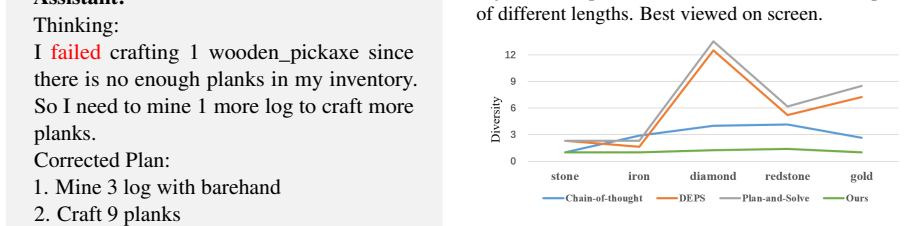
In contrast, our agent shows no significant vari- ation in performance when the length of the plans increases. This is because our agent can narrow down the situations that the agent needs to consider for goal decomposition through the recursive goal decomposition module. Ther...
-
[2022]
Bhavana Dalvi, Peter Jansen, Oyvind Tafjord, Zhengnan Xie, Hannah Smith, Leighanna Pipatanangkura, and Peter Clark
Selection-inference: Exploiting large language models for interpretable logical reasoning.arXiv preprint arXiv:2205.09712. Bhavana Dalvi, Peter Jansen, Oyvind Tafjord, Zhengnan Xie, Hannah Smith, Leighanna Pipatanangkura, and Peter Clark. 2021. Explaining answers with entail- ...
2021 arXiv
-
[2023]
Yinger Zhang, Hui Cai, Xierui Song, Yicheng Chen, Rui Sun, and Jing Zheng
Skill reinforcement learning and planning for open-world long-horizon tasks.arXiv preprint arXiv:2303.16563. Yinger Zhang, Hui Cai, Xierui Song, Yicheng Chen, Rui Sun, and Jing Zheng. 2024. Reverse chain: A generic-rule for LLMs to master multi-API planning. InFindings of the ...
2024 arXiv
-
[2024]
Shunyu Yao, Jeffrey Zhao, Dian Yu, Nan Du, Izhak Shafran, Karthik Narasimhan, and Yuan Cao
Tree of thoughts: Deliberate problem solving with large language models.Advances in Neural Information Processing Systems, 36. Shunyu Yao, Jeffrey Zhao, Dian Yu, Nan Du, Izhak Shafran, Karthik Narasimhan, and Yuan Cao. 2023. React: Synergizing reasoning and acting in language ...
2023 arXiv
Reviewed August 7, 2026 · model on record in the stance chip above.
Discussion (0). Sign in to comment.