REVIEW 3 major objections 4 minor 72 references
Software-enhanced simultaneous quantum-classical communication protocol with Gaussian post-selection
T0 review · 3 major / 4 minor · reviewed 2026-08-04 · deepseek-v4-flash
Pith's one-line read Gaussian post-selection applied to Alice's stored modulation data can emulate optimal modulation-variance tuning in a simultaneous quantum-classical communication protocol, extending fixed-variance fibre key distribution from 37.5 km to 76
desk verdict Useful but unpolished extension of SQCC with Gaussian post-selection; the asymptotic result is solid, but the finite-size composable security is asserted rather than proven, and a parameter inconsistency needs fixing. read the letter →
The pith
A machine-rendered reading of the paper's core claim, the machinery that carries it, and where it could break.
The reading
What carries the argument
The load-bearing object is the Gaussian post-selection filter F_A(x_a,p_a)=exp(-g^2(x_a^2+p_a^2)), applied by Alice to her own stored modulation data after the channel is estimated; it is a digital filter that either keeps or discards each symbol with that probability. Its effect is captured by the effective modulation variance V_mod/(2g^2V_mod+1), which enters the post-selected covariance matrix after Bob's electronic gain and renormalisation are applied. The filter gain g is then optimised to maximise the asymptotic key rate K_inf = P_A(beta I_AB - I_E), with the success probability P_A = 1/(2g^2V_mod+1) setting a data-rate penalty. The argument also relies on treating the receiver as trus
What would settle it
Recompute the fibre key-rate curve using the paper's parameters, but evaluate the classical bit-error rate, the correction term, and Bob's electronic gain on the post-selected subsample rather than on the full data set. If the key rate at 41 km with filter gain 0.25 drops below zero, the reported range extension is an artefact of keeping those error terms fixed.
Extended reading notes
Core claim
The central claim is that filtering Alice's retained quadrature data with the Gaussian weight exp(-g^2(x_a^2+p_a^2)) is mathematically equivalent to re-preparing a state with a smaller modulation variance, V_mod/(2g^2V_mod+1), and that this equivalence survives the renormalisation steps needed to keep the SQCC joint statistics physical. With the filter gain re-optimised for each estimated channel, Eve's Holevo information falls faster than Alice–Bob mutual information, turning a negative key rate at 41 km fibre into a positive one and extending the fixed-variance SQCC range to 76 km asymptotically. In the finite-size regime the range grows by 13 km and 22 km for block sizes 10^10 and 10^11,
Load-bearing premise
The reported distance and duty-cycle gains rest on the modelling assumption that after Alice keeps only small-amplitude symbols, the joint state is described by the same classical bit-error rate, electronic gain, and renormalisation as before filtering; if these quantities improve when conditioned on the kept symbols, the effective covariance matrix and key rates would have to be recomputed.
Editorial extensions
If this is right
- A fixed-variance SQCC transmitter no longer needs to know the channel in advance: after estimating loss and noise, Alice can tune the effective variance by choosing g, recovering most of the key rate a pre-optimised system would give.
- The asymptotic fibre range of the V=10 SNU protocol grows from 37.5 km to 76 km, extending into a regime where the unfiltered protocol produces negative key rates.
- Finite-size composable security improves: maximum secure distance rises by 13 km for N=10^10 and 22 km for N=10^11, making the scheme viable for realistic block sizes.
- Satellite-to-ground links gain full 3-hour communication windows at 100% duty cycle under good weather, versus 24–46% without filtering, and retain 1.5–2 hour windows under bad weather where the unfiltered protocol fails at N=10^11.
- Because the filter is probabilistic, the achieved key rate carries a success-probability penalty P_A, so the protocol approaches but does not surpass the fully pre-optimised variance upper bound.
Reading between the lines
- The same software filter could be applied block-by-block in a fading link, re-optimising g on each channel coherence interval; the paper optimises g per distance or elevation but not per fading realisation, so a dynamic-gain schedule is a natural extension.
- If keeping small-amplitude symbols also improves the classical bit-error rate of the co-propagated classical data, the classical error terms in the covariance model would decrease, potentially making the reported gains conservative; the paper keeps those terms fixed.
- Because the filter operates entirely on Alice's stored quadrature values, it could be ported to any discretely modulated or higher-dimensional CV-QKD scheme with a trusted receiver, though each variant would need its own security analysis.
- An experimental test could be built on a standard coherent transceiver: record Alice's quadratures, apply the digital filter, and measure the recovery of a positive key rate at 41 km fibre—no optical hardware changes are required, which makes the claim directly testable.
Editorial analysis
A structured set of objections, weighed in public.
Referee Report
Summary. The manuscript extends the simultaneous quantum-classical communication (SQCC) protocol by adding a software-based Gaussian post-selection step on Alice's retained modulation data. After channel estimation, Alice applies the filter exp[-g^2(x_a^2+p_a^2)] to her data, discarding symbols with large modulation amplitudes; this emulates a reduction of the effective modulation variance and is claimed to recover most of the performance of a system whose variance is pre-optimised for the actual channel. The authors give an asymptotic key-rate analysis with trusted and untrusted receiver models, a finite-size key-rate formula, and numerical results for fibre and satellite-to-ground channels. They report that post-selection extends the asymptotic fibre range from 37.5 km to 76 km, increases finite-size ranges by 13-22 km, and enables full communication windows in a satellite scenario under good weather.
Significance. If correct, the proposal is practically appealing: it is a passive, software-only way to adapt a fixed-variance SQCC transmitter to fluctuating channels, which is exactly the regime where pre-optimisation fails. The core algebraic identity for the filter's effect on the variance is straightforward, and the asymptotic key-rate integrals appear internally consistent with the stated model and parameters. The paper also includes useful comparisons with untrusted-detector scenarios and explicit parameter tables. However, the finite-size composable security analysis—one of the paper's headline claims—is not actually derived; it is quoted from Ref. [31] with a post-selection factor inserted. The missing derivation affects the 13-22 km finite-size improvements and the finite-size satellite results, so the paper's central new claims are only partly supported at this stage.
major comments (3)
- [Section II.B, unnumbered key-rate equation after Eq. (35)] The finite-size composable key-rate formula is asserted by inserting the post-selection success probability P_A into the formula of Ref. [31], but no derivation is given that the composable security proof of Ref. [31] extends to the post-selected protocol. The confidence bounds delta_Var and delta_Cov in Eqs. (29)-(34) are evaluated with the total block size N. If the post-selected covariance is estimated from the retained symbols, the effective sample size is N_ps = P_A N and the bounds should be evaluated with N_ps; if instead the covariance is estimated before post-selection, the error propagation through the nonlinear filter map is not supplied. Moreover, the terms sqrt(p_f P_A/N) and sqrt(p_f P_A log2(p_f P_A N)/N) scale as sqrt(N_ps)/N under P_A=N_ps/N, which is not the standard 1/sqrt(N_ps) scaling for a retained block of size N_ps; at face value this understates the finite-size p
- [Section II, Eqs. (13)-(15)] The post-selected covariance matrix is formed by replacing V with V~ in V_b and C_d while keeping the classical-error parameters e_C and delta at their pre-filter values and keeping N_d from the initial variances. Conditional on the retained low-amplitude symbols, the classical SNR is larger because Bob's variance is reduced to V~_b, so e_C and delta should be recomputed. The paper does not do this and gives no argument that the hybrid matrix using pre-filter e_C and delta is a conservative bound on the true post-selected state. This affects the mutual information and Eve's bound in both the asymptotic and finite-size calculations. The authors should either derive the conditional classical error rates for the kept symbols or prove that the pre-filter values yield a valid pessimistic bound.
- [Section II.B, Eqs. (27) and (35)] The filter gain g is optimised using the channel parameters estimated from the same data, so g itself is an adaptive public choice that depends on the estimated covariance matrix. A composable finite-size security statement must account for this adaptivity, for example by a union bound over a discretised family of gains. No such argument appears. Consequently, the finite-size key-rate formula after Eq. (35) cannot be taken directly from Ref. [31] without incorporating this dependence. This is a second reason why the finite-size claims are not yet established.
minor comments (4)
- [Eq. (28)] The condition on the classical displacement appears to omit the detection efficiency eta. From the definitions of SNR and alpha=sqrt(eta T)d, one expects d >= 2 erfc^{-1}(2W) sqrt((V_b+1)/(eta T)), not sqrt((V_b+1)/T). Please check.
- [Fig. 2 caption] The caption refers to 'Bob's classical bit-error rate, W', but in the main text W is the target quality-of-service and e_C is the actual classical bit-error rate. Please make the notation consistent.
- [Unnumbered finite-size key-rate formula after Eq. (35)] The quantities Delta_AEP, Delta_ent, Delta_S, and Delta_H are not defined in the manuscript. They should be defined explicitly or the reader should be referred to the specific equations in Ref. [31] where they are introduced.
- [Section III, Fig. 4(a)] The statement that the post-selected protocol 'maintains secure key rates across the entire elevation range' under good weather should specify whether this holds for all three block sizes shown (asymptotic, N=10^12, N=10^11), since the figure includes all three curves.
Circularity Check
No by-construction circularity; Gaussian post-selection is an exact variance transformation and the key rates are computed, not fitted. The self-cited finite-size formula is a proof gap, not a circular reduction.
full rationale
Walking the derivation chain, the central mechanism is Eqs. (9)-(15): the Gaussian filter F_A = exp(-g^2(x_a^2+p_a^2)) changes Alice's effective modulation variance to V_mod/(2g^2 V_mod+1), and the key rates are computed by inserting this into the SQCC covariance matrix with g optimized per channel. That is an exact algebraic identity, not a fit; the claimed distances in Figs. 2-4 are outputs of the key-rate formulas, not targets used to set parameters. The filter gain is optimized in-sample, but in-sample optimization of the protocol parameter is the protocol being evaluated, not a post-hoc fit disguised as a prediction. The only load-bearing external input is the unnumbered finite-size key-rate formula after Eq. (35), which is quoted from the authors' own Ref. [31] and modified by a P_A factor without derivation; this is a genuine support gap for the finite-size claims (13-22 km in Fig. 3 and satellite duty cycles in Fig. 4), but it is a missing proof rather than a by-construction equivalence: the formula is not identical to its inputs, and the asymptotic benefit is derived in the paper. Thus there is no significant circularity, only a notable self-citation burden in the finite-size analysis.
Assumptions & free parameters
free parameters (7)
- Modulation variance V_mod (or V) =
7 SNU (Tables I/II); text uses V=10 in §III
- Classical displacement d =
60 SNU (fibre), 50 SNU (satellite)
- Gaussian filter gain g =
Optimised per distance/elevation; e.g., g=0.25 at d=41 km
- Excess noise xi =
0.05 SNU (fibre), 0.02 SNU (satellite)
- Receiver parameters (eta, v_el) =
eta=0.95/0.985, v_el=0.01 SNU
- Reconciliation efficiency beta =
0.95 (fibre), 0.92 (satellite)
- Atmospheric scenario (visibility, C_n^2) =
200 km / 10^-16 (good), 20 km / 10^-13 (bad)
assumptions (6)
- standard math Gaussian states maximize von Neumann entropy for a fixed covariance matrix (Gaussian extremality theorem).
- domain assumption Eve has no access to Bob's detector efficiency and electronic noise; the trusted-receiver model sets eta=1, v_el=0 for Eve.
- domain assumption The EB-PM equivalence and the renormalisation/security framework of Zaunders et al. [31] apply to the post-selected protocol.
- domain assumption The finite-size parameter-estimation confidence corrections (Eqs. 29-34) remain valid for the post-selected covariance matrix.
- domain assumption Thermal-loss channel model with transmittivity T and thermal noise W = xi T/(1-T) + 1.
- domain assumption Classical re-displacement errors are described by Gaussian statistics with BER e_C and overlap delta given by Eqs. (6)-(8).
Cite this review
Pith. "Pith review of Software-enhanced simultaneous quantum-classical communication protocol with Gaussian post-selection." pith.science (2026). https://pith.science/paper/OHKENOG6
@misc{pith2026251013138,
  author       = {Pith},
  title        = {Pith review of: Software-enhanced simultaneous quantum-classical communication protocol with Gaussian post-selection},
  year         = {2026},
  howpublished = {\url{https://pith.science/paper/OHKENOG6}},
  note         = {Machine review of arXiv:2510.13138}
}
read the original abstract
Simultaneous quantum-classical communication (SQCC) protocols offer a practical approach to continuous-variable quantum key distribution (CV-QKD) by encoding quantum and classical signals onto the same optical pulse. However, like most QKD protocols, their performance is limited when experimental parameters, such as modulation variance, are optimised based on stationary channel assumptions. In fluctuating environments, such as free-space links, this can result in sub-optimal key rates and reduced transmission distances. In this work, we introduce Gaussian post-selection into the SQCC framework, enabling a software-based optimisation of the modulation variance after channel estimation. This passive approach enhances key rates in both asymptotic and finite-size regimes without requiring hardware modifications and remains effective even when receiver imperfections are taken into account. We demonstrate that our protocol improves the transmission distance and robustness of SQCC relative to the standard fixed-variance SQCC protocol, and approaches the performance of a fully pre-optimised system across both fibre and free-space channels. In particular, we show that the protocol enables full communication windows under ideal weather conditions and maintains higher duty cycles during adverse weather in satellite-to-ground scenarios. These results highlight the practicality of post-selection based SQCC for real-world quantum communication over both terrestrial fibre networks and satellite-based free-space links.
Figures


Figures from the paper (2 more)


Reference graph
Works this paper leans on
-
[54]
C., Symul, T
Walk, N., Ralph, T. C., Symul, T. & Lam, P. K. Secu- rity of continuous-variable quantum cryptography with gaussian postselection.Phys. Rev. A87, 020303 (2013)
2013
-
[31]
Express19, 10387–10409 (2011)
Sasaki, M.et al.Field test of quantum key distribution in the tokyo qkd network.Opt. Express19, 10387–10409 (2011)
2011
-
[1]
She keeps a copy of her encoding to perform post-selection after estimating the channel parameters if deemed necessary
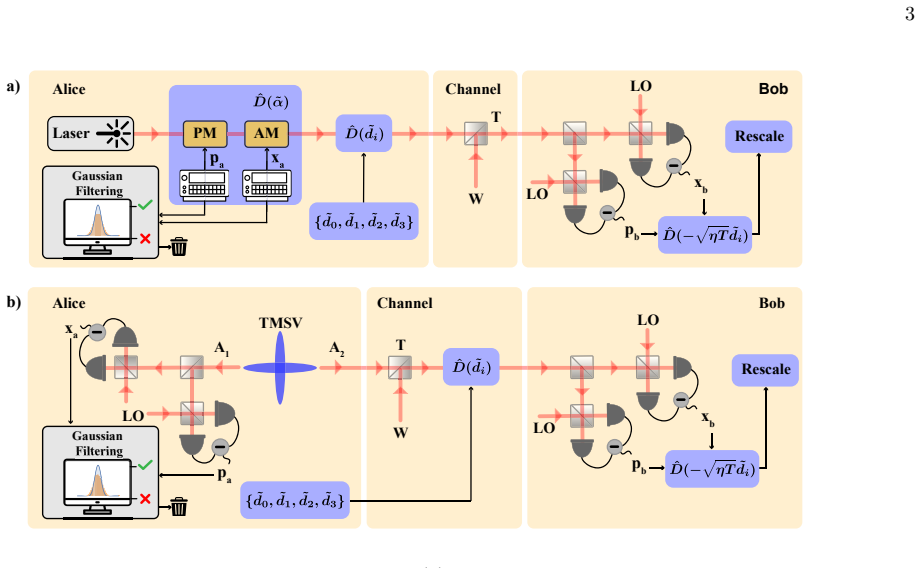
Alice encodes coherent states|(x a +ip a)/2⟩=|˜α⟩ from a bivariate Gaussian distribution with zero mean and variance,V mod, corresponding to the quantum symbols for the key generation. She keeps a copy of her encoding to perform post-selection after estimating the channel parameters if deemed necessary
-
[2]
She then displaces her states by some large phase displacement, ˜d, randomly chosen from her classical alphabetd i
-
[3]
The state ˜α+˜d E representing both the classi- cal and quantum symbols, is then sent through a thermal-loss channel modelled with transmittivity Tand thermal-noiseξ. 3 ChannelAlice W T LO Gaussian Filtering Filtering xb Alice LO TMSV A1 A2 PM xapa p a x a Laser LO LO pb AM Rescale Bob Gaussian Filtering Filtering xa pa Channel W T LO xbLO LO pb Bob a) b)...
-
[4]
Bob performs a heterodyne detection on the re- ceived signal to obtain ˜βwhich is a Gaussian vari- able with a mean value of √ηT dwhereηrepresents his detection efficiency
-
[5]
This maps the proto- col to an equivalent GG02 protocol with coherent states encoding and heterodyne measurements
Bob then re-displaces his measurement outcomes by ˜dlinked to the classical information to retrieve the quantum information. This maps the proto- col to an equivalent GG02 protocol with coherent states encoding and heterodyne measurements
-
[6]
In the case of such mistake, Bob can rescale his data by applying an electronic gain, denoted asN d, to obtain an equivalent physical non-Gaussian dis- tribution
As discussed in Zaunderset al.[31], any mistakes in the re-displacement operation of Bob result in a non-physical distribution between Alice and Bob. In the case of such mistake, Bob can rescale his data by applying an electronic gain, denoted asN d, to obtain an equivalent physical non-Gaussian dis- tribution
Show all 72 references
-
[7]
Alice and Bob then estimate the channel param- eters. If the modulation variance of the quantum data is sub-optimal, causing Eve’s inferred infor- mation to exceed their mutual information, Alice applies a Gaussian filter to her data, following the method of Erkılı¸ cet al.[54...
-
[8]
× 10-4 0.001 0.005 0.010 Key Rate (bits/use) Elevation Angle (Degrees) 0 50 100 1501. × 10-4
-
[9]
× 10-4 0.001 0.005 0.010 Key Rate (bits/use) Elevation Angle (Degrees) Gaussian Ps N = 1012 Gaussian Ps N = 1011 Gaussian Ps N = SQCC N = 1012 SQCC N = 1011 SQCC N = Gaussian Ps N = 1012 Gaussian Ps N = 1011 Gaussian Ps N = SQCC N = 1012 SQCC N = QKD Protocol Duty Cycle (%) 0 ...
-
[10]
× 10-4 0.001 0.005 0.010 0.050a) Key Rate (bits/use) Transmission Distance (km) SQCC V=10 Gaussian Ps Optimised SQCC 0 10 20 30 40 50 6010-5 10-4 0.001 0.010 0.100 1 Transmission Distance (km) SQCC V=10 Gaussian Ps Optimised SQCC Key Rate (bits/use) c) 22 23 24 25 26 27 28 291. × 10-4
-
[11]
× 10-4 0.001 0.005 0.010 0.050 Key Rate (bits/use)SQCC V=10 Gaussian Ps Optimised SQCC Transmission Distance (km) b) FIG. 5. Asymptotic key rates in the untrusted-detector scenario. Alice’s modulation variance is set toV= 10 SNU, with channel noiseξ= 0.05 SNU.(a)Detector effic...
-
[12]
& Zbinden, H
Gisin, N., Ribordy, G., Tittel, W. & Zbinden, H. Quan- tum cryptography.Rev. Mod. Phys.74, 145–195 (2002)
2002
-
[13]
& Renner, R
Ekert, A. & Renner, R. The ultimate physical limits of privacy.Nature507, 443–447 (2014)
2014
-
[14]
Pirandola, S.et al.Advances in quantum cryptography. Adv. Opt. Photonics12, 1012–1236 (2020)
2020
-
[15]
C.et al.Continuous-variable quantum com- munication.arXiv preprint arXiv:2501.12801(2025)
Usenko, V. C.et al.Continuous-variable quantum com- munication.arXiv preprint arXiv:2501.12801(2025)
2025 arXiv
-
[16]
Ralph, T. C. Continuous variable quantum cryptography. Phys. Rev. A61, 010303 (1999)
1999
-
[17]
Quantum cryptography with squeezed states
Hillery, M. Quantum cryptography with squeezed states. Phys. Rev. A61, 022309 (2000)
2000
-
[18]
& Grangier, P
Grosshans, F. & Grangier, P. Continuous variable quan- tum cryptography using coherent states.Phys. Rev. Lett. 88, 057902 (2002)
2002
-
[19]
Grosshans, F.et al.Quantum key distribution using gaussian-modulated coherent states.Nature421, 238– 241 (2003)
2003
-
[20]
Weedbrook, C.et al.Quantum cryptography without switching.Phys. Rev. Lett.93, 170504 (2004)
2004
-
[21]
M.et al.No-switching quantum key distribu- tion using broadband modulated coherent light.Phys
Lance, A. M.et al.No-switching quantum key distribu- tion using broadband modulated coherent light.Phys. Rev. Lett.95, 180503 (2005)
2005
-
[22]
Lodewyck, J.et al.Quantum key distribution over 25 km with an all-fiber continuous-variable system.Phys. Rev. A76, 042305 (2007)
2007
-
[23]
S., Usenko, V
Madsen, L. S., Usenko, V. C., Lassen, M., Filip, R. & Andersen, U. L. Continuous variable quantum key distri- bution with modulated entangled states.Nat. Commun. 3, 1083 (2012)
2012
-
[24]
& Diamanti, E
Jouguet, P., Kunz-Jacques, S., Leverrier, A., Grangier, P. & Diamanti, E. Experimental demonstration of long- distance continuous-variable quantum key distribution. Nat. Photonics7, 378–381 (2013)
2013
-
[25]
Wang, C.et al.25 mhz clock continuous-variable quan- tum key distribution system over 50 km fiber channel. Sci. Rep.5, 14607 (2015)
2015
-
[26]
Jain, N.et al.Practical continuous-variable quantum key distribution with composable security.Nat. Commun. 13, 4740 (2022)
2022
-
[27]
A.et al.Long-distance continuous-variable quantum key distribution over 100-km fiber with local local oscillator.Sci
Hajomer, A. A.et al.Long-distance continuous-variable quantum key distribution over 100-km fiber with local local oscillator.Sci. Adv.10, eadi9474 (2024)
2024
-
[28]
Quantum information with optical continuous variables: from bell tests to key dis- tribution (2007)
Garcia-Patron Sanchez, R. Quantum information with optical continuous variables: from bell tests to key dis- tribution (2007)
2007
-
[29]
Phys11, 075001 (2009)
Peev, M.et al.The secoqc quantum key distribution network in vienna.New J. Phys11, 075001 (2009)
2009
-
[30]
Express18, 27217–27225 (2010)
Chen, T.-Y.et al.Metropolitan all-pass and inter-city quantum communication network.Opt. Express18, 27217–27225 (2010)
2010
-
[32]
Pirandola, S.et al.High-rate quantum cryptography in untrusted networks.arXiv preprint arXiv:1312.4104 (2013)
2013 arXiv
-
[33]
Chen, Y.-A.et al.An integrated space-to-ground quan- tum communication network over 4,600 kilometres.Na- ture589, 214–219 (2021)
2021
-
[34]
Chen, T.-Y.et al.Implementation of a 46-node quantum metropolitan area network.npj Quantum Info.7, 134 (2021)
2021
-
[35]
A., Andersen, U
Hajomer, A. A., Andersen, U. L. & Gehring, T. High-rate continuous-variable measurement device- independent quantum key distribution with finite-size security.Quantum Science and Technology10, 025032 (2025)
2025
-
[36]
Phys 11, 105001 (2009)
Chapuran, T.et al.Optical networking for quantum key distribution and quantum communications.New J. Phys 11, 105001 (2009)
2009
-
[37]
& Zbinden, H
Eraerds, P., Walenta, N., Legr´ e, M., Gisin, N. & Zbinden, H. Quantum key distribution and 1 gbps data encryption over a single fibre.New J. Phys12, 063027 (2010)
2010
-
[38]
Patel, K.et al.Quantum key distribution for 10 gb/s dense wavelength division multiplexing networks.Appl. Phys. Lett.104(2014)
2014
-
[39]
Khaksar, Z. S. & Bahrampour, A. Simultaneous bpsk classical communication and continuous variable quan- tum key distribution with a locally local oscillator regen- erated by optical injection phase locked loop.J. Laser Appl.35(2023)
2023
-
[40]
Simultaneous classical communication and quan- tum key distribution using continuous variables.Physical Review A94, 042340 (2016)
Qi, B. Simultaneous classical communication and quan- tum key distribution using continuous variables.Physical Review A94, 042340 (2016)
2016
-
[41]
C., Aguinaldo, R
Zaunders, N., Wang, Z., Ralph, T. C., Aguinaldo, R. & Malaney, R. Quantum-amplified simultaneous quantum- classical communications. In2024 International Con- ference on Quantum Communications, Networking, and Computing (QCNC), 160–167 (IEEE, 2024)
2024
-
[42]
& Ralph, T
Zaunders, N., Wang, Z., Malaney, R., Aguinaldo, R. & Ralph, T. C. Enhanced simultaneous quantum- classical communications under composable security. arXiv preprint arXiv:2505.03145(2025)
2025
-
[43]
& Lim, C
Qi, B. & Lim, C. C. W. Noise analysis of simultaneous quantum key distribution and classical communication scheme using a true local oscillator.Physical Review Ap- plied9, 054008 (2018)
2018
-
[44]
Pan, D.et al.Simultaneous two-way classical commu- nication and measurement-device-independent quantum key distribution with coherent states.Physical Review A 101, 012343 (2020)
2020
-
[45]
S.et al.Classical-quantum dual encoding for laser communications in space.New Journal of Physics 26, 033012 (2024)
Winnel, M. S.et al.Classical-quantum dual encoding for laser communications in space.New Journal of Physics 26, 033012 (2024)
2024
-
[46]
C., Lund, A
Xiang, G.-Y., Ralph, T. C., Lund, A. P., Walk, N. & Pryde, G. J. Heralded noiseless linear amplification and distillation of entanglement.Nat. Photonics4, 316–319 (2010)
2010
-
[47]
S., Hosseinidehaj, N
Winnel, M. S., Hosseinidehaj, N. & Ralph, T. C. Gener- alized quantum scissors for noiseless linear amplification. Phys. Rev. A102, 063715 (2020)
2020
-
[48]
& Levenson, J.- A
Bencheikh, K., Symul, T., Jankovic, A. & Levenson, J.- A. Quantum key distribution with continuous variables. J. Mod. Opt.48, 1903–1920 (2001)
1903
-
[49]
& Zeng, G
Huang, P., He, G., Fang, J. & Zeng, G. Performance improvement of continuous-variable quantum key distri- bution via photon subtraction.Phys. Rev. A87, 012317 (2013)
2013
-
[50]
& Zubairy, M
Hu, L., Al-Amri, M., Liao, Z. & Zubairy, M. Continuous- variable quantum key distribution with non-gaussian op- 12 erations.Phys. Rev. A102, 012608 (2020)
2020
-
[51]
& Hu, L.-Y
Chen, X.-T., Zhang, L.-P., Chang, S.-K., Zhang, H. & Hu, L.-Y. Continuous-variable quantum key distribution based on photon addition operation.Chinese Physics B 30, 060304 (2021)
2021
-
[52]
Express27, 17186–17198 (2019)
Ye, W.et al.Improvement of self-referenced continuous- variable quantum key distribution with quantum photon catalysis.Opt. Express27, 17186–17198 (2019)
2019
-
[53]
& Guo, Y
Hu, J., Liao, Q., Mao, Y. & Guo, Y. Performance im- provement of unidimensional continuous-variable quan- tum key distribution using zero-photon quantum cataly- sis.Quantum Inf. Process.20, 1–20 (2021)
2021
-
[55]
& Cerf, N
Fiur´ aˇ sek, J. & Cerf, N. J. Gaussian postselection and vir- tual noiseless amplification in continuous-variable quan- tum key distribution.Phys. Rev. A86, 060302 (2012)
2012
-
[56]
M., Symul, T., Walk, N
Hosseinidehaj, N., Lance, A. M., Symul, T., Walk, N. & Ralph, T. C. Finite-size effects in continuous-variable quantum key distribution with gaussian postselection. Phys. Rev. A101, 052335 (2020)
2020
-
[57]
M.et al.Measurement-based noiseless linear amplification for quantum communication.Nat
Chrzanowski, H. M.et al.Measurement-based noiseless linear amplification for quantum communication.Nat. Photonics8, 333–338 (2014)
2014
-
[58]
Y., Symul, T., Lam, P
Zhao, J., Haw, J. Y., Symul, T., Lam, P. K. & Assad, S. M. Characterization of a measurement-based noiseless linear amplifier and its applications.Phys. Rev. A96, 012319 (2017)
2017
-
[59]
Commun.14, 4745 (2023)
Zhao, J.et al.Enhancing quantum teleportation efficacy with noiseless linear amplification.Nat. Commun.14, 4745 (2023)
2023
-
[60]
Shajilal, B.et al.Improving gaussian channel simula- tion using non-unity gain heralded quantum teleporta- tion.arXiv preprint arXiv:2408.08667(2024)
2024 arXiv
-
[61]
Li, Z.et al.Non-gaussian postselection and virtual pho- ton subtraction in continuous-variable quantum key dis- tribution.Phys. Rev. A93, 012310 (2016)
2016
-
[62]
Zhong, H.et al.Enhancing of self-referenced continuous- variable quantum key distribution with virtual photon subtraction.Entropy20, 578 (2018)
2018
-
[63]
Jeng, H., Lam, P. K. & Assad, S. M. Entanglement-based quantum key distribution with non-gaussian continuous variables.arXiv preprint arXiv:2507.18000(2025)
2025 arXiv
-
[64]
& Huang, D
Zhong, H., Guo, Y., Mao, Y., Ye, W. & Huang, D. Virtual zero-photon catalysis for improving continuous- variable quantum key distribution via gaussian post- selection.Sci. Rep.10, 17526 (2020)
2020
-
[65]
arXiv preprint arXiv:2507.18049(2025)
Erkilic, O.et al.Enhanced continuous-variable quantum key distribution protocol via adaptive signal processing. arXiv preprint arXiv:2507.18049(2025)
2025 arXiv
-
[66]
J., Wenger, J., Tualle-Brouri, R
Grosshans, F., Cerf, N. J., Wenger, J., Tualle-Brouri, R. & Grangier, P. Virtual entanglement and reconcilia- tion protocols for quantum cryptography with continuous variables.arXiv preprint quant-ph/0306141(2003)
2003 arXiv
-
[67]
Weedbrook, C.et al.Gaussian quantum information. Rev. Mod. Phys.84, 621–669 (2012)
2012
-
[68]
Holevo, A. S. The capacity of the quantum channel with general signal states.IEEE Trans. Inf. Theory44, 269– 273 (1998)
1998
-
[69]
& Cerf, N
Garc ´ ıa-Patr´ on, R. & Cerf, N. J. Unconditional optimality of gaussian attacks against continuous-variable quantum key distribution.Phys. Rev. Lett.97, 190503 (2006)
2006
-
[70]
M., Giedke, G
Wolf, M. M., Giedke, G. & Cirac, J. I. Extremality of gaussian quantum states.Phys. Rev. Lett.96, 080502 (2006)
2006
-
[71]
Quantum Technol.1, 1800011 (2018)
Laudenbach, F.et al.Continuous-variable quantum key distribution with gaussian modulation—the theory of practical implementations.Adv. Quantum Technol.1, 1800011 (2018)
2018
-
[72]
Commun.(2024)
Sayat, M.et al.Satellite-to-ground continuous variable quantum key distribution: The gaussian and discrete modulated protocols in low earth orbit.IEEE Trans. Commun.(2024)
2024
Reviewed August 4, 2026 · model on record in the stance chip above.
Discussion (0). Sign in to comment.