REVIEW 4 major objections 5 minor 137 references
Stress Softening Damage in Strongly Nonlinear Viscoelastic Soft Materials A Physics Informed Data Driven Constitutive Model with Time Temperature Coupling
T0 review · 4 major / 5 minor · reviewed 2026-08-06 · deepseek-v4-flash
Pith's one-line read A Temporal Convolutional Network trained on three thermomechanical tests can act as a thermodynamically consistent surrogate for nonlinear viscoelastic soft materials with stress-softening damage, extrapolating to unseen temperatures…
desk verdict A clever architecture for data-driven thermoviscoelastic surrogates with Mullins damage, but the validation is entirely self-referential: the 'high-fidelity experimental data' are generated by the same model the surrogate is supposed to replace. read the letter →
The pith
A machine-rendered reading of the paper's core claim, the machinery that carries it, and where it could break.
The reading
What carries the argument
The load-bearing object is a reduced-time, invariant-based stress decomposition: total isochoric stress is a linear combination of three integrity basis tensors, $\mathbb{I}_1 = \mathbf{C}^{-1}$, $\mathbb{I}_2 = \mathrm{Dev}(\mathbf{I})$, and $\mathbb{I}_3 = \mathrm{Dev}(\mathbf{C})$, with scalar response functions $\omega_\alpha(\tau^*, I_1, I_2, I_{1,\max})$ learned by a dilated causal Temporal Convolutional Network. Temperature enters through a shift-factor reduced time $\tau^*$, while Mullins-type damage is tracked by the historical maximum of the first isochoric invariant $I_{1,\max}$, which activates damage only when the current loading exceeds past maxima. The loss function appends a penalty whenever the Clausius-Duhem dissipation inequality is violated and constrains the damage variable to the interval $[0,1]$, so thermodynamic admissibility is imposed during training rather than checked afterward.
What would settle it
Train the identical surrogate on experimental two-cycle data at three thermomechanical states and compare its predictions with measured third-cycle responses at 10°C, 500%/min, and 200% elongation; any systematic divergence in peak stress, hysteresis area, or damage saturation would falsify the extrapolation claim.
Extended reading notes
Core claim
The paper's central claim is that a Temporal Convolutional Network trained on an invariant-based stress decomposition can act as a thermodynamically consistent surrogate for strongly nonlinear thermo-viscoelastic soft materials with stress-softening damage. In the reported tests, the surrogate reproduces cyclic loading-unloading hysteresis and damage accumulation in training cases, then extrapolates to 10°C from training temperatures of 0, 25, and 55°C, to 500%/min from a 200%/min training maximum, and to 200% elongation from 150%, while maintaining nonnegative internal dissipation and damage in the physical range. The model also tracks the first and second viscoelastic branch contributions, tolerates 20% Gaussian noise in the input stress, and matches finite element reference results for Mullins damage growth around an open hole. This is presented as closing the gap left by quasi-static or isothermal Mullins-effect models and by unconstrained data-driven networks that may violate the second law.
Load-bearing premise
The whole extrapolation story is built on synthetic training data generated by a specific combination of mathematical material laws; if those laws do not faithfully represent real soft materials, the reported success shows only that the network learned the generator, not that it predicts physical behavior.
Editorial extensions
If this is right
- A surrogate trained on just three two-cycle tests reproduces unseen loading cycles with R-squared values above 0.97 in the reported holdout cases.
- The model extrapolates to temperatures, strain rates, and stretch levels outside its training range, which suggests fewer physical tests may be needed to characterize a material across its service envelope.
- Because dissipation is enforced nonnegative and damage is bounded, the surrogate can be used inside finite element solvers without producing energetically impossible stress cycles.
- The noise-robustness result implies that modest experimental scatter in stress measurements need not destroy predictive accuracy.
- Deployment through a user material subroutine allows the surrogate to replace an explicit constitutive law in structural-scale simulations of Mullins damage.
Reading between the lines
- The strongest unstated test is experimental: the paper validates extrapolation against a synthetic generator, so retraining on real multicycle data from an actual elastomer and repeating the holdout comparisons would tell whether the generalization claim survives contact with physical measurements.
- Because the formulation is built on invariants and response functions rather than a fixed strain-energy form, the same architecture could in principle be transferred to multiaxial loading histories, provided training data with those paths are available.
- The separation of time-temperature effects through a reduced-time shift factor suggests that a material's master curve behavior could be learned once and reused across temperatures, cutting the data needed for each new temperature.
- The tolerance to 20% input noise hints that the dilated causal structure acts as a strong regularizer, which would be valuable when training on noisy lab data rather than clean simulations.
Editorial analysis
A structured set of objections, weighed in public.
Referee Report
Summary. The paper proposes a physics-informed, data-driven constitutive model for strongly nonlinear thermo-viscoelastic soft materials with Mullins-type damage. The model decomposes stress into volumetric and unified isochoric contributions expressed as linear combinations of integrity basis tensors with scalar response functions, following Upadhyay et al. A Temporal Convolutional Network (TCN) learns these response functions (and the damage variable) from sequences of invariant inputs, with a loss function that adds a dissipation penalty and a damage-boundedness penalty. The authors report accurate fits on training cases, generalization to unseen temperatures, strain rates, and stretch levels, robustness to 20% Gaussian noise, and agreement with Abaqus VUMAT simulations of an open-hole specimen. The central claim is that the TCN surrogate captures real soft-material behavior and can be deployed in finite element workflows.
Significance. If the claims were supported, the framework would be a useful contribution to machine-learning constitutive modeling: it uses causal TCNs for history dependence, an invariant-based decomposition that enforces objectivity and isotropy by construction, and a workflow for VUMAT deployment. The synthetic benchmark shows that a TCN can fit and interpolate within a parametric viscoelastic-damage family, which is a legitimate proof-of-concept. However, the paper's significance as a statement about real soft materials is currently unsupported: no experimental data appear anywhere, and the validation loop is closed within the synthetic generator. The novelty relative to existing physics-augmented neural-network approaches is incremental, and the absence of released code/data (data only 'on request') limits reproducibility.
major comments (4)
- [§4.1 and Abstract] The abstract claims the TCN is 'trained on high fidelity experimental data across multiple temperatures, strain rates, and stretch levels', but §4.1 states that all training data are generated synthetically from a Yeoh hyperelastic energy, an Ogden–Roxburgh damage function (Eq. 32), a four-branch generalized Maxwell model (Eqs. 33–36), and a WLF shift factor. No experimental measurement is described anywhere in the paper. Consequently, the central claim of generalization to real soft materials—the headline of the paper and the Conclusions—is unsupported. The reported R² values in Figures 5–10 and the 'ground truth' curves demonstrate only that the TCN can approximate the specific generator used to create the data, not that it captures real material physics.
- [§3.2.1, Eq. (18), and §4.3.4] The training targets for the surrogate—the response functions ω1, ω2 and the damage variable—are not measured or independently known; they are obtained by solving the linear system [b]=[A][x] (Eq. 18) using the same constitutive model that generated the raw stress–strain data (§3.2.1). The FEM 'reference solution' in §4.3.4 is produced by a VUMAT implementation of that same constitutive model. The validation is therefore circular: the TCN is trained to reproduce a known analytical model, and its 'unseen' test cases are extrapolations within that same model family. This does not test whether the learned representation transfers to a different material, different damage evolution law, or different temperature dependence.
- [§3.5.1 and Figure 3] The text repeatedly calls the Clausius–Duhem inequality a 'hard thermodynamic constraint' and claims 'strict enforcement' of thermodynamic admissibility. However, the implementation described in §3.5.1 and Figure 3 is a soft penalty: the loss is MSE plus a dissipation penalty term that is added when dissipation is negative, and violations are penalized rather than excluded from the feasible set. Therefore the model does not guarantee thermodynamic consistency for out-of-distribution states not seen in training. The claim of 'ensured' thermodynamic admissibility in the abstract is not justified by the actual loss construction.
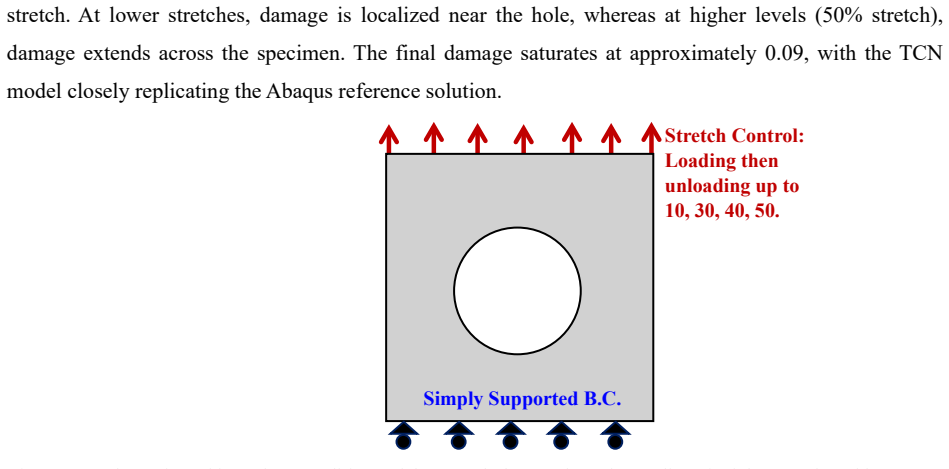
- [§2.1 and Eq. (2)] The damage-variable convention is internally inconsistent. The text states 'ϑ = 1 signifying no damage and ϑ = 0 signifying complete mechanical damage', but Eq. (2) multiplies the intact isochoric energy by the integrity factor (1−ϑ), so ϑ = 0 is the undamaged state and ϑ = 1 is complete damage. The same inconsistency affects the damage evolution law in Eq. (32) and the interpretation of the damage contours in §4.3.4, where a saturation value of approximately 0.09 is reported without clarifying whether this is '9% damage' or '91% damage'. This needs to be fixed before the results can be interpreted.
minor comments (5)
- [§4.3] Equation numbering is inconsistent: Eq. (24) is used for the relative-error metric in §4.3, but Eq. (24) already denotes the residual-block formula in §3.5. Also, Eq. (31) is introduced without Eqs. (29) and (30), and several equation numbers appear out of sequence.
- [§4.2] The TCN architecture description is incomplete for reproducibility: no learning rate, dropout rate, number of residual blocks, sequence length, or loss-weighting coefficients for the dissipation/damage penalties are given. The claim that 'only three tests is sufficient' would also benefit from repeated-training statistics.
- [§3.4 and §3.2.1] The paper first describes a volumetric surrogate and a stress-decomposition procedure requiring volumetric stress data, then states that volumetric effects are 'intentionally excluded' and the material is assumed incompressible. Please clarify the role of the volumetric model in the actual experiments and how the decomposition is performed for incompressible data.
- [Abstract and §5] The phrase 'high-fidelity experimental data' in the abstract and the 'trained directly on ground truth data' in the Conclusions should be replaced with 'synthetic data generated from a known constitutive model' throughout, to match the content of §4.1.
- [References] Reference [142] (about wall-shear stress from neural-network-enhanced fluid flow measurements) does not appear to support the sentence 'internal damage and microstructural reconfiguration tend to degrade the material’s shear resistance far more significantly than its volumetric response' in §2.1; please verify the citation.
Circularity Check
Central extrapolation claim is validated only against the same synthetic constitutive-model generator that produced the training data, and the Abaqus reference solution is generated by that same model family; the evidence chain is therefore internally circular.
-
other
[Abstract; Section 4.1 'Dataset Generation for Model Training']
"A Temporal Convolutional Network is trained on high-fidelity experimental data across multiple temperatures, strain rates, and stretch levels... This dataset is generated using a temperature-dependent viscoelastic model incorporating stress-softening damage and assuming material incompressibility. It is constructed based on a four-branch generalized Maxwell model..."
The abstract promises training on 'high-fidelity experimental data,' but Section 4.1 states that the dataset is generated synthetically from a Yeoh isochoric energy, an Ogden-Roxburgh damage function (Eq. 32), a four-branch generalized Maxwell evolution (Eq. 33), and WLF reduced time. The same generator supplies the 'ground truth' used to score all held-out predictions, so the claimed generalization to unseen temperatures, strain rates, and stretch levels is a self-consistency test within one parametric constitutive family, not evidence about real soft-material behavior.
-
other
[Section 4.3.2, Case 2; Figure 7]
"To evaluate the performance of the proposed surrogate model, we tested it against several additional loading conditions and one entirely new test at 10°C–500%/min, none of which were used during training ... Across all conditions, the surrogate TCN model closely tracks the ground truth curves, including the nonlinear loading–unloading hysteresis, with R² values consistently exceeding 0.97."
The 'ground truth curves' in Case 2 are not experimental measurements; they are outputs of the same Section 4.1 constitutive model that produced the training data. Because the response-function training targets were extracted from that model by solving the linear system in Eq. 18, both the training signal and the held-out 'unseen' reference are generated by the same equations (Yeoh plus Eqs. 32-33 plus WLF). A high R² therefore demonstrates only that the TCN can approximate this specific generator, not that it predicts real material response outside the generator's assumptions.
1 more flagged steps
-
other
[Section 4.3.4, Case 4; Conclusions]
"To simulate the material behavior, we use our group VUMAT subroutine in Abaqus/Explicit that captures finite strain viscoelasticity and Mullins damage evolution ... allowing for comparison against the Abaqus reference solution. ... Using VUMAT-generated FEM results as reference, the TCN surrogate closely matched the stress response and successfully reproduced the spatial and temporal evolution of Mullins damage."
The Abaqus 'reference solution' is computed with the same constitutive-model family that generated the training data and the Case 2 'ground truth.' Thus Case 4 checks agreement between the TCN and another numerical implementation of the same generator; it is an internal-consistency check, not an independent experimental or benchmark validation. This cannot confirm the surrogate's predictive capability for real soft materials and does not break the circular evidence chain.
full rationale
Most of the algebraic derivation (Eqs. 1-20) is self-contained and standard; no self-citation chain carries the central result. The circularity enters at the evidence level. The abstract states that the network is trained on 'high-fidelity experimental data,' but Section 4.1 explicitly says the dataset is generated using a Yeoh equilibrium model, Ogden-Roxburgh damage (Eq. 32), a four-branch generalized Maxwell evolution (Eq. 33), and WLF time-temperature shifting. Consequently, the 'unseen' conditions in Case 2 and the 'Abaqus reference solution' in Case 4 are outputs of the same constitutive family the surrogate is built to emulate; high R-squared values certify internal consistency with that generator, not physical extrapolation to real materials. The thermodynamic-admissibility claim is also softer than stated: Figure 3 defines the total loss as MSE plus a dissipation penalty, and Section 3.5.1 says the loss 'penalizes' violations, so the Clausius-Duhem condition is a soft regularizer rather than a hard constraint. Moreover, the dissipation expression is computed from the same Holzapfel-form specific energy used in the data generator, so the penalty does not inject independent physical information. These issues make the central generalization claim partially circular, even though the surrogate-versus-generator approximation task is internally coherent and the mathematical framework itself is not tautological.
Assumptions & free parameters
free parameters (5)
- Yeoh hyperelastic coefficients C10, C20, C30 =
not reported
- Ogden-Roxburgh damage parameters (e.g., r, m, beta; theta_SAT and zeta in Eq. 32) =
not reported
- Maxwell branch relaxation times tau_alpha and weighting factors beta_alpha^infinity (four branches) =
not reported
- WLF shift-factor constants C1, C2, T_ref =
not reported
- TCN hyperparameters (kernel size, dilation schedule, dropout rate, learning rate) =
not reported (architecture partially specified)
assumptions (4)
- domain assumption Temperature effects are fully captured by the reduced time tau* via the time-temperature superposition shift factor; the free energy and response functions have no explicit temperature dependence.
- ad hoc to paper The synthetic data generated by the Yeoh/Ogden-Roxburgh/generalized Maxwell constitutive model is representative of real soft materials.
- domain assumption The material is incompressible; volumetric effects are excluded from the model.
- domain assumption The Holzapfel form of the configurational free energy (Eq. 27) and the evolution law (Eq. 33) correctly describe the dissipative behavior.
Cite this review
Pith. "Pith review of Stress Softening Damage in Strongly Nonlinear Viscoelastic Soft Materials A Physics Informed Data Driven Constitutive Model with Time Temperature Coupling." pith.science (2026). https://pith.science/paper/OHLDQXUG
@misc{pith2026250712694,
  author       = {Pith},
  title        = {Pith review of: Stress Softening Damage in Strongly Nonlinear Viscoelastic Soft Materials A Physics Informed Data Driven Constitutive Model with Time Temperature Coupling},
  year         = {2026},
  howpublished = {\url{https://pith.science/paper/OHLDQXUG}},
  note         = {Machine review of arXiv:2507.12694}
}
read the original abstract
This study presents a novel physics informed, data-driven modeling framework for capturing the strongly nonlinear thermo-viscoelastic behavior of soft materials exhibiting stress softening, with emphasis on the Mullins effect. Unlike previous approaches limited to quasi-static or isothermal conditions, our model unifies rate dependence, temperature sensitivity, large strain cyclic loading, and evolving damage mechanisms. Thermodynamic admissibility is ensured via a custom loss function that embeds the Clausius Duhem inequality and explicitly constrains the damage variable for physically realistic softening. A Temporal Convolutional Network is trained on high fidelity experimental data across multiple temperatures, strain rates, and stretch levels, enabling the model to capture rich thermomechanical coupling and history dependence. The framework generalizes to unseen thermo mechanical conditions, higher strain rates, and larger deformations, and remains robust to input noise. Validation against finite element simulations using Abaqus/Explicit demonstrates excellent agreement under cyclic loading and damage evolution, confirming the surrogate models effectiveness for advanced simulation workflows.
Figures


Figures from the paper (1 more)
Reference graph
Works this paper leans on
-
[1]
K. Upadhyay, G. Subhash, and D. Spearot, “Hyperelastic constitutive modeling of hydrogels based on primary deformation modes and validation under 3D stress states,” Int J Eng Sci , vol. 154, Sep. 2020, doi: 10.1016/j.ijengsci.2020.103314
arXiv 2020
-
[2]
A. Ghaderi, V . Morovati, Y . Chen, and R. Dargazany, “A physics -informed multi -agents model to predict thermo - oxidative/hydrolytic aging of elastomers,” Int J Mech Sci, vol. 223, Jun. 2022, doi: 10.1016/j.ijmecsci.2022.107236
arXiv 2022
-
[3]
E. Choi, A. Ostadrahimi, and H. Youn, “Analytical and experimental study of shape memory alloy reinforcement on the performance of butt-fusion welded joints in high -density polyethylene pipe,” J Intell Mater Syst Struct , vol. 31, no. 17, 2020, doi: 10.1177/1045389X20942583
-
[4]
An analytical study on SMA beam -column actuators for anti - buckling phenomenon,
A. Ostadrahimi, F. Taheri-Behrooz, E. Choi, and G. Li, “An analytical study on SMA beam -column actuators for anti - buckling phenomenon,” Int J Solids Struct, vol. 295, p. 112792, Jun. 2024, doi: 10.1016/j.ijsolstr.2024.112792
arXiv 2024
-
[5]
G. Cao and X. Wang, “Parametric extended physics -informed neural networks for solid mechanics with complex mixed boundary conditions,” J Mech Phys Solids, vol. 194, Jan. 2025, doi: 10.1016/j.jmps.2024.105944
arXiv 2025
-
[6]
Physics-informed recovery of nonlinear residual stress fields in an inverse continuum framework,
J. A. Sanz-Herrera and A. Goriely, “Physics-informed recovery of nonlinear residual stress fields in an inverse continuum framework,” J Mech Phys Solids, vol. 200, Jul. 2025, doi: 10.1016/j.jmps.2025.106079
arXiv 2025
-
[7]
Enforcing physics onto PINNs for more accurate inhomogeneous material identification,
B. van der Heijden, X. Li, G. Lubineau, and E. Florentin, “Enforcing physics onto PINNs for more accurate inhomogeneous material identification,” Comput Methods Appl Mech Eng , vol. 441, p. 117993, Jun. 2025, doi: 10.1016/j.cma.2025.117993
arXiv 2025
-
[8]
S. Huang, Z. He, N. Dirr, J. Zimmer, and C. Reina, “Statistical -Physics-Informed Neural Networks (Stat -PINNs): A Machine Learning Strategy for Coarse-graining Dissipative Dynamics,” Dec. 2023, doi: 10.1016/j.jmps.2024.105908
arXiv 2023
Show all 137 references
-
[9]
On the efficiency of induced prestressing in SMA mortar beams through different thermal stimuli,
E. Choi, A. Ostadrahimi, J. H. Lee, and J. S. Jeon, “On the efficiency of induced prestressing in SMA mortar beams through different thermal stimuli,” Smart Mater Struct, vol. 31, no. 12, 2022, doi: 10.1088/1361-665X/aca3e2
2022 doi
-
[10]
On the performance of a smart hybrid damper consisting of shape memory alloy and steel rings,
E. Choi, B. Thanh Nhan, and A. Ostadrahimi, “On the performance of a smart hybrid damper consisting of shape memory alloy and steel rings,” Eng Struct, vol. 291, 2023, doi: 10.1016/j.engstruct.2023.116382
2023
-
[11]
A 3D finite deformation constitutive model for anisotropic shape memory polymer composites integrating viscoelasticity and phase transition concept,
C. Zeng et al., “A 3D finite deformation constitutive model for anisotropic shape memory polymer composites integrating viscoelasticity and phase transition concept,” Int J Plast, vol. 183, Dec. 2024, doi: 10.1016/j.ijplas.2024.104139
2024
-
[12]
A finite strain thermodynamically -based constitutive modeling and analysis of viscoelastic -viscoplastic deformation behavior of glassy polymers,
J. Wang, L. F. Peng, Y . J. Deng, X. M. Lai, M. W. Fu, and J. Ni, “A finite strain thermodynamically -based constitutive modeling and analysis of viscoelastic -viscoplastic deformation behavior of glassy polymers,” Int J Plast , vol. 122, pp. 135–163, Nov. 2019, doi: 10.1016/j...
2019 doi
-
[13]
A new micromechanical damage model for quasi -brittle geomaterials with non- associated and state-dependent friction law,
L. Y . Zhao, Z. M. Lv, Y . M. Lai, Q. Z. Zhu, and J. F. Shao, “A new micromechanical damage model for quasi -brittle geomaterials with non- associated and state-dependent friction law,” Int J Plast , vol. 165, Jun. 2023, doi: 10.1016/j.ijplas.2023.103606
2023
-
[14]
Modeling thermal recovery of the Mullins effect,
S. Wang and S. A. Chester, “Modeling thermal recovery of the Mullins effect,” Mechanics of Materials, vol. 126, pp. 88– 98, Nov. 2018, doi: 10.1016/j.mechmat.2018.08.002
2018 doi
-
[15]
Study of the Mullins Effect in Carbon Black-Filled Styrene -Butadiene Rubber by Atomic Force Microscopy Nanomechanics,
X. Liang and K. Nakajima, “Study of the Mullins Effect in Carbon Black-Filled Styrene -Butadiene Rubber by Atomic Force Microscopy Nanomechanics,” Macromolecules, vol. 55, no. 14, 2022, doi: 10.1021/acs.macromol.2c00776
2022 doi
-
[16]
Strain gradient continuum plasticity theories: Theoretical, numerical and experimental investigations,
G. Z. V oyiadjis and Y . Song, “Strain gradient continuum plasticity theories: Theoretical, numerical and experimental investigations,” Oct. 01, 2019, Elsevier Ltd. doi: 10.1016/j.ijplas.2019.03.002
2019 doi
-
[17]
A thermodynamically-based constitutive theory for amorphous glassy polymers at finite deformations,
T. Lan, Y . Jiang, and P. Wu, “A thermodynamically-based constitutive theory for amorphous glassy polymers at finite deformations,” Int J Plast, vol. 158, Nov. 2022, doi: 10.1016/j.ijplas.2022.103415
2022
-
[18]
Viscoelastic-viscoplastic modeling of epoxy based on transient network theory,
M. Uchida, K. Kamimura, T. Yoshida, and Y . Kaneko, “Viscoelastic-viscoplastic modeling of epoxy based on transient network theory,” Int J Plast, vol. 153, Jun. 2022, doi: 10.1016/j.ijplas.2022.103262
2022
-
[19]
Incorporating Mullins Effect into the Modeling of Hyperelastic Actuators,
A. B. Callahan, “Incorporating Mullins Effect into the Modeling of Hyperelastic Actuators,” 2021
2021
-
[20]
Mullins effect revisited: Relaxation, recovery and high-strain damage,
J. Plagge and M. Klüppel, “Mullins effect revisited: Relaxation, recovery and high-strain damage,” Mater Today Commun, vol. 20, Sep. 2019, doi: 10.1016/j.mtcomm.2019.100588
2019
-
[21]
Fatigue behaviour of FDM -3D printed polymers, polymeric composites and architected cellular materials,
V . Shanmugam et al., “Fatigue behaviour of FDM -3D printed polymers, polymeric composites and architected cellular materials,” Int J Fatigue, vol. 143, 2021, doi: 10.1016/j.ijfatigue.2020.106007
2021
-
[22]
A unified amorphous -crystalline viscoplastic hardening law for non - isothermal modelling of thermoplastics and thermosets,
P. Hao, Z. Dai, V . Laheri, and F. A. Gilabert, “A unified amorphous -crystalline viscoplastic hardening law for non - isothermal modelling of thermoplastics and thermosets,” Int J Plast , vol. 159, Dec. 2022, doi: 10.1016/j.ijplas.2022.103469
2022
-
[23]
A rate-dependent constitutive model predicting the double yield phenomenon, self-heating and thermal softening in semi -crystalline polymers,
P. Hao, V . Laheri, Z. Dai, and F. A. Gilabert, “A rate-dependent constitutive model predicting the double yield phenomenon, self-heating and thermal softening in semi -crystalline polymers,” Int J Plast , vol. 153, Jun. 2022, doi: 10.1016/j.ijplas.2022.103233
2022
-
[24]
Fatigue -induced stress -softening in cross -linked multi -network elastomers: Effect of damage accumulation,
V . Morovati, A. Bahrololoumi, and R. Dargazany, “Fatigue -induced stress -softening in cross -linked multi -network elastomers: Effect of damage accumulation,” Int J Plast, vol. 142, Jul. 2021, doi: 10.1016/j.ijplas.2021.102993
2021
-
[25]
A cyclic stress softening model for the Mullins effect,
S. R. Rickaby and N. H. Scott, “A cyclic stress softening model for the Mullins effect,” Int J Solids Struct, vol. 50, no. 1, 2013, doi: 10.1016/j.ijsolstr.2012.09.006. 40
2013 doi
-
[26]
Constitutive modeling of carbon nanotube rubber composites on the basis of chain length statistics,
M. Itskov and E. Darabi, “Constitutive modeling of carbon nanotube rubber composites on the basis of chain length statistics,” Compos B Eng, vol. 90, 2016, doi: 10.1016/j.compositesb.2015.12.002
2016 doi
-
[27]
Constitutive modelling for the mullins effect with permanent set and induced anisotropy in particle- filled rubbers,
P. Zhu and Z. Zhong, “Constitutive modelling for the mullins effect with permanent set and induced anisotropy in particle- filled rubbers,” Appl Math Model, vol. 97, 2021, doi: 10.1016/j.apm.2021.03.031
2021 doi
-
[28]
Nonlinear Solid Mechanics II,
A. G. Holzapfel, “Nonlinear Solid Mechanics II,” International Coal Preparation Congress 2010, Conference Proceedings, vol. 2, 2010
2010
-
[29]
Physics-driven neural networks for nonlinear micromechanics,
Z. Xiong, P . Yang, and P . Zhao, “Physics-driven neural networks for nonlinear micromechanics,” Int J Mech Sci, vol. 273, Jul. 2024, doi: 10.1016/j.ijmecsci.2024.109214
2024
-
[30]
Constitutive modelling of glassy polymers considering shear plasticity and craze yielding,
Z. Pan, H. Chen, and L. Brassart, “Constitutive modelling of glassy polymers considering shear plasticity and craze yielding,” Int J Plast, vol. 178, Jul. 2024, doi: 10.1016/j.ijplas.2024.103996
2024
-
[31]
An anisotropic damage visco-hyperelastic model for multiaxial stress-strain response and energy dissipation in filled rubber,
L. Ogouari, Q. Guo, F. Zaïri, T. T. Mai, and K. Urayama, “An anisotropic damage visco-hyperelastic model for multiaxial stress-strain response and energy dissipation in filled rubber,” Int J Plast , vol. 182, Nov. 2024, doi: 10.1016/j.ijplas.2024.104111
2024
-
[32]
A gradient -extended thermomechanical model for rate-dependent damage and failure within rubberlike polymeric materials at finite strains,
L. Lamm, A.awad, J. Pfeifer, H. Holthusen, S. Felder, S. Reese, T. Brepols ., “A gradient -extended thermomechanical model for rate-dependent damage and failure within rubberlike polymeric materials at finite strains,” Int J Plast, vol. 173, Feb. 2024, doi: 10.1016/j.ijplas.20...
2024
-
[33]
A compact constitutive model to describe the viscoelastic-plastic behaviour of glassy polymers: Comparison with monotonic and cyclic experiments and state-of-the-art models,
T. Barriere, X. Gabrion, and S. Holopainen, “A compact constitutive model to describe the viscoelastic-plastic behaviour of glassy polymers: Comparison with monotonic and cyclic experiments and state-of-the-art models,” Int J Plast, vol. 122, pp. 31–48, Nov. 2019, doi: 10.1016...
2019 doi
-
[34]
Inverse Physics -Informed Neural Networks for transport models in porous materials,
M. Berardi, F. Difonzo, and M. Icardi, “Inverse Physics -Informed Neural Networks for transport models in porous materials,” Jul. 2024, doi: 10.1016/j.cma.2024.117628
2024
-
[37]
A Review of Recent Advances in Surrogate Models for Uncertainty Quantification of High-Dimensional Engineering Applications,
Z. Azarhoosh and M. Ilchi Ghazaan, “A Review of Recent Advances in Surrogate Models for Uncertainty Quantification of High-Dimensional Engineering Applications,” Jan. 01, 2025, Elsevier B.V . doi: 10.1016/j.cma.2024.117508
2025
-
[38]
History-Matching of Imbibition Flow in Multiscale Fractured Porous Media Using Physics -Informed Neural Networks (PINNs),
J. Abbasi et al., “History-Matching of Imbibition Flow in Multiscale Fractured Porous Media Using Physics -Informed Neural Networks (PINNs),” Oct. 2024, doi: 10.1016/j.cma.2025.117784
2024
-
[39]
On modelling the constitutive and damage behaviour of highly non-linear bio-composites - Mesh sensitivity of the viscoplastic-damage law computations,
C. G. Skamniotis, M. Elliott, and M. N. Charalambides, “On modelling the constitutive and damage behaviour of highly non-linear bio-composites - Mesh sensitivity of the viscoplastic-damage law computations,” Int J Plast, vol. 114, pp. 40– 62, Mar. 2019, doi: 10.1016/j.ijplas.2...
2019 doi
-
[40]
Modeling of nonlinear viscoelastic-viscoplastic behavior of glassy polymers based on intramolecular rotation of molecular chains,
Y . Aoyagi and L. N. Camboulives, “Modeling of nonlinear viscoelastic-viscoplastic behavior of glassy polymers based on intramolecular rotation of molecular chains,” Int J Plast, vol. 189, Jun. 2025, doi: 10.1016/j.ijplas.2025.104328
2025
-
[41]
A unified viscoelastic model of progressive damage and failure for solid propellants,
M. Wubuliaisan, Y . Wu, and X. Hou, “A unified viscoelastic model of progressive damage and failure for solid propellants,” Int J Plast, vol. 170, Nov. 2023, doi: 10.1016/j.ijplas.2023.103765
2023
-
[42]
A thermodynamically consistent continuum damage model for time - dependent failure of thermoplastic polymers,
H. Khaleghi, A. Amiri-Rad, and M. Mashayekhi, “A thermodynamically consistent continuum damage model for time - dependent failure of thermoplastic polymers,” Int J Plast, vol. 154, Jul. 2022, doi: 10.1016/j.ijplas.2022.103278
2022
-
[43]
J. H. Lee, D. M. Ryu, and C. S. Lee, “Constitutive-damage modeling and computational implementation for simulation of elasto-viscoplastic-damage behavior of polymeric foams over a wide range of strain rates and temperatures,” Int J Plast , vol. 130, Jul. 2020, doi: 10.1016/j.i...
2020
-
[44]
A cohesive viscoelastic-elastoplastic -damage model for DEM and its applications to predict the rate- and time-dependent behaviour of asphalt concretes,
D. X. Lu, N. H. T. Nguyen, and H. H. Bui, “A cohesive viscoelastic-elastoplastic -damage model for DEM and its applications to predict the rate- and time-dependent behaviour of asphalt concretes,” Int J Plast, vol. 157, Oct. 2022, doi: 10.1016/j.ijplas.2022.103391
2022
-
[45]
An efficient mode-of-deformation dependent rate -type constitutive relation for multi -modal cyclic loading of elastomers,
K. Srikanth, P. Sreejith, K. Arvind, K. Kannan, and M. Pandey, “An efficient mode-of-deformation dependent rate -type constitutive relation for multi -modal cyclic loading of elastomers,” Int J Plast , vol. 163, Apr. 2023, doi: 10.1016/j.ijplas.2023.103517
2023
-
[46]
Development and validation of subject-specific 3D human head models based on a nonlinear visco- hyperelastic constitutive framework,
K. Upadhyay et al., “Development and validation of subject-specific 3D human head models based on a nonlinear visco- hyperelastic constitutive framework,” J R Soc Interface, vol. 19, no. 195, Oct. 2022, doi: 10.1098/rsif.2022.0561
2022
-
[47]
A new constitutive framework for arterial wall mechanics and a comparative study of material models,
G. A. Holzapfel, T. C. Gasser, and R. W. Ogden, “A new constitutive framework for arterial wall mechanics and a comparative study of material models,” J Elast, vol. 61, no. 1–3, 2000, doi: 10.1023/A:1010835316564
-
[49]
Deep learning predicts path-dependent plasticity,
M. A. B. M. Designed Research; M, “Deep learning predicts path-dependent plasticity,” vol. 116, no. 52, 2019, doi: 10.1073/pnas.1911815116/-/DCSupplemental.y. 41
2019 doi
-
[51]
Continuum damage-healing mechanics with introduction to new healing variables,
G. Z. V oyiadjis, A. Shojaei, G. Li, and P. Kattan, “Continuum damage-healing mechanics with introduction to new healing variables,” International Journal of Damage Mechanics , vol. 21, no. 3, pp. 391–414, Apr. 2012, doi: 10.1177/1056789510397069
2012 doi
-
[52]
A generalized coupled viscoplastic-viscodamage-viscohealing theory for glassy polymers,
G. Z. V oyiadjis, A. Shojaei, and G. Li, “A generalized coupled viscoplastic-viscodamage-viscohealing theory for glassy polymers,” Int J Plast, vol. 28, no. 1, pp. 21–45, Jan. 2012, doi: 10.1016/j.ijplas.2011.05.012
2012 doi
-
[53]
Comment on the use of the associated flow rule for transversely isotropic elasto-viscoplastic materials,
M. Hütter, D. J. A. Senden, and T. A. Tervoort, “Comment on the use of the associated flow rule for transversely isotropic elasto-viscoplastic materials,” Int J Plast, vol. 51, pp. 132–144, Dec. 2013, doi: 10.1016/j.ijplas.2013.06.001
2013 doi
-
[54]
Thermally actuated shape -memory polymers: Experiments, theory, and numerical simulations,
V . Srivastava, S. A. Chester, and L. Anand, “Thermally actuated shape -memory polymers: Experiments, theory, and numerical simulations,” J Mech Phys Solids, vol. 58, no. 8, pp. 1100–1124, 2010, doi: 10.1016/j.jmps.2010.04.004
2010 doi
-
[55]
A thermo-mechanically coupled theory for large deformations of amorphous polymers. Part I: Formulation,
L. Anand, N. M. Ames, V . Srivastava, and S. A. Chester, “A thermo-mechanically coupled theory for large deformations of amorphous polymers. Part I: Formulation,” Int J Plast , vol. 25, no. 8, pp. 1474– 1494, Aug. 2009, doi: 10.1016/j.ijplas.2008.11.004
2009 doi
-
[56]
A thermo-mechanically-coupled large-deformation theory for amorphous polymers in a temperature range which spans their glass transition,
V . Srivastava, S. A. Chester, N. M. Ames, and L. Anand, “A thermo-mechanically-coupled large-deformation theory for amorphous polymers in a temperature range which spans their glass transition,” Int J Plast, vol. 26, no. 8, pp. 1138–1182, Aug. 2010, doi: 10.1016/j.ijplas.2010.01.004
2010 doi
-
[57]
A Nonlinear Thermo-Visco-Green-Elastic Constitutive Model for Mullins Damage of Shape Memory Polymers under Giant Elongations,
A. Ostadrahimi, A. Enferadi, M. Baghani, S. Sarrafan, and G. Li, “A Nonlinear Thermo-Visco-Green-Elastic Constitutive Model for Mullins Damage of Shape Memory Polymers under Giant Elongations,” J Mech Phys Solids , vol. 196, Mar. 2025, doi: 10.1016/j.jmps.2025.106029
2025
-
[58]
A viscoelastic constitutive model for compressible polymers based on logarithmic strain and its finite element implementation,
R. Naghdabadi, M. Baghani, and J. Arghavani, “A viscoelastic constitutive model for compressible polymers based on logarithmic strain and its finite element implementation,” Finite Elements in Analysis and Design, vol. 62, pp. 18–27, Dec. 2012, doi: 10.1016/j.finel.2012.05.001
2012 doi
-
[59]
An analytical study on the bending of prismatic SMA beams,
A. Ostadrahimi, J. Arghavani, and S. Poorasadion, “An analytical study on the bending of prismatic SMA beams,” Smart Mater Struct, vol. 24, no. 12, 2015, doi: 10.1088/0964-1726/24/12/125035
2015 doi
-
[61]
A neural network -based enrichment of reproducing kernel approximation for modeling brittle fracture,
J. Baek and J. S. Chen, “A neural network -based enrichment of reproducing kernel approximation for modeling brittle fracture,” Comput Methods Appl Mech Eng, vol. 419, Feb. 2024, doi: 10.1016/j.cma.2023.116590
2024
-
[62]
Machine learning of evolving physics-based material models for multiscale solid mechanics,
I. B. C. M. Rocha, P. Kerfriden, and F. P. van der Meer, “Machine learning of evolving physics-based material models for multiscale solid mechanics,” Mechanics of Materials, vol. 184, Sep. 2023, doi: 10.1016/j.mechmat.2023.104707
2023
-
[63]
Prediction of damage evolution in CMCs considering the real microstructures through a deep -learning scheme,
R. Zhu, G. Niu, P. Wang, C. He, Z. Qu, and D. Fang, “Prediction of damage evolution in CMCs considering the real microstructures through a deep -learning scheme,” Comput Methods Appl Mech Eng , vol. 439, May 2025, doi: 10.1016/j.cma.2025.117923
2025
-
[64]
A review on data -driven constitutive laws for solids,
J. N. Fuhg et al. , “A review on data -driven constitutive laws for solids,” May 2024, [Online]. Available: http://arxiv.org/abs/2405.03658
2024 arXiv
-
[65]
Local approximate Gaussian process regression for data -driven constitutive models: development and comparison with neural networks,
J. N. Fuhg, M. Marino, and N. Bouklas, “Local approximate Gaussian process regression for data -driven constitutive models: development and comparison with neural networks,” Comput Methods Appl Mech Eng, vol. 388, Jan. 2022, doi: 10.1016/j.cma.2021.114217
2022
-
[66]
Parametrized polyconvex hyperelasticity with physics -augmented neural networks,
D. K. Klein, F. J. Roth, I. Valizadeh, and O. Weeger, “Parametrized polyconvex hyperelasticity with physics -augmented neural networks,” Data-Centric Engineering, vol. 4, no. 2, Nov. 2023, doi: 10.1017/dce.2023.21
2023 doi
-
[67]
Finite electro -elasticity with physics -augmented neural networks,
D. K. Klein, R. Ortigosa, J. Martínez -Frutos, and O. Weeger, “Finite electro -elasticity with physics -augmented neural networks,” Comput Methods Appl Mech Eng, vol. 400, Oct. 2022, doi: 10.1016/j.cma.2022.115501
2022
-
[68]
Input Convex Neural Networks,
B. Amos, L. Xu, and J. Zico Kolter, “Input Convex Neural Networks,” 2017
2017
-
[70]
Model -free Data-Driven viscoelasticity in the frequency domain,
H. Salahshoor and M. Ortiz, “Model -free Data-Driven viscoelasticity in the frequency domain,” Comput Methods Appl Mech Eng, vol. 403, Jan. 2023, doi: 10.1016/j.cma.2022.115657
2023
-
[71]
Data-driven physics-informed constitutive metamodeling of complex fluids: A multifidelity neural network (MFNN) framework,
M. Mahmoudabadbozchelou, M. Caggioni, S. Shahsavari, W. H. Hartt, G. Em Karniadakis, and S. Jamali, “Data-driven physics-informed constitutive metamodeling of complex fluids: A multifidelity neural network (MFNN) framework,” J Rheol (N Y N Y), vol. 65, no. 2, pp. 179–198, Mar....
2021 doi
-
[72]
What Uncertainties Do We Need in Bayesian Deep Learning for Computer Vision?
A. Kendall and Y . Gal, “What Uncertainties Do We Need in Bayesian Deep Learning for Computer Vision?”
-
[73]
Bayesian-EUCLID: Discovering hyperelastic material laws with uncertainties,
A. Joshi et al. , “Bayesian-EUCLID: Discovering hyperelastic material laws with uncertainties,” Comput Methods Appl Mech Eng, vol. 398, Aug. 2022, doi: 10.1016/j.cma.2022.115225
2022
-
[74]
A generalized dual potential for inelastic Constitutive Artificial Neural Networks: A JAX implementation at finite strains,
H. Holthusen, K. Linka, E. Kuhl, and T. Brepols, “A generalized dual potential for inelastic Constitutive Artificial Neural Networks: A JAX implementation at finite strains,” Feb. 2025, [Online]. Available: http://arxiv.org/abs/2502.17490 42
2025
-
[75]
Bayesian Physics Informed Neural Networks for real-world nonlinear dynamical systems,
K. Linka, A. Schäfer, X. Meng, Z. Zou, G. E. Karniadakis, and E. Kuhl, “Bayesian Physics Informed Neural Networks for real-world nonlinear dynamical systems,” Comput Methods Appl Mech Eng, vol. 402, Dec. 2022, doi: 10.1016/j.cma.2022.115346
2022
-
[76]
Empowering approximate Bayesian neural networks with functional priors through anchored ensembling for mechanics surrogate modeling applications,
J. Ghorbanian, N. Casaprima, and A. Olivier, “Empowering approximate Bayesian neural networks with functional priors through anchored ensembling for mechanics surrogate modeling applications,” Comput Methods Appl Mech Eng , Apr. 2025, doi: 10.1016/j.cma.2024.117645
2025
-
[77]
Uncertainty quantification for noisy inputs-outputs in physics-informed neural networks and neural operators,
Z. Zou, X. Meng, and G. E. Karniadakis, “Uncertainty quantification for noisy inputs-outputs in physics-informed neural networks and neural operators,” Nov. 2023, doi: 10.1016/j.cma.2024.117479
2023
-
[78]
Neural network model describing the temperature- And rate-dependent stress-strain response of polypropylene,
B. Jordan, M. B. Gorji, and D. Mohr, “Neural network model describing the temperature- And rate-dependent stress-strain response of polypropylene,” Int J Plast, vol. 135, Dec. 2020, doi: 10.1016/j.ijplas.2020.102811
2020
-
[79]
Machine learning informed visco-plastic model for the cyclic relaxation of 316H stainless steel at 550 °C,
R. Du et al., “Machine learning informed visco-plastic model for the cyclic relaxation of 316H stainless steel at 550 °C,” Int J Plast, vol. 170, Nov. 2023, doi: 10.1016/j.ijplas.2023.103743
2023
-
[80]
Rapid inverse calibration of a multiscale model for the viscoplastic and creep behavior of short fiber -reinforced thermoplastics based on Deep Material Networks,
A. P. Dey, F. Welschinger, M. Schneider, S. Gajek, and T. Böhlke, “Rapid inverse calibration of a multiscale model for the viscoplastic and creep behavior of short fiber -reinforced thermoplastics based on Deep Material Networks,” Int J Plast , vol. 160, Jan. 2023, doi: 10.101...
2023
-
[81]
A Bayesian surrogate constitutive model to estimate failure probability of elastomers,
A. Ghaderi, V . Morovati, and R. Dargazany, “A Bayesian surrogate constitutive model to estimate failure probability of elastomers,” Mechanics of Materials, vol. 162, Nov. 2021, doi: 10.1016/j.mechmat.2021.104044
2021
-
[82]
Automated identification of linear viscoelastic constitutive laws with EUCLID,
E. Marino, M. Flaschel, S. Kumar, and L. De Lorenzis, “Automated identification of linear viscoelastic constitutive laws with EUCLID,” Mechanics of Materials, vol. 181, Jun. 2023, doi: 10.1016/j.mechmat.2023.104643
2023
-
[83]
On sparse regression, Lp-regularization, and automated model discovery,
J. A. McCulloch, S. R. St. Pierre, K. Linka, and E. Kuhl, “On sparse regression, Lp-regularization, and automated model discovery,” Jul. 30, 2024, John Wiley and Sons Ltd. doi: 10.1002/nme.7481
2024 doi
-
[84]
Tunnel lining defects identification using TPE -CatBoost algorithm with GPR data: A model test study,
K. Li, X. Xie, J. Zhai, B. Zhou, C. Huang, and C. Wang, “Tunnel lining defects identification using TPE -CatBoost algorithm with GPR data: A model test study,” Tunnelling and Underground Space Technology, vol. 157, Mar. 2025, doi: 10.1016/j.tust.2024.106275
2025
-
[85]
Intelligent prediction of compressive strength of self- compacting concrete incorporating silica fume using hybrid IWOA -GPR model,
Y . Yu, G. Wang, G. F. Huseien, Z. Zou, Z. Ding, and C. Zhang, “Intelligent prediction of compressive strength of self- compacting concrete incorporating silica fume using hybrid IWOA -GPR model,” Mater Today Commun, vol. 45, Apr. 2025, doi: 10.1016/j.mtcomm.2025.112282
2025
-
[86]
Shear strength of beam-end bolted connections in cold-formed steel structures through experiments, numerical simulations and hybrid GPR-ECLPSO modeling,
V . T. Huynh, C. H. Pham, V . B. Pham, and H. T. Thai, “Shear strength of beam-end bolted connections in cold-formed steel structures through experiments, numerical simulations and hybrid GPR-ECLPSO modeling,” Thin-Walled Structures, vol. 211, Jun. 2025, doi: 10.1016/j.tws.2025.113114
2025
-
[87]
Recurrent neural networks (RNNs) learn the constitutive law of viscoelasticity,
G. Chen, “Recurrent neural networks (RNNs) learn the constitutive law of viscoelasticity,” Comput Mech, vol. 67, no. 3, pp. 1009–1019, Mar. 2021, doi: 10.1007/s00466-021-01981-y
2021 doi
-
[88]
Recurrent neural network modeling of the large deformation of lithium-ion battery cells,
T. Tancogne-Dejean, M. B. Gorji, J. Zhu, and D. Mohr, “Recurrent neural network modeling of the large deformation of lithium-ion battery cells,” Int J Plast, vol. 146, Nov. 2021, doi: 10.1016/j.ijplas.2021.103072
2021
-
[89]
From CP -FFT to CP-RNN: Recurrent neural network surrogate model of crystal plasticity,
C. Bonatti, B. Berisha, and D. Mohr, “From CP -FFT to CP-RNN: Recurrent neural network surrogate model of crystal plasticity,” Int J Plast, vol. 158, Nov. 2022, doi: 10.1016/j.ijplas.2022.103430
2022
-
[90]
A recurrent neural network-accelerated multi-scale model for elasto- plastic heterogeneous materials subjected to random cyclic and non-proportional loading paths,
L. Wu, V . D. Nguyen, N. G. Kilingar, and L. Noels, “A recurrent neural network-accelerated multi-scale model for elasto- plastic heterogeneous materials subjected to random cyclic and non-proportional loading paths,” Comput Methods Appl Mech Eng, vol. 369, Sep. 2020, doi: 10....
2020
-
[91]
Deep Learning for Multiscale Damage Analysis via Physics-Informed Recurrent Neural Network,
S. Deng, “Deep Learning for Multiscale Damage Analysis via Physics-Informed Recurrent Neural Network,” Dec. 2022, [Online]. Available: http://arxiv.org/abs/2212.01880
2022 arXiv
-
[93]
Data-driven elastoplastic constitutive modelling with physics - informed RNNs using the Virtual Fields Method for indirect training,
R. Lourenço, P. Georgieva, and A. Andrade -Campos, “Data-driven elastoplastic constitutive modelling with physics - informed RNNs using the Virtual Fields Method for indirect training,” Comput Methods Appl Mech Eng , vol. 440, May 2025, doi: 10.1016/j.cma.2025.117935
2025
-
[94]
Prediction and optimization of mechanical properties of composites using convolutional neural networks,
D. W. Abueidda, M. Almasri, R. Ammourah, U. Ravaioli, I. M. Jasiuk, and N. A. Sobh, “Prediction and optimization of mechanical properties of composites using convolutional neural networks,” Compos Struct , vol. 227, Nov. 2019, doi: 10.1016/j.compstruct.2019.111264
2019
-
[95]
Anti-interference damage localization in composite overwrapped pressure vessels using machine learning and ultrasonic guided waves,
C. Hu et al. , “Anti-interference damage localization in composite overwrapped pressure vessels using machine learning and ultrasonic guided waves,” NDT and E International, vol. 140, Dec. 2023, doi: 10.1016/j.ndteint.2023.102961
2023
-
[98]
An Empirical Evaluation of Generic Convolutional and Recurrent Networks for Sequence Modeling,
S. Bai, J. Z. Kolter, and V . Koltun, “An Empirical Evaluation of Generic Convolutional and Recurrent Networks for Sequence Modeling,” Apr. 2018, [Online]. Available: http://arxiv.org/abs/1803.01271 43
2018 arXiv
-
[99]
Learning viscoelasticity models from indirect data using deep neural networks,
K. Xu, A. M. Tartakovsky, J. Burghardt, and E. Darve, “Learning viscoelasticity models from indirect data using deep neural networks,” Comput Methods Appl Mech Eng, vol. 387, Dec. 2021, doi: 10.1016/j.cma.2021.114124
2021
-
[100]
ViscoelasticNet: A physics informed neural network framework for stress discovery and model selection,
S. Thakur, M. Raissi, and A. M. Ardekani, “ViscoelasticNet: A physics informed neural network framework for stress discovery and model selection,” J Nonnewton Fluid Mech, vol. 330, Aug. 2024, doi: 10.1016/j.jnnfm.2024.105265
2024
-
[101]
Hybrid Monte Carlo for Failure Probability Estimation with Gaussian Process Surrogates,
A. S. Booth and S. A. Renganathan, “Hybrid Monte Carlo for Failure Probability Estimation with Gaussian Process Surrogates,” 2024
2024
-
[102]
Deep learning for plasticity and thermo -viscoplasticity,
D. W. Abueidda, S. Koric, N. A. Sobh, and H. Sehitoglu, “Deep learning for plasticity and thermo -viscoplasticity,” Int J Plast, vol. 136, Jan. 2021, doi: 10.1016/j.ijplas.2020.102852
2021
-
[103]
Data-driven strain–stress modelling of granular materials via temporal convolution neural network,
M. Wang, T. Qu, S. Guan, T. Zhao, B. Liu, and Y . T. Feng, “Data-driven strain–stress modelling of granular materials via temporal convolution neural network,” Comput Geotech, vol. 152, Dec. 2022, doi: 10.1016/j.compgeo.2022.105049
2022
-
[104]
Robust deep learning framework for constitutive relations modeling,
Q. J. Li, M. N. Cinbiz, Y . Zhang, Q. He, G. Beausoleil, and J. Li, “Robust deep learning framework for constitutive relations modeling,” Acta Mater, vol. 254, Aug. 2023, doi: 10.1016/j.actamat.2023.118959
2023
-
[105]
Learning Neural Constitutive Laws From Motion Observations for Generalizable PDE Dynamics,
P. Ma et al., “Learning Neural Constitutive Laws From Motion Observations for Generalizable PDE Dynamics,” Apr. 2023, [Online]. Available: http://arxiv.org/abs/2304.14369
2023 arXiv
-
[106]
A physics-informed neural network approach to modelling elastoplastic soils and the implicit finite-element coupling 2 3
M. Liu, Q. Zhang, and R. Fuentes, “A physics-informed neural network approach to modelling elastoplastic soils and the implicit finite-element coupling 2 3.”
-
[107]
Identifying constitutive parameters for complex hyperelastic materials using physics-informed neural networks,
S. Song and H. Jin, “Identifying constitutive parameters for complex hyperelastic materials using physics-informed neural networks,” Soft Matter, vol. 20, no. 30, pp. 5915–5926, Jun. 2024, doi: 10.1039/d4sm00001c
2024 doi
-
[108]
Recovering Mullins damage hyperelastic behaviour with physics augmented neural networks,
M. Zlatić and M. Čanađija, “Recovering Mullins damage hyperelastic behaviour with physics augmented neural networks,” J Mech Phys Solids, vol. 193, Dec. 2024, doi: 10.1016/j.jmps.2024.105839
2024
-
[109]
A generic physics -informed neural network-based constitutive model for soft biological tissues,
M. Liu, L. Liang, and W. Sun, “A generic physics -informed neural network-based constitutive model for soft biological tissues,” Comput Methods Appl Mech Eng, vol. 372, Dec. 2020, doi: 10.1016/j.cma.2020.113402
2020
-
[110]
Physics -Guided, Physics - Informed, and Physics -Encoded Neural Networks and Operators in Scientific Computing: Fluid and Solid Mechanics,
S. A. Faroughi et al. , “Physics -Guided, Physics - Informed, and Physics -Encoded Neural Networks and Operators in Scientific Computing: Fluid and Solid Mechanics,” J Comput Inf Sci Eng, vol. 24, no. 4, Apr. 2024, doi: 10.1115/1.4064449
2024 doi
-
[111]
Time-resolved 3D CT with failure physics (5D CT) for quantifying internal defect evolution behaviors of criticality safety AM components,
S. Wu, “Time-resolved 3D CT with failure physics (5D CT) for quantifying internal defect evolution behaviors of criticality safety AM components,” May 02, 2025, Elsevier Ltd. doi: 10.1016/j.engfracmech.2025.111036
2025
-
[112]
Physics -informed multi -LSTM networks for metamodeling of nonlinear structures,
R. Zhang, Y . Liu, and H. Sun, “Physics -informed multi -LSTM networks for metamodeling of nonlinear structures,” Comput Methods Appl Mech Eng, vol. 369, Sep. 2020, doi: 10.1016/j.cma.2020.113226
2020
-
[113]
Data-driven anisotropic finite viscoelasticity using neural ordinary differential equations,
V . Taç, M. K. Rausch, F. Sahli Costabal, and A. B. Tepole, “Data-driven anisotropic finite viscoelasticity using neural ordinary differential equations,” Comput Methods Appl Mech Eng, vol. 411, Jun. 2023, doi: 10.1016/j.cma.2023.116046
2023
-
[114]
Physics -informed neural network for thin-film evaporation in hierarchical structures,
A. Jahanbakhsh, R. Firuznia, S. Nazifi, and H. Ghasemi, “Physics -informed neural network for thin-film evaporation in hierarchical structures,” Int J Heat Mass Transf, vol. 224, Jun. 2024, doi: 10.1016/j.ijheatmasstransfer.2024.125296
2024
-
[115]
Y . D. Shim, C. Kim, J. Kim, D. H. Yoon, W. H. Yang, and E. H. Lee, “Integrated modeling framework for the interactions of plastic deformation, magnetic fields, and electrical circuits: Theory and applications to physics -informed real-time material monitoring,” Int J Plast, v...
2025
-
[116]
Physics-informed machine learning model for computational fracture of quasi-brittle materials without labelled data,
B. Zheng, T. Li, H. Qi, L. Gao, X. Liu, and L. Yuan, “Physics-informed machine learning model for computational fracture of quasi-brittle materials without labelled data,” Int J Mech Sci, vol. 223, Jun. 2022, doi: 10.1016/j.ijmecsci.2022.107282
2022
-
[117]
A physically-based damage model for soft elastomeric materials with anisotropic Mullins effect,
D. Zhong, Y . Xiang, T. Yin, H. Yu, S. Qu, and W. Yang, “A physically-based damage model for soft elastomeric materials with anisotropic Mullins effect,” Int J Solids Struct , vol. 176–177, pp. 121–134, Nov. 2019, doi: 10.1016/j.ijsolstr.2019.05.018
2019 doi
-
[118]
Unified prediction of uniaxial ratcheting deformation at elevated temperatures with physics-informed multimodal network,
Z. Yu, X. Sun, R. Xing, and X. Chen, “Unified prediction of uniaxial ratcheting deformation at elevated temperatures with physics-informed multimodal network,” Int J Plast, vol. 187, Apr. 2025, doi: 10.1016/j.ijplas.2025.104275
2025
-
[119]
Calibrating constitutive models with full-field data via physics informed neural networks,
C. M. Hamel, K. N. Long, and S. L. B. Kramer, “Calibrating constitutive models with full-field data via physics informed neural networks,” Strain, vol. 59, no. 2, Apr. 2023, doi: 10.1111/str.12431
2023 doi
-
[120]
A physics -informed neural network model to predict thermo-oxidative/thermal aging of viscoelastic materials
H. Naderi and R. Dargazany, “A physics -informed neural network model to predict thermo-oxidative/thermal aging of viscoelastic materials.” [Online]. Available: https://ssrn.com/abstract=5255540
-
[121]
Learning solutions of thermodynamics-based nonlinear constitutive material models using physics -informed neural networks,
S. Rezaei, A. Moeineddin, and A. Harandi, “Learning solutions of thermodynamics-based nonlinear constitutive material models using physics -informed neural networks,” Comput Mech, vol. 74, no. 2, pp. 333– 366, Aug. 2024, doi: 10.1007/s00466-023-02435-3
2024 doi
-
[122]
Physics-Informed Deep Learning for Computational Elastodynamics without Labeled Data,
C. Rao, H. Sun, A. M. Asce, and Y . Liu, “Physics-Informed Deep Learning for Computational Elastodynamics without Labeled Data,” 2021, doi: 10.1061/(ASCE)EM.1943
2021 doi
-
[123]
Modeling finite-strain plasticity using physics-informed neural network and assessment of the network performance,
S. Niu, E. Zhang, Y . Bazilevs, and V . Srivastava, “Modeling finite-strain plasticity using physics-informed neural network and assessment of the network performance,” J Mech Phys Solids, vol. 172, Mar. 2023, doi: 10.1016/j.jmps.2022.105177
2023
-
[124]
NN-EVP: A physics informed neural network-based elasto-viscoplastic framework for predictions of grain size -aware flow response,
A. Eghtesad, J. Tan, J. N. Fuhg, and N. Bouklas, “NN-EVP: A physics informed neural network-based elasto-viscoplastic framework for predictions of grain size -aware flow response,” Int J Plast , vol. 181, Oct. 2024, doi: 10.1016/j.ijplas.2024.104072. 44
2024
-
[125]
Learning solution of nonlinear constitutive material models using physics - informed neural networks: COMM-PINN,
S. Rezaei, A. Moeineddin, and A. Harandi, “Learning solution of nonlinear constitutive material models using physics - informed neural networks: COMM-PINN,” Apr. 2023, [Online]. Available: http://arxiv.org/abs/2304.06044
2023 arXiv
-
[126]
Rediscovering the Mullins effect with deep symbolic regression,
R. Abdusalamov, J. Weise, and M. Itskov, “Rediscovering the Mullins effect with deep symbolic regression,” Int J Plast, vol. 179, Aug. 2024, doi: 10.1016/j.ijplas.2024.104037
2024
-
[127]
A physics-informed and data-enhanced tensile stress-strain model for UHPFRC,
W. H. Liu, L. W. Zhang, and J. G. Dai, “A physics-informed and data-enhanced tensile stress-strain model for UHPFRC,” Eng Struct, vol. 285, Jun. 2023, doi: 10.1016/j.engstruct.2023.115989
2023
-
[128]
Mechanical property tests and physics-informed data-driven modeling of viscoelastic materials subjected to thermal-oxidative aging,
Q. Q. Li et al., “Mechanical property tests and physics-informed data-driven modeling of viscoelastic materials subjected to thermal-oxidative aging,” Constr Build Mater, vol. 414, Feb. 2024, doi: 10.1016/j.conbuildmat.2024.134920
2024
-
[129]
Data-driven continuum damage mechanics with built-in physics,
V . Tac, E. Kuhl, and A. B. Tepole, “Data-driven continuum damage mechanics with built-in physics,” Extreme Mech Lett, vol. 71, Sep. 2024, doi: 10.1016/j.eml.2024.102220
2024
-
[130]
Learning a family of rheological constitutive models using neural operators,
D. Mangal, M. Saadat, and S. Jamali, “Learning a family of rheological constitutive models using neural operators,” J Rheol (N Y N Y), vol. 69, no. 2, pp. 55–67, Mar. 2025, doi: 10.1122/8.0000908
2025 doi
-
[131]
CANCOM2022-CANADIAN INTERNATIONAL CONFERENCE ON COMPOSITE MATERIALS A PHYSICS -INFORMED NEURAL NETWORK FRAMEWORK FOR CHARACTERIZATION OF DAMAGE IN COMPOSITES
S. Abouali and R. Vaziri, “CANCOM2022-CANADIAN INTERNATIONAL CONFERENCE ON COMPOSITE MATERIALS A PHYSICS -INFORMED NEURAL NETWORK FRAMEWORK FOR CHARACTERIZATION OF DAMAGE IN COMPOSITES.”
-
[132]
Parameter identification for a damage phase field model using a physics-informed neural network,
C. J. G. Rojas, J. L. Boldrini, and M. L. Bittencourt, “Parameter identification for a damage phase field model using a physics-informed neural network,” Theoretical and Applied Mechanics Letters , vol. 13, no. 3, May 2023, doi: 10.1016/j.taml.2023.100450
2023
-
[133]
Damage identification for plate structures using physics-informed neural networks,
W. Zhou and Y . F. Xu, “Damage identification for plate structures using physics-informed neural networks,” Mech Syst Signal Process, vol. 209, Mar. 2024, doi: 10.1016/j.ymssp.2024.111111
2024
-
[134]
Phase-field, dislocation based plasticity and damage coupled model: Modelling and application to single crystal superalloys,
R. Wu and Y . Zhang, “Phase-field, dislocation based plasticity and damage coupled model: Modelling and application to single crystal superalloys,” Int J Plast, vol. 157, Oct. 2022, doi: 10.1016/j.ijplas.2022.103376
2022
-
[135]
Dargazany, C
R. Dargazany, C. Schooler, and D. Technology Manager, “I Lightweight Materials I.1 Multi -Material Joining I.1.1 A Hybrid Physics -Based, Data-Driven Approach to Model Damage Accumulation in Corrosion of Polymeric Adhesives (Michigan State University),” 2018
2018
-
[136]
Machine-learning convex and texture- dependent macroscopic yield from crystal plasticity simulations,
J. N. Fuhg, L. van Wees, M. Obstalecki, P . Shade, N. Bouklas, and M. Kasemer, “Machine-learning convex and texture- dependent macroscopic yield from crystal plasticity simulations,” Materialia (Oxf), vol. 23, Jun. 2022, doi: 10.1016/j.mtla.2022.101446
2022
-
[137]
A Bayesian framework for quantifying uncertainty in the thermal history of curing composite structures,
A. Bhattacharjee, K. Gordnian, R. Vaziri, T. Campbell, and A. Poursartip, “A Bayesian framework for quantifying uncertainty in the thermal history of curing composite structures,” Compos Part A Appl Sci Manuf , vol. 193, Jun. 2025, doi: 10.1016/j.compositesa.2025.108843
2025
-
[138]
En-DeepONet: An enrichment approach for enhancing the expressivity of neural operators with applications to seismology,
E. Haghighat, U. bin Waheed, and G. Karniadakis, “En-DeepONet: An enrichment approach for enhancing the expressivity of neural operators with applications to seismology,” Comput Methods Appl Mech Eng, vol. 420, Feb. 2024, doi: 10.1016/j.cma.2023.116681
2024
-
[139]
Temporal consistency loss for physics-informed neural networks,
S. Thakur, M. Raissi, H. Mitra, and A. M. Ardekani, “Temporal consistency loss for physics-informed neural networks,” Physics of Fluids, vol. 36, no. 7, Jul. 2024, doi: 10.1063/5.0211398
2024 doi
-
[140]
Polyconvex physics -augmented neural network constitutive models in principal stretches,
A. B. Tepole, A. A. Jadoon, M. Rausch, and J. N. Fuhg, “Polyconvex physics -augmented neural network constitutive models in principal stretches,” Int J Solids Struct, vol. 320, Sep. 2025, doi: 10.1016/j.ijsolstr.2025.113469
2025
-
[141]
Inverse design of anisotropic microstructures using physics-augmented neural networks,
A. A. Jadoon, K. A. Kalina, M. K. Rausch, R. Jones, and J. N. Fuhg, “Inverse design of anisotropic microstructures using physics-augmented neural networks,” J Mech Phys Solids, vol. 203, Oct. 2025, doi: 10.1016/j.jmps.2025.106161
2025
-
[142]
Uncovering wall -shear stress dynamics from neural-network enhanced fluid flow measurements,
E. Lagemann, S. L. Brunton, and C. Lagemann, “Uncovering wall -shear stress dynamics from neural-network enhanced fluid flow measurements,” Proceedings of the Royal Society A: Mathematical, Physical and Engineering Sciences , vol. 480, no. 2292, 2024, doi: 10.1098/rspa.2023.0798
2024
-
[143]
The Temperature Dependence of Relaxation Mechanisms in Amorphous Polymers and Other Glass-forming Liquids,
M. L. Williams, R. F. Landel, and J. D. Ferry, “The Temperature Dependence of Relaxation Mechanisms in Amorphous Polymers and Other Glass-forming Liquids,” J Am Chem Soc, vol. 77, no. 14, 1955, doi: 10.1021/ja01619a008
1955 doi
-
[144]
Physics-informed data-driven discovery of constitutive models with application to strain-rate-sensitive soft materials,
K. Upadhyay, J. N. Fuhg, N. Bouklas, and K. T. Ramesh, “Physics-informed data-driven discovery of constitutive models with application to strain-rate-sensitive soft materials,” Comput Mech, 2024, doi: 10.1007/s00466-024-02497-x
2024 doi
-
[145]
Holzapfel, Nonlinear Solid Mechanics: A Continuum Approach for Engineering
Gerhard A. Holzapfel, Nonlinear Solid Mechanics: A Continuum Approach for Engineering. Chichester, United Kingdom: John Wiley & Sons Ltd., 2000
2000
-
[146]
A pseudo -elastic model for the Mullins effect in filled rubber
D. G. Roxburgh, “A pseudo -elastic model for the Mullins effect in filled rubber.” [Online]. Available: https://royalsocietypublishing.org/
Reviewed August 6, 2026 · model on record in the stance chip above.
Discussion (0). Sign in to comment.