First Kaonic Boron Isotopes Measurements with SIDDHARTA-2 at DAΦNE
Pith reviewed 2026-06-29 14:33 UTC · model grok-4.3
The pith
Kaonic boron X-ray energies match pure electromagnetic predictions, yielding upper limits on strong-interaction shifts in the 3d level.
A machine-rendered reading of the paper's core claim, the machinery that carries it, and where it could break.
Core claim
The measured energies of the 5g→4f and 4f→3d transitions in kaonic 10B and 11B are consistent with electromagnetic calculations; for the 4f→3d line in 11B this consistency translates directly into upper limits on the strong-interaction shift and width of the 3d state, which in turn bound phenomenological kaon-nucleus potentials and disfavor models that predict large effects in light nuclei.
What carries the argument
Comparison of the measured 4f→3d X-ray transition energy in kaonic 11B against pure QED predictions to extract upper limits on strong-interaction shift and width.
If this is right
- Upper limits are placed on the strong-interaction energy shift and width of the 3d level in light kaonic nuclei.
- Phenomenological kaon-nucleus optical potentials are constrained by the new limits.
- Within specific theoretical models the complex kaon-nucleus scattering amplitude is bounded.
- Scenarios predicting large shifts or widths in boron are disfavored.
Where Pith is reading between the lines
- The same technique could be applied to other light nuclei to map the A-dependence of strong-interaction effects.
- Improved detectors or higher beam intensity would tighten the limits enough to test chiral effective-field-theory predictions.
- The measured yields provide input for cascade-model calculations in kaonic atoms.
Load-bearing premise
Systematic uncertainties in energy scale and line assignment have been evaluated correctly and do not conceal a small strong-interaction effect.
What would settle it
A higher-statistics measurement of the same 4f→3d line in kaonic 11B that finds a statistically significant energy deviation from the QED value reported here.
Figures
read the original abstract
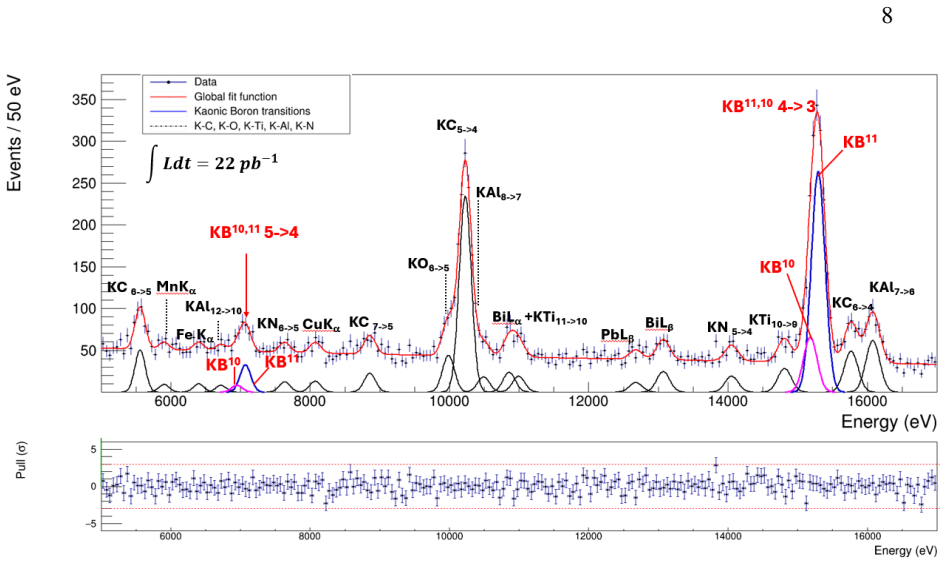
A precision measurement of X-ray transitions in kaonic boron, performed by the SIDDHARTA-2 collaboration at the DA$\Phi$NE collider, is reported. The energies and yields of the $5g\rightarrow4f$ and $4f\rightarrow3d$ transitions were determined for both boron isotopes, kaonic $^{10}\text{B}$ and kaonic $^{11}\text{B}$. For the $5g\rightarrow4f$ transition, the measured energies are $7064.62 \pm 16.93\,\text{(stat.)} \pm 2.00\,\text{(sys.)}$~eV for kaonic $^{11}\text{B}$ and $6920.96 \pm 58.23\,\text{(stat.)} \pm 2.00\,\text{(sys.)}$~eV for kaonic $^{10}\text{B}$. For the $4f\rightarrow3d$ transition, the corresponding values are $15293.33 \pm 4.80\,\text{(stat.)} \pm 5.30\,\text{(sys.)}$~eV and $15180.11 \pm 20.86\,\text{(stat.)} \pm 5.30\,\text{(sys.)}$~eV, respectively. The yields for the $5g\rightarrow4f$ transition are $0.076 \pm 0.013\,\text{(stat.)}^{+0.011}_{-0.012}\,\text{(sys.)}$ for kaonic $^{11}\text{B}$ and $0.0189 \pm 0.0032\,\text{(stat.)}^{+0.0028}_{-0.0030}\,\text{(sys.)}$ for kaonic $^{10}\text{B}$. For the $4f\rightarrow3d$ transition, the corresponding yields are $0.115 \pm 0.006\,\text{(stat.)}^{+0.002}_{-0.005}\,\text{(sys.)}$ and $0.0286 \pm 0.0015\,\text{(stat.)}^{+0.0007}_{-0.0014}\,\text{(sys.)}$, respectively. No statistically significant deviation from pure electromagnetic (QED) calculations is observed in the measurement of the $4f\rightarrow3d$ X-ray transition in kaonic $^{11}\text{B}$. Interpreted as upper limits, these results impose stringent constraints on the strong-interaction energy shift and width of the 3d level in light nuclei. Translating these limits into bounds on phenomenological kaon-nucleus optical potentials and, within specific theoretical models, on the complex scattering amplitude, we constrain and disfavor scenarios that predict large shifts or widths in boron.
Editorial analysis
A structured set of objections, weighed in public.
Referee Report
Summary. The manuscript reports the first measurements of X-ray transitions in kaonic boron isotopes (10B and 11B) performed with the SIDDHARTA-2 apparatus at the DAΦNE collider. It presents measured energies and yields (with statistical and systematic uncertainties) for the 5g→4f and 4f→3d transitions in both isotopes, finds no statistically significant deviation from QED predictions for the 4f→3d line in kaonic 11B, and translates the result into upper limits on the strong-interaction energy shift and width of the 3d level, thereby constraining kaon-nucleus optical potentials.
Significance. If the analysis is sound, the work is significant because it supplies the first experimental constraints on strong-interaction effects in kaonic boron, a light system where few data exist. The explicit separation of statistical and systematic errors, the use of both isotopes, and the conservative interpretation as upper limits rather than detections provide a solid basis for testing phenomenological models and disfavoring scenarios that predict large shifts or widths.
minor comments (1)
- The abstract quotes QED calculations but does not state the numerical QED reference values used for the 4f→3d comparison; adding these values (with their theoretical uncertainty) in the results section would make the “no significant deviation” statement fully transparent.
Simulated Author's Rebuttal
We thank the referee for the careful reading of the manuscript, the positive assessment of its significance, and the recommendation to accept. We are pleased that the work is viewed as providing solid first constraints on strong-interaction effects in light kaonic systems.
Circularity Check
No circularity in direct experimental measurements
full rationale
The paper reports direct experimental measurements of X-ray transition energies and yields for kaonic boron isotopes at DAΦNE, with explicit statistical and systematic uncertainties. The central claim compares measured 4f→3d energies to standard QED calculations, finds no significant deviation, and derives conservative upper limits on strong-interaction effects. No derivation chain, parameter fitting, or self-citation reduces any result to its own inputs by construction; the work is self-contained against external QED benchmarks and does not invoke uniqueness theorems or ansatzes from prior author work.
Axiom & Free-Parameter Ledger
axioms (2)
- domain assumption QED calculations accurately predict the transition energies in the absence of strong interactions.
- domain assumption The X-ray detector system and analysis correctly identify and calibrate the transition energies and yields.
Reference graph
Works this paper leans on
- [1]
- [2]
-
[3]
Akaishi Y and Yamazaki T 2017Phys. Lett. B774522–526 (Preprint1610.01249)
work page internal anchor Pith review Pith/arXiv arXiv
-
[4]
Nachr .340189–193
Drago A, Moretti M and Pagliara G 2019Astron. Nachr .340189–193
-
[5]
Curceanu Cet al.2020Symmetry12547
-
[6]
Curceanu C, Guaraldo C, Iliescu M, Cargnelli M, Hayano R, Marton J, Zmeskal J, Ishiwatari T, Iwasaki M, Okada S, Sirghi D L and Tatsuno H 2019Rev. Mod. Phys.91(2) 025006 URLhttps://link.aps. org/doi/10.1103/RevModPhys.91.025006
-
[7]
Curceanu C, Sgaramella F, Bazzi M, Hashimoto T, Iliescu M, Scordo A, Sirghi D and Sirghi F 2026Prog. Part. Nucl. Phys.147104226
-
[8]
Friedman E, Gal A and Batty C J 1994Nucl. Phys. A579518–538
-
[9]
Yamagata-Sekihara J, Iizawa Y , Jido D, Ikeno N, Hashimoto T, Okada S and Hirenzaki S 2024 Progress of Theoretical and Experimental Physics2025013D02 ISSN 2050-3911 (Preprint https://academic.oup.com/ptep/article-pdf/2025/1/013D02/61218706/ptae189.pdf) URLhttps://doi.org/10.1093/ptep/ptae189
-
[10]
Scripta97114002 (Preprint2201.12101)
Sgaramella Fet al.2022Phys. Scripta97114002 (Preprint2201.12101)
-
[11]
Batty C J, Friedman E and Gal A 1997Physics Reports287385–445
-
[12]
Friedman E and Gal A 2007Physics Reports45289–153
-
[13]
Friedman E and Gal A 2017Nuclear Physics A95966–82
-
[14]
Weise W 2010Nuclear Physics A83551–60
-
[15]
Ikeda Y , Hyodo T and Weise W 2011Physics Letters B70663–67
-
[16]
Hyodo T and Jido D 2012Progress in Particle and Nuclear Physics6755–98
-
[17]
Milardi Cet al.2018 Preparation Activity for the Siddharta-2 Run at DAΦNE9th International Particle Accelerator Conference, IPAC2018, V ancouver BC Canada
2018
-
[18]
Milardi Cet al.2021JACoWIPAC2021TUPAB001
-
[19]
Milardi Cet al.2024JACoWIPAC2024WEPR17
- [20]
-
[21]
Miliucci Met al.2021Measur . Sci. Tech.32095501
-
[22]
Miliucci Met al.2022Measur . Sci. Tech.33095502
-
[23]
Bazzi Met al.2013JINST8T11003
- [24]
- [25]
-
[26]
Desclaux J 1975Computer Physics Communications931–45 ISSN 0010-4655
-
[27]
Indelicato P and Desclaux J P 1990Physical Review A: Atomic, Molecular , and Optical Physics425139– 5149
-
[28]
Campbell J L 1990Nucl. Instrum. Meth. B49115–125
-
[29]
Campbell J and Maxwell J 1997Nuclear Instruments and Methods in Physics Research Section B: Beam Interactions with Materials and Atoms129297–299 ISSN 0168-583X
-
[30]
Gysel M, Lemberge P and Van Espen P 2003X-Ray Spectrometry32434 – 441
-
[31]
in Phys.111240250
Curceanu Cet al.2023Front. in Phys.111240250
-
[32]
org/10.1016/j.nuclphysa.2012.01.005
Friedman E and Gal A 2012Nuclear Physics A881150–158 ISSN 0375-9474 URLhttp://dx.doi. org/10.1016/j.nuclphysa.2012.01.005
-
[33]
Weise W 2008Nuclear Physics A80498–111
-
[34]
Ramos A and Oset E 2000Nuclear Physics A671481–502
-
[35]
Sirghi D Let al.2023Nucl. Phys. A1029122567
discussion (0)
Sign in with ORCID, Apple, or X to comment. Anyone can read and Pith papers without signing in.