REVIEW 3 major objections 6 minor 40 references
Deep unsupervised learning of turbulence for inflow generation at various Reynolds numbers
T0 review · 3 major / 6 minor · reviewed 2026-08-14 · deepseek-v4-flash
Pith's one-line read This paper claims that a GAN trained on turbulence data at three Reynolds numbers, combined with an RNN that advances its latent state in time, can generate instantaneous and time-varying channel-flow inflow fields at trained and…
desk verdict A solid, workmanlike GAN-plus-RNN inflow generator whose strongest result is long-time stationary generation at trained Reynolds numbers; the untrained-Reynolds interpolation claim is the soft spot and needs sharper framing. read the letter →
The pith
A machine-rendered reading of the paper's core claim, the machinery that carries it, and where it could break.
The reading
What carries the argument
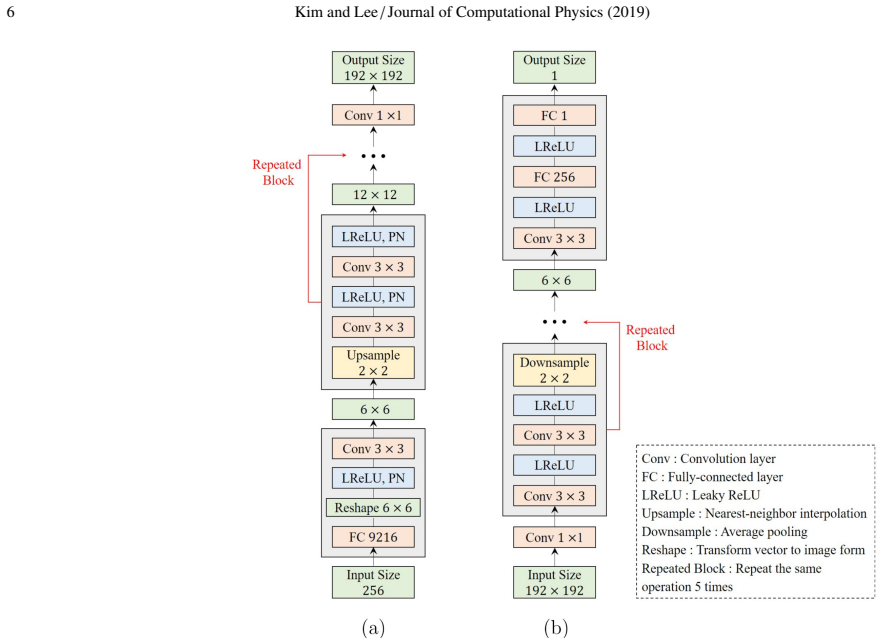
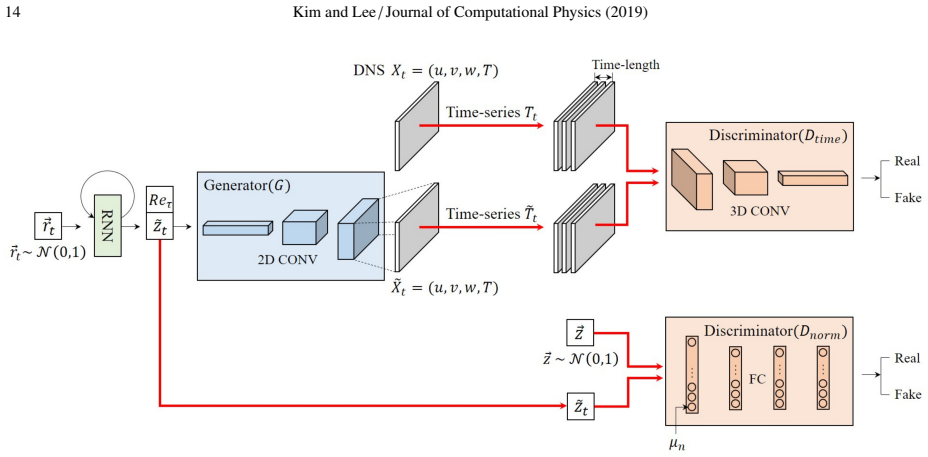
The load-bearing mechanism is the GAN latent vector $\mathbf{z}$, treated as a low-dimensional semantic code. One component $z_1$ is given the meaning of friction Reynolds number by appending a constant 'Re map' channel to the discriminator input; the WGAN-GP loss with gradient penalty and an energy-spectrum statistical constraint ($\mathrm{MSE_G}$) trains the generator to reproduce DNS two-point statistics. Time dependence is carried by an IndyLSTM—a recurrent network whose recurrent weights act elementwise rather than through a full matrix—which updates $\mathbf{z}_t$ to $\mathbf{z}_{t+1}$ from white noise; two auxiliary discriminators, $D_{\mathrm{time}}$ on short field sequences and $D_{\mathrm{norm}}$ on the latent outputs' distribution, keep the generated sequence statistically stationary and decorrelated over long horizons.
What would settle it
Run the trained RNN-GAN at an untrained Reynolds number such as $\mathrm{Re}_\tau=270$ as the actual inlet condition of a developing channel-flow DNS and measure skin-friction coefficient and streamwise spectra at $x^+ \approx 1000$ downstream. If the flow does not match a DNS with a faithful inlet, or if the inlet fields lose high-wavenumber energy within a few eddy-turnover times, the inflow-generation claim fails.
Extended reading notes
Core claim
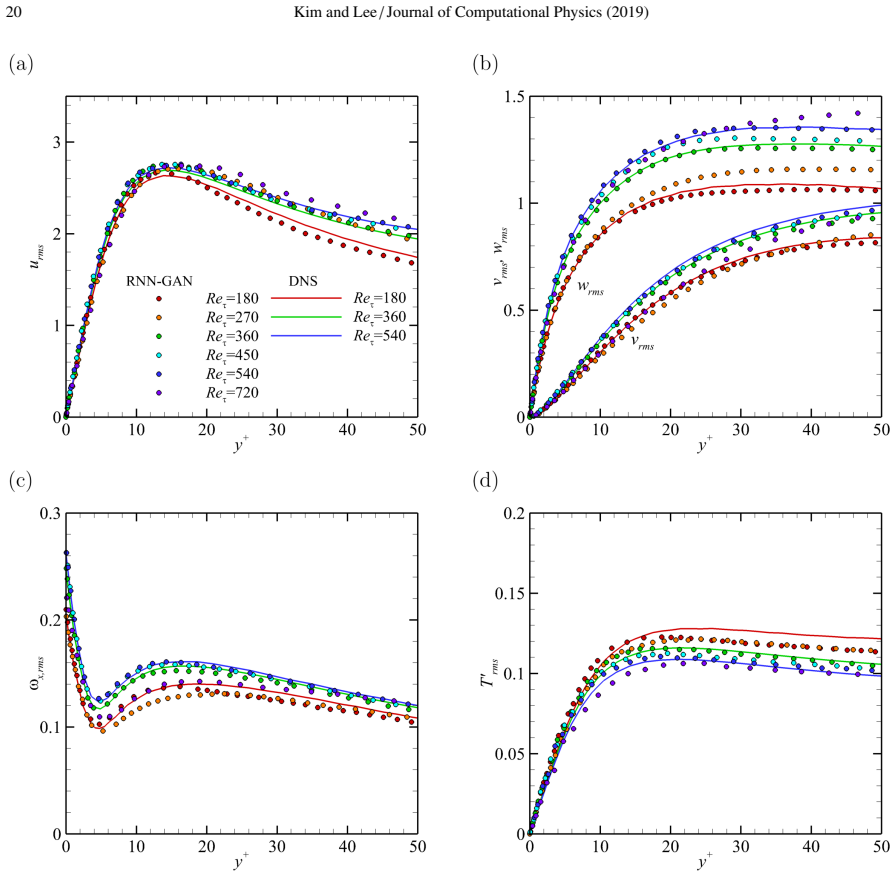
The central discovery is that the latent space of a WGAN-GP trained on y–z plane fields at $\mathrm{Re}_\tau = 180$, $360$, and $540$ contains a semantically meaningful Reynolds-number direction. Fixing one latent component to a target value and feeding a constant Re map to the discriminator lets the generator produce fields whose mean velocity, rms fluctuation, and vorticity statistics follow DNS at both trained and untrained Reynolds numbers—$270$, $450$, and $720$—with accuracy that is clearly better inside the trained interval than outside it. The same generator, driven by an independently recurrent LSTM (IndyLSTM) that consumes random noise and is constrained by temporal- and normality-discriminators, yields a long statistically stationary sequence whose spanwise spectra and temporal correlations match DNS, in contrast to an autoencoder baseline that blurs small-scale structure. The paper concludes that an RNN-GAN trained this way can serve as a synthetic inflow generator for turbulent channel flow.
Load-bearing premise
The central fragile premise is that linearly varying the Reynolds-number component of the latent vector, guided only by a constant label shown to the discriminator, produces physically correct intermediate fields; nothing guarantees this smoothness, and the paper's evidence for it is empirical.
Editorial extensions
If this is right
- Inside the trained interval ($180 \le \mathrm{Re}_\tau \le 540$), the model can supply inlet fields without an auxiliary DNS or a fully developed initial field, so the cost of inlet preparation drops to a single forward pass.
- Because temporal correlations do not rebound as they do in the periodic DNS domain, training data do not require extremely long streamwise domains, which simplifies future data collection.
- The spanwise width of the generated inlet can be enlarged by stitching independent latent maps, so one trained model can feed simulations wider than the training domain.
- Beyond $\mathrm{Re}_\tau = 540$, statistics degrade, so practical use should stay within or near the trained range unless the model is extended by a physics-based loss.
- The same latent-coding trick could carry other dimensionless parameters, such as Prandtl number, giving thermal inflow conditions at untrained values.
Reading between the lines
- A decisive test the paper does not report is a posteriori: use the generated fields as the actual inlet of a developing channel-flow simulation and compare downstream skin friction, heat transfer, and spectra with a reference DNS; the paper only validates the inlet fields themselves.
- If the latent-smoothness assumption generalizes, conditioning other latent components on parameters such as pressure gradient or wall temperature would give a single network as a cheap parameter sweep across flow conditions.
- The reported training cost—about three weeks on one GPU for 17 million parameters—should be weighed against the alternative of running a new auxiliary DNS for each target Reynolds number; inference itself is cheap, so the model is most attractive when many distinct inflow conditions are needed.
Signed reviews
Editorial analysis
A structured set of objections, weighed in public.
Referee Report
Summary. The manuscript presents an RNN-GAN framework for generating turbulent channel-flow inlet fields in a y-z cross-section. A WGAN-GP generator/discriminator pair is trained on DNS data at Reτ = 180, 360, and 540, conditioned on Reynolds number through an additional "Re map" input channel and augmented by a spanwise-spectrum statistical constraint (Eq. 7). The trained generator is combined with an IndyLSTM RNN whose output latent vectors are decoded by the generator; additional discriminators Dtime and Dnorm and temporal-correlation/autocorrelation constraints (Eqs. 19–25) are used to obtain statistically stationary time series. The authors report good agreement with DNS for mean and rms profiles, spanwise spectra, and temporal correlations at trained Reynolds numbers, and similar (though degraded) agreement at untrained Reτ = 270, 450, and 720. They also demonstrate long-time stationarity over 10,000 steps, stochastic variation, and extension to larger spanwise domains, and compare against an autoencoder baseline.
Significance. If the central claim holds, the work offers a practical, fast synthetic inflow generator and an interesting demonstration that GANs can capture Reynolds-number-dependent near-wall turbulence statistics. The paper's strengths include extensive statistical comparisons at multiple Reynolds numbers, a long-time generation test exceeding the training horizon by a factor of about 20, a fair comparison against an autoencoder baseline, and physically motivated architectural choices (periodic padding, spectral augmentation, statistical constraints). However, the headline claim of generating at untrained Reynolds numbers rests on an unverified linear interpolation in latent space, and the reported spectral/temporal agreement is partly guaranteed by the loss functions. The extrapolation beyond the trained range is acknowledged to be inaccurate, and no uncertainty quantification is provided. The contribution is therefore promising but not yet fully substantiated.
major comments (3)
- [§3.2, Eqs. (23)–(24) and Figs. 10–11] The spanwise energy spectrum and temporal autocorrelation are explicitly included as statistical constraints in the generator loss: S1 is the spectrum and S2 the temporal correlation in Eq. (24), with MSEG in Eq. (23) also based on the spectrum. The agreement shown in Figs. 10 and 11 is therefore partly a consequence of the training objective, not an independent validation of the model. Please state which validation metrics are not present in the loss and report them (for example, two-point spatial correlations, Reynolds-stress budgets, or probability density functions), or otherwise describe the degrees of freedom that make the spectral/temporal agreement nontrivial.
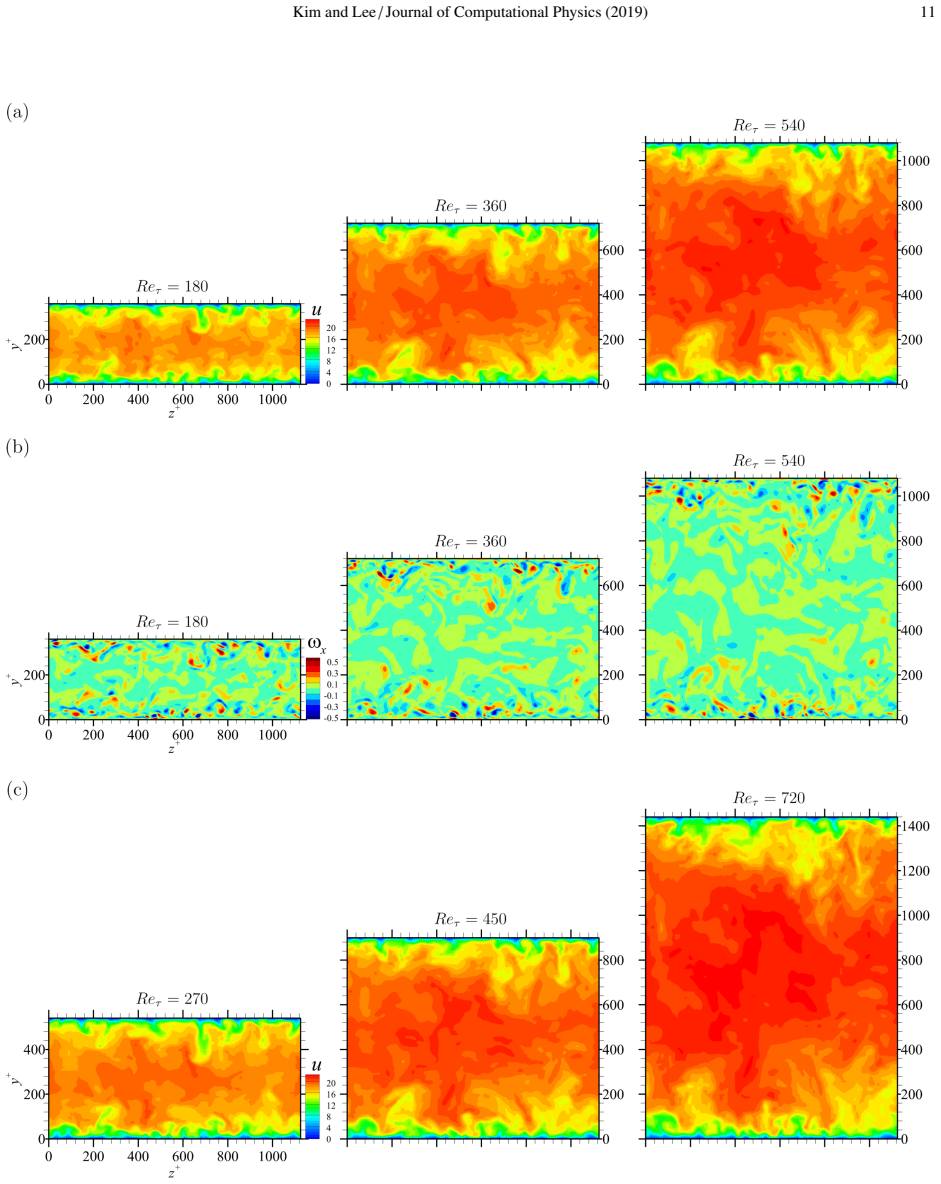
- [§3.1 and §4 (Figs. 6, 7, 12, 13)] The claim that the model generates physically correct fields at Reynolds numbers not seen in training relies on the assumption that linear variation of the first latent component z1 interpolates meaningful turbulence statistics. The training loss does not constrain intermediate z1 values beyond the three trained Reynolds numbers, and GAN latent interpolation is an empirical heuristic. The paper's evidence at Reτ = 270, 450, and 720 is qualitative (Figs. 6 and 12) plus a few profile comparisons, and the paper itself acknowledges that extrapolation beyond Reτ = 540 is inaccurate. To support the central claim, please provide a quantitative holdout evaluation at untrained Reynolds numbers, including independent DNS validation data described in Section 2, error bars, and preferably a comparison against a baseline that simply interpolates the DNS statistics at the three training Reynolds numbers.
- [§3.1, Fig. 7 and §3.2, Fig. 13] The statistical validation at untrained Reynolds numbers lacks uncertainty quantification. Figures 7 and 13 show profile agreements and visual similarity, but no confidence intervals, ensemble-size sensitivity, or quantitative error norms are reported; the described ensemble size of 10,000 generated fields would allow such estimates. Without them, phrases such as "very good agreement" and "fairly good agreement" are difficult to assess, especially where the generated profiles visibly deviate (e.g., Reτ = 720 in Fig. 7).
minor comments (6)
- [§3.1] The word "deails" in the paragraph on data augmentation should be "details."
- [§3.2] In the discussion of domain-size extension, "RAN-GAN" is a typo for "RNN-GAN."
- [§3.1] The description of the Re map is ambiguous: the text says it is filled with the pixel value of the Reynolds number (z1 value) and also with wall coordinates containing Reynolds number information; specify exactly what the sixth input channel contains.
- [§2] The DNS validation data at Reτ = 270, 450, and 720 are not described; state their provenance, grid resolution, sampling time, and averaging time so that the holdout comparisons are reproducible.
- [§3.2, Eq. (25)] The moments S3 are not defined explicitly; list the formulas for mean, rms, skewness, and flatness used in the normal-distribution constraint.
- [Fig. 7(b)] The inset figure should state which quantities are plotted and what the fitted log curve represents, so that the scatter of the maximum streamwise velocity fluctuation can be interpreted.
Circularity Check
The RNN-GAN's spanwise-spectrum and temporal-correlation validation is partly by construction: Eqs. (23)-(24) put exactly those statistics in the loss; the untrained-Reynolds-number claim remains an independent holdout test.
-
fitted input called prediction
[Section 3.2, Eqs. (23)-(24), Figs. 10-11; also Section 3.1 Eq. (7)]
"MSEG =λ1‖S (X)− S ( ˜X)‖2 (7) ... MSERNN-G =λ1‖S 1(Tt)− S 1( ˜Tt)‖2 +λ2‖S 2(Tt)− S 2( ˜Tt)‖2 (24) ... The spanwise energy spectrums near the wall and the center, which were time-averaged for 50≤ t≤ 20050 excluding the transient period (1≤ t < 50), are presented in Fig. 10. ... The temporal correlations of the velocity components and temperature of the field generated by the RNN-GAN are very favorably compared with those of the DNS in Fig. 11."
The same statistics that the paper presents as successful validation (spanwise energy spectrum S1 and temporal correlations S2 in Figs. 10 and 11) are directly minimized in the training objective. Eq. (7) penalizes ||S(X)-S(X̃)||2 for the instantaneous generator, and Eq. (24) penalizes ||S1(Tt)-S1(T̃t)||2 and ||S2(Tt)-S2(T̃t)||2 for the RNN-GAN time series. Therefore the agreement shown in Figs. 10 and 11 is in-sample by construction, not an independent test of the model. This does not make the entire paper circular: the mean and rms profiles, the pointwise correlations in Fig. 4, and the interpolation to untrained Reynolds numbers Reτ = 270, 450, 720 are not directly contained in the loss and provide independent support.
full rationale
No load-bearing self-citation is present: the cited GAN, WGAN-GP, Karras architecture, and statistical-constraint works are external, and the latent-space interpolation property is attributed to Radford/Berthelot rather than to the present authors. The various-Reynolds-number claim rests on a genuine holdout test at Reτ = 270, 450, and 720, with visual and statistical comparisons, so it is not circular; it is an empirical generalization of a conditional GAN with a Re map, not a derivation. The specific circularity is narrower: for the statistical quantities S (spanwise energy spectrum) and S2 (temporal correlations), the loss functions in Eqs. (7) and (23)-(24) directly force the generated values to approach the DNS values, and Figs. 10-11 then report that agreement as a result. Those validation panels are therefore partly by construction. Because the paper's headline claim of a successful synthetic inflow generator also relies on these spatiotemporal statistics, the circularity score is elevated to 6, but not higher, since the mean/rms statistics and the untrained-Reynolds-number behavior are genuinely out-of-sample empirical evidence.
Assumptions & free parameters
free parameters (4)
- Lambda_1 (spectral constraint weight) =
10
- Lambda_2 (temporal correlation weight) =
1000
- Lambda_3 (normal distribution moment weight) =
100
- Lambda_4 (autocorrelation weight) =
1
assumptions (4)
- domain assumption DNS data at three Reynolds numbers are representative of turbulent channel flow statistics.
- ad hoc to paper The latent space of the trained GAN is semantically smooth, so linear interpolation in z1 yields physically meaningful variation in Reynolds number.
- domain assumption Spanwise energy spectrum is a sufficient statistical constraint to ensure the generated fields are turbulent.
- ad hoc to paper The RNN can learn a stationary stochastic process in the latent space that, when decoded by G, yields physically correct time series.
Cite this review
Pith. "Pith review of Deep unsupervised learning of turbulence for inflow generation at various Reynolds numbers." pith.science (2026). https://pith.science/paper/OI7ZL2VA
@misc{pith2026190810515,
  author       = {Pith},
  title        = {Pith review of: Deep unsupervised learning of turbulence for inflow generation at various Reynolds numbers},
  year         = {2026},
  howpublished = {\url{https://pith.science/paper/OI7ZL2VA}},
  note         = {Machine review of arXiv:1908.10515}
}
read the original abstract
A realistic inflow boundary condition is essential for successful simulation of the developing turbulent boundary layer or channel flows. Recent advances in artificial intelligence (AI) have enabled the development of an inflow generator that performs better than the synthetic methods based on intuitions. In the present work, we applied generative adversarial networks (GANs), a representative of unsupervised learning, to generate an inlet boundary condition of turbulent channel flow. Upon learning the two-dimensional spatial structure of turbulence using data obtained from direct numerical simulation (DNS) of turbulent channel flow, the GAN could generate instantaneous flow fields that are statistically similar to those of DNS. Surprisingly, the GAN could produce fields at various Reynolds numbers without any additional simulation based on the trained data of only three Reynolds numbers. This indicates that the GAN could learn the universal nature of Reynolds number effect and might reflect other simulation conditions. Eventually, through a combination of the GAN and a recurrent neural network (RNN), we developed a novel model (RNN-GAN) that could generate time-varying fully developed flow for a long time. The spatiotemporal correlations of the generated flow are in good agreement with those of the DNS. This proves the usefulness of unsupervised learning in the generation of synthetic turbulence fields.
Figures


Figures from the paper (12 more)







Reference graph
Works this paper leans on
-
[1]
LeCun, Y
Y . LeCun, Y . Bengio, G. Hinton, Deep learning, Nature 521 (2015) 436–444
2015
-
[2]
I. Goodfellow, J. Pouget-Abadie, M. Mirza, B. Xu, D. Warde-Farley, S. Ozair, A. Courville, Y . Bengio, Generative adversarial nets, in: NIPS, 2014, pp. 2672–2680
work page 2014
- [3]
-
[4]
Wu, Inflow turbulence generation methods, Annu
X. Wu, Inflow turbulence generation methods, Annu. Rev. Fluid Mech. 49 (2017) 23–49
work page 2017
-
[5]
J. Kim, P. Moin, R. Moser, Turbulence statistics in fully developed channel flow at low reynolds number, J. Fluid Mech. 177 (1987) 133
work page 1987
-
[6]
P. R. Spalart, Direct simulation of a turbulent boundary layer up to Rθ = 1410, J. Fluid Mech. 187 (1988) 61–98
work page 1988
-
[7]
T. S. Lund, X. Wu, K. D. Squires, Generation of turbulent inflow data for spatially-developing boundary layer simulations, J. Comput. Phys. 140 (1998) 233–258
work page 1998
-
[8]
H. Le, P. Moin, J. Kim, Direct numerical simulation of turbulent flow over a backward-facing step, J. Fluid Mech. 330 (1997) 349–374
work page 1997
Show all 40 references
-
[9]
Klein, A
M. Klein, A. Sadiki, J. Janicka, A digital filter based generation of inflow data for spatially developing direct numerical or large eddy simulations, J. Comput. Phys. 186 (2003) 652–665. 26 Kim and Lee / Journal of Computational Physics (2019)
2003
-
[10]
Jarrin, S
N. Jarrin, S. Benhamadouche, D. Laurence, R. Prosser, A synthetic-eddy-method for generating inflow conditions for large-eddy simulations, Int. J. Heat Fluid Flow 27 (2006) 585–593
2006
-
[11]
G. Oh, K. Noh, H. Park, J.-I. Choi, Extended synthetic eddy method to generate inflow data for turbulent thermal boundary layer, Int. J. Heat Mass Transf. 134 (2019) 1261–1267
2019
-
[12]
Keating, U
A. Keating, U. Piomelli, E. Balaras, H.-J. Kaltenbach, A priori and a posteriori tests of inflow conditions for large-eddy simulation, Phys. Fluids 16 (2004) 4696–4712
2004
-
[13]
R. King, O. Hennigh, A. Mohan, M. Chertkov, From deep to physics-informed learning of turbulence: Diagnostics, arXiv preprint arXiv:1810.07785v2 (2018)
2018 arXiv
-
[14]
Mohan, D
A. Mohan, D. Daniel, M. Chertkov, D. Livescu, Compressed convolutional LSTM: An e fficient deep learning framework to model high fidelity 3D turbulence, arXiv preprint arXiv:1903.00033v2 (2019)
2019 arXiv
-
[15]
Fukami, Y
K. Fukami, Y . Nabae, K. Kawai, K. Fukagata, Synthetic turbulent inflow generator using machine learning, Phys. Rev. Fluids 4 (2019)
2019
-
[16]
S. Lee, D. You, Prediction of laminar vortex shedding over a cylinder using deep learning, arXiv preprint arXiv:1712.07854v1 (2017)
2017 arXiv
-
[17]
S. Lee, D. You, Data-driven prediction of unsteady flow fields over a circular cylinder using deep learning, arXiv preprint arXiv:1804.06076v2 (2018)
2018 arXiv
-
[18]
R ¨uttgers, S
M. R ¨uttgers, S. Lee, S. Jeon, D. You, Prediction of a typhoon track using a generative adversarial network and satellite images, Sci. Reports 9 (2019)
2019
-
[19]
Radford, L
A. Radford, L. Metz, S. Chintala, Unsupervised representation learning with deep convolutional generative adversarial networks, arXiv preprint arXiv:1511.06434v2 (2015)
2015 arXiv
-
[20]
Arjovsky, S
M. Arjovsky, S. Chintala, L. Bottou, Wasserstein GAN, arXiv preprint arXiv:1701.07875v3 (2017)
2017 arXiv
-
[21]
Gulrajani, F
I. Gulrajani, F. Ahmed, M. Arjovsky, V . Dumoulin, A. Courville, Improved training of Wasserstein GANs, in: NIPS, 2017, pp. 5767–5777
2017
-
[22]
Karras, T
T. Karras, T. Aila, S. Laine, J. Lehtinen, Progressive growing of GANs for improved quality, stability, and variation, arXiv preprint arXiv:1710.10196v3 (2017)
2017 arXiv
-
[23]
K. Roth, A. Lucchi, S. Nowozin, T. Hofmann, Stabilizing training of generative adversarial networks through regularization, in: In NIPS, 2017, pp. 2018–2028
2017
-
[24]
Mescheder, A
L. Mescheder, A. Geiger, S. Nowozin, Which training methods for GANs do actually converge?, arXiv preprint arXiv:1801.04406v4 (2018)
2018 arXiv
-
[25]
Karras, S
T. Karras, S. Laine, T. Aila, A style-based generator architecture for generative adversarial networks, arXiv preprint arXiv:1812.04948v3 (2018)
2018 arXiv
-
[26]
Y . Xie, E. Franz, M. Chu, N. Thuerey, tempoGAN: A temporally coherent, volumetric GAN for super-resolution fluid flow, arXiv preprint arXiv:1801.09710v2 (2018)
2018 arXiv
-
[27]
J.-L. Wu, K. Kashinath, A. Albert, D. Chirila, Prabhat, H. Xiao, Enforcing statistical constraints in generative adversarial networks for modeling chaotic dynamical systems, arXiv preprint arXiv:1905.06841v1 (2019)
2019 arXiv
-
[28]
R. D. Moser, J. Kim, N. N. Mansour, Direct numerical simulation of turbulent channel flow up to Reτ=590, Phys. Fluids 11 (1999) 943–945
1999
-
[29]
Garc ´ıa-Villalba, J
M. Garc ´ıa-Villalba, J. C. del ´Alamo, Turbulence modification by stable stratification in channel flow, Phys. Fluids 23 (2011) 045104
2011
-
[30]
D. P. Kingma, J. L. Ba, Adam: A method for stochastic optimization, arXiv preprint arXiv:1412.6980 (2014)
2014 arXiv
-
[31]
Abadi, A
M. Abadi, A. Agarwal, P. Barham, E. Brevdo, Z. Chen, C. Citro, G. S. Corrado, A. Davis, J. Dean, M. Devin, S. Ghemawat, I. Good- fellow, A. Harp, G. Irving, M. Isard, Y . Jia, R. Jozefowicz, L. Kaiser, M. Kudlur, J. Levenberg, D. Man ´e, R. Monga, S. Moore, D. Mur- ray, C. Ola...
2015
-
[32]
Berthelot, T
D. Berthelot, T. Schumm, L. Metz, BEGAN: boundary equilibrium generative adversarial networks, arXiv preprint arXiv:1703.10717v4 (2017)
2017 arXiv
-
[33]
M. Lee, R. D. Moser, Direct numerical simulation of turbulent channel flow up to Reτ=5200, J. Fluid Mech. 774 (2015) 395–415
2015
-
[34]
S. Li, W. Li, C. Cook, C. Zhu, Y . Gao, Independently recurrent neural network (indRNN): Building a longer and deeper RNN, arXiv preprint arXiv:1803.04831v3 (2018)
2018 arXiv
-
[35]
Gonnet, T
P. Gonnet, T. Deselaers, IndyLSTMs: Independently recurrent LSTMs, arXiv preprint arXiv:1903.08023v1 (2019)
2019 arXiv
-
[36]
Z. Wang, D. Xiao, F. Fang, R. Govindan, C. C. Pain, Y . Guo, Model identification of reduced order fluid dynamics systems using deep learning, Int. J. Numer. Methods Fluids 86 (2017) 255–268
2017
-
[37]
A. T. Mohan, D. V . Gaitonde, A deep learning based approach to reduced order modeling for turbulent flow control using LSTM neural networks, arXiv preprint arXiv:1804.09269v1 (2018)
2018 arXiv
-
[38]
Cooijmans, N
T. Cooijmans, N. Ballas, C. Laurent, G ¨ulc ¸ehre, A. Courville, Recurrent batch normalization, arXiv preprint arXiv:1603.09025v5 (2016)
2016 arXiv
-
[39]
Saito, E
M. Saito, E. Matsumoto, S. Saito, Temporal generative adversarial nets with singular value clipping, in: ICCV , 2017
2017
-
[40]
Quadrio, P
M. Quadrio, P. Luchini, Integral space-time scales in turbulent wall flows, Phys. Fluids 15 (2003) 2219–2227
2003
Reviewed August 14, 2026 · model on record in the stance chip above.
Discussion (0). Continue with ORCID to comment.