Tests of constructor theory
Pith reviewed 2026-06-27 21:43 UTC · model grok-4.3
The pith
Constructor theory's principles add novel constraints on possible tasks that yield experimental predictions beyond current dynamical laws.
A machine-rendered reading of the paper's core claim, the machinery that carries it, and where it could break.
Core claim
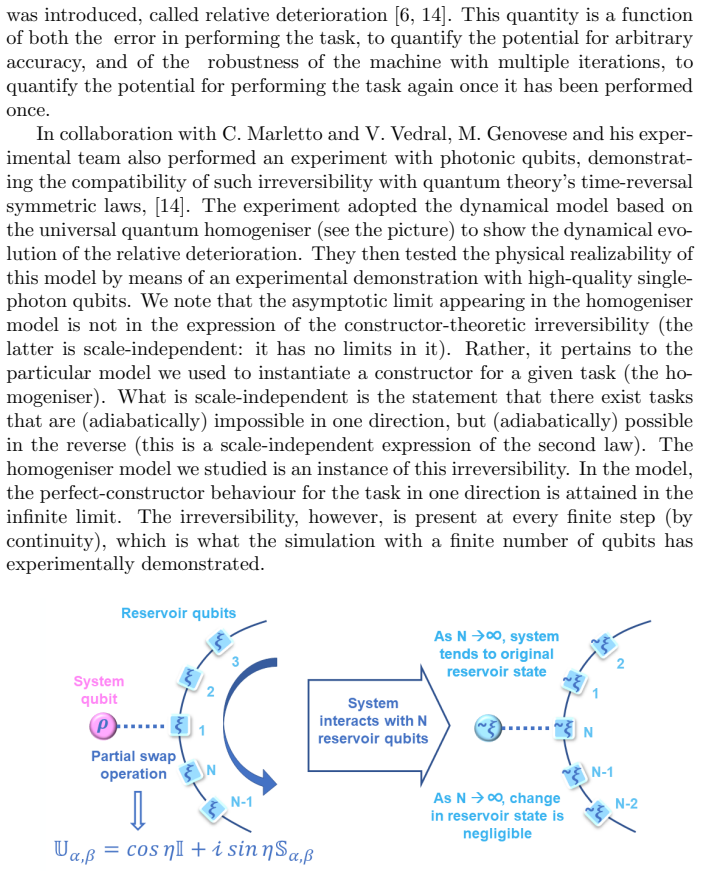
The principles of constructor theory have novel physical content that supplements current dynamical laws, leading to new predictions for experimental tests. In this paper, we review the main experimental proposals to test the principles of constructor theory and discuss their implications for existing theories of physics and for their successors.
What carries the argument
Constructor-theory principles stated as constraints on the possibility or impossibility of tasks performed by constructors.
If this is right
- The principles fix the complete set of tasks a universal constructor can perform.
- Specific experiments can distinguish constructor theory from quantum theory alone.
- Confirmation would require adjustments to any future theory that replaces current dynamical laws.
- The tests bear directly on what counts as a possible physical transformation.
Where Pith is reading between the lines
- Success of the tests would tighten the link between information-theoretic constraints and physical possibility.
- The same principles might later be applied to derive limits on computation or measurement that current theory leaves open.
- Experimental designs reviewed here could be adapted to other extensions of quantum information that also emphasize task possibility.
Load-bearing premise
The principles supply physical content that cannot already be derived from existing dynamical laws and that the proposed experiments can isolate this extra content.
What would settle it
Perform one of the reviewed experiments; if the measured outcome on task possibility matches standard quantum predictions but contradicts the constructor-theory constraint, the claim of novel content is refuted.
Figures
read the original abstract
Constructor theory is a proposal to extend quantum information theory beyond both quantum theory and computation, to cover more general machines than programmable computers -- called constructors. It consists of newly conjectured physical principles that can be expressed as constraints on what tasks are possible, what are impossible, and why. These principles also determine the repertoire of the universal constructor, which is a programmable machine that can perform all physically possible tasks. The principles of constructor theory have novel physical content that supplements current dynamical laws, leading to new predictions for experimental tests. In this paper, we review the main experimental proposals to test the principles of constructor theory and discuss their implications for existing theories of physics and for their successors.
Editorial analysis
A structured set of objections, weighed in public.
Referee Report
Summary. This manuscript is a review summarizing existing proposals for experimental tests of the principles of constructor theory. These principles are presented as conjectured constraints on possible and impossible tasks performable by constructors (general machines), determining the repertoire of a universal constructor, and asserted to supply novel physical content that supplements dynamical laws and yields new testable predictions.
Significance. If the reviewed experimental proposals can be implemented and the principles prove to have content independent of existing dynamical laws, the review could help consolidate and guide tests in quantum foundations. The paper does not derive new results, present original data, or include machine-checked proofs or parameter-free derivations, but compiles prior proposals and discusses implications.
major comments (1)
- [Abstract] Abstract: The central assertion that 'the principles of constructor theory have novel physical content that supplements current dynamical laws, leading to new predictions' is stated as a premise without a specific section or example within the review demonstrating a concrete prediction that cannot be derived from standard quantum theory or other existing frameworks; this is load-bearing for the paper's framing of the tests' significance.
Simulated Author's Rebuttal
We thank the referee for their careful reading of the manuscript and for the recommendation of minor revision. We address the single major comment below.
read point-by-point responses
-
Referee: [Abstract] Abstract: The central assertion that 'the principles of constructor theory have novel physical content that supplements current dynamical laws, leading to new predictions' is stated as a premise without a specific section or example within the review demonstrating a concrete prediction that cannot be derived from standard quantum theory or other existing frameworks; this is load-bearing for the paper's framing of the tests' significance.
Authors: We agree that the abstract states the claim without an immediate, self-contained example. While the body of the review summarizes proposals from the literature in which such distinctions are argued to arise (particularly in the sections on thermodynamics and information), the manuscript does not itself derive or exhibit a concrete, side-by-side comparison. To address this directly, we will add a short, explicit example in the revised introduction (or a new short subsection) that contrasts one specific prediction with what follows from standard quantum theory alone. This will make the framing more robust without altering the review character of the paper. revision: yes
Circularity Check
Review paper; no derivation chain present
full rationale
This is a review summarizing prior experimental proposals for constructor theory principles. No equations, derivations, or new predictions are introduced in the manuscript that could reduce to self-definitions, fitted inputs, or self-citation chains. The abstract and framing refer to principles from earlier work, but the paper itself performs no load-bearing derivation or uniqueness argument that would qualify as circular under the specified criteria. The content is self-contained as a literature review against external benchmarks.
Axiom & Free-Parameter Ledger
Forward citations
Cited by 1 Pith paper
-
Constructor-Theoretic Optical Time: Delay, Phase, and Fisher Distinguishability as Physical Tasks
The authors reformulate optical time using constructor theory, interpreting Fisher information as a distinguishability resource and the Cramer-Rao bound as a statement of task impossibility for delay estimation under ...
Reference graph
Works this paper leans on
-
[1]
Deutsch, Constructor Theory, Synthese 190, 4331–4359 (2013)
D. Deutsch, Constructor Theory, Synthese 190, 4331–4359 (2013)
2013
-
[2]
Deutsch and C
D. Deutsch and C. Marletto, Proc. R. Soc. A 471, 20140540 (2015)
2015
-
[3]
Marletto and A
C. Marletto and A. Ekert, Issues of Control and Causation in Quantum Information Theory, Thesis, Bodleian Library (2013)
2013
-
[4]
Marletto, Constructor Theory of Thermodynamics, arXiv:1608.02625 (2018)
C. Marletto, Constructor Theory of Thermodynamics, arXiv:1608.02625 (2018)
Pith/arXiv arXiv 2018
-
[5]
Marletto, J
C. Marletto, J. Phys. Commun. 6, 055012 (2022)
2022
-
[6]
Violaris and C
M. Violaris and C. C. Marletto, New J. Phys. 24, 113030 (2022)
2022
-
[7]
Marletto, Constructor Theory of Life, Proc
C. Marletto, Constructor Theory of Life, Proc. R. Soc. A 471, 20141288 (2015)
2015
-
[8]
Marletto, Proc
C. Marletto, Proc. R. Soc. A 472, 20150883 (2016)
2016
-
[9]
Marletto and V
C. Marletto and V. Vedral, npj Quantum Inf. 3, 29 (2017)
2017
-
[10]
Marletto and V
C. Marletto and V. Vedral, npj Quantum Inf. 3, 41 (2017)
2017
-
[11]
Marletto and V
C. Marletto and V. Vedral, Phys. Rev. D 102, 086012 (2020)
2020
-
[12]
Marletto and V
C. Marletto and V. Vedral, Nature 547, 156–158 (2017)
2017
-
[13]
Marletto and V
C. Marletto and V. Vedral, Phys. Rev. Lett. 119, 240402 (2017)
2017
-
[14]
Marletto, V
C. Marletto, V. Vedral, L. T. Knoll, F. Piacentini, E. Bernardi, E. Re- bufello, A. Avella, M. Gramegna, I. P. Degiovanni, and M. Genovese, Phys. Rev. Lett. 128, 080401 (2022)
2022
-
[15]
D. N. Page, W. K. Wootters, Physical Review D 27, 2885?2892 (1983)
1983
-
[16]
D. Deutsch and C. Marletto, Constructor Theory of Time, arXiv:2505.08692 (2025). 32
Pith/arXiv arXiv 2025
-
[17]
Chiribella and R
G. Chiribella and R. W. Spekkens (eds.),Quantum Theory: Informational Foundations and Foils(Springer, 2016)
2016
-
[18]
Chiribella, Int
G. Chiribella, Int. J. Softw. Inform. 8, 209–223 (2014)
2014
-
[19]
Hardy, Reformulating and Reconstructing Quantum Theory, arXiv:1104.2066 (2011)
L. Hardy, Reformulating and Reconstructing Quantum Theory, arXiv:1104.2066 (2011)
Pith/arXiv arXiv 2066
-
[20]
G. C. Ghirardi, A. Rimini, and T. Weber, Phys. Rev. D 34, 470–491 (1986)
1986
-
[21]
J. Kofler and ˇC. Brukner, The Conditions for Quantum Violation of Macro- scopic Realism, arXiv:0706.0668 (2007)
Pith/arXiv arXiv 2007
-
[22]
Penrose,Shadows of the Mind(Oxford University Press, 1994)
R. Penrose,Shadows of the Mind(Oxford University Press, 1994)
1994
-
[23]
On Unorthodox Qubits, with an Application to the Closed Timelike Curve Problem,
S. Kuypers, “On Unorthodox Qubits, with an Application to the Closed Timelike Curve Problem,” arXiv:2205.02797 (2022)
arXiv 2022
-
[24]
H.-T. Elze, J. Phys.: Conf. Ser. 442, 012007 (2013)
2013
-
[25]
von Neumann and A
J. von Neumann and A. W. Burks,Theory of Self-Reproducing Automata (University of Illinois Press, Champaign, IL, 1966)
1966
-
[26]
Deutsch, The Universal Constructor, in preparation
D. Deutsch, The Universal Constructor, in preparation
-
[27]
Deutsch, Stud
D. Deutsch, Stud. Hist. Philos. Mod. Phys. 55, 24–33 (2016)
2016
-
[28]
Marletto and V
C. Marletto and V. Vedral, Rev. Mod. Phys. 97, 015006 (2025)
2025
-
[29]
Plesnik and M
S. Plesnik and M. Violaris, New J. Phys. 26, 103019 (2024)
2024
-
[30]
DeWitt,The Global Approach to Quantum Field Theory(Oxford Uni- versity Press, 2003)
B. DeWitt,The Global Approach to Quantum Field Theory(Oxford Uni- versity Press, 2003)
2003
-
[31]
Marletto and V
C. Marletto and V. Vedral, Phys. Rev. D 98, 046001 (2018)
2018
-
[32]
S. Bose, A. Mazumdar, G. W. Morley, H. Ulbricht, M. Toroˇ s, M. Paternos- tro, A. A. Geraci, P. F. Barker, M. S. Kim, and G. Milburn, Phys. Rev. Lett. 119, 240401 (2017)
2017
-
[33]
Feynman, inReport of the Chapel Hill Conference(1957)
R. Feynman, inReport of the Chapel Hill Conference(1957)
1957
-
[34]
von Neumann,The Mathematical Foundations of Quantum Mechanics (1932)
J. von Neumann,The Mathematical Foundations of Quantum Mechanics (1932)
1932
-
[35]
Horodecki, P
R. Horodecki, P. Horodecki, M. Horodecki, and K. Horodecki, Rev. Mod. Phys. 81, 865 (2009)
2009
-
[36]
J. S. Bell,Speakable and Unspeakable in Quantum Mechanics(Cambridge University Press, 1987)
1987
-
[37]
Bhole, J
G. Bhole, J. Jones, V. Vedral, and C. Marletto, J. Phys. Commun. 4, 025013 (2020). 33
2020
-
[38]
G. Di Pietra and C. Marletto, Temporal Witnesses of Non-Classicality and Conservation Laws, arXiv:2205.00198 (2022)
arXiv 2022
-
[39]
Di Pietra, V
G. Di Pietra, V. Vedral, and C. Marletto, Sci. Rep. 14, 20094 (2024)
2024
-
[40]
Bondi, Eur
H. Bondi, Eur. J. Phys. 7, 14 (1986)
1986
-
[41]
Goold et al., J
J. Goold et al., J. Phys. A: Math. Theor. 49 (2016)
2016
-
[42]
2025 Algebraic identifiability of partial differential equation models.Nonlinearity38, 025022
M. Lostaglio, Rep. Prog. Phys. 82, 114001 (2019). DOI: 10.1088/1361- 6633/ab46e5
-
[43]
Lieb and J
E. Lieb and J. Yngvason, Phys. Rep. 310, 1–96 (1999)
1999
-
[44]
H. A. Buchdahl,The Concepts of Classical Thermodynamics(Cambridge University Press, 1966)
1966
-
[45]
Irreversibility and the Second Law of Thermodynamics,
J. B. Uffink, “Irreversibility and the Second Law of Thermodynamics,” inEntropy, edited by A. Greven, G. Keller, and G. Warnecke (Princeton University Press, 2003), pp. 121–146
2003
-
[46]
Chiribella and C
G. Chiribella and C. M. Scandolo, New J. Phys. 19, 123043 (2017)
2017
-
[47]
Chitambar and G
E. Chitambar and G. Gour, Rev. Mod. Phys. 91, 025001 (2019)
2019
-
[48]
Ziman, P
M. Ziman, P. Stelmachoviˇ c, V. Buˇ zek, M. Hillery, V. Scarani, and N. Gisin, Phys. Rev. A 65, 042105 (2002)
2002
-
[49]
Deutsch, Quantum Theory of Probability and Decisions, Proc
D. Deutsch, Quantum Theory of Probability and Decisions, Proc. R. Soc. A (1999)
1999
-
[50]
Wallace,The Emergent Multiverse(Oxford University Press, 2014)
D. Wallace,The Emergent Multiverse(Oxford University Press, 2014)
2014
-
[51]
Masanes, T
L. Masanes, T. D. Galley, and M. P. M¨ uller, Nat. Commun. 10, 1361 (2019)
2019
-
[52]
T. D. Galley and L. Masanes, Quantum 2, 104 (2018)
2018
-
[53]
Barrett, Information Processing in Generalised Probabilistic Theories, arXiv:quant-ph/0508211 (2005)
J. Barrett, Information Processing in Generalised Probabilistic Theories, arXiv:quant-ph/0508211 (2005)
Pith/arXiv arXiv 2005
-
[54]
Coecke, T
B. Coecke, T. Fritz, and R. Spekkens, Inf. Comput. 250, 59–86 (2016)
2016
-
[55]
Theodoris, Ling Xiao, Anant Chopra, Mark D
A. Sharma et al., Nature 622, 321–328 (2023). doi:10.1038/s41586-023- 06600-9
-
[56]
Musings on Constructor Theory and the Fine-Tuning Problem,
C. Marletto, “Musings on Constructor Theory and the Fine-Tuning Problem,” available at https://dd70th.weebly.com/chiara-C.Marletto.html (2021)
2021
-
[57]
Gisin, Phys
N. Gisin, Phys. Lett. A 143, 1–2 (1990)
1990
-
[58]
Aaronson, Is Quantum Mechanics an Island in Theoryspace?, arXiv:quant-ph/0401062
S. Aaronson, Is Quantum Mechanics an Island in Theoryspace?, arXiv:quant-ph/0401062. 34
-
[59]
van Dam, Implausible Consequences of Superstrong Nonlocality, arXiv:quant-ph/0501159
W. van Dam, Implausible Consequences of Superstrong Nonlocality, arXiv:quant-ph/0501159
-
[60]
Maruyama, F
K. Maruyama, F. Nori, and V. Vedral, Rev. Mod. Phys. 81, 1 (2009)
2009
-
[61]
Carath´ eodory, Math
C. Carath´ eodory, Math. Ann. 67, 355–386 (1909). 35
1909
discussion (0)
Sign in with ORCID, Apple, or X to comment. Anyone can read and Pith papers without signing in.