REVIEW 2 major objections 5 minor 2 cited by
Fractional Chern mosaic in supermoir\'e graphene
T0 review · 2 major / 5 minor · reviewed 2026-08-12 · deepseek-v4-flash
Pith's one-line read The paper predicts that helical trilayer graphene at twist angle 1.8° hosts a fractional Chern mosaic at filling ν=3+1/3, with alternating domains of opposite fractional Hall conductivity and opposite anyonic braiding phases.
desk verdict A solid proposal for a fractional Chern mosaic in helical trilayer graphene, with a genuine gap between the strong 1-band FCI evidence and the untested multi-band and supermoiré extrapolations. read the letter →
The pith
A machine-rendered reading of the paper's core claim, the machinery that carries it, and where it could break.
The reading
What carries the argument
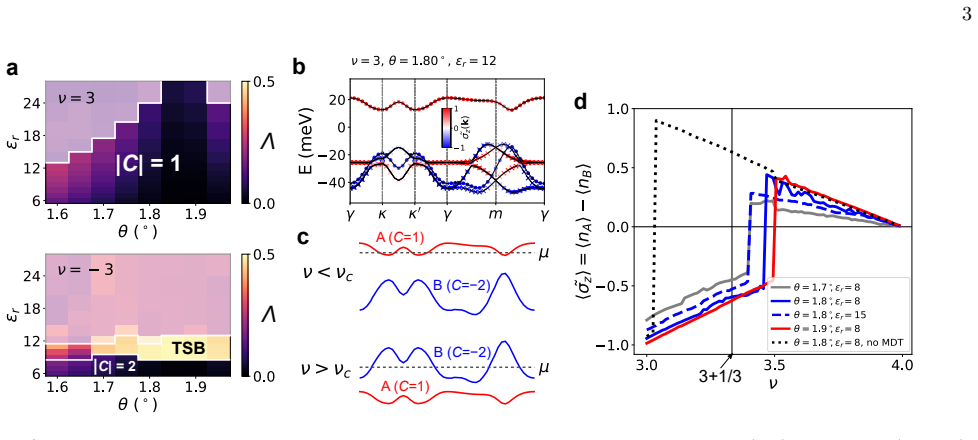
The machinery has two components. The first is the generalized Bistritzer-MacDonald continuum model (the standard continuum description of moiré graphene bands) of a single h-HTG domain, augmented by a momentum-dependent tunneling (MDT) term: a leading correction arising from the decay of interlayer tunneling with in-plane distance between atomic pz orbitals. MDT breaks particle-hole symmetry, lowers the mean energy of the B Chern-sublattice band relative to the A band, stabilizes the strong-coupling |C|=1 insulator at ν=+3, and pushes the first-order sublattice transition filling to νc≈3.5, above 3+1/3; the unoccupied |C|=1 A band then has favorable quantum geometry. The second component is the supermoiré lattice of alternating h-HTG and hbar-HTG domains: the paper invokes the separation of length scales (supermoiré period much larger than moiré period) to treat each domain as locally periodic, and uses the C2z rotation relating the two domain types to combine the single-domain fractional Chern insulator into a spatially varying topological order.
What would settle it
A scanning single-electron transistor measurement on a θ≈1.8° helical trilayer graphene device at ν=3+1/3 should see alternating supermoiré-scale regions that are incompressible and disperse with perpendicular magnetic field according to the Streda formula, with local Hall conductivities of opposite sign; their absence would rule out the mosaic. Alternatively, an exact diagonalization calculation on a supercell that includes the full supermoiré potential in the active bands, and that shows the three-fold degenerate fractional Chern insulator ground states collapse, would falsify the single-domain separation-of-scales assumption.
Extended reading notes
Core claim
On the paper's own terms, the central discovery is that fractionalization can occur locally in each moiré-periodic domain of helical trilayer graphene, and that the global C2z symmetry of the supermoiré lattice turns this into a fractional Chern mosaic. In the h-HTG domain, the |C|=1 conduction band of the ν=+3 Hartree-Fock insulator at θ=1.8° hosts a fractional Chern insulator at ν=3+1/3, with local Hall conductivity σxy=−(2/3)τz e²/h, where τz=±1 labels the valley. The hbar-HTG domains are C2z-related, so their partially filled band has opposite topology and local σxy=+(2/3)τz e²/h; electrons in both domains fractionalize into charge e/3 quasiparticles, but the anyonic exchange phase is $e^{{+iπ/3}}$ in one domain and $e^{{−iπ/3}}$ in the other. If the valley polarizations are instead opposite in the two domains, the local Hall conductivities are equal while the e/3 quasiparticles carry opposite valley quantum numbers.
Load-bearing premise
The load-bearing premise is that the system can be modeled as locally moiré-periodic within each h-HTG or hbar-HTG domain, ignoring the supermoiré modulation and the gapless domain walls; if that coupling is strong enough to spoil the local fractional Chern insulator, the mosaic does not form.
Editorial extensions
If this is right
- At ν=3+1/3 the full HTG crystal would consist of alternating domains with local Hall conductivities ±(2/3)e²/h, separated by domain walls that carry fractionally charged chiral edge modes.
- Charge e/3 quasiparticles in one domain type would acquire an anyonic phase of e^{+iπ/3} upon exchange, while those in the other domain type acquire e^{−iπ/3}; the topological order itself varies across the supermoiré scale.
- The particle-hole asymmetry seen in HTG transport, with correlated states only on the electron-doped side and anomalous Hall behavior persisting to ν≈3.5, is explained by MDT and the sublattice transition at νc≈3.5.
- Because the conducting domain walls short global transport, the mosaic is best detected with local probes: scanning single-electron transistors should see incompressible features that disperse with magnetic field according to the Streda formula, and STM should image the sublattice cascade.
- If a small magnetic field makes the valley polarizations opposite in the two domains, both domains have the same local σxy=−(2/3)e²/h but the e/3 quasiparticles carry opposite valley quantum numbers.
Reading between the lines
- Beyond the paper: the same sublattice-transition cascade suggests fractional Chern insulator plateaus at other fractional fillings of the form ν=3+k/(2k+1) below νc≈3.5, and possibly near other integer fillings where the flavor and sublattice physics resets.
- Beyond the paper: if the supermoiré potential or domain-wall coupling hybridizes the local Chern bands enough to destroy the FCI, the system would instead show an integer Chern mosaic or reentrant metallic regions; local Hall imaging as a function of filling and displacement field would map how robust the mosaic is.
- Beyond the paper: aligning the device with hBN breaks the C2z relation between domains and could confine fractionalization to one domain type, effectively turning the mosaic into a single uniform fractional Chern insulator that would be much easier to see in transport.
Signed reviews
Editorial analysis
A structured set of objections, weighed in public.
Referee Report
Summary. This paper predicts that helical trilayer graphene (HTG) at twist angle θ≈1.8° hosts a fractional Chern mosaic at filling ν=3+1/3. The authors introduce a momentum-dependent tunneling (MDT) correction to the Bistritzer-MacDonald model, which breaks particle-hole symmetry and explains the observed electron-hole asymmetry in transport. Hartree-Fock calculations show a strong-coupling |C|=1 insulator at ν=+3 and a sublattice transition at νc≈3.5, so that at ν=3+1/3 the low-energy physics is an effectively isolated |C|=1 conduction band of predominantly A character. One-band exact diagonalization on a 30-site cluster gives a three-fold quasi-degenerate FCI ground state with correct momenta and flux-threading gaps for εr=8 and 15. Two-band ED with a bandmax constraint on an 18-site tilted cluster at θ=1.76° suggests the FCI survives band mixing, but direct two-band FCI signatures at 1.8° are acknowledged in the text as not fully robust. The mosaic claim follows from the supermoiré structure: h-HTG and \bar{h}-HTG domains are related by C2z and have opposite local topology, yielding domain-wall chiral edge modes and quasiparticles with opposite braiding phases. The paper is a substantial proposal with strong local-domain numerical evidence but an extrapolative central claim.
Significance. If the local FCI is confirmed in the full two-band model at the headline parameters, the paper would establish a concrete material platform for fractional Chern mosaics, a novel class of states with spatially varying topological order. The work combines a parameter-free derivation of the MDT term from a Slater-Koster model, systematic Hartree-Fock phase diagrams, ED evidence with correct quantum numbers and spectral flow, and explicit falsifiable predictions for SET, STM, and transport experiments. The authors are transparent about the limitations of their multi-band ED, which is a strength. The significance for the correlated moiré electron community is high, provided the multi-band extrapolation is substantiated or the claim is appropriately softened.
major comments (2)
- [Exact diagonalization; App. D4] The central claim that the ν=3+1/3 fractional Chern insulator appears in the full two-band model at the headline parameters (θ=1.8°, εr=8,15) is not yet established. The 1-band ED freezes the B (|C|=-2) band; the only multi-band ED FCI spectra are the bandmax-restricted tilted N=18 calculation at θ=1.76° (App. D4, Fig. S13), and the text states that 'direct signatures of FCIs in our multi-band calculations are present but not fully robust.' The N=12,15,16 two-band calculations at 1.8° report only sublattice occupations (Fig. 3b), not degeneracy or spectral flow. Because virtual B-band holes could renormalize the A band enough to close the neutral gap or split the three-fold degeneracy at larger N, the frozen-band approximation could be invalid. The paper should either present full two-band ED or bandmax ED at θ=1.8° at a size comparable to the 1-band threshold (e.g., N=18 with Nmax=2 or 3) showing three-fold degeneracy with flux-threading gaps, or explicitly temper the mosaic prediction to the frozen-band regime. As written, the mosaic rests on an extrapolation that the authors themselves flag.
- [Introduction; Discussion (mosaic)] The fractional Chern mosaic is inferred from local-domain calculations under the assumption that the supermoiré modulation and the gapless domain walls do not substantially hybridize the local Chern bands: 'Due to the separation of lengthscales asm ≫ am, it suffices to model the system as locally periodic within each domain.' No calculation or estimate is given for the strength of inter-domain coupling relative to the FCI neutral gap, and the authors acknowledge that the favored mosaic scenario depends on fine details of domain-wall energetics. To make the mosaic claim quantitative, the paper should provide an estimate (or a minimal coupled-domain model) showing that the domain-wall bandwidth is small compared to the FCI gap; otherwise the conclusion that a fractional Chern mosaic 'can be realized' is a plausible scenario rather than a demonstrated result.
minor comments (5)
- [Interactions, Eq. (5)] The definition δρ_q = ρ_q - 4ρ_q uses the same symbol for the projected density operator and for the mean density of the central bands; please disambiguate the notation (e.g., δρ_q = ρ_q - 4⟨ρ_q⟩) so that the 'average' density subtraction is unambiguous.
- [Hartree-Fock phase diagram] Typo: the sentence 'the strong-coupling phase only exists for for relatively strong interactions' contains a duplicated 'for'.
- [Introduction] The text 'Lattice relaxation creates large triangular moiré-periodic domains, referred to as h-HTG and h-HTG' should read 'h-HTG and \bar{h}-HTG'; the overbar is missing on the second occurrence.
- [Fig. 3a caption] The momentum-resolved spectra in Fig. 3a would be easier to interpret if the high-symmetry momenta (γ, κ, κ′) were labeled directly on the momentum axis.
- [Discussion] In the second mosaic scenario (opposite valley polarizations), the local Hall conductivity is identical in both domains; the sense in which the topological order varies (valley quantum numbers of the e/3 quasiparticles) should be stated more explicitly, since the first scenario (opposite σxy) is the more conventional Chern mosaic.
Circularity Check
No significant circularity: the FCI and mosaic claims are numerical outputs of a model whose parameters come from prior literature, not from the target results.
full rationale
The derivation chain is: (1) continuum model Eqs. (1)-(3) with v, wAA, wAB from the literature and λ_MDT derived in App. A from a Slater-Koster W(r) using parameters of Refs. [68,86]; λ_MDT is not fitted to the FCI. (2) HF at integer filling produces the |C|=1 insulator as a computed output. (3) The 1-band ED at ν=3+1/3 in the HF conduction band and the 2-band/bandmax ED spectra are many-body numerical outputs, not imposed inputs. The admitted lack of fully robust multi-band FCI signatures at θ=1.8° (App. D4) is an evidence limitation, not circularity. (4) The mosaic follows from C2z symmetry relating h-HTG and hbar-HTG domains; the local domain structure is cited from prior work including the authors' own Ref. [36], but that prior model is independent published support corroborated by Refs. [37,38] and by SET imaging [67], and it does not already contain the fractional Chern mosaic. No step equates a prediction to a fitted parameter, defines X in terms of Y, or imports a uniqueness theorem from the authors' prior work. The supermoiré separation-of-length-scales statement is a stated physical approximation, not a circular reduction.
Assumptions & free parameters
free parameters (5)
- λ_MDT (momentum-dependent tunneling strength) =
-2.3 Å (derived from Slater-Koster W(q))
- w_AA (intra-sublattice tunneling) =
75 meV
- w_AB (inter-sublattice tunneling) =
110 meV
- Gate distance d_sc =
25 nm
- Relative permittivity ε_r =
8 to 15 (tuning parameter)
assumptions (6)
- domain assumption Bistritzer-MacDonald continuum model describes the local moiré band structure of each h-HTG domain.
- domain assumption Supermoiré scale is so much larger than the moiré scale that the system can be treated as locally periodic within each relaxed domain.
- domain assumption Interlayer tunneling obeys the two-center approximation and can be expanded to linear order in momentum (MDT).
- domain assumption The h-HTG and hbar-HTG domains are related by C2z, so the local FCI in one domain implies a mirror-symmetry-related FCI in the other.
- domain assumption The ground state at ν=3+1/3 lies in the maximally spin-valley-polarized flavor sector, allowing 1-band and 2-band ED truncations.
- ad hoc to paper Projected Coulomb interaction with the 'average' density subtraction captures the dominant correlations.
Cite this review
Pith. "Pith review of Fractional Chern mosaic in supermoir\'e graphene." pith.science (2026). https://pith.science/paper/OIH6ZYDH
@misc{pith2026241108880,
  author       = {Pith},
  title        = {Pith review of: Fractional Chern mosaic in supermoir\'e graphene},
  year         = {2026},
  howpublished = {\url{https://pith.science/paper/OIH6ZYDH}},
  note         = {Machine review of arXiv:2411.08880}
}
read the original abstract
We propose the realization of a fractional Chern mosaic: a state characterized by a spatially varying topological order. This state is enabled by a separation of length scales that emerges when three graphene sheets are sequentially rotated by a small twist angle. The resulting structure features not only conventional moir\'e lattices, but also a much larger supermoir\'e lattice. We demonstrate that a fractional Chern mosaic arises when electron correlations induce fractionalization locally on the moir\'e scale, while the pattern of fractionalization varies at the supermoir\'e scale.
Figures


Forward citations
Cited by 2 Pith papers
-
Magic continuum in multi-moir\'e twisted trilayer graphene
Correlated states in twisted trilayer graphene appear along two 'magic' twist-angle lines, with superconductivity in quasicrystalline samples and anomalous Hall effect in polycrystalline samples.
-
Emergent Interacting Phases in the Strong Coupling Limit of Twisted M-Valley Moir\'e Systems: Application to SnSe${}_2$
Twisted SnSe2 realizes quasi-1D triangular (AA) and kagome (AB) interacting models with predicted dimer, valence-bond-solid, and frustrated spin-liquid phases.
Reference graph
Works this paper leans on
-
[1]
E. Y. Andrei, D. K. Efetov, P. Jarillo-Herrero, A. H. MacDonald, K.F.Mak, T.Senthil, E.Tutuc, A.Yazdani, and A. F. Young, The marvels of moiré materials, Nature Reviews Materials6, 201 (2021)
2021
-
[2]
K. F. Mak and J. Shan, Semiconductor moiré materials, Nature Nanotechnology17, 686 (2022)
2022
-
[3]
D. M. Kennes, M. Claassen, L. Xian, A. Georges, A. J. Millis, J. Hone, C. R. Dean, D. Basov, A. N. Pa- supathy, and A. Rubio, Moiré heterostructures as a condensed-matter quantum simulator, Nature Physics 17, 155 (2021)
2021
-
[4]
N. P. Wilson, W. Yao, J. Shan, and X. Xu, Excitons and emergent quantum phenomena in stacked 2d semi- conductors, Nature599, 383 (2021)
2021
-
[5]
Y. Cao, V. Fatemi, S. Fang, K. Watanabe, T. Taniguchi, E.Kaxiras,andP.Jarillo-Herrero,Unconventionalsuper- conductivity in magic-angle graphene superlattices, Na- ture 556, 43 (2018)
2018
-
[6]
Taniguchi, D
M.Yankowitz, S.Chen, H.Polshyn, Y.Zhang, K.Watan- abe, T. Taniguchi, D. Graf, A. F. Young, and C. R. Dean, Tuning superconductivity in twisted bilayer graphene, Science 363, 1059 (2019)
2019
-
[7]
X. Lu, P. Stepanov, W. Yang, M. Xie, M. A. Aamir, I. Das, C. Urgell, K. Watanabe, T. Taniguchi, G. Zhang, et al., Superconductors, orbital magnets and correlated states in magic-angle bilayer graphene, Nature574, 653 (2019)
2019
-
[8]
G. Chen, A. L. Sharpe, P. Gallagher, I. T. Rosen, E. J. Fox, L. Jiang, B. Lyu, H. Li, K. Watanabe, T. Taniguchi, et al., Signatures of tunable superconduc- tivity in a trilayer graphene moiré superlattice, Nature 572, 215 (2019)
2019
Show all 102 references
-
[9]
H. S. Arora, R. Polski, Y. Zhang, A. Thomson, Y. Choi, H. Kim, Z. Lin, I. Z. Wilson, X. Xu, J.-H. Chu,et al., Superconductivity in metallic twisted bilayer graphene stabilized by wse2, Nature583, 379 (2020)
2020
-
[10]
J. M. Park, Y. Cao, K. Watanabe, T. Taniguchi, and P. Jarillo-Herrero, Tunable strongly coupled supercon- ductivity in magic-angle twisted trilayer graphene, Na- ture 590, 249 (2021)
2021
-
[11]
Z. Hao, A. Zimmerman, P. Ledwith, E. Khalaf, D. H. Najafabadi, K. Watanabe, T. Taniguchi, A. Vishwanath, and P. Kim, Electric field–tunable superconductivity in alternating-twist magic-angle trilayer graphene, Science 371, 1133 (2021)
2021
-
[12]
Y. Xia, Z. Han, K. Watanabe, T. Taniguchi, J. Shan, and K. F. Mak, Unconventional superconductivity in twisted bilayer wse2 (2024), arXiv:2405.14784 [cond-mat.mes- hall]
2024 arXiv
-
[13]
Y. Guo, J. Pack, J. Swann, L. Holtzman, M. Cothrine, K. Watanabe, T. Taniguchi, D. Mandrus, K. Barmak, J. Hone, A. J. Millis, A. N. Pasupathy, and C. R. Dean, Superconductivity in twisted bilayer wse2 (2024), arXiv:2406.03418 [cond-mat.mes-hall]
2024 arXiv
-
[14]
E. M. Spanton, A. A. Zibrov, H. Zhou, T. Taniguchi, K. Watanabe, M. P. Zaletel, and A. F. Young, Obser- vation of fractional chern insulators in a van der waals heterostructure, Science360, 62 (2018)
2018
-
[15]
Y. Xie, A. T. Pierce, J. M. Park, D. E. Parker, E. Kha- laf, P. Ledwith, Y. Cao, S. H. Lee, S. Chen, P. R. Forrester, K. Watanabe, T. Taniguchi, A. Vishwanath, P. Jarillo-Herrero, and A. Yacoby, Fractional chern in- sulators in magic-angle twisted bilayer graphene, Nature 600,...
2021
-
[16]
J. Cai, E. Anderson, C. Wang, X. Zhang, X. Liu, W. Holtzmann, Y. Zhang, F. Fan, T. Taniguchi, K. Watanabe, et al. , Signatures of fractional quantum anomalous hall states in twisted mote2 bilayer, arXiv preprint arXiv:2304.08470 (2023)
2023 arXiv
-
[17]
Y. Zeng, Z. Xia, K. Kang, J. Zhu, P. Knüppel, C. Vaswani, K. Watanabe, T. Taniguchi, K. F. Mak, and J. Shan, Thermodynamic evidence of fractional chern in- sulator in moiré mote2, Nature622, 69 (2023)
2023
-
[18]
F. Xu, Z. Sun, T. Jia, C. Liu, C. Xu, C. Li, Y. Gu, K. Watanabe, T. Taniguchi, B. Tong, J. Jia, Z. Shi, S. Jiang, Y. Zhang, X. Liu, and T. Li, Observation of integer and fractional quantum anomalous hall effects in twisted bilayermote2, Phys. Rev. X13, 031037 (2023)
2023
-
[19]
H. Park, J. Cai, E. Anderson, Y. Zhang, J. Zhu, X. Liu, C. Wang, W. Holtzmann, C. Hu, Z. Liu,et al., Observa- tion of fractionally quantized anomalous hall effect, Na- ture 622, 74 (2023)
2023
-
[20]
Z. Lu, T. Han, Y. Yao, A. P. Reddy, J. Yang, J. Seo, K. Watanabe, T. Taniguchi, L. Fu, and L. Ju, Fractional quantum anomalous hall effect in multilayer graphene, Nature 626, 759 (2024)
2024
-
[21]
X. Lai, D. Guerci, G. Li, K. Watanabe, T. Taniguchi, J. Wilson, J. H. Pixley, and E. Y. Andrei, Imaging self- aligned moir\’e crystals and quasicrystals in magic-angle bilayer graphene on hbn heterostructures, arXiv preprint arXiv:2311.07819 (2023)
2023 arXiv
-
[22]
Z. Wang, Y. B. Wang, J. Yin, E. Tóvári, Y. Yang, L. Lin, M. Holwill, J. Birkbeck, D. J. Perello, S. Xu, J. Zul- tak, R. V. Gorbachev, A. V. Kretinin, T. Taniguchi, K. Watanabe, S. V. Morozov, M. Andelković, S. P. Milo- vanović, L. Covaci, F. M. Peeters, A. Mishchenko, A. K. Ge...
2019 doi
-
[23]
L. Wang, S. Zihlmann, M.-H. Liu, P. Makk, K. Watan- abe, T. Taniguchi, A. Baumgartner, and C. Schonen- berger, New generation of moiré superlattices in doubly aligned hbn/graphene/hbn heterostructures, Nano let- ters 19, 2371 (2019)
2019
-
[24]
N. R. Finney, M. Yankowitz, L. Muraleetharan, K. Watanabe, T. Taniguchi, C. R. Dean, and J. Hone, Tunablecrystalsymmetryingraphene–boronnitridehet- erostructures with coexisting moiré superlattices, Nature nanotechnology 14, 1029 (2019)
2019
-
[25]
M. M. Al Ezzi, J. Hu, A. Ariando, F. Guinea, and S. Adam, Topological flat bands in graphene super-moiré lattices, Physical Review Letters132, 126401 (2024)
2024
-
[26]
Mao and T
D. Mao and T. Senthil, Quasiperiodicity, band topol- ogy, and moiré graphene, Physical Review B103, 115110 (2021)
2021
-
[27]
Leconte and J
N. Leconte and J. Jung, Commensurate and incommen- surate double moire interference in graphene encapsu- lated by hexagonal boron nitride, 2D Materials7, 031005 (2020)
2020
-
[28]
Andjelkovic, S
M. Andjelkovic, S. P. Milovanovic, L. Covaci, and F. M. Peeters, Double moiré with a twist: supermoiré in encap- 7 sulated graphene, Nano letters20, 979 (2020)
2020
-
[29]
J. Shi, J. Zhu, and A. MacDonald, Moiré commensura- bility and the quantum anomalous hall effect in twisted bilayer graphene on hexagonal boron nitride, Physical Review B103, 075122 (2021)
2021
-
[30]
Grover, M
S. Grover, M. Bocarsly, A. Uri, P. Stepanov, G. Di Bat- tista, I. Roy, J. Xiao, A. Y. Meltzer, Y. Myasoedov, K. Pareek,et al., Chern mosaic and berry-curvature mag- netism in magic-angle graphene, Nature physics18, 885 (2022)
2022
-
[31]
Rothstein, C
A. Rothstein, C. Schattauer, R. J. Dolleman, S. Trel- lenkamp, F. Lentz, K. Watanabe, T. Taniguchi, D. M. Kennes, B. Beschoten, C. Stampfer, and F. Libisch, Band gap formation in commensurate twisted bilayer graphene/hbn moiré lattices, Phys. Rev. B109, 155139 (2024)
2024
-
[32]
C. Mora, N. Regnault, and B. A. Bernevig, Flatbands and perfect metal in trilayer moiré graphene, Physical review letters123, 026402 (2019)
2019
-
[33]
Z. Zhu, S. Carr, D. Massatt, M. Luskin, and E. Kaxi- ras, Twisted trilayer graphene: A precisely tunable plat- form for correlated electrons, Physical review letters125, 116404 (2020)
2020
-
[34]
Z. Zhu, P. Cazeaux, M. Luskin, and E. Kaxiras, Modeling mechanical relaxation in incommensurate trilayer van der waals heterostructures, Physical Review B101, 224107 (2020)
2020
-
[35]
Zhang, K.-T
X. Zhang, K.-T. Tsai, Z. Zhu, W. Ren, Y. Luo, S. Carr, M. Luskin, E. Kaxiras, and K. Wang, Correlated insulat- ing states and transport signature of superconductivity intwistedtrilayergraphenesuperlattices,Physicalreview letters 127, 166802 (2021)
2021
-
[36]
Devakul, P
T. Devakul, P. J. Ledwith, L.-Q. Xia, A. Uri, S. C. de la Barrera, P. Jarillo-Herrero, and L. Fu, Magic-angle helical trilayer graphene, Science Advances9, eadi6063 (2023)
2023
-
[37]
Nakatsuji, T
N. Nakatsuji, T. Kawakami, and M. Koshino, Multi-scale lattice relaxation in general twisted trilayer graphenes (2023), arXiv:2305.13155 [cond-mat.mes-hall]
2023 arXiv
-
[38]
Guerci, Y
D. Guerci, Y. Mao, and C. Mora, Chern mosaic and ideal flat bands in equal-twist trilayer graphene (2023), arXiv:2305.03702 [cond-mat.mes-hall]
2023 arXiv
-
[39]
Y. Mao, D. Guerci, and C. Mora, Supermoiré low-energy effective theory of twisted trilayer graphene, Physical Re- view B107, 125423 (2023)
2023
-
[40]
F. K. Popov and G. Tarnopolsky, Magic angles in equal- twist trilayer graphene, arXiv preprint arXiv:2303.15505 (2023)
2023 arXiv
-
[41]
F. K. Popov and G. Tarnopolsky, Magic angle butterfly in twisted trilayer graphene, Physical Review Research 5, 043079 (2023)
2023
-
[42]
D. Foo, Z. Zhan, M. M. Al Ezzi, L. Peng, S. Adam, and F. Guinea, Extended magic phase in twisted graphene multilayers, Physical Review Research6, 013165 (2024)
2024
-
[43]
Guerci, Y
D. Guerci, Y. Mao, and C. Mora, Nature of even and odd magic angles in helical twisted trilayer graphene (2023), arXiv:2308.02638 [cond-mat.mes-hall]
2023 arXiv
-
[44]
M. Long, A. Jimeno-Pozo, H. Sainz-Cruz, P. A. Pan- taleon, and F. Guinea, Evolution of superconductiv- ity in twisted graphene multilayers, arXiv preprint arXiv:2403.00903 (2024)
2024 arXiv
-
[45]
D. Park, C. Park, E. Ko, K. Yananose, R. Engelke, X. Zhang, K. Davydov, M. Green, S. H. Park, J. H. Lee, et al., Tunable incommensurability and spontaneous symmetry breaking in the reconstructed moir \’e-of- moir\’e lattices, arXiv preprint arXiv:2402.15760 (2024)
2024 arXiv
-
[46]
W. Ren, K. Davydov, Z. Zhu, J. Ma, K. Watanabe, T. Taniguchi, E. Kaxiras, M. Luskin, and K. Wang, Tun- able inter-moir\’e physics in consecutively-twisted tri- layer graphene, arXiv preprint arXiv:2311.10313 (2023)
2023 arXiv
-
[47]
I. M. Craig, M. Van Winkle, C. Groschner, K. Zhang, N. Dowlatshahi, Z. Zhu, T. Taniguchi, K. Watanabe, S. M. Griffin, and D. K. Bediako, Local atomic stack- ing and symmetry in twisted graphene trilayers, Nature Materials , 1 (2024)
2024
-
[48]
C.-Y. Hao, Z. Zhan, P. A. Pantaleón, J.-Q. He, Y.-X. Zhao, K. Watanabe, T. Taniguchi, F. Guinea, and L. He, Robust flat bands in twisted trilayer graphene quasicrys- tals, arXiv preprint arXiv:2401.09010 (2024)
2024 arXiv
-
[49]
A. Uri, S. C. de la Barrera, M. T. Randeria, D. Rodan- Legrain, T. Devakul, P. J. Crowley, N. Paul, K. Watan- abe, T. Taniguchi, R. Lifshitz,et al., Superconductivity and strong interactions in a tunable moir\’e quasiperi- odic crystal, arXiv preprint arXiv:2302.00686 (2023)
2023 arXiv
-
[50]
C. Yang, J. May-Mann, Z. Zhu, and T. Devakul, Multi-moir\’{e} trilayer graphene: lattice relaxation, electronic structure, and magic angles, arXiv preprint arXiv:2310.12961 (2023)
2023 arXiv
-
[51]
L.-Q. Xia, S. C. de la Barrera, A. Uri, A. Sharpe, Y. H. Kwan, Z. Zhu, K. Watanabe, T. Taniguchi, D. Goldhaber-Gordon, L. Fu, T. Devakul, and P. Jarillo- Herrero, Helical trilayer graphene: a moiré plat- form for strongly-interacting topological bands (2023), arXiv:2310.12204 ...
2023 arXiv
-
[52]
Y. H. Kwan, P. J. Ledwith, C. F. B. Lo, and T. Devakul, Strong-coupling topological states and phase transitions in helical trilayer graphene, Phys. Rev. B109, 125141 (2024)
2024
-
[53]
Dunbrack and J
A. Dunbrack and J. Cano, Intrinsically multilayer moiré heterostructures, Physical Review B107, 235425 (2023)
2023
-
[54]
Grover, M
S. Grover, M. Bocarsly, A. Uri, P. Stepanov, G. Di Bat- tista, I. Roy, J. Xiao, A. Y. Meltzer, Y. Myasoedov, K. Pareek, K. Watanabe, T. Taniguchi, B. Yan, A. Stern, E. Berg, D. K. Efetov, and E. Zeldov, Chern mosaic and berry-curvature magnetism in magic-angle graphene, Na- tu...
2022
-
[55]
J. Shi, J. Zhu, and A. H. MacDonald, Moiré commensu- rability and the quantum anomalous hall effect in twisted bilayer graphene on hexagonal boron nitride, Phys. Rev. B 103, 075122 (2021)
2021
-
[56]
Guerci, Y
D. Guerci, Y. Mao, and C. Mora, Chern mosaic and ideal flat bands in equal-twist trilayer graphene, Phys. Rev. Res. 6, L022025 (2024)
2024
-
[57]
J. Shin, Y. Park, B. L. Chittari, J.-H. Sun, and J. Jung, Electron-hole asymmetry and band gaps of commensu- rate double moire patterns in twisted bilayer graphene on hexagonal boron nitride, Phys. Rev. B103, 075423 (2021)
2021
-
[58]
Y. H. Kwan, G. Wagner, N. Chakraborty, S. H. Si- mon, and S. Parameswaran, Domain wall competition in the chern insulating regime of twisted bilayer graphene, Physical Review B104, 115404 (2021)
2021
-
[59]
Shavit and Y
G. Shavit and Y. Oreg, Domain formation driven by the entropy of topological edge modes, Phys. Rev. Lett.128, 156801 (2022)
2022
-
[60]
S.A.Parameswaran, R.Roy,andS.L.Sondhi,Fractional quantum Hall physics in topological flat bands, Comptes Rendus Physique14, 816 (2013). 8
2013
-
[61]
E. J. Bergholtz and Z. Liu, Topological flat band models and fractional chern insulators, International Journal of Modern Physics B27, 1330017 (2013)
2013
-
[62]
Liu and E
Z. Liu and E. J. Bergholtz, Recent Developments in Frac- tional Chern Insulators (2022), arxiv:2208.08449 [cond- mat, physics:math-ph, physics:quant-ph]
2022 arXiv
-
[63]
Neupert, L
T. Neupert, L. Santos, C. Chamon, and C. Mudry, Frac- tional Quantum Hall States at Zero Magnetic Field, Physical Review Letters106, 236804 (2011)
2011
-
[64]
Sheng, Z.-C
D. Sheng, Z.-C. Gu, K. Sun, and L. Sheng, Fractional quantum Hall effect in the absence of Landau levels, Na- ture Communications2, 389 (2011)
2011
-
[65]
Regnault and B
N. Regnault and B. A. Bernevig, Fractional Chern Insu- lator, Physical Review X1, 021014 (2011)
2011
-
[66]
K. Sun, Z. Gu, H. Katsura, and S. Das Sarma, Nearly flatbands with nontrivial topology, Phys. Rev. Lett.106, 236803 (2011)
2011
-
[67]
J. C. Hoke, Y. Li, Y. Hu, J. May-Mann, K. Watanabe, T. Taniguchi, T. Devakul, and B. E. Feldman, Imaging supermoire relaxation and conductive domain walls in helical trilayer graphene (2024), arXiv:2410.16269 [cond- mat.mes-hall]
2024
-
[68]
Koshino, Interlayer interaction in general incommen- surate atomic layers, New Journal of Physics17, 015014 (2015)
M. Koshino, Interlayer interaction in general incommen- surate atomic layers, New Journal of Physics17, 015014 (2015)
2015
-
[69]
Bistritzer and A
R. Bistritzer and A. H. MacDonald, Moiré bands in twisted double-layer graphene, Proceedings of the Na- tional Academy of Sciences108, 12233 (2011)
2011
-
[70]
Bultinck, E
N. Bultinck, E. Khalaf, S. Liu, S. Chatterjee, A. Vish- wanath, and M. P. Zaletel, Ground state and hidden symmetry of magic-angle graphene at even integer fill- ing, Physical Review X10, 031034 (2020)
2020
-
[71]
Lian, Z.-D
B. Lian, Z.-D. Song, N. Regnault, D. K. Efetov, A. Yaz- dani, and B. A. Bernevig, TBG IV: Exact insula- tor ground states and phase diagram of twisted bi- layer graphene, arXiv preprint arXiv:2009.13530 (2020), arxiv:2009.13530
2020 arXiv
-
[72]
P. J. Ledwith, E. Khalaf, and A. Vishwanath, Strong coupling theory of magic-angle graphene: A pedagogical introduction, Annals of Physics435, 168646 (2021)
2021
-
[73]
Z. Wang, Y. H. Kwan, G. Wagner, S. H. Simon, N. Bult- inck, and S. A. Parameswaran, Chern-textured exciton insulators with valley spiral order in moiré materials (2024), arXiv:2406.15342 [cond-mat.str-el]
2024
-
[74]
Y. Xie, A. T. Pierce, J. M. Park, D. E. Parker, E. Khalaf, P. Ledwith, Y. Cao, S. H. Lee, S. Chen, P. R. Forrester, K. Watanabe, T. Taniguchi, A. Vishwanath, P. Jarillo- Herrero, and A. Yacoby, Fractional Chern insulators in magic-angle twisted bilayer graphene, Nature600, 439 (2021)
2021
-
[75]
J. Yu, B. A. Foutty, Z. Han, M. E. Barber, Y. Schat- tner, K. Watanabe, T. Taniguchi, P. Phillips, Z.-X. Shen, S. A. Kivelson, et al. , Correlated hofstadter spectrum and flavour phase diagram in magic-angle twisted bilayer graphene, Nature Physics18, 825 (2022)
2022
-
[76]
J. Yu, B. A. Foutty, Y. H. Kwan, M. E. Bar- ber, K. Watanabe, T. Taniguchi, Z.-X. Shen, S. A. Parameswaran, and B. E. Feldman, Spin skyrmion gaps as signatures of intervalley-coherent insulators in magic- angle twisted bilayer graphene (2022), arXiv:2206.11304 [cond-mat.mes-hall]
2022 arXiv
-
[77]
D. Wong, K. P. Nuckolls, M. Oh, B. Lian, Y. Xie, S. Jeon, K. Watanabe, T. Taniguchi, B. A. Bernevig, and A. Yaz- dani, Cascade of electronic transitions in magic-angle twisted bilayer graphene, Nature582, 198 (2020)
2020
-
[78]
Polski, Y
Y.Choi, H.Kim, Y.Peng, A.Thomson, C.Lewandowski, R. Polski, Y. Zhang, H. S. Arora, K. Watanabe, T. Taniguchi, et al. , Correlation-driven topological phases in magic-angle twisted bilayer graphene, Nature 589, 536 (2021)
2021
-
[79]
Polski, Y
Y.Choi, H.Kim, C.Lewandowski, Y.Peng, A.Thomson, R. Polski, Y. Zhang, K. Watanabe, T. Taniguchi, J. Al- icea, and S. Nadj-Perge, Interaction-driven band flatten- ing and correlated phases in twisted bilayer graphene (2021), arXiv:2102.02209 [cond-mat.str-el]
2021 arXiv
-
[80]
K. P. Nuckolls, R. L. Lee, M. Oh, D. Wong, T. Soejima, J. P. Hong, D. Călugăru, J. Herzog-Arbeitman, B. A. Bernevig, K. Watanabe,et al., Quantum textures of the many-body wavefunctions in magic-angle graphene, Na- ture 620, 525 (2023)
2023
-
[81]
H. Kim, Y. Choi, Étienne Lantagne-Hurtubise, C. Lewandowski, A. Thomson, L. Kong, H. Zhou, E. Baum, Y. Zhang, L. Holleis, K. Watanabe, T. Taniguchi, A. F. Young, J. Alicea, and S. Nadj-Perge, Imaging inter-valley coherent order in magic-angle twisted trilayer graphene (2023), ...
2023 arXiv
-
[82]
Turkel, J
S. Turkel, J. Swann, Z. Zhu, M. Christos, K. Watan- abe, T. Taniguchi, S. Sachdev, M. S. Scheurer, E. Kaxi- ras, C. R. Dean,et al., Orderly disorder in magic-angle twisted trilayer graphene, Science376, 193 (2022)
2022
-
[83]
K. P. Nuckolls, M. Oh, D. Wong, B. Lian, K. Watanabe, T. Taniguchi, B. A. Bernevig, and A. Yazdani, Strongly correlated Chern insulators in magic-angle twisted bi- layer graphene, Nature588, 610 (2020)
2020
-
[84]
Zhang, T
C. Zhang, T. Zhu, T. Soejima, S. Kahn, K. Watanabe, T. Taniguchi, A. Zettl, F. Wang, M. P. Zaletel, and M. F. Crommie, Local spectroscopy of a gate-switchable moiré quantum anomalous hall insulator, Nature Communica- tions 14, 3595 (2023)
2023
-
[85]
J. C. Slater and G. F. Koster, Simplified lcao method for the periodic potential problem, Physical review94, 1498 (1954)
1954
-
[86]
Moon and M
P. Moon and M. Koshino, Optical absorption in twisted bilayer graphene, Physical Review B—Condensed Matter and Materials Physics87, 205404 (2013)
2013
-
[87]
Wilhelm, T
P. Wilhelm, T. C. Lang, and A. M. Läuchli, Interplay of fractional chern insulator and charge density wave phases in twisted bilayer graphene, Phys. Rev. B103, 125406 (2021)
2021
-
[88]
J. Yu, J. Herzog-Arbeitman, M. Wang, O. Vafek, B. A. Bernevig, and N. Regnault, Fractional chern insulators versus nonmagnetic states in twisted bilayermote2, Phys. Rev. B109, 045147 (2024)
2024
-
[89]
C. Xu, J. Li, Y. Xu, Z. Bi, and Y. Zhang, Maximally localized wannier functions, interaction models, and fractional quantum anomalous hall effect in twisted bilayer mote<sub>2</sub>, Proceedings of the Na- tional Academy of Sciences 121, e2316749121 (2024), https://www.pnas.or...
2024 doi
-
[90]
Abouelkomsan, A
A. Abouelkomsan, A. P. Reddy, L. Fu, and E. J. Bergholtz, Band mixing in the quantum anomalous hall regime of twisted semiconductor bilayers, Phys. Rev. B 109, L121107 (2024)
2024
-
[91]
J. Yu, J. Herzog-Arbeitman, Y. H. Kwan, N. Regnault, and B. A. Bernevig, Moiré fractional chern insulators iv: Fluctuation-driven collapse of fcis in multi-band exact diagonalization calculations on rhombohedral graphene 9 (2024), arXiv:2407.13770 [cond-mat.str-el]
2024
-
[92]
Y. H. Kwan, G. Wagner, J. Yu, A. K. Dagnino, Y. Jiang, X. Xu, B. A. Bernevig, T. Neupert, and N. Reg- nault, When could abelian fractional topological insula- tors exist in twisted mote2 (and other systems) (2024), arXiv:2407.02560 [cond-mat.str-el]
2024 arXiv
-
[93]
first harmonics
E. H. Rezayi and S. H. Simon, Breaking of particle-hole symmetry by landau level mixing in theν = 5/2 quan- tized hall state, Phys. Rev. Lett.106, 116801 (2011). 10 Appendix A: Derivation of momentum dependent tunneling term In this Appendix, we give a derivation of the moment...
2011
-
[94]
S4, we show HF phase diagrams for all non-integer fillings in the presence of MDT
Phase diagrams for other integer fillings In Fig. S4, we show HF phase diagrams for all non-integer fillings in the presence of MDT. The particle-hole asymmetry is apparent for all non-integer fillings. For positive integer fillings, the strong-coupling insulator occupies the ...
-
[95]
S5, we compute the Berry curvaturef (k) and the trace of the Fubini-Study metricgFS(k) [60] for the unoccupied |C| = 1 HF band of the strong-coupling insulator atν = +3
Quantum geometry of the |C| = 1 band at ν = +3 In Fig. S5, we compute the Berry curvaturef (k) and the trace of the Fubini-Study metricgFS(k) [60] for the unoccupied |C| = 1 HF band of the strong-coupling insulator atν = +3. The curvature is relatively homogeneous throughout t...
-
[96]
S6, we show the Chern-sublattice polarization ⟨˜σz⟩ obtained with HF calculations in the filling range 3 ≤ ν ≤ 4 for additional sets of parameters
Additional HF data for 3 ≤ ν ≤ 4 Chern-sublattice polarization In Fig. S6, we show the Chern-sublattice polarization ⟨˜σz⟩ obtained with HF calculations in the filling range 3 ≤ ν ≤ 4 for additional sets of parameters. The data for λMDT = −2.0Å is remarkably similar to that fo...
-
[97]
S7, we present various properties of the HF solution throughout the narrow-band filling regime−4 < ν <+4
Properties at all fillings In Fig. S7, we present various properties of the HF solution throughout the narrow-band filling regime−4 < ν <+4. The sublattice polarization⟨˜σz⟩ monotonically decreases from 0 for−4 < ν <0, as the system populates the dispersive 15 ϵr=8 ϵr=12 FIG. ...
-
[98]
HF phase diagram at ν = +3 with interlayer potential Λ |C| = 1 |C| = 0 FIG. S8. Hartree-Fock phase diagram at ν = +3 with MDT and interlayer potential U. Λ ≡ maxτ,s, ˜σ h min ⟨nτ,s, ˜σ⟩, 1 − ⟨nτ,s, ˜σ⟩ i is a measure of how far the HF solution is from an idealized strong-coupl...
-
[99]
S9 and S10 show additionalν = 3 + 1 3 ED data performed atθ = 1.8◦ with finite interlayer potentialU and ϵr = 8
Calculations for θ = 1.8◦ with displacement field Fig. S9 and S10 show additionalν = 3 + 1 3 ED data performed atθ = 1.8◦ with finite interlayer potentialU and ϵr = 8. For a wide range of displacement fields|U | < 30 meV, 1-band ED shows good evidence of an FCI. However, Fig. ...
-
[100]
S11a shows the many-body spectrum of 2-band ED performed on the3 × 4 cluster at ν = 3
Calculations for θ = 1.8◦ without displacement field Fig. S11a shows the many-body spectrum of 2-band ED performed on the3 × 4 cluster at ν = 3. There is a single non-degenerate ground state, separated by a neutral gap of around 10meV and 5meV forϵr = 8 and ϵr = 15 respectivel...
-
[101]
S12 shows additional ED data at twist angleθ = 1.85◦
Calculations for θ = 1.85◦ Fig. S12 shows additional ED data at twist angleθ = 1.85◦. 1-band ED performed on the5 × 6 cluster shows clear signs of an FCI, as indicated by the 3-fold quasi-degenerate ground states that evolve into each other and remain gapped from higher states...
-
[102]
Owing to the U (2)K × U (2) ¯K symmetry of the Hamiltonian, we can focus our attention on the two bands within the single partially-occupied flavor
Multi-band calculations of FCIs In this subsection, we discuss multi-band ED calculations of FCIs in the fully flavor polarized sector atν = 3 + 1 3. Owing to the U (2)K × U (2) ¯K symmetry of the Hamiltonian, we can focus our attention on the two bands within the single parti...
Reviewed August 12, 2026 · model on record in the stance chip above.
Discussion (0). Continue with ORCID to comment.