REVIEW 3 major objections 5 minor 59 references
Quantum Higher Order Singular Value Decomposition
T0 review · 3 major / 5 minor · reviewed 2026-08-14 · deepseek-v4-flash
Pith's one-line read The paper presents two quantum algorithms for higher-order singular value decomposition (HOSVD), claiming polylogarithmic runtime and exponential speedup over the classical method.
desk verdict Algorithm 1's complexity claim is internally inconsistent, but Algorithm 2 and the recommendation scheme are worth a major-revision review. read the letter →
The pith
A machine-rendered reading of the paper's core claim, the machinery that carries it, and where it could break.
The reading
What carries the argument
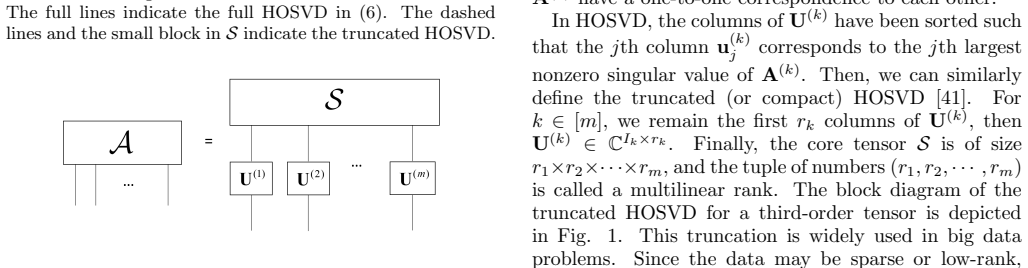
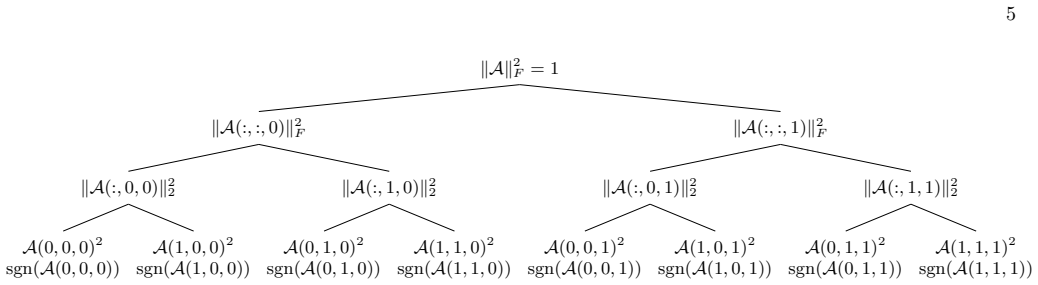
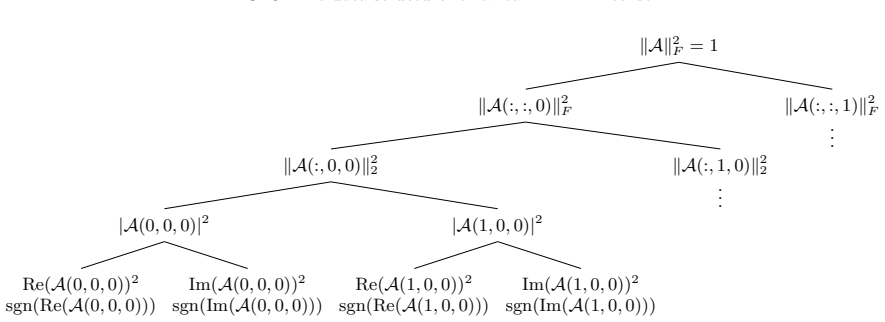
The load-bearing object is the Hermitian extension of the mode-$k$ unfolding, $\tilde A^{(k)}$ (the block matrix with $A^{(k)}$ and $A^{(k)\dagger}$ off-diagonal), together with a SWAP-like operator $S^{(k)}_{\tilde A}$ built from the entries of the original tensor. Because $S^{(k)}_{\tilde A}$ is one-sparse in a larger space, its Hamiltonian simulation is efficient, and qPCA on it reveals the singular values and singular vectors of each unfolding. The alternative algorithm replaces this with the quantum singular value estimation operator $W=(2PP^\dagger-I)(2QQ^\dagger-I)$, constructed from the row and column state-preparation isometries $P$ and $Q$; phase estimation on $W$ yields the singular values directly. Both algorithms rely on a quantum-accessible tree data structure (with qRAM access) that prepares the tensor state and row states in polylogarithmic time.
What would settle it
Compare end-to-end runtimes including data-structure construction: if any faithful preparation of the input requires reading all $n^m$ entries, the total time is $\Omega(n^m)$, so the claimed exponential advantage over $O(m n^{m+1})$ classical HOSVD would not hold as an end-to-end statement. A concrete check would be to instantiate the qRAM data structure for a dense $n\times n\times n$ tensor and count the entry-loading operations, or to run Algorithm 2 with the data-structure build cost included and show it saturates the classical time.
Extended reading notes
Core claim
On the paper's own terms, the central discovery is that HOSVD, previously treated as a classical multilinear-algebra routine, can be implemented quantumly with polylogarithmic scaling in the tensor dimension. Algorithm 1 uses quantum principal component analysis on a Hermitian extension of each mode-$k$ unfolding to estimate tensor singular values and vectors; Algorithm 2 uses quantum singular value estimation on the unfolding matrices directly and works for arbitrary input structure. The claimed complexities for preparing the superposition state are $O(m^2 \mathrm{polylog}\, n)$ and $O(m^3 \mathrm{polylog}\, n)$, respectively, versus $O(m n^{m+1})$ classically. Reconstructing the singular matrices and core tensor explicitly costs $O(m^3 n^2 \mathrm{polylog}\, n)$ and $O(m^4 n^2 \mathrm{polylog}\, n)$. In addition, the paper applies the HOSVD model to a hybrid quantum-classical recommendation system, where gradient computations are accelerated by quantum inner-product estimation.
Load-bearing premise
The exponential speedup assumes a pre-existing quantum-accessible data structure that can supply the $n^m$ tensor entries (or every mode-$k$ row state) in polylogarithmic time; building or updating that structure costs at least $O(n^m)$, and that cost is excluded from the complexity claims.
Editorial extensions
If this is right
- If correct, HOSVD-based tensor analysis in machine learning, signal processing, and quantum chemistry can be run on large tensors whose classical decomposition cost $O(m n^{m+1})$ would be prohibitive.
- Algorithm 2 removes the low-rank requirement on the unfolding matrices, so the method applies to dense, high-rank input tensors once the quantum data structure is available.
- The hybrid recommendation algorithm shows a concrete downstream use: gradient updates in tensor completion can be evaluated with polylogarithmic quantum subroutines instead of classical $O(K m d^m)$ computations.
- The explicit-output versions of both algorithms, with $O(m^3 n^2 \mathrm{polylog}\, n)$ and $O(m^4 n^2 \mathrm{polylog}\, n)$ costs, set a benchmark for what full HOSVD reconstruction would cost on a quantum computer.
Reading between the lines
- The end-to-end speedup is conditional on the quantum-accessible data structure already existing: loading an $n^m$-entry tensor classically costs at least $O(n^m)$ time and memory, which is not counted in the polylogarithmic bounds; if that loading cost is included, the exponential separation over classical HOSVD disappears.
- Because the same data-structure oracle underlies most quantum machine-learning speedup claims, the HOSVD result inherits the general open question of whether qRAM can be built and maintained cheaply in practice.
- A natural extension, not pursued in the paper, is to adapt the two algorithms to other tensor decompositions such as CP or tensor-train, where the same mode-wise singular-value ideas could apply.
- The recommendation-system application suggests a testable small-scale experiment: simulate Algorithm 3 with quantum gradient estimates and compare convergence against classical SGD; the paper does not report numerical results.
Signed reviews
Editorial analysis
A structured set of objections, weighed in public.
Referee Report
Summary. The paper proposes two quantum algorithms for higher-order singular value decomposition (HOSVD) of an mth-order n-dimensional tensor. Algorithm 1 builds a Hermitian extension of each mode-k unfolding, applies a qPCA-style simulation via a sparse SWAP-like operator, and uses phase estimation to prepare a superposition of tensor singular values and singular vectors. Algorithm 2 instead uses the quantum singular value estimation (QSVE) subroutine of Kerenidis and Prakash on each unfolding matrix. The paper claims O(m^2 polylog n) and O(m^3 polylog n) query complexity for the two algorithms, respectively, and hence an exponential speedup over classical HOSVD's O(m n^{m+1}); it also presents a hybrid quantum-classical recommendation-system algorithm based on HOSVD and SGD. The central claims are the two quantum HOSVD algorithms and their complexity analysis in Sections III-V and the summary in Section VII.
Significance. Quantum tensor algorithms are a timely and underexplored topic, and the paper is one of the first to formulate quantum HOSVD. Algorithm 2's structure around QSVE is natural and, under the standard quantum-accessible data structure assumption, could plausibly yield polylogarithmic query complexity for preparing singular-value/vector superpositions of tensor unfoldings. The hybrid recommendation application is also a reasonable extension of existing quantum recommendation ideas. However, the paper's headline exponential speedup is not established: Algorithm 1's complexity argument contains an internal inconsistency in the eigenvalue-resolvability analysis, and the cost of producing explicit singular matrices/core tensors as well as the preprocessing cost of the data structure are not accounted for. These issues are load-bearing for the main claims, so the contribution as it stands is not sound enough for publication.
major comments (3)
- [Section V, Eq. (45)] The eigenvalue-resolvability argument is internally inconsistent. With the normalization ||A||_F = 1, the Hermitian extension ~A^(k) in Eq. (16) has Frobenius norm sqrt(2), so the simulated Hamiltonian H = ~A^(k)/N has eigenvalues mu_j satisfying sum_j mu_j^2 = ||H||_F^2 = 2/N^2; in particular |mu_j| <= sqrt(2)/N. The condition |mu_j| = Omega(1/t) that the text imposes for phase estimation at simulation time t therefore forces t = Omega(N). Substituting this spectral bound into the lower bound in Eq. (45) gives Omega(r/t^2) <= tr(H_r^2) <= 2/N^2, hence t = Omega(N) unless r = 0. This contradicts the subsequent choice t = O(polylog n) and invalidates the derived rank bound r = O(||A||_max^2 t^2). Consequently the advertised O(m^2 polylog n) complexity of Algorithm 1 does not follow from the stated simulation.
- [Section V (final paragraph) and Sections III.D-III.E] The claimed complexities O(m^3 n^2 polylog n) and O(m^4 n^2 polylog n) for obtaining the singular matrices and core tensor are not derived and appear inconsistent with the algorithm as written. Step 4 obtains each U^(k) by measurement and amplitude amplification in T_U = O(n^{3/2}) per mode, giving O(m n^{3/2}) in total, while Step 5 costs O(m sqrt(n)/epsilon) by Eq. (35). No m^3 n^2 or m^4 n^2 factor appears in these ingredients. If the intention is to output the complete classical matrices and tensor, a readout lower bound of Omega(n^2) or Omega(n^m) applies and is not discussed. The summary in Section VII therefore overstates what the algorithm is shown to deliver.
- [Section VII vs. Theorem 1 and Lemma 3] The exponential-speedup comparison excludes the cost of constructing the quantum-accessible data structure. Theorem 1 and Lemma 3 provide O(polylog(n^m)) state-preparation time only after the tree structure has been built, and building it from the n^m entries requires Omega(n^m) time and memory. Algorithm 1's Step 1 says 'Load A into qRAM', but this preprocessing is never included in the runtime. Since the abstract and Section VII compare against the full classical cost O(m n^{m+1}), the comparison is between a query complexity under a strong input model and an unconditional classical cost. This distinction should be stated explicitly and the speedup claims adjusted accordingly.
minor comments (5)
- [Section III.D, after Eq. (29)] The text says that projecting onto the u_j part succeeds 'with probability <~u_j|u_j,0> = 1/2'; since |~u_j> = (u_j; +/- v_j)/sqrt(2), the inner product is 1/sqrt(2) and the probability is |<~u_j|u_j,0>|^2 = 1/2. Please correct the displayed value.
- [Section V, Algorithm 2 complexity] The claimed O(m^3 polylog n) complexity for Algorithm 2 lacks a derivation. The stated ingredients give O(m polylog n) per mode, so a sequential implementation would cost O(m^2 polylog n); either way the extra factor of m needs explanation.
- [Section VI, Algorithm 3] In the recommendation application, the cost of preparing the subtensor states |s> after each SGD update is not counted. The factor matrices and core tensor change at every iteration, so the underlying data structure must be updated, but the stated complexity O(K m^2 d polylog d) does not include this.
- [Section III.E, Eq. (31)] The notation for the column norms of U^(k) is used inconsistently: the state in Eq. (31) includes a factor ||U^(k)_{bullet j_k}||_2 while the surrounding text sometimes treats the columns as unnormalized; please clarify the normalization convention.
- [General] There are several typographical and grammatical errors, including 'Base on this algorithm' in Section I and inconsistent spacing in displayed equations; a careful proofreading pass is needed.
Circularity Check
No significant circularity: the Q-HOSVD algorithms are compositions of external qPCA and QSVE subroutines; self-citations are comparative and not load-bearing.
full rationale
The derivation chain starts from the standard HOSVD definition (De Lathauwer et al. [10]), then builds Algorithm 1 on external qPCA [24] and phase estimation [22], and Algorithm 2 on the external QSVE data-structure and estimation lemmas [20,29]. No parameter is fitted to a subset of data and then repackaged as a prediction. The outputs (singular values, singular matrices, core tensor) are defined by the standard HOSVD equations (6)-(8), not by the quantum circuits. The self-citations [14] and [44] are used only in comparative remarks: 'Algorithm 1 is similar to that in [14]' and 'We have carried out the similar SVD and truncation operations in [44]', so they do not carry the correctness or speedup claims. The quantum-accessible data structure (Theorem 1 and Lemma 3) is an explicit oracle assumption; its construction cost is not counted, but that is a modeling caveat and an unfair-comparison concern, not a reduction of the output to the input by construction. The low-rank restriction for Algorithm 1 is stated openly in Sections IV and VII, and the eigenvalue-resolvability issue in Eq. (45) identified by the skeptic is a potential complexity/correctness gap, not a circularity, because it is not a case of a fitted parameter being renamed a prediction or a definition being used as its own proof.
Assumptions & free parameters
free parameters (1)
- simulation time t =
O(polylog n)
assumptions (4)
- domain assumption A pre-built qRAM or tensor data structure provides quantum access to all tensor entries and to the row states of every mode-k unfolding in O(polylog n) time.
- standard math The qPCA identity in Lemma 1, cited from [24], correctly simulates the evolution of ~A/N in the form used by the paper.
- domain assumption The mode-k unfolding matrices are low-rank with rank r=O(polylog n) for Algorithm 1.
- standard math The quantum singular value estimation result of Lemma 4 from [20] is correct.
Cite this review
Pith. "Pith review of Quantum Higher Order Singular Value Decomposition." pith.science (2026). https://pith.science/paper/OIKNYU2M
@misc{pith2026190800719,
  author       = {Pith},
  title        = {Pith review of: Quantum Higher Order Singular Value Decomposition},
  year         = {2026},
  howpublished = {\url{https://pith.science/paper/OIKNYU2M}},
  note         = {Machine review of arXiv:1908.00719}
}
read the original abstract
Higher order singular value decomposition (HOSVD) is an important tool for analyzing big data in multilinear algebra and machine learning. In this paper, we present two quantum algorithms for HOSVD. Our methods allow one to decompose a tensor into a core tensor containing tensor singular values and some unitary matrices by quantum computers. Compared to the classical HOSVD algorithm, our quantum algorithms provide an exponential speedup. Furthermore, we introduce a hybrid quantum-classical algorithm of HOSVD model applied in recommendation systems.
Figures

Figures from the paper (4 more)


Reference graph
Works this paper leans on
-
[1]
HOSVD performs orthogonal coordinate transforma- tions for a higher-order tensor
When m = 2, i.e., A is a matrix, the HOSVD is degenerated to the well-known matrix SVD. HOSVD performs orthogonal coordinate transforma- tions for a higher-order tensor. Here, the unitary matrix U(k) is also called the k-mode factor matrix and consid- ered as the principal components inkth mode. Moreover, the entries of the core tensorS show the level of ...
-
[2]
Implement qPCA (18) by the SWAP operator S(k) ˜A in (17)
- [3]
-
[4]
end for 5.S←A× 1 U(1)† ×2 U(2)† ×3···× m U(m)†
Perform measurement on |˜λj/N⟩ and extract|˜uj⟩ to compose U(k). end for 5.S←A× 1 U(1)† ×2 U(2)† ×3···× m U(m)† . Several techniques and subroutines are applied in Algo- rithm 1. First, tensor A to be decomposed is loaded into the quantum register by qRAM. For a fixed k, we design a SWAP operator S(k) ˜A based on matrix unfolding and Hermitian extension, a...
-
[5]
Initialize |0⟩|⃗1⟩|b⟩, then apply phase estimation to obtain |ψ⟩ = r−1∑ j=0 βj|˜λj/N⟩| ˜uj⟩. (10)
-
[6]
Large-scale machine learning with stochas- tic gradient descent
L´ eon Bottou. Large-scale machine learning with stochas- tic gradient descent. InProceedings of COMPSTAT’2010, pages 177–186. Springer, 2010
work page 2010
-
[7]
For a precision parameter ϵ > 0, there exists a quantum phase estimation algorithm that runs in time O(T (U) logn/ϵ) and with probability 1−1/poly(n) maps a state ∑n−1 j=0 αj|vj⟩ to the state ∑n−1 j=0 αj|vj⟩ ⏐⏐¯θj ⟩ such that ¯θj∈θj±ϵ for all j = 0, 1,...,n − 1. Theorem 2. For the input |0⟩⊗d|⃗1⟩|b⟩, apply (18) in Lemma 1 to the input, and apply phase est...
-
[8]
Then, the singular matrix U is calculated by U = n∑ j=1 |uj⟩⟨j|. (29) Repeating measurements with the initial state |b⟩ = |0⟩,|1⟩,··· ,|n− 1⟩ and applying amplitude amplifica- tion [1], we can obtain all the singular vectors in TU = O(n3/2) times with probability close to 1. Thus, the sin- gular matrix U(k) is reconstructed. E. Step 5 After we get all U(k)...
Show all 59 references
-
[9]
Prepare the initial state 1√m ∑m−1 k=0 |b⟩| 0⟩|k⟩
-
[10]
Implement the controlled-k QSVE by the last register to obtain the superposition state |ψ⟩ = 1√m m−1∑ k=0 r−1∑ i=0 β(k) i |u(k) i ⟩|σ(k) i ⟩|k⟩
-
[11]
4.S←A× 1 U(1)† ×2 U(2)† ×3···× m U(m)†
Post-select k and perform measurement on |σ(k) i ⟩ and extract|u(k) i ⟩ to compose U(k). 4.S←A× 1 U(1)† ×2 U(2)† ×3···× m U(m)† . Algorithm 2 is similar to Algorithm 1, but we do not need to apply phase estimation on the extended Hermi- tian matrices. For Step 1, we prepare th...
-
[12]
Variable time amplitude amplification and quantum algorithms for linear algebra problems
Andris Ambainis. Variable time amplitude amplification and quantum algorithms for linear algebra problems. In STACS’12 (29th Symposium on Theoretical Aspects of Computer Science) , volume 14, pages 636–647. LIPIcs, 2012
2012
-
[13]
Higher order singular value decomposition in quantum chemistry
Franziska Bell, Daniel S Lambrecht, and Martin Head- Gordon. Higher order singular value decomposition in quantum chemistry. Molecular Physics, 108(19-20):2759– 2773, 2010
2010
-
[14]
The Netflix Prize
James Bennett and Stan Lanning. The Netflix Prize. In Proceedings of KDD cup and workshop , volume 2007, page 35. New York, NY, USA., 2007
2007
-
[15]
Efficient quantum algorithms for sim- ulating sparse Hamiltonians
Dominic W Berry, Graeme Ahokas, Richard Cleve, and Barry C Sanders. Efficient quantum algorithms for sim- ulating sparse Hamiltonians. Communications in Math- ematical Physics, 270(2):359–371, 2007
2007
-
[16]
Tensor networks in a nutshell
Jacob Biamonte and Ville Bergholm. Tensor networks in a nutshell. arXiv preprint arXiv:1708.00006 , 2017
2017 arXiv
-
[17]
Comput- ing the geometric measure of entanglement of multipar- tite pure states by means of non-negative tensors
Shenglong Hu, Liqun Qi, and Guofeng Zhang. Comput- ing the geometric measure of entanglement of multipar- tite pure states by means of non-negative tensors. Phys- ical Review A, 93(1):012304, 2016
2016
-
[18]
Quantum amplitude amplification and estimation
Gilles Brassard, Peter Hoyer, Michele Mosca, and Alain Tapp. Quantum amplitude amplification and estimation. Contemporary Mathematics, 305:53–74, 2002
2002
-
[19]
Experimental quantum computing to solve systems of linear equations
X-D Cai, Christian Weedbrook, Z-E Su, M-C Chen, Mile Gu, M-J Zhu, Li Li, Nai-Le Liu, Chao-Yang Lu, and Jian-Wei Pan. Experimental quantum computing to solve systems of linear equations. Physical review letters, 110(23):230501, 2013
2013
-
[20]
Eckart-Young
J Douglas Carroll and Jih-Jie Chang. Analysis of individ- ual differences in multidimensional scaling via an N-way generalization of “Eckart-Young” decomposition. Psy- chometrika, 35(3):283–319, 1970
1970
-
[21]
A multilinear singular value decomposition
Lieven De Lathauwer, Bart De Moor, and Joos Vande- walle. A multilinear singular value decomposition. SIAM journal on Matrix Analysis and Applications, 21(4):1253– 1278, 2000
2000
-
[22]
Machine learning & artificial intelligence in the quantum domain: a re- view of recent progress
Vedran Dunjko and Hans J Briegel. Machine learning & artificial intelligence in the quantum domain: a re- view of recent progress. Reports on Progress in Physics , 81(7):074001, 2018
2018
-
[23]
Quantum random access memory.Physical review letters, 100(16):160501, 2008
Vittorio Giovannetti, Seth Lloyd, and Lorenzo Maccone. Quantum random access memory.Physical review letters, 100(16):160501, 2008
2008
-
[24]
A fast quantum mechanical algorithm for database search
Lov K Grover. A fast quantum mechanical algorithm for database search. In Proceedings of the Twenty-eighth Annual ACM Symposium on Theory of Computing, pages 212–219. New York, NY, USA., 1996
1996
-
[25]
Quan- tum higher order singular value decomposition
Lejia Gu, Xiaoqiang Wang, and Guofeng Zhang. Quan- tum higher order singular value decomposition. In 2019 IEEE International Conference on Systems, Man and Cybernetics (SMC), pages 1166–1171. IEEE, 2019
2019
-
[26]
Quantum algorithm for linear systems of equations
Aram W Harrow, Avinatan Hassidim, and Seth Lloyd. Quantum algorithm for linear systems of equations. Physical review letters, 103(15):150502, 2009
2009
-
[27]
ex- planatory
Richard A Harshman et al. Foundations of the PARAFAC procedure: Models and conditions for an “ex- planatory” multimodal factor analysis. 1970
1970
-
[28]
Experimental realization of quantum al- gorithm for solving linear systems of equations
Jian Pan, Yudong Cao, Xiwei Yao, Zhaokai Li, Cheny- ong Ju, Hongwei Chen, Xinhua Peng, Sabre Kais, and Jiangfeng Du. Experimental realization of quantum al- gorithm for solving linear systems of equations. Physical Review A, 89(2):022313, 2014
2014
-
[29]
Towards quan- tum machine learning with tensor networks
William Huggins, Piyush Patil, Bradley Mitchell, K Bir- gitta Whaley, and E Miles Stoudenmire. Towards quan- tum machine learning with tensor networks. Quantum Science and technology, 4(2):024001, 2019
2019
-
[30]
Multiverse recommendation: n-dimensional tensor factorization for context-aware col- laborative filtering
Alexandros Karatzoglou, Xavier Amatriain, Linas Bal- trunas, and Nuria Oliver. Multiverse recommendation: n-dimensional tensor factorization for context-aware col- laborative filtering. In Proceedings of the fourth ACM conference on Recommender systems, pages 79–86. ACM, 2010
2010
-
[31]
Quantum rec- ommendation systems
Iordanis Kerenidis and Anupam Prakash. Quantum rec- ommendation systems. In Christos H. Papadimitriou, editor, 8th Innovations in Theoretical Computer Sci- ence Conference (ITCS 2017) , volume 67 of Leibniz In- ternational Proceedings in Informatics (LIPIcs) , pages 49:1–49:21...
2017
-
[32]
Iterative low-rank approx- imation for CNN compression
Maksym Kholiavchenko. Iterative low-rank approx- imation for CNN compression. arXiv preprint arXiv:1803.08995, 2018
2018 arXiv
-
[33]
Quantum measurements and the Abelian stabilizer problem
A Yu Kitaev. Quantum measurements and the Abelian stabilizer problem. arXiv preprint quant-ph/9511026 , 1995
1995 arXiv
-
[34]
Tensor decom- positions and applications
Tamara G Kolda and Brett W Bader. Tensor decom- positions and applications. SIAM review, 51(3):455–500, 2009
2009
-
[35]
Quantum principal component analysis
Seth Lloyd, Masoud Mohseni, and Patrick Rebentrost. Quantum principal component analysis. Nature Physics, 10(9):631, 2014
2014
-
[36]
Quantum compu- tation and quantum information, 2002
Michael A Nielsen and Isaac Chuang. Quantum compu- tation and quantum information, 2002
2002
-
[37]
A ten- sor higher-order singular value decomposition for inte- grative analysis of DNA microarray data from different studies
Larsson Omberg, Gene H Golub, and Orly Alter. A ten- sor higher-order singular value decomposition for inte- grative analysis of DNA microarray data from different studies. Proceedings of the National Academy of Sciences, 104(47):18371–18376, 2007
2007
-
[38]
Tensor-train decomposition
Ivan V Oseledets. Tensor-train decomposition. SIAM Journal on Scientific Computing , 33(5):2295–2317, 2011. 13
2011
-
[39]
Tensor completion algorithms in big data analytics
Qingquan Song, Hancheng Ge, James Caverlee, and Xia Hu. Tensor completion algorithms in big data analytics. ACM Transactions on Knowledge Discovery from Data (TKDD), 13(1):1–48, 2019
2019
-
[40]
Quantum algorithms for linear algebra and machine learning
Anupam Prakash. Quantum algorithms for linear algebra and machine learning . PhD thesis, UC Berkeley, 2014
2014
-
[41]
Tensor eigen- values and their applications , volume 39
Liqun Qi, Haibin Chen, and Yannan Chen. Tensor eigen- values and their applications , volume 39. Springer, 2018
2018
-
[42]
Tensor analysis: spectral theory and special tensors, volume 151
Liqun Qi and Ziyan Luo. Tensor analysis: spectral theory and special tensors, volume 151. SIAM, 2017
2017
-
[43]
Regularly decomposable tensors and classical spin states
Liqun Qi, Guofeng Zhang, Daniel Braun, Fabian Bohnet- Waldraff, and Olivier Giraud. Regularly decomposable tensors and classical spin states. Communications in Mathematical Sciences, 15(6):1651–1665, 2017
2017
-
[44]
How entangled can a multi-party system possibly be? Physics Letters A, 382(22):1465–1471, 2018
Liqun Qi, Guofeng Zhang, and Guyan Ni. How entangled can a multi-party system possibly be? Physics Letters A, 382(22):1465–1471, 2018
2018
-
[45]
Quantum support vector machine for big data classifica- tion
Patrick Rebentrost, Masoud Mohseni, and Seth Lloyd. Quantum support vector machine for big data classifica- tion. Physical review letters, 113(13):130503, 2014
2014
-
[46]
Since HOSVD deals with high dimensional data, it has been put into practice in some machine learning meth- ods
to derive the output m photon state of a quantum linear passive system which is driven by an m photon input state; more specifically, the wave function of the output is expressed in terms of the HOSVD of the input wave function. Since HOSVD deals with high dimensional data, it ...
1908 arXiv
-
[47]
Quantum singular-value decomposi- tion of nonsparse low-rank matrices
Patrick Rebentrost, Adrian Steffens, Iman Marvian, and Seth Lloyd. Quantum singular-value decomposi- tion of nonsparse low-rank matrices. Physical review A , 97(1):012327, 2018
2018
-
[48]
On tensor-product model based representation of neural net- works
Andr´ as R¨ ovid, L´ aszl´ o Szeidl, and P´ eter V´ arlaki. On tensor-product model based representation of neural net- works. In 2011 15th IEEE International Conference on Intelligent Engineering Systems , pages 69–72. IEEE, 2011
2011
-
[49]
Quantum algorithms to matrix multi- plication
Changpeng Shao. Quantum algorithms to matrix multi- plication. arXiv preprint arXiv:1803.01601 , 2018
2018 arXiv
-
[50]
Algorithms for quantum computation: discrete logarithms and factoring
Peter W Shor. Algorithms for quantum computation: discrete logarithms and factoring. In Proceedings 35th annual symposium on foundations of computer science , pages 124–134. IEEE, 1994
1994
-
[51]
Tag recommendations based on tensor dimensionality reduction
Panagiotis Symeonidis, Alexandros Nanopoulos, and Yannis Manolopoulos. Tag recommendations based on tensor dimensionality reduction. In Proceedings of the 2008 ACM conference on Recommender systems , pages 43–50. ACM, 2008
2008
-
[52]
Numerical reconstruction of the HOSVD based canonical form of polytopic dynamic models
L´ aszl´ o Szeidl, Peter Baranyi, Zolt´ an Petres, and Peter Varlaki. Numerical reconstruction of the HOSVD based canonical form of polytopic dynamic models. In 2007 International Symposium on Computational Intelligence and Intelligent Informatics , pages 111–116. IEEE, 2007
2007
-
[53]
Some mathematical notes on three- mode factor analysis
Ledyard R Tucker. Some mathematical notes on three- mode factor analysis. Psychometrika, 31(3):279–311, 1966
1966
-
[54]
Multi- linear analysis of image ensembles: Tensorfaces
M Alex O Vasilescu and Demetri Terzopoulos. Multi- linear analysis of image ensembles: Tensorfaces. In Eu- ropean Conference on Computer Vision , pages 447–460. Springer, 2002
2002
-
[55]
Quantum tensor singular value decom- position with applications to recommendation systems
Xiaoqiang Wang, Lejia Gu, Heung-wing Joseph Lee, and Guofeng Zhang. Quantum tensor singular value decom- position with applications to recommendation systems. arXiv preprint arXiv:1910.01262 , 2019
1910 arXiv
-
[56]
Quan- tum algorithm for data fitting
Nathan Wiebe, Daniel Braun, and Seth Lloyd. Quan- tum algorithm for data fitting. Physical review letters , 109(5):050505, 2012
2012
-
[57]
Dynamical analysis of quantum linear systems driven by multi-channel multi-photon states.Au- tomatica, 83:186–198, 2017
Guofeng Zhang. Dynamical analysis of quantum linear systems driven by multi-channel multi-photon states.Au- tomatica, 83:186–198, 2017
2017
-
[58]
Iterative methods for computing U-eigenvalues of non-symmetric complex tensors with application in quantum entangle- ment
Mengshi Zhang, Guyan Ni, and Guofeng Zhang. Iterative methods for computing U-eigenvalues of non-symmetric complex tensors with application in quantum entangle- ment. Computational Optimization and Applications , pages 1–20, 2019
2019
-
[59]
Bayesian deep learning on a quantum computer
Zhikuan Zhao, Alejandro Pozas-Kerstjens, Patrick Rebentrost, and Peter Wittek. Bayesian deep learning on a quantum computer. Quantum Machine Intelligence, 1(1-2):41–51, 2019
2019
Reviewed August 14, 2026 · model on record in the stance chip above.
Discussion (0). Continue with ORCID to comment.