REVIEW 4 major objections 5 minor 117 references
Polar alignment of a circumbinary disc around a brown dwarf binary
T0 review · 4 major / 5 minor · reviewed 2026-08-06 · deepseek-v4-flash
Pith's one-line read The paper argues that a primordial misaligned circumbinary disc around the brown dwarf binary 2M1510 AB can evolve into a polar configuration within a typical disc lifetime, which would make the suspected polar planet around it a…
desk verdict A sound but incremental application of established polar-alignment theory to a brown dwarf binary; the simulation is a proof-of-concept that does not directly test the low-viscosity, extended-disc timescales the paper advertises. read the letter →
The pith
A machine-rendered reading of the paper's core claim, the machinery that carries it, and where it could break.
The reading
What carries the argument
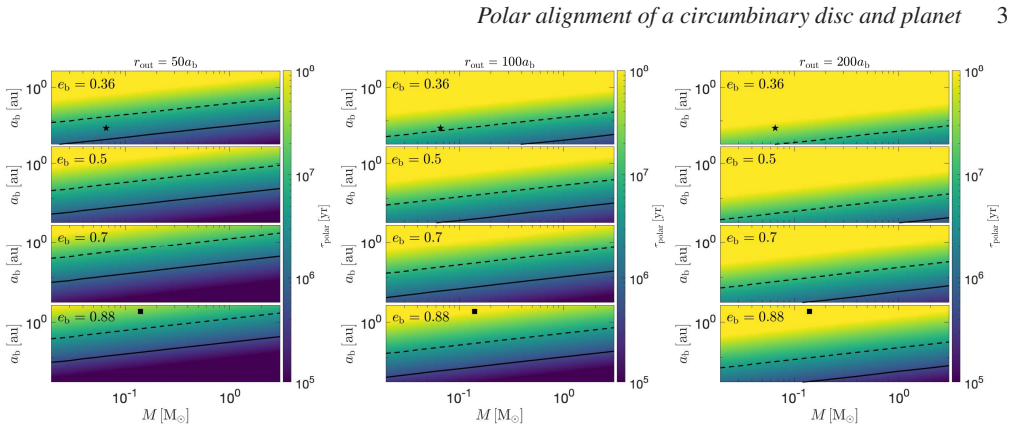
The load-bearing mechanism is the torque from the eccentric binary acting on a misaligned gas disc, which drives precession and, for sufficiently large initial tilts, polar alignment. The argument is carried by two analytical formulas: the polar-alignment timescale $\tau_{\rm polar} = (1/\alpha)(H/r)^2 \Omega_b/\Omega_d^2$, with the disc precession frequency $\Omega_d$ given by a mass-weighted average over the disc, and a two-regime critical tilt $i_{\rm crit}$ that separates coplanar from polar alignment. The hydrodynamical simulation acts as a proof-of-concept that a 75-degree-tilted disc around the 2M1510 AB binary evolves toward the polar state without breaking.
What would settle it
A hydrodynamical simulation of the same 2M1510 AB binary parameters but with an outer disc radius extending well beyond 10 binary separations into the regime where the disc is predicted to break or tear, and that fails to reach a polar state before the disc disperses, would directly falsify the claim that a primordial disc aligns as a coherent body. Alternatively, direct imaging of a young brown dwarf binary showing a circumbinary disc with initial tilt above the critical angle that remains coplanar or misaligned after the predicted alignment time would contradict the timescale calculation.
Extended reading notes
Core claim
The central claim is that a circumbinary disc around a low-mass, moderately eccentric brown dwarf binary such as 2M1510 AB can achieve polar alignment within the disc's lifetime. The authors compute alignment timescales from linear warp-dissipation theory, identify an analytical critical tilt angle that separates coplanar from polar alignment, and verify the behavior with a smoothed-particle hydrodynamics simulation of an initially 75-degree-inclined disc. They find that discs around brown dwarf binaries align more slowly than discs around more massive binaries, but that with suitable parameters (viscosity $\alpha = 10^{-4}$, aspect ratio $H/r = 0.05$, outer radius up to roughly $100$ binary separations) alignment can still finish before the disc disperses. The paper concludes that the suspected polar planet around 2M1510 AB could have formed in place from such an aligned disc, and that the lack of other polar circumbinary planets is consistent with detection biases rather than with the process being impossible.
Load-bearing premise
The whole argument assumes the disc stays a single, coherent, rigidly precessing structure for the entire alignment, so that one global precession frequency (a mass-weighted average) describes it; if the disc breaks into mutually misaligned rings before aligning, the timescales and the polar-state conclusion do not follow.
Editorial extensions
If this is right
- For 2M1510 AB, a disc with $\alpha = 10^{-4}$, $H/r = 0.05$, and an outer radius out to roughly $100\,a_b$ can reach polar alignment within a typical 1–10 Myr disc lifetime, making in-situ formation of the suspected polar planet plausible.
- Polar alignment around brown dwarf binaries takes longer than around more massive binaries, so among brown dwarf systems only those with favorable disc properties (moderately compact, viscous, thin) are expected to produce polar planets before the disc disperses.
- The near-polar companion to VHS 1256 AB is unlikely to have formed from a polar-aligning disc within the disc lifetime; the paper argues a scattering origin or a primordially near-polar disc is more likely.
- The outer companion 2M1510 C does not destabilize the polar alignment of a compact primordial disc, and most circumbinary orbits remain stable against von Zeipel–Kozai–Lidov oscillations over the system's roughly 45 Myr age.
- The known absence of polar circumbinary planets is consistent with observational selection: transiting circumbinary searches favor coplanar configurations, and radial-velocity samples are dominated by low-eccentricity binaries.
Reading between the lines
- Because the alignment timescale scales inversely with binary mass and increases with binary separation, the model implies that the most promising targets for finding polar circumbinary planets are young, tight, eccentric, near-equal-mass binaries; this is an observational consequence not explored in the paper.
- A testable extension: if the suspected planet around 2M1510 AB is confirmed and its orbit is measured, it should lie close to the plane perpendicular to the binary's orbital plane and aligned with the binary's eccentricity vector, matching the polar state the disc reached before it dispersed.
- The paper's reliance on a coherent disc suggests that more massive discs (higher disc-to-binary angular momentum ratio) may align to a different critical tilt near 40 degrees; whether massive discs remain coherent long enough is an open question the authors do not address.
- The detection-bias argument implies that a dedicated search for retrograde apsidal precession in binaries with eccentricity around 0.4 could uncover more polar circumbinary planets, providing a direct test of whether the 2M1510 configuration is rare or just rarely seen.
Editorial analysis
A structured set of objections, weighed in public.
Referee Report
Summary. The paper studies whether a primordial misaligned circumbinary disc around the brown dwarf binary 2M1510 AB can evolve into a polar configuration within the disc lifetime, motivated by the suspected polar circumbinary planet 2M1510 (AB)b. The authors use the analytical polar-alignment timescale and critical-tilt expressions of Martin & Lubow (2017, 2019), evaluate them for the observed binary parameters, and present one smoothed-particle-hydrodynamics simulation of an initially 75°-tilted disc around 2M1510 AB. They report that the disc evolves toward polar alignment and conclude that a primordial disc with sufficient initial misalignment and suitable viscosity and aspect ratio could have polar-aligned within 1–10 Myr, yielding favorable conditions for forming a polar planet. The paper also discusses the effect of the outer companion 2M1510 C, proposes a modified empirical disc-radius relation for low-mass objects, and speculates on why polar circumbinary systems have not been found more widely.
Significance. If the central claim is correct, the paper would offer a plausible in-situ formation pathway for the suspected polar circumbinary planet around 2M1510 AB, and would extend the theory of polar disc alignment from stellar binaries to brown-dwarf binaries. The analytical framework is imported from prior published work, which is appropriate as an external benchmark; the new hydrodynamical simulation provides an independent numerical test, although its parameter regime differs from the analytical fiducial case. The paper also makes falsifiable predictions about the parameter combinations (viscosity α≈1e-4, H/r≈0.05, r_out≲100 a_b, initial tilt ≳50°) required for polar alignment in low-mass systems. A strength of the manuscript is that it grounds the calculation in the observed parameters of 2M1510 AB (Triaud et al. 2020; Baycroft et al. 2025), but the support for the specific application to that system is weakened by a disc-size inconsistency and by the absence of a convergence study for the simulation.
major comments (4)
- [Section 3.1 and Section 3.2] The hydrodynamical simulation that is presented as confirmation of the polar-alignment scenario adopts α_SS = 0.005 and r_out = 10 a_b (Section 3.1), whereas the analytical timescales highlighted for 2M1510 AB use α = 1e-4 and r_out up to 100 a_b (Figure 2; Section 5). Because Eq. (1) scales as τ_polar ∝ 1/α, the simulated alignment proceeds roughly fifty times faster than in the fiducial analytical case, everything else being equal. The simulation therefore demonstrates that a relatively viscous, narrow disc can polar-align, but it does not by itself confirm that the α = 1e-4, r_out ≈ 100 a_b parameter combination aligns within a typical disc lifetime. The abstract's statement that 'A hydrodynamical simulation confirms that an initially inclined disc ... evolves towards a polar state' should be tempered, or supplemented by a simulation in the fiducial regime (or by an explicit argument explaining why the α-dependence in Eq. (1) can be safely extrapolated).
- [Section 4.1 and Section 4.2] There is an inconsistency between the inferred disc size for 2M1510 AB and the region of Figure 2 used to claim alignment within the disc lifetime. Applying Eq. (9) gives r_out,dust ≈ 15 au, and the authors then infer a gas-disc outer edge of ~30 au (Section 4.1); for a_b = 0.06 au, this corresponds to roughly 250–500 a_b. Yet Section 4.2 states that 'a disc within ~100 a_b around 2M1510 AB is expected to align polar within its lifetime,' and Figure 2 extends only to r_out = 100 a_b. The timescale in Eq. (1) grows with r_out through Eq. (3), so the authors' own disc-size estimate places 2M1510 AB well outside the parameter range for which alignment within 1–10 Myr is demonstrated. The central conclusion that a primordial disc around 2M1510 AB could polar-align before dispersal is therefore not supported for the disc size the authors themselves adopt; a calculation of τ_polar at the inferred r_out, or a revised estimate of the primordial disc size, is needed.
- [Section 3.1] No resolution or convergence study is presented for the SPH simulation. The single run uses 10^6 particles, and the Shakura-Sunyaev viscosity is implemented through the artificial-viscosity prescription with an average smoothing length per scale height ⟨h⟩/H = 0.34. The reliability of the simulated alignment timescale and the statement that the disc does not break depend on the numerical viscosity being converged and on the warp being spatially resolved. Without a higher- or lower-resolution test, the hydrodynamical evidence is only qualitative. A resolution study, or at least a discussion of the known resolution sensitivity of SPH warp simulations, should be added.
- [Section 4.1, Eq. (9)] The modified disc-radius relation in Eq. (9) introduces parameters β and λ that are never assigned numerical values in the text, so the plotted curve in Figure 6 and the inferred r_out ≈ 15 au for 2M1510 AB are not reproducible. This estimate is load-bearing for the argument that vZKL oscillations are quenched (Figure 5) and for the disc-size calculation discussed in the previous comment. The authors should state the adopted values of β and λ and explain how they were calibrated.
minor comments (5)
- [Section 3.1] The text says the particles are distributed 'from the inner disc radius, r_out = 0.12 au ... to the outer disc radius, r_out = 0.6 au'; the first occurrence should presumably be r_in, not r_out.
- [Equations (8)-(9) and throughout] The symbol α is used both for the Shakura-Sunyaev viscosity parameter and for the power-law index in the disc-radius relation, which is confusing; please use a different symbol (e.g., γ) for the radius exponent.
- [Abstract and Section 2] The abstract states that the critical tilt converges to the Kozai-Lidov threshold of ~39°, while Section 2 and Figure 3 report a limiting value near 40°; these numbers should be made consistent.
- [Figure 2 caption] The caption should state explicitly that the ordinate is τ_polar in years and should identify the unit of the horizontal axis (r_out/a_b), as the current prose is ambiguous without the figure.
- [Introduction and Conclusions] There are several typographical errors in the prose, such as 'more rapidity' and 'the efficient of alignment is in influences' in the concluding paragraph; a careful proofread is needed.
Circularity Check
No significant circularity: the analytic alignment formalism is imported from independent prior work, and the SPH simulation is a separate numerical test of that formalism.
full rationale
The paper's central timescale relation (Eq. 1) and precession frequency (Eq. 2) are quoted from published linear-warp theory, with Eq. (2) citing Lubow & Martin (2018) and Smallwood et al. (2019), and the critical tilt expression Eq. (4) is taken from Martin & Lubow (2019). These are external results used as inputs, not outputs of this paper, and they are not redefined in terms of the target quantities. The hydrodynamical simulation is an independent Phantom calculation with its own initial conditions (i = 75 degrees, alpha_SS = 0.005, r_out = 10 a_b); it is not constructed by imposing the analytic polar-alignment solution, and the fact that the initial tilt lies above the imported critical angle is the intended test, not a circular definition. The only fitted component is the empirical disc-radius relation Eq. (9), which is explicitly labelled an adopted modification of literature scalings and is used to estimate the radial extent of the 2M1510 disc for the vZKL discussion rather than to define the polar-alignment claim. Self-citations to Smallwood et al. appear in contextual statements about polar planet formation and prior precession-frequency results, but the core derivation does not reduce to those citations; Eq. (2)'s origin is the independent Lubow & Martin (2018) result. No fitted parameter is renamed as a prediction, no uniqueness argument is imported from the authors' own prior work, and no known result is merely relabelled. Discrepancies between the analytic fiducial parameters (alpha = 1e-4, r_out up to 100 a_b) and the simulation parameters (alpha = 0.005, r_out = 10 a_b), and the untested assumption of coherent disc precession in the low-viscosity regime, are legitimate extrapolation and robustness concerns, but they are not circularity.
Assumptions & free parameters
free parameters (6)
- Simulation Shakura-Sunyaev viscosity alpha_SS =
0.005
- Initial disc aspect ratio (H/r)_in =
0.05
- Initial disc tilt i0 =
75 degrees
- Disc mass fraction =
0.1% of binary mass
- Simulation outer disc radius r_out =
0.6 au, or 10 a_b
- Modified disc radius relation parameters =
r0=100 au, alpha=0.5, M_break=0.1 M_sun, beta and gamma unspecified
assumptions (6)
- standard math Keplerian angular velocity and standard angular momentum integrals in Eqs. (5) and (6) define the disc-to-binary angular momentum ratio j0.
- domain assumption Linear warp propagation theory with the bending-wave regime gives the polar alignment timescale Eq. (1) and the global precession frequency Eq. (2).
- domain assumption The circumbinary disc precesses as a coherent rigid body and does not break or tear.
- domain assumption Primordial discs around brown dwarf binaries can form with substantial misalignment relative to the binary plane.
- ad hoc to paper The modified empirical disc radius relation Eq. (9) captures the flattening of disc size at very low stellar masses.
- domain assumption Protoplanetary disc lifetimes around brown dwarfs are comparable to the 1 to 10 Myr range used as the alignment deadline.
Cite this review
Pith. "Pith review of Polar alignment of a circumbinary disc around a brown dwarf binary." pith.science (2026). https://pith.science/paper/OILEWYEO
@misc{pith2026250622747,
  author       = {Pith},
  title        = {Pith review of: Polar alignment of a circumbinary disc around a brown dwarf binary},
  year         = {2026},
  howpublished = {\url{https://pith.science/paper/OILEWYEO}},
  note         = {Machine review of arXiv:2506.22747}
}
abstract
Inspired by recent observations suggesting that the retrograde precession of the brown dwarf binary 2M1510 AB is consistent with induction by a polar circumbinary planet, we investigate the formation of such planets by studying the evolution of a primordial misaligned circumbinary disc around a brown dwarf binary. Analytical calculations show that a critical tilt angle of $i_{\rm crit} \gtrsim 50^\circ$ for moderately eccentric binaries is needed for polar alignment of circumbinary discs in systems with low disc-to-binary angular momentum ratios. For higher ratios, this angle converges to the Kozai-Lidov instability threshold of $\sim 39^\circ$. We identify disc parameters, such as viscosity ($\alpha = 10^{-4}$) and aspect ratio ($H/r = 0.05$), that enable polar alignment within typical disc lifetimes. Notably, a circumbinary disc around a low-mass binary, such as a brown dwarf binary, will require more time to achieve polar alignment compared to higher-mass systems. A hydrodynamical simulation confirms that an initially inclined disc around a brown dwarf evolves towards a polar state, creating favorable conditions for polar planet formation. Using these results, we finish by placing 2M1510 AB into a wider context and speculate why such a polar circumbinary configuration has not been identified before.
Figures


Figures from the paper (4 more)


Reference graph
Works this paper leans on
-
[1]
Aly H., Dehnen W., Nixon C., King A., 2015, @doi [ ] 10.1093/mnras/stv128 , http://adsabs.harvard.edu/abs/2015MNRAS.449...65A 449, 65
-
[2]
Andrews S. M., Rosenfeld K. A., Kraus A. L., Wilner D. J., 2013, @doi [ ] 10.1088/0004-637X/771/2/129 , https://ui.adsabs.harvard.edu/abs/2013ApJ...771..129A 771, 129
-
[3]
Andrews S. M., et al., 2018, @doi [ ] 10.3847/2041-8213/aaf741 , https://ui.adsabs.harvard.edu/abs/2018ApJ...869L..41A 869, L41
-
[4]
Ansdell M., et al., 2018, @doi [ ] 10.3847/1538-4357/aab890 , https://ui.adsabs.harvard.edu/abs/2018ApJ...859...21A 859, 21
-
[5]
Apai D., Pascucci I., Bouwman J., Natta A., Henning T., Dullemond C. P., 2005, @doi [Science] 10.1126/science.1118042 , https://ui.adsabs.harvard.edu/abs/2005Sci...310..834A 310, 834
-
[6]
H., 1994, @doi [ApJ] 10.1086/173679 , http://adsabs.harvard.edu/abs/1994ApJ...421..651A 421, 651
Artymowicz P., Lubow S. H., 1994, @doi [ApJ] 10.1086/173679 , http://adsabs.harvard.edu/abs/1994ApJ...421..651A 421, 651
doi:10.1086/173679 1994
-
[7]
Bailer-Jones C. A. L., Rybizki J., Fouesneau M., Mantelet G., Andrae R., 2018, @doi [ ] 10.3847/1538-3881/aacb21 , https://ui.adsabs.harvard.edu/abs/2018AJ....156...58B 156, 58
-
[8]
Bate M. R., 2012, @doi [MNRAS] 10.1111/j.1365-2966.2011.19955.x , http://adsabs.harvard.edu/abs/2012MNRAS.419.3115B 419, 3115
arXiv 2012
Show all 117 references
-
[9]
R., 2018, @doi [ ] 10.1093/mnras/sty169 , http://adsabs.harvard.edu/abs/2018MNRAS.475.5618B 475, 5618
Bate M. R., 2018, @doi [ ] 10.1093/mnras/sty169 , http://adsabs.harvard.edu/abs/2018MNRAS.475.5618B 475, 5618
2018 doi
-
[10]
R., Bonnell I
Bate M. R., Bonnell I. A., 1997, @doi [ ] 10.1093/mnras/285.1.33 , https://ui.adsabs.harvard.edu/abs/1997MNRAS.285...33B 285, 33
1997 doi
-
[11]
R., Bonnell I
Bate M. R., Bonnell I. A., Price N. M., 1995, @doi [ ] 10.1093/mnras/277.2.362 , https://ui.adsabs.harvard.edu/abs/1995MNRAS.277..362B 277, 362
1995 doi
-
[12]
R., Bonnell I
Bate M. R., Bonnell I. A., Bromm V., 2003, @doi [ ] 10.1046/j.1365-8711.2003.06210.x , http://adsabs.harvard.edu/abs/2003MNRAS.339..577B 339, 577
2003
-
[13]
R., Lodato G., Pringle J
Bate M. R., Lodato G., Pringle J. E., 2010, @doi [MNRAS] 10.1111/j.1365-2966.2009.15773.x , http://adsabs.harvard.edu/abs/2010MNRAS.401.1505B 401, 1505
2010
-
[14]
A., Triaud A
Baycroft T. A., Triaud A. H. M. J., Lai D., 2024, in Lemaitre A., Libert A.-S., eds, IAU Symposium Vol. 382, Complex Planetary Systems II: Latest Methods for an Interdisciplinary Approach. pp 51--58 ( @eprint arXiv 2409.04191 ), @doi 10.1017/S1743921323004180
2024 arXiv
-
[15]
A., Sairam L., Triaud A
Baycroft T. A., Sairam L., Triaud A. H. M. J., Correia A. C. M., 2025, arXiv e-prints, https://ui.adsabs.harvard.edu/abs/2025arXiv250412209B p. arXiv:2504.12209
2025 arXiv
-
[16]
H., Charbonneau D., White R
Blake C. H., Charbonneau D., White R. J., 2010, @doi [The Astrophysical Journal] 10.1088/0004-637X/723/1/684 , 723, 684
2010 doi
-
[17]
Bonnell I., Bastien P., 1992, @doi [ ] 10.1086/172093 , http://adsabs.harvard.edu/abs/1992ApJ...401..654B 401, 654
1992 doi
-
[18]
P., et al., 2023, @doi [ ] 10.3847/1538-3881/acbd34 , https://ui.adsabs.harvard.edu/abs/2023AJ....165..164B 165, 164
Bowler B. P., et al., 2023, @doi [ ] 10.3847/1538-3881/acbd34 , https://ui.adsabs.harvard.edu/abs/2023AJ....165..164B 165, 164
2023 doi
-
[19]
J., Kirkpatrick J
Burgasser A. J., Kirkpatrick J. D., Reid I. N., Brown M. E., Miskey C. L., Gizis J. E., 2003, @doi [ ] 10.1086/346263 , https://ui.adsabs.harvard.edu/abs/2003ApJ...586..512B 586, 512
2003 doi
-
[20]
J., Kirkpatrick J
Burgasser A. J., Kirkpatrick J. D., Cruz K. L., Reid I. N., Leggett S. K., Liebert J., Burrows A., Brown M. E., 2006, @doi [ ] 10.1086/506327 , https://ui.adsabs.harvard.edu/abs/2006ApJS..166..585B 166, 585
2006 doi
-
[21]
B., Lunine J
Burrows A., Hubbard W. B., Lunine J. I., Liebert J., 2001, @doi [Reviews of Modern Physics] 10.1103/RevModPhys.73.719 , https://ui.adsabs.harvard.edu/abs/2001RvMP...73..719B 73, 719
2001 doi
-
[22]
Calissendorff P., Janson M., Asensio-Torres R., K \"o hler R., 2019, @doi [ ] 10.1051/0004-6361/201935319 , https://ui.adsabs.harvard.edu/abs/2019A&A...627A.167C 627, A167
2019 doi
-
[23]
Chabrier G., Baraffe I., Allard F., Hauschildt P., 2000, @doi [ ] 10.1086/309513 , https://ui.adsabs.harvard.edu/abs/2000ApJ...542..464C 542, 464
2000 doi
-
[24]
M., Dumas C., Zuckerman B., Mouillet D., Song I., Beuzit J
Chauvin G., Lagrange A. M., Dumas C., Zuckerman B., Mouillet D., Song I., Beuzit J. L., Lowrance P., 2005, @doi [ ] 10.1051/0004-6361:200500116 , https://ui.adsabs.harvard.edu/abs/2005A&A...438L..25C 438, L25
2005 doi
-
[25]
Chen Z., Kipping D., 2022, @doi [ ] 10.1093/mnras/stac1246 , https://ui.adsabs.harvard.edu/abs/2022MNRAS.513.5162C 513, 5162
2022 doi
-
[26]
H., Martin R
Chen C., Lubow S. H., Martin R. G., 2020, @doi [ ] 10.1093/mnras/staa1037 , https://ui.adsabs.harvard.edu/abs/2020MNRAS.494.4645C 494, 4645
2020 doi
-
[27]
I., Goldreich P., 1997, @doi [ApJ] 10.1086/304869 , http://adsabs.harvard.edu/abs/1997ApJ...490..368C 490, 368
Chiang E. I., Goldreich P., 1997, @doi [ApJ] 10.1086/304869 , http://adsabs.harvard.edu/abs/1997ApJ...490..368C 490, 368
1997 doi
-
[28]
C., Martin R
Childs A. C., Martin R. G., 2021, @doi [ ] 10.3847/2041-8213/ac2957 , https://ui.adsabs.harvard.edu/abs/2021ApJ...920L...8C 920, L8
2021 doi
-
[29]
H., Claes P., Torra J., Laureijs R
Comeron F., Rieke G. H., Claes P., Torra J., Laureijs R. J., 1998, , https://ui.adsabs.harvard.edu/abs/1998A&A...335..522C 335, 522
1998
-
[30]
A., 2019, @doi [ ] 10.1051/0004-6361/201833976 , https://ui.adsabs.harvard.edu/abs/2019A&A...628A.119C 628, A119
Cuello N., Giuppone C. A., 2019, @doi [ ] 10.1051/0004-6361/201833976 , https://ui.adsabs.harvard.edu/abs/2019A&A...628A.119C 628, A119
2019 doi
-
[31]
M., et al., 2003, VizieR Online Data Catalog: 2MASS All-Sky Catalog of Point Sources (Cutri+ 2003) , VizieR On-line Data Catalog: II/246
Cutri R. M., et al., 2003, VizieR Online Data Catalog: 2MASS All-Sky Catalog of Point Sources (Cutri+ 2003) , VizieR On-line Data Catalog: II/246. Originally published in: University of Massachusetts and Infrared Processing and Analysis Center, (IPAC/California Institute of Te...
2003
-
[32]
M., Jensen E
Czekala I., Andrews S. M., Jensen E. L. N., Stassun K. G., Torres G., Wilner D. J., 2015, @doi [ ] 10.1088/0004-637X/806/2/154 , https://ui.adsabs.harvard.edu/abs/2015ApJ...806..154C 806, 154
2015 doi
-
[33]
M., Jensen E
Czekala I., Chiang E., Andrews S. M., Jensen E. L. N., Torres G., Wilner D. J., Stassun K. G., Macintosh B., 2019, @doi [ ] 10.3847/1538-4357/ab287b , https://ui.adsabs.harvard.edu/abs/2019ApJ...883...22C 883, 22
2019 doi
-
[34]
Daemgen S., Natta A., Scholz A., Testi L., Jayawardhana R., Greaves J., Eastwood D., 2016, @doi [ ] 10.1051/0004-6361/201628431 , https://ui.adsabs.harvard.edu/abs/2016A&A...594A..83D 594, A83
2016 doi
-
[35]
J., et al., 2014, @doi [ ] 10.1093/mnras/stt1932 , https://ui.adsabs.harvard.edu/abs/2014MNRAS.437.1216D 437, 1216
De Rosa R. J., et al., 2014, @doi [ ] 10.1093/mnras/stt1932 , https://ui.adsabs.harvard.edu/abs/2014MNRAS.437.1216D 437, 1216
2014 doi
-
[36]
Delorme P., et al., 2013, @doi [ ] 10.1051/0004-6361/201321169 , https://ui.adsabs.harvard.edu/abs/2013A&A...553L...5D 553, L5
2013 doi
-
[37]
I., 2022, @doi [ ] 10.1093/mnras/stac858 , https://ui.adsabs.harvard.edu/abs/2022MNRAS.512.6078D 512, 6078
Deng H., Ogilvie G. I., 2022, @doi [ ] 10.1093/mnras/stac858 , https://ui.adsabs.harvard.edu/abs/2022MNRAS.512.6078D 512, 6078
2022 doi
-
[38]
J., Ryan G., 2024, @doi [ ] 10.3847/1538-4357/ad2f1e , https://ui.adsabs.harvard.edu/abs/2024ApJ...967...12D 967, 12
Dittmann A. J., Ryan G., 2024, @doi [ ] 10.3847/1538-4357/ad2f1e , https://ui.adsabs.harvard.edu/abs/2024ApJ...967...12D 967, 12
2024 doi
-
[39]
Duch \^e ne G., Kraus A., 2013, @doi [ ] 10.1146/annurev-astro-081710-102602 , http://adsabs.harvard.edu/abs/2013ARA
2013 doi
-
[40]
J., Liu M
Dupuy T. J., Liu M. C., Evans E. L., Best W. M. J., Pearce L. A., Sanghi A., Phillips M. W., Bardalez Gagliuffi D. C., 2023, @doi [ ] 10.1093/mnras/stac3557 , https://ui.adsabs.harvard.edu/abs/2023MNRAS.519.1688D 519, 1688
2023 doi
-
[41]
J., 2013, @doi [ ] 10.1093/mnras/stt877 , https://ui.adsabs.harvard.edu/abs/2013MNRAS.433.2142F 433, 2142
Facchini S., Lodato G., Price D. J., 2013, @doi [ ] 10.1093/mnras/stt877 , https://ui.adsabs.harvard.edu/abs/2013MNRAS.433.2142F 433, 2142
2013 doi
-
[42]
W., Ogilvie G
Fairbairn C. W., Ogilvie G. I., 2021, @doi [ ] 10.1093/mnras/stab2717 , https://ui.adsabs.harvard.edu/abs/2021MNRAS.508.2426F 508, 2426
2021 doi
-
[43]
Fontanive C., Biller B., Bonavita M., Allers K., 2018, @doi [ ] 10.1093/mnras/sty1682 , https://ui.adsabs.harvard.edu/abs/2018MNRAS.479.2702F 479, 2702
2018 doi
-
[44]
B., Kozinsky B., Rasio F
Ford E. B., Kozinsky B., Rasio F. A., 2000, @doi [ApJ] 10.1086/308815 , http://adsabs.harvard.edu/abs/2000ApJ...535..385F 535, 385
2000 doi
-
[45]
Gagn \'e J., et al., 2015, @doi [ ] 10.1088/0067-0049/219/2/33 , https://ui.adsabs.harvard.edu/abs/2015ApJS..219...33G 219, 33
2015 doi
-
[46]
Gauza B., B \'e jar V. J. S., P \'e rez-Garrido A., Zapatero Osorio M. R., Lodieu N., Rebolo R., Pall \'e E., Nowak G., 2015, @doi [ ] 10.1088/0004-637X/804/2/96 , https://ui.adsabs.harvard.edu/abs/2015ApJ...804...96G 804, 96
2015 doi
-
[47]
Gillon M., Triaud A. H. M. J., Jehin E., Delrez L., Opitom C., Magain P., Lendl M., Queloz D., 2013, @doi [ ] 10.1051/0004-6361/201321620 , https://ui.adsabs.harvard.edu/abs/2013A&A...555L...5G 555, L5
2013 doi
-
[48]
P., et al., 2017, @doi [ ] 10.3847/1538-4357/aa71b8 , https://ui.adsabs.harvard.edu/abs/2017ApJ...841..116H 841, 116
Hendler N. P., et al., 2017, @doi [ ] 10.3847/1538-4357/aa71b8 , https://ui.adsabs.harvard.edu/abs/2017ApJ...841..116H 841, 116
2017 doi
-
[49]
Hueso R., Guillot T., 2005, @doi [ ] 10.1051/0004-6361:20041905 , https://ui.adsabs.harvard.edu/abs/2005A&A...442..703H 442, 703
2005 doi
-
[50]
Ida S., Lin D. N. C., 2004, @doi [ ] 10.1086/381724 , https://ui.adsabs.harvard.edu/abs/2004ApJ...604..388I 604, 388
2004 doi
-
[51]
Ida S., Lin D. N. C., 2005, @doi [ ] 10.1086/429953 , https://ui.adsabs.harvard.edu/abs/2005ApJ...626.1045I 626, 1045
2005 doi
-
[52]
R., Stelzer B., Haisch Jr
Jayawardhana R., Ardila D. R., Stelzer B., Haisch Jr. K. E., 2003, @doi [ ] 10.1086/377144 , https://ui.adsabs.harvard.edu/abs/2003AJ....126.1515J 126, 1515
2003 doi
-
[53]
M., et al., 2019, @doi [Nature Astronomy] 10.1038/s41550-018-0667-x , https://ui.adsabs.harvard.edu/abs/2019NatAs...3..230K 3, 230
Kennedy G. M., et al., 2019, @doi [Nature Astronomy] 10.1038/s41550-018-0667-x , https://ui.adsabs.harvard.edu/abs/2019NatAs...3..230K 3, 230
2019 doi
-
[54]
G., Eggleton P
Kiseleva L. G., Eggleton P. P., Mikkola S., 1998, @doi [MNRAS] 10.1046/j.1365-8711.1998.01903.x , http://adsabs.harvard.edu/abs/1998MNRAS.300..292K 300, 292
1998
-
[55]
Klein R., Apai D., Pascucci I., Henning T., Waters L. B. F. M., 2003, @doi [ ] 10.1086/377729 , https://ui.adsabs.harvard.edu/abs/2003ApJ...593L..57K 593, L57
2003 doi
-
[56]
W., Kulkarni S
Konacki M., Muterspaugh M. W., Kulkarni S. R., He miniak K. G., 2009, @doi [ ] 10.1088/0004-637X/704/1/513 , https://ui.adsabs.harvard.edu/abs/2009ApJ...704..513K 704, 513
2009 doi
-
[57]
Kozai Y., 1962, @doi [AJ] 10.1086/108790 , http://adsabs.harvard.edu/abs/1962AJ.....67..591K 67, 591
1962 doi
-
[58]
S., 1963, @doi [ ] 10.1086/147589 , https://ui.adsabs.harvard.edu/abs/1963ApJ...137.1121K 137, 1121
Kumar S. S., 1963, @doi [ ] 10.1086/147589 , https://ui.adsabs.harvard.edu/abs/1963ApJ...137.1121K 137, 1121
1963 doi
-
[59]
L., 1962, @doi [Planet
Lidov M. L., 1962, @doi [Planet. Space Sci.] 10.1016/0032-0633(62)90129-0 , http://adsabs.harvard.edu/abs/1962P
1962 doi
-
[60]
Liu B., Lambrechts M., Johansen A., Pascucci I., Henning T., 2020, @doi [ ] 10.1051/0004-6361/202037720 , https://ui.adsabs.harvard.edu/abs/2020A&A...638A..88L 638, A88
2020 doi
-
[61]
J., 2010, @doi [MNRAS] 10.1111/j.1365-2966.2010.16526.x , http://adsabs.harvard.edu/abs/2010MNRAS.405.1212L 405, 1212
Lodato G., Price D. J., 2010, @doi [MNRAS] 10.1111/j.1365-2966.2010.16526.x , http://adsabs.harvard.edu/abs/2010MNRAS.405.1212L 405, 1212
2010
-
[63]
Lodato G., Rice W. K. M., 2004, @doi [ ] 10.1111/j.1365-2966.2004.07811.x , http://adsabs.harvard.edu/abs/2004MNRAS.351..630L 351, 630
2004
-
[64]
J., 2005, @doi [ ] 10.1111/j.1745-3933.2005.00112.x , https://ui.adsabs.harvard.edu/abs/2005MNRAS.364L..91L 364, L91
Lodato G., Delgado-Donate E., Clarke C. J., 2005, @doi [ ] 10.1111/j.1745-3933.2005.00112.x , https://ui.adsabs.harvard.edu/abs/2005MNRAS.364L..91L 364, L91
2005
-
[65]
H., Martin R
Lubow S. H., Martin R. G., 2018, @doi [ ] 10.1093/mnras/stx2643 , http://adsabs.harvard.edu/abs/2018MNRAS.473.3733L 473, 3733
2018 doi
-
[66]
H., Ogilvie G
Lubow S. H., Ogilvie G. I., 2000, @doi [ ] 10.1086/309101 , http://adsabs.harvard.edu/abs/2000ApJ...538..326L 538, 326
2000 doi
-
[67]
E., Bell C
Mamajek E. E., Bell C. P. M., 2014, @doi [ ] 10.1093/mnras/stu1894 , https://ui.adsabs.harvard.edu/abs/2014MNRAS.445.2169M 445, 2169
2014 doi
-
[68]
G., Lubow S
Martin R. G., Lubow S. H., 2017, @doi [ ] 10.3847/2041-8213/835/2/L28 , http://adsabs.harvard.edu/abs/2017ApJ...835L..28M 835, L28
2017 doi
-
[69]
G., Lubow S
Martin R. G., Lubow S. H., 2019, @doi [ ] 10.1093/mnras/stz2670 , https://ui.adsabs.harvard.edu/abs/2019MNRAS.490.1332M 490, 1332
2019 doi
-
[70]
V., Triaud A
Martin D. V., Triaud A. H. M. J., 2014, @doi [ ] 10.1051/0004-6361/201323112 , https://ui.adsabs.harvard.edu/abs/2014A&A...570A..91M 570, A91
2014 doi
-
[71]
V., Triaud A
Martin D. V., Triaud A. H. M. J., 2015, @doi [ ] 10.1093/mnras/stv121 , https://ui.adsabs.harvard.edu/abs/2015MNRAS.449..781M 449, 781
2015 doi
-
[72]
V., et al., 2019, @doi [ ] 10.1051/0004-6361/201833669 , https://ui.adsabs.harvard.edu/abs/2019A&A...624A..68M 624, A68
Martin D. V., et al., 2019, @doi [ ] 10.1051/0004-6361/201833669 , https://ui.adsabs.harvard.edu/abs/2019A&A...624A..68M 624, A68
2019 doi
-
[73]
G., Lepp S., Lubow S
Martin R. G., Lepp S., Lubow S. H., Kenworthy M. A., Kennedy G. M., Vallet D., 2022, @doi [ ] 10.3847/2041-8213/ac54b4 , https://ui.adsabs.harvard.edu/abs/2022ApJ...927L..26M 927, L26
2022 doi
-
[74]
G., Lubow S
Martin R. G., Lubow S. H., Vallet D., Anugu N., Gies D. R., 2023, @doi [ ] 10.3847/2041-8213/ad0730 , https://ui.adsabs.harvard.edu/abs/2023ApJ...957L..28M 957, L28
2023 doi
-
[75]
E., et al., 2023, @doi [ ] 10.3847/2041-8213/acb04a , https://ui.adsabs.harvard.edu/abs/2023ApJ...946L...6M 946, L6
Miles B. E., et al., 2023, @doi [ ] 10.3847/2041-8213/acb04a , https://ui.adsabs.harvard.edu/abs/2023ApJ...946L...6M 946, L6
2023 doi
-
[76]
Mohanty S., Jayawardhana R., Natta A., Fujiyoshi T., Tamura M., Barrado y Navascu \'e s D., 2004, @doi [ ] 10.1086/422555 , https://ui.adsabs.harvard.edu/abs/2004ApJ...609L..33M 609, L33
2004 doi
-
[77]
Mohanty S., et al., 2013, @doi [ ] 10.1088/0004-637X/773/2/168 , https://ui.adsabs.harvard.edu/abs/2013ApJ...773..168M 773, 168
2013 doi
-
[78]
A., Alves J., Lada C
Muench A. A., Alves J., Lada C. J., Lada E. A., 2001, @doi [ ] 10.1086/323420 , https://ui.adsabs.harvard.edu/abs/2001ApJ...558L..51M 558, L51
2001 doi
-
[79]
Natta A., Testi L., 2001, @doi [ ] 10.1051/0004-6361:20011055 , https://ui.adsabs.harvard.edu/abs/2001A&A...376L..22N 376, L22
2001 doi
-
[80]
Natta A., Testi L., Comer \'o n F., Oliva E., D'Antona F., Baffa C., Comoretto G., Gennari S., 2002, @doi [ ] 10.1051/0004-6361:20021065 , https://ui.adsabs.harvard.edu/abs/2002A&A...393..597N 393, 597
2002 doi
-
[81]
L., Aly H., Winter A
Nealon R., Smallwood J. L., Aly H., Winter A. J., Longarini C., Cuello N., Veras D., Alexander R., 2025, @doi [ ] 10.1093/mnrasl/slaf032 , https://ui.adsabs.harvard.edu/abs/2025MNRAS.540L..84N 540, L84
2025 doi
-
[82]
J., 2012, @doi [MNRAS] 10.1111/j.1365-2966.2012.21072.x , http://adsabs.harvard.edu/abs/2012MNRAS.423.2597N 423, 2597
Nixon C. J., 2012, @doi [MNRAS] 10.1111/j.1365-2966.2012.21072.x , http://adsabs.harvard.edu/abs/2012MNRAS.423.2597N 423, 2597
2012
-
[83]
Offner S. S. R., Kratter K. M., Matzner C. D., Krumholz M. R., Klein R. I., 2010, @doi [ApJ] 10.1088/0004-637X/725/2/1485 , http://adsabs.harvard.edu/abs/2010ApJ...725.1485O 725, 1485
2010 doi
-
[84]
S., Moe M., Kratter K
Offner S. S., Moe M., Kratter K. M., Sadavoy S. I., Jensen E. L., Tobin J. J., 2022, arXiv preprint arXiv:2203.10066
2022 arXiv
-
[85]
Papaloizou J. C. B., Lin D. N. C., 1995, @doi [ ] 10.1086/175127 , http://adsabs.harvard.edu/abs/1995ApJ...438..841P 438, 841
1995 doi
-
[86]
J., Lodato G., 2007, @doi [ ] 10.1111/j.1365-2966.2007.12362.x , https://ui.adsabs.harvard.edu/abs/2007MNRAS.381.1597P 381, 1597
Payne M. J., Lodato G., 2007, @doi [ ] 10.1111/j.1365-2966.2007.12362.x , https://ui.adsabs.harvard.edu/abs/2007MNRAS.381.1597P 381, 1597
2007
-
[87]
W., et al., 2020, @doi [ ] 10.1051/0004-6361/201937381 , https://ui.adsabs.harvard.edu/abs/2020A&A...637A..38P 637, A38
Phillips M. W., et al., 2020, @doi [ ] 10.1051/0004-6361/201937381 , https://ui.adsabs.harvard.edu/abs/2020A&A...637A..38P 637, A38
2020 doi
-
[88]
L., Rein H., Morley C
Poon M., Bryan M. L., Rein H., Morley C. V., Mace G., Zhou Y., Bowler B. P., 2024, @doi [ ] 10.3847/1538-3881/ad84e5 , https://ui.adsabs.harvard.edu/abs/2024AJ....168..270P 168, 270
2024 doi
-
[89]
J., et al., 2018, @doi [ ] 10.1017/pasa.2018.25 , https://ui.adsabs.harvard.edu/abs/2018PASA...35...31P 35, e031
Price D. J., et al., 2018, @doi [ ] 10.1017/pasa.2018.25 , https://ui.adsabs.harvard.edu/abs/2018PASA...35...31P 35, e031
2018 doi
-
[90]
R., 2016, @doi [ ] 10.3847/0004-637X/830/1/7 , https://ui.adsabs.harvard.edu/abs/2016ApJ...830....7R 830, 7
Rafikov R. R., 2016, @doi [ ] 10.3847/0004-637X/830/1/7 , https://ui.adsabs.harvard.edu/abs/2016ApJ...830....7R 830, 7
2016 doi
-
[91]
Raghavan D., et al., 2010, @doi [ ] 10.1088/0067-0049/190/1/1 , http://adsabs.harvard.edu/abs/2010ApJS..190....1R 190, 1
2010 doi
-
[92]
Ricci L., Testi L., Natta A., Scholz A., de Gregorio-Monsalvo I., 2012, @doi [ ] 10.1088/2041-8205/761/2/L20 , https://ui.adsabs.harvard.edu/abs/2012ApJ...761L..20R 761, L20
2012 doi
-
[93]
Ricci L., Testi L., Natta A., Scholz A., de Gregorio-Monsalvo I., Isella A., 2014, @doi [ ] 10.1088/0004-637X/791/1/20 , https://ui.adsabs.harvard.edu/abs/2014ApJ...791...20R 791, 20
2014 doi
-
[94]
A., Currie T., Wisniewski J
Rich E. A., Currie T., Wisniewski J. P., Hashimoto J., Brandt T. D., Carson J. C., Kuzuhara M., Uyama T., 2016, @doi [ ] 10.3847/0004-637X/830/2/114 , https://ui.adsabs.harvard.edu/abs/2016ApJ...830..114R 830, 114
2016 doi
-
[95]
M., Espaillat C
Rilinger A. M., Espaillat C. C., Mac \' as E., 2019, @doi [ ] 10.3847/1538-4357/ab211d , https://ui.adsabs.harvard.edu/abs/2019ApJ...878..103R 878, 103
2019 doi
-
[96]
F., S \'e gransan D., Mart \' n E
Sahlmann J., Lazorenko P. F., S \'e gransan D., Mart \' n E. L., Mayor M., Queloz D., Udry S., 2014, @doi [ ] 10.1051/0004-6361/201323208 , https://ui.adsabs.harvard.edu/abs/2014A&A...565A..20S 565, A20
2014 doi
-
[97]
Sanchis E., et al., 2021, @doi [ ] 10.1051/0004-6361/202039733 , https://ui.adsabs.harvard.edu/abs/2021A&A...649A..19S 649, A19
2021 doi
-
[98]
Schneider J., 1994, @doi [ ] 10.1016/0032-0633(94)90075-2 , https://ui.adsabs.harvard.edu/abs/1994P&SS...42..539S 42, 539
1994 doi
-
[99]
Scholz A., Jayawardhana R., Wood K., 2006, @doi [ ] 10.1086/504464 , https://ui.adsabs.harvard.edu/abs/2006ApJ...645.1498S 645, 1498
2006 doi
-
[100]
Scholz A., Jayawardhana R., Wood K., Meeus G., Stelzer B., Walker C., O'Sullivan M., 2007, @doi [ ] 10.1086/513066 , https://ui.adsabs.harvard.edu/abs/2007ApJ...660.1517S 660, 1517
2007 doi
-
[101]
I., Sunyaev R
Shakura N. I., Sunyaev R. A., 1973, A&A, http://adsabs.harvard.edu/abs/1973A
1973
-
[102]
L., Lubow S
Smallwood J. L., Lubow S. H., Franchini A., Martin R. G., 2019, @doi [ ] 10.1093/mnras/stz994 , http://adsabs.harvard.edu/abs/2019MNRAS.486.2919S 486, 2919
2019 doi
-
[103]
L., Franchini A., Chen C., Becerril E., Lubow S
Smallwood J. L., Franchini A., Chen C., Becerril E., Lubow S. H., Yang C.-C., Martin R. G., 2020, @doi [ ] 10.1093/mnras/staa654 , https://ui.adsabs.harvard.edu/abs/2020MNRAS.494..487S 494, 487
2020 doi
-
[104]
L., Lubow S
Smallwood J. L., Lubow S. H., Martin R. G., 2022, @doi [ ] 10.1093/mnras/stac1416 , https://ui.adsabs.harvard.edu/abs/2022MNRAS.514.1249S 514, 1249
2022 doi
-
[105]
L., Lin M.-K., Aly H., Nealon R., Longarini C., 2024a, @doi [ ] 10.1093/mnras/stae1462 , https://ui.adsabs.harvard.edu/abs/2024MNRAS.532.1068S 532, 1068
Smallwood J. L., Lin M.-K., Aly H., Nealon R., Longarini C., 2024a, @doi [ ] 10.1093/mnras/stae1462 , https://ui.adsabs.harvard.edu/abs/2024MNRAS.532.1068S 532, 1068
-
[106]
L., Lin M.-K., Nealon R., Aly H., Longarini C., 2024b, @doi [ ] 10.1093/mnras/stae2328 , https://ui.adsabs.harvard.edu/abs/2024MNRAS.534.4018S 534, 4018
Smallwood J. L., Lin M.-K., Nealon R., Aly H., Longarini C., 2024b, @doi [ ] 10.1093/mnras/stae2328 , https://ui.adsabs.harvard.edu/abs/2024MNRAS.534.4018S 534, 4018
-
[107]
R., et al., 2023, @doi [Nature Astronomy] 10.1038/s41550-023-01948-4 , https://ui.adsabs.harvard.edu/abs/2023NatAs...7..702S 7, 702
Standing M. R., et al., 2023, @doi [Nature Astronomy] 10.1038/s41550-023-01948-4 , https://ui.adsabs.harvard.edu/abs/2023NatAs...7..702S 7, 702
2023 doi
-
[108]
G., Mathieu R
Stassun K. G., Mathieu R. D., Valenti J. A., 2006, @doi [ ] 10.1038/nature04570 , https://ui.adsabs.harvard.edu/abs/2006Natur.440..311S 440, 311
2006 doi
-
[109]
M., et al., 2016, @doi [ ] 10.3847/2041-8205/818/1/L12 , https://ui.adsabs.harvard.edu/abs/2016ApJ...818L..12S 818, L12
Stone J. M., et al., 2016, @doi [ ] 10.3847/2041-8205/818/1/L12 , https://ui.adsabs.harvard.edu/abs/2016ApJ...818L..12S 818, L12
2016 doi
-
[110]
Testi L., Natta A., Scholz A., Tazzari M., Ricci L., de Gregorio Monsalvo I., 2016, @doi [ ] 10.1051/0004-6361/201628623 , https://ui.adsabs.harvard.edu/abs/2016A&A...593A.111T 593, A111
2016 doi
-
[111]
Tokuda K., et al., 2014, @doi [ApJL] 10.1088/2041-8205/789/1/L4 , http://adsabs.harvard.edu/abs/2014ApJ...789L...4T 789, L4
2014 doi
-
[112]
Triaud A. H. M. J., et al., 2020, @doi [Nature Astronomy] 10.1038/s41550-020-1018-2 , https://ui.adsabs.harvard.edu/abs/2020NatAs...4..650T 4, 650
2020 doi
-
[113]
G., et al., 2019, @doi [ ] 10.3847/1538-3881/ab05dc , https://ui.adsabs.harvard.edu/abs/2019AJ....157..216W 157, 216
Winters J. G., et al., 2019, @doi [ ] 10.3847/1538-3881/ab05dc , https://ui.adsabs.harvard.edu/abs/2019AJ....157..216W 157, 216
2019 doi
-
[114]
J., Lai D., 2017, @doi [ ] 10.1093/mnras/stx208 , https://ui.adsabs.harvard.edu/abs/2017MNRAS.467.1957Z 467, 1957
Zanazzi J. J., Lai D., 2017, @doi [ ] 10.1093/mnras/stx208 , https://ui.adsabs.harvard.edu/abs/2017MNRAS.467.1957Z 467, 1957
2017 doi
-
[115]
J., Lai D., 2018, @doi [ ] 10.1093/mnras/stx2375 , http://adsabs.harvard.edu/abs/2018MNRAS.473..603Z 473, 603
Zanazzi J. J., Lai D., 2018, @doi [ ] 10.1093/mnras/stx2375 , http://adsabs.harvard.edu/abs/2018MNRAS.473..603Z 473, 603
2018 doi
-
[116]
Zuckerman B., 2019, @doi [ ] 10.3847/1538-4357/aaee66 , https://ui.adsabs.harvard.edu/abs/2019ApJ...870...27Z 870, 27
2019 doi
-
[117]
von Zeipel H., 1910, @doi [Astronomische Nachrichten] 10.1002/asna.19091832202 , https://ui.adsabs.harvard.edu/abs/1910AN....183..345V 183, 345
1910 doi
-
[118]
write newline
" write newline "" before.all 'output.state := FUNCTION fin.entry write newline FUNCTION new.block output.state before.all = 'skip after.block 'output.state := if FUNCTION new.sentence output.state after.block = 'skip output.state before.all = 'skip after.sentence 'output.stat...
Reviewed August 6, 2026 · model on record in the stance chip above.
Discussion (0). Sign in to comment.