Feasibility-driven QAOA with penalty scheduling
Pith reviewed 2026-06-25 23:22 UTC · model grok-4.3
The pith
Making penalty weights variational parameters with per-term ramp schedules in QAOA lets the algorithm jointly optimize for feasible high-quality solutions without separate tuning loops.
A machine-rendered reading of the paper's core claim, the machinery that carries it, and where it could break.
Core claim
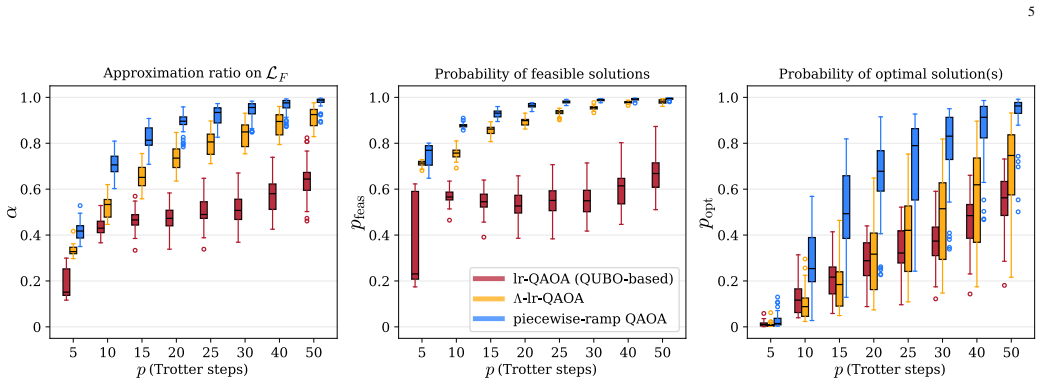
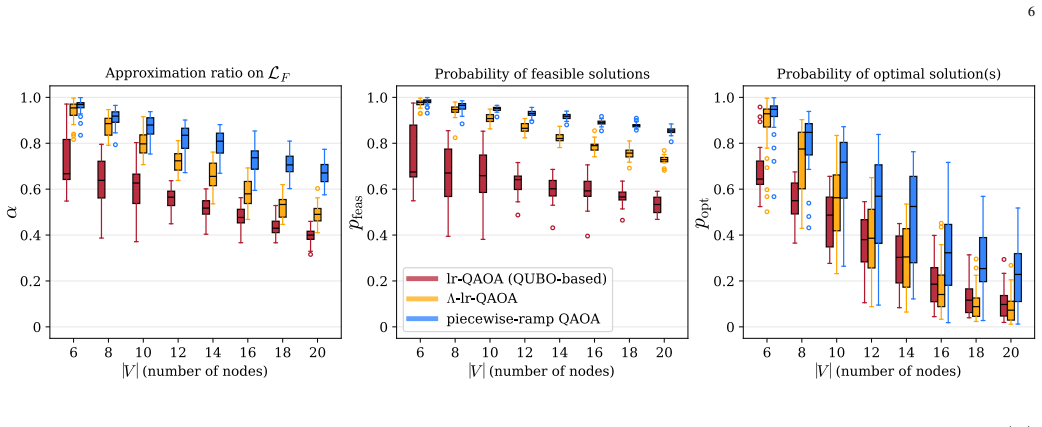
By promoting each constraint penalty to its own variational ramp schedule and replacing linear ramps with two-segment piecewise schedules, QAOA can be trained end-to-end with a feasibility-driven loss; the resulting states, when measured, yield feasible solutions whose objective values are higher than those obtained by standard linear-ramp QAOA or by the per-penalty linear variant, as demonstrated on satellite mission planning instances.
What carries the argument
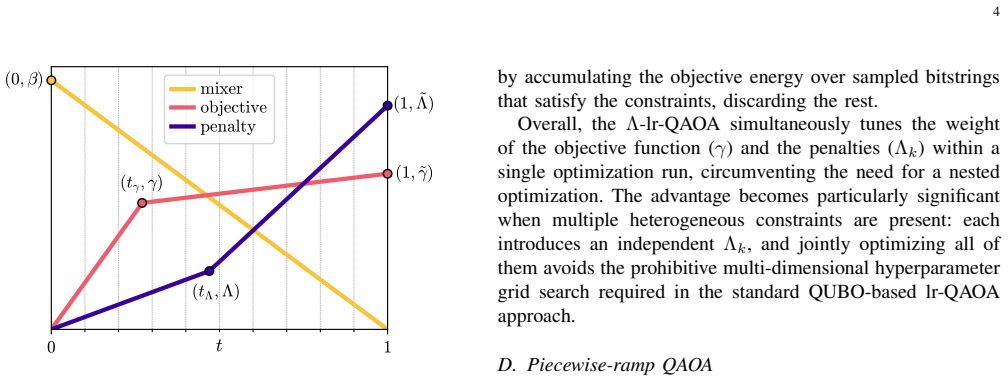
Per-constraint penalty ramp schedules promoted to variational parameters and optimized jointly under a feasibility-driven loss function.
If this is right
- Nested loops for tuning penalty coefficients are no longer required.
- The method scales to problems whose constraints have widely different magnitudes without manual rescaling.
- High feasibility rates appear automatically, which is essential for deployment in planning applications.
- A single filter hyperparameter in the loss lets the user move along the feasibility-optimality curve.
Where Pith is reading between the lines
- The same per-penalty schedule idea could be tried in other variational algorithms that currently rely on fixed penalties.
- Because the extra parameters are independent of depth, the approach may keep its advantage even when circuit depth is limited by hardware noise.
- The observed feasibility-optimality trade-off suggests that future work could replace the simple filter with a multi-objective optimizer.
Load-bearing premise
Joint optimization of the penalty schedules and QAOA parameters under the feasibility loss will produce states whose high-probability measurement outcomes are both feasible and high-quality rather than merely feasible but low-quality.
What would settle it
On the same Earth-observation satellite mission planning instances, if piecewise-ramp QAOA at a given depth does not return higher average objective value among feasible samples or a lower fraction of infeasible samples than lr-QAOA, the performance advantage claim is false.
Figures

read the original abstract
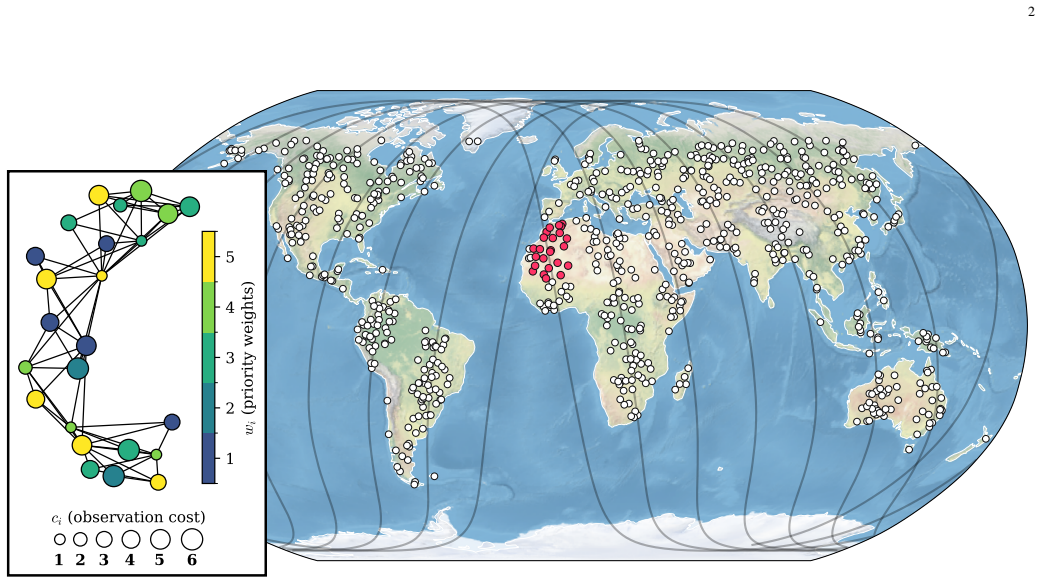
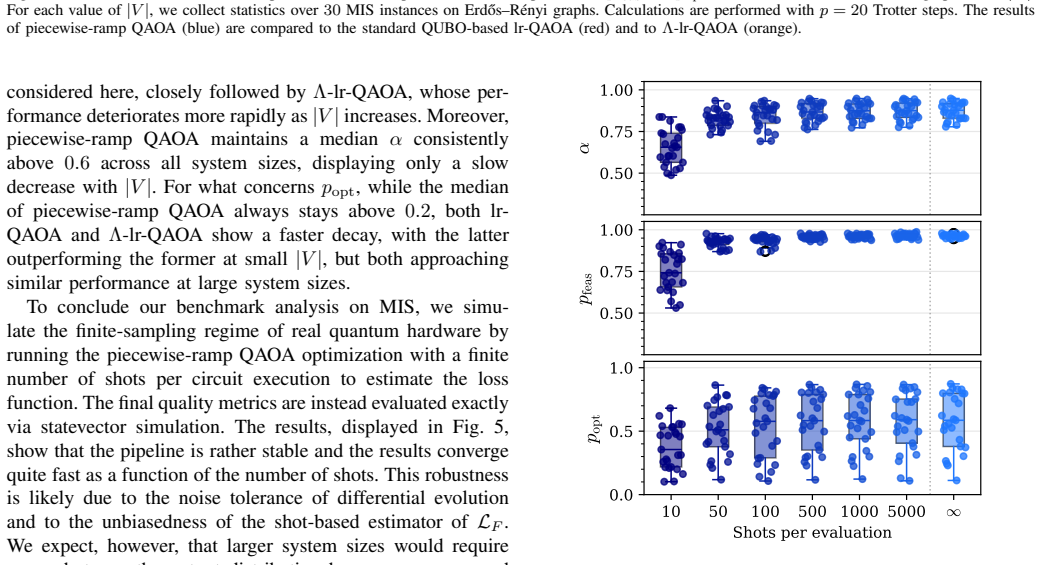
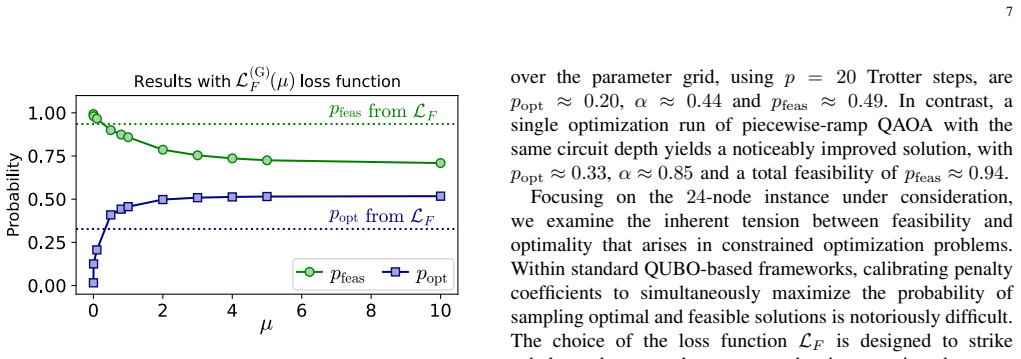
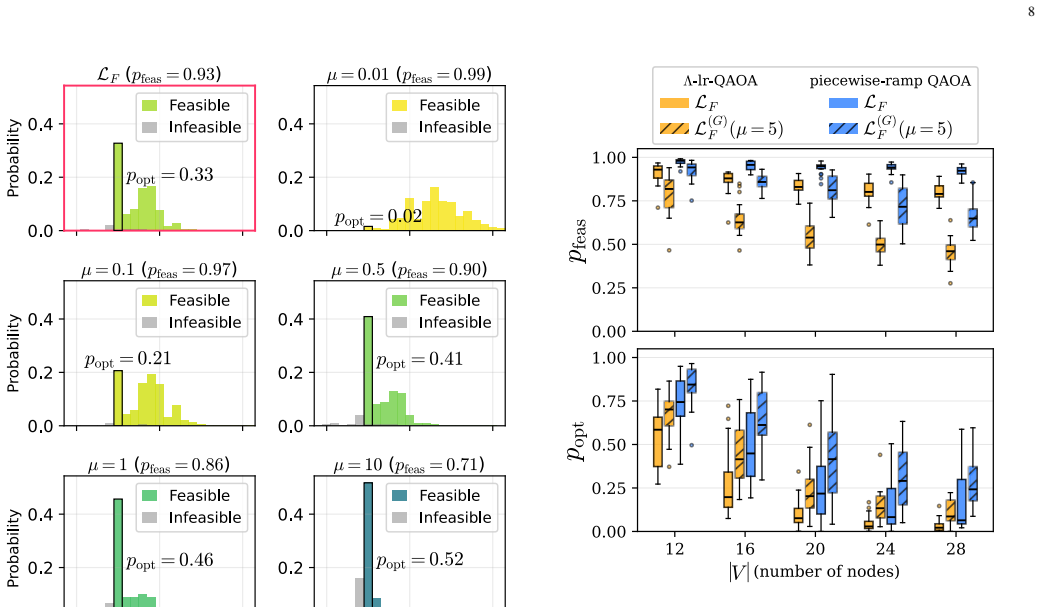
Most available quantum algorithms address constrained optimization problems by treating constraints as soft penalty terms within a QUBO formulation. This approach requires careful adjustment of the penalty coefficients, which scales poorly with the number of constraints and lacks a proper strategy to balance feasibility and solution quality. In this work, we introduce two extensions of standard linear-ramp QAOA (lr-QAOA) tailored to problems with multiple heterogeneous constraints. We first construct $\Lambda$-lr-QAOA, in which each penalty term is assigned its own linear-ramp schedule, promoting penalty weights from external hyperparameters to internal variational parameters of QAOA, similarly to the objective and mixer parameters. By optimizing all schedules jointly in a single run, this approach eliminates nested penalty tuning and scales more efficiently to multiple constraints. The optimization is guided by a feasibility-driven loss function that pushes the quantum state towards high-quality feasible solutions. As a further refinement, we introduce piecewise-ramp QAOA, in which the linear ramps are replaced by two-segment piecewise schedules, enhancing the expressiveness of the Ansatz at the cost of a small parameter overhead independent of the circuit depth. We benchmark both methods on Earth-observation satellite mission planning tasks formulated as budget-constrained Maximum Weight Independent Set problems. Numerical results show that piecewise-ramp QAOA consistently outperforms lr-QAOA and $\Lambda$-lr-QAOA across circuit depths and system sizes. Furthermore, both $\Lambda$-lr-QAOA and piecewise-ramp QAOA exhibit a high feasibility rate, which is crucial in industrial applications. Our analysis highlights an intrinsic feasibility-optimality trade-off, which we address by introducing a filtered variant of the loss providing a single hyperparameter to tune this balance.
Editorial analysis
A structured set of objections, weighed in public.
Referee Report
Summary. The manuscript proposes two extensions to linear-ramp QAOA (lr-QAOA) for constrained combinatorial optimization: Λ-lr-QAOA, which promotes per-constraint penalty schedules to variational parameters, and piecewise-ramp QAOA, which replaces linear ramps with two-segment piecewise-linear schedules. Both are optimized under a feasibility-driven loss that incorporates a feasibility indicator and an objective term; a filtered variant of the loss is introduced to tune the feasibility-optimality trade-off. The methods are benchmarked on budget-constrained Maximum Weight Independent Set instances arising from Earth-observation satellite mission planning, with the central claim that piecewise-ramp QAOA outperforms both lr-QAOA and Λ-lr-QAOA in solution quality while maintaining high feasibility rates across circuit depths and system sizes.
Significance. If the numerical claims are placed on a statistically firmer footing, the work would supply a concrete, scalable route to handling heterogeneous constraints inside QAOA without external penalty tuning. The internalisation of per-constraint ramps and the introduction of piecewise schedules increase ansatz expressivity at modest parameter cost, while the feasibility-driven loss and its filtered variant directly address a known practical difficulty. The choice of an industrially motivated benchmark set is a positive feature.
major comments (2)
- [Abstract and §4] Abstract and §4 (numerical results): the claim of consistent outperformance by piecewise-ramp QAOA is presented without error bars, without the number of random seeds or independent runs, and without any comparison to classical solvers or to other recent constrained-QAOA formulations. These omissions make the headline numerical result difficult to evaluate and constitute a load-bearing weakness for the central empirical claim.
- [§3] §3 (loss function and filtered variant): the feasibility-driven loss is asserted to produce states whose measurement statistics correspond to high-quality feasible solutions. However, the manuscript does not report an explicit check that the conditional expectation of the objective (given feasibility) exceeds the value obtained by uniform sampling over the feasible subspace. Because the loss contains a dominant feasibility indicator, gradient descent can increase feasible probability mass without regard to objective values inside that subspace; the filtered variant is introduced precisely to control this trade-off, yet no quantitative verification of its effect on conditional objective quality is supplied.
minor comments (2)
- [§2-3] Notation for the per-constraint ramp slopes and breakpoints should be introduced once in a single table or equation block rather than being redefined inline in multiple places.
- [Figures in §4] Figure captions for the performance plots should state the number of instances, system sizes, and circuit depths explicitly rather than referring the reader to the main text.
Simulated Author's Rebuttal
We thank the referee for the constructive comments that help strengthen the empirical foundation of the work. We address each major point below.
read point-by-point responses
-
Referee: [Abstract and §4] Abstract and §4 (numerical results): the claim of consistent outperformance by piecewise-ramp QAOA is presented without error bars, without the number of random seeds or independent runs, and without any comparison to classical solvers or to other recent constrained-QAOA formulations. These omissions make the headline numerical result difficult to evaluate and constitute a load-bearing weakness for the central empirical claim.
Authors: We agree that the presentation of numerical results requires error bars and explicit reporting of the number of random seeds and independent runs to allow proper evaluation. In the revised manuscript we will include these statistics, averaging over multiple independent optimization runs with error bars. Regarding comparisons to classical solvers or other constrained-QAOA formulations, the central contribution is the relative improvement of the proposed variants over the lr-QAOA baseline under identical conditions and the same feasibility-driven loss; broader benchmarking against classical methods or alternative QAOA approaches lies outside the scope of the present study and would require a separate, substantially expanded experimental section. revision: partial
-
Referee: [§3] §3 (loss function and filtered variant): the feasibility-driven loss is asserted to produce states whose measurement statistics correspond to high-quality feasible solutions. However, the manuscript does not report an explicit check that the conditional expectation of the objective (given feasibility) exceeds the value obtained by uniform sampling over the feasible subspace. Because the loss contains a dominant feasibility indicator, gradient descent can increase feasible probability mass without regard to objective values inside that subspace; the filtered variant is introduced precisely to control this trade-off, yet no quantitative verification of its effect on conditional objective quality is supplied.
Authors: We acknowledge that an explicit verification comparing the conditional expectation of the objective (conditioned on feasibility) to uniform sampling over the feasible subspace would strengthen the validation of the loss. In the revised manuscript we will add this quantitative check for both the standard and filtered variants of the feasibility-driven loss, demonstrating the effect of the filter hyperparameter on conditional objective quality. revision: yes
Circularity Check
No circularity; new penalty schedules and feasibility-driven loss explicitly constructed, performance from numerical simulation
full rationale
The paper defines Λ-lr-QAOA (per-constraint linear ramps promoted to variational parameters) and piecewise-ramp QAOA (two-segment schedules) as explicit extensions of lr-QAOA, together with a new feasibility-driven loss. These are presented as constructions rather than derivations that reduce to prior fits or self-citations. Benchmark claims rest on numerical results for MWIS instances, not on any equation that is forced by construction or by a load-bearing self-citation chain. No self-definitional, fitted-input-as-prediction, or ansatz-smuggled steps appear.
Axiom & Free-Parameter Ledger
free parameters (2)
- per-constraint ramp slopes and breakpoints
- feasibility weight in the loss
axioms (1)
- domain assumption The QUBO formulation with soft penalties correctly encodes the original constrained problem when penalties are large enough.
Reference graph
Works this paper leans on
-
[1]
Alumur, Claudia Archetti, Hayriye Ayhan, Maria Battarra, Julia A
Fotios Petropoulos, Gilbert Laporte, Emel Aktas, Sibel A. Alumur, Claudia Archetti, Hayriye Ayhan, Maria Battarra, Julia A. Bennell, Jean-Marie Bourjolly, John E. Boylan, Mich `ele Breton, David Canca, Laurent Charlin, Bo Chen, Cihan Tugrul Cicek, Louis Anthony Cox Jr, Christine S.M. Currie, Erik Demeulemeester, Li Ding, Stephen M. Disney, Matthias Ehrgot...
-
[2]
George L. Nemhauser and Laurence A. Wolsey.Inte- ger and combinatorial optimization. Wiley-Interscience, USA, 1988.doi:10.1002/9781118627372
-
[3]
Hillier and G.J
F.S. Hillier and G.J. Lieberman.Introduction to Op- erations Research. McGraw-Hill International Editions. McGraw-Hill, 2001. URL: https://books.google.it/books? id=SrfgAAAAMAAJ
2001
-
[4]
Woeginger.Exact Algorithms for NP-Hard Problems: A Survey, pages 185–207
Gerhard J. Woeginger.Exact Algorithms for NP-Hard Problems: A Survey, pages 185–207. Springer Berlin Heidelberg, Berlin, Heidelberg, 2003.doi:10.1007/ 3-540-36478-1_17
2003
-
[5]
Dorit S. Hochba. Approximation algorithms for np-hard problems.SIGACT News, 28(2):40–52, June 1997.doi: 10.1145/261342.571216
-
[6]
Kochenderfer and Tim A
Mykel J. Kochenderfer and Tim A. Wheeler.Algo- rithms for Optimization. MIT Press, Cambridge, MA,
-
[7]
URL: https://mitpress.mit.edu/9780262039420/ algorithms-for-optimization/. 10
-
[8]
Challenges and opportunities in quantum optimization.Nature Reviews Physics, 6(12):718–735, 2024
Amira Abbas, Andris Ambainis, Brandon Augustino, An- dreas B ¨artschi, Harry Buhrman, Carleton Coffrin, Gior- gio Cortiana, Vedran Dunjko, Daniel J. Egger, Bruce G. Elmegreen, Nicola Franco, Filippo Fratini, Bryce Fuller, Julien Gacon, Constantin Gonciulea, Sander Gribling, Swati Gupta, Stuart Hadfield, Raoul Heese, Gerhard Kircher, Thomas Kleinert, Thors...
-
[9]
Egger, Heike Riel, Stefan Woerner, and Christa Zoufal.Quantum Optimization, pages 57–64
Daniel J. Egger, Heike Riel, Stefan Woerner, and Christa Zoufal.Quantum Optimization, pages 57–64. Springer Nature Switzerland, Cham, 2026.doi:10.1007/ 978-3-031-90727-2_6
2026
-
[10]
Rieffel, Davide Venturelli, and Rupak Biswas
Stuart Hadfield, Zhihui Wang, Bryan O’Gorman, Eleanor G. Rieffel, Davide Venturelli, and Rupak Biswas. From the quantum approximate optimization algorithm to a quantum alternating operator ansatz.Algorithms, 12(2),
-
[11]
URL: https://www.mdpi.com/1999-4893/12/2/34, doi:10.3390/a12020034
-
[12]
Andreas B ¨artschi and Stephan Eidenbenz. Grover mixers for qaoa: Shifting complexity from mixer design to state preparation. In2020 IEEE International Conference on Quantum Computing and Engineering (QCE), pages 72– 82, 2020.doi:10.1109/QCE49297.2020.00020
-
[14]
Cavity electro-optic circuit for microwave-to-optical conversion in the quantum ground state
Ningyi Xie, Jiahua Xu, Tiejin Chen, Xinwei Lee, Yoshiyuki Saito, Nobuyoshi Asai, and Dongsheng Cai. Performance upper bound of a grover-mixer quantum alternating operator ansatz.Phys. Rev. A, 111:012401, Jan 2025. URL: https://link.aps.org/doi/10.1103/ PhysRevA.111.012401,doi:10.1103/PhysRevA. 111.012401
-
[15]
Constraint-preserving quantum algorithm for the multi- frequency antenna placement problem, 2025
Matteo Vandelli, Francesco Ferrari, and Daniele Dragoni. Constraint-preserving quantum algorithm for the multi- frequency antenna placement problem, 2025. URL: https: //arxiv.org/abs/2511.15566,arXiv:2511.15566
arXiv 2025
-
[16]
David Bucher, Daniel Porawski, Maximilian Janetschek, Jonas Stein, Corey O’Meara, Giorgio Cortiana, and Clau- dia Linnhoff-Popien. Efficient qaoa architecture for solv- ing multi-constrained optimization problems. In2025 IEEE International Conference on Quantum Computing and Engineering (QCE), volume 01, pages 356–367, 2025.doi:10.1109/QCE65121.2025.00048
-
[17]
Empirical quantum advantage in constrained optimiza- tion from encoded unitary designs, 2026
Chinonso Onah, Roman Firt, and Kristel Michielsen. Empirical quantum advantage in constrained optimiza- tion from encoded unitary designs, 2026. URL: https: //arxiv.org/abs/2511.14296,arXiv:2511.14296
arXiv 2026
-
[18]
Constrained quantum optimization via iterative warm-start xy-mixers, 2026
David Bucher, Maximilian Janetschek, Michael Poppel, Jonas Stein, Claudia Linnhoff-Popien, and Sebastian Feld. Constrained quantum optimization via iterative warm-start xy-mixers, 2026. URL: https://arxiv.org/abs/ 2604.02083,arXiv:2604.02083
arXiv 2026
-
[19]
The unconstrained binary quadratic programming prob- lem: a survey.Journal of Combinatorial Opti- mization, 28(1):58–81, Jul 2014.doi:10.1007/ s10878-014-9734-0
Gary Kochenberger, Jin-Kao Hao, Fred Glover, Mark Lewis, Zhipeng L ¨u, Haibo Wang, and Yang Wang. The unconstrained binary quadratic programming prob- lem: a survey.Journal of Combinatorial Opti- mization, 28(1):58–81, Jul 2014.doi:10.1007/ s10878-014-9734-0
2014
-
[20]
(2014) Ising formulations of many NP problems
Andrew Lucas. Ising formulations of many np problems.Frontiers in Physics, V olume 2 - 2014, 2014. URL: https://www.frontiersin.org/ journals/physics/articles/10.3389/fphy.2014.00005, doi:10.3389/fphy.2014.00005
-
[21]
A tu- torial on formulating and using qubo models, 2019
Fred Glover, Gary Kochenberger, and Yu Du. A tu- torial on formulating and using qubo models, 2019. URL: https://arxiv.org/abs/1811.11538,arXiv:1811. 11538
arXiv 2019
-
[22]
Alleviat- ing the quantum big-m problem.npj Quantum In- formation, 11(1):125, Jul 2025.doi:10.1038/ s41534-025-01067-0
Edoardo Alessandroni, Sergi Ramos-Calderer, Ingo Roth, Emiliano Traversi, and Leandro Aolita. Alleviat- ing the quantum big-m problem.npj Quantum In- formation, 11(1):125, Jul 2025.doi:10.1038/ s41534-025-01067-0
2025
-
[23]
A quantum approximate optimization algorithm, 2014
Edward Farhi, Jeffrey Goldstone, and Sam Gutmann. A quantum approximate optimization algorithm, 2014. URL: https://arxiv.org/abs/1411.4028,arXiv:1411. 4028
Pith/arXiv arXiv 2014
-
[24]
A review on Quantum Approximate Optimization Algorithm and its variants , volume=
Kostas Blekos, Dean Brand, Andrea Ceschini, Chiao-Hui Chou, Rui-Hao Li, Komal Pandya, and Alessandro Summer. A review on quantum approximate optimization algorithm and its variants. Physics Reports, 1068:1–66, 2024. A review on Quantum Approximate Optimization Algorithm and its variants. URL: https://www.sciencedirect. com/science/article/pii/S03701573240...
-
[25]
Lennart Bittel and Martin Kliesch. Training vari- ational quantum algorithms is np-hard.Phys. Rev. Lett., 127:120502, Sep 2021. URL: https://link.aps.org/ doi/10.1103/PhysRevLett.127.120502,doi:10.1103/ PhysRevLett.127.120502
-
[26]
Multi- start methods for quantum approximate optimization
Ruslan Shaydulin, Ilya Safro, and Jeffrey Larson. Multi- start methods for quantum approximate optimization. In 2019 IEEE High Performance Extreme Computing Con- ference (HPEC), page 1–8. IEEE, 2019. URL: http://dx. doi.org/10.1109/HPEC.2019.8916288,doi:10.1109/ hpec.2019.8916288
-
[27]
Leo Zhou, Sheng-Tao Wang, Soonwon Choi, Hannes Pichler, and Mikhail D. Lukin. Quantum approximate optimization algorithm: Performance, mechanism, and implementation on near-term devices.Phys. Rev. X, 10:021067, Jun 2020. URL: https://link.aps.org/doi/10.1103/PhysRevX.10.021067, doi:10.1103/PhysRevX.10.021067
-
[28]
Martin Larocca, Piotr Czarnik, Kunal Sharma, Gopikr- 11 ishnan Muraleedharan, Patrick J. Coles, and M. Cerezo. Diagnosing Barren Plateaus with Tools from Quantum Optimal Control.Quantum, 6:824, September 2022. doi:10.22331/q-2022-09-29-824
-
[29]
Matteo Vandelli, Alessandra Lignarolo, Carlo Cavaz- zoni, and Daniele Dragoni. Evaluating the practi- cality of quantum optimization algorithms for proto- typical industrial applications.Quantum Information Processing, 23(10):344, Oct 2024.doi:10.1007/ s11128-024-04560-1
2024
-
[30]
Deep-Circuit QAOA.Quantum, 9:1882, October 2025.doi:10
Gereon Koßmann, Lennart Binkowski, Lauritz van Luijk, Timo Ziegler, and Ren ´e Schwonnek. Deep-Circuit QAOA.Quantum, 9:1882, October 2025.doi:10. 22331/q-2025-10-13-1882
2025
-
[31]
Fernando G. S. L. Brandao, Michael Broughton, Edward Farhi, Sam Gutmann, and Hartmut Neven. For fixed control parameters the quantum approximate optimiza- tion algorithm’s objective function value concentrates for typical instances, 2018. URL: https://arxiv.org/abs/1812. 04170,arXiv:1812.04170
Pith/arXiv arXiv 2018
-
[32]
Dennis Willsch, Madita Willsch, Fengping Jin, Kris- tel Michielsen, and Hans De Raedt. Gpu-accelerated simulations of quantum annealing and the quan- tum approximate optimization algorithm.Com- puter Physics Communications, 278:108411, 2022. URL: https://www.sciencedirect.com/science/article/pii/ S0010465522001308,doi:10.1016/j.cpc.2022. 108411
-
[33]
Nancy Barraza, Gabriel Alvarado Barrios, Jie Peng, Lucas Lamata, Enrique Solano, and Francisco Albarr ´an- Arriagada. Analog quantum approximate optimization al- gorithm.Quantum Science and Technology, 7(4):045035, sep 2022.doi:10.1088/2058-9565/ac91f0
-
[34]
Parameter Setting in Quan- tum Approximate Optimization of Weighted Problems
Shree Hari Sureshbabu, Dylan Herman, Ruslan Shay- dulin, Joao Basso, Shouvanik Chakrabarti, Yue Sun, and Marco Pistoia. Parameter Setting in Quan- tum Approximate Optimization of Weighted Problems. Quantum, 8:1231, January 2024.doi:10.22331/ q-2024-01-18-1231
2024
-
[35]
J. A. Monta ˜nez-Barrera, Dennis Willsch, and Kristel Michielsen. Transfer learning of optimal qaoa parameters in combinatorial optimization.Quantum Information Processing, 24(5):129, May 2025.doi:10.1007/ s11128-025-04743-4
2025
-
[36]
Quantum approximate optimization algorithm with fixed number of parameters, 2025
Sebasti ´an Saavedra-Pino, Ricardo Quispe-Mendiz ´abal, Gabriel Alvarado Barrios, Enrique Solano, Juan Carlos Retamal, and Francisco Albarr ´an-Arriagada. Quantum approximate optimization algorithm with fixed number of parameters, 2025. URL: https://arxiv.org/abs/2512. 21181,arXiv:2512.21181
arXiv 2025
-
[37]
Transferring linearly fixed qaoa angles: performance and real device results, 2025
Ryo Sakai, Hiromichi Matsuyama, Wai-Hong Tam, and Yu Yamashiro. Transferring linearly fixed qaoa angles: performance and real device results, 2025. URL: https: //arxiv.org/abs/2504.12632,arXiv:2504.12632
arXiv 2025
-
[38]
Zichang He, Anuj Apte, Brandon Augustino, Arman Babakhani, Abid Khan, Sivaprasad Omanakuttan, and Ruslan Shaydulin. Regularized warm-started quantum approximate optimization and conditions for surpass- ing classical solvers on the max-cut problem, 2026. URL: https://arxiv.org/abs/2603.10191,arXiv:2603. 10191
arXiv 2026
-
[39]
A spectral gap informed parameter schedule for qaoa, 2026
Kieran McDowall, Konstantinos Georgopoulos, and Pet- ros Wallden. A spectral gap informed parameter schedule for qaoa, 2026. URL: https://arxiv.org/abs/2604.24580, arXiv:2604.24580
Pith/arXiv arXiv 2026
-
[40]
Haupt, Alberto Baiardi, Dimitrios Athanasakos, M
Maosheng Guo, Joel Jurado Diaz, Anurag Ramesh, Con- rad J. Haupt, Alberto Baiardi, Dimitrios Athanasakos, M. Emre Sahin, Oscar Wallis, George Pennington, Chris- tian Arenz, Sebastian Brandhofer, Georgios Korpas, Ieva ˇCepait˙e, J. A. Monta ˜nez-Barrera, Jakub Marecek, Davide Venturelli, Stephan Eidenbenz, David E. Bernal Neira, and Daniel J. Egger. Settin...
Pith/arXiv arXiv 2026
-
[41]
Quantum annealing: a journey through digitaliza- tion, control, and hybrid quantum variational schemes,
Glen Bigan Mbeng, Rosario Fazio, and Giuseppe San- toro. Quantum annealing: a journey through digitaliza- tion, control, and hybrid quantum variational schemes,
-
[42]
URL: https://arxiv.org/abs/1906.08948,arXiv: 1906.08948
arXiv 1906
-
[43]
Ruslan Shaydulin, Stuart Hadfield, Tad Hogg, and Ilya Safro. Classical symmetries and the quantum approx- imate optimization algorithm.Quantum Information Processing, 20(11), October 2021. URL: http://dx. doi.org/10.1007/s11128-021-03298-4,doi:10.1007/ s11128-021-03298-4
-
[44]
Vladimir Kremenetski, Tad Hogg, Stuart Hadfield, Stephen J. Cotton, and Norm M. Tubman. Quantum alternating operator ansatz (qaoa) phase diagrams and applications for quantum chemistry, 2021. URL: https: //arxiv.org/abs/2108.13056,arXiv:2108.13056
arXiv 2021
-
[45]
Sack and Maksym Serbyn
Stefan H. Sack and Maksym Serbyn. Quantum annealing initialization of the quantum approximate optimization algorithm.Quantum, 5:491, July 2021.doi:10. 22331/q-2021-07-01-491
2021
-
[46]
Vladimir Kremenetski, Anuj Apte, Tad Hogg, Stuart Hadfield, and Norm M. Tubman. Quantum alternating operator ansatz (qaoa) beyond low depth with gradually changing unitaries, 2023. URL: https://arxiv.org/abs/ 2305.04455,arXiv:2305.04455
arXiv 2023
-
[47]
Zichang He, Ruslan Shaydulin, Dylan Herman, Chang- hao Li, Rudy Raymond, Shree Hari Sureshbabu, and Marco Pistoia. Parameter setting heuristics make the quantum approximate optimization algorithm suitable for the early fault-tolerant era. InProceedings of the 43rd IEEE/ACM International Conference on Computer-Aided Design, ICCAD ’24, New York, NY , USA, 2...
arXiv 2025
-
[48]
Vanessa Dehn, Martin Zaefferer, Gerhard Hellstern, Karthik Jayadevan, Florentin Reiter, and Thomas Wellens. Extrapolation method to optimize linear-ramp quantum approximate optimization algorithm parame- ters: Evaluation of runtime scaling.Phys. Rev. A, 113:032413, Mar 2026. URL: https://link.aps.org/doi/10. 1103/l5r4-zcqv,doi:10.1103/l5r4-zcqv
-
[49]
J. A. Monta ˜nez-Barrera and Kristel Michielsen. To- 12 ward a linear-ramp qaoa protocol: evidence of a scaling advantage in solving some combinatorial optimization problems.npj Quantum Information, 11(1):131, Aug 2025.doi:10.1038/s41534-025-01082-1
-
[50]
Springer Inter- national Publishing, Cham, 2019.doi:10.1007/ 978-3-030-10501-3_11
Snezana Mitrovic-Minic, Darren Thomson, Jean Berger, and Jeff Secker.Collection Planning and Schedul- ing for Multiple Heterogeneous Satellite Missions: Sur- vey, Optimization Problem, and Mathematical Program- ming Formulation, pages 271–305. Springer Inter- national Publishing, Cham, 2019.doi:10.1007/ 978-3-030-10501-3_11
2019
-
[51]
Xiaoyu Chen, Gerhard Reinelt, Guangming Dai, and Andreas Spitz. A mixed integer linear programming model for multi-satellite scheduling.European Journal of Operational Research, 275(2):694– 707, 2019. URL: https://www.sciencedirect. com/science/article/pii/S0377221718309998, doi:10.1016/j.ejor.2018.11.058
-
[52]
Agile earth observation satellite schedul- ing over 20 years: Formulations, methods, and future directions.IEEE Systems Journal, 15(3):3881–3892,
Xinwei Wang, Guohua Wu, Lining Xing, and Witold Pedrycz. Agile earth observation satellite schedul- ing over 20 years: Formulations, methods, and future directions.IEEE Systems Journal, 15(3):3881–3892,
-
[53]
2997050,doi:10.1109/jsyst.2020.2997050
URL: http://dx.doi.org/10.1109/JSYST.2020. 2997050,doi:10.1109/jsyst.2020.2997050
-
[54]
Xiutian Li, Yingwu Chen, Lining Xing, Yingguo Chen, Yonghao Du, and Lei He. A review of the frameworks, models, and algorithms for large-scale imaging satellite mission planning.Expert Syst. Appl., 292(C), November 2025.doi:10.1016/j.eswa.2025.128471
-
[55]
Virginie Gabrel and C ´ecile Murat.Mathematical Pro- gramming for Earth Observation Satellite Mission Plan- ning, pages 103–122. Springer US, Boston, MA, 2003. doi:10.1007/978-1-4757-3752-3_7
-
[56]
Duncan Eddy and Mykel J. Kochenderfer. A maximum independent set method for scheduling earth-observing satellite constellations.Journal of Spacecraft and Rockets, 58(5):1416–1429, 2021.arXiv: https://doi.org/10.2514/1.A34931, doi:10.2514/1.A34931
-
[57]
Tobias Stollenwerk, Vincent Michaud, Elisabeth Lobe, Mathieu Picard, Achim Basermann, and Thierry Bot- ter. Agile earth observation satellite scheduling with a quantum annealer.IEEE Transactions on Aerospace and Electronic Systems, 57(5):3520–3528, 2021.doi: 10.1109/TAES.2021.3088490
-
[58]
Nils Quetschlich, Vincent Koch, Lukas Burgholzer, and Robert Wille. A hybrid classical quantum computing ap- proach to the satellite mission planning problem. In2023 IEEE International Conference on Quantum Computing and Engineering (QCE), volume 01, pages 642–647, 2023.doi:10.1109/QCE57702.2023.00079
-
[59]
Taddei, Eneko Osaba, Paloma del Barrio Cabello, Esther Villar-Rodriguez, and Izaskun Oregi
Ant ´on Makarov, Carlos P ´erez-Herrad´on, Giacomo Franceschetto, M ´arcio M. Taddei, Eneko Osaba, Paloma del Barrio Cabello, Esther Villar-Rodriguez, and Izaskun Oregi. Quantum optimization methods for satellite mis- sion planning.IEEE Access, 12:71808–71820, 2024. doi:10.1109/ACCESS.2024.3402990
-
[60]
One for all: Toward unified foundation models for earth vision
Amer Delilbasic, Bertrand Le Saux, Morris Riedel, Kris- tel Michielsen, and Gabriele Cavallaro. Reverse quantum annealing for hybrid quantum-classical satellite mission planning. InIGARSS 2024 - 2024 IEEE International Geoscience and Remote Sensing Symposium, pages 432– 436, 2024.doi:10.1109/IGARSS53475.2024. 10640974
-
[61]
Towards large-scale satellite ac- quisition scheduling with hybrid quantum-classical op- timization
Amer Delilbasic, Morris Riedel, Kristel Michielsen, and Gabriele Cavallaro. Towards large-scale satellite ac- quisition scheduling with hybrid quantum-classical op- timization. In Fr ´ed´eric Barbaresco and Franc ¸ois Gerin, editors,Quantum Engineering Sciences and Technologies for Industry and Services, pages 56–64, Cham, 2026. Springer Nature Switzerland
2026
-
[62]
Rebecca Casati and Enrico Prati. Exploiting adiabatic quantum computing in deep space missions.Journal of Physics: Conference Series, 3017(1):012042, jun 2025. doi:10.1088/1742-6596/3017/1/012042
-
[63]
Vinicius Marchioli, Mattia Boggio, Deborah V olpe, Luca Massotti, and Carlo Novara. Quantum optimization for closed-loop scheduling of earth observation satellite formation.SN Computer Science, 6(6):739, Aug 2025. doi:10.1007/s42979-025-04252-2
-
[64]
Marco Baioletti, Fabrizio Fagiolo, Angelo Oddi, and Riccardo Rasconi. Applying quantum approximate optimization algorithm to the oversubscribed satellite scheduling problem.Journal of Aerospace Informa- tion Systems, 23(5):382–392, 2026.arXiv:https:// doi.org/10.2514/1.I011645,doi:10.2514/ 1.I011645
-
[65]
Serge Rainjonneau, Igor Tokarev, Sergei Iudin, Saaketh Rayaprolu, Karan Pinto, Daria Lemtiuzhnikova, Mi- ras Koblan, Egor Barashov, Mo Kordzanganeh, Markus Pflitsch, and Alexey Melnikov. Quantum algorithms applied to satellite mission planning for earth observa- tion.IEEE Journal of Selected Topics in Applied Earth Observations and Remote Sensing, 16:7062...
-
[66]
M. R. Garey and David S. Johnson.Computers and In- tractability: A Guide to the Theory of NP-Completeness. W. H. Freeman, 1979
1979
-
[67]
Andrea Bettinelli, Valentina Cacchiani, and Enrico Malaguti. A branch-and-bound algorithm for the knap- sack problem with conflict graph.INFORMS Journal on Computing, 29(3):457–473, 2017.doi:10.1287/ ijoc.2016.0742
arXiv 2017
-
[68]
J A Monta ˜nez-Barrera, Dennis Willsch, A Maldonado- Romo, and Kristel Michielsen. Unbalanced penalization: a new approach to encode inequality constraints of combinatorial problems for quantum optimization algo- rithms.Quantum Science and Technology, 9(2):025022, apr 2024.doi:10.1088/2058-9565/ad35e4
-
[69]
Edoardo Alessandroni, Sergi Ramos-Calderer, Michel Krispin, Fritz Schinkel, Stefan Walter, Martin Kliesch, Leandro Aolita, and Ingo Roth. Scalable determination of penalization weights for constrained optimizations on approximate solvers, 2026. URL: https://arxiv.org/abs/ 2604.02416,arXiv:2604.02416
Pith/arXiv arXiv 2026
-
[70]
Rainer Storn and Kenneth Price. Differential evolution 13 – a simple and efficient heuristic for global optimization over continuous spaces.Journal of Global Optimiza- tion, 11(4):341–359, Dec 1997.doi:10.1023/A: 1008202821328
work page doi:10.1023/a: 1997
-
[71]
A Limited Memory Algorithm for Bound Constrained Optimization
Richard H. Byrd, Peihuang Lu, Jorge Nocedal, and Ciyou Zhu. A limited memory algorithm for bound constrained optimization.SIAM Journal on Scientific Computing, 16(5):1190–1208, 1995.doi:10.1137/0916069
-
[72]
Qiskit: An open-source frame- work for quantum computing, 2023.doi:10.5281/ zenodo.2573505
Qiskit contributors. Qiskit: An open-source frame- work for quantum computing, 2023.doi:10.5281/ zenodo.2573505
2023
-
[73]
European Space Agency. IRIDE. URL: https://www.esa. int/Applications/Observing the Earth/IRIDE
-
[74]
Skyfield: High precision research- grade positions for planets and Earth satellites generator
Brandon Rhodes. Skyfield: High precision research- grade positions for planets and Earth satellites generator. Astrophysics Source Code Library, record ascl:1907.024, July 2019.arXiv:1907.024
1907
-
[75]
URLhttps://doi.org/10.1088/2058-9565/ aad3e4
David Amaro, Carlo Modica, Matthias Rosenkranz, Mat- tia Fiorentini, Marcello Benedetti, and Michael Lubasch. Filtering variational quantum algorithms for combina- torial optimization.Quantum Science and Technology, 7(1):015021, feb 2022.doi:10.1088/2058-9565/ ac3e54
-
[76]
Quantum optimization with a novel gibbs objective function and ansatz architecture search.Phys
Li Li, Minjie Fan, Marc Coram, Patrick Riley, and Stefan Leichenauer. Quantum optimization with a novel gibbs objective function and ansatz architecture search.Phys. Rev. Res., 2:023074, Apr 2020. URL: https://link.aps. org/doi/10.1103/PhysRevResearch.2.023074,doi:10. 1103/PhysRevResearch.2.023074
-
[77]
(11) was not restricted to the feasible subspaceF, the limitµ→0 would yield P σ Eobj(σ)|⟨σ|ψ⟩| 2, i.e
We note that if the sum over bitstrings in Eq. (11) was not restricted to the feasible subspaceF, the limitµ→0 would yield P σ Eobj(σ)|⟨σ|ψ⟩| 2, i.e. the expectation value of the objective Hamiltonian. This is the analogous ofL F with an unrestricted sum over all bitstrings. Here, however,L (G) F (µ)≈ L F /pfeas −µ −1 log(pfeas)for µ→0. So the filtered lo...
discussion (0)
Sign in with ORCID, Apple, or X to comment. Anyone can read and Pith papers without signing in.