REVIEW 4 major objections 5 minor 1 cited by
GraphAvatar: Compact Head Avatars with GNN-Generated 3D Gaussians
T0 review · 4 major / 5 minor · reviewed 2026-08-11 · deepseek-v4-flash
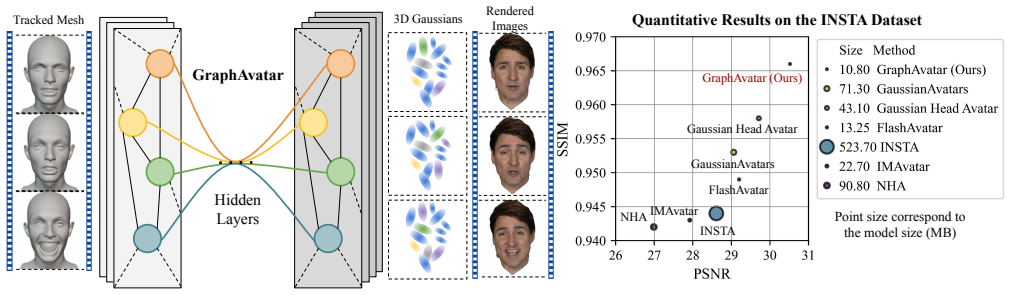
Pith's one-line read GNN-generated Gaussians replace stored scene data, cutting head-avatar storage to about 10MB while matching or exceeding the fidelity of larger Gaussian avatars.
desk verdict A solid empirical step toward compact head avatars—the GNN-generated Gaussian idea is genuinely new and the numbers are good—but the warm-up stage is under-specified and the whole method leans on it, so treat the quantitative claims as provisional until that's clarified. read the letter →
The pith
A machine-rendered reading of the paper's core claim, the machinery that carries it, and where it could break.
The reading
What carries the argument
The central object is the pair of Graph Unets — geometric and appearance — that map the 5023 vertices of the tracked FLAME mesh to Gaussian attributes. The mechanism is the Chebyshev graph convolution defined via the mesh Laplacian and adjacency matrix, which lets the network aggregate local facial topology; combined with a mesh sampling/upsampling bottleneck and expression-code conditioning, the learned weights act as a compact generative model of the per-vertex Gaussian parameters, with anchor-based neural Gaussians (after Scaffold-GS) covering parts of the head not present in the FLAME template.
What would settle it
Train GraphAvatar on a subject where the static-scene 3DGS fit is clearly unrepresentative (for example, a subject whose expression in the first frames differs strongly from the rest of the sequence, or with occluding hair that the static fit cannot reconstruct) and measure end-of-training PSNR; if quality remains high without the warm-up stage or with a deliberately bad static fit, the claimed centrality of the warm-up is contradicted. Alternatively, re-run the ablation replacing pseudo-Gaussians with randomly initialized Gaussians and check whether the training collapses, as the paper's own 'w/o Warm-up' row predicts.
Extended reading notes
Core claim
On its own terms, the paper's central claim is that the mapping from a tracked head mesh to the full set of Gaussian attributes — position offsets, rotation, scale, opacity, and color — is learnable by a pair of Chebyshev graph-convolution Unets, one for geometry and one for appearance, operating on vertex positions and normals with the mesh adjacency matrix. Around each generated anchor Gaussian the method attaches k view-dependent neural Gaussians whose attributes are decoded by MLPs conditioned on anchor features, view direction, and expression coefficients, borrowing the anchor idea from Scaffold-GS. The avatar is then stored as these networks rather than as Gaussians, and the paper shows quantitatively that this representation can exceed the rendering quality of direct-Gaussian baselines while using roughly a quarter of the smallest competing model size.
Load-bearing premise
The load-bearing premise is that the target actor can first be treated as a static scene and fitted with vanilla 3D Gaussian Splatting, and that the resulting pseudo-Gaussians are a good enough initialization target that the graph networks can learn from; the paper's ablation shows that removing this warm-up stage collapses the PSNR to 8.97, so if that static fit is not representative of the dynamic head, the whole pipeline degrades.
Editorial extensions
If this is right
- A head avatar becomes a downloadable ~10MB artifact rather than a large Gaussian store, which is a concrete enabler for real-time avatar apps on phones, VR headsets, and other memory-constrained devices.
- Because the networks generate Gaussians from tracked mesh vertices, novel expressions and poses can be produced by changing the input coefficients, giving the avatar the same retargeting controls as the underlying FLAME model.
- The warm-up stage is load-bearing: without the static-scene 3DGS fit used to initialize the graph networks, the paper's ablation reports the PSNR falling to 8.97, so the method's practical recipe includes that initialization as a required ingredient.
- The graph-guided optimization module implies the method can tolerate imperfect FLAME tracking, since it refines expression coefficients and camera pose during training rather than trusting the tracker blindly.
- The 3D-aware enhancer shows that a depth-modulated post-processor can recover high-frequency detail lost to graph-convolution smoothing, which the paper verifies through improved SSIM and LPIPS.
Reading between the lines
- The same 'store the generator, not the field' recipe could extend beyond FLAME heads to any mesh-tracked subject (hands, bodies, animals), provided a template mesh and tracking exist; the paper only demonstrates heads, but nothing in the architecture is head-specific.
- A natural next test is cross-subject generalization: the paper trains one GNN pair per actor, but if the GNN weights were shared across identities with identity codes, the approach might yield a single universal avatar model that is even more compact per user; that extension is untested here.
- The reported 10MB model depends on the fixed 5023-vertex FLAME topology; higher-resolution meshes would increase the cost, so the storage advantage relative to stored Gaussians could shrink for very detailed geometry, a trade-off the paper does not quantify.
- The warm-up's reliance on a static-scene 3DGS fit suggests a falsifiable boundary condition: actors with hair or accessories that are not represented in the FLAME template may require the scaffolded initialization to come from a pose close to the training video's typical view, which the paper does not vary systematically.
Editorial analysis
A structured set of objections, weighed in public.
Referee Report
Summary. GraphAvatar proposes to replace directly stored 3D Gaussians in head-avatar rendering with two Graph Unets that generate Gaussian attributes from FLAME-tracked meshes. Anchor Gaussians are produced on the 5023 mesh vertices, view-dependent neural Gaussians are spawned per anchor via MLPs, a graph-guided optimization module refines tracked expression and camera parameters during training, and a 3D-aware enhancer post-processes the coarse render using depth modulation. Experiments on INSTA and NeRFBlendShape report consistently higher PSNR/SSIM and lower LPIPS than NeRF- and 3DGS-based baselines, with a model size of 10.8 MB, and a component-wise ablation studies each proposed module.
Significance. If the reported results are reproducible, the paper addresses a real limitation of Gaussian-splatting head avatars: storage overhead that grows with densification and is tied to the mesh or UV representation. Storing compact GNNs instead of per-frame or per-Gaussian parameters is a sensible and practically motivated direction, and the reported gains are consistent across two datasets and several baselines. The authors also provide a component-wise ablation that isolates the contribution of the warm-up, neural Gaussians, graph-guided optimization, and the enhancer. However, the absence of released code, the lack of error bars, and the critical dependence on an underspecified warm-up stage currently prevent full verification of the central claim.
major comments (4)
- [Training] The warm-up stage is critically underspecified and is load-bearing for the method. The text states that the target actor is treated as a static scene and vanilla 3DGS produces pseudo Gaussians, with an MSE loss between Ganc and those pseudo Gaussians, but it does not specify which frame or frames are used, how a dynamic monocular sequence is converted into a static scene, how the unstructured pseudo-Gaussian set is matched to the 5023 anchor Gaussians on the FLAME mesh, or which Gaussian attributes (position, rotation, scale, opacity, color) enter the MSE. Table 2 shows that removing the warm-up collapses PSNR from 30.52 to 8.97, so the entire result rests on this unreported initialization procedure. Please provide the full warm-up protocol, including the pseudo-Gaussian construction, the correspondence mechanism, loss weights, and the exact number of warm-up iterations.
- [Experiments] The quantitative comparison in Table 1 lacks error bars and per-subject statistics, despite the fact that all 3DGS-based baselines were retracked with metrical-tracker. The reported margins (30.52 vs. 29.71 PSNR on INSTA; 27.32 vs. 26.38 on NBS) are small enough that they may be within subject-level or tracking-induced variance. Please report standard deviations or per-subject breakdowns, and clarify whether the baselines were run with their original tracking parameters where available; otherwise the claim of state-of-the-art quality is not yet fully supported.
- [Graph-guided Optimization] The graph-guided optimization module is ambiguous in its test-time behavior. Equation (9) uses a normalized time t through an MLP and cross-attention to predict offsets δe and δpose, but the paper does not state whether these offsets are applied to test frames. If t is normalized over the whole sequence, the test frames (the final 350 or 500 frames) have time values outside the training range; if t is re-normalized within the training split, the mapping differs at test time. Please clarify the inference-time use of GGO and describe how it avoids overfitting to temporal patterns of the training split.
- [GNN-based Avatar Representation] The model-size claim depends on details that are not reported. The per-anchor learnable features fanc, the number k of neural Gaussians per anchor, the per-anchor offsets, and the sizes of the MLPs and enhancer all contribute to the 10.8 MB total, but no parameter breakdown is given. Since the central contribution is replacing stored Gaussians with a compact learned generator, please provide a full size accounting (graph Unets, anchor features, neural-Gaussian MLPs, GGO module, enhancer) and specify all relevant dimensions so the reader can verify that the 10.8 MB figure is not achieved by offloading parameters into an unaccounted component.
minor comments (5)
- [Method, Eq. (11)] The loss notation LD-SSIM is used without definition; please define it as the D-SSIM loss from 3DGS.
- [Method, Eq. (4)] The Chebyshev graph convolution gθi,j is not fully specified; please state the polynomial order, the normalization of the Laplacian, and the exact activation functions applied to each output Gaussian attribute.
- [Graph-guided Optimization] The sentence describing δpose as an offset 'within the Lie group SO(3)' is mathematically imprecise; the offset should be in the Lie algebra or parameterized as a rotation increment, so please correct this formulation.
- [Experimental Settings] The paper says the code will be released, but the linked repository does not yet contain code or training configurations; please either release the code or state clearly what will be provided.
- [Component-wise Ablations] Table 2 reports the model size for each ablation, but the differences are small (10.1–10.8 MB) and no explanation is given for why removing the 3D-aware enhancer reduces size while removing neural Gaussians leaves size nearly unchanged; a brief parameter-count explanation would help.
Circularity Check
No significant circularity: the GNN-based avatar generator is trained end-to-end on training frames and evaluated on held-out test frames against external baselines.
full rationale
GraphAvatar's central claim is that geometric and appearance GNNs can generate 3D Gaussian attributes from a tracked mesh, allowing the GNN models to be stored instead of the Gaussians. This claim is assessed on held-out test frames from the INSTA and NBS datasets with PSNR, SSIM, LPIPS, and model size comparisons against external baselines (Table 1). The GNNs are trained with L1, SSIM, LPIPS, and cross-entropy losses (Eqs. 11-12) on training frames, and the reported numbers are test-set renderings, not fitted constants later presented as predictions. The warm-up stage that uses vanilla 3DGS to produce pseudo-Gaussians and an MSE loss to initialize the Graph Unets is an initialization or teacher-student step, not a quantity that is subsequently reported as a prediction; its ablation importance (PSNR 8.97 without it) reflects training dynamics, not circularity. The architectural citations to Ranjan et al. 2018 and Scaffold-GS (Lu et al. 2023) are external prior work supplying the graph-unet and anchor-Gaussian machinery. Self-citations (Wei et al. 2023, 2024; Chen et al. 2023, 2024) appear only in related-work lists and are not load-bearing. No uniqueness theorem, fitted-input-renamed-as-prediction, or definitional equivalence is present. The warm-up MSE between unstructured pseudo-Gaussians and mesh-vertex anchors is under-specified in the manuscript, but under-specification is a reproducibility concern, not a circularity concern.
Assumptions & free parameters
free parameters (5)
- Trained weights of Graph Unets, per-anchor MLPs, and enhancer U-Net =
estimated from training data (not auditable without code)
- Number of neural Gaussians per anchor (k) =
not reported
- Graph Unet bottleneck dimension =
8
- Loss weights =
lambda_f=1.0, lambda_c=0.1, lambda_w=0.1, lambda=0.2, lambda_LPIPS=0.1
- Warm-up iterations =
10,000
assumptions (5)
- standard math Chebyshev graph convolution approximates spectral graph convolution and is differentiable with respect to vertex features.
- domain assumption FLAME template topology with n=5023 vertices is a sufficient conditioning geometry for all subjects; hair, teeth, and accessories can be compensated by neural Gaussians.
- domain assumption Metrical-tracker face tracking provides initial camera pose and expression coefficients that are close enough for the graph-guided optimization module to refine.
- domain assumption Monocular RGB video plus per-frame segmentation provides sufficient supervision to train the graph generators and the enhancer.
- ad hoc to paper Vanilla 3DGS pseudo-Gaussians from the static-scene warm-up are a valid initialization target for the animated GNN.
invented entities (1)
-
Anchor and neural Gaussians
Cite this review
Pith. "Pith review of GraphAvatar: Compact Head Avatars with GNN-Generated 3D Gaussians." pith.science (2026). https://pith.science/paper/OIQ4AMIF
@misc{pith2026241213983,
  author       = {Pith},
  title        = {Pith review of: GraphAvatar: Compact Head Avatars with GNN-Generated 3D Gaussians},
  year         = {2026},
  howpublished = {\url{https://pith.science/paper/OIQ4AMIF}},
  note         = {Machine review of arXiv:2412.13983}
}
read the original abstract
Rendering photorealistic head avatars from arbitrary viewpoints is crucial for various applications like virtual reality. Although previous methods based on Neural Radiance Fields (NeRF) can achieve impressive results, they lack fidelity and efficiency. Recent methods using 3D Gaussian Splatting (3DGS) have improved rendering quality and real-time performance but still require significant storage overhead. In this paper, we introduce a method called GraphAvatar that utilizes Graph Neural Networks (GNN) to generate 3D Gaussians for the head avatar. Specifically, GraphAvatar trains a geometric GNN and an appearance GNN to generate the attributes of the 3D Gaussians from the tracked mesh. Therefore, our method can store the GNN models instead of the 3D Gaussians, significantly reducing the storage overhead to just 10MB. To reduce the impact of face-tracking errors, we also present a novel graph-guided optimization module to refine face-tracking parameters during training. Finally, we introduce a 3D-aware enhancer for post-processing to enhance the rendering quality. We conduct comprehensive experiments to demonstrate the advantages of GraphAvatar, surpassing existing methods in visual fidelity and storage consumption. The ablation study sheds light on the trade-offs between rendering quality and model size. The code will be released at: https://github.com/ucwxb/GraphAvatar
Figures


Figures from the paper (2 more)


Forward citations
Cited by 1 Pith paper
-
EMD: Explicit Motion Modeling for High-Quality Street Gaussian Splatting
A learnable motion embedding and two-level deformation module improve dynamic street-scene rendering for several Gaussian splatting baselines.
Reference graph
Works this paper leans on
-
[1]
, " * write output.state after.block = add.period write newline
ENTRY address archivePrefix author booktitle chapter edition editor eid eprint howpublished institution isbn journal key month note number organization pages publisher school series title type volume year label extra.label sort.label short.list INTEGERS output.state before.all mid.sentence after.sentence after.block FUNCTION init.state.consts #0 'before.a...
-
[2]
write newline
" write newline "" before.all 'output.state := FUNCTION n.dashify 't := "" t empty not t #1 #1 substring "-" = t #1 #2 substring "--" = not "--" * t #2 global.max substring 't := t #1 #1 substring "-" = "-" * t #2 global.max substring 't := while if t #1 #1 substring * t #2 global.max substring 't := if while FUNCTION word.in bbl.in capitalize " " * FUNCT...
-
[3]
Chen, P.; Wei, X.; Lu, M.; Zhu, Y.; Yao, N.; Xiao, X.; and Chen, H. 2023. DiffusionTalker: Personalization and Acceleration for Speech-Driven 3D Face Diffuser. arXiv preprint arXiv:2311.16565
arXiv 2023
-
[4]
Chen, P.; Wei, X.; Wuwu, Q.; Wang, X.; Xiao, X.; and Lu, M. 2024. MixedGaussianAvatar: Realistically and Geometrically Accurate Head Avatar via Mixed 2D-3D Gaussian Splatting. arXiv preprint arXiv:2412.04955
arXiv 2024
-
[5]
Cudeiro, D.; Bolkart, T.; Laidlaw, C.; Ranjan, A.; and Black, M. 2019. Capture, Learning, and Synthesis of 3D Speaking Styles. In Proceedings IEEE Conf. on Computer Vision and Pattern Recognition (CVPR), 10101--10111
work page 2019
-
[6]
Dhamo, H.; Nie, Y.; Moreau, A.; Song, J.; Shaw, R.; Zhou, Y.; and P \'e rez-Pellitero, E. 2023. Headgas: Real-time animatable head avatars via 3d gaussian splatting. arXiv preprint arXiv:2312.02902
arXiv 2023
-
[7]
Fan, Y.; Lin, Z.; Saito, J.; Wang, W.; and Komura, T. 2022. Faceformer: Speech-driven 3d facial animation with transformers. In Proceedings of the IEEE/CVF Conference on Computer Vision and Pattern Recognition, 18770--18780
work page 2022
-
[8]
Fang, J.; Wang, J.; Zhang, X.; Xie, L.; and Tian, Q. 2023. Gaussianeditor: Editing 3d gaussians delicately with text instructions. arXiv preprint arXiv:2311.16037
arXiv 2023
Show all 38 references
-
[9]
Gafni, G.; Thies, J.; Zollhofer, M.; and Nie ner, M. 2021. Dynamic neural radiance fields for monocular 4d facial avatar reconstruction. In Proceedings of the IEEE/CVF Conference on Computer Vision and Pattern Recognition, 8649--8658
2021
-
[10]
Gao, X.; Zhong, C.; Xiang, J.; Hong, Y.; Guo, Y.; and Zhang, J. 2022. Reconstructing Personalized Semantic Facial NeRF Models From Monocular Video. ACM Transactions on Graphics (Proceedings of SIGGRAPH Asia), 41(6)
2022
-
[11]
Grassal, P.-W.; Prinzler, M.; Leistner, T.; Rother, C.; Nie ner, M.; and Thies, J. 2022. Neural head avatars from monocular rgb videos. In Proceedings of the IEEE/CVF Conference on Computer Vision and Pattern Recognition, 18653--18664
2022
-
[12]
Hong, Y.; Peng, B.; Xiao, H.; Liu, L.; and Zhang, J. 2022. Headnerf: A real-time nerf-based parametric head model. In Proceedings of the IEEE/CVF Conference on Computer Vision and Pattern Recognition, 20374--20384
2022
-
[13]
Kerbl, B.; Kopanas, G.; Leimk \"u hler, T.; and Drettakis, G. 2023. 3d gaussian splatting for real-time radiance field rendering. ACM Transactions on Graphics (ToG), 42(4): 1--14
2023
-
[14]
N.; and Welling, M
Kipf, T. N.; and Welling, M. 2016. Semi-supervised classification with graph convolutional networks. arXiv preprint arXiv:1609.02907
2016 arXiv
-
[15]
J.; Li, H.; and Romero, J
Li, T.; Bolkart, T.; Black, M. J.; Li, H.; and Romero, J. 2017. Learning a model of facial shape and expression from 4D scans. ACM Trans. Graph., 36(6): 194--1
2017
-
[16]
Lombardi, S.; Simon, T.; Saragih, J.; Schwartz, G.; Lehrmann, A.; and Sheikh, Y. 2019. Neural volumes: Learning dynamic renderable volumes from images. arXiv preprint arXiv:1906.07751
2019 arXiv
-
[17]
Lombardi, S.; Simon, T.; Schwartz, G.; Zollhoefer, M.; Sheikh, Y.; and Saragih, J. 2021. Mixture of volumetric primitives for efficient neural rendering. ACM Transactions on Graphics (ToG), 40(4): 1--13
2021
-
[18]
Lu, T.; Yu, M.; Xu, L.; Xiangli, Y.; Wang, L.; Lin, D.; and Dai, B. 2023. Scaffold-gs: Structured 3d gaussians for view-adaptive rendering. arXiv preprint arXiv:2312.00109
2023 arXiv
-
[19]
P.; Tancik, M.; Barron, J
Mildenhall, B.; Srinivasan, P. P.; Tancik, M.; Barron, J. T.; Ramamoorthi, R.; and Ng, R. 2021. Nerf: Representing scenes as neural radiance fields for view synthesis. Communications of the ACM, 65(1): 99--106
2021
-
[20]
Ming, X.; Li, J.; Ling, J.; Zhang, L.; and Xu, F. 2024. High-Quality Mesh Blendshape Generation from Face Videos via Neural Inverse Rendering. arXiv preprint arXiv:2401.08398
2024 arXiv
-
[21]
Paysan, P.; Knothe, R.; Amberg, B.; Romdhani, S.; and Vetter, T. 2009. A 3D face model for pose and illumination invariant face recognition. In 2009 sixth IEEE international conference on advanced video and signal based surveillance, 296--301. Ieee
2009
-
[22]
Peng, Z.; Luo, Y.; Shi, Y.; Xu, H.; Zhu, X.; Liu, H.; He, J.; and Fan, Z. 2023 a . Selftalk: A self-supervised commutative training diagram to comprehend 3d talking faces. In Proceedings of the 31st ACM International Conference on Multimedia, 5292--5301
2023
-
[23]
Peng, Z.; Wu, H.; Song, Z.; Xu, H.; Zhu, X.; He, J.; Liu, H.; and Fan, Z. 2023 b . Emotalk: Speech-driven emotional disentanglement for 3d face animation. In Proceedings of the IEEE/CVF International Conference on Computer Vision, 20687--20697
2023
-
[24]
Qian, S.; Kirschstein, T.; Schoneveld, L.; Davoli, D.; Giebenhain, S.; and Nie ner, M. 2024. Gaussianavatars: Photorealistic head avatars with rigged 3d gaussians. In Proceedings of the IEEE/CVF Conference on Computer Vision and Pattern Recognition, 20299--20309
2024
-
[25]
Ranjan, A.; Bolkart, T.; Sanyal, S.; and Black, M. J. 2018. Generating 3D faces using convolutional mesh autoencoders. In Proceedings of the European conference on computer vision (ECCV), 704--720
2018
-
[26]
L.; and Frahm, J.-M
Schonberger, J. L.; and Frahm, J.-M. 2016. Structure-from-motion revisited. In Proceedings of the IEEE conference on computer vision and pattern recognition, 4104--4113
2016
-
[27]
Wang, P.; Liu, L.; Liu, Y.; Theobalt, C.; Komura, T.; and Wang, W. 2021. Neus: Learning neural implicit surfaces by volume rendering for multi-view reconstruction. arXiv preprint arXiv:2106.10689
2021 arXiv
-
[28]
Wei, X.; Chen, P.; Li, G.; Lu, M.; Chen, H.; and Tian, F. 2024. GazeGaussian: High-Fidelity Gaze Redirection with 3D Gaussian Splatting. arXiv preprint arXiv:2411.12981
2024 arXiv
-
[29]
Wei, X.; Zhang, R.; Wu, J.; Liu, J.; Lu, M.; Guo, Y.; and Zhang, S. 2023. NOC: High-Quality Neural Object Cloning with 3D Lifting of Segment Anything. arXiv preprint arXiv:2309.12790
2023 arXiv
-
[30]
Xiang, J.; Gao, X.; Guo, Y.; and Zhang, J. 2024. FlashAvatar: High-fidelity Head Avatar with Efficient Gaussian Embedding. In The IEEE Conference on Computer Vision and Pattern Recognition (CVPR)
2024
-
[31]
Xu, Y.; Chen, B.; Li, Z.; Zhang, H.; Wang, L.; Zheng, Z.; and Liu, Y. 2023. Gaussian head avatar: Ultra high-fidelity head avatar via dynamic gaussians. arXiv preprint arXiv:2312.03029
2023 arXiv
-
[32]
Xu, Y.; Chen, B.; Li, Z.; Zhang, H.; Wang, L.; Zheng, Z.; and Liu, Y. 2024. Gaussian Head Avatar: Ultra High-fidelity Head Avatar via Dynamic Gaussians. In Proceedings of the IEEE/CVF Conference on Computer Vision and Pattern Recognition (CVPR)
2024
-
[33]
A.; Shechtman, E.; and Wang, O
Zhang, R.; Isola, P.; Efros, A. A.; Shechtman, E.; and Wang, O. 2018. The unreasonable effectiveness of deep features as a perceptual metric. In Proceedings of the IEEE conference on computer vision and pattern recognition, 586--595
2018
-
[34]
F.; B \"u hler, M
Zheng, Y.; Abrevaya, V. F.; B \"u hler, M. C.; Chen, X.; Black, M. J.; and Hilliges, O. 2022. Im avatar: Implicit morphable head avatars from videos. In Proceedings of the IEEE/CVF Conference on Computer Vision and Pattern Recognition, 13545--13555
2022
-
[35]
J.; and Hilliges, O
Zheng, Y.; Yifan, W.; Wetzstein, G.; Black, M. J.; and Hilliges, O. 2023. Pointavatar: Deformable point-based head avatars from videos. In Proceedings of the IEEE/CVF Conference on Computer Vision and Pattern Recognition, 21057--21067
2023
-
[36]
Zielonka, W.; Bolkart, T.; and Thies, J. 2022 a . Instant Volumetric Head Avatars. 2023 IEEE/CVF Conference on Computer Vision and Pattern Recognition (CVPR), 4574--4584
2022
-
[37]
Zielonka, W.; Bolkart, T.; and Thies, J. 2022 b . Towards metrical reconstruction of human faces. In European Conference on Computer Vision, 250--269. Springer
2022
-
[38]
Zielonka, W.; Bolkart, T.; and Thies, J. 2023. Instant volumetric head avatars. In Proceedings of the IEEE/CVF Conference on Computer Vision and Pattern Recognition, 4574--4584
2023
Reviewed August 11, 2026 · model on record in the stance chip above.
Discussion (0). Continue with ORCID to comment.