REVIEW 3 major objections 4 minor 54 references
Fundamental limits to far-infrared lasing in Auger-suppressed HgCdTe quantum wells
T0 review · 3 major / 4 minor · reviewed 2026-08-14 · deepseek-v4-flash
Pith's one-line read Narrow HgCdTe quantum wells can lase at roughly 50 µm at liquid-nitrogen temperature, with threshold currents two orders of magnitude below existing far-infrared lasers.
desk verdict A credible and detailed case for Auger-suppressed HgCdTe QW lasers, but the central quantitative limits rely on an unquantified Monte Carlo truncation bias that should be nailed down before the 'two orders of magnitude' claims stand. read the letter →
The pith
A machine-rendered reading of the paper's core claim, the machinery that carries it, and where it could break.
The reading
What carries the argument
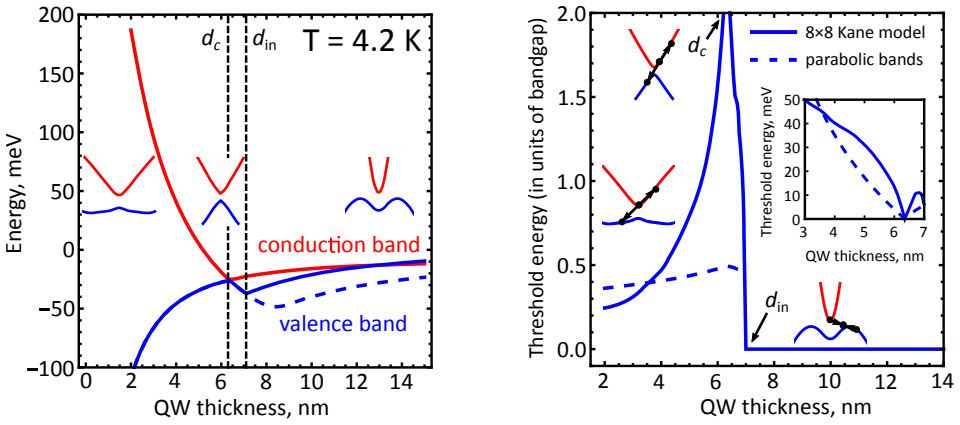
The load-bearing object is the quasi-relativistic dispersion $\varepsilon_p^2 = p^2 v_0^2 + E_g^2/4$, in which electrons and holes cannot satisfy energy and momentum conservation for Auger decay in the center-of-mass frame. Its quantitative work is done by an eight-band Kane $\mathbf{k}\cdot\mathbf{p}$ envelope-function solver for the subband spectra and wave functions, from which the authors compute optical conductivity, gain, and—by Fermi's golden rule with Monte Carlo integration—the Auger, phonon-assisted, and radiative recombination rates. The single parameter that encodes Auger suppression is the threshold energy $E_{th}$, defined as the minimum net kinetic energy of the three particles involved in the CCCH or CHHH process; the calculations compare $E_{th}$ and the resulting threshold currents for wells of different thickness.
What would settle it
Grow a roughly 6.5 nm HgTe well, cool the lattice to 77 K, and measure the threshold pump power for stimulated emission near 5–6 THz; the paper predicts threshold currents about two orders of magnitude below existing quantum cascade lasers, so failing to reach that range would show that the Dirac mechanism is not controlling lasing.
Extended reading notes
Core claim
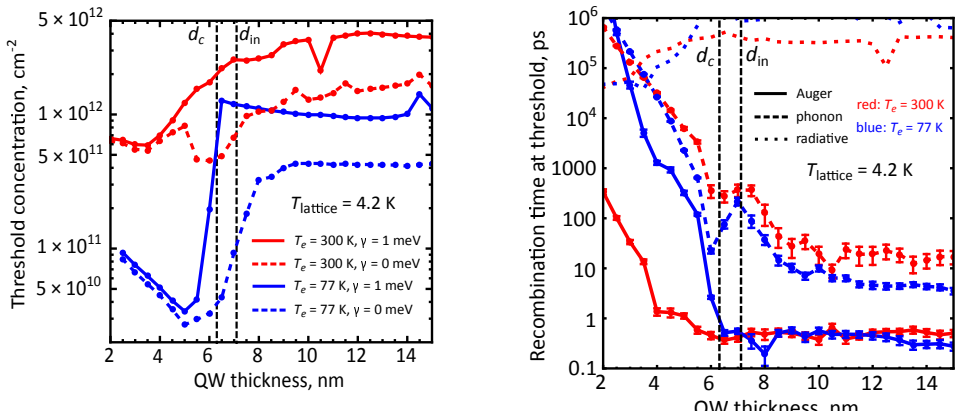
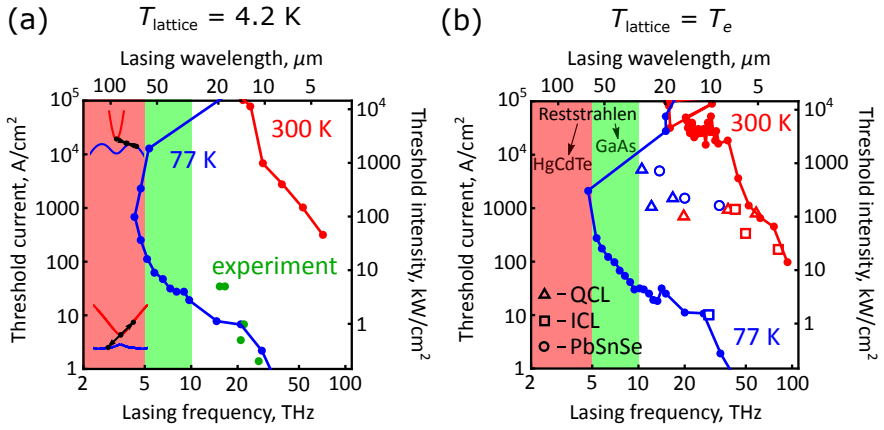
Below the critical thickness $d_c \approx 6.3$ nm, the electron and hole bands in HgCdTe quantum wells form a quasi-relativistic, Dirac-like dispersion, arising from hybridization of topological states at the two interfaces. In this regime the Auger recombination threshold energy $E_{th}$ rises well above the parabolic-band prediction, and the authors show that this "diracness" suppresses Auger recombination enough to make interband lasing feasible at about 50 µm (roughly 6 THz) at 77 K. Their calculated threshold carrier densities, recombination times, and threshold currents reproduce the trend of measured stimulated emission in optically pumped wells with an extracted carrier temperature of about 80 K, and place HgCdTe wells below the threshold currents of quantum cascade and interband cascade lasers across the 10–30 µm range. Wide, inverted-band wells are instead predicted to be non-lasing because a zero-threshold Auger channel turns on near the direct-to-indirect transition.
Load-bearing premise
The predicted thresholds assume electrons and holes in every subband all share a single temperature while the crystal lattice stays cold, and the Auger rates depend exponentially on the high-energy tails of those distributions.
Editorial extensions
If this is right
- Interband HgCdTe lasers could cover the 5–10 THz gap where GaAs quantum cascade lasers fail, with lasing down to roughly 6 THz after lattice absorption is included.
- At 77 K, threshold currents in HgCdTe wells are predicted to be about two orders of magnitude below existing quantum cascade lasers in the 10–30 µm range, and below interband cascade lasers beyond about 15 µm.
- Wells above the topological transition are unsuitable for far-infrared lasing because a thresholdless CHHH Auger channel switches on near the direct-to-indirect gap transition.
- Optimal designs should use narrow, non-topological wells of nearly pure HgTe rather than the wide or high-cadmium wells studied in earlier work.
- At room temperature the advantage shrinks: quantum cascade lasers become superior below about 6–7 µm, while HgCdTe wells remain competitive in the mid-infrared.
Reading between the lines
- The single-carrier-temperature assumption is the first point to stress-test: if the pumped carrier gas develops a non-thermal or two-temperature distribution, the exponential tails that set Auger rates change, and both the 50 µm wavelength limit and the two-order threshold advantage would have to be revised.
- The same mechanism should be looked for in other narrow-gap, two-dimensionally confined heterostructures with band inversion at their interfaces; the paper's figures of merit—Auger threshold energy relative to the gap, intersubband absorption, and Drude loss—form a transferable screening test.
- An experimentally sharp prediction: threshold pump intensity versus well thickness should show a minimum just below the critical thickness and a steep rise on the inverted side, a curve shape independent of the detailed material parameters.
- If the predicted thresholds survive direct measurement, a practical consequence is that simple interband diode lasers, rather than engineered cascade structures, could become the cheapest route into the 5–10 THz window, provided injected carriers can be kept near liquid-nitrogen temperature.
Signed reviews
Editorial analysis
A structured set of objections, weighed in public.
Referee Report
Summary. The paper proposes that HgCdTe quantum wells just below the topological transition develop a quasi-relativistic (Dirac-like) electron-hole dispersion that strongly suppresses Auger recombination, and it presents a microscopic calculation of recombination, absorption, and gain to support the claim that far-infrared lasing is feasible down to about 50 micrometers at liquid nitrogen temperature, with threshold currents two orders of magnitude lower than those of existing QCLs and ICLs. The band structure is computed with an anisotropic eight-band Kane model, the optical gain and absorption are obtained from Fermi's golden rule, and radiative, phonon-assisted, and Auger recombination rates are evaluated. The theoretical thresholds are compared with recent stimulated-emission experiments, from which the authors extract a photoexcited carrier temperature of roughly 80 K.
Significance. If the quantitative predictions hold, the paper is significant for the terahertz gap, particularly the 5-10 THz window that GaAs-based QCLs cannot cover. The strengths are the physically transparent suppression mechanism based on energy-momentum conservation in quasi-relativistic bands, the use of a realistic k.p bandstructure, the microscopic treatment of several competing recombination channels, and the direct, falsifiable comparison with experimental threshold data. The central derivation is not circular: the Auger suppression follows from the band dispersion and conservation laws rather than from the target lasing data. The paper is also transparent about its main idealizations. However, the headline quantitative claims rest on several disclosed approximations whose impact is not quantified, most notably the truncated Monte Carlo estimator for the Auger integral, the common single-carrier-temperature quasi-equilibrium assumption, and the omission of lattice absorption from the loss budget. No code or data are provided, which limits independent verification of the numerical estimates.
major comments (3)
- [Supporting Information, 'CALCULATION OF AUGER RECOMBINATION RATE', Eqs.] The Auger rate entering the threshold-current predictions is computed by Monte Carlo integration of an integrand that has infinite variance after elimination of the delta function. The authors state that discarding 'one or two largest samples' introduces 'only a minor systematic underestimation' of the integral, but no convergence study, tail-bound estimate, or comparison with an unbiased estimator is provided. This is load-bearing because J_th is proportional to R_th, and the heavy tail of the integrand contains the high-energy Fermi-tail configurations that dominate Auger recombination. An unquantified downward bias of even a factor of two would proportionally raise the predicted threshold currents at the optimal thickness and could reduce the advertised two-order-of-magnitude advantage to roughly one order. The error bars in Fig. 4 are standard deviations of the truncated estimator and do not quantify the truncation bias. I request a quantitative tail/convergence analysis, for example sample-size scaling, variation of the number of discarded samples, or an independent importance-sampled unbiased estimator.
- [Methods, 'Electron/hole distributions were taken in the Fermi-Dirac form with temperature Te...'; Fig. 5] The threshold densities and Auger rates are exponentially sensitive to the high-energy tails of the carrier distributions, yet the model assumes a common Fermi-Dirac distribution with a single electron temperature T_e for all conduction and valence subbands, and the comparison in Fig. 5 is used to extract one value T_e about 80 K. This quasi-equilibrium assumption is load-bearing for the quantitative threshold-current and wavelength predictions. I ask for a sensitivity analysis, for example varying T_e over a plausible range or allowing separate electron and hole temperatures, to show how the predicted thresholds and the minimum lasing wavelength shift if the distribution is not fully thermalized or is characterized by two temperatures.
- [Main text, 'PROSPECTS FOR CdHgTe INTERBAND INFRARED LASERS'; Fig. 5] Lattice absorption is explicitly not included in the model, and the statement that lasing down to about 50 micrometers (about 6 THz) is feasible rests on an order-of-magnitude estimate rather than a computed loss budget. Because the longest-wavelength feasibility is a central abstract claim, the Reststrahlen and multiphonon absorption should be quantified at least parametrically, for example as a function of mode confinement factor and number of quantum wells, so that the reader can see how the 'lasing down to about 50 micrometers' limit is obtained and how robust it is to design details.
minor comments (4)
- [Supporting Information, 'CALCULATION OF AUGER RECOMBINATION RATE'] The manuscript does not report the Monte Carlo sample sizes, number of integration points, or convergence diagnostics; providing these numbers would substantially improve reproducibility of the Auger-rate estimates.
- [References, footnote to ref 52] The erratum-style footnote correcting the Hamiltonian in ref 52 should be stated in the Methods text itself, so that the implemented band-structure Hamiltonian is unambiguous to readers who do not consult the footnote.
- [Main text, 'PROSPECTS FOR CdHgTe INTERBAND INFRARED LASERS'] The conversion from recombination rate to threshold current assumes a carrier capture probability alpha_cap = 100%; for injection lasers this is an optimistic idealization and should be flagged as such in the main text rather than only in the equation.
- [Fig. 5 caption] The green experimental points have unknown carrier temperature, while the theory curves are labeled by T_e; the main-text comparison should state more explicitly that the extracted carrier temperature is a fitted quantity rather than an independently measured one.
Circularity Check
Minor fitted-temperature comparison; core derivation is self-contained.
-
fitted input called prediction
[Discussion (paragraph comparing with experiments); Figure 5 caption and associated text.]
"At the same time, it is possible to compare the experimentally obtained data on threshold intensity vs lasing frequency24 with theory and extract the carrier temperature thereof. Such a comparison is presented in Figure 5 where experimental data for various QWs are shown with green dots. It indicates that interband pumping heats the carriers up to∼ 80 K, which is a reasonable value of temperature."
The paper cites compliance with experimental stimulated-emission data (green dots in Fig. 5) as support, but the electron temperature Te≈80 K used for that comparison is extracted from those same experimental data. Thus the agreement with the experiment is partly enforced by the fitted temperature rather than being an independent prediction. The headline claims of ~50 µm lasing and two-orders-lower threshold currents are computed at fixed Te=77 K and 300 K, not fitted to these data, so the circularity is limited to the compliance statement and does not force the central quantitative conclusions.
full rationale
The central derivation—band structure from the eight-band Kane model, Auger thresholds from energy-momentum conservation, and recombination/gain rates from Fermi's golden rule—is independent of the target lasing data. The only notable circular element is the use of an electron temperature extracted from the same experimental points against which the theory is validated. That is a minor fitted-input comparison, not a self-citation chain or an ansatz that smuggles in the conclusion. The Monte Carlo truncation issue flagged in the paper is a numerical-convergence concern, not circularity. Overall, the paper's main predictions rest on its own microscopic calculation, so a score of 2 reflects one minor fitted comparison without indicating that the central claim reduces to its inputs.
Assumptions & free parameters
free parameters (4)
- gamma (momentum relaxation rate) =
1 meV
- alpha_abs (pump absorption probability) =
0.4%
- alpha_cap (carrier capture probability) =
100%
- Te (photoexcited carrier temperature) =
~80 K
assumptions (7)
- domain assumption The 8-band anisotropic Kane k·p model with the corrections given in ref 52 correctly describes the bulk and quantum-well band structure of HgCdTe.
- domain assumption Envelope-function approximation with plane-wave expansion is valid for these quantum wells.
- standard math Fermi's golden rule applies to Auger, phonon-assisted, and radiative recombination.
- domain assumption Electrons and holes are in quasi-equilibrium Fermi-Dirac distributions with a common temperature Te and separate chemical potentials in all subbands.
- domain assumption Phonons are in thermal equilibrium at lattice temperature Tlattice; QWs are undoped.
- domain assumption The dielectric function is approximated by a Lorentz multi-oscillator model with parameters from ref 34 and high-frequency constant kappa_inf = 12; dependence on composition, temperature, and defects is ignored.
- ad hoc to paper Truncated-mean Monte Carlo, discarding the largest integrand samples, gives a finite-variance estimator with only minor systematic underestimation of the Auger integral.
Cite this review
Pith. "Pith review of Fundamental limits to far-infrared lasing in Auger-suppressed HgCdTe quantum wells." pith.science (2026). https://pith.science/paper/OIS37BPT
@misc{pith2026190803496,
  author       = {Pith},
  title        = {Pith review of: Fundamental limits to far-infrared lasing in Auger-suppressed HgCdTe quantum wells},
  year         = {2026},
  howpublished = {\url{https://pith.science/paper/OIS37BPT}},
  note         = {Machine review of arXiv:1908.03496}
}
abstract
A challenge of bridging the terahertz gap with semiconductor lasers faces an inevitable problem of enhanced non-radiative Auger recombination with reduction of photon energy. We show that this problem can be mitigated in mercury-cadmium-telluride quantum wells (HgCdTe QWs) wherein the Auger process is suppressed due to formation of quasi-relativistic electron-hole dispersion imposing strong energy-momentum restrictions on recombining carriers. Such dispersion is formed upon interaction of topological states at the two QW interfaces. We characterize the lasing properties of HgCdTe QWs quantitatively by constructing a microscopic theory for recombination, absorption, and gain, and show the feasibility of lasing down to ~ 50 $\mu$m at liquid nitrogen temperature with threshold currents two orders of magnitude lower than in existing lasers. Our findings comply with recent experimental data on stimulated far-infrared emission from HgCdTe QWs and show the directions toward achievement of maximum possible lasing wavelength.
Figures
Reference graph
Works this paper leans on
-
[1]
L.; Alhathlool, R.; Burnett, A
Dean, P.; Valavanis, A.; Keeley, J.; Bertling, K.; Lim, Y. L.; Alhathlool, R.; Burnett, A. D.; Li, L. H.; Khanna, S. P.; Indjin, D.; Taimre, T.; Raki \' c , A. D.; Linfield, E. H.; Davies, A. G. Terahertz imaging using quantum cascade lasers---a review of systems and applications https://iopscience.iop.org/article/10.1088/0022-3727/47/37/374008/pdf#page=3...
-
[2]
Tittel, F. K.; Richter, D.; Fried, A. Mid-infrared laser applications in spectroscopy https://www.researchgate.net/profile/Dirk_Richter2/publication/226784435_Mid-Infrared_Laser_Applications_in_Spectroscopy/links/09e4150c768053f83d000000/Mid-Infrared-Laser-Applications-in-Spectroscopy.pdf\#page=37. In Solid-State Mid-Infrared Laser Sources; Sorokina, I. T...
-
[3]
Consolino, L.; Bartalini, S.; Beere, H. E.; Ritchie, D. A.; Vitiello, M. S.; De Natale, P. THz QCL-based cryogen-free spectrometer for in situ trace gas sensing https://pdfs.semanticscholar.org/51b3/f98c4f2a658759e97bc0f951a89d19c3b35b.pdf. Sensors 2013, 13, 3331--3340
work page 2013
-
[4]
Davies, A. G.; Burnett, A. D.; Fan, W.; Linfield, E. H.; Cunningham, J. E. Terahertz spectroscopy of explosives and drugs https://www.researchgate.net/profile/W_Fan/publication/248556278_Terahertz_spectroscopy_of_explosives_and_drugs/links/54adcfb70cf2213c5fe41a0c/Terahertz-spectroscopy-of-explosives-and-drugs.pdf#page=2. Materials Today 2008, 11, 18--26
-
[5]
Abakumov, V. N.; Perel, V. I.; Yassievich, I. N. Nonradiative Recombination in Semiconductors https://books.google.com/books?id=FlZToc1dq1AC&pg=191 ; Elsevier, 1991
work page 1991
-
[6]
Popov, A.; Sherstnev, V.; Yakovlev, Y.; M\" u cke, R.; Werle, P. High power InAsSb/InAsSbP double heterostructure laser for continuous wave operation at 3.6 m https://pdfs.semanticscholar.org/91aa/f71401e995197872634bce58b1050cca7b0d.pdf. Applied Physics Letters 1996, 68, 2790--2792
work page 1996
-
[7]
M.; Zandian, M.; Zucca, R.; Singh, J
Arias, J. M.; Zandian, M.; Zucca, R.; Singh, J. https://doi.org/10.1088/0268-1242/8/1s/056 HgCdTe infrared diode lasers grown by MBE . Semiconductor Science and Technology 1993, 8, S255--S260
-
[8]
Malin, J. I.; Meyer, J. R.; Felix, C. L.; Lindle, J. R.; Goldberg, L.; Hoffman, C. A.; Bartoli, F. J.; Lin, C.-H.; Chang, P. C.; Murry, S. J.; Yang, R. Q.; Pei, S.-S. Type II mid-infrared quantum well lasers https://doi.org/10.1063/1.116374. Applied Physics Letters 1996, 68, 2976--2978
Show all 54 references
-
[9]
A.; Capasso, F
Belkin, M. A.; Capasso, F. New frontiers in quantum cascade lasers: high performance room temperature terahertz sources https://pdfs.semanticscholar.org/8a46/f63c11a40e5abef2608e141836a1faca0e76.pdf#page=5. Physica Scripta 2015, 90, 118002
2015
-
[10]
S.; Scalari, G.; Williams, B.; Natale, P
Vitiello, M. S.; Scalari, G.; Williams, B.; Natale, P. D. Quantum cascade lasers: 20 years of challenges https://www.osapublishing.org/oe/viewmedia.cfm?uri=oe-23-4-5167#page=8. Optics Express 2015, 23, 5167--5182
2015
-
[11]
J.; Faist, J.; Andrews, A
Ohtani, K.; Beck, M.; S\" u ess, M. J.; Faist, J.; Andrews, A. M.; Zederbauer, T.; Detz, H.; Schrenk, W.; Strasser, G. Far-infrared quantum cascade lasers operating in the AlAs phonon Reststrahlen band https://arxiv.org/pdf/1609.08196. ACS Photonics 2016, 3, 2280--2284
2016 arXiv
-
[12]
J.; Khanna , S
Chassagneux , Y.; Wang , Q. J.; Khanna , S. P.; Strupiechonski , E.; Coudevylle , J.-R.; Linfield , E. H.; Davies , A. G.; Capasso , F.; Belkin , M. A.; Colombelli , R. Limiting factors to the temperature performance of THz quantum cascade lasers based on the resonant-phonon d...
2012
-
[13]
M.; Murdin, B
Ciesla, C. M.; Murdin, B. N.; Pidgeon, C. R.; Stradling, R. A.; Phillips, C. C.; Livingstone, M.; Galbraith, I.; Jaroszynski, D. A.; Langerak, C. J. G. M.; Tang, P. J. P.; Pullin, M. J. https://doi.org/10.1063/1.363157 Suppression of Auger recombination in arsenic-rich InAs_ 1...
-
[14]
Slonopas, A.; Tomkinson, D. Study of the natural Auger suppression mechanism in heterostructures through heteroboundary engineering https://www.researchgate.net/profile/Andre_Slonopas/publication/320054238_Study_of_the_Natural_Auger_Suppression_Mechanism_in_Heterostructures_Th...
2017
-
[15]
E.; Efros, A
Cragg, G. E.; Efros, A. L. Suppression of Auger processes in confined structures https://doi.org/10.1021/nl903592h. Nano Letters 2010, 10, 313--317
2010 doi
-
[16]
D irac, P. A. M. On the annihilation of electrons and protons https://books.google.ru/books?id=H-w8AAAAIAAJ&pg=PA428. Mathematical Proceedings of the Cambridge Philosophical Society 1930, 26, 361--375
1930
-
[17]
O.; Melngailis, I.; Strauss, A
Dimmock, J. O.; Melngailis, I.; Strauss, A. J. https://doi.org/10.1103/PhysRevLett.16.1193 Band structure and laser action in Pb_ x Sn_ 1-x Te . Physical Review Letters 1966, 16, 1193--1196
1966 doi
-
[18]
Emtage, P. R. Auger recombination and junction resistance in lead-tin telluride https://doi.org/10.1063/1.322975. Journal of Applied Physics 1976, 47, 2565--2568
1976 doi
-
[19]
Ryzhii, V.; Ryzhii, M.; Otsuji, T. Negative dynamic conductivity of graphene with optical pumping https://www.researchgate.net/profile/Maxim_Ryzhii/publication/224454514_Negative_dynamic_conductivity_of_graphene_with_optical_pumping/links/0c960518e1ef303d3c000000/Negative-dyna...
2007
-
[20]
T.; Springate, E.; Link, S.; Starke, U.; Ast, C
Gierz, I.; Calegari, F.; Aeschlimann, S.; Ch\'avez Cervantes, M.; Cacho, C.; Chapman, R. T.; Springate, E.; Link, S.; Starke, U.; Ast, C. R.; Cavalleri, A. Tracking primary thermalization events in graphene with photoemission at extreme time scales https://arxiv.org/pdf/1506.0...
2015 arXiv
-
[21]
Auger recombination in Dirac materials: A tangle of many-body effects https://arxiv.org/pdf/1709.09015.pdf#page=5
Alymov, G.; Vyurkov, V.; Ryzhii, V.; Satou, A.; Svintsov, D. Auger recombination in Dirac materials: A tangle of many-body effects https://arxiv.org/pdf/1709.09015.pdf#page=5. Phys. Rev. B 2018, 97, 205411
2018 arXiv
-
[22]
A.; Hughes, T
Bernevig, B. A.; Hughes, T. L.; Zhang, S.-C. Quantum spin Hall effect and topological phase transition in HgTe quantum wells https://arxiv.org/pdf/cond-mat/0611399.pdf#page=14. Science 2006, 314, 1757--1761
2006 arXiv
-
[23]
V.; Rumyantsev, V
Morozov, S. V.; Rumyantsev, V. V.; Kadykov, A. M.; Dubinov, A. A.; Kudryavtsev, K. E.; Antonov, A. V.; Mikhailov, N. N.; Dvoretskii, S. A.; Gavrilenko, V. I. Long wavelength stimulated emission up to 9.5 m from HgCdTe quantum well heterostructures https://doi.org/10.1063/1.494...
-
[25]
A.; Rumyantsev, V
Fadeev, M. A.; Rumyantsev, V. V.; Kadykov, A. M.; Dubinov, A. A.; Antonov, A. V.; Kudryavtsev, K. E.; Dvoretskii, S. A.; Mikhailov, N. N.; Gavrilenko, V. I.; Morozov, S. V. Stimulated emission in the 2.8--3.5 m wavelength range from Peltier cooled HgTe/CdHgTe quantum well hete...
2018
-
[26]
Laser emission in HgCdTe in the 2--3.5 m range https://doi.org/10.1016/S0022-0248(98)00746-5
Bleuse, J.; Bonnet-Gamard, J.; Mula, G.; Magnea, N.; Pautrat, J.-L. Laser emission in HgCdTe in the 2--3.5 m range https://doi.org/10.1016/S0022-0248(98)00746-5. Journal of Crystal Growth 1999, 197, 529--536
1999 doi
-
[27]
Room-temperature optically pumped CdHgTe vertical-cavity surface-emitting laser for the 1.5 m range https://doi.org/10.1063/1.124831
Roux, C.; Hadji, E.; Pautrat, J.-L. Room-temperature optically pumped CdHgTe vertical-cavity surface-emitting laser for the 1.5 m range https://doi.org/10.1063/1.124831. Applied Physics Letters 1999, 75, 1661--1663
1999 doi
-
[28]
Vurgaftman, I.; Meyer, J. R. High-temperature HgTe/CdTe multiple-quantum-well lasers https://www.osapublishing.org/oe/viewmedia.cfm?uri=oe-2-4-137. Optics Express 1998, 2, 137--142
1998
-
[29]
H.; Jung, H.; Singh, R.; Flatt\' e , M
Grein, C. H.; Jung, H.; Singh, R.; Flatt\' e , M. E. Comparison of normal and inverted band structure HgTe/CdTe superlattices for very long wavelength infrared detectors http://flatte.physics.uiowa.edu/publications/2005_100.pdf#page=4. Journal of electronic materials 2005, 34,...
2005
-
[30]
Zholudev, M.; Teppe, F.; Orlita, M.; Consejo, C.; Torres, J.; Dyakonova, N.; Czapkiewicz, M.; Wr\'obel, J.; Grabecki, G.; Mikhailov, N.; Dvoretskii, S.; Ikonnikov, A.; Spirin, K.; Aleshkin, V.; Gavrilenko, V.; Knap, W. Magnetospectroscopy of two-dimensional HgTe-based topologi...
2012
-
[31]
When the band anisotropy present in HgCdTe QWs is taken into account (which we did, see fig:all-in-one ), the valence band edge consists of only two points in the momentum space
Actually, the side maximum of the valence band is circular only in the isotropic approximation. When the band anisotropy present in HgCdTe QWs is taken into account (which we did, see fig:all-in-one ), the valence band edge consists of only two points in the momentum space. Ho...
-
[32]
V.; Kadykov, A
Rumyantsev, V. V.; Kadykov, A. M.; Fadeev, M. A.; Dubinov, A. A.; Utochkin, V. V.; Mikhailov, N. N.; Dvoretskii, S. A.; Morozov, S. V.; Gavrilenko, V. I. Investigation of HgCdTe waveguide structures with quantum wells for long-wavelength stimulated emission http://journals.iof...
2017
-
[33]
A.; Kvon, Z
Kozlov, D. A.; Kvon, Z. D.; Mikhailov, N. N.; Dvoretskii, S. A.; Weish\" a upl, S.; Krupko, Y.; Portal, J.-C. Quantum Hall effect in HgTe quantum wells at nitrogen temperatures https://www.researchgate.net/profile/Yuriy_Krupko/publication/266398657_Quantum_Hall_effect_in_HgTe_...
2014
-
[34]
M.; Cebulski, J.; Kisiel, A.; Marcelli, A.; Robouch, B
Polit, J.; Sheregii, E. M.; Cebulski, J.; Kisiel, A.; Marcelli, A.; Robouch, B. V.; Cestelli Guidi , M.; Piccinini, M.; Mycielski, A. Additional phonon modes related to intrinsic defects in CdHgTe https://www.academia.edu/23373497/Additional_phonon_modes_related_to_intrinsic_d...
2009
-
[35]
W.; Canedy, C
Vurgaftman, I.; Bewley, W. W.; Canedy, C. L.; Kim, C. S.; Kim, M.; Merritt, C. D.; Abell, J.; Lindle, J. R.; Meyer, J. R. Rebalancing of internally generated carriers for mid-infrared interband cascade lasers with very low power consumption https://www.nature.com/articles/ncom...
2011
-
[36]
J.; Fan, J
Wang, X. J.; Fan, J. Y.; Tanbun-Ek, T.; Choa, F.-S. Low threshold quantum-cascade lasers of room temperature continuous-wave operation grown by metal-organic chemical-vapor deposition https://www.researchgate.net/profile/Tawee_Tanbun-Ek/publication/234866621_Low_threshold_quan...
2007
-
[37]
Rassel , S. M. S.; Li, L.; Li, Y.; Yang, R. Q.; Gupta, J. A.; Wu, X.; Aers, G. C. High-temperature and low-threshold interband cascade lasers at wavelengths longer than 6 m https://par.nsf.gov/servlets/purl/10079407. Optical Engineering 2017, 57, 011021
2017
-
[38]
Q.; Li , L.; Huang , W.; Rassel , S
Yang , R. Q.; Li , L.; Huang , W.; Rassel , S. M. S.; Gupta , J. A.; Bezinger , A.; Wu , X.; Razavipour , S. G.; Aers , G. C. InAs-based interband cascade lasers https://www.researchgate.net/profile/Rui_Yang134/publication/333096131_InAs-Based_Interband_Cascade_Lasers/links/5d...
2019
-
[39]
Xu, G.; Li, A.; Li, Y.; Wei, L.; Zhang, Y.; Lin, C.; Li, H. Low threshold current density distributed feedback quantum cascade lasers with deep top gratings https://www.researchgate.net/profile/Yong_Gang_Zhang2/publication/234884852_Low_threshold_current_density_distributed_fe...
2006
-
[40]
Q.; Mishima , T
Tian , Z.; Li , L.; Ye , H.; Yang , R. Q.; Mishima , T. D.; Santos , M. B.; Johnson , M. B. InAs-based interband cascade lasers with emission wavelength at 10.4 m https://www.researchgate.net/profile/Zhaobing_Tian/publication/233529674_InAs-based_interband_cascade_lasers_with_...
-
[41]
N.; Bahriz, M.; Teissier, R
Baranov, A. N.; Bahriz, M.; Teissier, R. Room temperature continuous wave operation of InAs-based quantum cascade lasers at 15 m https://www.osapublishing.org/oe/viewmedia.cfm?uri=oe-24-16-18799. Optics Express 2016, 24, 18799--18806
2016
-
[42]
H.; Baranov, A
Chastanet, D.; Bousseksou, A.; Lollia, G.; Bahriz, M.; Julien, F. H.; Baranov, A. N.; Teissier, R.; Colombelli, R. High temperature, single mode, long infrared ( = 17.8 m) InAs-based quantum cascade lasers http://www.mir-thz-devices.u-psud.fr/Publications/Chastanet - InAs base...
2014
-
[43]
Loghmari , Z.; Bahriz , M.; Meguekam , A.; Teissier , R.; Baranov , A. N. InAs-based quantum cascade lasers emitting close to 25 m https://www.researchgate.net/profile/Alexei_Baranov/publication/329422546_InAs-based_quantum_cascade_lasers_emitting_close_to_25_m/links/5c742937a...
2019
-
[44]
V.; Ikonnikov, A
Maremyanin, K. V.; Ikonnikov, A. V.; Antonov, A. V.; Rumyantsev, V. V.; Morozov, S. V.; Bovkun, L. S.; Umbetalieva, K. R.; Chizhevskiy, E. G.; Zasavitskiy, I. I.; Gavrilenko, V. I. http://journals.ioffe.ru/articles/viewPDF/42552#page=2 Long-wavelength injection lasers based on...
2015
-
[45]
Liquid phase epitaxy grown PbSnSeTe/PbSe double heterostructure diode lasers https://doi.org/10.1016/1350-4495(95)00120-4
Feit, Z.; Fuchs, J.; Kostyk, D.; Jalenak, W. Liquid phase epitaxy grown PbSnSeTe/PbSe double heterostructure diode lasers https://doi.org/10.1016/1350-4495(95)00120-4. Infrared Physics and Technology 1996, 37, 439--443
1996 doi
-
[46]
We assume it decreases to 15 m at 77 K based on the known temperature dependence of in Pb_ 1-x Sn_ x Se Lead_Salt_LaserCharacteristics
In LeadSalt_DoubleHeterostructure , the lasing wavelength is = 20 m at 20 K. We assume it decreases to 15 m at 77 K based on the known temperature dependence of in Pb_ 1-x Sn_ x Se Lead_Salt_LaserCharacteristics
-
[47]
F.; Morozov, S
Rumyantsev, V.; Fadeev, M.; Aleshkin, V.; Kulikov, N.; Utochkin, V.; Mikhailov, N.; Dvoretskii, S.; Pavlov, S.; H\" u bers, H.-W.; Gavrilenko, V.; Sirtori, C.; Krasilnik, Z. F.; Morozov, S. Carrier recombination, long-wavelength photoluminescence, and stimulated emission in Hg...
-
[48]
Bugajski, M.; Gutowski, P.; Karbownik, P.; Kolek, A.; Ha da\' s , G.; Pier\' s ci\' n ski, K.; Pier\' s ci\' n ska, D.; Kubacka-Traczyk, J.; Sankowska, I.; Trajnerowicz, A.; Kosiel, K.; Szerling, A.; Grzonka, J.; Kurzyd owski, K.; Slight, T.; Meredith, W. Mid-IR quantum cascad...
2014
-
[49]
https://doi.org/10.1103/PhysRevB.8.4693 Band inversion in Pb _ 1 - x Sn _ x Se alloys under hydrostatic pressure
Martinez, G. https://doi.org/10.1103/PhysRevB.8.4693 Band inversion in Pb _ 1 - x Sn _ x Se alloys under hydrostatic pressure. III. Laser emission . Physical Review B 1973, 8, 4693--4707
1973 doi
-
[50]
https://doi.org/10.1016/0038-1101(78)90227-7 The effect of single-phonon and plasmon recombination on the lifetime in n - Hg_ 1-x Cd_ x Te with magnetically tuned bandgap
Dornhaus, R.; Nimtz, G. https://doi.org/10.1016/0038-1101(78)90227-7 The effect of single-phonon and plasmon recombination on the lifetime in n - Hg_ 1-x Cd_ x Te with magnetically tuned bandgap . Solid-State Electronics 1978, 21, 1471--1474
-
[51]
Surface plasmon lasing in mercury cadmium telluride quantum wells (to be published)
Kapralov, K.; Alymov, G.; Dubinov, A.; Svintsov, D. Surface plasmon lasing in mercury cadmium telluride quantum wells (to be published)
-
[52]
The sign before 18 25 k_y\ _2- _3,k_z\ in the definition of V should be plus, + _2 k_x^2 should be omitted from the definition of R , and \ ,k_z\ should be replaced with [ ,k_z] everywhere in the definitions of S _ and S _
-
[53]
o hlich electron-phonon interaction and calculated the phonon-assisted recombination rates R_ ph from the following formula, which absorbs phonon frequencies and Fr\
Baars, J.; Sorger, F. https://doi.org/10.1016/0038-1098(72)90211-6 Reststrahlen spectra of HgTe and Cd_ x Hg_ 1-x Te . Solid State Communications 1972, 10, 875--878 mcitethebibliography main.tex0000664000000000000000000000103213523305357011226 0ustar rootroot =1 [9pt,letterpap...
1972 doi
-
[54]
Crude Monte Carlo quadrature in infinite variance case and the central limit theorem https://doi.org/10.1007/BF01966094
T \"o rn, A. Crude Monte Carlo quadrature in infinite variance case and the central limit theorem https://doi.org/10.1007/BF01966094. BIT Numerical Mathematics 1966, 6, 339--346
1966 doi
-
[55]
V.; Rumyantsev, V
Morozov, S. V.; Rumyantsev, V. V.; Fadeev, M. A.; Zholudev, M. S.; Kudryavtsev, K. E.; Antonov, A. V.; Kadykov, A. M.; Dubinov, A. A.; Mikhailov, N. N.; Dvoretsky, S. A.; Gavrilenko, V. I. https://www.researchgate.net/profile/Vladimir_Rumyantsev/publication/320882246_Stimulate...
2017
Reviewed August 14, 2026 · model on record in the stance chip above.
Discussion (0). Continue with ORCID to comment.