Low-cost demonstration of the Zeeman effect: From qualitative observation to quantitative experiments
Pith reviewed 2026-05-23 22:38 UTC · model grok-4.3
The pith
A magnetic field applied to a sodium flame lightens its shadow, offering a naked-eye view of the Zeeman effect.
A machine-rendered reading of the paper's core claim, the machinery that carries it, and where it could break.
Core claim
When a magnetic field is applied to the flame, the shadow cast by the flame noticeably lightens, providing a clear, naked-eye demonstration of the Zeeman effect.
What carries the argument
The shadow cast by a sodium flame in front of a sodium lamp, which lightens when a magnetic field splits the absorption lines.
If this is right
- The same apparatus can be used to measure how the lightening changes with different magnetic field strengths.
- The lightening also varies with sodium concentration in the flame, allowing a second quantitative test.
- The setup requires only everyday items and a small magnet, making it practical for classroom use.
- Students can explore the effect by adjusting the flame position or salt amount and recording the change in shadow.
Where Pith is reading between the lines
- The method could be adapted to other elements that have strong visible resonance lines if a matching lamp is available.
- Adding a simple spectroscope would turn the qualitative demo into a measurement of the splitting size.
- The same principle might work for demonstrating related effects such as the Stark effect if an electric field replaces the magnet.
Load-bearing premise
The lightening is produced by magnetic splitting of the sodium absorption lines and not by unrelated changes in flame temperature, lamp brightness, or scattering when the magnet is energized.
What would settle it
Record the spectrum of light passing through the flame with and without the magnet; the absorption feature should split or broaden in the manner predicted for the Zeeman effect on the sodium D lines.
Figures
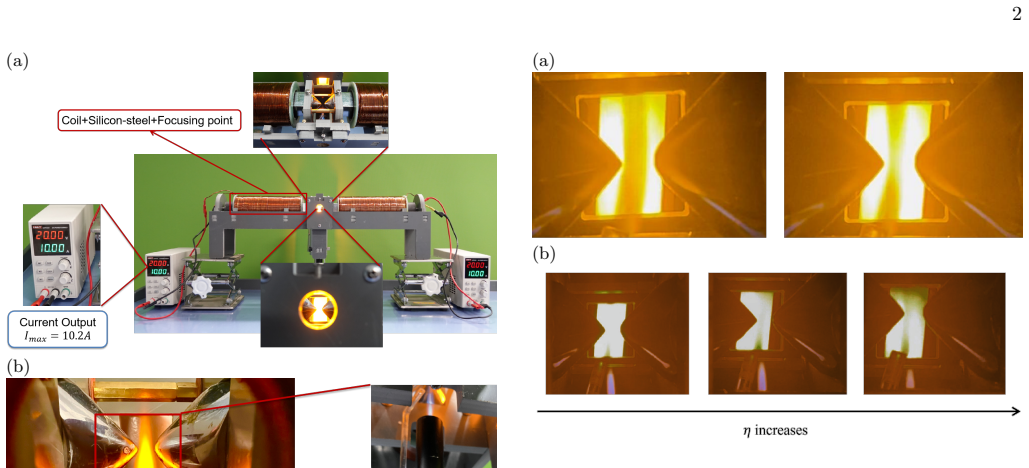
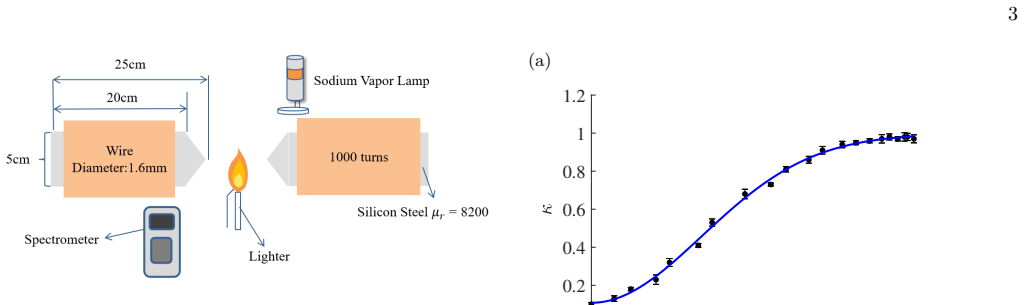
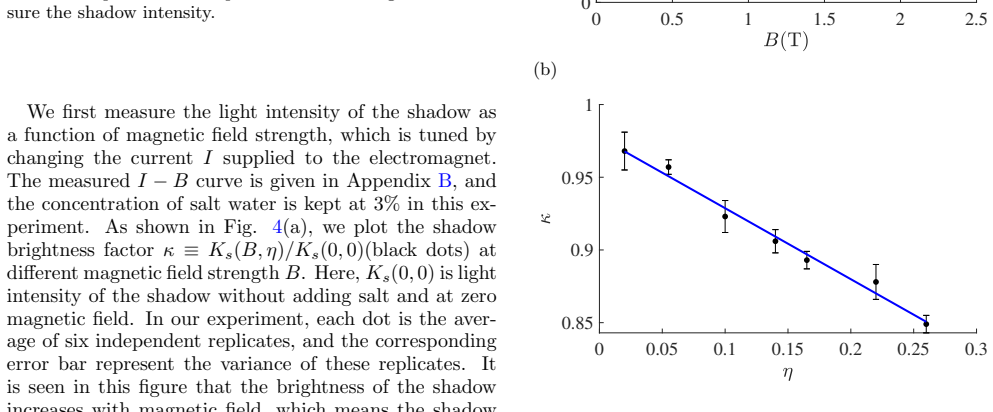
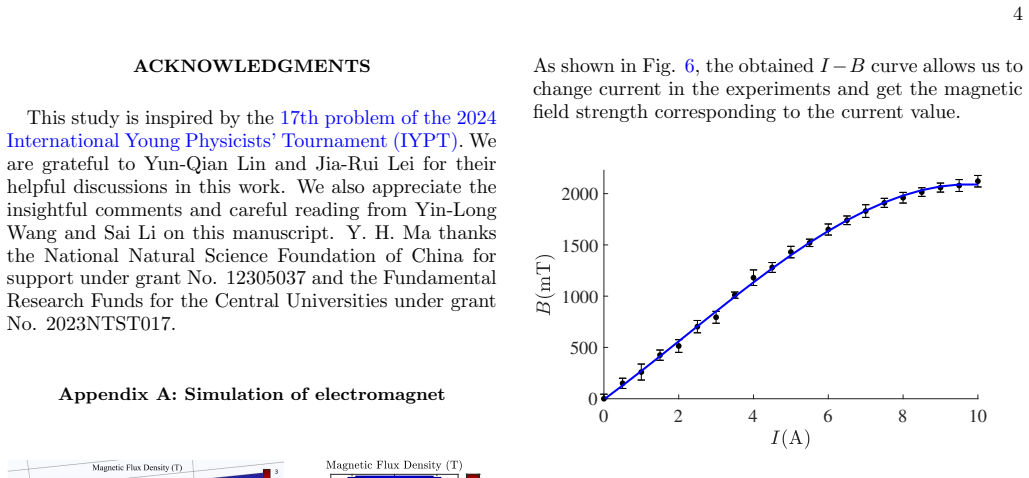

read the original abstract
The Zeeman effect, a fundamental quantum phenomenon, demonstrates the interaction between magnetic fields and atomic systems. While precise spectroscopic measurements of this effect have advanced significantly, there remains a lack of simple, visually accessible demonstrations for educational purposes. Here, we present a low-cost experiment that allows for direct visual observation of the Zeeman effect. Our setup involves a flame containing sodium (from table salt) placed in front of a sodium vapor lamp. When a magnetic field is applied to the flame, the shadow cast by the flame noticeably lightens, providing a clear, naked-eye demonstration of the Zeeman effect. Furthermore, we conduct two quantitative experiments using this setup, examining the effects of varying magnetic field strength and sodium concentration. This innovative approach not only enriches the experimental demonstration for teaching atomic physics at undergraduate and high school levels but also provides an open platform for students to explore the Zeeman effect through hands-on experience.
Editorial analysis
A structured set of objections, weighed in public.
Referee Report
Summary. The paper presents a low-cost setup using a sodium-containing flame in front of a sodium vapor lamp to visually demonstrate the Zeeman effect: application of a magnetic field to the flame lightens the shadow cast by the flame. It further describes two quantitative experiments varying magnetic field strength and sodium concentration for educational use at high-school and undergraduate levels.
Significance. A validated, accessible visual demonstration of the Zeeman effect would be valuable for physics education, particularly given its low-cost nature. However, the absence of controls to isolate the claimed mechanism limits its current utility as a reliable teaching tool.
major comments (2)
- [Abstract] Abstract and qualitative-observation description: the central claim that shadow lightening is caused by Zeeman splitting of the sodium D lines is not supported by any reported controls (temperature monitoring, lamp-intensity calibration with field on/off, or non-sodium flame runs) to exclude magnet-induced changes in flame temperature, density, convection, or lamp output.
- [Quantitative experiments] Quantitative-experiments section: no data tables, error analysis, or statistical measures are referenced in the abstract or described for the runs that vary magnetic field strength and sodium concentration, making it impossible to assess whether the reported trends are distinguishable from the same uncontrolled variables.
minor comments (1)
- [Abstract] The abstract states that 'quantitative runs were performed' but provides no numerical results, figures, or error bars; this should be expanded with at least one representative data set or figure reference.
Simulated Author's Rebuttal
We thank the referee for their thoughtful review and constructive feedback on our manuscript describing a low-cost Zeeman effect demonstration. We address each major comment below and indicate where revisions will be made to improve the paper.
read point-by-point responses
-
Referee: [Abstract] Abstract and qualitative-observation description: the central claim that shadow lightening is caused by Zeeman splitting of the sodium D lines is not supported by any reported controls (temperature monitoring, lamp-intensity calibration with field on/off, or non-sodium flame runs) to exclude magnet-induced changes in flame temperature, density, convection, or lamp output.
Authors: We agree that the absence of explicit controls leaves open the possibility of confounding effects from the magnetic field on flame properties or lamp output. The manuscript attributes the observed lightening to Zeeman splitting based on the use of resonant sodium D-line illumination and the specificity of the setup, but we recognize this attribution would be more robust with supporting controls. In the revised manuscript we will add a dedicated subsection on potential alternative mechanisms and, where feasible within the low-cost educational context, report results from control runs (e.g., non-sodium flame and field-on/off lamp intensity checks). revision: yes
-
Referee: [Quantitative experiments] Quantitative-experiments section: no data tables, error analysis, or statistical measures are referenced in the abstract or described for the runs that vary magnetic field strength and sodium concentration, making it impossible to assess whether the reported trends are distinguishable from the same uncontrolled variables.
Authors: We acknowledge that the current text describes the trends qualitatively without presenting raw data, uncertainties, or statistical analysis. This omission makes it difficult for readers to evaluate the reliability of the observed dependencies. In the revised version we will include representative data tables, estimates of measurement uncertainty, and a brief discussion of how the trends relate to the expected Zeeman behavior, while noting the educational rather than metrological purpose of the experiments. revision: yes
Circularity Check
No circularity: experimental demonstration with no derivations or fitted predictions
full rationale
The paper describes a low-cost experimental setup for observing the Zeeman effect via shadow lightening in a sodium flame, followed by qualitative and quantitative observations of magnetic field strength and concentration effects. No mathematical derivations, first-principles calculations, parameter fittings, or predictions are presented that could reduce to inputs by construction. The central claims rest on direct observation rather than any self-definitional logic, self-citation load-bearing arguments, or renamed known results. This is a standard honest finding for an education-focused experimental paper with no derivation chain.
Axiom & Free-Parameter Ledger
axioms (1)
- domain assumption Application of a magnetic field to sodium atoms produces the Zeeman splitting that alters resonant absorption at the sodium D-line wavelength.
Reference graph
Works this paper leans on
-
[1]
Bakker, Fifty years zeeman effect, Physica 12, 555 (1946)
C. Bakker, Fifty years zeeman effect, Physica 12, 555 (1946)
work page 1946
-
[2]
A. Srivastava, M. Sidler, A. V. Allain, D. S. Lembke, A. Kis, and A. Imamo˘ glu, Valley zeeman effect in ele- mentary optical excitations of monolayer wse 2, Nature Physics 11, 141 (2015)
work page 2015
-
[3]
Z. Sun, Z. Cao, J. Cui, C. Zhu, D. Ma, H. Wang, W. Zhuo, Z. Cheng, Z. Wang, X. Wan, et al. , Large zee- man splitting induced anomalous hall effect in zrte5, npj Quantum Materials 5, 36 (2020)
work page 2020
-
[4]
R. M. Crutcher and A. J. Kemball, Review of zeeman effect observations of regions of star formation, Frontiers in Astronomy and Space Sciences 6, 66 (2019)
work page 2019
-
[5]
Kochukhov, Magnetic fields of m dwarfs, The Astron- omy and Astrophysics Review 29, 1 (2021)
O. Kochukhov, Magnetic fields of m dwarfs, The Astron- omy and Astrophysics Review 29, 1 (2021)
work page 2021
-
[6]
A. S. Taylor, A. R. Hyde, and O. V. Batishchev, Zee- man effect experiment with high-resolution spectroscopy for advanced physics laboratory, American Journal of Physics 85, 565 (2017)
work page 2017
-
[7]
M. C. dos Santos, P. Porcher, J. Krupa, and J. Gesland, Absorption and zeeman effect in-doped: measurements and simulation, Journal of Physics: Condensed Matter 8, 4643 (1996)
work page 1996
-
[8]
D. A. Jackson and H. Kuhn, The hyperfine structure of the zeeman components of the resonance lines of sodium, Proceedings of the Royal Society of London. Series A. Mathematical and Physical Sciences 167, 205 (1938)
work page 1938
-
[9]
C. J. Foot, Atomic physics , Vol. 7 (Oxford university press, 2005)
work page 2005
-
[10]
A. Gribl and D. Petrinovi´ c, A robust method for gaus- sian profile estimation in the case of overlapping objects, IEEE access 9, 21071 (2021)
work page 2021
discussion (0)
Sign in with ORCID, Apple, or X to comment. Anyone can read and Pith papers without signing in.