REVIEW 5 major objections 5 minor 48 references
Link to the Past: Temporal Propagation for Fast 3D Human Reconstruction from Monocular Video
T0 review · 5 major / 5 minor · reviewed 2026-08-15 · deepseek-v4-flash
Pith's one-line read TemPoFast3D reconstructs 3D clothed humans from monocular video at up to 12 FPS by reusing a canonical shape across frames.
desk verdict Useful temporal-propagation speed-up for pixel-aligned human reconstruction, but the SOTA quality claim is contradicted by the paper's own monocular results. read the letter →
The pith
A machine-rendered reading of the paper's core claim, the machinery that carries it, and where it could break.
The reading
What carries the argument
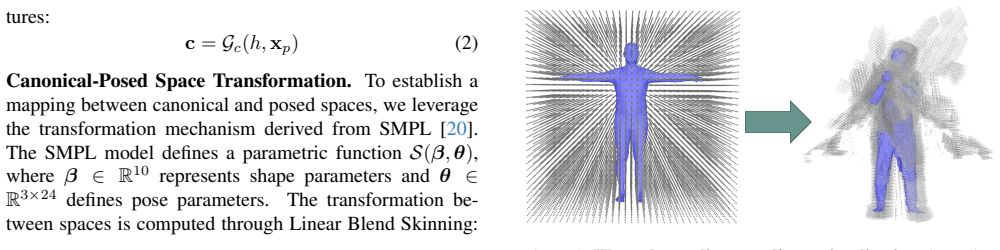
The load-bearing object is the canonical-space shape representation plus the skinning field used to move between canonical and posed space. A parametric body model supplies per-vertex transformation matrices $T_s$ via linear blend skinning; TemPoFast3D transfers these to arbitrary query coordinates by K-nearest-neighbor association, giving a deformation $x_p = T_x x_c$. A volumetric boundary mask discards query points outside a proximal volume around the canonical body mesh, visibility-guided sampling keeps only coordinates observable from the current view, and surface-adjacent sampling restricts queries to an occupancy band $\alpha \le o_c \le \beta$. Color for occluded vertices is propagated from the previous frame's canonical vertices by nearest-neighbor lookup. These mechanisms together turn a per-frame dense implicit reconstruction into sparse local updates on a persistent canonical mesh.
What would settle it
Take a monocular video from a dataset with ground-truth body scans in which the subject wears a loose coat and removes it after frame five. Run TemPoFast3D and a per-frame full-reconstruction baseline on the same frames. If after the garment change the propagated canonical shape keeps the coat's geometry and the chamfer or point-to-surface error jumps far above the baseline's error, the time-invariance assumption that carries the speedup is falsified.
Extended reading notes
Core claim
The central claim is that temporal coherence can be converted directly into computation savings without retraining. Instead of re-reconstructing the whole volume each frame, TemPoFast3D maintains a canonical occupancy and appearance representation in a canonical pose, deforms query coordinates into posed space with per-vertex skinning transforms, and after the first five frames treats the propagated canonical shape as a geometric prior. Inference then samples only coordinates that are visible from the current camera and within a narrow occupancy band around the surface, and fills in occluded vertex colors by nearest-neighbor lookup in the previous canonical mesh. The paper reports that applying this wrapper to two pixel-aligned backbones keeps single-frame geometric error on the THuman2.0 and CAPE benchmarks in the same range as the base methods, improves on them in multi-view configurations, reaches 23.25 dB PSNR on CAPE textures, and on the NeuMan zero-shot video benchmark achieves 27.60 PSNR at 8.9 FPS average and 12.3 FPS maximum, compared with hours of training and slower inference for optimization-based baselines. The implied discovery is that the redundant work in per-frame human reconstruction is removable once a stable canonical body shape exists.
Load-bearing premise
The pipeline assumes the body shape and clothing seen in the first few frames stay essentially unchanged in later frames, and that the estimated body model lines up accurately with the person in every frame.
Editorial extensions
If this is right
- Real-time applications such as VR telepresence can reconstruct a clothed person from a single RGB camera at interactive rates without per-video optimization or templates.
- Existing body-model-guided pixel-aligned reconstruction networks can be accelerated by swapping in this inference loop, so future improvements to those backbones carry over automatically.
- Synchronized multi-view setups can improve geometry by merging canonical representations with no architectural change, with most of the gain coming by three views and diminishing returns after roughly seven views.
- Speed has a warm-up cost: the first five frames are full reconstructions, so average throughput over short clips is lower than the 12 FPS maximum reported after warm-up.
- Because color is stored per-vertex on the propagated mesh, texture fidelity depends on vertex density and view coverage, giving a concrete target for future appearance refinement.
- The method's reported FPS includes both shape and color reconstruction, unlike some baselines that report only rendering speed.
Reading between the lines
- The fixed warm-up threshold of five frames is a heuristic; an adaptive trigger based on how much the propagated canonical shape changes between frames would likely make the method robust to sudden pose or clothing changes, and that is a testable extension the paper does not explore.
- The recipe likely generalizes beyond humans: any articulated object with a parametric model and skinning deformation could receive the same temporal-propagation speedup, though color propagation quality for non-rigid texture is untested.
- The reported plateau in multi-view quality suggests the canonical representation, not the number of views, is the bottleneck; further gains would require a richer per-frame appearance model rather than more cameras.
- A direct stress test with loose clothing and accessories, where the paper itself expects degraded alignment, would quantify how much of the speed advantage survives outside tight-fitting apparel.
Signed reviews
Editorial analysis
A structured set of objections, weighed in public.
Referee Report
Summary. TemPoFast3D proposes a plug-and-play framework that wraps SMPL-guided pixel-aligned reconstruction backbones (GTA and SIFU) and temporally propagates a canonical shape representation across frames, aiming to achieve fast 3D clothed human reconstruction from monocular video without per-video optimization. The method introduces coordinate mapping between canonical and posed space, volumetric boundary filtering, visibility-guided and surface-adjacent sampling, and a frame threshold to switch from full reconstruction to efficient inference. Experiments are reported on THuman2.0, CAPE, and NeuMan, with ablations on the proposed optimizations. The paper claims a maximum speed of 12 FPS and that the method matches or exceeds state-of-the-art across standard metrics.
Significance. If the central claims were supported, this work would be a meaningful contribution to real-time 3D human reconstruction: it offers an algorithmic recipe for converting existing single-image pixel-aligned reconstructions into a temporal stream without per-video optimization, and the systematic ablation documents how each optimization affects speed and quality. The plug-and-play design is attractive and the idea of maintaining a propagated canonical shape is sound. However, the evidence in the manuscript does not support the headline claim for the advertised monocular setting: single-view results are worse than the backbone methods, the monocular-video results sit near the bottom of the comparison table, and the only rows that beat state-of-the-art use synchronized multi-view input.
major comments (5)
- [Abstract; Table 1; Section 4.1] The headline claim that TemPoFast3D "matches or exceeds state-of-the-art methods" is not supported for monocular input. In Table 1, the single-view rows TPF3D-GTA and TPF3D-SIFU are worse than their respective backbones on most geometry metrics: on THuman2.0, TPF3D-SIFU has Chamfer 0.5047 versus SIFU† 0.4409 and Normal error 0.0374 versus 0.0342; TPF3D-GTA has Chamfer 0.5247 versus GTA† 0.4625 and Normal error 0.0383 versus 0.0348. The rows that exceed the backbones, TPF3D-GTA-3v and TPF3D-SIFU-3v, use three synchronized views from Section 3.4, which is not the monocular setting promised in the abstract.
- [Table 2; Section 4.1] The monocular-video results on NeuMan also contradict the "matches or exceeds" claim. TPF3D-GTA obtains PSNR 27.60, SSIM 0.965, and LPIPS 0.022, placing it near the bottom of Table 2; for example, ExAvatar achieves 34.80/0.984/0.009 and Vid2Avatar achieves 30.70/0.980/0.014. The manuscript's own phrasing that the method is "comparable against early optimization-based approaches" appears to concede this point.
- [Section 4.1, first paragraph] The paper states that "fair comparison is not possible as TPF3D requires multiple view/frame for optimal result while other methods only need single image to achieve max quality." This admission is load-bearing because it concedes that the favorable numbers in Table 1 come from a setting outside the abstract's monocular-video claim, while the monocular numbers are degraded relative to the backbones.
- [Table 2 versus Table 3; Section 4.2] There is an unexplained inconsistency between the reported video-quality numbers. Table 3 reports a baseline PSNR of 32.80 with GTA on the citron sequence and a final optimized PSNR of 31.13, but Table 2 reports TPF3D-GTA at 27.60 on NeuMan for the same method. The manuscript does not reconcile these numbers; if they come from different protocols, the protocol should be described, and if they come from the same protocol, the enormous gap needs an explanation.
- [Supplementary, Tables 4-6; Section 4] The hyperparameters K, the frame threshold n, and the surface-adjacent thresholds alpha and beta are selected by tuning on THuman2.0 evaluation tables and by development observations, rather than on a validation split. No sensitivity analysis for alpha and beta is provided on video data. This undermines the "plug-and-play" claim and leaves open the possibility that the reported speed-quality tradeoff is partially tuned to the evaluation benchmark.
minor comments (5)
- [Section 3.1, Eq. (3)] The summation index K is overloaded with the later use of K as the nearest-neighbor count in Section 3.2; please use distinct notation for the number of joints.
- [Section 3.2.2, Eq. (8)] The composition of the per-vertex transformation Tm with the global scale s and translation t is not defined precisely; please clarify whether Tm already includes a global rigid component or whether it must be applied after the per-vertex transform.
- [Table 2 caption] The sentence "We run each methods in the same environment" should be corrected to "We run each method in the same environment."
- [Abstract and Tables 2/3] The paper emphasizes 12 FPS in the abstract, while Table 2 reports average FPS of 8.900 and Table 3 reports a maximum of 12.301 FPS; please state clearly which reporting convention is used for the headline speed.
- [Section 2, Related Works] The statement that FOF "lacks texture inference capability" is a strong claim; please provide a citation or a direct comparison, or soften the wording.
Circularity Check
No significant circularity: the temporal-propagation pipeline is an empirical system built on external pretrained backbones; the abstract's evidence gap is a correctness issue, not a circular derivation.
full rationale
The paper is an empirical systems contribution rather than a first-principles derivation. Its core operation is a temporal-propagation wrapper around pretrained pixel-aligned backbones (GTA and SIFU): the first n frames are fully reconstructed, and later frames reuse the canonical shape with visibility-guided and surface-adjacent sampling (Eq. 9 and Eq. 10). The coordinate transformations in Eqs. 3-8 are standard SMPL linear-blend-skinning mappings, and the sampling thresholds (alpha, beta) operate on previously inferred occupancy values, so the later-frame output is a local refinement of an earlier reconstruction rather than a quantity defined in terms of the target evaluation metrics. The reported chamfer, PSNR, SSIM, and LPIPS numbers are measured against held-out THuman2.0, CAPE, and NeuMan data, not fitted to those metrics. Hyperparameters such as K=5, n=5, alpha=0.4, and beta=0.7 are selected empirically and may raise benchmark-tuning concerns, but tuning does not make the evaluation results equivalent to the inputs by construction. There are no load-bearing self-citations: the backbones, SMPL, datasets, and comparison numbers all come from external work. The skeptical observation that Table 1's state-of-the-art-beating rows are three-view variants while the abstract advertises monocular video is a claim-evidence mismatch, not circular reasoning, and therefore does not raise the circularity score.
Assumptions & free parameters
free parameters (4)
- frame threshold n =
5
- surface-adjacent thresholds alpha, beta =
alpha=0.4, beta=0.7
- nearest-neighbor count K in coordinate mapping =
5
- sampling point cap =
n < 2^10 (probable reading of 'n<210' in Supplementary)
assumptions (4)
- domain assumption PyMAF's SMPL estimates are accurate enough for the target videos.
- domain assumption SMPL linear blend skinning extends to arbitrary points around the body and remains valid for clothing.
- domain assumption Pretrained GTA/SIFU backbones generalize to canonical-space queries and video frames.
- domain assumption Human body shape and clothing are approximately time-invariant over the sequence.
Cite this review
Pith. "Pith review of Link to the Past: Temporal Propagation for Fast 3D Human Reconstruction from Monocular Video." pith.science (2026). https://pith.science/paper/OJFAS2IN
@misc{pith2026250507333,
  author       = {Pith},
  title        = {Pith review of: Link to the Past: Temporal Propagation for Fast 3D Human Reconstruction from Monocular Video},
  year         = {2026},
  howpublished = {\url{https://pith.science/paper/OJFAS2IN}},
  note         = {Machine review of arXiv:2505.07333}
}
read the original abstract
Fast 3D clothed human reconstruction from monocular video remains a significant challenge in computer vision, particularly in balancing computational efficiency with reconstruction quality. Current approaches are either focused on static image reconstruction but too computationally intensive, or achieve high quality through per-video optimization that requires minutes to hours of processing, making them unsuitable for real-time applications. To this end, we present TemPoFast3D, a novel method that leverages temporal coherency of human appearance to reduce redundant computation while maintaining reconstruction quality. Our approach is a "plug-and play" solution that uniquely transforms pixel-aligned reconstruction networks to handle continuous video streams by maintaining and refining a canonical appearance representation through efficient coordinate mapping. Extensive experiments demonstrate that TemPoFast3D matches or exceeds state-of-the-art methods across standard metrics while providing high-quality textured reconstruction across diverse pose and appearance, with a maximum speed of 12 FPS.
Figures


Figures from the paper (9 more)


Reference graph
Works this paper leans on
-
[1]
Photorealistic monocular 3D reconstruction of humans wear- ing clothing
Thiemo Alldieck, Mihai Zanfir, and Cristian Sminchisescu. Photorealistic monocular 3D reconstruction of humans wear- ing clothing. In Proc. IEEE/CVF Conference on Computer Vision and Pattern Recognition, pages 1496–1505, 2022. 1, 2
work page 2022
-
[2]
Yukang Cao, Kai Han, and Kwan-Yee K. Wong. SeSDF: Self-evolved signed distance field for implicit 3D clothed human reconstruction. In Proc. IEEE/CVF Conference on Computer Vision and Pattern Recognition, 2023. 2
work page 2023
-
[3]
Alvaro Collet, Ming Chuang, Pat Sweeney, Don Gillett, Den- nis Evseev, David Calabrese, Hugues Hoppe, Adam G. Kirk, and Steve Sullivan. High-quality streamable free-viewpoint video. ACM Trans. on Graphics, 34(4):69:1–69:13, 2015. 2
work page 2015
-
[4]
Structured 3D features for reconstructing controllable avatars
Enric Corona, Mihai Zanfir, Thiemo Alldieck, Ed- uard Gabriel Bazavan, Andrei Zanfir, and Cristian Sminchis- escu. Structured 3D features for reconstructing controllable avatars. pages 16954–16964. IEEE, 2023. 2
work page 2023
-
[5]
PINA: learning a personalized implicit neural avatar from a single RGB-D video sequence
Zijian Dong, Chen Guo, Jie Song, Xu Chen, Andreas Geiger, and Otmar Hilliges. PINA: learning a personalized implicit neural avatar from a single RGB-D video sequence. In Proc. IEEE/CVF Conference on Computer Vision and Pat- tern Recognition, 2022. 2
work page 2022
-
[6]
FOF: learning fourier occupancy field for monocular real-time human reconstruction
Qiao Feng, Yebin Liu, Yu-Kun Lai, Jingyu Yang, and Kun Li. FOF: learning fourier occupancy field for monocular real-time human reconstruction. InProc. Advances in Neural Information Processing Systems, 2022. 2
work page 2022
-
[7]
Vid2Avatar: 3D avatar reconstruction from videos in the wild via self-supervised scene decomposition
Chen Guo, Tianjian Jiang, Xu Chen, Jie Song, and Otmar Hilliges. Vid2Avatar: 3D avatar reconstruction from videos in the wild via self-supervised scene decomposition. In Proc. IEEE/CVF Conference on Computer Vision and Pat- tern Recognition, pages 12858–12868, 2023. 1, 2, 7
work page 2023
-
[8]
LiveCap: Real-time human performance capture from monocular video
Marc Habermann, Weipeng Xu, Michael Zollh ¨ofer, Gerard Pons-Moll, and Christian Theobalt. LiveCap: Real-time human performance capture from monocular video. ACM Trans. on Graphics, 38(2):14:1–14:17, 2019. 2
work page 2019
Show all 48 references
-
[9]
Collomosse, Hailin Jin, and Stefano Soatto
Tong He, John P. Collomosse, Hailin Jin, and Stefano Soatto. Geo-PIFu: Geometry and pixel aligned implicit functions for single-view human reconstruction. In Proc. Advances in Neural Information Processing Systems, 2020. 1, 2
2020
-
[10]
ARCH++: animation-ready clothed human re- construction revisited
Tong He, Yuanlu Xu, Shunsuke Saito, Stefano Soatto, and Tony Tung. ARCH++: animation-ready clothed human re- construction revisited. In Proc. IEEE/CVF International Conference on Computer Vision, pages 11026–11036, 2021. 2
2021
-
[11]
GaussianAvatar: Towards realistic human avatar model- ing from a single video via animatable 3D gaussians
Liangxiao Hu, Hongwen Zhang, Yuxiang Zhang, Boyao Zhou, Boning Liu, Shengping Zhang, and Liqiang Nie. GaussianAvatar: Towards realistic human avatar model- ing from a single video via animatable 3D gaussians. In Proc. IEEE/CVF Conference on Computer Vision and Pat- tern Recogn...
2024
-
[12]
ARCH: animatable reconstruction of clothed hu- mans
Zeng Huang, Yuanlu Xu, Christoph Lassner, Hao Li, and Tony Tung. ARCH: animatable reconstruction of clothed hu- mans. In Proc. IEEE/CVF Conference on Computer Vision and Pattern Recognition, pages 3090–3099, 2020. 2
2020
-
[13]
Sel- fRecon: Self reconstruction your digital avatar from monoc- ular video
Boyi Jiang, Yang Hong, Hujun Bao, and Juyong Zhang. Sel- fRecon: Self reconstruction your digital avatar from monoc- ular video. In Proc. IEEE/CVF Conference on Computer Vision and Pattern Recognition, pages 5595–5605, 2022. 1, 2
2022
-
[14]
In- stantAvatar: Learning avatars from monocular video in 60 seconds
Tianjian Jiang, Xu Chen, Jie Song, and Otmar Hilliges. In- stantAvatar: Learning avatars from monocular video in 60 seconds. In Proc. IEEE/CVF Conference on Computer Vi- sion and Pattern Recognition, pages 16922–16932, 2023. 7
2023
-
[15]
NeuMan: Neural human radiance field from a single video
Wei Jiang, Kwang Moo Yi, Golnoosh Samei, Oncel Tuzel, and Anurag Ranjan. NeuMan: Neural human radiance field from a single video. In Proc. European Conference on Com- puter Vision, pages 402–418, 2022. 1, 2, 6, 7, 8
2022
-
[16]
HUGS: human gaussian splats
Muhammed Kocabas, Jen-Hao Rick Chang, James Gabriel, Oncel Tuzel, and Anurag Ranjan. HUGS: human gaussian splats. In Proc. IEEE/CVF Conference on Computer Vision and Pattern Recognition, pages 505–515, 2024. 2
2024
-
[17]
Monocular real-time volumetric per- formance capture
Ruilong Li, Yuliang Xiu, Shunsuke Saito, Zeng Huang, Kyle Olszewski, and Hao Li. Monocular real-time volumetric per- formance capture. pages 49–67, 2020. 2
2020
-
[18]
High-fidelity clothed avatar re- construction from a single image
Tingting Liao, Xiaomei Zhang, Yuliang Xiu, Hongwei Yi, Xudong Liu, Guo-Jun Qi, Yong Zhang, Xuan Wang, Xi- angyu Zhu, and Zhen Lei. High-fidelity clothed avatar re- construction from a single image. In Proc. IEEE/CVF Con- ference on Computer Vision and Pattern Recognition, page...
2023
-
[19]
GV A: Reconstructing vivid 3D gaussian avatars from monocular videos
Xinqi Liu, Chenming Wu, Jialun Liu, Xing Liu, Chen Zhao, Haocheng Feng, Errui Ding, and Jingdong Wang. GV A: Reconstructing vivid 3D gaussian avatars from monocular videos. Arxiv, 2024. 2
2024
-
[20]
Matthew Loper, Naureen Mahmood, Javier Romero, Gerard Pons-Moll, and Michael J. Black. SMPL: A skinned multi- person linear model. ACM Trans. on Graphics, 34(6):248:1– 248:16, 2015. 2, 4, 6
2015
-
[21]
Qianli Ma, Jinlong Yang, Anurag Ranjan, Sergi Pujades, Gerard Pons-Moll, Siyu Tang, and Michael J. Black. Learn- ing to Dress 3D People in Generative Clothing. In Proc. IEEE/CVF Conference on Computer Vision and Pattern Recognition, 2020. 6, 7
2020
-
[22]
Srinivasan, Matthew Tancik, Jonathan T
Ben Mildenhall, Pratul P. Srinivasan, Matthew Tancik, Jonathan T. Barron, Ravi Ramamoorthi, and Ren Ng. NeRF: Representing scenes as neural radiance fields for view syn- thesis. In Proc. European Conference on Computer Vision, pages 405–421, 2020. 2
2020
-
[23]
Expressive whole-body 3D gaussian avatar
Gyeongsik Moon, Takaaki Shiratori, and Shunsuke Saito. Expressive whole-body 3D gaussian avatar. In Proc. Euro- pean Conference on Computer Vision, 2024. 1, 2, 6, 7
2024
-
[24]
Newcombe, Shahram Izadi, Otmar Hilliges, David Molyneaux, David Kim, Andrew J
Richard A. Newcombe, Shahram Izadi, Otmar Hilliges, David Molyneaux, David Kim, Andrew J. Davison, Push- meet Kohli, Jamie Shotton, Steve Hodges, and Andrew W. Fitzgibbon. KinectFusion: Real-time dense surface mapping and tracking. In Proc. IEEE International Symposium on Mixe...
2011
-
[25]
Newcombe, Dieter Fox, and Steven M
Richard A. Newcombe, Dieter Fox, and Steven M. Seitz. DynamicFusion: Reconstruction and tracking of non-rigid scenes in real-time. In Proc. IEEE Conference on Computer Vision and Pattern Recognition, pages 343–352, 2015. 2
2015
-
[26]
TransHuman: A transformer-based human represen- tation for generalizable neural human rendering
Xiao Pan, Zongxin Yang, Jianxin Ma, Chang Zhou, and Yi Yang. TransHuman: A transformer-based human represen- tation for generalizable neural human rendering. In Proc. IEEE/CVF International Conference on Computer Vision , pages 3521–3532, 2023. 2
2023
-
[27]
Neural Body: Implicit neural representations with structured latent codes for novel view synthesis of dynamic humans
Sida Peng, Yuanqing Zhang, Yinghao Xu, Qianqian Wang, Qing Shuai, Hujun Bao, and Xiaowei Zhou. Neural Body: Implicit neural representations with structured latent codes for novel view synthesis of dynamic humans. In Proc. IEEE/CVF Conference on Computer Vision and Pattern Reco...
2021
-
[28]
3DGS-Avatar: Animatable avatars via deformable 3D gaussian splatting
Zhiyin Qian, Shaofei Wang, Marko Mihajlovic, Andreas Geiger, and Siyu Tang. 3DGS-Avatar: Animatable avatars via deformable 3D gaussian splatting. In Proc. IEEE/CVF Conference on Computer Vision and Pattern Recognition , pages 5020–5030, 2024. 1, 2, 7
2024
-
[29]
Real-time volumetric rendering of dynamic hu- mans
Ignacio Rocco, Iurii Makarov, Filippos Kokkinos, David Novotn´y, Benjamin Graham, Natalia Neverova, and Andrea Vedaldi. Real-time volumetric rendering of dynamic hu- mans. arXiv:2303.11898, 2023. 2
2023 arXiv
-
[30]
PIFu: Pixel-aligned implicit function for high-resolution clothed human digitiza- tion
Shunsuke Saito, Zeng Huang, Ryota Natsume, Shigeo Mor- ishima, Hao Li, and Angjoo Kanazawa. PIFu: Pixel-aligned implicit function for high-resolution clothed human digitiza- tion. In Proc. IEEE/CVF International Conference on Com- puter Vision, pages 2304–2314, 2019. 1, 2, 3, 6
2019
-
[31]
Saragih, and Han- byul Joo
Shunsuke Saito, Tomas Simon, Jason M. Saragih, and Han- byul Joo. PIFuHD: Multi-level pixel-aligned implicit func- tion for high-resolution 3D human digitization. In Proc. IEEE/CVF Conference on Computer Vision and Pattern Recognition, pages 81–90, 2020. 1, 2, 6
2020
-
[32]
X- Avatar: Expressive human avatars
Kaiyue Shen, Chen Guo, Manuel Kaufmann, Juan Jose Zarate, Julien Valentin, Jie Song, and Otmar Hilliges. X- Avatar: Expressive human avatars. In Proc. IEEE/CVF Con- ference on Computer Vision and Pattern Recognition, pages 16911–16921, 2023. 1
2023
-
[33]
Bagautdinov, and Helge Rhodin
Shih-Yang Su, Timur M. Bagautdinov, and Helge Rhodin. DANBO: disentangled articulated neural body representa- tions via graph neural networks. In Proc. European Con- ference on Computer Vision, pages 107–124, 2022. 1, 2
2022
-
[34]
A-NeRF: Articulated neural radiance fields for learning human shape, appearance, and pose
Shih-Yang Su, Frank Yu, Michael Zollh ¨ofer, and Helge Rhodin. A-NeRF: Articulated neural radiance fields for learning human shape, appearance, and pose. In Proc. Ad- vances in Neural Information Processing Systems, 2021
2021
-
[35]
Srinivasan, Jonathan T
Chung-Yi Weng, Brian Curless, Pratul P. Srinivasan, Jonathan T. Barron, and Ira Kemelmacher-Shlizerman. Hu- manNeRF: Free-viewpoint rendering of moving people from monocular video. In Proc. IEEE/CVF Conference on Com- puter Vision and Pattern Recognition , pages 16189–16199,
-
[36]
Yuliang Xiu, Jinlong Yang, Dimitrios Tzionas, and Michael J. Black. ICON: implicit clothed humans obtained from normals. In Proc. IEEE/CVF Conference on Computer Vision and Pattern Recognition, pages 13286–13296, 2022. 1, 2
2022
-
[37]
Yuliang Xiu, Jinlong Yang, Xu Cao, Dimitrios Tzionas, and Michael J. Black. ECON: explicit clothed humans optimized via normal integration. In Proc. IEEE/CVF Conference on Computer Vision and Pattern Recognition , pages 512–523,
-
[38]
MonoPerfCap: Human performance capture from monocular video
Weipeng Xu, Avishek Chatterjee, Michael Zollh ¨ofer, Helge Rhodin, Dushyant Mehta, Hans-Peter Seidel, and Christian Theobalt. MonoPerfCap: Human performance capture from monocular video. ACM Trans. on Graphics, 37(2), 2018. 2
2018
-
[39]
D-IF: uncertainty-aware human digitiza- tion via implicit distribution field
Xueting Yang, Yihao Luo, Yuliang Xiu, Wei Wang, Hao Xu, and Zhaoxin Fan. D-IF: uncertainty-aware human digitiza- tion via implicit distribution field. In Proc. IEEE/CVF Inter- national Conference on Computer Vision, pages 9088–9098,
-
[40]
Function4D: Real-time human vol- umetric capture from very sparse consumer rgbd sensors
Tao Yu, Zerong Zheng, Kaiwen Guo, Pengpeng Liu, Qiong- hai Dai, and Yebin Liu. Function4D: Real-time human vol- umetric capture from very sparse consumer rgbd sensors. In Proc. IEEE/CVF Conference on Computer Vision and Pat- tern Recognition, 2021. 6, 7, 2, 3, 5
2021
-
[41]
PyMAF: 3D hu- man pose and shape regression with pyramidal mesh align- ment feedback loop
Hongwen Zhang, Yating Tian, Xinchi Zhou, Wanli Ouyang, Yebin Liu, Limin Wang, and Zhenan Sun. PyMAF: 3D hu- man pose and shape regression with pyramidal mesh align- ment feedback loop. In Proc. IEEE/CVF International Con- ference on Computer Vision, pages 11426–11436, 2021. 6
2021
-
[42]
Editable free-viewpoint video using a layered neu- ral representation
Jiakai Zhang, Xinhang Liu, Xinyi Ye, Fuqiang Zhao, Yan- shun Zhang, Minye Wu, Yingliang Zhang, Lan Xu, and Jingyi Yu. Editable free-viewpoint video using a layered neu- ral representation. ACM Trans. on Graphics , 40(4):149:1– 149:18, 2021. 2
2021
-
[43]
Global-correlated 3D-decoupling transformer for clothed avatar reconstruction
Zechuan Zhang, Li Sun, Zongxin Yang, Ling Chen, and Yi Yang. Global-correlated 3D-decoupling transformer for clothed avatar reconstruction. In Proc. Advances in Neural Information Processing Systems, 2023. 1, 2, 6, 7, 8
2023
-
[44]
SIFU: side- view conditioned implicit function for real-world usable clothed human reconstruction
Zechuan Zhang, Zongxin Yang, and Yi Yang. SIFU: side- view conditioned implicit function for real-world usable clothed human reconstruction. In Proc. IEEE/CVF Con- ference on Computer Vision and Pattern Recognition, pages 9936–9947, 2024. 2, 6
2024
-
[45]
PaMIR: Parametric model-conditioned implicit representa- tion for image-based human reconstruction
Zerong Zheng, Tao Yu, Yebin Liu, and Qionghai Dai. PaMIR: Parametric model-conditioned implicit representa- tion for image-based human reconstruction. IEEE Trans. on Pattern Analysis and Machine Intelligence , 44(6):3170– 3184, 2022. 1, 2 Link to the Past: Temporal Propagation...
2022
-
[46]
All comparative experi- ments in Table 2 were conducted on a single NVIDIA RTX 4090 GPU
Implementation Details Training and Inference Setup. All comparative experi- ments in Table 2 were conducted on a single NVIDIA RTX 4090 GPU. Training times represent the duration required to train each method only on the “bike” sequence from Neu- Man dataset [15]. Methods wit...
-
[47]
Our baseline implementation uses GTA [43] as the feature extraction backbone, achieving 3.27 FPS while maintaining high reconstruction quality
Details on Optimization Strategies Baseline. Our baseline implementation uses GTA [43] as the feature extraction backbone, achieving 3.27 FPS while maintaining high reconstruction quality. This represents the unmodified network performing full reconstruction at each frame with...
-
[48]
In Figure 9, we present detailed comparisons with state- of-the-art methods, highlighting the regions with significant differences
More results We provide additional evaluation results to demonstrate our method’s reconstruction capabilities across different scenar- ios. In Figure 9, we present detailed comparisons with state- of-the-art methods, highlighting the regions with significant differences. Our m...
Reviewed August 15, 2026 · model on record in the stance chip above.
Discussion (0). Continue with ORCID to comment.