REVIEW 4 major objections 5 minor 56 references
Decision-making in light-trapped slime molds involves active mechanical processes
T0 review · 4 major / 5 minor · reviewed 2026-08-07 · deepseek-v4-flash
Pith's one-line read A trapped slime mold's escape route is set by the contraction mode that moves fluid most efficiently.
desk verdict Escape along longest axis is solid; efficiency-optimization claim is post-hoc. read the letter →
The pith
A machine-rendered reading of the paper's core claim, the machinery that carries it, and where it could break.
The reading
What carries the argument
The central object is the transport-efficiency spectrum of the flow network. For each tube the dissipation is $D_{ij}=Q_{ij}^{2}/\kappa_{ij}+\frac{1}{12}\kappa_{ij}(\partial V_{ij}/\partial t)^{2}$, where $Q_{ij}$ is the volume flow rate and $\kappa_{ij}=\pi a_{ij}^{4}/(8\mu l)$ the hydraulic conductance; the first term is the cost of net forward transport and the second the cost of oscillatory flow that does not contribute to net displacement. Using the network relation $\vec{Q}=\Gamma\,\partial\vec{V}/\partial t$ (from the flow-mode framework the paper builds on), the total dissipation becomes a quadratic form in the volume-change rates, and the ratio of the two dissipation terms defines an efficiency measure. Singular value decomposition of this ratio yields orthogonal volume-change patterns, whose associated pressure modes are ranked by transport efficiency. On the experimental side, PCA of detrended pixel intensities decomposes the organism's contractions into standing-wave eigenmodes with time-varying relative amplitudes. The argument is carried by matching the dominant PCA mode at escape to the top SVD efficiency mode, with the relative-neighborhood graph (a planar grid graph with no imposed hierarchy) of the trap, including the experimentally observed hole, being the network topology on which the theoretical modes are computed.
What would settle it
Take a trap whose longest axis is not the mode the dissipation model ranks most efficient, and watch which route the plasmodium takes: if it escapes along the longest axis anyway, the claim that confinement selects the transport-optimal mode is falsified. Alternatively, compute the model's top efficiency mode from the actual network topology before escape and check whether the dominant PCA contraction mode at the moment of escape matches it; a systematic mismatch would settle against the claim.
Extended reading notes
Core claim
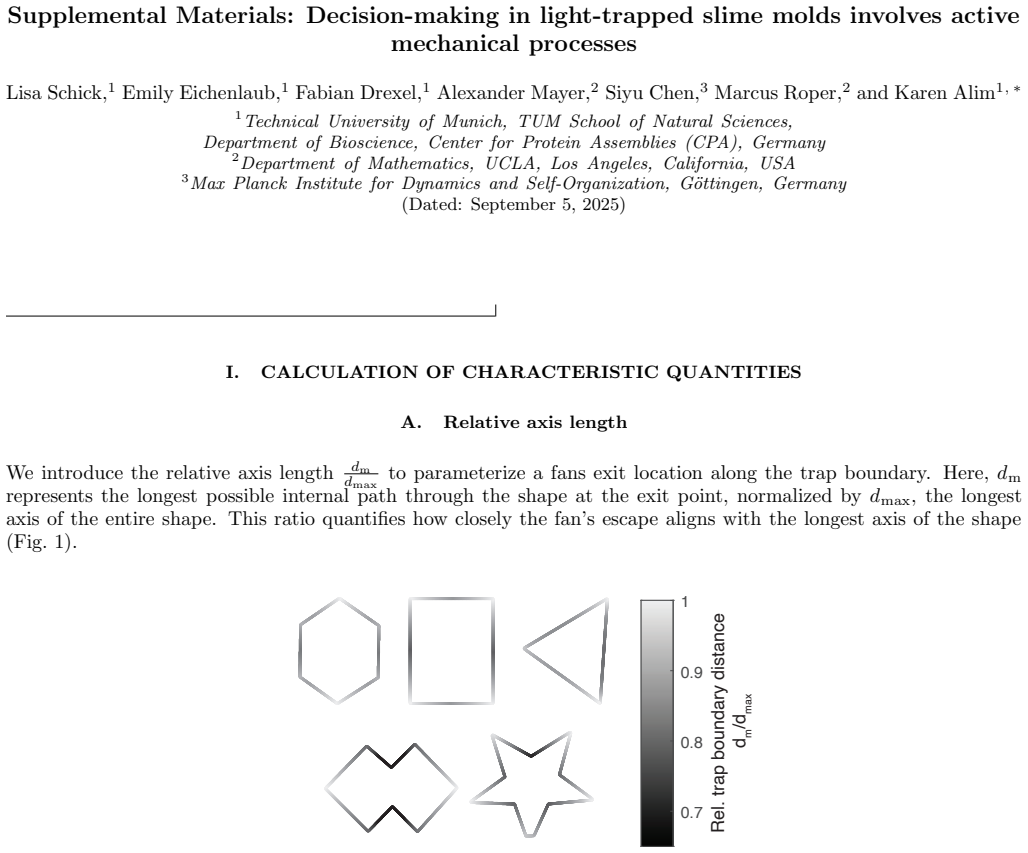
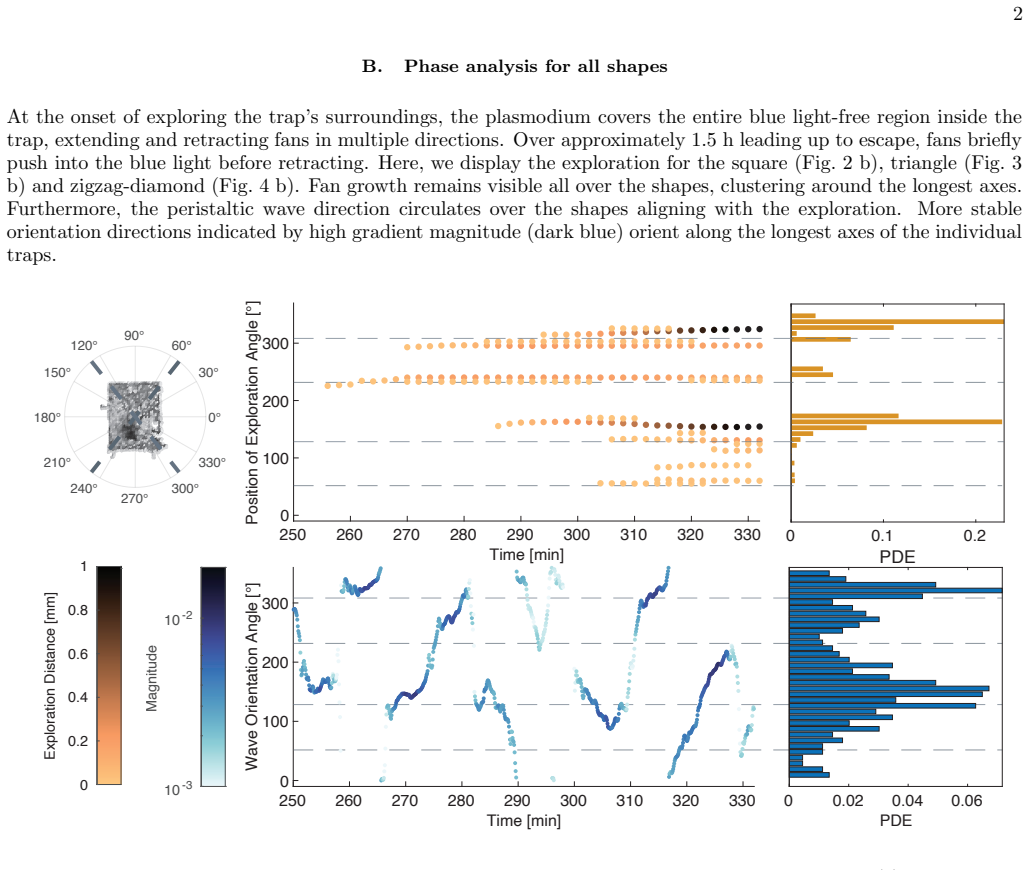
On the paper's own terms, the discovery is that decision-making in P. polycephalum is an active mechanical process carried by fluid transport. In blue-light traps shaped as hexagons, squares, triangles, zigzag polygons, and stars, plasmodia nearly fill the trap and then spend roughly 1.5 hours making small, short-lived protrusions in many directions; the protrusion that finally escapes is consistently located near the longest internal axis. Phase analysis of bright-field images shows that the peristaltic wave reorients during exploration and stabilizes along the escape axis about 20 minutes before escape. PCA of the contraction patterns reveals distinct standing-wave modes whose relative activities switch over time, with the mode aligned with the escape direction dominating at the transition to escape. A theoretical flow network built on the trap geometry, with dissipation split into a net-transport term and an oscillatory-flow term, yields SVD-ranked pressure modes; the most efficient mode aligns with the observed escape direction once the experimentally observed hole in the network is inserted into the model. The paper concludes that harsh confinement forces the organism to settle into the transport-optimal contraction mode, and that the preceding exploration is an out-of-equilibrium sampling of less efficient modes.
Load-bearing premise
The load-bearing premise is that the organism's network can be treated as a simple uniform network of tubes, that the fluid-dissipation ratio in the model is the actual cost that makes one contraction mode win, and that adding the experimentally observed hole to that idealized network fairly reproduces the escape direction.
Editorial extensions
If this is right
- Across five trap shapes, the escaping protrusion consistently leaves near the longest internal axis, so the longest axis is a behavioral signature of the transport-optimization process.
- The peristaltic wave is not locked to one direction during exploration; it switches among long-axis directions and only stabilizes about 20 minutes before escape, so exploratory protrusions track the instantaneous wave direction.
- Distinct PCA contraction modes support distinct behavioral phases: modes 2–5 dominate the early exploration while mode 1, aligned with the escape route, dominates the transition to escape.
- Network topology, not just the outer confinement shape, sets the efficient transport mode: inserting the observed hole rotates the theoretically dominant mode onto the observed escape angle.
- Harsh confinement is what triggers the optimal behavior; freely migrating plasmodia of comparable size move fast enough that a less efficient route would suffice, so optimal transport is a response to constraint, not a default state.
Reading between the lines
- The paper does not say this, but the same SVD efficiency spectrum could be used as a forward predictor: in a new trap geometry whose network topology, including holes, is known, the model should predict the escape direction before the organism escapes.
- The paper does not say this, but if the dissipation-ratio efficiency truly governs mode selection, then artificially creating or removing a hole in the network should rotate the eventual escape direction in the direction the model predicts.
- The paper does not say this, but the observed switching among PCA modes could be interpreted as a stochastic search over the dissipation landscape; recording the switching statistics would let one test whether the organism samples modes in proportion to their predicted efficiency.
Signed reviews
Editorial analysis
A structured set of objections, weighed in public.
Referee Report
Summary. The paper studies how the slime mold Physarum polycephalum explores and escapes from blue-light traps of different polygonal shapes. The authors report three main findings: (1) across 32 plasmodia in five trap shapes, escape consistently occurs along the longest axis of the shape; (2) during a ~1.5 h exploration phase, protrusions emerge around nearly the entire boundary and their angular positions correlate qualitatively with the orientation of the peristaltic contraction wave; and (3) principal component analysis of contraction patterns shows switching among contraction modes, and a theoretical dissipation-based network model is claimed to show that the organism ultimately settles on the contraction mode most efficient for fluid transport, which coincides with the escape direction. The theoretical identification is obtained by computing SVD modes of a dissipation-ratio efficiency matrix on a uniform relative-neighborhood graph of the trap, and then inserting the observed hole in the hexagonal network to rotate the predicted dominant mode toward the observed escape angle.
Significance. If the central mechanistic claim were fully supported, the paper would be an important advance: it connects decision-making in a non-neural organism to measurable mechanical quantities (peristaltic flow, contraction modes, dissipation) and makes a falsifiable prediction about how network topology should reshape transport modes. The escape-along-longest-axis result is well supported by a large sample (32 plasmodia, five shapes) and is a clean, quantitative behavioral finding. The paper also promises to release data and code. However, the stronger claim—that the organism settles on the transport-optimal contraction mode—rests on a single hexagonal exemplar, on qualitative visual comparisons between experimental and theoretical modes, and on a theoretical model that is adjusted post hoc by inserting an observed hole. These limitations are substantial enough that the paper cannot be accepted without additional evidence or a substantial softening of the claim.
major comments (4)
- [Confinement sets contraction mode optimized for transport (Fig. 4a–b)] The central claim that the organism settles on the most efficient transport mode is not independently supported. The default relative-neighborhood graph of the hexagonal trap predicts the first transport mode along the vertical axis, while the observed escape is approximately 160° (roughly horizontal); the text states that the default orientations are "consistent" with the experimental PCA modes, but Fig. 3c shows the dominant experimental mode 1 as horizontal and modes 2–3 as vertical, so the ordering is actually mismatched. Agreement is achieved only after manually inserting the observed large hole into the network, which rotates the first mode to 120° and the second to 30°, and the text then appeals to their combination to reach ~160°. This is a post hoc calibration, not a prediction, and no quantitative criterion is given for how the two modes combine to yield the escape angle. Because the hole arises from the same exploratory process under study, using it as a fixed input conflates cause and consequence.
- [Varying activation of contraction modes during exploration (Fig. 3)] The PCA-based mode-switching analysis and the association of mode 1 with escape are presented for a single plasmodium in a hexagonal trap. No replicate numbers, error bars, or statistical tests are given for the mode structures, the temporal activity traces, or the mode-versus-protrusion comparison across the 32 recorded plasmodia or across the five shapes. The statement that "the transition to escape behavior is primarily associated with mode 1" is therefore an observation about one individual, not a general result. The paper should either provide multi-individual PCA analyses (at least two or three per shape) or explicitly reframe the PCA section as a case study that motivates, rather than establishes, the optimization claim.
- [Transport efficient flow modes (Methods)] The theoretical efficiency metric depends on assumptions that are not tested or justified for Physarum. The model assumes a uniform relative-neighborhood graph with equal edge lengths and radii, and defines efficiency as the ratio of Hagen–Poiseuille dissipation to oscillatory-flow dissipation. This ratio is introduced as an axiom rather than derived from measured energy expenditure, and the predicted "most efficient" mode is likely sensitive to this choice. No sensitivity analysis is provided for the grid spacing, the graph construction rule, the cost function, or the size and placement of the inserted hole. Given that the key theoretical result is obtained only after modifying the default network, the paper should demonstrate that the predicted dominant mode is robust to reasonable perturbations of these modeling choices.
- [Orientation of peristaltic wave aligns with location of protrusion (Fig. 2)] The claim that protrusion growth aligns with peristaltic wave orientation is supported only by qualitative visual comparison of a single hexagonal example and single examples for the other shapes in the supplementary figures. No quantitative correlation, circular statistics, or hypothesis test is reported between the angular position of protrusions and the wave orientation over time. The assertion that the wave "stabilizes" around 150° before escape is based on inspection of one time series. This is a load-bearing part of the argument that peristaltic waves drive exploration, so a quantitative measure (e.g., circular correlation, or a comparison of wave-orientation distributions during successful versus retracted protrusion events) is needed.
minor comments (5)
- [Abstract] The word "polygones" should be "polygons."
- [Fig. 3a caption and text] "principle contraction modes" should be "principal contraction modes" in several places, including the Fig. 3a caption and the section heading "Varying activation of contraction modes during exploration."
- [Transport efficient flow modes and Discussion] "Single Value Decomposition" should be "Singular Value Decomposition" (two occurrences).
- [Bibliography] Reference [19] has a stray leading comma: "[19] , B. Y. Hayden" should be "[19] B. Y. Hayden."
- [Fig. 1d caption] The caption mentions "light orange shaded data points," but the figure description does not define the shading in a way that would allow a reader to distinguish exploration from escape protrusions in grayscale printing; consider adding a legend or marker-style distinction.
Circularity Check
The efficiency-optimization claim is partly circular: the theoretical 'most efficient' mode matches the observed escape only after the observed hole is inserted into the network model.
-
fitted input called prediction
[Results, 'Confinement sets contraction mode optimized for transport', Fig. 4b]
"when considering the actual topology observed in the experiment, specifically the large hole in the top-right part of the network, we find that the theoretically optimal transport direction shifts. By incorporating this hole into the theoretical model, the dominant transport mode rotates to align along the 120◦-axis (Fig.4b). Together with the second mode, oriented along the 30◦-axis, this results in the most efficient transport aligned with the observed escape direction, approximately 160◦."
The theoretical 'most efficient transport mode' is computed from the network graph. With the default uniform relative-neighborhood graph, the first mode is vertical, while the observed escape is approximately 160 degrees. Agreement is achieved only after inserting the large hole observed in the same organism into the model. The hole is part of the very exploration/escape process being explained and may itself be a product of the contraction-driven reorganization, so using it as a fixed input makes the theoretical mode a recalibrated consistency check rather than an independent prediction.
full rationale
The escape-along-the-longest-axis result is well supported and independent: it uses 32 plasmodia in five trap shapes, and the escape direction is measured separately from the contraction analysis. The PCA mode-1 activation at escape and the stabilization of the peristaltic wave around the escape direction are also independent experimental observations. However, the theoretical identification of the 'most efficient transport mode' is not independent. The default model predicts the vertical axis as most efficient, contradicting the observed roughly 160-degree escape; the agreement is restored only when the observed hole is inserted into the network. That hole is not a parameter-free prediction of the model; it is taken from the same organism and may be an outcome of the same contraction dynamics the model is invoked to explain. The paper presents this as demonstrating that local topology reshapes transport modes, but the central efficiency-selection claim needs this calibrated example as its only direct theoretical support. Same-group citations to Fleig et al. [15] and Wilkinson et al. [54] supply methods and the dissipation relation, but they are not the source of the circularity; the circularity is the post hoc incorporation of the observed topology into the calculation that is then used to validate the behavioral claim. Thus the paper's strongest 'optimality' claim is partially circular, while its more modest empirical findings remain sound.
Assumptions & free parameters
free parameters (4)
- gridfit smoothing parameter (phase analysis) =
30
- gridfit smoothing parameter (mode directionality) =
10
- gridfit grid point count =
70 x 70
- contraction period moving window =
120 s
assumptions (6)
- domain assumption The dissipation model from Wilkinson et al. [54], Q = Gamma * dV/dt and D_ij = Q_ij^2/kappa_ij + (1/12) kappa_ij (dV_ij/dt)^2, correctly describes the energetic cost of transport in P. polycephalum networks.
- domain assumption PCA modes of bright-field intensity fluctuations represent the physical contraction modes (standing waves) of the plasmodium, as established in Fleig et al. [15].
- domain assumption The Hilbert-transform phase of detrended, smoothed pixel intensities faithfully tracks local contraction phase.
- domain assumption The network can be represented as a relative-neighborhood graph with uniform edge lengths and uniform tube thickness for computing theoretical efficiency modes.
- ad hoc to paper The efficiency of a transport mode is the ratio of the net-transport dissipation to the oscillatory-flow dissipation, and SVD of this ratio identifies the modes the organism should preferentially adopt.
- domain assumption Blue light at 470 nm acts primarily as an avoidance cue and does not fundamentally alter the contraction mechanics under study.
Cite this review
Pith. "Pith review of Decision-making in light-trapped slime molds involves active mechanical processes." pith.science (2026). https://pith.science/paper/OJJUQRSE
@misc{pith2026250612803,
  author       = {Pith},
  title        = {Pith review of: Decision-making in light-trapped slime molds involves active mechanical processes},
  year         = {2026},
  howpublished = {\url{https://pith.science/paper/OJJUQRSE}},
  note         = {Machine review of arXiv:2506.12803}
}
read the original abstract
Decision-making is the process of selecting an action among alternatives, allowing biological and artificial systems to navigate complex environments and optimize behavior. While neural systems rely on neuron-based sensory processing and evaluation, decision-making also occurs in organisms without a centralized organizing unit, such as the unicellular slime mold \textit{Physarum polycephalum}. Unlike neural systems, P. polycephalum relies on rhythmic peristaltic contractions to drive internal flows and redistribute mass, allowing it to adapt to its environment. However, while previous studies have focused on the outcomes of these decisions, the underlying mechanical principles that govern this mass relocation remain unknown. Here, we investigate the exploration process of P. polycephalum confined by blue light into polygonal shapes up to its escape. While the escape occurs along the longest axis of the polygones, independent of confinement shape, the exploration process prior to escape extends protrusions almost everywhere around a shape boundary. We find protrusions to align with the direction of peristaltic contraction waves driving mass relocation. Mapping out contraction modes during exploration in detail we observe an ongoing switching between different dominant principle contraction modes. Only over the course of time does the organism ultimately settle on the contraction mode most efficient for transport, which coincides with the escape. Thus, we find that only harsh environmental confinement triggers optimal behaviour which is reached by long time re-organization of the flow patterns. Our findings provide insights into the mechanics of decision-making in non-neuronal organisms, shedding light on how decentralized systems process environmental constraints to drive adaptive behavior.
Figures


Figures from the paper (5 more)



Reference graph
Works this paper leans on
- [1]
-
[2]
K. Alim, G. Amselem, F. Peaudecerf, M. P. Brenner, and A. Pringle. Random network peristalsis inPhysarum polycephalumorganizes fluid flows across an individ- ual.Proceedings of the National Academy of Sciences, 110(33):13306–13311, Aug. 2013
work page 2013
-
[3]
S. Alonso, U. Strachauer, M. Radszuweit, M. B¨ ar and M. Hauser. Oscillations and uniaxial mechanochemical waves in a model of an active poroelastic medium: Appli- cation to deformation patterns in protoplasmic droplets ofPhysarum polycephalum.Physica D: Nonlinear Phe- nomena, 318–319:58–69, Apr. 2016
work page 2016
-
[4]
F. K. B¨ auerle, S. Karpitschka, and K. Alim. Living sys- tem adapts harmonics of peristaltic wave for cost-efficient optimization of pumping performance.Phys. Rev. Lett., 124(9):098102, Mar. 2020
work page 2020
-
[5]
F. K. B¨ auerle, M. Kramar, and K. Alim. Spatial mapping reveals multi-step pattern of wound healing inPhysarum polycephalum.J. Phys. D: Appl. Phys., 50(43):434005, Nov. 2017
work page 2017
-
[6]
W. Baumgarten and M. J. B. Hauser. Dynamics of frontal extension of an amoeboid cell.EPL, 108(5):50010, Dec. 2014
work page 2014
- [7]
-
[8]
A. Boussard, A. Fessel, C. Oettmeier, L. Briard, H. G. D¨ obereiner, and A. Dussutour. Adaptive behaviour and learning in slime moulds: the role of oscillations. Phil. Trans. R. Soc. B376(1820), 20190757, 2021
work page 2021
Show all 56 references
-
[9]
K. L. Briggman, H. D. I. Abarbanel and W. B. Kristan. Optical imaging of neuronal populations during decision- making.Science307(5711):896–901, Feb. 2005
2005
-
[10]
Chen and K
S. Chen and K. Alim. Network topology enables efficient response to environment inPhysarum polycephalum. Phys. Biol., 20(4):046003, July 2023
2023
-
[11]
F. Corson. Fluctuations and redundancy in optimal transport networks.Phys. Rev. Lett., 104(4):048703, Jan. 2010
2010
-
[12]
D’Errico
J. D’Errico. Surface Fitting using gridfit, 2023
2023
-
[13]
Dussutour, T
A. Dussutour, T. Latty, M. Beekman, and S. J. Simp- son. Amoeboid organism solves complex nutritional chal- lenges.Proc Natl Acad Sci USA107, 4607–4611, 2010
2010
-
[14]
Eckert, M
L. Eckert, M. S. Vidal-Saez, Z. Ziyuan, J. Garcia-Ojalvo, R. Martinez-Corral and J. Gunawardena. Biochemically plausible models of habituation for single-cell learning. Current Biology, 34(24):5646-5658.e3, Dec. 2024
2024
-
[15]
Fleig, M
P. Fleig, M. Kramar, M. Wilczek, and K. Alim. Emer- gence of behaviour in a self-organized living matter net- work.eLife11, e62863, Jan. 2022
2022
-
[16]
Fukasawa, M
Y. Fukasawa, M. Savoury and L. Boddy. Ecological memory and relocation decisions in fungal mycelial net- works: responses to quantity and location of new re- sources.ISME J.14(2), 380–388, Feb. 2020
2020
-
[17]
L. N. Groschner, L. Chan Wah Hak, R. Bogacz, S. Das- Gupta and G. Miesenb¨ ock. Dendritic integration of sensory evidence in perceptual decision-making.Cell, 173(4):00928674, Mai 2018
2018
-
[18]
M. Hato, T. Ueda, K. Kurihara and Y. Kobatake. Pho- totaxis in true slime moldPhysarum polycephalum.Cell Struct. Funct., 1(3):269–278, 1976
1976
-
[19]
, B. Y. Hayden, J. M. Pearson and M. L. Platt. Neu- ronal basis of sequential foraging decisions in a patchy environmentNat. Neurosci.14(7), 933–939, July 2011
2011
-
[20]
Hu and D
D. Hu and D. Cai. Adaptation and optimization of biological transport networks.Phys. Rev. Lett., 111(13):138701, Sept. 2013
2013
-
[21]
Huang, L
L.T. Huang, L. Bich and W. Bechtel. Model organism for studying decision-making: A phylogenetically expanded perspective.Philos. of Sci., 88(5):1055–1066, Dec. 2021
2021
-
[22]
Kakiuchi and T
Y. Kakiuchi and T. Ueda. Multiple oscillations in changing cell shape by the plasmodium ofPhysarum polycephalum: General formula governing oscillatory phenomena by thePhysarumplasmodium.Biological Rhythm Research, 37(2):137–146, Apr. 2004
2004
-
[23]
N. Kamiya. Physical and chemical basis of cytoplasmic streaming.Annu. Rev. Plant. Physiol., 32(1):205–236, 1981
1981
-
[24]
Katifori, G
E. Katifori, G. J. Sz¨ oll˝ osi, and M. O. Magnasco. Dam- age and fluctuations induce loops in optimal transport networks.Phys. Rev. Lett., 104(4):048704, Jan. 2010
2010
-
[25]
Kramar and K
M. Kramar and K. Alim. Encoding memory in tube di- ameter hierarchy of living flow network.Proc. Natl. Acad. Sci. U.S.A, 118(10):e2007815118, Mar. 2021
2021
-
[26]
Kscheschinski, M
B. Kscheschinski, M. Kramar and K. Alim. Calcium regulates cortex contraction inPhysarum polycephalum. Phys. Biol.21(1):016001, Jan. 2024
2024
-
[27]
Kuroda, S
S. Kuroda, S. Takagi, T. Nakagaki, and T. Ueda. Allom- etry in Physarum plasmodium during free locomotion: Size versus shape, speed and rhythm.Journal of Exper- imental Biology, 218(23):3729–3738, Dec. 2015
2015
-
[28]
Latty and M
T. Latty and M. Beekman. Food quality affects search strategy in the acellular slime mould,Physarum poly- cephalum.Behavioral Ecology, 20(6):1160–1167, 2009
2009
-
[29]
Latty and M
T. Latty and M. Beekman. Food and the risk of light exposure affect patch-choice decisions in the slime mold 11 Physarum polycephalum.Ecology, 91(1):22–27, 2010
2010
-
[30]
Latty and M
T. Latty and M. Beekman. Speed–accuracy trade-offs during foraging decisions in the acellular slime mould Physarum polycephalum.Proc. R. Soc. B, 278(1705):539– 545, 2011
2011
-
[31]
Matsumoto, S
K. Matsumoto, S. Takagi and T. Nakagaki. Locomotive mechanism of Physarum plasmodia based on spatiotem- poral analysis of protoplasmic streaming.Biophysical Journal, 94(7):2492–2504, Apr. 2008
2008
-
[32]
Y. Mori, K. Matsumoto, T. Ueda and Y. Kobatake. Spatio-temporal organization of intracellularATPcon- tent and oscillation patterns in response to blue light byPhysarum polycephalum.Protoplasma, 135(1):31–37, Feb. 1986
1986
-
[33]
C. D. Murray. The physiological principle of minimumi work. I. The vascular system and the cost of blood vol- ume.Proc Natl Acad Sci USA, 12:8, 1926
1926
-
[34]
Nakagaki, S
T. Nakagaki, S. Umemura, Y. Kakiuchi and T. Ueda. Action spectrum for sporulation and photoavoidance in the plasmodium ofPhysarum polycephalum, as modified differentially by temperature and starvation.Photochem. Photobiol., 64(5):859–862, Nov. 1996
1996
-
[35]
Nakagaki
T. Nakagaki. Smart behavior of true slime mold in a labyrinth.Research in Microbiology152(9):767–770, Nov. 2001
2001
-
[36]
T Nakagaki, M. Iima, T. Ueda, Y. Nishiura, T. Saigusa, A. Tero, R. Kobayashi and K. Showalter. Minimum-risk path finding by an adaptive amoebal network.Phys. Rev. Lett., 99(6):068104, Aug. 2007
2007
-
[37]
Oettmeier and H.-G
C. Oettmeier and H.-G. D¨ obereiner. A lumped pa- rameter model of endoplasm flow inPhysarum poly- cephalumexplains migration and polarization-induced asymmetry during the onset of locomotion.PLoS ONE, 14(4):e0215622, Apr. 2019
2019
-
[38]
Oettmeier, J
C. Oettmeier, J. Lee, and H.-G. D¨ obereiner. Form fol- lows function: Ultrastructure of different morphotypes ofPhysarum polycephalum.J. Phys. D: Appl. Phys., 51(13):134006, Apr. 2018
2018
-
[39]
C. R. Reid, H. MacDonald, R. P. Mann, J. A. R. Mar- shall, T. Latty and S. Garnier. Decision-making with- out a brain: How an amoeboid organism solves the two- armed bandit.J. R. Soc. Interface, 13(119):20160030, June 2016
2016
-
[40]
C. R. Reid, T. Latty, A. Dussutour and M. Beekman. Slime mold uses an externalized spatial ”memory” to navigate in complex environments.Proc. Natl. Acad. Sci. U.S.A, 109(43):17490–17494, Oct. 2012
2012
-
[41]
Rodiek, S
B. Rodiek, S. Takagi, T. Ueda and M. Hauser. Patterns of cell thickness oscillations during directional migration ofPhysarum polycephalum.Eur. Biophys. J., 44(5):349– 358, July 2015
2015
-
[42]
Ronellenfitsch and E
H. Ronellenfitsch and E. Katifori. Phenotypes of vascular flow networks.Phys. Rev. Lett., 123(24):248101, Dec. 2019
2019
-
[43]
Samaha, L
J. Samaha, L. Iemi, S. Heagens and N. A. Busch. Sponta- neous brain oscillations and perceptual decision-making. Trends in Cognitive Science24(8):639–653, Aug. 2020
2020
-
[44]
Schick, M
L. Schick, M. Kramar and K. Alim. Dynamic cost allo- cation allows network-forming forager to switch between search strategies.PRX Life2(3):033005, Aug. 2024
2024
-
[45]
Schreckenbach, B
T. Schreckenbach, B. Walckhoff and C. Verfuerth. Blue- light receptor in a white mutant ofPhysarum poly- cephalummediates inhibition of spherulation and regula- tion of glucose metabolism.Proc. Natl. Acad. Sci. U.S.A. 78(2), 1009–1013, 1981
1981
-
[46]
Schenz, Y
D. Schenz, Y. Shima, S. Kuroda, T. Nakagaki, and K.- I. Ueda. A mathematical model for adaptive vein for- mation during exploratory migration ofPhysarum poly- cephalum: Routing while scouting.J. Phys. D: Appl. Phys., 50(43):434001, Nov. 2017
2017
-
[47]
Semechko
A. Semechko. Fast Fuzzy C-Means Image Segmentation.GitHubauthor = Semechko, Anton, date = 2024, location = GitHub, https://github.com/AntonSemechko/Fast-Fuzzy-C- Means-Segmentation, 2024
2024
-
[48]
L. S. Severino. Plants make smart decisions in complex environments.Plant Signaling & Behavior 16(11):1970448, Nov. 2021
2021
-
[49]
Takagi and T
S. Takagi and T. Ueda. Annihilation and creation of rotating waves by a local light pulse in a protoplasmic droplet of thePhysarum plasmodium.Physica D: Non- linear Phenomena, 239(11):873–878, June 2010
2010
-
[50]
Takagi and T
S. Takagi and T. Ueda. Emergence and transitions of dy- namic patterns of thickness oscillation of the plasmodium of the true slime moldPhysarum polycephalum.Physica D: Nonlinear Phenomena, 237(3):420–427
-
[51]
A. Tero, R. Kobayashi and T. Nakagaki. Physarum Solver: A biologically inspired method of road-network navigation.Physica A: Statistical Mechanics and its Ap- plications363(1):115–119, Apr. 2006
2006
-
[52]
A. Tero, S. Takagi, T. Saigusa, K. Ito, D. P. Bebber, M. D. Fricker, K. Yumiki, R. Kobayashi, and T. Nak- agaki. Rules for biologically inspired adaptive network design.Science, 327(5964), 439–442, Jan. 2010
2010
-
[53]
K.-I. Ueda, S. Takagi, Y. Nishiura and T. Nakagaki. Mathematical model for contemplative amoeboid loco- motion.Phys. Rev. E83(2):021916, Feb. 2011
2011
-
[54]
Wilkinson, M
R. Wilkinson, M. Koziol, K. Alim and M. Roper. Flow modes provide a quantification ofPhysarumnetwork peristalsis.Fungal Ecology, 65:101283, Oct. 2023
2023
-
[55]
K. E. Wohlfarth-Bottermann. Oscillatory contraction ac- tivity inPhysarum J. exp. Biol., 81:15–32, 1979
1979
-
[56]
Zhang, J
S. Zhang, J. C. Lasheras and J. C. ´Alamo. Symme- try breaking transition towards directional locomotion inPhysarummicroplasmodia.J. Phys. D: Appl. Phys., 52(49):494004, Dec. 2019. Supplemental Materials: Decision-making in light-trapped slime molds involves active mechanical ...
2019
Reviewed August 7, 2026 · model on record in the stance chip above.
Discussion (0). Continue with ORCID to comment.