REVIEW 3 major objections 6 minor 12 references
Emergent Collaborative Deliberation in Multi-Model AI Systems: A BFT-Derived Protocol for Epistemic Synthesis
T0 review · 3 major / 6 minor · reviewed 2026-07-13 · grok-4.5
Pith's one-line read Cognitive personas, not model size, set how multi-model AI panels reason—and free models can match frontier ones while exposing RLHF blind spots.
desk verdict Solid systems paper with real scale and a usable IS/OOS + persona package; the RLHF causal story is the soft center, not the whole contribution. read the letter →
The pith
A machine-rendered reading of the paper's core claim, the machinery that carries it, and where it could break.
The reading
What carries the argument
The Consilium Protocol: a BFT-derived panel architecture that assigns composable cognitive personas (Model × Persona × Skills) under an adversarial–integrator dyad constraint, measures challenge coverage with a Convergence Index (CI), and separates in-sample panel deliberation from out-of-sample live evidence retrieval in a signal matrix that flags stale consensus, false debates, and blind spots.
What would settle it
Rerun the same 32 topics with matched base (pre-RLHF) and post-RLHF versions of the same models under identical persona and panel constraints; if the 12.3 pp CI gap and the 11.6% AI-risk asymmetry shrink or reverse on base models, the RLHF attribution fails.
Extended reading notes
Core claim
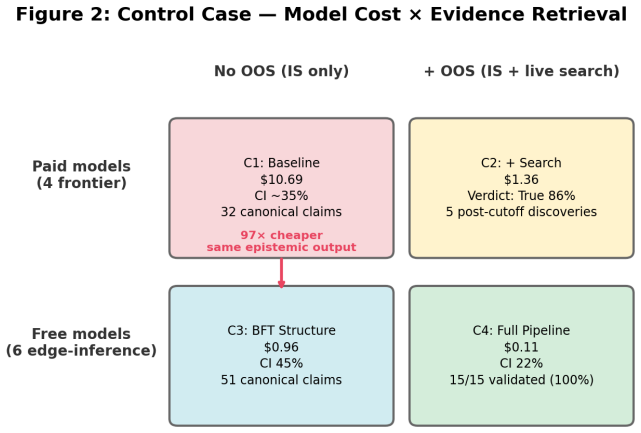
Structured multi-model deliberation under engineered cognitive personas and out-of-sample evidence validation produces more thoroughly tested claim maps than single-model generation. Across 1,478 sessions, the cognitive persona—not the underlying model—determines epistemic behavior: free edge models matched frontier models at roughly 97× lower cost; RLHF creates measurable domain-specific blind spots (12.3 pp less challenge on contested policy versus settled science; AI-risk asymmetry Δ=11.6%); the protocol itself is directionally unbiased on non-AI pairs; and live evidence validated 239 claims (100% retrieval) while surfacing 167 blind-spot discoveries, with run-to-run reproducibility of ±2
Load-bearing premise
That lower challenge rates on contested policy and AI-risk topics mainly measure RLHF alignment suppression rather than topic structure, evidence scarcity, cultural charge, or the engineered personas themselves—the design does not compare base models to RLHF-tuned ones.
Editorial extensions
If this is right
- Persona design, not model selection, becomes the primary epistemic design lever; cheap models can replace expensive ones for panel deliberation.
- Low Convergence Index on contested topics can triage live-search budget toward claims most likely to be stale or alignment-compressed.
- Multi-model panels with forced adversarial personas can surface institutional alignment biases (e.g., AI-risk asymmetry) that single models hide.
- Preserving structured disagreement as claim chains with explicit justification status gives humans an audit trail instead of a single certified verdict.
- Domain velocity (slow/medium/fast) predicts OOS dependency, enabling cost-aware epistemic pipelines.
Reading between the lines
- If persona is the unit of design, open libraries of calibrated personas could become shared infrastructure the way model weights are today.
- The same CI and IS/OOS diagnostics could measure conformity pressure in human expert panels or hybrid human–AI deliberation.
- Persona-guided selective search (flagged as future work) would likely cut OOS cost by skipping the large share of queries that only confirm already-correct in-sample claims.
- If the AI-risk asymmetry replicates across labs, it becomes a concrete external-audit metric for alignment-training side-effects.
Editorial analysis
A structured set of objections, weighed in public.
Referee Report
Summary. The paper introduces the Consilium Protocol, a BFT-inspired multi-model deliberation architecture that assigns engineered cognitive personas (separating model identity from reasoning posture), uses a moderator gate, and applies an In-Sample/Out-of-Sample (IS/OOS) validation framework adapted from quantitative finance. Across 1,478 sessions on 32 topics in 10 categories, it reports that (1) persona, not base model, drives epistemic behavior, with free edge models producing comparable claim registries to frontier models at ~97× lower cost; (2) contested/policy topics show lower Convergence Index (CI) than settled science (12.3 pp HISTORICAL–NORMATIVE gap) and an AI-risk contradictory-pair asymmetry of Δ=11.6%; (3) the protocol itself is directionally unbiased on immigration and renewables pairs; and (4) OOS retrieval validated 239 claims (100% retrieval) and surfaced 167 scout discoveries, with run-to-run CI reproducibility ±2.2%. Supporting elements include a 2×2 cost×search control, a BFT-structure ablation, a five-filter pipeline, and an explicit limitations section.
Significance. If the core architectural and empirical results hold, the work offers a practical, low-cost alternative to single-model or consensus-seeking multi-agent systems for epistemic auditing: structured disagreement as signal, persona as the unit of design, and IS/OOS separation to break training-data monoculture. Strengths that raise the contribution above pure systems description include the large multi-category battery, the cost×search 2×2 and BFT ablation, contradictory-pair bias tests, reported reproducibility (±2.2%), full OOS validation counts, and MIT release of the protocol specification. Even if the RLHF causal attribution is weakened, the persona-vs-model cost result, protocol-level unbiasedness on non-AI pairs, and the IS/OOS signal matrix remain useful for multi-agent deliberation research and for practitioners seeking transparent claim chains rather than single verdicts.
major comments (3)
- Abstract bullet (2) and §6.3 Findings 7–8 present the 12.3 pp HISTORICAL–NORMATIVE CI gap and the AI-risk Δ=11.6% as evidence that “RLHF alignment training creates measurable, domain-specific epistemic blind spots.” §7.4 Limitations and the three-variable model (CI = f(evidence_quality, cultural_charge, RLHF_pressure)) correctly note that the design does not isolate RLHF (no base-model vs RLHF-tuned contrast on matched topics). Without that control, the gaps remain descriptive category differences that could reflect topic structure, evidence density, cultural charge, or persona pressure. The causal language in the abstract and findings should be revised to match the admitted design limit, or a base-vs-RLHF experiment should be added; otherwise the load-bearing second claim overreaches the evidence.
- §3.5 and §6.3: CI is defined inside the protocol (supermajority alignment / embedding similarity under adversarial persona composition) and is then used both as a health diagnostic and as the primary measure of “RLHF suppression.” Because adversarial personas and BFT composition are engineered to increase challenge (and thus lower CI), low CI on contested topics is partly by construction. The paper should either (a) report a non-persona or fixed-persona baseline that holds disposition constant while varying topic/RLHF status, or (b) clearly separate “challenge coverage under the protocol” from “alignment-induced suppression,” so that the metric is not used to validate the intervention that defines it.
- §5.1–§6.1 “comparable analytical output” (free vs frontier): the claim rests mainly on raw/canonical claim counts, dedup rates, CI, and 100% OOS validation of free-model claims. These are process metrics, not independent quality metrics (e.g., human-rated claim accuracy, completeness against a gold set, or downstream decision utility). Given that free models produced lower CI and higher dedup rates, the paper should either supply an external quality evaluation or narrow the claim to “comparable claim volume and OOS-testability under the same persona layer,” so that “comparable analytical output” is not overstated.
minor comments (6)
- §3.1 “laws” and Adversarial-Integrator Dyad Law: present these as empirically motivated design rules rather than laws until the supporting statistics (e.g., cacophony bound 7–26% CI) are tabulated with sample sizes.
- Figure/table numbering: the manuscript refers to Figures 1–7 and several tables; ensure every referenced figure (CI gradient, control 2×2, contradictory pairs, reproducibility, signal matrix, pipeline) is present and captioned in the submission package.
- §5.1: clarify exclusion criteria (CI=0% with swap_count≥2; incomplete rounds) and report how many sessions were dropped so that the 1,478 figure is fully auditable.
- References: several 2025–2026 arXiv items are fine for a preprint but should be checked for final citation form; also ensure consistency of author lists and titles (e.g., Zheng et al. BFT multi-agent work).
- Appendix B: persona schema is described but specific definitions are proprietary; for independent verification of the “persona not model” claim, at least one fully specified example persona (or a public subset) would strengthen reproducibility beyond the MIT protocol release.
- Notation: CI is sometimes reported as percentage (13.8%) and sometimes as proportion in the RoC formula; standardize and define supermajority threshold explicitly once.
Circularity Check
No load-bearing circular derivation; mild dual-use of Convergence Index as both protocol health metric and primary RLHF evidence, without results forced by construction.
-
other
[§3.5 Convergence Detection; §6.3 V2 Battery CI gradient / Findings 7–8; Abstract bullet (2)]
"CI inversely correlates with evidence quality — low CI = more challenges = better-tested claims. High CI is a warning signal, not a success metric. ... The RLHF suppression gap: 12.3 percentage points (HISTORICAL 38.4% − NORMATIVE 26.1%). ... RLHF alignment training creates measurable, domain-specific epistemic blind spots — contested policy topics exhibit 12.3 percentage points less adversarial challenge than settled science topics"
CI is defined as a within-protocol diagnostic of panelist alignment under engineered adversarial/integrator personas, then the same CI category gradient is treated as primary evidence that RLHF suppresses challenge. The instrument and the claimed phenomenon share the protocol’s design (personas are built to force challenge; CI measures residual agreement). This is dual-use of an internal metric, not a forced identity: personas are held fixed across topics, so cross-topic CI variation is still empirical. Causal isolation of RLHF is missing (Limitations §7.4), but that is identification failure, not definitional circularity.
full rationale
This is an empirical systems paper, not a first-principles derivation. Core claims (persona vs model cost parity, OOS 100% retrieval and 167 scout discoveries, contradictory-pair protocol bias near zero on immigration/renewables, run-to-run CI reproducibility ±2.2%) are measured against external search evidence and randomized model×persona assignments, not fitted parameters renamed as predictions. There is no self-citation chain: the single author (VD Doske) does not invoke prior uniqueness theorems or load-bearing results by the same authors; BFT, debate, and RLHF citations are external literature. The only mild circularity risk is that CI is defined inside the protocol (alignment/challenge coverage under engineered adversarial personas) and then used as the main quantitative evidence that RLHF creates domain blind spots. That is dual-use of an internal instrument, not a reduction by construction: the same persona constraints are held fixed while CI varies across topics, so topic differences are empirical rather than definitional. Causal attribution of those differences specifically to RLHF (vs evidence density, cultural charge, or training-data composition) is underdetermined—as the paper’s own Limitations admit—but underdetermination is an identification/correctness issue, not circularity. Score 2 reflects one non-load-bearing dual-use concern; central results remain independently grounded.
Assumptions & free parameters
free parameters (5)
- CI echo-chamber / block threshold (~0.85) and RoC window (n=2 rounds)
- BFT adversarial-persona upper bound vs panel size
- Persona temperature and behavioral constraint settings
- Round budgets (typically 3–4 for 3-model, 2–3 for 6-model panels)
- Supermajority rule inside CI definition
assumptions (6)
- domain assumption Inter-model disagreement under structured challenge is primarily epistemic signal (information asymmetry / shared blind spots), not noise to minimize.
- ad hoc to paper PBFT-style coordinator/moderator gate and view-change substitutions transfer usefully from distributed systems safety to multi-model deliberation quality.
- domain assumption Live commercial web search is a valid out-of-sample check independent of model training distributions.
- ad hoc to paper Engineered cognitive personas can be separated from base model identity and reused as the main unit of epistemic design.
- ad hoc to paper Cross-category CI differences, especially HISTORICAL vs NORMATIVE/REGULATION and the AI-risk pair, largely reflect RLHF convergence pressure.
- domain assumption Standard multi-agent debate and RLHF diversity results (Du, Kirk, Santurkar, Wynn, etc.) correctly describe the failure modes the protocol claims to counter.
invented entities (5)
-
Consilium Protocol (BFT-derived multi-model deliberation with moderator gate)
-
Cognitive personas (engineered epistemic postures: disposition, domain focus, constraints)
-
Convergence Index (CI) as challenge-coverage diagnostic
-
IS/OOS signal matrix (six diagnostic states for claim×evidence)
-
Adversarial-Integrator Dyad Law and related structural laws (BFT composition, verifiability ceiling, etc.)
Cite this review
Pith. "Pith review of Emergent Collaborative Deliberation in Multi-Model AI Systems: A BFT-Derived Protocol for Epistemic Synthesis." pith.science (2026). https://pith.science/paper/OJNMMHFL
@misc{pith2026260600005,
  author       = {Pith},
  title        = {Pith review of: Emergent Collaborative Deliberation in Multi-Model AI Systems: A BFT-Derived Protocol for Epistemic Synthesis},
  year         = {2026},
  howpublished = {\url{https://pith.science/paper/OJNMMHFL}},
  note         = {Machine review of arXiv:2606.00005}
}
abstract
We present the Consilium Protocol, a Byzantine Fault Tolerance-derived architecture for structured multi-model AI deliberation that treats inter-model disagreement as epistemic signal rather than error. The protocol assigns engineered cognitive personas to language models -- separating what a model is from how it reasons -- and introduces an In-Sample/Out-of-Sample validation framework adapted from quantitative finance to distinguish training-data consensus from empirically grounded conclusions. Across 1,478 deliberation sessions spanning 32 topics in 10 domain categories, we demonstrate that (1) the cognitive persona, not the underlying model, determines epistemic behavior: free edge-inference models costing 0.0002 USD per batch produced comparable analytical output to frontier models costing 10.69 USD; (2) RLHF alignment training creates measurable, domain-specific epistemic blind spots -- contested policy topics exhibit 12.3 percentage points less adversarial challenge than settled science topics, and AI safety topics show asymmetric bias ($\Delta$=11.6%) where models challenge claims that AI is dangerous far more vigorously than claims that AI risk is overstated; (3) the protocol exhibits no directional bias of its own (immigration $\Delta$=2.3%, renewables $\Delta$=1.2%); and (4) out-of-sample evidence retrieval validated 239 claims with 100% evidence retrieval and surfaced 167 blind-spot discoveries invisible to training-data deliberation. Run-to-run reproducibility across randomized model$\times$persona assignments averages $\pm$2.2% standard deviation. Total cost for the complete battery including all overhead: 217 USD. We release the protocol specification under MIT license to enable independent verification.
Figures


Figures from the paper (4 more)


Reference graph
Works this paper leans on
-
[1]
Berdoz, F., Rugli, L., & Wattenhofer, R. (2026). Can AI Agents Agree? arXiv:2603.01213. Castro, M., & Liskov, B. (1999). Practical Byzantine Fault Tolerance. OSDI. Chakraborty, S., et al. (2024). MaxMin-RLHF. ICML
arXiv 2026
-
[2]
arXiv:2402.08925. Chen, Z., et al. (2025). Can LLM Agents Really Debate? arXiv:2511.07784. Cui, Z., et al. (2025). Free-MAD: Consensus-Free Multi-Agent Debate. arXiv:2509.11035. Dalio, R. (2011). Principles for Navigating Big Debt Crises. Bridgewater Associates. Doshi, A. R., & Haas, O. P. (2026). The Homogenizing Effect of LLMs on Human Expression. Trend...
arXiv 2025
-
[3]
arXiv:2305.14325. Estornell, A., et al. (2024). Multi-LLM Debate: Framework, Principals, and Interventions. NeurIPS
arXiv 2024
-
[4]
Fisher, M., et al. (2024). Reward Model Political Bias. MIT. Frigo, R. (2026). kalshi-ai-trading-bot [Software]. GitHub. Glosten, L. R., & Milgrom, P. R. (1985). Bid, Ask and Transaction Prices. JFE, 14(1), 71-100. Greenblatt, R., et al. (2024). Alignment Faking in Large Language Models. Anthropic. arXiv: 2412.14093. Gupta, T., et al. (2026). From Biased ...
arXiv 2024
-
[5]
Khan, A., et al. (2024). Debating with More Persuasive LLMs. arXiv:2402.06782. Kirk, R., et al. (2024). Understanding the Effects of RLHF on LLM Generalisation and Diversity. ICLR
arXiv 2024
-
[6]
arXiv:2310.06452. Kyle, A. S. (1985). Continuous Auctions and Insider Trading. Econometrica, 53(6), 1315-1335. Lamport, L., Shostak, R., & Pease, M. (1982). The Byzantine Generals Problem. ACM TOPLAS, 4(3), 382-401. Minsky, M. (1988). Society of Mind. Simon and Schuster. Park, J. S., et al. (2023). Generative Agents. UIST ’23. arXiv:2304.03442. Sachdeva, ...
arXiv 1985
-
[7]
Preprint — March 2026 31 Santurkar, S., et al. (2023). Whose Opinions Do Language Models Reflect? ICML
2026
-
[8]
arXiv: 2303.17548. Smit, A., et al. (2023). Should We Be Going MAD? arXiv:2311.17371. Tseng, Y ., et al. (2024). Two Tales of Persona in LLMs. EMNLP
arXiv 2023
Show all 12 references
-
[9]
Wolf, L., Yoon, S., & Bogunovic, I
arXiv:2406.01171. Wolf, L., Yoon, S., & Bogunovic, I. (2025). Exploring Deception and Robustness in Mixture of LLMs. arXiv:2503.05856. Wynn, O., Satija, H., & Hadfield, G. (2025). Talk Isn’t Always Cheap. ICML
2025 arXiv
-
[10]
Xie, J., et al
arXiv: 2509.05396. Xie, J., et al. (2024). Preference Collapse in RLHF. arXiv:2405.16455. Yang, Z., et al. (2025). Peacemaker or Troublemaker: Sycophancy in Multi-Agent Debate. arXiv:2509.23055. Zheng, L., et al. (2023). Judging LLM-as-a-Judge. NeurIPS
2024
-
[11]
Zhang, J., et al
arXiv:2306.05685. Zhang, J., et al. (2026). HyperAgents: Self-Referential Self-Improving Agents. arXiv: 2603.19461. Zheng, L., et al. (2025). Rethinking Multi-agent Reliability via BFT. arXiv:2511.10400. Appendix A: Control Case Reports Control case reports (C1–C4) are availab...
2026 arXiv
-
[12]
Preprint — March 2026 32
2026
Reviewed July 13, 2026 · model on record in the stance chip above.
Discussion (0). Sign in to comment.