LF-MightyPix: A second HV-MAPS prototype for the {LHCb} Mighty-Tracker
Pith reviewed 2026-06-25 21:55 UTC · model grok-4.3
The pith
LF-MightyPix prototype chip demonstrates compatibility with MightyPix requirements for 40 MHz bunch-crossing identification.
A machine-rendered reading of the paper's core claim, the machinery that carries it, and where it could break.
Core claim
The LF-MightyPix chip records both the time of arrival and the time over threshold for each pixel hit, and the presented results confirm that this functionality is compatible with the requirements for correct bunch-crossing identification at 40 MHz in the Mighty-Tracker.
What carries the argument
Time-of-arrival and time-over-threshold recording per pixel hit to ensure correct 40 MHz bunch-crossing identification.
If this is right
- The prototype is suitable for further integration into the Mighty-Tracker.
- The high-voltage CMOS process on high-resistivity wafers supports the needed timing performance.
- Recording both time of arrival and time over threshold allows correct identification at 40 MHz.
- Lab tests confirm compatibility with the requirements.
Where Pith is reading between the lines
- Additional testing in radiation and high-rate environments would be required to validate performance in real LHCb conditions.
- The chip size and pixel size choices may affect the overall tracker design and cost.
- This prototype approach could be adapted for other high-luminosity collider experiments.
Load-bearing premise
The laboratory measurements of time-of-arrival and time-over-threshold on this prototype chip are sufficient to guarantee correct 40 MHz bunch-crossing identification once the chip is installed in the actual LHCb radiation and rate environment.
What would settle it
A test showing failure to correctly identify the bunch crossing in a high-radiation, high-rate environment similar to LHCb operation.
Figures
read the original abstract
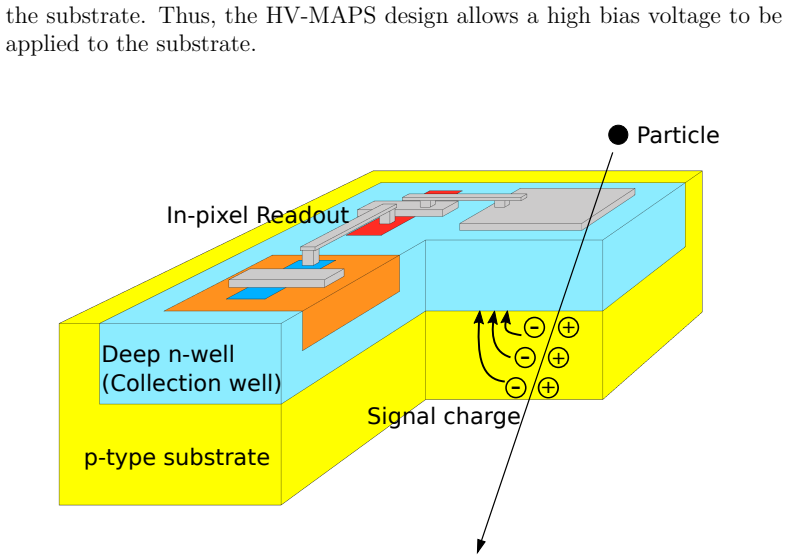
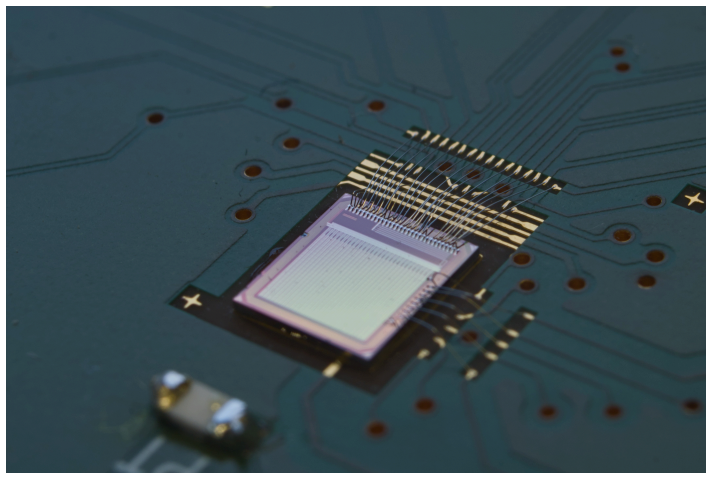
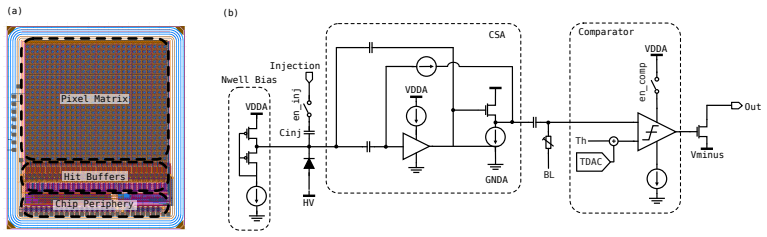
For the future high-luminosity operation of the LHCb experiment, the downstream tracker will be upgraded to the Mighty-Tracker. A key part of this upgrade is the introduction of silicon pixel detectors, MightyPix, in the central region of the tracker. We have developed MightyPix prototype chips using High-Voltage Monolithic Active Pixel Sensors fabricated in a commercially available CMOS process on high-resistivity wafers. The second prototype chip, LF-MightyPix, is fabricated in the LFoundry 150 nm CMOS process. LF-MightyPix has a chip size of 3.5 mm $\times$ 4.0 mm and a pixel size of 0.1 mm $\times$ 0.1 mm. For each pixel hit, both the time of arrival and the time over threshold are recorded to ensure correct bunch-crossing identification at 40 MHz. The results presented in this paper confirm compatibility with the MightyPix requirements.
Editorial analysis
A structured set of objections, weighed in public.
Referee Report
Summary. The manuscript describes LF-MightyPix, the second HV-MAPS prototype fabricated in the LFoundry 150 nm CMOS process on high-resistivity wafers for the LHCb Mighty-Tracker upgrade. The chip is 3.5 mm × 4.0 mm with 100 μm × 100 μm pixels; each hit records time-of-arrival and time-over-threshold to support 40 MHz bunch-crossing identification. The central claim is that the presented laboratory test results confirm compatibility with the MightyPix requirements.
Significance. If the timing performance measurements are shown to be robust, the work provides a concrete step toward radiation-tolerant monolithic pixel sensors for the high-luminosity LHCb downstream tracker, where precise ToA/ToT information is required for correct BCID in the inner region.
major comments (2)
- [Abstract] Abstract: the statement that 'the results presented in this paper confirm compatibility with the MightyPix requirements' is unsupported because no data, figures, error bars, test conditions, or quantitative metrics (e.g., timing resolution, threshold uniformity, noise) are supplied; the compatibility claim therefore rests entirely on an unshown extrapolation.
- [Results / Test sections] No section of the manuscript reports results from irradiated devices at the target fluence of ~10^15 n_eq/cm² or efficiency measurements at the expected hit rates and occupancies; laboratory ToA/ToT data on unirradiated chips alone cannot substantiate the claim of correct 40 MHz BCID once the sensor is exposed to the combined radiation and rate environment of the LHCb inner tracker.
minor comments (1)
- Pixel dimensions are stated as 0.1 mm × 0.1 mm; adopt consistent SI units (100 μm × 100 μm) throughout the text and figures for clarity.
Simulated Author's Rebuttal
We thank the referee for the thorough review and constructive comments on the LF-MightyPix manuscript. We respond to each major comment below, agreeing where the claims require qualification and indicating the revisions that will be made to the next version.
read point-by-point responses
-
Referee: [Abstract] Abstract: the statement that 'the results presented in this paper confirm compatibility with the MightyPix requirements' is unsupported because no data, figures, error bars, test conditions, or quantitative metrics (e.g., timing resolution, threshold uniformity, noise) are supplied; the compatibility claim therefore rests entirely on an unshown extrapolation.
Authors: We agree that the abstract statement is too broad. The manuscript reports laboratory ToA/ToT measurements performed on unirradiated devices that demonstrate the sensor's timing functionality. No data on irradiated performance or quantitative metrics beyond the basic functionality are presented. We will revise the abstract to state that the results show the chip's basic timing performance is consistent with the requirements for 40 MHz BCID under the tested (unirradiated) conditions. revision: yes
-
Referee: [Results / Test sections] No section of the manuscript reports results from irradiated devices at the target fluence of ~10^15 n_eq/cm² or efficiency measurements at the expected hit rates and occupancies; laboratory ToA/ToT data on unirradiated chips alone cannot substantiate the claim of correct 40 MHz BCID once the sensor is exposed to the combined radiation and rate environment of the LHCb inner tracker.
Authors: The referee is correct that the current results are limited to unirradiated laboratory tests and do not address radiation hardness at the target fluence or high-rate efficiency. This is a prototype characterization paper, and full qualification under radiation and rate conditions is outside its scope. We will revise the results, discussion, and conclusions sections to explicitly note these limitations and state that irradiation and beam-test studies are planned for subsequent work. revision: yes
Circularity Check
No circularity: purely experimental prototype characterization with no derivations or fitted predictions
full rationale
The manuscript is an experimental report on a fabricated HV-MAPS prototype chip. It describes chip design parameters, laboratory measurements of ToA/ToT, noise, and threshold behavior, and states that these results are compatible with MightyPix requirements. No equations, derivations, parameter fits, or model predictions appear. The central claim is an empirical statement about measured performance on the unirradiated device; it does not reduce to any self-referential definition, fitted input renamed as prediction, or self-citation chain. Self-citations, if present, are not load-bearing for any derivation because none exists. This matches the default expectation for non-circular experimental papers.
Axiom & Free-Parameter Ledger
Reference graph
Works this paper leans on
-
[1]
The LHCb Collaboration, The LHCb detector at the LHC, Jour- nal of Instrumentation 3 (08) (2008) S08005. doi:10.1088/1748- 0221/3/08/S08005
-
[2]
The LHCb Collaboration, LHCb Framework TDR for the LHCb Up- grade II Opportunities in flavour physics, and beyond, in the HL-LHC era, Tech. Rep. CERN-LHCC-2021-012, CERN, Geneva (2022)
2021
-
[3]
rep., CERN, Geneva (2024)
The LHCb collaboration, LHCb Upgrade II Scoping Document, Tech. rep., CERN, Geneva (2024)
2024
-
[4]
I. Peric, A novel monolithic pixelated particle detector implemented in high-voltage CMOS technology, Nucl. Instr. and Meth. A 582 (2007) 876–885. doi:10.1016/j.nima.2007.07.115
-
[5]
Scherl, Development of a silicon detector in HV-CMOS processes for the LHCb Mighty Tracker, Ph.D
S. Scherl, Development of a silicon detector in HV-CMOS processes for the LHCb Mighty Tracker, Ph.D. thesis, University of Liverpool (2025). doi:10.17638/03190258. 11
-
[6]
Striebig, et al., MightyPix a novel high voltage monolithic active pixel sensor for the proposed LHCb Mighty-Tracker, Journal of Instru- mentation (submitted)
N. Striebig, et al., MightyPix a novel high voltage monolithic active pixel sensor for the proposed LHCb Mighty-Tracker, Journal of Instru- mentation (submitted)
-
[7]
H. Kolanoski, N. Wermes, Particle Detectors: Funda- mentals and Applications, Oxford University Press, 2020. doi:10.1093/oso/9780198858362.001.0001
-
[8]
URL https://tsi.com/
TSI Incorporated, TSI. URL https://tsi.com/
-
[9]
URL https://ams-osram.com/
ams-OSRAM AG, ams OSRAM. URL https://ams-osram.com/
-
[10]
M. Benoit, et al., Testbeam results of irradiated ams H18 HV-CMOS pixel sensor prototypes, Journal of Instrumentation 13 (02) (2018) P02011. doi:10.1088/1748-0221/13/02/P02011
-
[11]
URL https://ams-osram.com/
LFoundry S.r.l, LFoundry. URL https://ams-osram.com/
-
[12]
M. Barbero, et al., Radiation hard DMAPS pixel sensors in 150 nm CMOS technology for operation at LHC, Journal of Instrumentation 15 (05) (2020) P05013. doi:10.1088/1748-0221/15/05/P05013
-
[13]
I. Peric, et al., High-Voltage CMOS active pixel sensor, IEEE Journal of Solid-State Circuits 56 (8) (2021) 2488–2502. doi:10.1109/JSSC.2021.3061760
-
[14]
S. Scherl, et al., MightyPix at the LHCb Mighty Tracker verification of an HV-CMOS pixel chip’s digital readout, Journal of Instrumentation 19 (04) (2024) C04045. doi:10.1088/1748-0221/19/04/C04045
-
[15]
Schimassek, Development and characterisation of integrated sensors for particle physics, Ph.D
R. Schimassek, Development and characterisation of integrated sensors for particle physics, Ph.D. thesis, Karlsruher Institut für Technologie (2021). doi:10.5445/IR/1000141412
-
[16]
F. M. Ehrler, Characterization of monolithic HV-CMOS pixel sensors for particle physics experiments, Ph.D. thesis (2021). doi:10.5445/IR/1000133748. 12
-
[17]
URL https://github.com/silab-Bonn/basil
SiLab, University of Bonn, Basil. URL https://github.com/silab-Bonn/basil
-
[18]
T. Hirono, et al., CMOS pixel sensors on high resistive substrate for high-rate, high-radiation environments, Nucl. Instr. and Meth. A 831 (2016) 94–98. doi:10.1016/j.nima.2016.01.088. 13
discussion (0)
Sign in with ORCID, Apple, or X to comment. Anyone can read and Pith papers without signing in.