Strabo: Declarative Specification and Implementation of Agentic Interaction Protocols
Pith reviewed 2026-06-28 06:37 UTC · model grok-4.3
The pith
Modeling UCP checkout interactions as declarative Langshaw protocols lets Peach agents interoperate with Google's implementations.
A machine-rendered reading of the paper's core claim, the machinery that carries it, and where it could break.
Core claim
We model the part of UCP dealing with checkouts as a declarative Langshaw protocol and implement agents using Peach; Peach agents can interoperate with UCP agents implemented by Google, establishing the fidelity of our approach.
What carries the argument
Langshaw declarative protocol for specifying agent interactions, realized through the Peach programming model.
If this is right
- Formal declarative specifications offer clear advantages for specifying and verifying agent interactions compared with conventional code.
- Peach agents achieve interoperability with conventional UCP agents built by Google.
- Declarative protocols can be introduced incrementally into existing agentic settings.
- EMAS ideas can influence practice through targeted adoption rather than wholesale replacement.
Where Pith is reading between the lines
- The same declarative modeling approach could be applied to other segments of UCP or to additional standardized agent protocols.
- Interoperation success on one interaction type suggests the method could scale to more complex multi-step agent workflows.
- Adoption of such models might allow independent verification of agent compliance with commercial protocols.
Load-bearing premise
That interoperation between Peach agents and Google's UCP agents on checkouts means the Langshaw model fully and faithfully captures the intended UCP semantics in all scenarios.
What would settle it
A concrete checkout interaction sequence where a Peach agent and a Google UCP agent reach different states or outcomes while both claim to follow the same protocol rules.
Figures
read the original abstract
The last few years have witnessed major advances in the modeling and implementation of multiagent systems based on declarative interaction protocols. Our contribution, Strabo, establishes the relevance of these advances to ongoing industry efforts in Agentic AI. Specifically, we consider UCP, the Universal Commerce Protocol, a recent Google-led effort to standardize e-commerce interactions for AI agents. Our exercise is in two parts. One, we model the part of UCP dealing with checkouts as a declarative Langshaw protocol and implement agents using Peach, a programming model for Langshaw. This part of the exercise brings out the advantages of formal, declarative specifications. Two, we show that Peach agents can interoperate with UCP agents implemented by Google, thereby establishing the fidelity of our approach with respect to UCP. Such interoperation enables the incremental introduction of declarative protocols and agents into a conventional setting, indicating a pathway by which EMAS ideas could influence practice without demanding a wholesale update.
Editorial analysis
A structured set of objections, weighed in public.
Referee Report
Summary. The paper introduces Strabo, which models the checkout portion of Google's Universal Commerce Protocol (UCP) as a declarative Langshaw protocol, implements the corresponding agents in the Peach programming model, and reports that these Peach agents successfully interoperate with Google's own UCP agents. This interoperation is presented as evidence that the declarative model faithfully captures UCP semantics, thereby offering an incremental pathway for introducing EMAS-style declarative protocols into existing agentic-AI practice without requiring wholesale replacement of conventional implementations.
Significance. If the fidelity claim is substantiated by adequate coverage of UCP behaviors, the result would be significant: it would supply concrete evidence that declarative interaction protocols can be retrofitted into an industry-standard e-commerce protocol, lowering the barrier for formal methods to influence deployed agentic systems.
major comments (2)
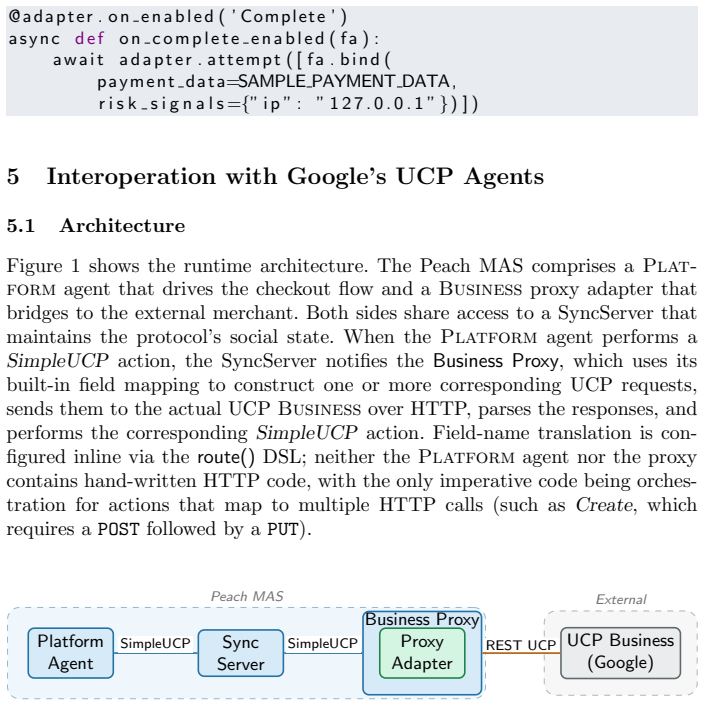
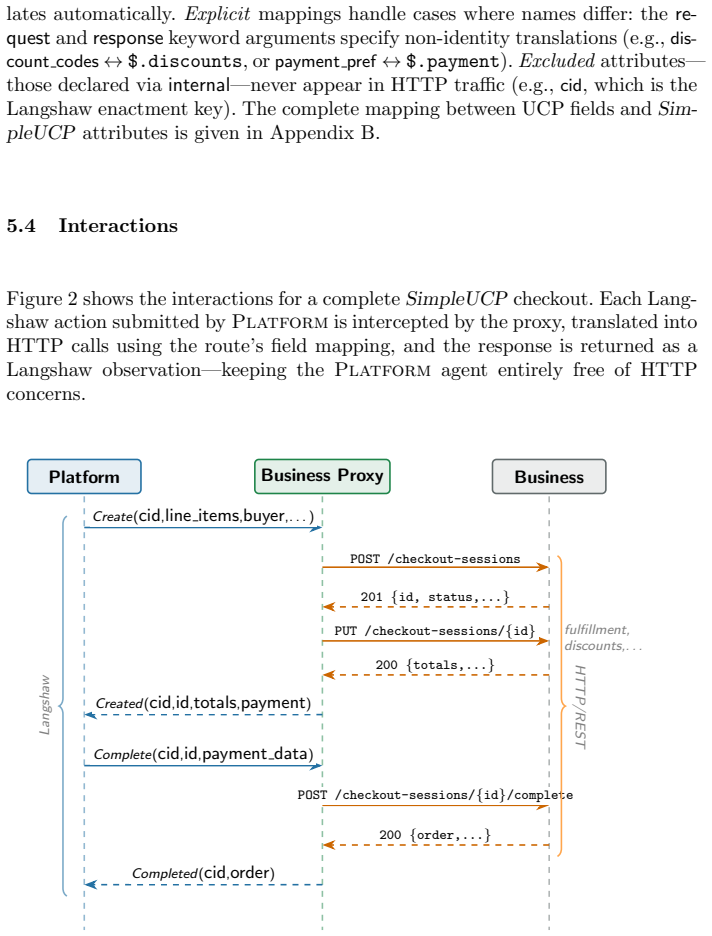
- [Abstract / interoperation section] Abstract and the interoperation experiment (presumably §5): the central claim that successful Peach–UCP interoperation 'establishes the fidelity' of the Langshaw model is not supported by any reported test coverage, state-machine enumeration, error-path handling, timeout behavior, or concurrent-session scenarios. Without such evidence, interoperation on nominal flows alone does not rule out semantically significant divergences that would appear only under unexercised conditions.
- [Modeling and implementation sections] The modeling section (presumably §3–4): the declarative Langshaw specification of UCP checkout is presented without an explicit mapping or completeness argument showing that every UCP transition, message field, and protocol obligation has a counterpart in the Langshaw model; the fidelity argument therefore rests entirely on the external interoperation result rather than an internal verification.
minor comments (2)
- [Abstract] The abstract refers to 'the part of UCP dealing with checkouts' without citing the precise UCP document version or section numbers; adding an explicit reference would improve reproducibility.
- [Throughout] Notation for Langshaw constructs and Peach primitives should be introduced with a small glossary or table on first use to aid readers unfamiliar with the prior EMAS literature.
Simulated Author's Rebuttal
We thank the referee for the constructive comments. We address each major point below and indicate where revisions will be made to clarify the scope of our claims.
read point-by-point responses
-
Referee: [Abstract / interoperation section] Abstract and the interoperation experiment (presumably §5): the central claim that successful Peach–UCP interoperation 'establishes the fidelity' of the Langshaw model is not supported by any reported test coverage, state-machine enumeration, error-path handling, timeout behavior, or concurrent-session scenarios. Without such evidence, interoperation on nominal flows alone does not rule out semantically significant divergences that would appear only under unexercised conditions.
Authors: We acknowledge that the interoperation results focus on nominal checkout flows and do not report exhaustive coverage of error paths, timeouts, concurrent sessions, or state-machine enumeration. The paper presents interoperation as practical evidence that the Langshaw model captures UCP semantics sufficiently to enable compatible agent behavior with Google's implementations. We will revise the abstract and §5 to explicitly qualify the fidelity claim as demonstrating compatibility on core protocol flows (rather than claiming exhaustive semantic equivalence) and to describe the tested scenarios in more detail. This revision preserves the contribution regarding an incremental pathway while addressing the scope concern. revision: partial
-
Referee: [Modeling and implementation sections] The modeling section (presumably §3–4): the declarative Langshaw specification of UCP checkout is presented without an explicit mapping or completeness argument showing that every UCP transition, message field, and protocol obligation has a counterpart in the Langshaw model; the fidelity argument therefore rests entirely on the external interoperation result rather than an internal verification.
Authors: Sections 3–4 construct the Langshaw protocol by direct translation of UCP checkout interactions, with each message type and transition rule corresponding to UCP elements. We accept that an explicit mapping table or completeness argument is absent. We will revise the modeling section to add a correspondence table (or subsection) that maps UCP transitions, message fields, and obligations to their Langshaw counterparts, providing an internal verification alongside the interoperation evidence. revision: yes
Circularity Check
No significant circularity; fidelity claim rests on external interoperation rather than internal reduction.
full rationale
The paper's central claim is that modeling UCP checkout as a Langshaw protocol in Peach and demonstrating successful interoperation with Google's independent UCP implementation establishes fidelity of the declarative approach. This validation is external and empirical, not derived from self-referential definitions, fitted parameters renamed as predictions, or load-bearing self-citations that reduce the result to its inputs. No equations or steps in the abstract reduce the interoperation result to a construction internal to the model itself. The derivation chain is self-contained against the external benchmark.
Axiom & Free-Parameter Ledger
Reference graph
Works this paper leans on
-
[1]
A2A: Agent2Agent protocol (2025), https://a2aprotocol.ai/, last accessed: 2025-08-11
2025
-
[2]
Baldoni, M., Baroglio, C., Galland, S., Micalizio, R., Outay, F., Tedeschi, S.: Interaction protocols in an imperative agent-oriented programming lan- guage: The case of BSPL and SARL. In: Proceedings of the 24th Interna- tional Conference on Autonomous Agents and MultiAgent Systems (AA- MAS). pp. 2426–2427. IFAAMAS, Detroit (May 2025). https://doi.org/10...
arXiv 2025
-
[3]
In: Proceedings of the 39th AAAI Conference on Artificial Intelligence (AAAI)
Baldoni, M., Christie V, S.H., Singh, M.P., Chopra, A.K.: Orpheus: Engi- neering multiagent systems via communicating agents. In: Proceedings of the 39th AAAI Conference on Artificial Intelligence (AAAI). pp. 23135– 23143. AAAI, Philadelphia (Feb 2025). https://doi.org/10.1609/aaai.v39i2 2.34478
-
[4]
Chopra, A.K., Christie V, S.H., Singh, M.P.: Splee: A declarative information-based language for multiagent interaction protocols. In: Pro- ceedings of the 16th International Conference on Autonomous Agents and MultiAgent Systems (AAMAS). pp. 1054–1063. IFAAMAS, S˜ ao Paulo (May 2017). https://doi.org/10.5555/3091125.3091274
-
[5]
In: Proceedings of the 25th International Confer- ence on Autonomous Agents and MultiAgent Systems (AAMAS)
Chopra, A.K., Christie V, S.H., Singh, M.P.: Peach: Program each agent and communicate howsoever. In: Proceedings of the 25th International Confer- ence on Autonomous Agents and MultiAgent Systems (AAMAS). IFAA- MAS, Paphos, Cyprus (May 2026), accepted
2026
-
[6]
In: Collier, R., Mascardi, V., Ricci, A
Chopra, A.K., Christie V, S.H., Singh, M.P.: Tools for implementing mul- tiagent systems based on protocols. In: Collier, R., Mascardi, V., Ricci, A. (eds.) Agents and Multi-Agent Systems Development: Platforms, Toolkits, Technologies, chap. 8, pp. 211–230. Springer Nature, Cham, Switzerland (2026). https://doi.org/10.1007/978-3-032-01082-7 8
-
[7]
In: In Proceedings of the 13th Engineering Multiagent Systems Workshop
Chopra, A.K., Singh, M.P.: Fluid: Social norms-based multiagent systems on the Web. In: In Proceedings of the 13th Engineering Multiagent Systems Workshop. LNCS, vol. 16407, pp. 62–79. Springer (2025)
2025
-
[8]
Journal of Autonomous Agents and Multi-Agent Systems (JAAMAS)36(1), 16:1– 16:30 (Apr 2022)
Christie V, S.H., Chopra, A.K., Singh, M.P.: Mandrake: Multiagent systems as a basis for programming fault-tolerant decentralized applications. Journal of Autonomous Agents and Multi-Agent Systems (JAAMAS)36(1), 16:1– 16:30 (Apr 2022). https://doi.org/10.1007/s10458-021-09540-8
-
[9]
Christie V, S.H., Singh, M.P., Chopra, A.K.: Kiko: Programming agents to enact interaction protocols. In: Proceedings of the 22nd International Conference on Autonomous Agents and MultiAgent Systems (AAMAS). pp. 1154–1163. IFAAMAS, London (May 2023). https://doi.org/10.5555/ 3545946.3598758
arXiv 2023
-
[10]
In: Proceedings of the 3rd International Conference on Information and Knowledge Management
Finin, T., Fritzson, R., McKay, D., McEntire, R.: KQML as an agent com- munication language. In: Proceedings of the 3rd International Conference on Information and Knowledge Management. pp. 456–463. ACM Press, Gaithersburg, Maryland (Dec 1994). https://doi.org/10.1145/191246.1 91322
-
[11]
http://www.fip a.org/repository/aclspecs.html (2002), FIPA: The Foundation for Intelli- gent Physical Agents
FIPA: FIPA agent communication language specifications. http://www.fip a.org/repository/aclspecs.html (2002), FIPA: The Foundation for Intelli- gent Physical Agents. Accessed 2025-01-20
2002
-
[12]
IEEE Computer31(12), 40–47 (Dec 1998)
Singh, M.P.: Agent communication languages: Rethinking the principles. IEEE Computer31(12), 40–47 (Dec 1998). https://doi.org/10.1109/2.7358 49
-
[13]
Singh, M.P.: Information-driven interaction-oriented programming: BSPL, the Blindingly Simple Protocol Language. In: Proceedings of the 10th In- ternational Conference on Autonomous Agents and MultiAgent Systems (AAMAS). pp. 491–498. IFAAMAS, Taipei (May 2011). https://doi.org/10 .5555/2031678.2031687
arXiv 2011
-
[14]
Singh, M.P.: Semantics and verification of information-based protocols. In: Proceedings of the 11th International Conference on Autonomous Agents and MultiAgent Systems (AAMAS). pp. 1149–1156. IFAAMAS, Valencia, Spain (Jun 2012). https://doi.org/10.5555/2343776.2343861
-
[15]
In: Proceedings of the 30th International Joint Conference on Artificial Intelligence (IJCAI)
Singh, M.P., Christie V, S.H.: Tango: Declarative semantics for multiagent communication protocols. In: Proceedings of the 30th International Joint Conference on Artificial Intelligence (IJCAI). pp. 391–397. IJCAI, Online (Aug 2021). https://doi.org/10.24963/ijcai.2021/55
-
[16]
In: Proceedings of the 33rd International Joint Conference on Artificial Intelligence (IJCAI)
Singh, M.P., Christie V, S.H., Chopra, A.K.: Langshaw: Declarative inter- action protocols based on sayso and conflict. In: Proceedings of the 33rd International Joint Conference on Artificial Intelligence (IJCAI). pp. 202–
-
[17]
https://doi.org/10.24963/ijcai.2024/23
IJCAI, Jeju, Korea (Aug 2024). https://doi.org/10.24963/ijcai.2024/23
-
[18]
Field Type Required Description ucpResponseCheckout Yes Protocol metadata and checkout response root
UCP: Universal commerce protocol (Jan 2026), https://ucp.dev, last ac- cessed: 2026-02-20 ACheckoutCapability Table 5 gives the complete specification of theCheckoutcapability. Field Type Required Description ucpResponseCheckout Yes Protocol metadata and checkout response root. idstring Yes Unique identifier of the checkout session. line itemsLineItemResp...
2026
discussion (0)
Sign in with ORCID, Apple, or X to comment. Anyone can read and Pith papers without signing in.