REVIEW 3 major objections 3 minor 27 references
On BD-algebra and CM-Auslander algebra for a gentle algebra and their representation types
T0 review · 3 major / 3 minor · reviewed 2026-08-16 · deepseek-v4-flash
Pith's one-line read Applying BD or CM-Auslander constructions to a gentle algebra preserves its representation type and derived-discreteness.
desk verdict The BD half of the main theorem is new and plausible, but the key lemma's converse relies on a false structural claim about bands in the doubled quiver; the paper needs a real proof repair, not just typo fixes. read the letter →
The pith
A machine-rendered reading of the paper's core claim, the machinery that carries it, and where it could break.
The reading
What carries the argument
The load-bearing objects are bands and homotopy bands. A band is a cyclic string, i.e. a word in arrows and formal inverses whose square is again a string and that is not a nontrivial power; one band forces infinitely many indecomposable modules. A homotopy band is the derived-category analogue, with equal numbers of direct and inverse letters, and its absence exactly characterizes derived-discreteness for gentle algebras. The technical core is a letter-by-letter translation: in $BD(A)$ every permitted path of $A$ is doubled by inserting new primed vertices, while in $A_{CMA}$ each arrow lying on a forbidden cycle splits into a pair of arrows. The lemmas show these translations send bands to bands and homotopy bands to homotopy bands, and that deleting the primed vertices or collapsing the split arrows recovers a band of $A$.
What would settle it
Take a gentle algebra $A$, compute the bound quiver of $BD(A)$, and enumerate all cyclic strings on it; if any band has a letter whose length is not odd or whose primed vertices do not occur exactly once per original arrow, then deleting primed vertices does not collapse it to a band of $A$. Exhibiting such a band for an $A$ that itself has no bands would give a representation-infinite $BD(A)$ with representation-finite $A$, directly contradicting Theorem 1.1.
Extended reading notes
Core claim
Let $A$ be gentle, let $B=BD(A)$ be its BD-gentle algebra, and let $C=A_{CMA}$ be its CM-Auslander algebra. The paper claims that $A$, $B$, and $C$ are simultaneously representation-finite, and simultaneously derived-discrete; moreover, for any finite sequence of the two operations $BD$ and $(-)^{CMA}$, the resulting algebra has the same two properties as $A$. The proof works by tracking bands and homotopy bands. A gentle algebra is representation-infinite exactly when its bound quiver contains a band, and it fails to be derived-discrete exactly when a homotopy band exists; the paper constructs explicit path-level translations showing that bands and homotopy bands occur in $BD(A)$ or $A_{CMA}$ if and only if they occur in $A$. Thus the absence of these cyclic structures, which is what finiteness and discreteness mean for gentle algebras, is inherited in both directions.
Load-bearing premise
The reverse direction assumes every band or homotopy band in $BD(A)$ has a rigid alternating shape—each original arrow doubled into exactly one primed and one unprimed step—so that deleting all primed vertices always collapses it to a band in $A$; the CM-Auslander argument makes an analogous structural assumption about split arrows.
Editorial extensions
If this is right
- For any gentle algebra $A$, representation-finiteness of $BD(A)$ or $A_{CMA}$ is equivalent to representation-finiteness of $A$, so neither construction can create or destroy the finite/infinite dichotomy.
- Derived-discreteness is likewise invariant: repeated application of $BD$ and $(-)^{CMA}$ does not create or destroy infinite families of indecomposable objects in the bounded derived category.
- The class of gentle algebras that are representation-finite or derived-discrete is closed under the semigroup generated by $BD$ and $(-)^{CMA}$, so any finite composition preserves the property.
- For checking these properties, it suffices to inspect $A$ itself: a band or homotopy band search in $A$ decides the status of every iterated image.
Reading between the lines
- The band-collapsing correspondence suggests a stronger structural claim the paper does not make: the set of bands up to rotation may be preserved bijectively, not just its emptiness, which would imply finer invariants like the number of one-parameter module families are also unchanged.
- The marked-surface proofs in the remarks point to a testable extension: $BD$ and CM-Auslander may induce homotopy equivalences between the relevant curve spaces in the geometric models, which would let band and homotopy-band correspondences be upgraded to functorial statements.
- One could test whether the same preservation extends to neighbouring dichotomies such as domesticity or $\tau$-tilting finiteness; the paper's band-counting method alone does not settle those, and they would require additional arguments.
Signed reviews
Editorial analysis
A structured set of objections, weighed in public.
Referee Report
Summary. The manuscript studies two algebras attached to a gentle algebra A: the BD-gentle algebra BD(A) of Burban–Drozd and the CM-Auslander algebra A_CMA. It claims that A, BD(A), and A_CMA have the same representation-finiteness and the same derived-discreteness, and that both properties are preserved under arbitrary finite iterations of the two operations (Theorems 1.1 and 1.2). The strategy is to compare strings/bands and homotopy strings/homotopy bands of the three bound quivers: Lemmas 4.3, 4.8, and 4.9 assert correspondences of bands and homotopy bands, and these are then combined with the Butler–Ringel correspondence and the Bekkert–Merklen criterion for derived-discreteness. The CM-Auslander part is largely delegated to Chen–Lu [15]; the BD part is the new content.
Significance. If correct, the result is a clean invariance statement: the two geometrically natural constructions BD and (-)_CMA do not change whether a gentle algebra is representation-finite or derived-discrete, and can be iterated freely. The surface constructions in Section 3 are a useful contribution, and the overall strategy of comparing bands is natural. However, the BD part is currently supported by incomplete structural assertions about the form of bands in BD(A), one of which is false as stated; until those assertions are replaced by a valid collapse argument, the main theorems are conditional.
major comments (3)
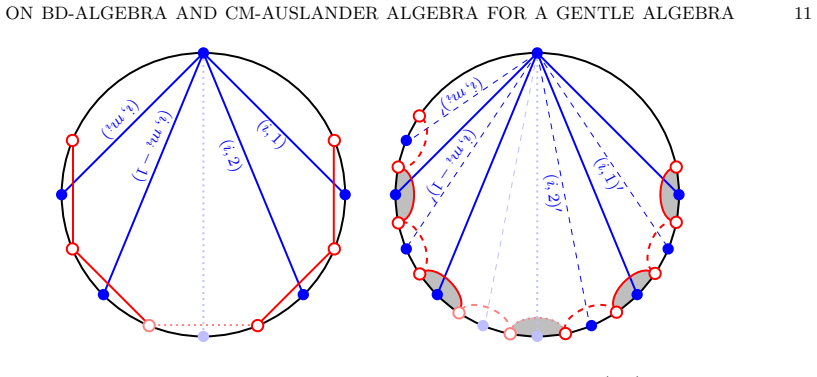
- [4.1, Lemma 4.3] The converse direction of Lemma 4.3 is not proved. The proof assumes that every band of BD(A) has the displayed form (4.1), with each letter q_k of odd length and arising from a permitted path in A by inserting primed vertices. This is false: for the Kronecker gentle algebra A = k(1=>2) with arrows α and β, the quiver of BD(A) contains the paths 1'_α -> 1 -> 2'_α -> 2 and 1'_β -> 1 -> 2'_β -> 2, and the cyclic string ρ = (1 -> 2'_α -> 2)(2 -> 2'_β -> 1) is a band in BD(A) whose two letters have length 2. This contradicts the assertion that all letters are odd. The example does collapse to the band αβ^{-1} in A, so it does not disprove the theorem, but it shows the given proof mechanism is invalid. The paper needs a separate argument that deleting all primed vertices sends every band of BD(A) to a band of A, or that bands of BD(A) cannot mix the doubled vertices in other ways.
- [4.2, Lemma 4.8] The converse direction of Lemma 4.8 is asserted rather than proved: after constructing a homotopy band from A to BD(A), the proof says that a homotopy band in BD(A) 'must be of the form given by (4.3)' and then removes primed vertices. No argument is given that excludes homotopy bands whose letters mix different doubling scales or use the primed vertices in a non-alternating way. Since Proposition 4.12 and Theorem 1.2 depend on this converse, this is a load-bearing gap.
- [4.2, Lemma 4.9] Lemma 4.9 also has a load-bearing gap and a formula error. In the forward direction, the displayed definition of y_{i,j} is the reverse of the preceding sentence: an arrow on a forbidden cycle should become the two-letter path x^-_{i,j} x^+_{i,j}, not remain x_{i,j}. In the converse, the claim that α+ and α- must occur together in every homotopy letter is not justified; α+ can start a directed letter at the vertex αA without a preceding α- in the same letter. The equivalence of homotopy bands between A and A_CMA is therefore not rigorously established.
minor comments (3)
- [Theorems 1.2 and 4.13] The statements say 'representation-discrete', but the property defined and proved in Section 4.2 is 'derived-discrete'; the statements should be corrected for consistency.
- [4.2, Lemma 4.9] The two cases in the displayed formula for y_{i,j} are swapped relative to the surrounding text; one of the two needs to be corrected.
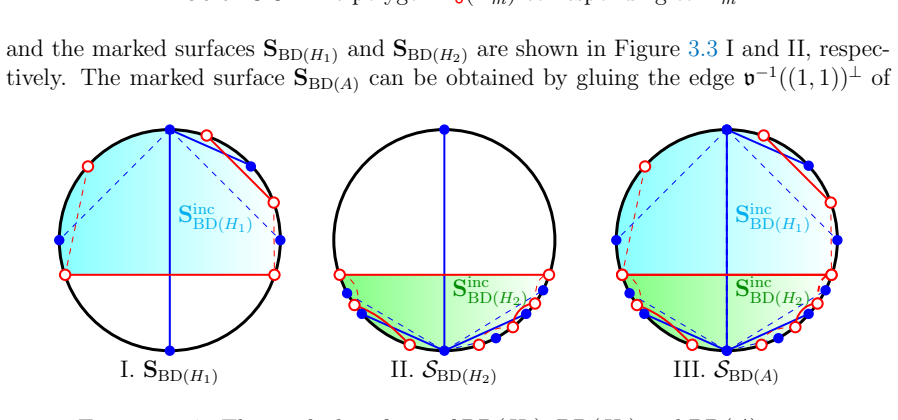
- [Throughout] There are several typos, e.g., 't he' in the Abstract, 'Baurban–Drozd' in the title of Section 2.2, and inconsistent use of 'permissible' versus 'permitted'; in Example 3.3 the reference to 'Figure 3.3, III' appears to mean Figure 3.4, III.
Circularity Check
No significant circularity: main equivalences rest on external theorems and independent quiver constructions.
full rationale
After walking the derivation chain, I find no circularity in the paper's central argument. The equivalence for the BD-algebra (Proposition 4.5(1)-(2), via Lemma 4.3) is attempted by explicit quiver-theoretic construction: a band in A is lifted to a band in BD(A), and conversely a band in BD(A) is claimed to collapse to one in A by deleting primed vertices. Whatever the validity of the converse structural claim (a potential correctness gap, not a circularity), the two band notions are defined independently, and the claimed correspondence is a proved assertion, not a definitional equivalence or a fitted parameter renamed as a prediction. The CM-Auslander part is explicitly outsourced to Chen-Lu [15, Theorem 3.5 and Theorem 4.4] and to Kalck's description [21], all external results independent of the present authors; these are genuine independent support, not self-citations. The self-citations present in the paper ([22], [26]) occur in background passages and in alternative geometric Remarks 4.4 and 4.10; the main quiver-based proofs of Lemmas 4.3, 4.8, and 4.9 do not lean on them. There is no imported uniqueness theorem, no ansatz smuggled in by citation, and no renaming of a known empirical pattern. The skeptic's objection--that the converses of Lemmas 4.3, 4.8, and 4.9 assume a rigid form for bands in BD(A)/ACMA--is a proof-validity issue, not a circularity, because the conclusion does not reduce to the hypothesis by construction. Hence score 0.
Assumptions & free parameters
assumptions (5)
- domain assumption Butler-Ringel correspondence: indecomposable modules of a string algebra are classified by strings and bands (Theorem 4.2).
- domain assumption Bekkert-Merklen theorem: a gentle algebra is derived-discrete if and only if its bound quiver has no homotopy band (Theorem 4.11).
- domain assumption Chen-Lu theorems: the CM-Auslander algebra of a gentle algebra is gentle (Theorem 2.9) and A is representation-finite if and only if its CM-Auslander algebra is (used in Proposition 4.5).
- domain assumption Kalck's characterization: an indecomposable Gorenstein-projective module over a gentle algebra is either projective or the module attached to an arrow on a forbidden cycle (Theorem 2.8).
- domain assumption Marked-surface correspondence: isoclasses of gentle algebras biject with homotopy classes of marked surfaces (Theorem 2.3).
Cite this review
Pith. "Pith review of On BD-algebra and CM-Auslander algebra for a gentle algebra and their representation types." pith.science (2026). https://pith.science/paper/OLOFUCG7
@misc{pith2026250500072,
  author       = {Pith},
  title        = {Pith review of: On BD-algebra and CM-Auslander algebra for a gentle algebra and their representation types},
  year         = {2026},
  howpublished = {\url{https://pith.science/paper/OLOFUCG7}},
  note         = {Machine review of arXiv:2505.00072}
}
abstract
Let $A$ be a gentle algebra, and $B$ and $C$ be its BD-gentle algebra and CM-Auslander algebra, respectively. In this paper, we show that the representation-finiteness of $A$, $B$ and $C$ coincide and the representation-discreteness of $A$, $B$ and $C$ coincide.
Figures


Figures from the paper (11 more)





Reference graph
Works this paper leans on
-
[15]
X. Chen and M. Lu. Cohen-Macaulay Auslander algebras of gent le algebras. Commun. Algebra , 47(9):3597–3613, 2019. DOI:10.1080/00927872.2019.1570225
arXiv 2019
-
[1]
C. Amiot, P.-G. Plamondon, and S. Schroll. A complete derived invar iant for gentle algebras via winding numbers and Arf invariants. Selecta Math. (N.S.) , 29(2):Paper No. 30, 36, 2023. DOI:10.1007/s00029-022-00822-x
-
[2]
K. K. Arnesen, R. Laking, and D. Pauksztello. Morphisms betwee n indecomposable com- plexes in the bounded derived category of a gentle algebra. J. Algebra , 467:1–46, 2016. DOI:10.1016/j.jalgebra.2016.07.019
- [3]
-
[4]
I. Assem and A. Skowro´ nski. Iterated tilted algebras of type ~An. Math. Z. , 195(2):269–290, 1987. DOI:10.1007/bf01166463
-
[5]
D. Avella-Alaminos and C. Geiß. Combinatorial derived invariants fo r gentle algebras. J. Pure Appl. Algebra, 212(1):228–243, 2008. DOI:10.1016/j.jpaa.2007.05.014. 24 MENGDIE ZHANG, YU-ZHE LIU ∗, AND CHAO ZHANG
-
[6]
K. Baur and R. Coelho-Sim˜ oes. A geometric model for the module category of a gentle algebra. Int. Math. Res. Notices , 2021(15):11357–11392, 2021. DOI: 10.1093/imrn/rnz150 (Published:31 July 2019)
-
[7]
V. Bekkert and H. A. Merklen. Indecomposables in derived categ ories of gentle algebras. Algebr. Represent. Theory, (6):285–302, 2003. DOI:10.1023/A:1025142023594
Show all 27 references
-
[8]
Beligiannis
A. Beligiannis. On algebras of finite Cohen-Macaulay type. Adv. Math. , 226(1), 2011. DOI:10.1016/j.aim.2010.09.006
2011 doi
-
[9]
Burban and Y
I. Burban and Y. Drozd. On the derived categories of gentle and skew-gentle algebras: homological algebra and matrix problems. arXiv:1706.08358, 2017
2017 arXiv
-
[10]
M. C. Butler and C. M. Ringel. Auslander-Reiten sequences with f ew middle terms and applications to string algebras. Commun. Algebra , 15(1-2):145–179, 1987. DOI:10.1080/00927878708823416
1987 doi
-
[11]
W. Chang. Geometric models for the hearts in the derived categ ories of a gentle algebra. arXiv:2305.03998, 2023
2023 arXiv
-
[12]
Chang, H
W. Chang, H. Jin, and S. Schroll. Recollements of derived catego ries of graded gentle algebras and surface cuts. arXiv:2206.11196, 2022
2022 arXiv
-
[13]
Chang and S
W. Chang and S. Schroll. A geometric realization of silting theory f or gentle algebras. Math. Z. , 303(3):Paper No. 67, 37, 2023. DOI:10.1007/s00209-023-03207-8
2023 doi
-
[14]
Chen and M
X. Chen and M. Lu. Cohen-Macaulay Auslander algebras of skew ed-gentle algebras. Com- mun. Algebra , 45(2):849–865, 2017. DOI:10.1080/00927872.2016.1175601 (preprint in 2015, arXiv:1502.03948)
2017
-
[16]
X.-W. Chen, D. Shen, and G. Zhou. The Gorenstein-projective modules over a monomial algebra. P. Roy. Soc. Edinb. A , 148A(1):1115–1134, 2018. DOI:10.1017/S0308210518000185
2018 doi
-
[17]
C. Fu, S. Geng, P. Liu, and Y. Zhou. On support τ-tilting graphs of gentle algebras. J. Algebra, 628:189–211, 2023. DOI:10.1016/j.jalgebra.2023.03.013
2023 doi
-
[18]
Geiss and I
C. Geiss and I. Reiten. Gentle algebras are Gorenstein, in representations of algebras and re- lated topics , proceedings from the 10th international conference, toronto , canada, july 15 – au- gust 10, 2002. Amer. Math. Soc., Providence, RI, Fields Institute Comm. , 1(45):129...
2002
-
[19]
Haiden, L
F. Haiden, L. Katzarkov, and M. Kontsevich. Flat surfaces an d stability structures. Publ. Math. Inst. Hautes ´EtudesSci., 126(1):247–318, 2017. DOI:10.1007/s10240-017-0095-y
2017 doi
-
[20]
P. He, Y. Zhou, and B. Zhu. A geometric model for the module ca tegory of a skew-gentle algebra. Math. Z. , 304(1):18, 2023. DOI:10.1007/s00209-023-03275-w
2023 doi
-
[21]
M. Kalck. Singularity categories of gentle algebras. Bull. Lond. Math. Soc. , 47(1):65–74, 2015. DOI:10.1112/blms/bdu093
2015 doi
-
[22]
Y.-Z. Liu, H. Gao, and Z. Huang. Homological dimensions of gentle algebras via geometric models. Sci. China Math. , 67(4):733–766, 2023. DOI:10.1007/s11425-022-2120-8
2023 doi
-
[23]
Liu and C
Y.-Z. Liu and C. Zhang. On string algebras and the Cohen–Macau lay Auslander algebras. Appl. Categor. Struct. , 32(17):no.17, 2024. DOI:10.1007/s10485-024-09779-8
2024 doi
-
[24]
Liu and Y
Y.-Z. Liu and Y. Zhou. A negative answer to complement question for presilting complexes. J. Algebra, 667(1):282–304, 2024. DOI:j.jalgebra.2024.12.020
2024
-
[25]
Opper, P.-G
S. Opper, P.-G. Plamondon, and S. Schroll. A geometric model fo r the derived category of gentle algebras. arXiv:1801.09659, 2018
2018 arXiv
-
[26]
Y. Qiu, Y. Zhou, and C. Zhang. Two geometric models for graded skew-gentle algebras. arXiv:2212.10369, 2022
2022 arXiv
-
[27]
Wald and J
B. Wald and J. Waschb¨ usch. Tame biserial algebras. J. Algebra , 1(95):480–500, 1985. DOI:10.1016/0021-8693(85)90119-X. ON BD-ALGEBRA AND CM-AUSLANDER ALGEBRA FOR A GENTLE ALGEBRA 25 Department of Mathematics, Nanjing University, Nanjing 21 0093, China Email address : 6020232...
1985 doi
Reviewed August 16, 2026 · model on record in the stance chip above.
Discussion (0). Continue with ORCID to comment.