REVIEW 4 major objections 5 minor 40 references
HyperGS: Fast and Generalizable Gaussian Video Representation
T0 review · 4 major / 5 minor · reviewed 2026-08-04 · deepseek-v4-flash
Pith's one-line read A single forward pass predicts per-frame Gaussian splats for video, achieving 10^4–10^5× faster encoding than per-video optimization at matched quality, and zero-shot 720p rendering.
desk verdict Promising feedforward Gaussian video representation, but the 10^4–10^5× speedup headline is measured on a 256×256 proxy, not 720p video; the method is worth refereeing, the evaluation needs recalibration. read the letter →
The pith
A machine-rendered reading of the paper's core claim, the machinery that carries it, and where it could break.
The reading
What carries the argument
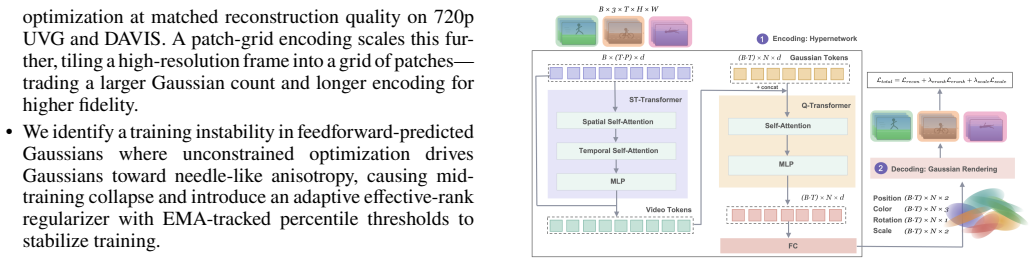
The architecture is a factorized spatio-temporal Transformer (spatial self-attention with 2D RoPE, temporal self-attention with 1D RoPE, complexity O(T·P^2 + P·T^2)) that contextualizes video patch tokens, followed by a Query Transformer in which learnable Gaussian tokens attend to these features via self-attention and are regressed into the 8 Gaussian parameters. The load-bearing second mechanism is the adaptive covariance regularizer: it tracks the EMA of the 1st-percentile effective rank (Shannon entropy of normalized squared scales) and penalizes only Gaussians below the threshold with a hinge loss, plus a parallel scale-magnitude regularizer, which together prevent the needle-like degen
What would settle it
Train HyperGS on a 16-frame 512×512 video with N=3000 using the default adaptive regularization; if the effective rank collapses to near 1 and PSNR degrades mid-training (or if the fixed-threshold schedule diverges across seeds), the generalizable-stability claim fails. Alternatively, rasterize the same predicted Gaussians at 720p and compare against bicubic upsampling of the 256p render: if there is no PSNR gain, the resolution-independence claim is vacuous.
Extended reading notes
Core claim
On the paper's own terms, the central discovery is that explicit 2D Gaussian primitives can be predicted rather than optimized: a single network maps an input video directly to per-frame sets of 8-parameter Gaussians (position, scale, rotation, color) in one forward pass. Trained on a K400 subset at 256×256, the model reaches 30.3 dB PSNR on K400, 33.4 dB on SSv2, and 29.8 dB on UCF-101 with a 64K-parameter per-video representation, surpassing the strongest prior feedforward method by +2.9–3.1 dB. Because the Gaussians are continuous, the same predicted set can be rasterized at 640×480 or 1280×720 without re-encoding, beating methods trained at that resolution. Encoding runs at roughly 400–2
Load-bearing premise
The central claim depends on the adaptive effective-rank regularizer reliably preventing the needle-like Gaussian collapse for arbitrary video lengths and resolutions; the paper itself reports that for N≥3000 or ≥16 frames the adaptive regularizer can overconstrain the model, requiring a separately relaxed hyperparameter schedule whose stability is not shown beyond the reported runs.
Editorial extensions
If this is right
- Video encoding becomes near-real-time: a single forward pass (milliseconds) replaces tens of thousands of optimization iterations, enabling on-the-fly encoding of arbitrary clips.
- Zero-shot resolution generalization: Gaussian primitives predicted at 256×256 can be rasterized at 720p or beyond without re-encoding, and a patch-grid encoding can tile high-resolution frames for higher fidelity.
- Explicit rate control: the number of Gaussians N per frame directly trades representation size against quality, and post-training quantization with ANS entropy coding and cross-frame residuals yields a rate–distortion curve.
- The representation is decoupled from an implicit decoder, which the paper argues extends Gaussian Splatting's fast rendering and editability to feedforward prediction.
- At matched quality, HyperGS also beats the H.265 codec's encoding speed by 1.3–2.7× and decoding speed by ~1.3× on 8-frame 256² clips.
Reading between the lines
- If the approach scales to longer videos and higher capacities without per-configuration relaxation of the regularizer, feedforward Gaussian prediction could become a practical drop-in for video compression pipelines that need random access and resolution independence.
- The needle-like degeneration may be a general failure mode for any feedforward prediction of explicit anisotropic primitives; the EMA-percentile regularization scheme could transfer to other primitive-based representation tasks, though this is not tested in the paper.
- Because the predicted representation is explicit and per-frame, downstream tasks like video editing, inpainting, or object manipulation could operate directly on Gaussians rather than on rendered pixels, a direction the paper does not explore.
- The patch-grid encoding hints at an untested path to arbitrary-resolution video representation by composing independent forward passes, which could be a simpler alternative to training at higher resolutions.
Editorial analysis
A structured set of objections, weighed in public.
Referee Report
Summary. HyperGS is a feedforward hypernetwork that maps a video clip to explicit 2D Gaussian primitives per frame in a single forward pass. A factorized spatio-temporal Transformer produces per-patch features, and a query-based Transformer with learnable Gaussian tokens regresses position, scale, rotation, and color; the Gaussians are rasterized with a 2DGS-style differentiable rasterizer. Training uses an MSE reconstruction loss plus an adaptive effective-rank regularizer and an adaptive scale-magnitude regularizer, both with EMA-tracked percentile thresholds. The paper reports gains of +2.9–3.1 dB PSNR over prior feedforward INR video encoders on K400/SSv2/UCF-101, claims 10^4–10^5× encoding-speedups over per-video 2DGS optimization at matched quality on 720p UVG/DAVIS, and compares favorably with H.265. The main evaluation-protocol issues concern the resolution at which the speedup is actually measured, the training-resolution asymmetry in the feedforward baselines, and the hardware/quality matching in the codec comparison.
Significance. The core idea is attractive and, if verified, would move Gaussian video representation toward practicality: a single forward pass predicts explicit, resolution-independent primitives that generalize zero-shot to new datasets and resolutions. The paper is well structured, the architecture is clearly described, and the ablations of depth, width, attention type, temporal window, and the adaptive regularizer are useful. The training details and hyperparameters are reported in enough detail to make the method reproducible in principle, although no code or data are released. The main limitations are concentrated in the evaluation protocol rather than in the architecture or derivation: the headline speedup is measured against a 256×256 proxy rather than the 720p target, several baseline comparisons are asymmetric in training resolution or hardware, and the 'matched-quality' codec pairs are not exactly matched. These issues are fixable with revised benchmarking and reporting, so they warrant a major revision rather than rejection.
major comments (4)
- [Sec. 4 (Higher-Resolution Rendering), Fig. 2, Fig. 5] The headline 10^4–10^5× speedup is not actually measured on 720p video. The full-frame ST-Transformer always receives a fixed 256×256 input; 720p frames are downsampled to 256×256, Gaussians are predicted from this proxy, and then stretched at render time via the covariance transformation in Appendix D. The quoted encoding time is therefore the cost of encoding a 256×256 proxy, not the 720p video. The patch-grid variant, which does process all 720p pixels in a 5×5 grid, takes ~7.9 s per UVG video at N=3000; against the 2DGS per-video costs of 38 min–3.3 h, this is a speedup of roughly 10^2–10^3×, not 10^4–10^5×. Furthermore, full-frame 720p PSNR values in Fig. 5 are low (e.g., 24.95 dB on UVG at N=3000), so the matched-quality comparison is at an easy operating point. Please report the speedup using the patch-grid encoding time for 720p, or state unambiguously that the 10^4–10^5× figure
- [Table 1 and Table 2 (640×480 feedforward comparisons)] The 640×480 comparison is not apples-to-apples. FastNeRV† and TeCoNeRV† are trained and evaluated at 640×480, whereas HyperGS is trained at 256×256 and evaluated at 640×480 zero-shot. The claimed margins (28.94 vs 22.86 and 25.15 dB on K400) conflate representation-transfer capability with training-resolution mismatch. A fair test would include a 256×256-trained baseline evaluated at 640×480, or a 640×480-trained HyperGS. The same caveat applies to Table 2 on UVG, where TeCoNeRV and FastNeRV are evaluated zero-shot but were trained at 640×480 while HyperGS was trained at 256×256.
- [Table 3 (H.265 comparison)] The codec speed comparison is run on unequal hardware: HyperGS uses a single A100, while H.265 runs on 8 CPUs. The 'matched-quality' pairs are also not closely matched in PSNR: pair 1 is 32.08 vs 32.34 dB, pair 2 is 29.25 vs 29.37 dB, both in H.265's favor, while pair 3 favors HyperGS by 1.39 dB. The reported 1.3–2.7× encoding and ~1.3× decoding speed advantages may therefore be partly artifacts of hardware or operating-point mismatch. Please rerun the codec on the same hardware (or at least on a single CPU/GPU with documented settings) and choose operating points with PSNR differences below roughly 0.1 dB, or report the sensitivity to this matching.
- [Sec. 3 (Adaptive Covariance Regularization) and Table 10] The stress-test concern about the adaptive regularizer is real, though secondary to the resolution issue. The paper itself states that the adaptive regularizer 'can overconstrain higher-capacity models (e.g., ≥3000 Gaussians, ≥16 frames)', and Table 10 shows that N=3000 requires a separately relaxed schedule: loss weights halved, erank floor and initial threshold near unity, and more extreme percentiles. This does not invalidate the N=3000 results, but it weakens the claim of 'consistent training stability across all settings.' No stability analysis is presented for T=16 or for resolutions beyond 256×256. Please show how sensitive the N=3000 result is to one or two intermediate hyperparameter settings, and state whether the relaxed schedule was chosen by validation on the target datasets or by a fixed rule.
minor comments (5)
- [Sec. 5 / Table 5] The text says an MLP Q-Transformer is 9.1 dB below a self-attention Q-Transformer 'at the same N=2000 (30.29dB)', but Table 5 lists the full model at N=2000 as 32.08 dB, while 30.29 dB corresponds to N=1000 in Table 4. Please correct the reference value.
- [Table 6] Table 6 reports SSIM=0.8395 for the ST2/Q4 configuration with 1000 Gaussians, whereas Table 4 reports SSIM=0.8667 for the same configuration at the same PSNR (30.29 dB). Please check which number is correct.
- [Figure 5] The third row of Figure 5 shows the 2K-point column at ~30.5–30.8 dB while the 1K and 3K columns are ~17 dB for both methods. Such non-monotonic behavior is implausible and likely reflects a labeling or computation error; please verify the figure.
- [Appendix D, Eqs. (18)–(20)] When computing L00 = sqrt(a), if a is zero the Cholesky factor is degenerate. The scale-positivity constraint and regularizer likely prevent this in practice, but a one-sentence note about the degenerate case would be helpful.
- [Throughout] There are several small presentation issues: 'newwork' in Sec. 1, inconsistent notation for resolution ('256^2' vs '256×256'), and the use of both VPS and FPS without always stating which is which. Please proofread and unify the notation.
Circularity Check
No significant circularity: central results are empirical zero-shot evaluations; only minor non-load-bearing self-citation to STGV.
full rationale
HyperGS's derivation chain is empirical rather than definitional. The model f_theta is trained once on a K400 subset and then evaluated zero-shot on K400-val, SSv2, UCF-101, UVG, and DAVIS; no test video or test quality value is used to fit network weights, and the per-test-video Gaussian parameters are outputs of the same forward pass. The adaptive regularizer thresholds (Eqs. 12-15) are EMA statistics over the training batch; the paper discloses the capacity limitation ('can overconstrain higher-capacity models (e.g., ≥3000 Gaussians, ≥16 frames), limiting their representational flexibility') and Table 10 shows a separately relaxed schedule for N=3000, but this affects stability/quality trade-offs, not a prediction derived from its own inputs. The 720p 'generalization' is obtained by rasterizing Gaussians predicted from a fixed 256×256 encoder view via the covariance stretch Cov' = T Cov T (App. D); the 720p content is never encoded, so no 720p fitting occurs. The 10^4-10^5× speedup and H.265/2DGS comparisons use matched-quality operating points selected by varying N/iterations, but the speed values are measured independently; selecting an operating point is not a fitted parameter renamed as a prediction. The only self-citation is STGV (Lin et al. 2026), coauthored by Shuming Liu, and it is used solely as a baseline in Related Work and evaluation subsets; no load-bearing claim rests on it. No equation in the paper defines a reported result in terms of a fitted test constant, so there is no circular reduction.
Assumptions & free parameters
free parameters (5)
- Gaussian count N per frame =
250–3000
- Regularization loss weights λ_erank, λ_scale =
0.01 (0.005 for N=3000)
- EMA threshold parameters (m, τ_floor, s_ceil, percentiles, initial thresholds) =
m=0.99/0.98; τ_floor=1.005/1.001; s_ceil=80; p_erank=0.01/0.0015; p_scale=0.99/0.999; τ(0)=1.05/1.001; s_max(0)=32
- Patch-grid size g_c × g_r =
5×5 grid in 720p experiments
- Fixed opacity α =
1.0
assumptions (5)
- domain assumption 2DGS differentiable rasterization (Zhang et al. 2024) is a valid forward model for reconstruction.
- domain assumption Additive Gaussian accumulation with fixed opacity α=1.0 (Eq. 9) can represent the tested video frames.
- domain assumption Training on 25 videos/class from K400 at 256×256 is sufficient to generalize zero-shot to SSv2, UCF-101, UVG, and DAVIS.
- ad hoc to paper The adaptive effective-rank regularizer (Eqs. 12–13) with EMA percentiles stabilizes training without over-constraining.
- domain assumption Covariance stretching Cov'=T Cov T (Eq. 17) is a correct way to rasterize predicted Gaussians at anisotropic target resolutions.
invented entities (1)
-
Learnable Gaussian tokens W ∈ R^{N×d}
Cite this review
Pith. "Pith review of HyperGS: Fast and Generalizable Gaussian Video Representation." pith.science (2026). https://pith.science/paper/OLSHSZXQ
@misc{pith2026260711500,
  author       = {Pith},
  title        = {Pith review of: HyperGS: Fast and Generalizable Gaussian Video Representation},
  year         = {2026},
  howpublished = {\url{https://pith.science/paper/OLSHSZXQ}},
  note         = {Machine review of arXiv:2607.11500}
}
abstract
Gaussian Splatting has emerged as an effective representation for video, but existing methods rely on per-video optimization. This leads to slow encoding and limits generalization across videos. To amortize this optimization, we propose HyperGS, a feedforward, optimization-free approach that directly predicts Gaussian representations from any video in a single forward pass, speeding up encoding and decoding by orders of magnitude while generalizing to out-of-distribution videos at higher resolutions. In HyperGS, we design a factorized spatiotemporal Transformer to extract tokens from video, and a learnable query-based Transformer to obtain 8-parameter Gaussian representations for each video frame. We find that naively predicting Gaussians across diverse videos induces a needle-like degeneration that collapses training, and address this with a rank-based geometric regularizer whose strength adapts dynamically to stabilize optimization. HyperGS achieves encoding at $10^4$--$10^5\times$ the speed of per-video Gaussian optimization at matched reconstruction quality while generalizing zero-shot to $720p$ video, enabling higher-resolution rendering without re-encoding. HyperGS improves PSNR by +2.9--3.1 dB over the prior video encoders on K400, SSv2, and UCF101 at a smaller video representation size. By predicting explicit 2D Gaussians in a single forward pass, HyperGS combines the fast, flexible rendering of Gaussian Splatting with the speed and generalization of feedforward prediction, advancing Gaussians as a practical direction for fast and generalizable video representation.
Figures


Figures from the paper (12 more)


Reference graph
Works this paper leans on
-
[1]
, author=
3D Gaussian splatting for real-time radiance field rendering. , author=. ACM Trans. Graph. , volume=
-
[2]
264/AVC video coding standard , author=
Overview of the H. 264/AVC video coding standard , author=. IEEE Transactions on circuits and systems for video technology , volume=. 2003 , publisher=
2003
-
[3]
IEEE Transactions on Image Processing , volume=
Image quality assessment: from error visibility to structural similarity , author=. IEEE Transactions on Image Processing , volume=. 2004 , publisher=
2004
-
[4]
Advances in Neural Information Processing Systems , volume=
Scalable neural video representations with learnable positional features , author=. Advances in Neural Information Processing Systems , volume=
-
[5]
European Conference on Computer Vision , pages=
Transformers as meta-learners for implicit neural representations , author=. European Conference on Computer Vision , pages=. 2022 , organization=
2022
-
[6]
Proceedings of the IEEE conference on computer vision and pattern recognition , pages=
The unreasonable effectiveness of deep features as a perceptual metric , author=. Proceedings of the IEEE conference on computer vision and pattern recognition , pages=
-
[7]
Chen, Hao and Gwilliam, Matthew and Lim, Ser-Nam and Shrivastava, Abhinav , booktitle=
-
[8]
265/HEVC intra encoder , author=
Algorithm and architecture design of the H. 265/HEVC intra encoder , author=. IEEE Transactions on circuits and systems for video technology , volume=. 2015 , publisher=
2015
Show all 40 references
-
[9]
arXiv preprint arXiv:2501.04782 , year=
Gaussianvideo: Efficient video representation via hierarchical gaussian splatting , author=. arXiv preprint arXiv:2501.04782 , year=
-
[10]
European Conference on Computer Vision , pages=
Gaussianimage: 1000 fps image representation and compression by 2d gaussian splatting , author=. European Conference on Computer Vision , pages=. 2024 , organization=
2024
-
[11]
Liu, Mufan and Yang, Qi and Zhao, Miaoran and Huang, He and Yang, Le and Li, Zhu and Xu, Yiling , journal=
-
[12]
Advances in neural information processing systems , volume=
Implicit neural representations with periodic activation functions , author=. Advances in neural information processing systems , volume=
-
[13]
Chen, Hao and He, Bo and Wang, Hanyu and Ren, Yixuan and Lim, Ser Nam and Shrivastava, Abhinav , journal=
-
[14]
2022 , organization=
Li, Zizhang and Wang, Mengmeng and Pi, Huaijin and Xu, Kechun and Mei, Jianbiao and Liu, Yong , booktitle=. 2022 , organization=
2022
-
[15]
Advances in Neural Information Processing Systems , volume=
Splatter a video: Video gaussian representation for versatile processing , author=. Advances in Neural Information Processing Systems , volume=
-
[16]
Wu, Guanjun and Yi, Taoran and Fang, Jiemin and Xie, Lingxi and Zhang, Xiaopeng and Wei, Wei and Liu, Wenyu and Tian, Qi and Wang, Xinggang , booktitle=
-
[17]
Proceedings of the IEEE/CVF conference on computer vision and pattern recognition , pages=
Deformable 3d gaussians for high-fidelity monocular dynamic scene reconstruction , author=. Proceedings of the IEEE/CVF conference on computer vision and pattern recognition , pages=
-
[18]
Saragadam, Vishwanath and LeJeune, Daniel and Tan, Jasper and Balakrishnan, Guha and Veeraraghavan, Ashok and Baraniuk, Richard G , booktitle=
-
[19]
Mercat, Alexandre and Viitanen, Marko and Vanne, Jarno , booktitle=
-
[20]
Proceedings of the IEEE conference on computer vision and pattern recognition , pages=
A benchmark dataset and evaluation methodology for video object segmentation , author=. Proceedings of the IEEE conference on computer vision and pattern recognition , pages=
-
[21]
Proceedings of the IEEE/CVF Conference on Computer Vision and Pattern Recognition , pages=
Dl3dv-10k: A large-scale scene dataset for deep learning-based 3d vision , author=. Proceedings of the IEEE/CVF Conference on Computer Vision and Pattern Recognition , pages=
-
[22]
European Conference on Computer Vision , pages=
Fast encoding and decoding for implicit video representation , author=. European Conference on Computer Vision , pages=. 2024 , organization=
2024
-
[23]
arXiv preprint arXiv:1705.06950 , year =
Zisserman, Andrew and Carreira, Joao and Simonyan, Karen and Kay, Will and Zhang, Brian and Hillier, Chloe and Vijayanarasimhan, Sudheendra and Viola, Fabio and Green, Tim and Back, Trevor and others , title =. arXiv preprint arXiv:1705.06950 , year =
-
[24]
Proceedings of the IEEE International Conference on Computer Vision (ICCV) , year=
The ``something something" video database for learning and evaluating visual common sense , author=. Proceedings of the IEEE International Conference on Computer Vision (ICCV) , year=
-
[25]
Soomro, Khurram and Roshan Zamir, Amir and Shah, Mubarak , booktitle =
-
[26]
2021 , publisher=
Mildenhall, Ben and Srinivasan, Pratul P and Tancik, Matthew and Barron, Jonathan T and Ramamoorthi, Ravi and Ng, Ren , journal=. 2021 , publisher=
2021
-
[27]
2021 , eprint=
Is Space-Time Attention All You Need for Video Understanding? , author=. 2021 , eprint=
2021
-
[28]
2023 , eprint=
Generalizable Implicit Neural Representations via Instance Pattern Composers , author=. 2023 , eprint=
2023
-
[29]
2024 , eprint=
Effective Rank Analysis and Regularization for Enhanced 3D Gaussian Splatting , author=. 2024 , eprint=
2024
-
[30]
2020 , eprint=
Large Batch Optimization for Deep Learning: Training BERT in 76 minutes , author=. 2020 , eprint=
2020
-
[31]
Proceedings of the Special Interest Group on Computer Graphics and Interactive Techniques Conference Conference Papers , pages=
Image-gs: Content-adaptive image representation via 2d gaussians , author=. Proceedings of the Special Interest Group on Computer Graphics and Interactive Techniques Conference Conference Papers , pages=
-
[32]
2026 , issn =
VeGaS: Video Gaussian Splatting , journal =. 2026 , issn =. doi:https://doi.org/10.1016/j.ins.2025.123033 , url =
2026
-
[33]
2025 , booktitle=
An Exploration with Entropy Constrained 3D Gaussians for 2D Video Compression , author=. 2025 , booktitle=
2025
-
[34]
and Ohm, Jens-Rainer and Han, Woo-Jin and Wiegand, Thomas , journal=
Sullivan, Gary J. and Ohm, Jens-Rainer and Han, Woo-Jin and Wiegand, Thomas , journal=. Overview of the High Efficiency Video Coding (HEVC) Standard , year=
-
[35]
Proceedings of the IEEE/CVF Conference on Computer Vision and Pattern Recognition , pages=
Gaussian-flow: 4d reconstruction with dynamic 3d gaussian particle , author=. Proceedings of the IEEE/CVF Conference on Computer Vision and Pattern Recognition , pages=
-
[36]
2025 , isbn =
Luo, Zhihang , title =. 2025 , isbn =. doi:10.1145/3743093.3771035 , booktitle =
2025
-
[37]
2026 , eprint=
TeCoNeRV: Leveraging Temporal Coherence for Compressible Neural Representations for Videos , author=. 2026 , eprint=
2026
-
[38]
The 2017 DAVIS Challenge on Video Object Segmentation , journal =
Jordi Pont-Tuset and Federico Perazzi and Sergi Caelles and Pablo Arbel\'aez and Alexander Sorkine-Hornung and Luc. The 2017 DAVIS Challenge on Video Object Segmentation , journal =
2017
-
[39]
Perazzi and J
F. Perazzi and J. Pont-Tuset and B. McWilliams and L. A Benchmark Dataset and Evaluation Methodology for Video Object Segmentation , booktitle =
-
[40]
2026 , eprint=
STGV: Spatio-Temporal Hash Encoding for Gaussian-based Video Representation , author=. 2026 , eprint=
2026
Reviewed August 4, 2026 · model on record in the stance chip above.
Discussion (0). Continue with ORCID to comment.