REVIEW 4 major objections 4 minor 12 references
AGDC: Automatic Garbage Detection and Collection
T0 review · 4 major / 4 minor · reviewed 2026-08-14 · deepseek-v4-flash
Pith's one-line read AGDC is a proposed low-cost robot that detects bottle litter with a neural network on a Raspberry Pi, locates it by camera geometry, and picks it up with a servo arm.
desk verdict A prototype write-up with unsupported performance numbers; the honest limitations section can't make up for the absence of any experimental evidence. read the letter →
The pith
A machine-rendered reading of the paper's core claim, the machinery that carries it, and where it could break.
The reading
What carries the argument
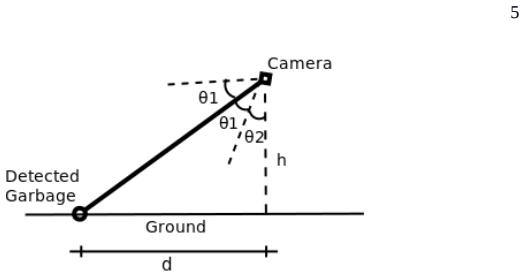
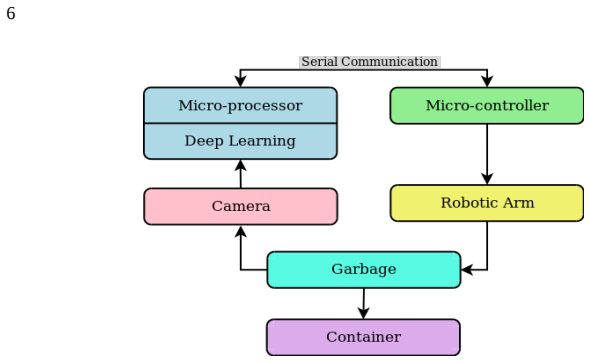
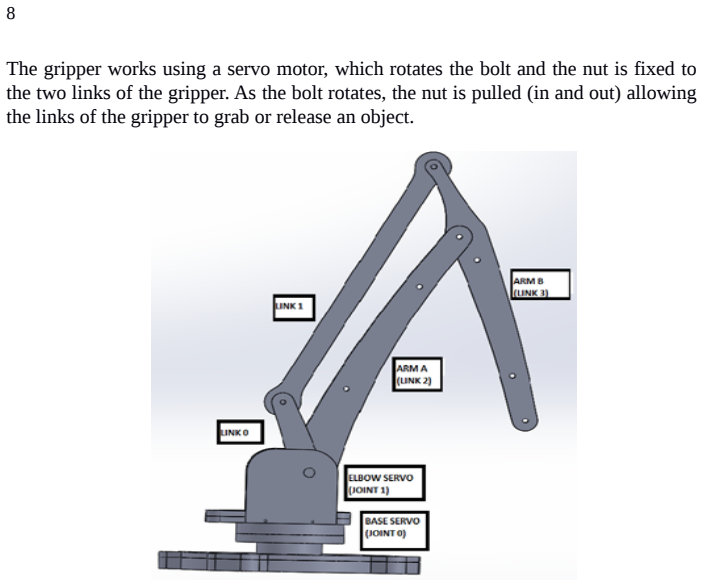
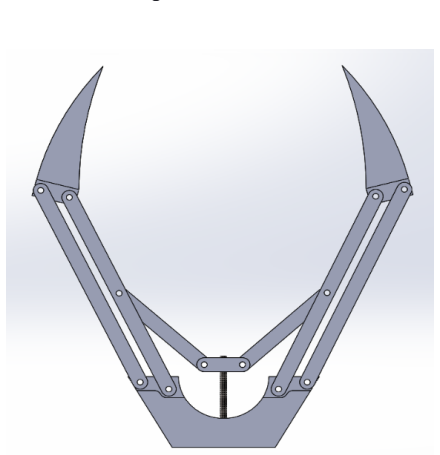
The load-bearing mechanism is the cascade that turns pixels into servo angles. At the front, a MobileNet object-detection model outputs a bounding box, and a PID controller aligns the detected object's centre with the image centre. Distance is then recovered from monocular geometry: with camera height $h$, tilt angle, and field of view known, the ground distance to the object follows from a tangent relation in a right triangle, $d = h/\tan\theta$. That 3D position is sent over USB serial to an Arduino, which uses inverse kinematics to compute the joint angles that move a 4-DOF parallelogram arm so its gripper reaches the point while staying parallel to the ground. Each stage supplies the input for the next, so the claimed 90%+ detection and ±2 cm positioning depend on the whole chain working together.
What would settle it
Place the prototype on a flat floor with bottles at measured distances of 20–100 cm, and compare its reported distance to a tape measure at a fixed camera tilt; the ±2 cm claim fails if repeated errors exceed that bound. In parallel, run a scene with bottles among non-garbage objects: the 95% valuables-versus-garbage claim fails if the detector routinely labels the wrong class at the claimed 3–4 frames per second.
Extended reading notes
Core claim
The paper's central claim is that a complete detect-locate-pick loop for litter can run on low-cost, off-the-shelf hardware without a depth sensor. A pre-trained MobileNet CNN on a Raspberry Pi draws a bounding box around a bottle; a PID loop steers the camera and robot until the box centre aligns with the frame centre; a tangent calculation on a right triangle, using the camera's known height, tilt angle, and field of view, recovers the perpendicular distance; and the resulting $(x, y, z)$ position is sent by USB serial to an Arduino. The Arduino then solves the inverse kinematics of a 4-DOF arm whose parallelogram linkage keeps the gripper parallel to the ground, so the gripper can close on the bottle and deposit it in the bin. The authors state that this distinguishes garbage from valuables with more than 95% confidence, detects bottles with 90%+ confidence at 3–4 frames per second, and achieves positioning with about ±2 cm error.
Load-bearing premise
The claimed ±2 cm positioning rests on the camera's tilt angle, height, and field of view being known accurately enough for a single-image tangent calculation to locate the bottle, and the paper does not report the calibration values or show how tilt error propagates.
Editorial extensions
If this is right
- A working version would give municipalities a low-cost litter-picking platform: the compute, camera, arm, and wheels are commodity parts, with no lidar or depth camera required.
- The Raspberry Pi/Arduino split keeps neural-network inference from delaying motor commands, which is what makes 3–4 frames per second sufficient for real-time pickup.
- The omni-wheel base can approach a detected bottle from any direction, so the robot does not need to be aligned head-on before the arm extends.
- The first prototype only handles bottles and 100–200 g loads; extending the system to other trash types and heavier items is a training and mechanical upgrade, not a re-design of the perception-to-arm pipeline.
Reading between the lines
- If the claimed performance holds, the same camera-only ranging and inverse-kinematics chain should transfer to other short-range grasp tasks, such as agricultural picking or debris removal, by replacing only the trained detector.
- The 95% garbage-versus-valuables figure is the least specified part of the system; a natural audit would be a held-out set of bottles, cans, wrappers, and personal objects with per-class confusion reported.
- Because the distance error is said to shrink by fixing the camera tilt more precisely, a testable extension is a calibration routine that measures tilt with an IMU and then checks whether the ±2 cm error persists across the workspace.
- End-to-end usefulness depends not only on detection confidence but on the full pick-and-place success rate; time-to-basket per bottle would be the metric that tells whether the robot is actually faster than a person.
Signed reviews
Editorial analysis
A structured set of objections, weighed in public.
Referee Report
Summary. The paper describes AGDC, a robotic system intended to autonomously detect and collect garbage. A Raspberry Pi runs a pre-trained MobileNet CNN to detect bottles in a camera stream, a geometric algorithm estimates the object's position from a single camera using the camera height, tilt angle, and angle of view, and serial communication sends commands to an Arduino that drives a four-wheel omnidirectional base and a 4-DOF robotic arm with a gripper. The abstract and Section 4 state specific quantitative capabilities: garbage detection at 90%+ confidence, discrimination between valuables and garbage at more than 95% confidence, a distance error of ±2 cm, and a processing rate of 3-4 frames per second on the Raspberry Pi. The paper also reports workspace ranges for the arm and the prototype's limitations (bottle-only detection, 100-200 g payload, MDF construction). No experimental protocol, dataset, or measurement log is provided.
Significance. If the stated performance figures were verified, the paper would describe a low-cost, real-time mobile robot for collecting bottle litter, with the technically interesting feature of monocular geometric distance estimation and edge deployment on a Raspberry Pi. The claimed accuracies and frame rate would be useful quantitative results for the waste-management robotics community. However, these figures are entirely unsubstantiated in the current manuscript: there are no experiments, no test set, no statistical analysis, and no end-to-end demonstration. The strongest contribution at present is a system architecture description, not an evaluated system; the paper's value would depend heavily on collecting and reporting even a modest validation dataset and error analysis.
major comments (4)
- [Abstract and Section 4] The central measurable claims — 90%+ detection confidence, more than 95% confidence for distinguishing valuables from garbage, 3-4 frames per second, and ±2 cm distance error — are stated in the abstract and Section 4 without any supporting experimental protocol, test set, number of trials, error statistics, or comparison against a baseline. Because these numbers are the paper's main contribution, they cannot be evaluated or reproduced. The manuscript needs a defined experiment (e.g., a specified image set or field trial, per-class confidence distributions, and an error analysis for the distance estimates) before any of these claims can be accepted.
- [Section 3.1] The distance-estimation algorithm relies on the camera's height, tilt angle, and angle of view, but the manuscript never specifies these parameters, nor does it provide a calibration procedure or an error-propagation analysis. The claim in Section 4 of ±2 cm accuracy is thus not derived or measured. Since the tangent formula is highly sensitive to errors in the tilt angle, the paper must provide either the actual calibrated values and a sensitivity analysis or a measurement log showing the claimed error was obtained.
- [Section 3.3] The robot workspace ranges stated in Section 3.3 (approximately -46 cm to +46 cm in x, 9 cm to 46 cm in y, and 5 cm to 32 cm in z) are presented without the link lengths, joint angle limits, or inverse-kinematics equations from which they would follow. Similarly, the statement that the servo offset is 'around ± 0.5cm' is unsupported by any measurement. These values should either be derived from the mechanism parameters listed in the paper or measured experimentally.
- [Section 3.1 and Section 4] The claimed capability of distinguishing valuables from garbage with more than 95% confidence is never defined operationally. The system uses a pre-trained MobileNet, and the manuscript does not describe any fine-tuning or a custom classifier that would separate 'valuables' from 'garbage' as categories; Section 4 actually limits the prototype to detecting bottles. The paper needs to specify the class set, the training data, and the test protocol before this claim can be assessed.
minor comments (4)
- [Section 3.1] The sentence 'The following information like the angle of view of the camera, a height of the camera with respect to the ground and tilt angle of the camera' is grammatically incomplete; it should present a full list of the inputs or be merged into the next sentence.
- [Figures 1 and 2] The citation of figures is inconsistent: the text near Fig. 1 says 'Fig.2' for the centres and the caption of Fig. 1 reads 'Distance approximation demonstration', while Fig. 2 is titled 'Distance measurement schematic'. Please renumber or re-caption so that every figure reference matches the intended schematic.
- [Section 2] The overview refers to 'section-3' and 'section-4' of the methodology, but the actual section numbers are 3.1, 3.2, and 3.3; update these cross-references to the correct subsections.
- [Throughout] The text contains several typographical and phrasing issues (e.g., 'upto', 'Tapon', '1st portion of the methodology'); a careful proofreading pass would improve clarity.
Circularity Check
No circular derivation; headline metrics are unsupported assertions rather than the output of any fitted loop.
full rationale
AGDC does not fit any parameter to a target result and then rename it as a prediction. The detection pipeline is a pre-trained MobileNet model (Section 3.1, 'pre-trained Mobile Net [7] model is used'), whose confidence figures are imported from external training, not fitted in this paper. The distance estimate (Section 3.1, 'Distance and robot movement estimation') is a right-triangle tangent calculation using the camera's angle of view, height, and tilt angle as known inputs; these are assumed constants, not calibrated against the same bottle positions that the system later reports, so no quantity is defined in terms of the claimed output. The claimed 90%+ confidence, >95% valuables discrimination, and ±2 cm error appear in the Abstract and Section 4 as summary assertions; they are unsupported by any experimental protocol, dataset, or error analysis, but unsupported assertions are not circularity because they do not reduce to their own inputs. Inverse kinematics is standard external material. There are no load-bearing self-citations by the current authors; references are standard works (MobileNets, AlexNet, etc.). The paper's central weakness is lack of evidence for its headline numbers and an undefined 'valuables' class, which is a correctness/evidence gap, not a circularity.
Assumptions & free parameters
assumptions (3)
- domain assumption The MobileNet pretrained on ImageNet detects bottles as garbage with sufficient accuracy in the robot's operating environment.
- domain assumption The camera's tilt angle, height, and angle of view are known precisely enough for the tangent-based distance estimate to achieve ±2 cm.
- domain assumption The inverse kinematics of the four-link arm has a solution that keeps the gripper parallel to the ground for all reachable positions.
Cite this review
Pith. "Pith review of AGDC: Automatic Garbage Detection and Collection." pith.science (2026). https://pith.science/paper/OM7DH2DE
@misc{pith2026190805849,
  author       = {Pith},
  title        = {Pith review of: AGDC: Automatic Garbage Detection and Collection},
  year         = {2026},
  howpublished = {\url{https://pith.science/paper/OM7DH2DE}},
  note         = {Machine review of arXiv:1908.05849}
}
read the original abstract
Waste management is one of the significant problems throughout the world. Contemporaneous methods find it difficult to manage the volume of solid waste generated by the growing urban population. In this paper, we propose a system which is very hygienic and cheap that uses Artificial Intelligence algorithms for detection of the garbage. Once the garbage is detected the system calculates the position of the garbage by the use of the camera only. The proposed system is capable of distinguishing between valuables and garbage with more than 95% confidence in real-time. Finally, a robotic arm controlled by the microcontroller is used to pick up the garbage and places it in the bin. Concluding, the paper explains a system that is capable of working as a human in terms of inspecting and collecting the garbage. The system is able to achieve 3-4 frames per second on the Raspberry Pi, capable of detecting the garbage in real-time with 90%+ confidence.
Figures

Figures from the paper (4 more)

Reference graph
Works this paper leans on
-
[1]
TapanNarayana, “ Waste Management : Municipal solid waste management in India: From waste disposal to recovery of resources?”. In: June 2008
work page 2008
-
[2]
Solid wastes generation in India and their recycling potential in building materials
Asokan P., Mohini S., Shyam R. et al. “Solid wastes generation in India and their recycling potential in building materials”
-
[3]
Gabriele F, Alessandro M, Pericle S, Barbara M, Cecilia L, Paolo D et al. ”DustCart, an autonomous robot for door-to-door garbage collection: From DustBot project to the experimentation in the small town of Peccioli”
-
[4]
Municipal solid waste management in Indian cities – A review
Mufeed S., Kafeel A., Gauhar M., R.C. Trivedi et al. “Municipal solid waste management in Indian cities – A review”
-
[5]
Solid waste management in India: options and opportunities
Shuchi G, Krishna M, Rajkumar P, Sujata G, ArunK et al. “Solid waste management in India: options and opportunities”
-
[6]
K. Alex, S. Ilya, and H. Geoffrey, ImageNet Classification with Deep Convolutional Neural Networks. In NIPS, 2012
work page 2012
-
[7]
MobileNets: Efficient Convolutional Neural Networks for Mobile Vision Applications
Andrew G. Howard et al. “MobileNets: Efficient Convolutional Neural Networks for Mobile Vision Applications”. In: (Apr. 2017)
work page 2017
-
[8]
Mechanical design: Raminsh Farah Kanwal and Syed Baqar Hussian “Design of a 3 DOF robotic arm”. In(Aug. 2016)
work page 2016
Show all 12 references
-
[9]
Sebastian Klug, Bernhard Möhl , Oskar von Stryk and Oliver Barth “Design and Application of a 3 DOF Bionic Robot Arm “.In(Sep 2005)
2005
-
[10]
A Geometric Approach for Robotic Arm Kinematics with Hardware Design,Electrical Design,and Implementation
KurtE.Clothier and YingShang,“A Geometric Approach for Robotic Arm Kinematics with Hardware Design,Electrical Design,and Implementation”Edwardsville, IL 62026, USA
-
[11]
Kim, J. H. & Kumar, V . R. (1990). Kinematics of robot manipulators via line transformations. J. Robot. Syst., V ol., 7, No., 4, pp. 649–674
1990
-
[12]
A Survey on Deep Transfer Learning
Chuanqi Tan et al. “A Survey on Deep Transfer Learning”, arXiv: 1808.01974
Reviewed August 14, 2026 · model on record in the stance chip above.
Discussion (0). Continue with ORCID to comment.