REVIEW 4 major objections 5 minor 8 references
MuCO: Generative Peptide Cyclization Empowered by Multi-stage Conformation Optimization
T0 review · 4 major / 5 minor · reviewed 2026-08-03 · deepseek-v4-flash
Pith's one-line read Peptide cyclization is reformulated as generative ensemble modeling, and the paper claims a three-stage flow-matching pipeline outperforms deterministic folding on diversity, energy, and speed.
desk verdict Useful generative pipeline for cyclic peptide conformations, but the benchmark ground truth and metrics are soft enough that 'consistently outperforms' is conditional. read the letter →
The pith
A machine-rendered reading of the paper's core claim, the machinery that carries it, and where it could break.
The reading
What carries the argument
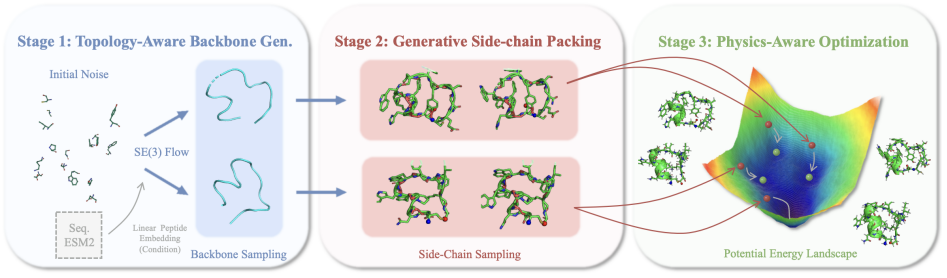
The load-bearing mechanism is the factorized conditional model p(X|S)=p(B|S)p(C|B,S), implemented as three connected stages. Stage 1 uses sequence-conditioned flow matching on SE(3)^L × T^L to generate backbones; training on cyclic data makes ring closure an emergent property. Stage 2 uses torsional flow matching on T^{4L} conditioned on the generated backbone, with cyclic relative positional encoding that rewires residue 1 and L as neighbors to prevent steric clashes at the junction. Stage 3 runs rule-based topology detection and CHARMM36 energy minimization, monotonically lowering potential energy. The tree-structured K×M sampling strategy is what converts these stages into fast, diverse e
What would settle it
Take the 85 experimentally determined CPSea-PDB structures as a clean test set: if MuCO's generated ensemble (even at K×M=100) does not place at least one conformation within a few Ångströms RMSD of each experimental structure while an AlphaFold2-based baseline does, or if its lower-energy advantage disappears when training and evaluation exclude AF2-derived conformations, the central claim would be falsified.
Extended reading notes
Core claim
The paper's own claim is that p(X|S), the conditional distribution of cyclic peptide conformations given a linear sequence, can be factorized exactly as p(B|S)p(C|B,S) and learned in two independent generative stages: an SE(3) flow-matching model generates ring-closed backbones on the manifold (SE(3)×T)^L, and a torsional flow-matching model generates side-chain angles on T^{4L}, with a cyclic relative positional encoding so that the ring closure junction is treated as adjacent. A third stage minimizes each sample under the CHARMM36 force field with automatically inferred cyclization topology. Trained directly on cyclic peptide data, the backbone flow learns ring closure implicitly rather th
Load-bearing premise
The benchmark treats CPSea's largely AlphaFold2-derived conformations as valid ground truth and assumes the functional-annotation split prevents sequence-level leakage; if those predicted structures encode the biases of AF2-style models, the reported energy and diversity gains may not transfer to experimentally determined cyclic peptides.
Editorial extensions
If this is right
- Given one linear peptide, MuCO can generate many distinct ring-closed conformations, including different cyclization modes (head-to-tail, disulfide, isopeptide), instead of a single deterministic prediction.
- In benchmark comparisons, MuCO's single-sample outputs achieve much lower average CHARMM36 energy and higher Shannon-entropy diversity than AlphaFold2-derived cyclization methods, which collapse to one mode.
- Raising the sampling budget K×M pushes success rate to 100% and reaches energies comparable to or lower than the reference conformations, supporting ensemble-based virtual screening.
- Parallel sampling gives an amortized cost of roughly 41 ms per conformation on one consumer GPU, more than 100× faster than folding-based baselines, making large-scale screening feasible.
- Training on native cyclic peptides lets ring closure be learned rather than imposed, avoiding the unnatural strain caused by forced cyclization of linear-predicted structures.
Reading between the lines
- Because most of the benchmark data is itself AlphaFold2 output, part of MuCO's apparent advantage may come from learning the same predictive biases it is compared against; the 85 experimental PDB structures are the only fully independent check.
- The same factorized architecture could be conditioned on experimental restraints (NMR-derived distances, rotamer preferences) or extended to lasso and branched macrocycles, giving immediate testable variants.
- MuCO's cheap ensemble generation could act as a seeding mechanism for molecular dynamics or as a coverage oracle for evaluating other generative peptide models.
Editorial analysis
A structured set of objections, weighed in public.
Referee Report
Summary. The paper proposes MuCO, a three-stage generative pipeline for cyclic peptide conformation ensembles conditioned on the linear peptide sequence: (1) an SE(3) flow-matching backbone generator trained on cyclic peptide data to implicitly enforce ring closure; (2) a torsional flow-matching side-chain packer augmented with cyclic relative positional encodings; and (3) a CHARMM36-based physics-aware refinement with rule-based topology detection. The authors evaluate MuCO on the CPSea-derived benchmark they construct (CPTrans, CPBind, CPCore, CPSea-PDB) and report that MuCO achieves lower mean potential energy, higher Shannon-entropy diversity, better secondary-structure recovery, and lower amortized sampling latency than AF2-based (HighFold2, AfCycDesign) and geometric-deep-learning (EGNN, WGFormer) baselines. The core algorithmic decomposition is coherent and the efficiency analysis is concrete, but the empirical claims rest on benchmark and metric choices that require further validation before the headline claim of 'significantly and consistently outperforms' can be accepted.
Significance. If substantiated, MuCO would be a practically useful generative tool for cyclic peptide conformation exploration, combining a principled coarse-to-fine decomposition, a large-scale training set, and an efficient KxM hierarchical sampling scheme. The paper's strengths include a clear three-stage formulation (Eq. 1-2), use of cyclic-aware encoding in the packing module, a public demo/code release, detailed ablations of the generative stages and the optimization stage, and an explicit latency/parameter comparison. However, the manuscript's central empirical claim is currently conditional: the benchmark largely uses AF2-derived conformations as ground truth, the diversity metric rewards balance rather than fidelity to the ground-truth mode distribution, and the energy metric is computed after the same minimization routine that constitutes MuCO's Stage-3. These issues do not prove the method fails, but they make the 'significantly and consistently outperforms' claim exceed what the current evidence supports.
major comments (4)
- [Section 4.1, Appendix A.2, Appendix C.2] The benchmark's external validity is undermined by the provenance of the ground truth. The paper states in Appendix A.2 that CPSea, excluding the PDB subset, is 'largely derived from AF2 predictions,' and MuCO is trained on CPSea-Train, while CPTrans, CPBind, and CPCore are drawn from the same source. The AF2-based baselines are described as having 'prior exposure to the underlying data distribution.' The train/test split is by functional annotation, with no reported sequence-identity clustering or redundancy analysis. Consequently, the reported improvements on the non-PDB test sets may largely reflect memorization of the AF2 conformational bias shared by training and test data. I request a sequence-level redundancy analysis, an evaluation on the 85 experimental CPSea-PDB structures with confidence intervals, and a clear statement of performance transferability to experimentally determin
- [Appendix D.1, Table 5] The diversity metric H (Shannon entropy) does not measure agreement with the ground truth; it rewards a balanced distribution across the three cyclization-mode categories. On CPSea-PDB, MuCO reports H=0.88 with mode distribution 30.0/70.0/0.0, while the ground truth has H=0.54 with distribution 11.9/86.9/1.2. A model that assigned equal probabilities to all modes would score higher than the ground truth despite being less faithful. The claim of 'structural diversity recovery' therefore conflates dispersion with accuracy. In addition to H, report a distributional divergence (e.g., KL or Jensen-Shannon divergence) between the generated and ground-truth mode distributions and secondary-structure distributions, and report per-dataset bootstrap confidence intervals.
- [Appendix D.2, Appendix B, Stage-3] The physical-stability metric is measured after the same CHARMM36 minimization pipeline that constitutes MuCO's Stage-3. Appendix D.2 states that 'all candidate structures, including MuCO generations, baseline predictions, and the original Ground Truth samples, are processed through the identical force-field optimization pipeline before any metrics are calculated.' This makes the energy comparison a measure of seed quality for that specific minimizer rather than an independent test of physical stability. The comparison is internally consistent, but it is partly circular for MuCO, whose Stage-3 is exactly that minimizer. Please report energies both before and after Stage-3 refinement, add RMSD to the ground-truth conformation, and, if possible, validate a subset with an independent relaxation protocol or short MD.
- [Tables 1, 5-10] The headline claim that MuCO 'significantly and consistently outperforms' is not supported by any error bars, confidence intervals, or statistical tests. All tables report single point estimates. Given the stochasticity of training and sampling, I request at least three independent training seeds or, at minimum, multiple sampling runs with reported mean±std and a paired significance test for the main metrics (energy, diversity, secondary-structure composition) on each test set. This is particularly important for the CPSea-PDB subset, which contains only 85 structures.
minor comments (5)
- [Abstract] Typo/grammar: 'significantly outperforms state-of-the-art methods in consistently in physical stability.' The word 'consistently' appears misplaced.
- [Appendix A.2] The sentence 'the CPSea dataset (excluding the PDB subset) is largely derived from AF2 predictions; thus, these models can be considered to have prior exposure to the underlying data distribution' is an explicit acknowledgment of benchmark contamination. This should be moved to the Limitations section or addressed by additional experiments, not used as a justification for not fine-tuning baselines.
- [Remark 3 / Appendix B.2] Remark 3 states that the energy is reduced 'monotonically during optimization' and mentions Langevin thermostat, while Appendix B.2 says the protocol uses 500 steps of Steepest Descent. These are inconsistent; please clarify which optimizer is used.
- [Table 7] Table 7 lists both Energy (kJ/mol) and Energy (eV) columns that appear to be the same quantity in different units but with inconsistent conversions (e.g., -3.9 kJ/mol is not -0.049 eV). Clarify whether these are two separate metrics or remove the duplicate.
- [Figure 3] The legend abbreviations 'GT EGNN WG AfCyc HF2 MuCO' are not expanded in the caption. Define each method name to make the figure self-contained.
Circularity Check
No equation-level circularity; benchmark circularity from AF2-derived CPSea ground truth and training source.
-
other
[Appendix A.2 (Hardware and Other Training Details); Section 4.1 (Dataset Construction)]
"This is justified by the fact that the CPSea dataset (excluding the PDB subset) is largely derived from AF2 predictions; thus, these models can be considered to have prior exposure to the underlying data distribution."
Section 4.1 defines the test subsets CPTrans/CPBind/CPCore as part of CPSea and states 'These conformations work as the Ground Truth (GT)'. MuCO is trained on CPSea-Train from the same repository. Since the non-PDB portion of CPSea is admittedly 'largely derived from AF2 predictions', the evaluation mainly measures agreement with AF2-derived conformations that the training distribution already encodes. The functional-annotation split does not prevent sequence-level redundancy; no clustering or identity filtering is reported. The 85-structure CPSea-PDB subset is the only external gold standard and is too small to support the abstract's broad claim. This is benchmark-source circularity, not a fitted-parameter prediction.
full rationale
The method's mathematical derivation is self-contained: Eq. (1) is the identity p(X|S)=p(B|S)p(C|B,S) under the backbone/side-chain reparametrization, and Stages 1-3 are trained with flow-matching and force-field objectives rather than fitted to the evaluation metrics. No fitted constant is relabeled as a prediction; no self-citation is load-bearing (WGFormer and ReQFlow are cited as baselines/related work only); no uniqueness theorem is invoked. The main circularity is in the benchmark: CPSea (except the 85 PDB structures) is largely AF2-derived, MuCO is trained on CPSea, and the 'Ground Truth' test conformations come from the same repository. This makes the headline CPSea gains partly a measure of agreement with AF2's conformational biases. The energy metric also shares the Charmm36 objective with Stage-3, though because all baselines are passed through the same minimization pipeline the comparison is fair as a seed-quality test. Overall, the central architecture is not circular, but the empirical claim is only as strong as the CPSea ground-truth provenance; hence a moderate score of 4.
Assumptions & free parameters
free parameters (7)
- Closure tolerance δ =
0.1 Å
- Failure energy threshold =
103 kJ/mol
- Disulfide detection threshold =
2.5 Å
- Sequence length filter =
8–16 residues
- Backbone mass ratio filter =
ResSum > 0.20
- Stage-1 coordinate scaling factor =
0.1
- Stage-3 regularization weight w =
not reported
assumptions (6)
- standard math Riemannian flow matching on SE(3)^L × T^L and T^{4L} learns the target conditional distributions.
- domain assumption CPSea's recorded cyclic conformations are valid ground truth for physical stability and diversity.
- domain assumption SimpleFold 3M produces accurate linear precursor conformations for baseline conditioning.
- domain assumption CHARMM36 with custom patches is an appropriate arbiter of physical stability and success.
- ad hoc to paper Training on cyclic peptides makes ring-closure an implicit constraint learned by the backbone flow field.
- domain assumption Shannon entropy over cyclization modes and secondary structure classes measures useful structural diversity.
Cite this review
Pith. "Pith review of MuCO: Generative Peptide Cyclization Empowered by Multi-stage Conformation Optimization." pith.science (2026). https://pith.science/paper/OMGBLEHN
@misc{pith2026260211189,
  author       = {Pith},
  title        = {Pith review of: MuCO: Generative Peptide Cyclization Empowered by Multi-stage Conformation Optimization},
  year         = {2026},
  howpublished = {\url{https://pith.science/paper/OMGBLEHN}},
  note         = {Machine review of arXiv:2602.11189}
}
read the original abstract
Modeling peptide cyclization is critical for the virtual screening of candidate peptides with desirable physical and pharmaceutical properties. This task is challenging because a cyclic peptide often exhibits diverse, ring-shaped conformations, which cannot be well captured by deterministic prediction models derived from linear peptide folding. In this study, we propose MuCO (Multi-stage Conformation Optimization), a generative peptide cyclization method that models the distribution of cyclic peptide conformations conditioned on the corresponding linear peptide. In principle, MuCO decouples the peptide cyclization task into three stages: topology-aware backbone design, generative side-chain packing, and physics-aware all-atom optimization, thereby generating and optimizing conformations of cyclic peptides in a coarse-to-fine manner. This multi-stage framework enables an efficient parallel sampling strategy for conformation generation and allows for rapid exploration of diverse, low-energy conformations. Experiments on the large-scale CPSea dataset demonstrate that MuCO significantly and consistently outperforms state-of-the-art methods in physical stability, structural diversity, secondary structure recovery, and computational efficiency, making it a promising computational tool for exploring and designing cyclic peptides. The demo of the proposed method can be found at https://github.com/mianqiu00/MuCO.
Figures


Figures from the paper (11 more)


Reference graph
Works this paper leans on
-
[2]
Dapeng Jiang, Xiangzhe Kong, Jiaqi Han, Mingyu Li, Rui Jiao, Wenbing Huang, Stefano Ermon, Jianzhu Ma, and Yang Liu. Zero-shot cyclic peptide design via composable geometric constraints.arXiv preprint arXiv:2507.04225,
-
[3]
Language models of protein sequences at the scale of evolution enable accurate structure prediction.bioRxiv, 2022:500902,
Zeming Lin, Halil Akin, Roshan Rao, Brian Hie, Zhongkai Zhu, Wenting Lu, Allan dos Santos Costa, et al. Language models of protein sequences at the scale of evolution enable accurate structure prediction.bioRxiv, 2022:500902,
2022
-
[4]
Fanmeng Wang, Minjie Cheng, and Hongteng Xu. WGFormer: An SE(3)-transformer driven by Wasserstein gradient flows for molecular ground-state conformation prediction. In42nd International Conference on Machine Learning (ICML), 2025a. Yuyang Wang, Jiarui Lu, Navdeep Jaitly, Josh Susskind, and Miguel Angel Bautista. Simplefold: Folding proteins is simpler tha...
arXiv 2024
-
[64]
The training objective Lbackbone is a multi-task composite loss that penalizes errors in flow prediction and structural geometry
The model operates on the SE(3) manifold with a coordinate scaling factor of0.1to normalize the translational variance. The training objective Lbackbone is a multi-task composite loss that penalizes errors in flow prediction and structural geometry. We define total loss as a weighted sum of five components: Lbackbone =L trans + 0.5Lrot +L bb_atom +L dist_...
2024
-
[2013]
Standard residue templates are insufficient for cyclic bonds because of atom loss
for local geometry refinement. Standard residue templates are insufficient for cyclic bonds because of atom loss. We implemented custom patches to handle these transitions: the Cys template removes sulfur hydrogen (HG); the Lys template removes two hydrogens from the Nζ amine; the Asp/Glu templates remove the hydroxyl group (OH) from the side-chain carbox...
2025
-
[2017]
Each component is stacked with 2 blocks of Invariant Point Attention (IPA) or transformer layers
14 A Training Details A.1 Training Protocols and Hyperparameters A.1.1 Stage-1: Backbone Flow Matching The backbone generation module is built on the FoldFlow-2 architecture (Huguet et al., 2024), employing a tripartite structure of an encoder, a multi-modal fusion trunk, and a geometric decoder. Each component is stacked with 2 blocks of Invariant Point ...
2024
-
[2024]
Chai-1: Decoding the molecular interactions of life.bioRxiv, pages 2024–10,
12 Chai Discovery team, Jacques Boitreaud, Jack Dent, Matthew McPartlon, Joshua Meier, Vinicius Reis, Alex Ro- gozhonikov, and Kevin Wu. Chai-1: Decoding the molecular interactions of life.bioRxiv, pages 2024–10,
2024
-
[2025]
Jason Yim, Andrew Campbell, Andrew Y . K. Foong, Michael Gastegger, José Jiménez-Luna, Sarah Lewis, Victor Garcia Satorras, et al. Fast protein backbone generation with SE(3) flow matching.arXiv preprint arXiv:2310.05297, 2023a. Jason Yim, Brian L. Trippe, Valentin De Bortoli, Emile Mathieu, Arnaud Doucet, Regina Barzilay, and Tommi S. Jaakkola. SE(3) dif...
Reviewed August 3, 2026 · model on record in the stance chip above.
Discussion (0). Sign in to comment.